
 By
By Quick takeaways:
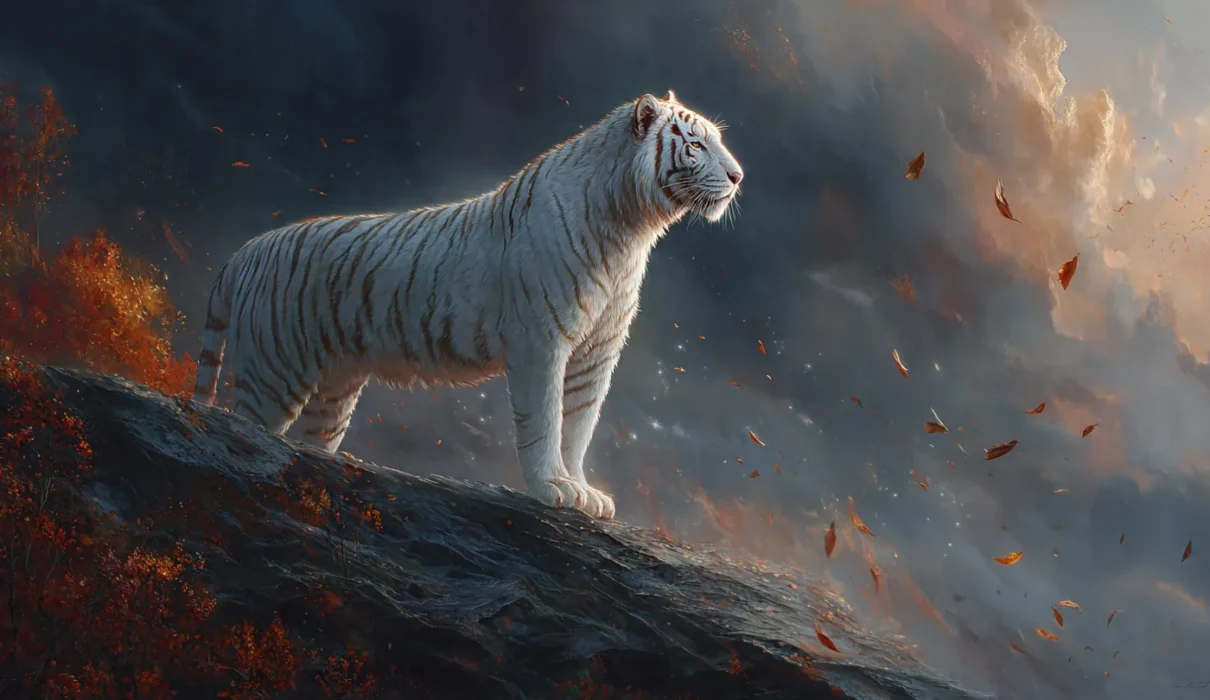
- Byakko is the Japanese name for the White Tiger, one of the Four Symbols of Chinese cosmology, guardian of the West, and ruler of the Metal element and autumn season
- The White Tiger originates in Chinese astronomy and cosmology as Baihu, one of four celestial guardians corresponding to cardinal directions, elements, and seasons
- Korea and Vietnam each developed distinct but deeply related white tiger traditions, with the beast carrying protective, martial, and ancestral significance across both cultures
- In Xianxia and cultivation fiction, the white tiger appears as a divine beast, a cultivation bloodline, a sect symbol, and a spiritual beast companion, drawing on all four national traditions simultaneously
- The white tiger’s cross-cultural consistency, appearing in Chinese, Japanese, Korean, and Vietnamese mythology with strikingly similar core attributes, makes it one of the most pan-Asian mythological figures in existence
To be honest, I was introduced to Eastern mythology pretty late, and that too through my reading of cultivation novels. I have always been a fan of mythology, fantasy, and sci-fi. I was introduced to Western mythology pretty early and have been immersed in mythology ever since. And I am not that old. When I started reading cultivation novels, I was hooked and spent weeks binge-reading, and that led me to my exploration of eastern mythology.
Ten years of reading cultivation novels means I have encountered the white tiger hundreds of times. When I finally traced the white tiger back through its full mythological history, across four national traditions spanning two millennia,
what I found was not a piece of genre decoration. It was one of the most consistently imagined divine figures in all of East Asian mythology, a being that China, Japan, Korea, and Vietnam each encountered, adapted, and revered in ways that are both strikingly consistent and fascinatingly distinct.
This is the full story of the white tiger: where it comes from, what it means in each tradition, and why cultivation fiction keeps returning to it.
Origins: The Four Symbols and The Celestial Map
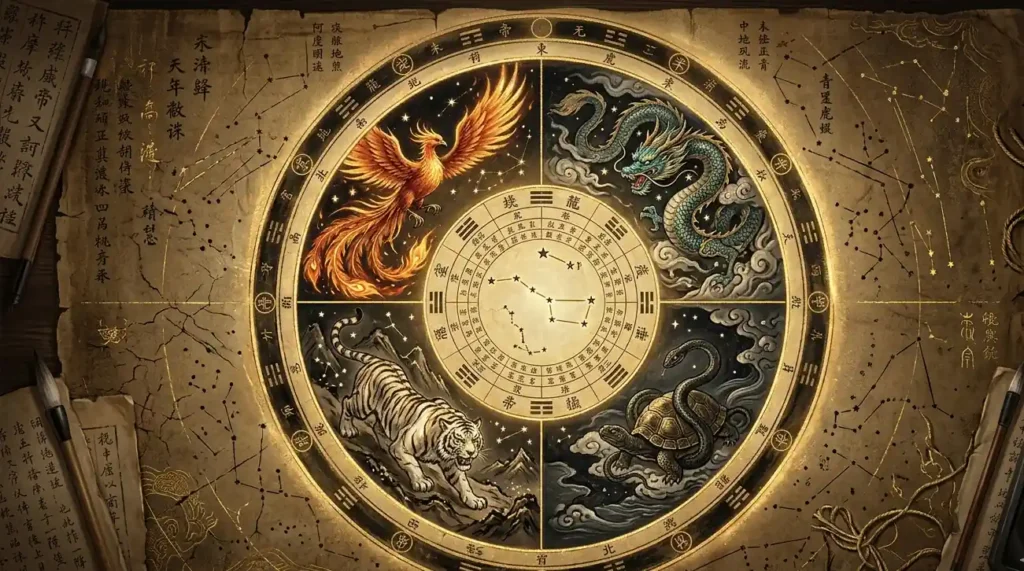
The White Tiger’s story begins not in mythology but in astronomy. Chinese astronomers of antiquity divided the night sky into four quadrants, each associated with a direction, a season, an element, and a colour. Each quadrant was then personified as a divine beast whose character reflected the qualities attributed to it.
These four figures are the Si Xiang, the Four Symbols:
- The Azure Dragon of the East (Qinglong)
- The Vermilion Bird of the South (Zhuque)
- The White Tiger of the West (Baihu)
- The Black Tortoise of the North (Xuanwu)
They together form a cosmological map that describes not just space but time, elemental energy, and the forces governing natural and human affairs. The system is ancient enough that its origins are debated by scholars, with some elements traceable to the Warring States period (475 to 221 BCE) and others possibly earlier.
The White Tiger’s cosmological assignments are specific and internally consistent. It governs the West, which in Chinese cosmological thought is the direction of setting, of gathering, of the completion of cycles. Its season is autumn, when summer’s expansion contracts and things return toward stillness.
Its element is Metal, with Metal’s qualities of sharpness, refinement, and reduction to essential form. Its colour is white, associated in Chinese culture with mourning, the completion of life cycles, and the liminal space between existence and whatever follows.
These associations give the White Tiger a character that is simultaneously martial and elegiac. It is a war god’s beast, its Metal element is the element of blades and precision, its directional authority is the direction armies face before battle, and at the same time, a creature that presides over endings, over the harvest that precedes winter, over the honest accounting of what a cycle produced.
This dual nature is what makes it such a rich figure for mythology and fantasy alike.
Baihu: The White Tiger in Chinese Mythology
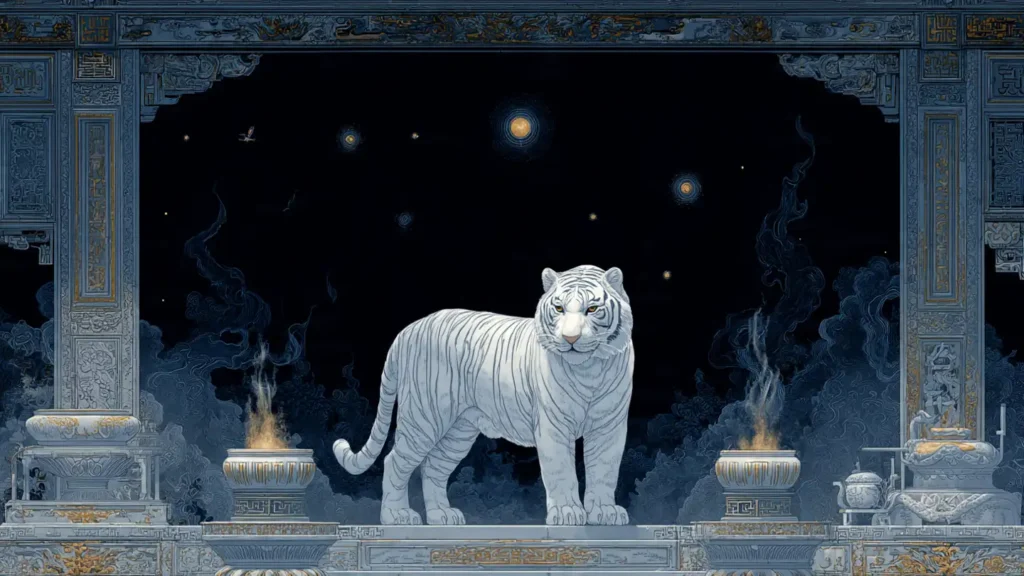
Baihu (白虎, White Tiger) is the Chinese source from which all East Asian white tiger traditions ultimately flow. In classical Chinese cosmological and religious thought, Baihu is one of the four great guardians of the cosmos and simultaneously the ruler of the western heaven.
Myths and Origin
In Daoist cosmology, Baihu takes on an additional role as a protector against evil. White tiger images were placed at tomb entrances and on grave goods to ward off malevolent spirits, because the tiger in Chinese tradition is the king of all beasts and the creature most capable of driving away demons.
The combination of the tiger’s natural dominance with the white tiger’s cosmological authority makes Baihu one of the most powerful protective figures in the classical Chinese spiritual imagination.
The physical description of Baihu in classical sources is specific. It is an enormous white tiger whose fur carries the markings of the seven western lunar mansions, the twenty-eight lunar mansions being the Chinese astronomical system’s division of the sky, with seven assigned to each of the four guardian beasts.
Baihu’s markings are not decoration, but a celestial map written on its body. This is not the white tiger of simple heraldry but a creature that literally carries the western sky’s star chart in its coat.
Symbolism and Sacred Meaning
In Chinese feng shui, Baihu represents the right-hand side, specifically the right when facing south, which is the auspicious direction in Chinese orientation. A proper feng shui arrangement balances the Azure Dragon on the left with the White Tiger on the right, with the site of power between them. This spatial logic is why the white tiger appears in architectural contexts, above gates, at corners of important buildings, in the layout of military encampments, as a protective presence balanced against the dragon’s creative force.
The Metal element association gives Baihu a specific role in Chinese traditional medicine and Daoist internal cultivation. Metal corresponds to the lungs and large intestine, to the quality of contraction and refinement, and to the respiratory cycle.
White tiger imagery appears in some classical Daoist internal cultivation texts as a symbol of the refined essence that correct cultivation produces, distinct from the Azure Dragon, which represents the vital rising force of Wood. The interplay between Dragon and Tiger in internal cultivation symbolism is one of the most layered and persistent images in Daoist alchemical literature, and it feeds directly into cultivation fiction’s treatment of both beasts as complementary divine forces.
Read: Why the Four Symbols Cannot Exist Without Yin Yang
Byakko: The Japanese Tradition
Origin & Symbolism
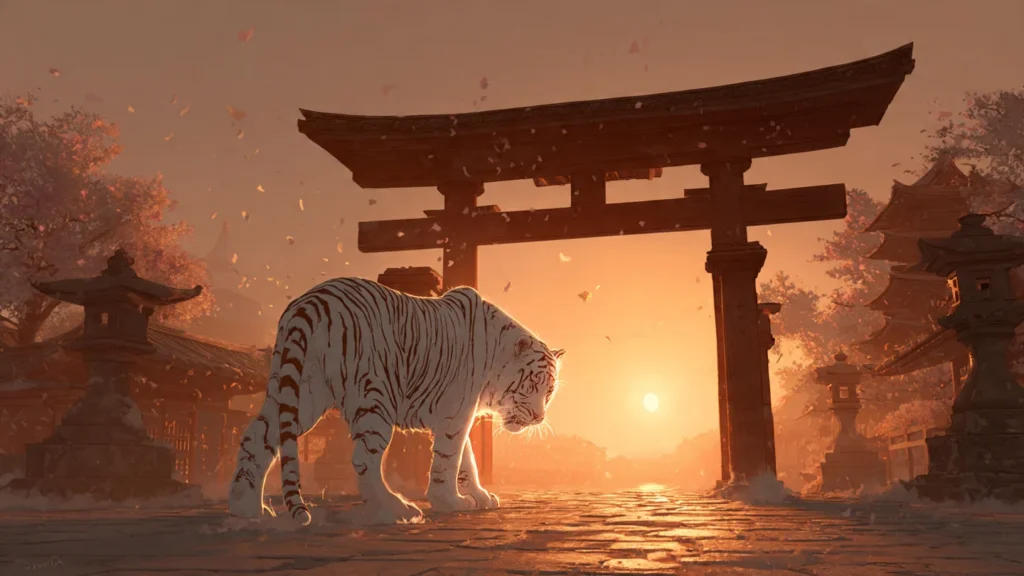
Byakko (白虎) is the Japanese reading of the same characters used for the Chinese Baihu. The cultural transmission was direct, part of the broader adoption of Chinese cosmological frameworks that reshaped Japanese religious and philosophical thought during the Asuka and Nara periods (roughly the 6th through 8th centuries CE). The Four Symbols arrived in Japan alongside Buddhism and Chinese cosmological astronomy and were integrated into the existing framework of Japanese religious thought.
In Japanese tradition, Byakko functions as the guardian of the West with all the attributes the Chinese tradition established, but several distinctive Japanese developments are worth noting.
The city of Nara, Japan’s ancient capital established in 710 CE, was laid out according to Chinese geomantic principles with the four guardian beasts in their prescribed positions.
Byakko’s western position was associated with the Saho River, one of the four rivers that defined the classical capital’s cosmological orientation. The physical landscape of Nara was deliberately mapped to the celestial guardian framework, making the white tiger’s presence not just symbolic but spatially embedded in the capital’s urban geography.
Byakko Modern Adaptation
Byakko has remained more present in Japanese popular culture than its Chinese counterpart has in mainland Chinese popular culture, partly because the four guardian beasts became a persistent motif in Japanese art, architecture, and later in manga, anime, and game design.
The famous Fushimi Inari shrine’s fox imagery and the four guardian beast symbolism both draw on the same import of Chinese cosmological thought, but the four beasts have a distinct visual identity in the Japanese tradition that emphasises the tiger’s ferocity alongside its protective qualities.
In contemporary Japanese fiction and media, Byakko appears extensively as a spirit guardian, a summonable beast, and a divine entity in stories drawing on classical Japanese mythology. The series Fushigi Yuugi made the Four Gods, including Byakko (called Byakko no Miko in that context), central to its narrative framework, introducing an entire generation of manga readers to the four guardian beast system.
This popularisation through manga and anime contributed significantly to the white tiger’s familiarity in contemporary cultivation fiction fandoms, many of whose readers encountered Byakko through Japanese media before encountering Baihu through Chinese xianxia.
Baekho: The White Tiger in Korean Mythology
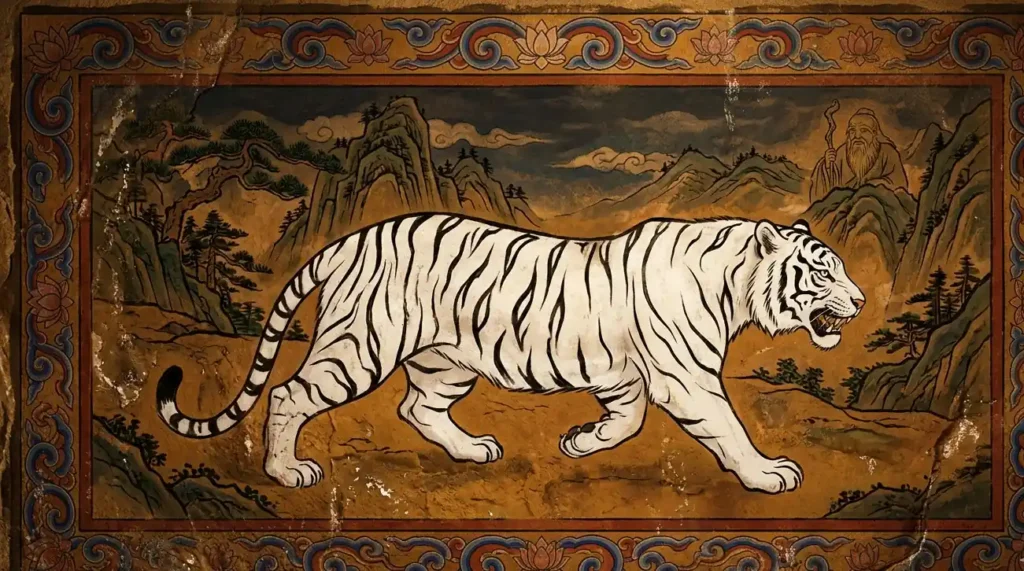
Baekho (백호, 白虎) is the Korean tradition’s version of the white tiger, and Korea’s relationship with the four guardian beasts has its own distinct character shaped by the peninsula’s particular history and spiritual traditions.
Origin & History
The four guardian beasts were introduced to Korea through the same transmission of Chinese cosmological thought that reached Japan, and they appear with striking frequency in Goguryeo tomb murals from the 4th through 7th centuries CE.
The Goguryeo kingdom, one of the Three Kingdoms of Korea, produced elaborate tomb paintings that place the four guardian beasts on the four walls of burial chambers in their correct cosmological positions: the Azure Dragon to the east, the Vermilion Bird to the south, the White Tiger to the west, and the Black Tortoise to the north. These tomb murals are among the most significant surviving visual records of the four guardian beast tradition anywhere in East Asia and were designated a UNESCO World Heritage Site in 2004.
Symbolism and Sacred Meaning
The Korean white tiger tradition carries additional layers connected to Korea’s indigenous shamanic traditions. In Korean shamanism, tigers are among the most potent spirit animals, and the white tiger in particular is associated with the Mountain Spirit, the Sanshin, who frequently appears with a tiger as his companion or vehicle.
This layering of the cosmological white tiger onto the indigenous Korean tiger spirit produced a distinctive Baekho tradition that is simultaneously more deeply connected to the natural world and more locally rooted than the Chinese astronomical framework alone would suggest.
The tiger in Korean culture more broadly carries enormous symbolic weight. Korea was historically home to wild tigers until the 20th century, and tiger imagery pervades Korean folk religion, folk art, and cultural identity in ways that predate and exist independently of the Chinese cosmological import.
The white tiger, Baekho, sits at the intersection of this indigenous tiger tradition and the imported four-symbol framework, drawing resonance from both simultaneously.
In Korean folk belief, the white tiger is considered auspicious and protective, capable of warding off evil spirits, and associated with courage, military virtue, and righteous strength. Its white colour carries additional significance in the Korean context: white has been a traditional Korean colour of purity, mourning, and spiritual significance.
The traditional Korean colour of common people’s clothing was white, and the association of whiteness with purity and spiritual power reinforces the white tiger’s sacred character in Korean culture.
Bach Ho: The Vietnamese Tradition
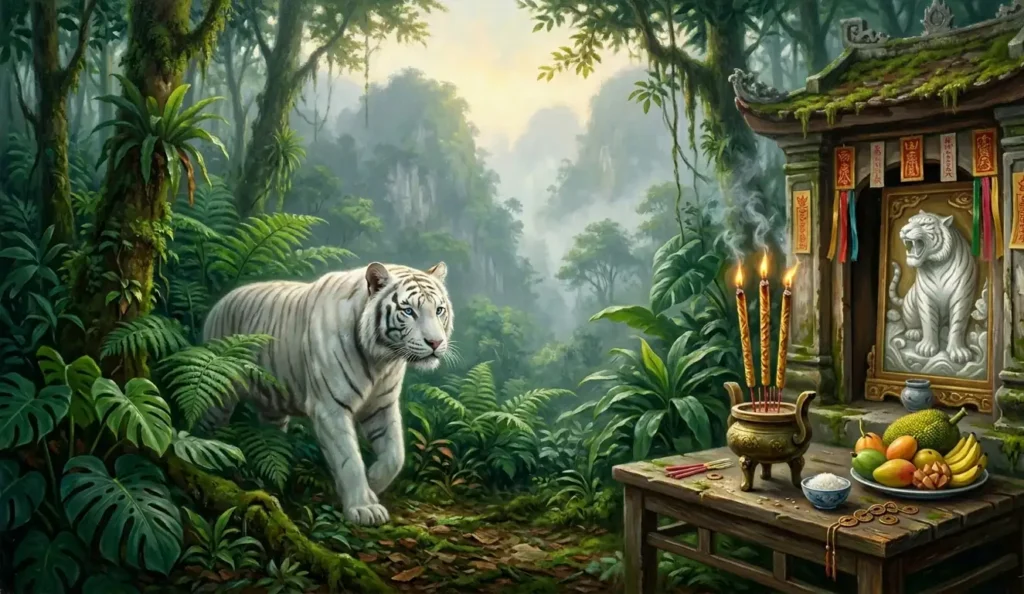
Bach Ho (Bạch Hổ) is the Vietnamese name for the white tiger, and the Vietnamese tradition represents both a faithful transmission of the Chinese cosmological framework and a distinct cultural adaptation shaped by Vietnam’s unique religious and ecological context.
Bach Ho Origin
Vietnamese cosmological thought absorbed the four guardian beasts through the same historical channels as Korea and Japan, as Chinese cultural influence shaped Vietnamese religious and philosophical frameworks over centuries of contact. The four symbols appear in Vietnamese Daoist and folk religious contexts with the same directional and elemental assignments as their Chinese originals, with Bach Ho governing the West and the Metal element.
Bach Ho Symbolism and Sacred Meaning
What distinguishes the Vietnamese white tiger tradition is its integration with Vietnamese folk religion and the specific tiger lore of Southeast Asian cultures. In Vietnamese folk belief, the tiger is one of the most powerful spiritual entities in the natural world, and tiger worship and tiger propitiation were practised in parts of Vietnam well into the modern period.
The white tiger carries particular sacred authority because white tigers, while extraordinarily rare in the wild, were occasionally sighted in the forests of Vietnam and Indochina historically, giving Bach Ho a grounding in natural reality that reinforced its supernatural authority.
In Vietnamese traditional medicine, which draws heavily on Chinese medical theory including the five element framework, the white tiger’s Metal and autumn associations are applied in the same ways as in Chinese medical thought. Vietnamese feng shui practice similarly positions the white tiger as the right-hand guardian of auspicious sites, balanced against the left-hand dragon.
Vietnamese martial arts traditions, many of which draw on both Chinese and indigenous Southeast Asian fighting systems, incorporate tiger symbolism extensively. The white tiger in this context carries the full weight of its martial associations: Metal element precision, western direction decisiveness, and the tiger’s own qualities of predatory patience and explosive force. Tiger-style martial arts in Vietnam, as in China and across East Asia, invoke these qualities deliberately.
The White Tiger in Xianxia and Modern Adaptations
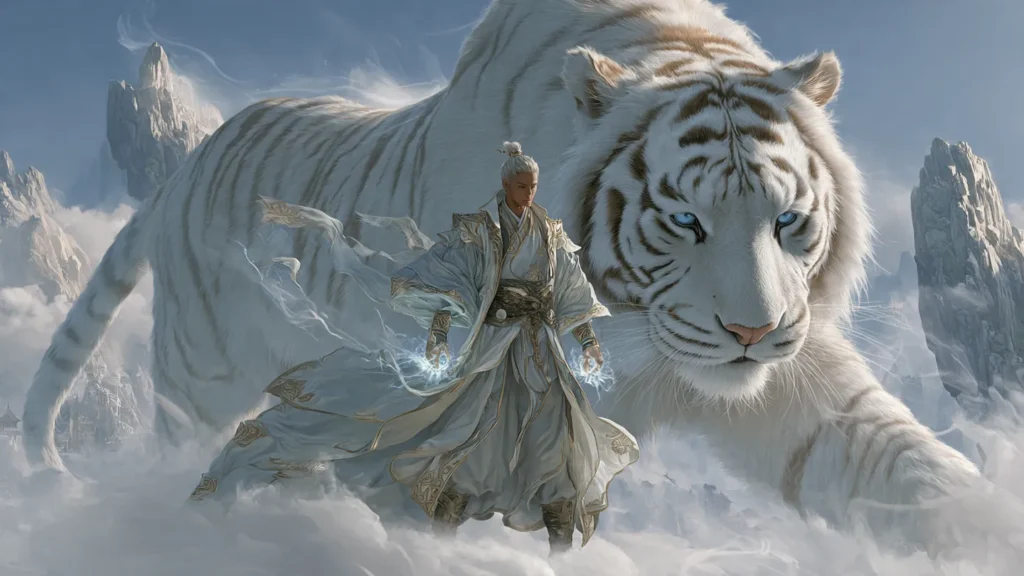
Having traced the white tiger through four national mythological traditions, its ubiquity in cultivation fiction becomes not just understandable but inevitable. The figure arrives in Xianxia carrying two thousand years of accumulated symbolic weight from multiple civilizations simultaneously.
In cultivation novels, Baihu and its cross-cultural equivalents appear in several distinct roles, each drawing on different aspects of the mythological tradition.
As a divine beast, the white tiger is among the most commonly summoned or contracted creatures in xianxia. Its Metal element affinity, martial associations, and status as one of the four great guardian beasts of Chinese cosmology give it immediate recognisability and narrative gravity. A protagonist who contracts a white tiger as a spiritual beast companion inherits all of this symbolism without the author needing to explain it, provided the reader comes from a culture where the figure is already known.
As a bloodline or constitution, the White Tiger Body or White Tiger Bloodline appears in numerous cultivation series as a rare and powerful physical cultivation heritage. This usage draws on the white tiger’s associations with physical strength, martial virtue, and the refining quality of Metal. Characters with white tiger bloodlines typically excel in close combat and body cultivation, their physical capabilities elevated by the beast’s essence within them.
As a sectarian symbol, the white tiger marks Metal-element cultivation sects, western-positioned territories in cultivation world maps, and military cultivation forces. When a cultivation sect’s banner carries a white tiger, the reader immediately understands its elemental alignment, its martial orientation, and its cosmological positioning within the world’s spiritual geography.
The cross-cultural transmission visible in the mythological record shows up in cultivation fiction’s readership as well. Korean readers encountering Baekho in xianxia bring the Goguryeo tomb mural tradition and the shamanic mountain tiger tradition to their reading. Japanese readers bring Byakko’s extensive presence in manga, anime, and game design. Vietnamese readers bring Bach Ho’s folk religious resonance. The white tiger is one of the rare cultivation fiction elements where the symbol arrives pre-loaded with meaning for readers across multiple national traditions.
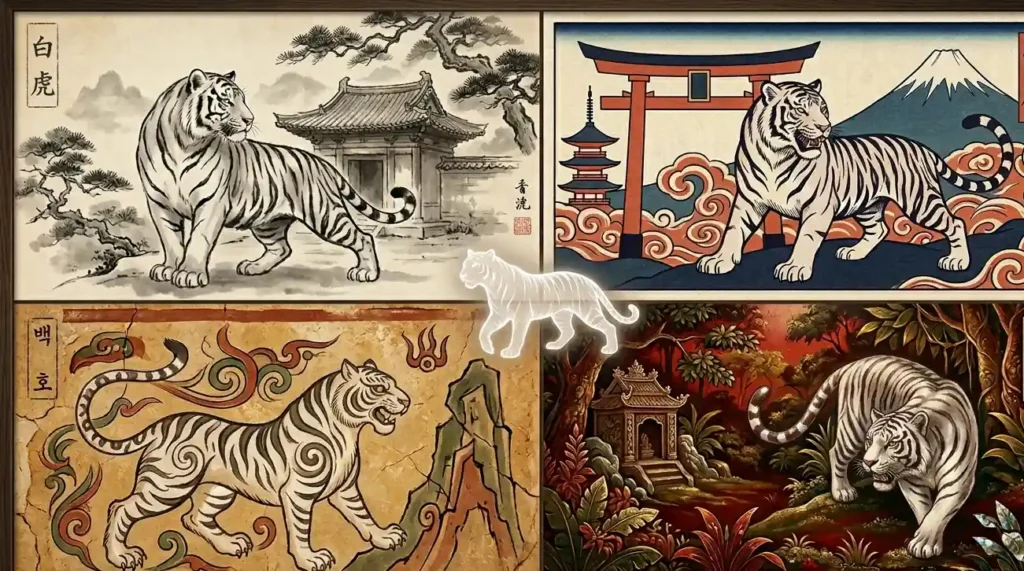
Cross-Tradition Comparison
| Attribute | Chinese (Baihu) | Japanese (Byakko) | Korean (Baekho) | Vietnamese (Bach Ho) |
|---|---|---|---|---|
| Direction | West | West | West | West |
| Season | Autumn | Autumn | Autumn | Autumn |
| Element | Metal | Metal | Metal | Metal |
| Colour | White | White | White | White |
| Primary role | Celestial guardian, protector against evil | Celestial guardian, summonable spirit | Cosmological guardian, shamanic spirit | Celestial guardian, folk protector |
| Distinct tradition | Daoist internal cultivation symbolism | Integration with Japanese art and popular media | Goguryeo tomb murals, shamanic tiger traditions | Integration with Southeast Asian tiger veneration |
| Martial association | Strong, sword and Metal | Strong, fierce protector | Strong, military virtue | Strong, tiger martial arts traditions |
| Protective function | Tomb protection, evil warding | City and directional protection | Burial protection, spirit warding | Household and site protection |
Frequently Asked Questions
What is Byakko in Japanese mythology?
Byakko is the Japanese White Tiger, one of the Four Symbols of East Asian cosmology. It guards the West and rules the Metal element and the autumn season. Introduced to Japan through Chinese cosmology during the Asuka and Nara periods, Byakko remains an important figure in Japanese mythology and art.
What is the difference between Baihu and Byakko?
Baihu and Byakko are the same White Tiger entity with shared Chinese characters 白虎 and identical cosmological roles in both traditions, differing mainly in cultural interpretation across Daoist practice and Japanese popular media.
What does the white tiger symbolise in Chinese culture?
In Chinese culture, the White Tiger symbolises military virtue, western authority, the Metal element, and the autumn season. It is regarded as a powerful protector against evil spirits and was often placed at tombs and important structures. In Daoist thought, Baihu reflects the contracting nature of Metal energy, balancing the Azure Dragon, and is also associated with mourning and life completion due to its white color.
Who is Baekho in Korean mythology?
Baekho is the Korean White Tiger, one of the Four Guardian Beasts in Korean cosmology. It appears in Goguryeo tomb murals from the 4th to 7th centuries CE on the western wall as a protective figure. Korean tradition blends the Chinese White Tiger concept with native shamanic tiger beliefs, linking Baekho to mountain spirits and strong reverence in Korean folk religion.
How does the white tiger appear in xianxia cultivation novels?
In xianxia, the White Tiger often appears as a divine beast bound to cultivators, a bloodline or constitution enhancing physical cultivation, or a sect symbol for Metal based sects. It draws on its mythological traits of Metal affinity, martial strength, western authority, and its role as one of the Four Guardian Beasts in East Asian cosmology.
What are the Four Symbols in Chinese mythology?
The Four Symbols are the four celestial guardian beasts of Chinese cosmology: the Azure Dragon of the East (Qinglong), Vermilion Bird of the South (Zhuque), White Tiger of the West (Baihu), and Black Tortoise of the North (Xuanwu). Each represents a direction, season, element, and color, originating in ancient Chinese astronomy and later spreading across East Asia.
Is the white tiger a real animal or purely mythological?
The White Tiger is a rare genetic variant of the Bengal tiger caused by a recessive gene that reduces orange pigmentation. In East Asian tradition, Baihu is a celestial guardian whose mythological significance far exceeds that of the natural animal, though its rarity likely reinforced its sacred symbolism.
Final thoughts
The white tiger is one of those mythological figures where the more carefully you look at the sources, the more substantial the figure becomes. Most divine animals in fantasy fiction are decoration: their mythological origins are thin, their cross-cultural presence minimal, and their appearance in genre fiction is essentially arbitrary. Byakko, Baihu, Baekho, and Bach Ho are something else entirely.
Two thousand years of consistent cosmological, artistic, religious, and martial significance across four distinct national cultures have produced a figure that arrives in cultivation fiction pre-loaded with more meaning than most authors who use it are consciously aware of.
The white tiger presides over endings that are honest, over the sharpening that makes things truly themselves, over the martial discipline that does not flinch from what it is. These are not arbitrary attributes. They are the accumulated wisdom of multiple civilizations, thinking carefully about what kind of force the Western sky represents.
When a xianxia protagonist contracts a white tiger as a divine beast, or awakens a white tiger bloodline constitution, they inherit all of this. The genre is richer for it than readers typically realise, and the mythological tradition is deeper than the genre typically acknowledges.
Related Articles
- Suzaku Meaning: The Vermilion Bird Myth, Symbolism & Powers
- Xuanwu: Black Tortoise of the North Symbolism & Mythology
- Yellow Dragon: Myths, Symbolism & the Forgotten Fifth Beast
- Why the Four Holy Beasts Cannot Exist Without Yin Yang
- Yin Yang, Five Elements & Four Symbols: China’s Complete Cosmos
- Are the Four Heavenly Kings & Four Holy Beasts the Same?
- The Four Holy Beasts: Baihu, Qinglong, Zhuque & Xuanwu
References
- Birrell, Anne. Chinese Mythology: An Introduction.
- Eberhard, Wolfram. A Dictionary of Chinese Symbols.
- Major, John. Heaven and Earth in Early Han Thought.
- The Chinese Sky
- Lewis, Mark Edward. The Construction of Space in Early China.
- Kohn, Livia. Daoism and Chinese Culture.
- Allan, Sarah. The Shape of the Turtle.Hanshu (Book of Han).
- Daoist Ritual, State Religion, and Popular Practices
- UNESCO World Heritage Centre – Complex of Goguryeo Tombs
- Shanhaijing (Classic of Mountains and Seas).
- Shiji (Records of the Grand Historian).