

 By
By Quick takeaways:
- Cultivation Power is not a single number. It accumulates simultaneously across five distinct axes: realm, technique, body, dao comprehension, and external resources
- Realm level sets a ceiling, but does not determine where within that ceiling a cultivator actually sits
- Leapfrog combat protagonists defeating opponents one, two, or more realms above them is only believable when the author has built genuine depth into the non-realm axes
- The most common failure mode in power scaling is authors who inflate realm numbers without developing the other axes, producing fights that feel weightless
- Understanding how power scaling works makes it possible to read cultivation novel much more critically and appreciate the series that do it well
The question I get asked often by readers new to cultivation novels is:
if two cultivators are at the same realm, why does one of them so often seem massively stronger than the other? And if realm levels are not the whole picture, what is?
I spent the first few years of reading xianxia novels accepting this as a given without fully working out the logic. But, as my cultivation knowledge improved, I started noticing that the best series had an internal consistency to their power comparisons that the weaker ones lacked. Two cultivators at the same level could have wildly different combat power, and in a good series, you could always trace exactly why. In weaker series, the gap felt arbitrary. The author needed one character to be stronger, so they were.
Based on my personalI can now articulate what I was detecting. Cultivation power in well-constructed Xianxia operates across five distinct axes simultaneously. Realm level is one of them, an important one, but only one. Here is how all five actually work, and what happens when authors get the balance wrong.
The Five Axes of Cultivation Power

Before breaking each one down, it is worth naming them clearly so the framework is easy to reference.
The five axes are: realm, technique, body, dao comprehension, and external resources. Every cultivator in every xianxia novel sits somewhere on all five of these scales simultaneously. Their actual combat power is a function of all five together, not any single one in isolation.
This is the key insight that most surface-level discussions of cultivation power miss. When a protagonist defeats an opponent two realms above them, they are not defying the power system. They are exploiting the gap between their own non-realm axes and their opponent’s. When that gap is not properly established, the fight feels like authorial convenience. When it is, the fight feels earned.
Realm as the Foundation
Realm is the most visible axis and the one that cultivation world foregrounds most heavily. It sets the absolute ceiling for a cultivator’s power and determines their access to certain techniques, abilities, and phenomena.
A Qi Condensation cultivator cannot access the flying sword techniques available to Core Formation cultivators. A Foundation Establishment cultivator cannot perceive the Dao insights accessible at Nascent Soul. Realm gatekeeps capability in a fundamental way.
It also has direct mechanical consequences for cross-realm combat. In virtually every xianxia system, there is a suppression effect when two cultivators of significantly different realms fight.
The higher realm cultivator’s qi density alone creates pressure that the lower realm cultivator’s body and qi channels are not designed to handle. This is not metaphorical. It is a physical force within these fictional worlds. Standing in the presence of a sufficiently advanced cultivator can injure or kill a lower realm cultivator without a single deliberate attack.
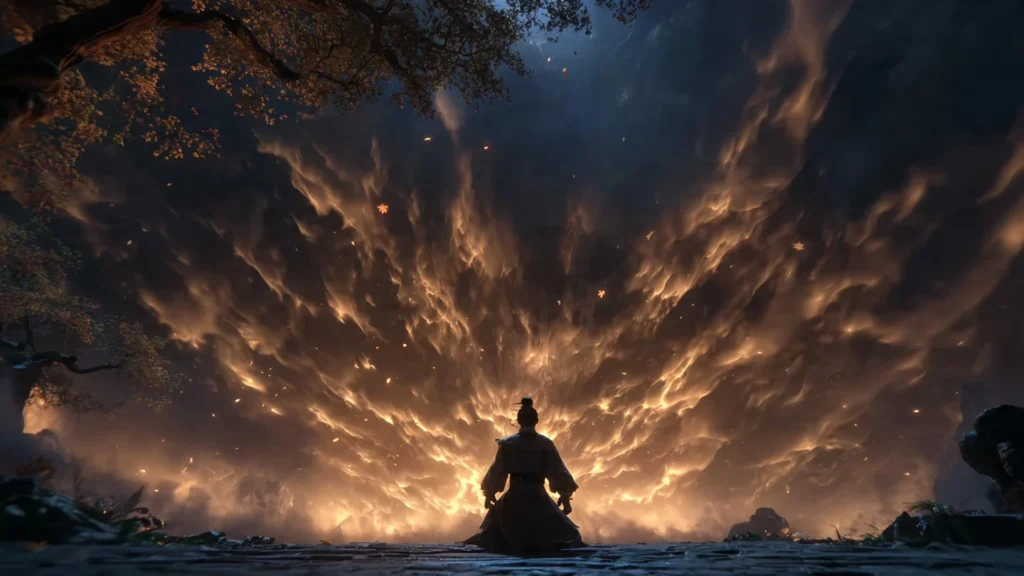
This suppression mechanic is what makes leapfrog combat narratively meaningful. Every time a protagonist fights an opponent above their realm, they are fighting not just that opponent’s skill and power, but the passive pressure of the realm gap itself. A Record of a Mortal’s Journey to Immortality handles this with particular care. Han Li never casually defeats opponents far above him. When he does manage it, the author has established exactly what compensating advantages he has deployed.
What realm does not determine is where within a given realm a cultivator sits. Two Nascent Soul cultivators can have wildly different combat power. Understanding why requires looking at the other four axes.
Some authors use a special realm that only a few talented, prodigious monsters can attain, such as the Extreme Realm and the Supreme Realm. These special realms enable the protagonist to fight far above his cultivation stage.
Technique and Dao Comprehension: The Multipliers
These two axes are deeply intertwined and together form the most complex dimension of cultivation power. I am separating them slightly for clarity but in practice they feed each other constantly.
Cultivation Technique

Technique refers to the specific cultivation and combat methods a cultivator has mastered. Not all techniques are equal. The quality of a cultivation method directly affects the quality of the qi it produces, the speed of advancement, and the special properties of the resulting power. A cultivator using a Heaven-grade cultivation technique produces fundamentally superior qi compared to a cultivator at the same realm using a Yellow-grade technique. The realm level is identical. The actual power output is not.
Combat techniques have the same variation. A sword technique ranked at the Heaven tier hits qualitatively differently than an Earth-tier technique used by someone at the same cultivation level.
I Shall Seal the Heavens is one of the best illustrations of this. Meng Hao’s access to ancient or unusual techniques repeatedly gives him combat leverage that his realm level alone would not justify, and Er Gen is careful to establish what each technique contributes specifically rather than handwaving a generic power boost.
Dao Comprehension

Dao Comprehension is the more philosophical axis and the one that separates cultivation fiction most clearly from simpler power fantasy. Dao comprehension is not about the technique you use but the depth of your understanding of the underlying principles that the technique expresses.
Two cultivators can use the same fire-based technique. The one who has genuinely comprehended the nature of fire at a fundamental level, who has, in the language the genre uses, understood the fire Dao or achieved Major Accomplishment, will execute it with entirely different results.
This axis scales without an obvious ceiling in the best cultivation fiction. A cultivator can be at a lower realm than their opponent while having significantly deeper Dao comprehension, and that comprehension gap can compensate for the realm gap in certain conditions.
It also explains why old monsters who have been stuck at the same realm for centuries are not always weaker than younger cultivators who have recently broken through. The older cultivator’s centuries of Dao study may have produced comprehension that raw realm advancement cannot match.
Reader Note: Lord of the Mysteries handles this axis better than almost any other series, though it uses different terminology. Klein Moretti’s upper hand in many confrontations comes not from raw power but from his deeper understanding of the pathways and their principles. The power feels earned because the comprehension is shown, not simply claimed.
Body Cultivation: The Wild Card

This axis is the one most likely to produce the “how is that possible” moments that newer readers find confusing. Body cultivation, the direct refinement of the physical body as a separate cultivation track, operates partially independently of the qi-based realm system, and a cultivator who invests heavily in it can have physical combat capability that vastly exceeds what their qi realm would suggest. In short, the body cultivators are straight-up beasts in the human body.
Body cultivation traditions in Xianxia draw on real philosophical traditions of physical refinement, the idea that the body itself can be transformed into something beyond its mortal limitations through dedicated practice, specific techniques, and sometimes rare physical cultivation resources.
In fictional terms, a body cultivator who has tempered their flesh and bone to a sufficient degree can take blows from weapons that should kill them, deliver physical strikes that hit with the force of qi-based attacks far above their realm, and exhibit physical speed and strength that seems impossible for their stage.
The protagonist archetype who uses body cultivation as a primary or secondary track is one of the most satisfying in the genre precisely because it creates a specific kind of leapfrog logic that is immediately comprehensible. When Meng Hao’s Fleshly Body allows him to take hits from opponents who outclass him in qi-based power, the reader understands the mechanism and the dramatic stakes simultaneously.
Body cultivation also interacts with the constitution(Divine Body), the innate physical gifts a cultivator was born with. An Undying Body constitution, a Dragon Body constitution, or any of the dozens of special physiques that appear across xianxia series are not just flavor. They are a significant modifier on the body cultivation axis that can dramatically shift how a character scales compared to their peers.
External Resources: Treasure, Pills, and Formations

The fourth axis is the most variable because it depends entirely on what the cultivator has managed to acquire, and this acquisition is often where the plot directly feeds into power. External resources include spirit treasures and weapons, medicinal pills and elixirs, formation arrays, and beast companions or contracted spirits.
Spirit treasures deserve particular attention because they are frequently the most impactful short-term modifier on combat power.
A Nascent Soul cultivator wielding an immortal-grade spirit treasure is genuinely threatening to opponents above their level in a way they would not be without it. The treasure does not raise their realm. It multiplies the effectiveness of what their realm can produce. It also creates dramatic leverage: a cultivator who relies heavily on their treasure has a meaningful vulnerability that skilled opponents can exploit.
Medicinal pills and elixirs operate differently. They either accelerate cultivation advancement (affecting the realm axis) or provide temporary combat boosts during fights. The cultivation novel’s alchemist characters exist precisely because the pill axis is so significant that dedicated pill refinement becomes a viable and important specialization.
A Record of a Mortal’s Journey to Immortality treats the pill axis with particular seriousness. Han Li’s progress is closely tied to his access to rare pills, and the novel is honest about how much his advancement has depended on resources that most cultivators never encounter.
Formation arrays are the most underappreciated external resource in cultivation fiction discussions. A cultivator operating within a formation they have set up in advance can fight opponents dramatically above their normal capability, because the formation is contributing power that is not strictly theirs. Many of the genre’s most dramatic defensive stands involve formations, and the cultivators who specialize in them are often more dangerous in their home territory than their realm level would suggest to an uninformed opponent.
Why Protagonists Can Fight Above Their Realm

This is the question the entire framework above is building toward, because it is the central dramatic mechanic of cultivation fiction and the one readers most need to understand to appreciate what good writing in this genre actually looks like.
Leapfrog combat, a protagonist defeating opponents one, two, sometimes three or more major realms above them, is only credible when the author has established genuine depth in the non-realm axes. The protagonist wins not by defying the power system but by exploiting asymmetries within it.
A typical protagonist’s leapfrog advantage package looks something like this. Their technique quality is exceptional, usually because of a system, legacy, or cultivation method unavailable to ordinary cultivators. Their Dao comprehension is abnormally deep for their realm, because their unusual experiences or innate insight have allowed them to understand the Dao at a level most cultivators only reach much later.
Their body cultivation is extraordinary, giving them physical durability and strike power that exceeds what their qi realm would suggest. And they have accumulated external resources, usually treasures, sometimes pills that add additional combat leverage their opponent does not account for.
When all five axes are genuinely developed, a cross-realm win feels completely credible. The reader can trace exactly why the protagonist won despite the realm’s disadvantage. When the non-realm axes are underdeveloped, the protagonist wins because the author needs them to, and the reader feels this even if they cannot name what is wrong.
The clearest illustration I know of a well-constructed leapfrog scenario is Han Li’s fights in A Record of a Mortal’s Journey to Immortality. His wins against stronger opponents are seldom clean or easy, and the reader can always identify the specific combination of preparation, resources, and unconventional technique choice that made the outcome possible. His victories feel earned because the work to earn them is visible in the chapters preceding the fight.
When Power Scaling Breaks Down

After a decade of reading Xianxia novels, I have become reasonably good at identifying when a series’s power scaling is starting to lose coherence, usually well before it becomes dramatically obvious. The warning signs are consistent across series.
- The first is when realm inflation outpaces axis development. This happens when an author advances the protagonist’s realm rapidly to create escalating threats but does not correspondingly develop their technique, dao comprehension, or body cultivation. The result is a character whose realm number is high, but whose actual combat feel has not changed since they were two tiers lower. Fights stop having texture because the protagonist’s toolkit has not grown to match their realm.
- The second is when leapfrog combat becomes the baseline rather than the exception. If a protagonist routinely and comfortably defeats opponents three realms above them without high cost or specific preparation, the realm axis effectively stops being meaningful. The power system loses its internal logic because the suppression mechanism is no longer functioning. Opponents at higher realms cease to feel genuinely threatening, and the tension that power scaling is supposed to generate disappears.
- The third, and most damaging, is when combat outcomes are determined by narrative necessity rather than established axis development. This is the hardest one for readers to prove, but the easiest to feel the vague sense that the protagonist is winning because they are the protagonist, not because the fight’s outcome follows logically from what has been established. Good cultivation fiction never produces this feeling. Every win, even a dramatic one, feels like it had to be that way, given what we know.
Martial God Asura is frequently cited as a series that struggles with scaling coherence at higher chapter counts, not because Chao Shen lacks craft, but because the sheer length of the series creates compounding pressure on the power system that eventually produces inconsistencies. A Record of a Mortal’s Journey to Immortality and I Shall Seal the Heavens are the series I recommend most often to readers who want to see power scaling done with sustained internal consistency across a long run.
Frequently Asked Questions
What is power scaling in cultivation novels?
Power scaling defines how cultivators grow stronger and compare across stages. It operates on multiple axes, realm, techniques, dao comprehension, body cultivation, and resources, rather than a single linear measure. Grasping this layered structure explains why some outcomes are possible while others aren’t.
Why can cultivation protagonists fight enemies above their realm?
Realm level is only one axis of combat power. Protagonists offset lower realms with superior techniques, deeper dao comprehension, stronger body cultivation, or smart use of resources like spirit treasures and formations. Good authors establish these factors early so victories feel earned rather than arbitrary.
What is realm suppression in cultivation novels?
Realm suppression is the passive pressure a higher realm cultivator’s qi exerts on weaker ones. Their denser qi creates an oppressive force that can injure or immobilize without attacking. It makes large realm gaps hard to overcome, and resisting it shows exceptional strength beyond realm level.
How cultivation system work?
Cultivation is basically a 100-level system: mortals at zero, Immortals at the top. Power comes from refining qi through techniques, resources, and breakthroughs, with major spikes every ten levels. Higher levels usually win, but talent and tools bend rules. It starts as enlightenment, ends as explosive, ego-driven power clashes.
What is the difference between combat power and cultivation realm?
Cultivation realm is a formal stage defining qi density, lifespan, and abilities. Combat power is actual fighting effectiveness, shaped by realm plus techniques, dao comprehension, body cultivation, and resources. Two cultivators at the same realm can differ greatly in combat power if their other development is uneven.
What is dao comprehension and how does it affect power?
Dao comprehension is a cultivator’s depth of understanding of the principles behind their path and techniques. Deeper insight allows more efficient, creative, and potent use beyond raw mechanics. It can offset lower realms and often separates those who stagnate from those who keep advancing despite limited resources.
Why do some cultivation novels feel like the power scaling stops making sense?
Usually, because realm inflation outpaces axis development. When protagonists advance too fast without matching growth in techniques, dao comprehension, or body cultivation, fights lose texture and opponents lose menace. If leapfrog wins become routine, internal stakes collapse, and the power system stops feeling meaningful.
Which cultivation novels have the best power scaling?
From years of reading, standouts are A Record of a Mortal’s Journey to Immortality for long-term coherence, where Han Li’s wins track to preparation and axis advantages, and I Shall Seal the Heavens for creative use of all axes. Lord of the Mysteries has the tightest system overall, while He Who Fights With Monsters presents axis development clearly for Western audiences.
Final thoughts

The reason power scaling matters, beyond the purely analytical interest of working out the mechanics, is that it is the structural backbone of cultivation fiction’s emotional payload. Every breakthrough, every cross-realm win, every dramatic last-stand against an overwhelmingly stronger opponent lands differently depending on whether the reader understands and believes the power system underlying it.
When scaling is consistent and multi-axis development is visible, the genre produces its most satisfying moments, victories that feel simultaneously surprising and inevitable, setbacks that feel genuinely threatening because the reader knows what the power gap actually means, and breakthroughs that represent real transformation rather than just a number going up.
When scaling breaks down, something harder to name but immediately felt goes wrong. Fights lose their stakes. Opponents stop being threatening. The protagonist’s victories start feeling like the author doing them a favour. Readers who quit long cultivation series mid-run are very often responding to exactly this collapse, even when they describe their reason for stopping in different terms.
The good news is that the series that get it right and there are many offer an experience that almost no other fiction genre can match: thousands of chapters of genuinely escalating tension, where every new power level means something specific and every fight has a real logic behind its outcome.
If this analysis has made you want to look at a cultivation series’s power system more closely, our breakdown of cultivation realms explained is a good place to start building the framework. And if you want to understand the psychological dimension of why power scaling is so compelling to read in the first place, our piece on what makes cultivation novels psychologically appealing goes into the mechanisms underneath the experience.
Related Articles
- Best Xianxia Novels of 2026: From Hidden Gems to Legends
- 13 Best Cultivation Novels With No Harem [2026 Picks]
- 12 Best Cultivation Novels [Ranked by Genre Fans]
- 7 Female MC Cultivation Novels Where the Female MC Shines [2026]
- 9 Best Progression Fantasy Books 2026 [Ranked List]
- 13 Fantasy Genres Ranked: Which One Actually Suits You?
- How Fast Would You Die in a Cultivation Novel World?
- What If Cultivation Was Real, Starting Tomorrow?
Sources & Further Reading
- Stanford Encyclopedia of Philosophy – Daoism
- Joseph Needham, Science and Civilisation in China
- Dao De Jing (Tao Te Ching)
- Zhuangzi
- Taoist Alchemy insights on Neidan and Waidan
- Stanford Encyclopedia of Philosophy – Heart Mind in Chinese Philosophy
- Mihaly Csikszentmihalyi – Flow: The Psychology of Optimal Experience (1990)
- Ryan, R. M., & Deci, E. L. (2000). Self-Determination Theory and the Facilitation of Intrinsic Motivation, Social Development, and Well-Being.
- Raph Koster – A Theory of Fun for Game Design
Written by Batin Khan, a curious free spirit who loves reading and exploring the worlds of fantasy, mythology, and ancient stories. Through this blog, Batin hopes to share that sense of wonder with readers while building an exciting future along the way.