
 By
By Quick Takeaways:
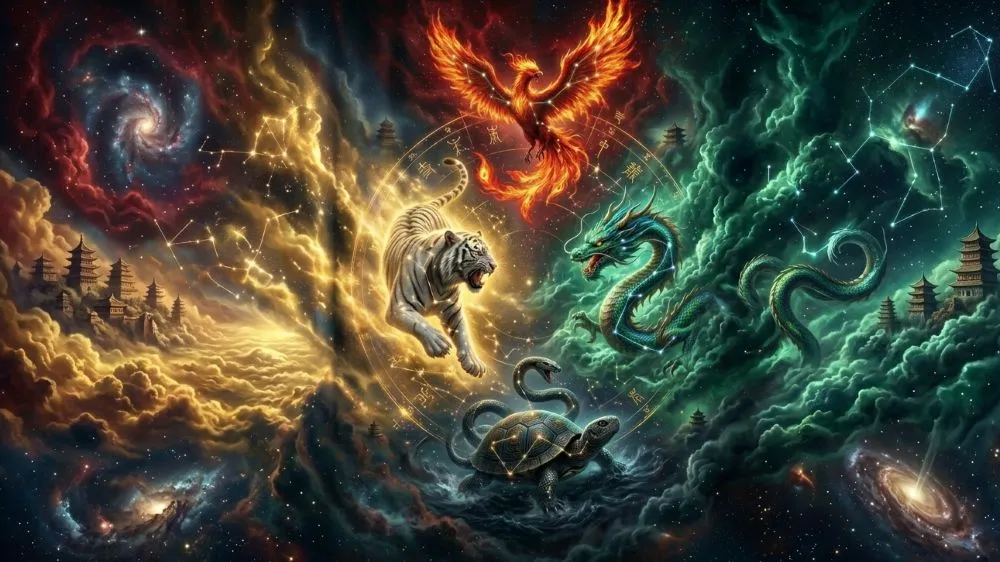
- The Four Holy Beasts, or Four Symbols, divide the entire visible sky into four quarters of seven lunar mansions each, meaning this is a complete astronomical system rather than four loosely related mythological figures
- Each beast governs one cardinal direction, one season, and one element in the Wu Xing system, together covering every position on the cosmological wheel with no gaps
- Only one of the four, Xuanwu, eventually broke away from purely symbolic duty and became an independently worshipped deity with an entire sacred mountain built around him
- Qinglong and Zhuque are both frequently confused with more famous relatives, the dragon in general and the phoenix specifically, and untangling those confusions actually clarifies what each beast is really for
- You can still find all four placed correctly on temples and restored historical buildings across China today, which is one of the more genuinely satisfying things to go looking for on a trip there
I’ve written about Qinglong on its own before, and about Zhuque’s relationship to the Fenghuang in another piece, but I’ve never sat down and treated all four of these figures as what they actually are: one interlocking system rather than four separate mythological entries that happen to share a category label.
That’s a mistake worth correcting, because the system only really makes sense once you see all four pieces at once, and one part of that system did something genuinely surprising that the other three never managed.
What the Four Holy Beasts Actually Are
A Complete Map of the Sky
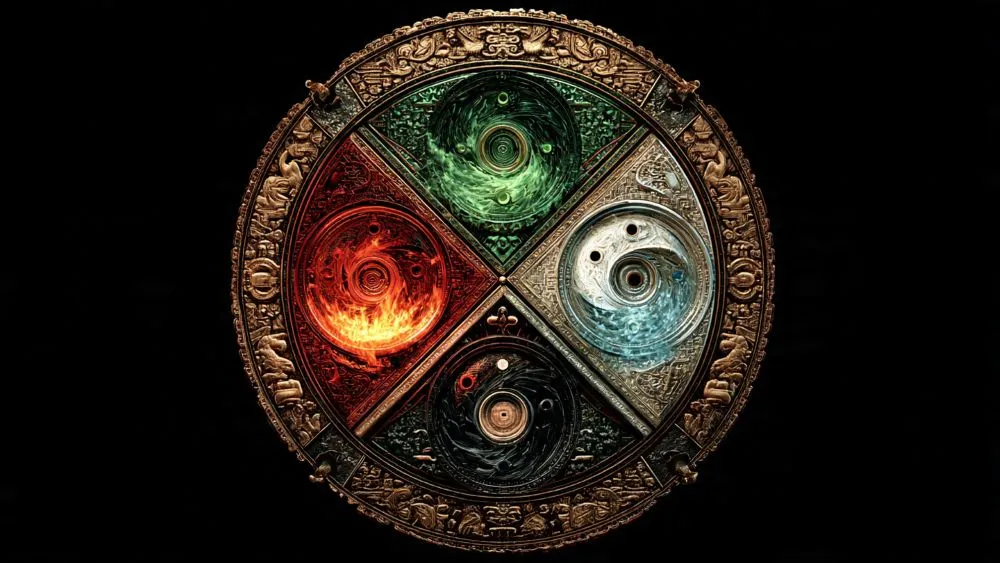
The Four Symbols, sometimes called the Four Holy Beasts or Four Auspicious Beasts, divide the twenty eight lunar mansions of traditional Chinese astronomy into four groups of seven. Each group of seven star mansions occupies one quarter of the sky, and each quarter is represented by one creature: Qinglong in the east, Zhuque in the south, Baihu in the west, and Xuanwu in the north.
This is the detail most casual accounts skip, and it’s the one that actually matters. These aren’t four unrelated legendary animals somebody grouped together for symmetry.
They’re a working astronomical coordinate system that ancient Chinese observers used to track the moon’s monthly path against the fixed stars, given animal form so ordinary people could actually hold the system in their heads.
The Wu Xing Layer
Each beast also carries a full Wu Xing correspondence: an element, a season, and a color. Qinglong holds Wood, spring, and the color qing, somewhere between blue and green. Zhuque holds Fire, summer, and red. Baihu holds Metal, autumn, and white. Xuanwu holds Water, winter, and black.
Stacked together, the four cover every direction, every season, and every generative phase of the Wu Xing cycle with nothing left over. That completeness is the whole point of the system, and it’s why you’ll find all four depicted together so consistently across two thousand years of Chinese tomb art, temple architecture, and ritual practice.
Qinglong: The Piece You Already Know
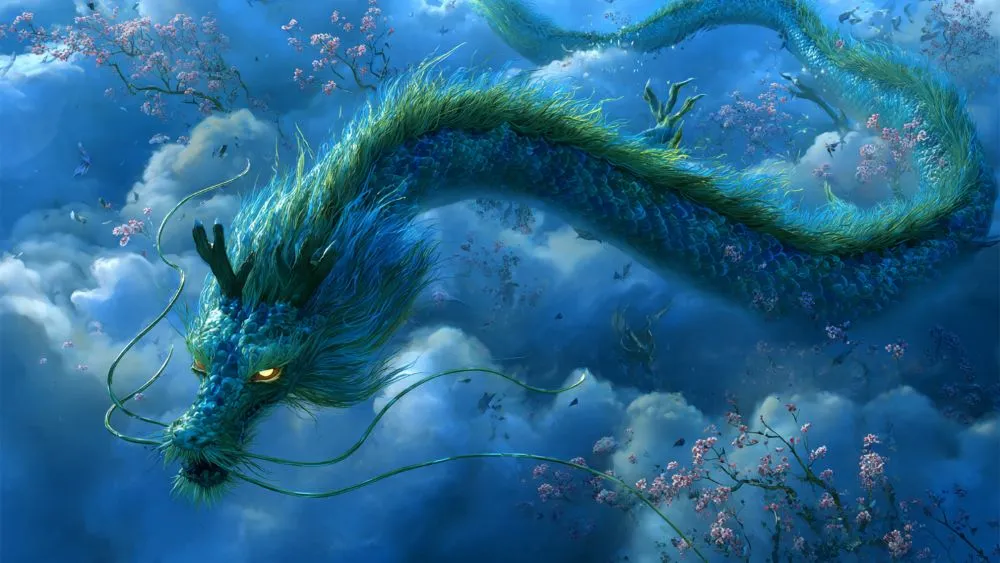
I’ve given Qinglong its own full treatment elsewhere on this site, so I won’t repeat all of it here. The short version worth restating: Qinglong governs the east, spring, and the Wood element, its seven lunar mansions trace a dragon shaped outline across the eastern sky, and it’s genuinely distinct from the administrative Dragon Kings who handle rainfall under the Jade Emperor’s court.
What matters for this article specifically is Qinglong’s position in the larger system. Listed first among the four in most traditional presentations, Qinglong anchors the wheel at its natural starting point, spring following winter, morning following night, the season of beginnings opening the yearly cycle that the other three beasts then carry forward.
Baihu: The White Tiger of the West
Governing Autumn, Metal, and Martial Virtue
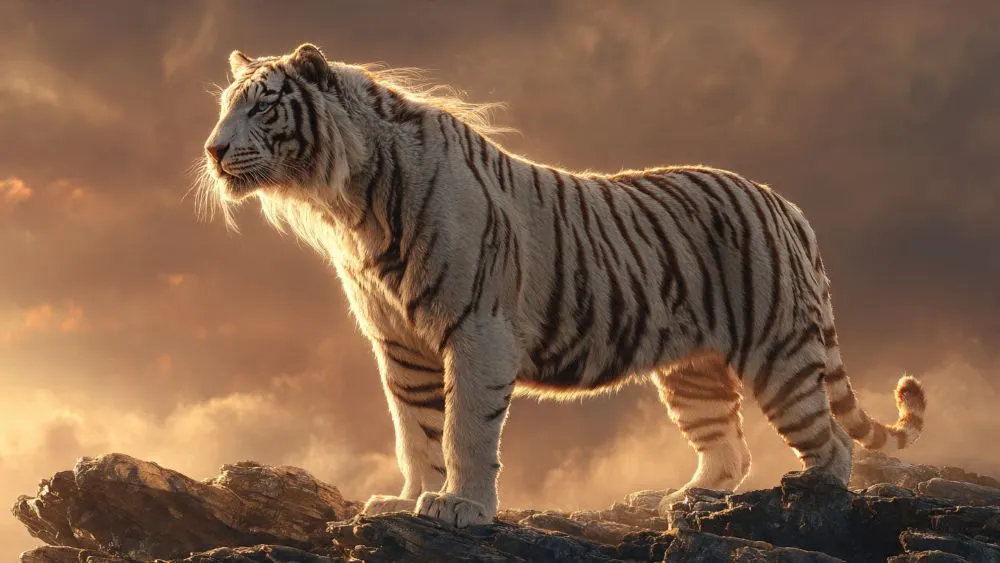
Baihu holds the western quarter of the sky, governing autumn, the Metal element, and the color white. Its seven lunar mansions trace the western sky’s star groupings the same way Qinglong’s seven trace the east.
Where Qinglong’s Wood energy is about growth pushing upward and outward, Baihu’s Metal energy is about refinement, contraction, and the harvest that follows a full season’s growth. Autumn in this system isn’t decline. It’s completion, the point where a year’s effort gets gathered in and made useful.
Danger as Part of the Symbolism
Here’s where Baihu genuinely differs from Qinglong in a way I find underexplored in most popular accounts. Tigers were a real, documented ecological presence and a real threat across much of early China, and that lived danger shows up directly in how Baihu functions symbolically.
Baihu carries martial virtue, courage, and righteous military force, which is why the White Tiger banner historically signaled military campaigns and why generals invoked the creature before battle. But that martial association never fully sheds its undertone of genuine danger, in a way that Qinglong’s benevolent growth energy simply doesn’t carry. Baihu is a guardian you want on your side specifically because you understand what it would be like to have it against you.
The Feng Shui Rule Worth Knowing
This tension between protection and danger produced a specific, still practiced feng shui principle: the dragon side of a building, traditionally the left or eastern side, should sit slightly higher or more prominent than the tiger side, traditionally the right or western side.
The general logic is that Qinglong’s growth energy is safe to let flourish, while Baihu’s more forceful energy needs to be kept in a supporting rather than dominant position, or its martial force can tip into genuine harm rather than protection.
I find this rule genuinely revealing about how the whole system actually worked in practice. These weren’t purely abstract cosmological placeholders. People building real homes were making real decisions based on which of these four energies they wanted leading and which they wanted following.
Zhuque: The Vermilion Bird, Not the Phoenix
A Distinction Worth Repeating
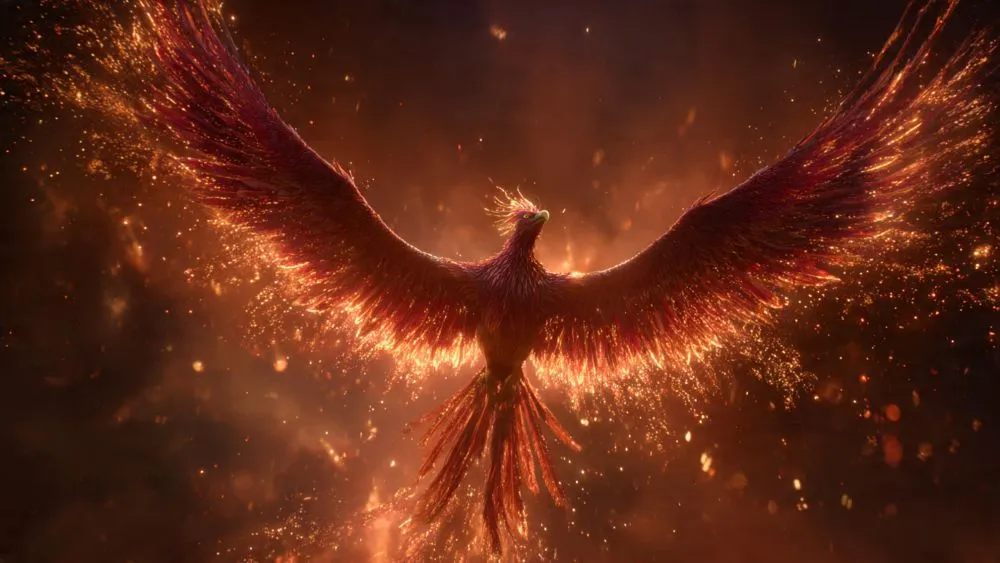
I made this point at length in an earlier piece about the dragon and phoenix pairing, and it’s worth restating here because the confusion is genuinely common and genuinely obscures what Zhuque is actually for. Zhuque, the Vermilion Bird, is not the Fenghuang, the auspicious phoenix associated with virtue, the empress, and the appearance of a sage ruler.
Zhuque belongs specifically to this directional, astronomical system. It governs the south, summer, the Fire element, and its own seven lunar mansions tracing the southern sky.
The Fenghuang exists entirely outside this four direction framework, unpaired with any single cardinal point, carrying its own separate symbolic history tied to virtue and imperial legitimacy rather than to a fixed position on the cosmic wheel.
The Peak of Yang Energy
Zhuque’s specific placement, south, summer, Fire, represents the cosmological system’s point of maximum yang expression, the fullest, most outward, most vital expression of generative life energy before the wheel begins its turn back toward yin. Noon sits under Zhuque’s governance in the same way midnight sits under Xuanwu’s, and midsummer sits opposite midwinter across the entire wheel.
This makes Zhuque’s position genuinely central to understanding the whole system’s logic, even though the Vermilion Bird itself receives less individual mythological attention than Qinglong or the increasingly important Xuanwu. It’s the peak the other three positions are measured against.
Xuanwu: The One That Became a God
Starting as a Symbol Like the Others
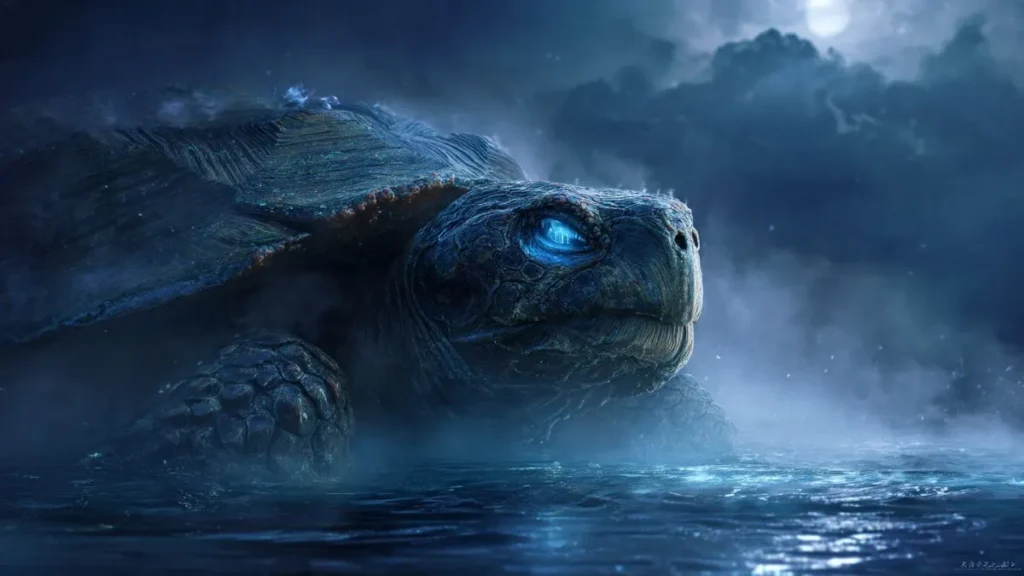
Xuanwu, the Black Tortoise, sometimes shown as a tortoise entwined with a snake, governs the north, winter, the Water element, and the color black, its worship documented as far back as the Warring States period.
For centuries, Xuanwu functioned exactly the way Qinglong, Zhuque, and Baihu functioned: a directional symbol, a set of seven lunar mansions, a presence painted correctly on the northern wall of a tomb or the northern side of a temple complex.
Then something happened to Xuanwu that never happened to the other three.
The Anthropomorphic Turn
Starting in the early Northern Song dynasty, Xuanwu began transforming from a purely animal composite figure into a fully humanized warrior deity: long unbound hair, bare feet, a sword, armor beneath his robes.
The turtle and snake that had once been the primary objects of worship in their own right gradually became his subordinate mounts, subjugated companions standing beneath a god who now looked like a person rather than a creature.
Emperor Zhenzong of the Song, deeply devoted to religious Daoism, built the first temple to this newly humanized deity in the capital of Bianling in 1017, after what was recorded as a miraculous appearance of a tortoise and a snake together. This is the moment Xuanwu genuinely stops being purely symbolic and becomes an object of direct religious devotion.
Why the Name Changed
Here’s a detail I find delightful precisely because of how bureaucratic the reasoning is.
Xuanwu’s name literally means Dark Warrior or Mysterious Warrior, xuan meaning dark or mysterious, wu meaning martial. But the character xuan happened to appear in the personal name of a Song imperial ancestor, Zhao Xuanlang, and Chinese naming taboo tradition required avoiding characters used in an emperor’s own lineage.
So the deity’s name was officially changed to Zhenwu, the Perfected Warrior or True Warrior, specifically to sidestep this taboo. Both names remain in active use today depending on region, but the Zhenwu title is the one that carries the deity’s full later imperial history.
A god’s name changed because of a scheduling conflict with a dead relative’s paperwork is exactly the kind of specific, human detail that makes real mythology so much more interesting than the tidied up version.
Wudang Mountain and Imperial Patronage
Xuanwu’s cult grew steadily through the Song dynasty, eventually becoming one of the Four Saints of Daoism, but it reached its true peak under the Ming dynasty, specifically under the Yongle Emperor. Yongle had usurped the throne from his own nephew in a campaign known as the Jingnan Campaign, and he credited Xuanwu with providing direct divine assistance during that fight.
In gratitude, and to help legitimize a throne he’d taken by force, Yongle sponsored a massive construction program on what had been Mount Taihe in Hubei province, renaming it Wudang, meaning roughly that only Xuanwu is worthy of the mountain.
The resulting temple complex deliberately echoed the layout of the Forbidden City itself, and Wudang Mountain became, and remains, one of the most sacred sites in Daoist practice.
Other Names Worth Knowing
Xuanwu accumulated an unusually large collection of titles across this development, more than any of the other three beasts ever did: Beidi, Emperor of the North, Beidou, Northern Dipper, and Xuantian Shangdi, the Highest Emperor of Dark Heaven, among others. In Hong Kong and southern Chinese tradition specifically, the same figure is often known as Pak Tai.
That accumulation of titles is itself evidence of the scale this cult eventually reached. None of the other three holy beasts collected anything close to this many independent names, because none of them needed to. They stayed symbols. Xuanwu became a person people prayed to directly.
Why Only Xuanwu Made This Leap
The Question Worth Actually Asking
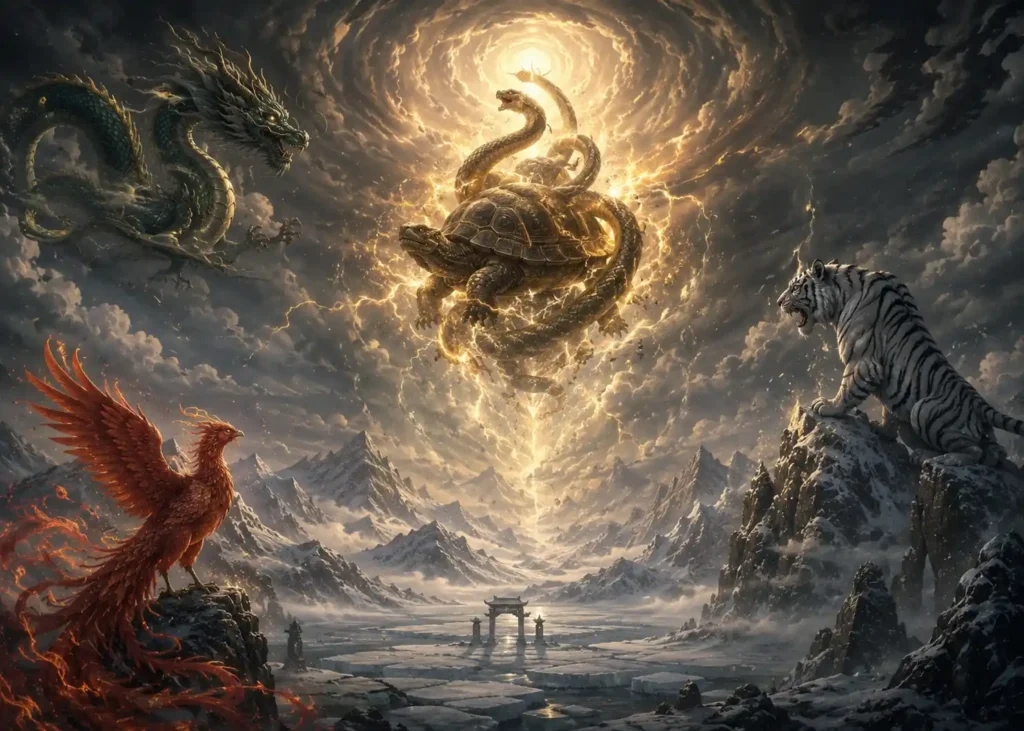
This is the part of the system I find most genuinely interesting, and it’s the part most comparative treatments skip entirely. All four beasts started from the same basic status: directional symbols mapped onto real constellations, appearing together in tomb art with equal cosmological weight.
Only one of them went on to become a fully independent, humanized deity with imperial dynasties competing to claim his favor and an entire sacred mountain built in his name.
I don’t think there’s a single, fully settled scholarly answer to why Xuanwu specifically made this leap while Qinglong, Zhuque, and Baihu didn’t, and I want to be honest that this is genuinely debated territory rather than a fact with a clean citation. But a few contributing factors show up consistently across the historical record.
Water, Warfare, and Imperial Need
Xuanwu’s Water and North associations connected naturally to specific practical concerns, healing, and to the literal northern gates of palaces that needed defending. Tang Emperor Taizong named the northern gate of his own palace the Dark Warrior Gate specifically to invoke Xuanwu’s protection, which is the same gate later famous in Chinese history for the succession conflict fought there.
That association with palace defense and imperial legitimacy made Xuanwu specifically useful to emperors who needed a martial, protective deity to back their own political claims, in a way that Qinglong’s growth energy or Zhuque’s summer vitality simply didn’t offer the same kind of direct political utility for.
A Deity Ready to Personify
The turtle and snake composite form may also have simply been more available for humanization than a dragon, a bird, or a tiger already fully formed as recognizable single animals.
Turning two creatures wound together into a single armed and armored human figure standing on both of them as subdued companions is a specific transformation that the other three beasts, each already a complete single animal, didn’t invite in the same way.
Whatever the full explanation, the outcome is clear and genuinely striking once you notice it. Four beasts started at the same cosmological rank. One of them ended up with his own mountain.
Where You Can Still Find All Four Today
Tomb Art and Restored Architecture
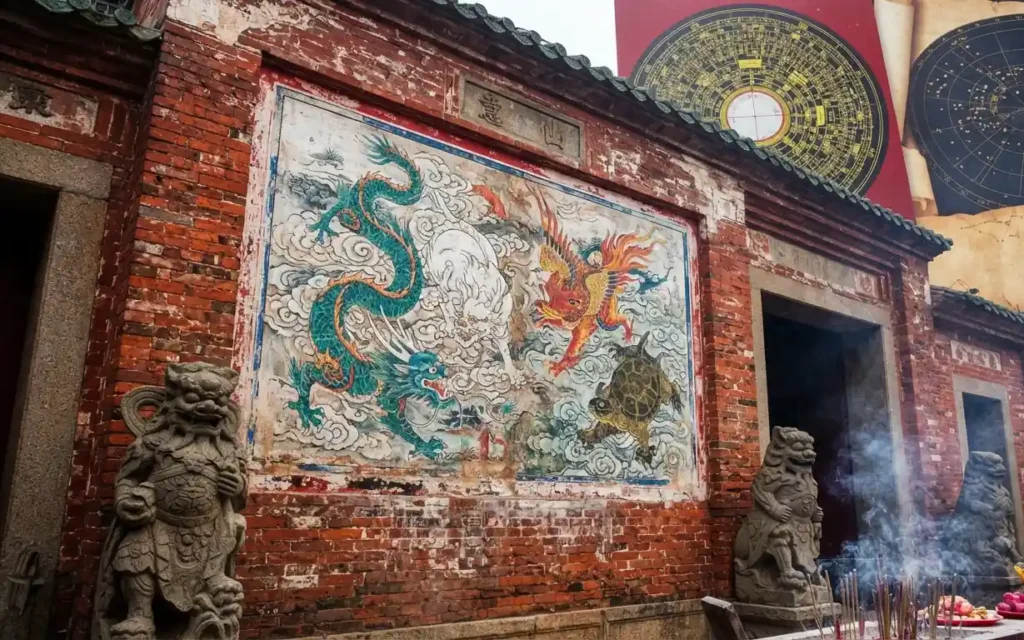
Han dynasty tomb tiles, roof end tiles, and bronze mirrors regularly depict all four symbols together, correctly oriented to their cardinal positions, and this pattern of correct placement continued into later temple and palace architecture.
Restored historical sites and newly built traditional style temples across China and the Chinese diaspora still place these four correctly, Qinglong east, Zhuque south, Baihu west, Xuanwu north, meaning the system remains genuinely visible rather than purely historical.
Wudang Mountain Specifically
If you want to see where this system’s most successful individual branch actually ended up, Wudang Mountain in Hubei is the destination. The temple complex Yongle built there remains an active Daoist pilgrimage site, and it’s the clearest physical evidence anywhere of how far one piece of this four part system eventually traveled from its cosmological starting point.
Everyday Feng Shui Practice
The dragon higher, tiger lower placement principle mentioned earlier isn’t a museum piece either. It’s still applied in contemporary feng shui consultation for home and building layout, meaning this four thousand year old astronomical system continues to shape real decisions about real construction projects today, whether or not the people making those decisions are thinking about lunar mansions while they do it.
Frequently Asked Questions
Are the Four Holy Beasts the same as the Chinese zodiac animals?
No. The Chinese zodiac is a separate twelve year cycle system with its own twelve animals. The Four Holy Beasts belong to a different, older astronomical framework built around four directions, four seasons, and twenty eight lunar mansions rather than a twelve year rotation.
Is Zhuque the same creature as the Fenghuang phoenix?
No, and this is a common and understandable mix up. Zhuque belongs specifically to the four direction astronomical system, governing the south. The Fenghuang is a separate auspicious figure tied to virtue and imperial legitimacy, existing entirely outside the four direction framework.
Why did Xuanwu become a major independent god while the other three didn’t?
There’s no single settled answer, but Xuanwu’s Water and North associations connected naturally to healing and to palace gate defense, which made the deity specifically useful to emperors seeking political legitimacy, particularly the Yongle Emperor after his own contested succession.
What does the name Xuanwu actually mean?
Xuanwu combines xuan, meaning dark or mysterious, with wu, meaning martial or warrior, giving a literal translation close to Dark Warrior or Mysterious Warrior. The name was later changed to Zhenwu, Perfected Warrior, during the Song dynasty to avoid an imperial naming taboo.
Can I still visit a site connected to this system today?
Yes. Wudang Mountain in Hubei province remains an active Daoist pilgrimage site built specifically around Xuanwu’s cult. Restored historical temples and tombs across China also continue to display all four beasts correctly placed at their cardinal directions.
Final Thoughts
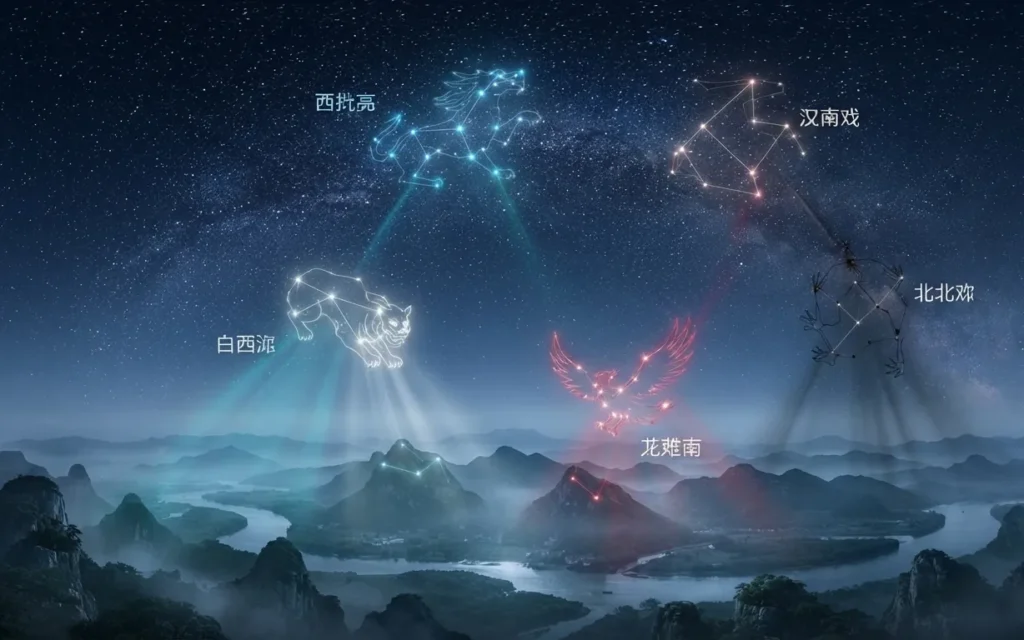
Four beasts, one complete map of the sky, and one genuinely surprising divergence sitting right at the end of it. Qinglong, Zhuque, and Baihu did exactly what the system asked of them for over two thousand years: hold their direction, hold their season, hold their place in the pattern.
Xuanwu did that too, for a while. Then a Song dynasty emperor built him a temple, a naming taboo changed his title, and a usurping Ming emperor gave him an entire mountain. The other three are still exactly where the system put them. Xuanwu simply outgrew his own assignment. that’s still the detail that makes the whole four part system worth taking apart properly instead of reciting as four equal entries on a list.
Related Articles
- Byakko: White Tiger Symbolism, Myths & Sacred Meaning
- Suzaku Meaning: The Vermilion Bird Myth, Symbolism & Powers
- Xuanwu: Black Tortoise of the North Symbolism & Mythology
- Yellow Dragon: Myths, Symbolism & the Forgotten Fifth Beast
- Why the Four Holy Beasts Cannot Exist Without Yin Yang
- Yin Yang, Five Elements & Four Symbols: China’s Complete Cosmos
- Are the Four Heavenly Kings & Four Holy Beasts the Same?
References
- Birrell, Anne. Chinese Mythology: An Introduction.
- Eberhard, Wolfram. A Dictionary of Chinese Symbols.
- Major, John. Heaven and Earth in Early Han Thought.
- The Chinese Sky
- Lewis, Mark Edward. The Construction of Space in Early China.
- Kohn, Livia. Daoism and Chinese Culture.
- Allan, Sarah. The Shape of the Turtle.Hanshu (Book of Han).
- Daoist Ritual, State Religion, and Popular Practices
- Shanhaijing (Classic of Mountains and Seas).
- Shiji (Records of the Grand Historian).