

 By
By Quick Takeaways:
- The Longma is a composite creature, a horse’s body carrying dragon scales and often wings, and its most important role in Chinese mythology has nothing to do with combat or treasure
- Its single most consequential appearance is the legend of the He Tu, the River Chart, which the sage ruler Fu Xi is said to have used to derive the Eight Trigrams underlying the entire Yijing tradition
- The Longma has a companion legend involving a completely different creature, a dragon turtle called Longgui, and keeping the two straight matters if you want the mythology to actually make sense
- Confucius himself is recorded lamenting that the Longma never appeared during his own troubled lifetime, treating its absence as a genuine sign of the times
- The phrase longma jingshen, dragon horse spirit, is still in everyday use in Chinese today, describing vigorous energy that doesn’t fade with age
The Longma doesn’t get nearly the attention the Dragon Kings or the Four Holy Beasts get on this blog, and that’s a genuine oversight on my part, because this is arguably the single most consequential dragon adjacent figure in the entire tradition. Every other dragon on this site governs weather, water, or a direction.
The Longma allegedly handed a sage ruler the pattern for the Eight Trigrams themselves. That’s not a small claim, and it deserves proper treatment.
What a Longma Actually Looks Like

Horse Body, Dragon Nature
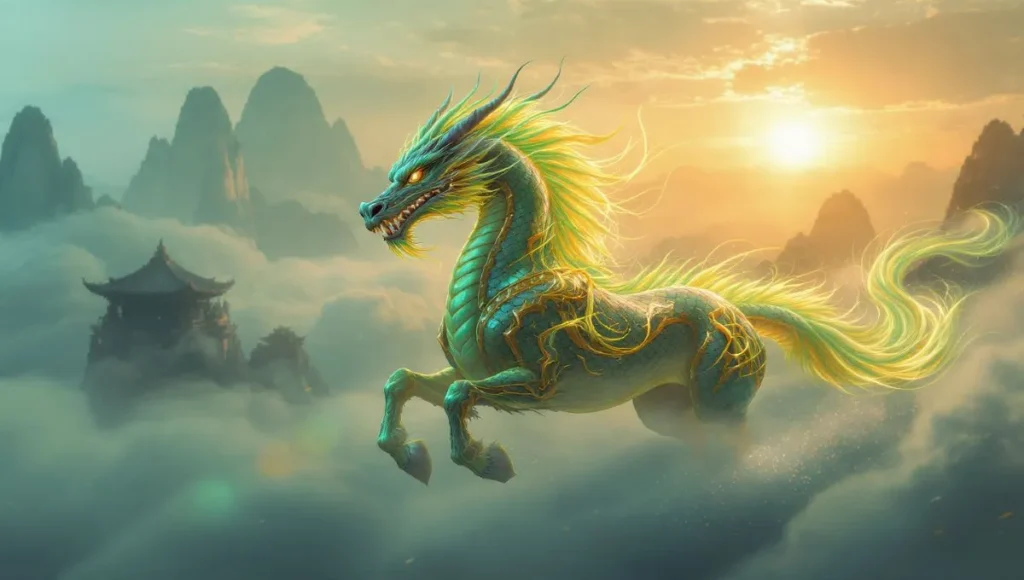
Classical descriptions consistently give the Longma a horse’s basic shape, broad chested, long limbed, moving the way a horse moves, but covered in iridescent dragon scales rather than an ordinary coat. A mane closer to a dragon’s than a horse’s runs along its neck, and several accounts give it wings, folded close against its shoulders while walking and spreading open in flight.
One classical description records the creature at roughly two point eight meters tall, with a notably long neck and long hair hanging along its sides, its call described as carrying several distinct, mournful tones rather than a single ordinary neigh.
A Creature That Doesn’t Sink
A recurring detail across multiple accounts is that the Longma walks across the surface of moving water without breaking it, its hooves resting on the current the way an ordinary horse’s hooves rest on solid ground.
That single image, a horse shaped being crossing a river as though the river were simply another kind of floor, tells you almost everything about how this creature was meant to feel: genuinely between two worlds, aquatic and terrestrial, mortal shaped and divine.
The He Tu Legend: Where the Eight Trigrams Actually Came From
Fu Xi and the River Chart
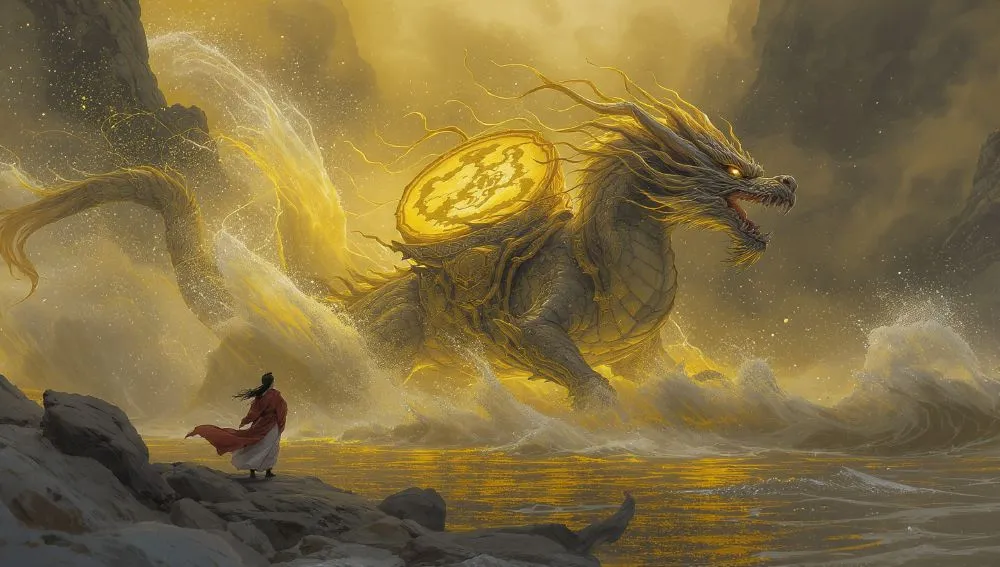
The Longma’s central myth, and the reason it matters as much as it does, is the legend of the He Tu, the River Chart. According to the account first recorded by the Han dynasty scholar Kong Anguo in his commentary on the Shangshu, the Book of Documents, a Longma emerged from the Yellow River during the reign of the sage ruler Fu Xi, carrying a specific numerical pattern on its back.
One later text, the Yuan dynasty era Compendium of the Changes, describes that pattern in genuinely specific terms: the numbers one and six positioned on the horse’s back, two and seven on its front, three and eight on its left, four and nine on its right, and the numbers five and ten at the center, the whole arrangement resembling whorled hair patterned like scattered stars.
Fu Xi is said to have based the Eight Trigrams of the Yijing, the foundational system I wrote about at length in an earlier piece on this blog, directly on the odd and even number relationships encoded in that pattern.
The Honest Complication
Here’s the part most popular accounts skip, and it’s worth including precisely because it’s more interesting than a clean, single origin story.
The Xici, the Great Commentary appended to the Yijing itself, records the He Tu legend as one explanation for the trigrams’ origin. But that same commentary also preserves a second, entirely different account, in which Fu Xi derives the trigrams simply by directly observing the patterns of heaven above and earth below, with no dragon horse or river involved at all.
Both explanations sit inside the same authoritative text without the tradition ever fully reconciling them. I genuinely like this kind of textual honesty. It tells you the Yijing tradition itself was comfortable holding two different creation stories for its most foundational system rather than insisting on a single, tidy answer.
An Omen for Virtuous Rule
The Longma’s He Tu appearance wasn’t treated as a one time event. Multiple sources describe the creature appearing again during the reigns of the sage rulers Yao, Shun, and Yu the Great, each sighting understood as confirmation that heaven’s favor rested on a genuinely virtuous government.
The Longma, in this reading, isn’t simply a messenger. It’s a kind of living verdict on whoever currently holds power.
Luoshu and the Dragon Turtle: A Different Creature Entirely

Don’t Confuse the Two
This is a distinction worth being precise about, because popular accounts frequently blur it. The Longma’s He Tu legend has a companion myth involving a completely separate creature: a dragon turtle, called Longgui, said to have emerged from the Luo River carrying its own numerical pattern, the Luoshu, on its shell.
Where the He Tu is associated with Fu Xi, the Luoshu is traditionally connected to Yu the Great, the legendary flood tamer and founder of the Xia dynasty. The earliest mention of this specific legend appears in the Guanzi, an older text than the Shangshu commentary that first records the Longma story.
Two Diagrams, One Cosmological System
The He Tu and Luoshu are both referenced together in the Xici commentary, and both continued to shape Chinese cosmological thought for millennia afterward, including their continued use in feng shui practice today. But they arrived through two different animals, presented to two different sage rulers, at two different rivers.
Keeping the Longma and the Longgui straight matters, because they’re doing genuinely different symbolic work. The Longma is a horse crossing water it can’t sink into, delivering the pattern behind the trigrams. The Longgui is a turtle, an animal already associated with longevity and the bearing of written record, delivering a companion numerical pattern from a separate river entirely.
When the Longma Stopped Appearing

Confucius’s Lament
One of the more genuinely affecting details in this entire tradition involves Confucius himself.
Multiple sources record that the sage lamented, during his own difficult and politically fractured lifetime, that neither the Longma nor the phoenix had appeared, reading their absence as confirmation that no truly virtuous ruler occupied the throne and that his own era simply wasn’t destined for the kind of sage governance the ancient legends described.
I find this detail genuinely moving, honestly, because it takes a creature that could easily read as pure decorative mythology and turns it into something Confucius himself apparently felt the real, personal absence of. The Longma not showing up wasn’t treated as folklore trivia. It was treated as a diagnosis of the times.
The Longma in Later Story: Bai Longma

A Dragon Prince Becomes a Horse
The Longma concept doesn’t stay confined to ancient cosmological legend. It resurfaces directly in Journey to the West, the sixteenth century classical novel I’ve written about on this blog, through the figure commonly called Bai Longma, the White Dragon Horse.
In the novel, this character begins as the third son of the Dragon King of the West Sea, sentenced to death for destroying a priceless pearl given to him by his father.
The bodhisattva Guanyin intervenes, sparing his life on the condition that he serve the pilgrim monk Xuanzang by carrying him on the long journey west, transformed into the shape of a white horse for the entire duration of the pilgrimage.
Why the Naming Matters
Calling this character a dragon horse isn’t incidental terminology borrowed loosely from the older Longma tradition. It’s a direct continuation of the same basic idea, a genuinely divine being taking horse form to carry someone toward a destination that matters cosmically rather than just geographically.
Fu Xi’s Longma carried the pattern behind the entire universe’s ordering system. Xuanzang’s dragon horse carries the pilgrim who will bring back the scriptures that reorder Chinese Buddhism’s relationship to its own textual tradition.
The specific job changes across sixteen centuries of storytelling. The underlying image, a dragon accepting horse shaped humility in service of something larger than itself, stays remarkably consistent.
Dragon Horse Spirit: A Phrase Still in Use Today
Longma Jingshen
The idiom longma jingshen, dragon horse spirit, remains genuinely alive in everyday Chinese, typically describing vigorous, energetic vitality, especially the kind an older person maintains well past when you’d expect their energy to fade.
One tracing of the phrase’s origin points to the late Tang poet Li Ying’s poem addressed to a Minister Pei, praising his continued vigor across four successive imperial reigns.
I like this detail specifically because it shows the Longma tradition doing something the other cosmological figures on this blog mostly don’t manage quite as directly.
Qinglong stays largely confined to astronomy and architecture. Xuanwu grew into an entire independent cult with his own mountain. The Longma ended up compressed into a four character phrase people still use to compliment their grandfather’s energy at a family dinner.
Longma in Modern Pop Culture

A Mechanical Dragon Horse Wakes Up in France
The single most striking modern manifestation of this myth isn’t in a film or a game at all. It’s a genuine, physical, forty foot mechanical creature called Long Ma, built by the French street theater company La Machine, led by designer François Delarozière.
Long Ma made its most famous public appearance in Toulouse in April 2022, performing across two days in front of crowds estimated between seventy thousand and one hundred and ten thousand people, in a staged spectacle called Le Combat des Titans, where the creature battled a giant mechanical minotaur and spider puppets through the city streets.
La Machine’s own framing draws directly on Chinese mythology, describing the dragon horse as an emissary sent by the goddess Nüwa to help fix a damaged sky.
I genuinely love this example precisely because it inverts everything about how these myths usually travel. Most classical Chinese mythology reaches Western audiences filtered through animation or fiction. This is the opposite: a French engineering team built an actual, breathing, fire capable machine and sent it walking through their own streets in the old creature’s honor, wings and all.
Further Reading: LONG MA JING SHEN | Spectacle vivant | Compagnie La Machine
The Dragon Horse in Chess
A smaller but genuinely charming survival shows up in shogi, Japanese chess, where a promoted rook is specifically called Ryūma, the dragon horse, gaining the ability to move diagonally in addition to its usual straight lines once promoted.
It’s one of the game’s most powerful pieces, and the name is a direct, centuries old borrowing of the same underlying concept, an ordinary piece transformed into something considerably more capable once it crosses into dragon territory.
Screen Appearances
The Longma and its most famous literary descendant, Bai Longma from Journey to the West, continue showing up across Chinese language film and television.
Wuxia and fantasy productions, including The Forbidden Kingdom and The Monkey King 2, draw on dragon horse imagery, and the white dragon horse remains a fixture of essentially every screen adaptation of Journey to the West, continuing directly from the novel’s own account of the character.
I’ll be honest that documentation of exactly how each specific production handles the creature varies in quality and detail, so I’d treat the deeper specifics of any individual film’s version as worth verifying yourself if you’re writing about a particular title. The broader pattern, the dragon horse surviving as a recognizable figure across centuries of adaptation, is the genuinely solid takeaway here.
What the Longma Actually Represents

Cosmic Order Delivered Through Humility
Pulling everything together, the Longma’s deepest symbolic thread is the delivery of profound cosmic order through a form that carries no obvious threat or grandeur.
A dragon alone, in Chinese tradition, already represents cosmic power. Putting that power inside a horse’s shape, an animal defined by service, labor, and being ridden rather than by independent sovereign authority, produces something genuinely distinct from every other dragon type covered on this site.
The Longma isn’t a ruler like the Jade Emperor. It isn’t an administrator like the Dragon Kings. It’s closer to a messenger whose entire mythological function is walking calmly out of a river to hand humanity something it couldn’t have derived on its own, then walking back in.
A Living Barometer of Good Government
The recurring appearances during Yao, Shun, and Yu’s reigns, followed by its conspicuous absence during Confucius’s own lifetime, gives the Longma a specific ongoing function beyond its founding legend. It becomes a living barometer, a way of asking whether the current moment actually deserves the kind of cosmic confirmation the ancient sage kings once received.
That’s a genuinely unusual role for a mythological creature to hold. Most dragons in this tradition govern something concrete, water, direction, imperial authority. The Longma governs something closer to a verdict on whether the current era of governance is actually worthy of heaven’s attention at all.
Frequently Asked Questions
Is the Longma the same creature as the Chinese dragon generally called Long?
No. The Longma is specifically a composite creature, a horse’s body carrying dragon scales and often wings, distinct from the standard serpentine Long form. It belongs to its own specific mythological tradition centered on the He Tu legend rather than to the broader Dragon King or zodiac dragon traditions.
What is the difference between the Longma and the dragon turtle Longgui?
The Longma is a horse shaped creature associated with Fu Xi and the He Tu, the River Chart. Longgui is a completely separate turtle shaped creature associated with Yu the Great and the Luoshu, a companion but distinct numerical diagram. They’re often discussed together but are not the same animal.
Did Confucius actually say the Longma stopped appearing?
Multiple classical sources record Confucius lamenting the absence of both the Longma and the phoenix during his own lifetime, interpreting their absence as confirmation that his troubled era lacked a genuinely virtuous ruler capable of receiving the kind of heavenly confirmation the ancient sage kings once received.
Is the White Dragon Horse from Journey to the West related to the ancient Longma legend?
Yes, directly. Bai Longma is a dragon prince transformed into horse form to carry the monk Xuanzang on his pilgrimage, continuing the same underlying image the ancient Longma legend established, a divine dragon accepting a horse’s shape to carry something of cosmic significance toward its destination.
What does the idiom longma jingshen actually mean today?
Longma jingshen, dragon horse spirit, describes vigorous, energetic vitality that persists well past when it might be expected to fade, most often used as a compliment for an older person’s continued liveliness and energy, tracing back to Tang dynasty poetic tradition praising sustained vigor across a long career.
Final Thoughts

A horse walking out of a river without sinking, carrying a pattern that became the basis for an entire cosmological system, then walking back in whenever the ruler on the throne stopped deserving the visit. That’s the Longma’s actual job description, and it’s a considerably stranger and more specific role than “dragon that happens to look like a horse.”
Decade of following Chinese Mythology, the figures that keep surprising me are the ones doing exactly this: quiet, specific, cosmologically load bearing work while getting a fraction of the attention their more dramatic relatives receive. The Longma has been standing in that river a very long time, waiting to see if anyone currently in charge is actually worth the visit.
Related Articles
- Dragon Mythology: How Dragons Are Depicted Across Cultures
- Chinese, Japanese & Korean Dragons: How They Actually Differ
- 7 Eastern Dragon Facts Most People Believe But Are Wrong
- 9 Eastern Dragon Myths That Sound Too Strange to Be True
- 11 Eastern Dragon Legends Still Shaping Fantasy Today
- 15 Japanese Dragon Legends Hollywood Has Been Ignoring
- 11 Oldest Dragons in World Mythology: Sumeria to China
Sources
- Shanhaijing (Classic of Mountains and Seas).
- Birrell, Anne. Chinese Mythology: An Introduction.
- Richard Wilhelm (translated by Cary F. Baynes). The I Ching or Book of Changes.
- LONG MA JING SHEN | Spectacle vivant | Compagnie La Machine
- Guanzi – Chinese Text Project
- Xici Commentary – Chinese Text Project
- Long Ma Jing Shen – On the Year of the Horse
- The Dragon in China and Japan – Willem de Visser
- Legge, James. The Chinese Classics
- Journey to the West by Wu Cheng’en