 By
By Quick Takeaways:
- The Eight Trigrams (Bāguà) are eight symbols composed of three stacked lines, each line either solid (yang) or broken (yin), that together map the complete range of natural phenomena
- They emerge directly from the yin-yang binary through a simple doubling process: 2 becomes 4 becomes 8
- Each trigram represents a natural force, a family member, a direction, a season, a body part, and a quality of cosmic energy
- They’re the foundation of the I Ching (Book of Changes), two trigrams stacked produce the 64 hexagrams used in divination
- Understanding their inner logic makes them immediately accessible rather than mystical and impenetrable
Here’s what nobody told me when I first encountered the Eight Trigrams in my study of Chinese mythology: they’re not mysterious.
They feel mysterious. They look like ancient symbols with secret meanings. The trigram arrangement on a Bagua mirror or a Daoist talisman has an aura of impenetrable antiquity.
But the underlying logic is completely transparent once you see it. Eight symbols. Three lines each. Each line is either yang (solid) or yin (broken). That’s it. From that single binary yin or yang, eight combinations emerge through exhaustive permutation, and Chinese cosmological thinking mapped the entire natural world onto those eight combinations.
That mapping is what this article explains.
The Origin: Where The 8 Trigrams Came From
The Mythological Source
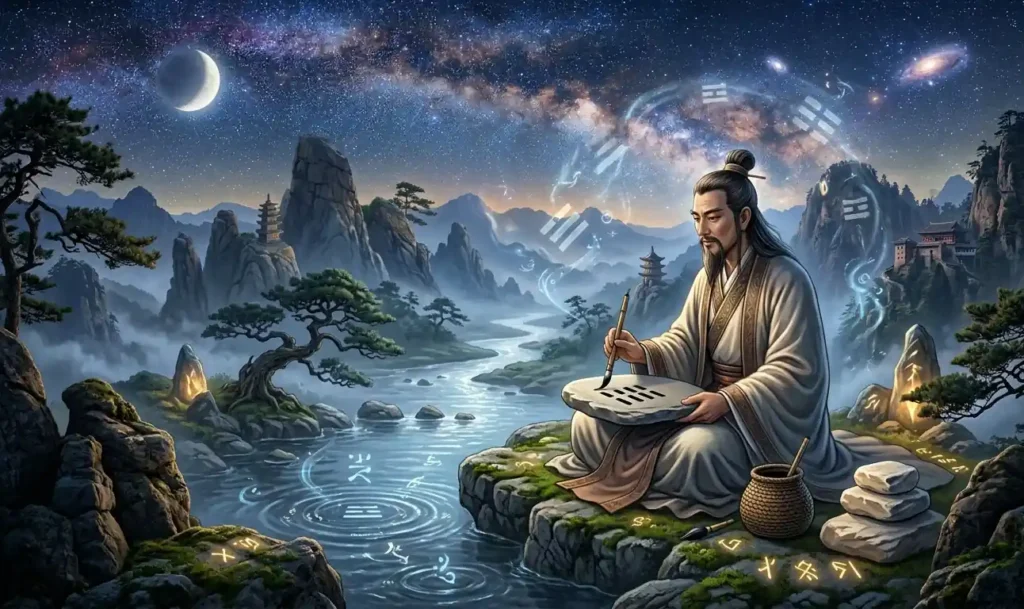
The tradition credits Fuxi, one of China’s legendary culture heroes, with discovering the trigrams. According to the classical account, Fuxi observed the patterns on a tortoise’s back and the markings on a dragon-horse that emerged from the Yellow River.
From these patterns, he derived the trigrams, recognizing in them a map of the natural world’s fundamental forces. The story is mythological rather than historical, but it encodes something true about the trigrams’ character. They emerged from observation of natural patterns, not from pure philosophical invention.
The earliest evidence of trigram-like notation appears in Shang Dynasty oracle bones, suggesting the system has roots deeper than the classical period that first fully articulated it.
The Mathematical Generation
The trigrams emerge from yin and yang through three successive doublings, the same sequence that generates the Four Symbols I discussed in my earlier articles.
The cosmological ladder goes:
- Tai Ji (Supreme Ultimate) – the undivided unity
- Liang Yi (Two Principles) – yin and yang, the first distinction
- Si Xiang (Four Symbols) – the four yin-yang combinations
- Bagua (Eight Trigrams) – each Four Symbol extended with a third line
Adding a third line (either yin or yang) to each of the four two-line symbols produces exactly eight three-line combinations. Every possible arrangement of three yin or yang lines, no more, no fewer.
The Eight Trigrams don’t feel arbitrary once you understand this. They’re not eight symbols chosen for symbolic convenience. They’re the complete set of combinations that the yin-yang binary produces at three lines.
For more on this, check out the I Ching Great Treatise here
The Eight Trigrams: Complete Guide
Each trigram has a name, a natural image, a family member correspondence, a direction, and a quality. Here’s the complete mapping:
☰ Qian (乾): Heaven
Lines: Three solid yang lines
Natural image: Heaven, sky
Family member: Father
Direction: Northwest (or South in the Earlier Heaven arrangement)
Quality: Strength, creativity, the maximum expression of yang energy
Qian is pure yang, all three lines solid, the furthest possible expression of active, outward, creative force. It’s the first trigram and in many ways the reference point against which the others are measured. Heaven creates; the other forces express, respond, and transform.
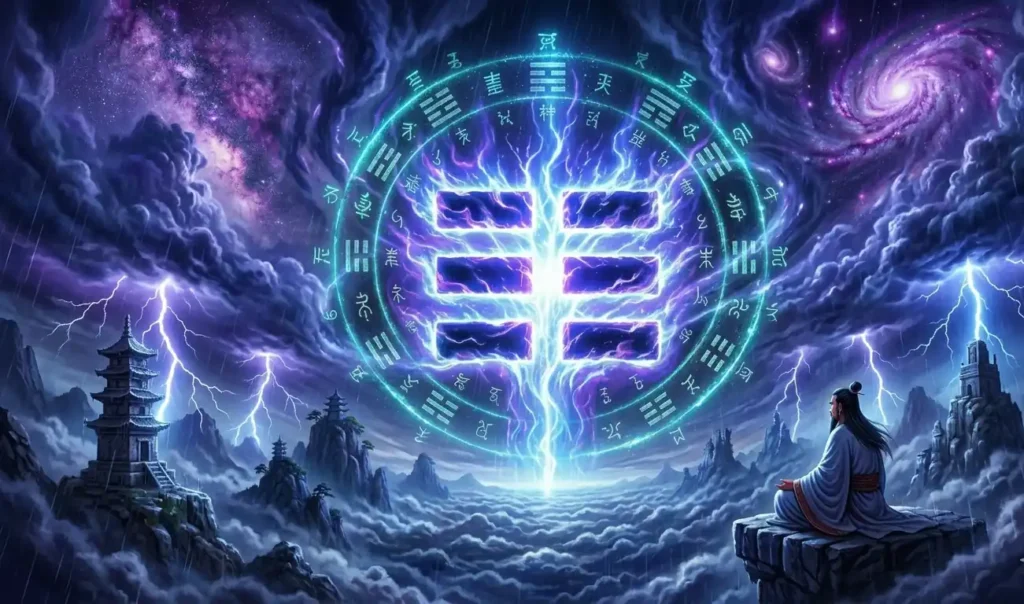
☷ Kun (坤): Earth
Lines: Three broken yin lines
Natural image: Earth, ground
Family member: Mother
Direction: Southwest (or North in the Earlier Heaven arrangement)
Quality: Receptivity, nourishment, the maximum expression of yin energy
Kun is pure yin, Qian’s perfect complement. Where Qian creates, Kun receives and nourishes. Where Qian is active, Kun is responsive. The relationship between Qian and Kun is the cosmic template for every yin-yang complementary pair.
☳ Zhen (震): Thunder
Lines: Broken, broken, solid (yang below, yin above)
Natural image: Thunder, earthquake
Family member: Eldest son
Direction: East
Quality: Arousing, initiating, the shock that begins movement
Zhen has yang energy rising from below through yin above, the image of something powerful emerging from stillness, like thunder erupting from a quiet sky. It’s the trigram of beginnings and initiations, the arousing force that shocks things into motion.
☴ Xun (巽): Wind/Wood
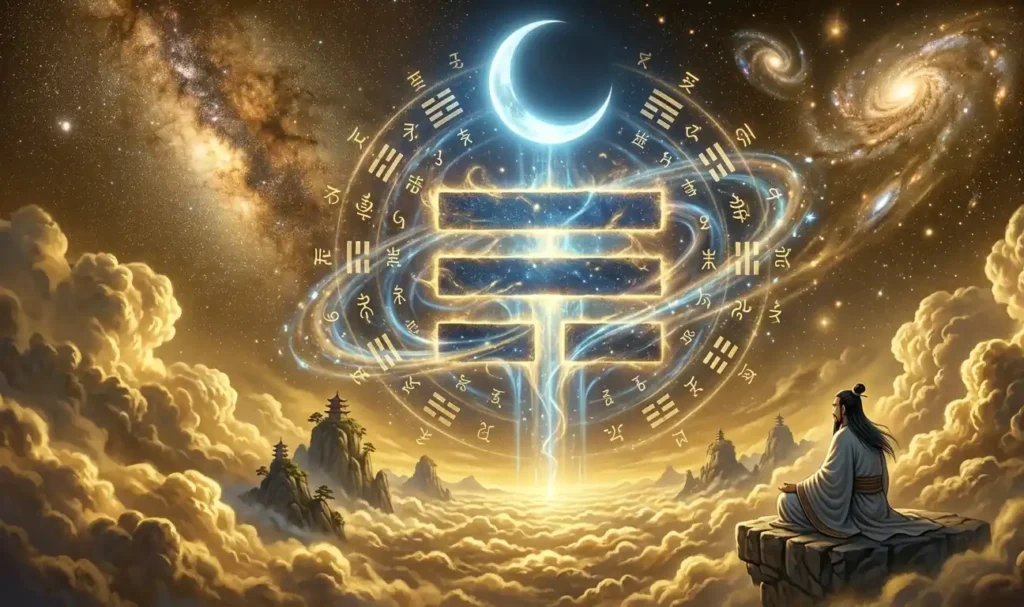
Lines: Solid, solid, broken (yin below, yang above)
Natural image: Wind, wood
Family member: Eldest daughter
Direction: Southeast
Quality: Penetrating, gentle persistence, entering through small openings
Xun is the opposite of Zhen in structure and character. Where Zhen shocks, Xun penetrates gradually like wind finding every gap, like roots slowly breaking rock. It’s one of the tradition’s most precise symbolic observations: gentle persistence achieves what sudden force cannot.
☵ Kan (坎): Water
Lines: Solid, broken, solid (yang between two yin)
Natural image: Water, moon
Family member: Middle son
Direction: North
Quality: Danger, depth, flowing through obstacles
Kan shows yang trapped between two yin lines, the image of something strong contained within something fluid and dangerous. Water carves canyons not through force but through persistent flow around obstacles. Kan represents danger but also the power of navigating through it rather than confronting it directly.
☲ Li (離): Fire
Natural image: Fire, sun
Lines: Broken, solid, broken (yin between two yang)
Family member: Middle daughter
Direction: South
Quality: Brightness, clarity, clinging and illuminating
Li is the structural inverse of Kan Yin enclosed between two yang. Fire needs fuel to cling to. It gives light but depends on what sustains it. Li represents both illumination and dependency, the brilliant visibility that requires something to burn.
☶ Gen (艮): Mountain
Lines: Broken, broken, solid (yang above, yin below)
Natural image: Mountain
Family member: Youngest son
Direction: Northeast
Quality: Stillness, stopping, the keeping still that allows completion
Gen has yang at the top, resting on two yin lines, the image of a mountain’s solid peak above its broad base. It represents the keeping still that isn’t passivity but active, grounded stability. In the I Ching, Gen often appears as the advice to stop moving, to wait, to let circumstances complete themselves.
☱ Dui (兑): Lake/Marsh
Lines: Solid, solid, broken (yin above, yang below)
Natural image: Lake, marsh
Family member: Youngest daughter
Direction: West
Quality: Joy, openness, pleasure in exchange
Dui has yin open at the top, yang strong below, the image of a lake’s open surface above its deep body. It’s the most joyful trigram, associated with speech, delight, and the pleasure of free exchange. The open mouth speaks; the open surface reflects.
The Two Classical Arrangements
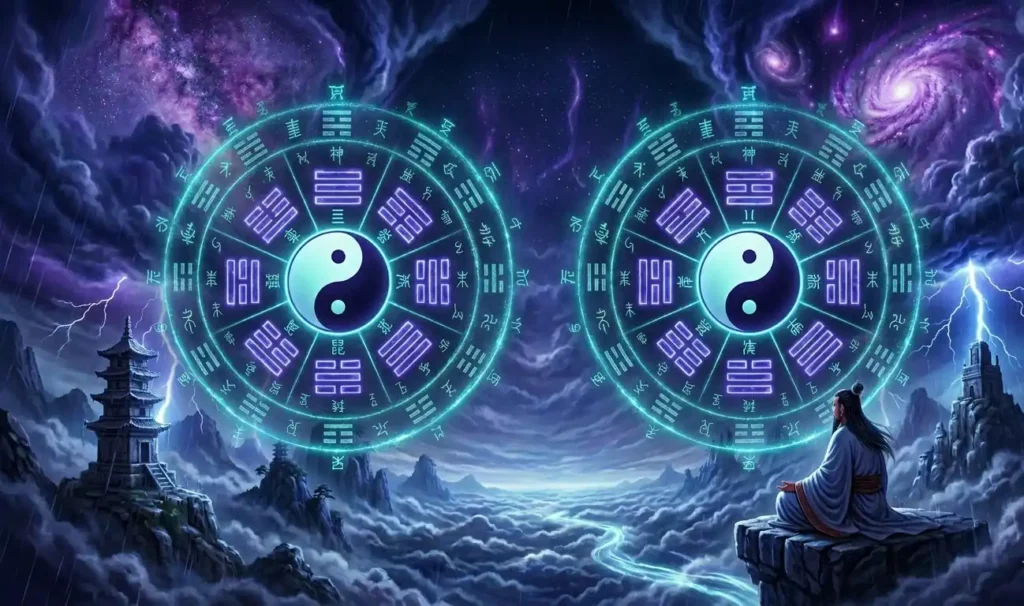
The trigrams appear in two classical arrangements, each encoding a different cosmological understanding.
Earlier Heaven: Fuxi’s arrangement
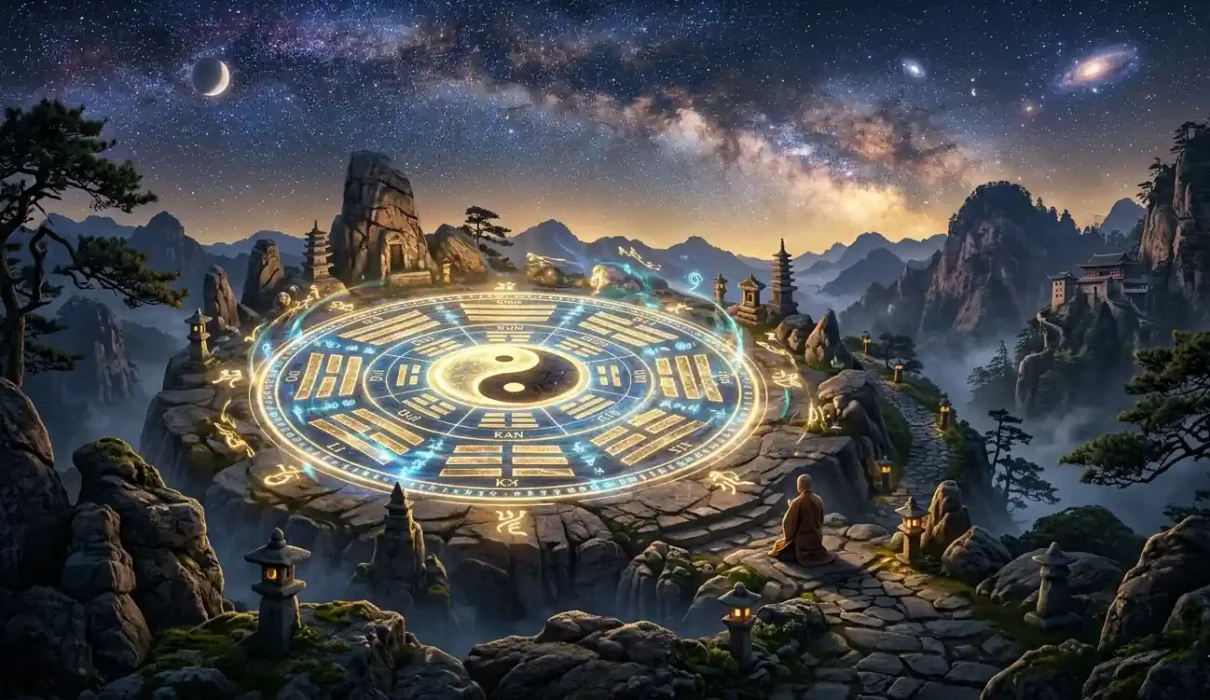
The Earlier Heaven arrangement places the trigrams in a circular pattern representing the ideal cosmic order, the state of perfect balance that precedes actual conditions.
Key pairings in this arrangement:
- Qian (Heaven) opposite Kun (Earth)
- Li (Fire) opposite Kan (Water)
- Zhen (Thunder) opposite Xun (Wind)
- Gen (Mountain) opposite Dui (Lake)
Each trigram is directly opposite its structural complement, maximum yang opposite maximum yin, fire opposite water. This arrangement represents the cosmic ideal, the template of perfect balance.
Later Heaven: King Wen’s Arrangement
The Later Heaven arrangement, attributed to King Wen of Zhou, places the trigrams according to their functional relationships in the actual experienced world, the dynamic order of seasons, directions, and natural processes as they actually operate.
This is the arrangement used in feng shui, in I Ching divination, and in Bagua Zhang martial arts. It represents not the ideal cosmic order but the living, dynamic order of the world we inhabit.
The trigrams in practice
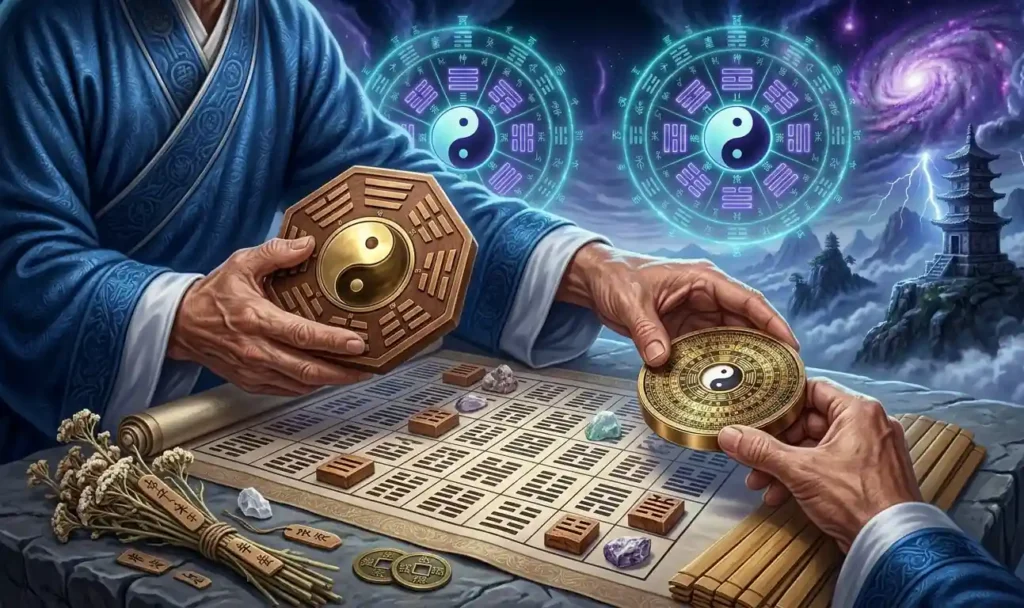
I Ching Divination
The primary practical application of the Eight Trigrams is in the I Ching (Book of Changes), one of the oldest texts in the world and the foundational text of Chinese philosophy.
The I Ching works by stacking two trigrams to produce a hexagram, a six-line symbol. Eight trigrams stacked in pairs produce 64 hexagrams, each describing a specific dynamic configuration of cosmic forces and its implications for human affairs.
Each hexagram has a name, a judgment, and line-by-line commentary. Divination involves producing a hexagram through a randomising process (traditionally yarrow stalks, later coins) and reading the hexagram’s guidance for the current situation.
Feng Shui and Spatial Arrangement
The Bagua is fundamental to feng shui practice. The Later Heaven arrangement maps the eight trigrams onto the eight compass directions and is used to assess the energetic qualities of spaces and to determine appropriate placements for objects, rooms, and structures.
The Bagua, a circular mirror surrounded by the eight trigrams, is one of feng shui’s most common protective tools, used to deflect harmful energies from building entrances.
Bagua Zhang: The Martial Art
Bagua Zhang (Eight Trigrams Palm) is one of China’s three major internal martial arts, alongside Tai Chi and Xing Yi. It’s built on the philosophy of the eight trigrams, using circular walking patterns that express each trigram’s energetic quality.
The practitioner walks in circles, changing direction and palm position in ways that correspond to trigram transitions, the martial embodiment of the I Ching’s dynamic model of change.
Frequently Asked Questions
What does the Bagua symbol on a mirror do?
In feng shui practice, a Bagua mirror placed above a doorway is believed to reflect and disperse negative energy approaching the home. The octagonal arrangement of the eight trigrams creates a complete energetic boundary. This is a folk religious application of the trigrams’ status as a map of cosmic forces.
Is the I Ching actually useful for making decisions?
After spending time reading it, I’d say it depends on what you mean by useful. As a tool for predicting the future, the evidence is weak. As a way to reflect, explore perspectives, and think more deeply about a situation, many people find the I Ching genuinely valuable.
What are the Eight Trigrams?
The Eight Trigrams are ancient Chinese symbols used in Taoist philosophy and the I Ching. Each trigram represents natural forces like heaven, fire, water, thunder, and earth. Together, they explain balance, change, and energy in life
What do the Eight Trigrams symbolize?
Each trigram symbolizes a different element, direction, energy, and personality trait. For example, Qian represents heaven and strength, while Kun represents earth and nurturing energy.
Are the Eight Trigrams connected to Yin and Yang?
Yes. The Eight Trigrams are built from combinations of Yin and Yang lines. Yin lines are broken, while Yang lines are solid. Their combinations create the eight symbolic patterns.
How are the Eight Trigrams used today?
People use the Eight Trigrams in feng shui, meditation, martial arts, and spiritual practices. They are also used to understand balance, personal energy, and life changes.
What is the difference between Bagua and the Eight Trigrams?
The Eight Trigrams are the individual symbols, while Bagua refers to the complete arrangement of all eight trigrams. Bagua is commonly used in feng shui and Taoist teachings.
Final Thoughts
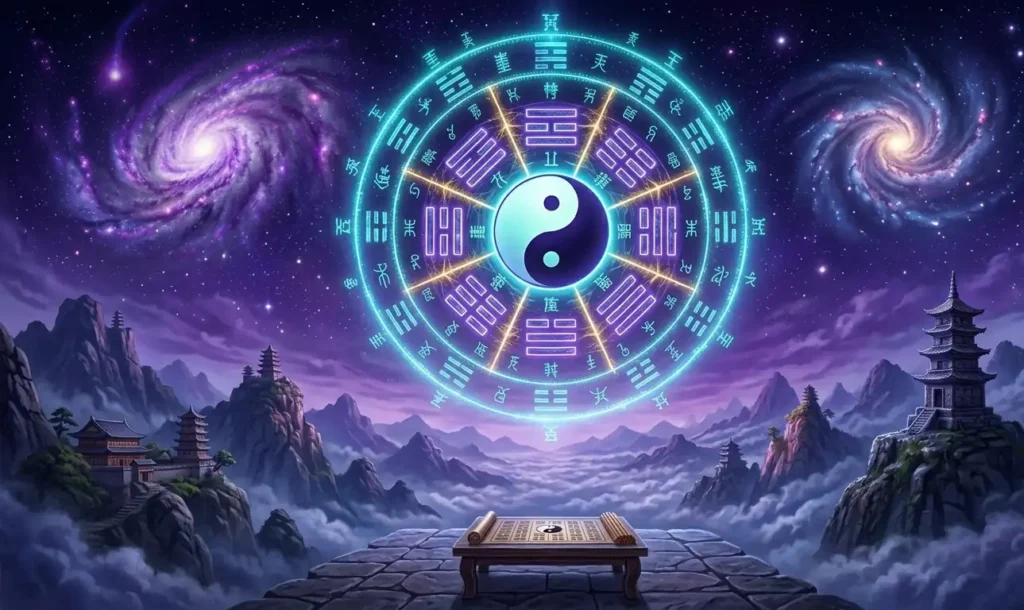
The Eight Trigrams are one of those intellectual achievements that look mystical from the outside and reveal themselves to be elegant once you understand the logic.
Eight symbols. Three lines each. Every possible arrangement of three yin or yang lines. Mapped onto the complete range of natural phenomena: heaven and earth, water and fire, thunder and wind, mountain and lake.
What I find most admirable about the system after years of study is how much it achieves from how little. One binary distinction, yin and yang, generates, through three doublings, a map of the cosmos that Chinese philosophy has been working with productively for three thousand years.
That’s not mysticism. That’s one of the most parsimonious symbolic systems ever invented. And it’s still working.
Related Articles
- Yin Yang & the Five Elements: The Hidden Cosmological Link
- Why the Four Holy Beasts Cannot Exist Without Yin Yang
- The Five Elements Behind Every Holy Beast [Chinese Myth Map]
- Is Yin Yang Demonic? The Truth You Don’t Know
- 7 Misconceptions About Yin Yang You Probably Believe
- Yin Yang, Five Elements & Four Symbols: China’s Complete Cosmos
References
- The Book of Changes (Zhouyi): A Bronze Age Document
- Zhu Xi’s Commentary on the Xicizhuan
- Original Meaning of the Zhouyi, Volume 4: Commentary on the Trigrams – Original Meaning of the Zhouyi
- Birrell, Anne. Chinese Mythology: An Introduction.
- Kohn, Livia. Daoism and Chinese Culture.
- Sources of Shang History: The Oracle-bone Inscriptions of Bronze Age China – David N. Keightley
- Fengshui in China- Ole Bruun