 By
By Quick takeaways:
- Yin-yang is not a symbol of opposites at war, but a description of how all phenomena exist as complementary, interdependent, and mutually generative aspects of a single unified reality
- The concept originates in Chinese cosmological observation centuries before Yin Yang in Daoism was formalized. The words yin and yang originally described the shady and sunny sides of a single hill
- The taijitu, the familiar circular symbol, encodes five philosophical principles that most people who display it have never examined
- Xianxia cultivation fiction absorbed yin yang so completely that it underpins every major power system mechanic, from spiritual root classification to tribulation design to dual cultivation
- Understanding yin yang at a philosophical depth transforms the reading experience of any cultivation novel that uses it seriously
The yin-yang symbol is one of the most widely recognized images in the world and one of the most thoroughly misunderstood. After spending years reading about Eastern culture, Philosophy, Daoism, and cultivation fiction, I have encountered it more times than I can count, and I found out it is one of the most misunderstood concepts.
The common understanding goes roughly like this: yin is dark and passive, yang is light and active, they are opposites, and balance between them is good. This is not wrong exactly. It is the surface layer of something considerably deeper, the equivalent of describing the ocean as wet.
The philosophical tradition that produced yin yang thinking spent centuries developing a framework for understanding reality that is genuinely sophisticated, and the cultivation novels that engage with it at any real depth are drawing on that sophistication whether they know it or not.
This article traces yin yang from its oldest observable origins through its classical Daoist development and into the specific ways cultivation fiction has borrowed, dramatized, and occasionally subverted it. Understanding the real source makes the fiction richer. It also makes the symbol on the wall considerably more interesting than it previously seemed.
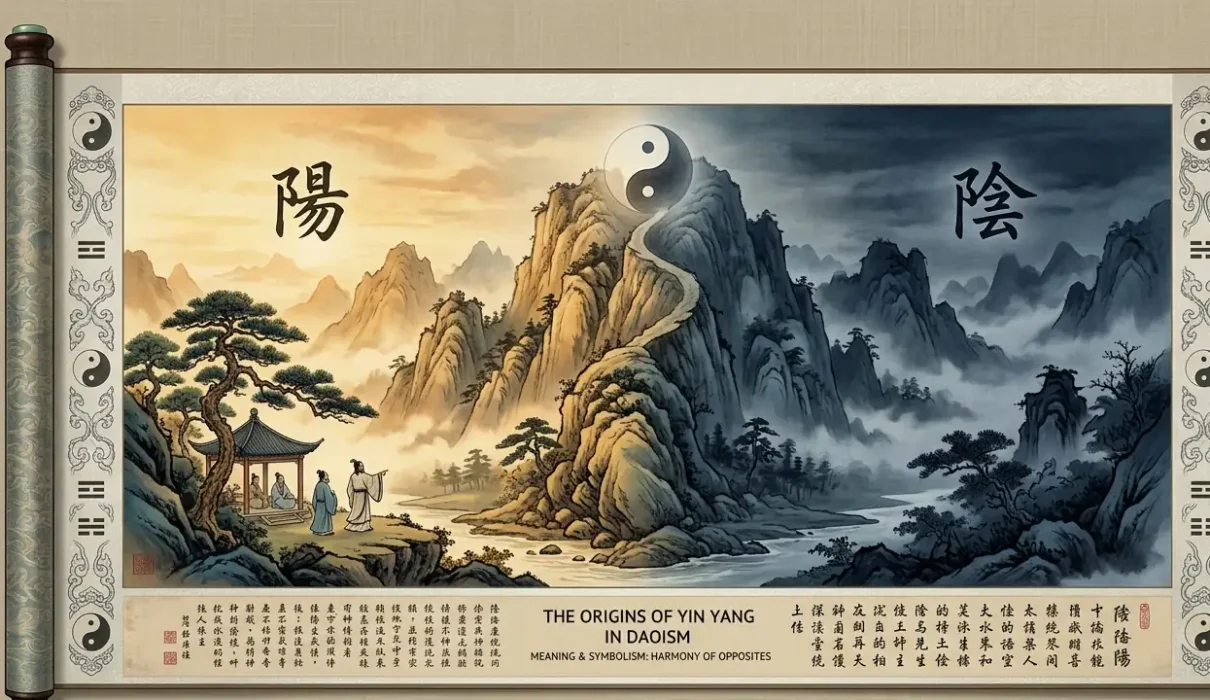
The Origins of Yin Yang: Before the Symbol

The words yin (陰) and yang (陽) appear in Chinese texts as early as the Western Zhou period, roughly 1000 BCE, and their original meaning has nothing to do with cosmic duality. They are concrete geographical descriptions. Yang means the sunny side of a hill or river bank, the side that faces the sun, warm and bright and drying. Yin means the shady side, the side turned away from the sun, cool and moist and dark.
This origin is not a trivial etymological footnote. It is the key to understanding what yin yang actually describes. The sunny and shady sides of a hill are not two different things. They are two aspects of a single thing, the hill, whose character at any given point depends entirely on its relationship to the sun.
There is no hill that is entirely sunny, no hill that is entirely shady. And as the sun moves across the sky, the boundary between the two sides shifts constantly: what was yin at morning is yang by afternoon. The qualities are real and distinct, but they exist only in relationship to each other, only as aspects of a unified whole, and only as a moving boundary rather than a fixed one.
This relational, dynamic, boundary-as-process understanding is what the later philosophical tradition formalized into the yin yang framework. The concept was not invented by philosophers. It was observed in the world and then systematized. The hill came first. The cosmology followed.
The systematization happened gradually through the Warring States period (475 to 221 BCE), when schools of thought, including the Naturalists or Yin Yang School, developed the framework from a descriptive observation about natural phenomena into a comprehensive cosmological theory applicable to astronomy, medicine, governance, music, and personal cultivation.
By the time Daoist philosophy formalized its classical texts, yin yang was already an established intellectual framework that Daoism inherited and deepened rather than invented.
What Yin and Yang Actually Mean
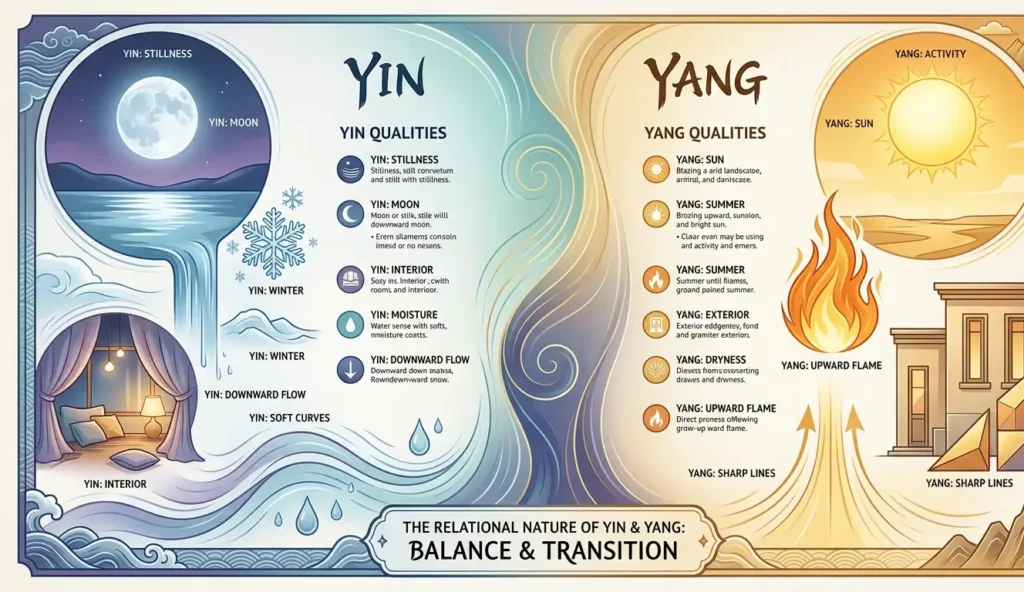
The philosophical yin yang framework assigns specific qualities to each pole, but these qualities are always understood as relative and contextual rather than absolute and fixed. This is the most important thing to grasp and the most consistently misrepresented aspect of the concept.
- Yang qualities include: brightness, warmth, activity, upward movement, expansion, heaven, summer, the exterior of things, the masculine principle in nature, hardness, dryness, and the more obvious or visible aspects of phenomena.
- Yin qualities include: darkness, coolness, stillness, downward movement, contraction, earth, winter, the interior of things, the feminine principle in nature, softness, moisture, and the hidden or latent aspects of phenomena.
But here is the essential qualifier that most Western summaries omit. Nothing is purely yin or purely yang. Everything contains both in varying proportions, and the proportion shifts with context, time, and relationship. Water is yin relative to fire but yang relative to ice. A mountain is yang relative to a valley but yin relative to the sky above it.
A cultivator’s qi at noon is more yang than at midnight. An elder at rest is more yin than an elder in combat. The categories are real and useful. They are not boxes that things fit into. They are descriptions of dynamic relationships.
This is the philosophical move that makes yin yang genuinely sophisticated rather than merely evocative. It is not a binary classification system. It is a relational observation tool, a way of understanding any phenomenon by asking: in relation to what, and under what conditions, and at what moment? The answer is always provisional and always changing, which is precisely what the taijitu encodes in its form.
The Taijitu: Reading the Symbol Correctly
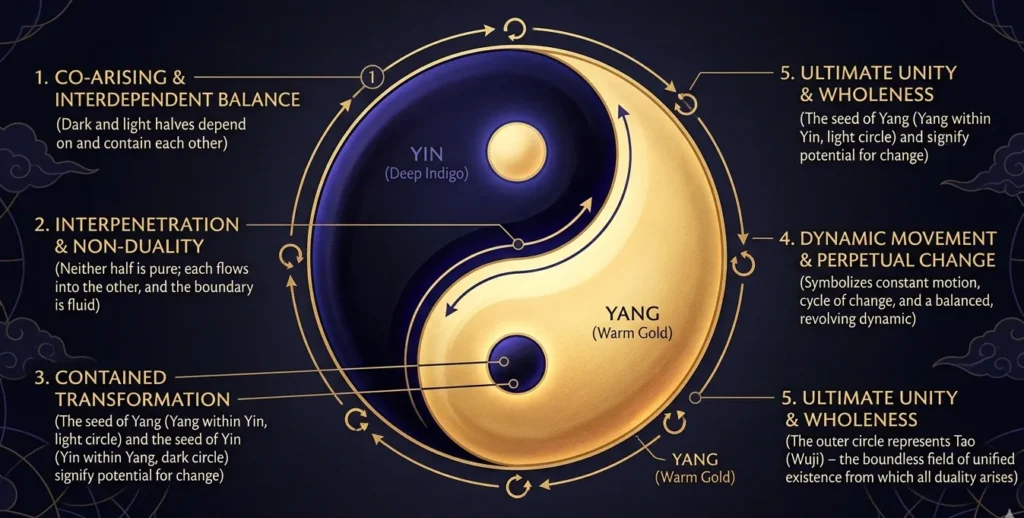
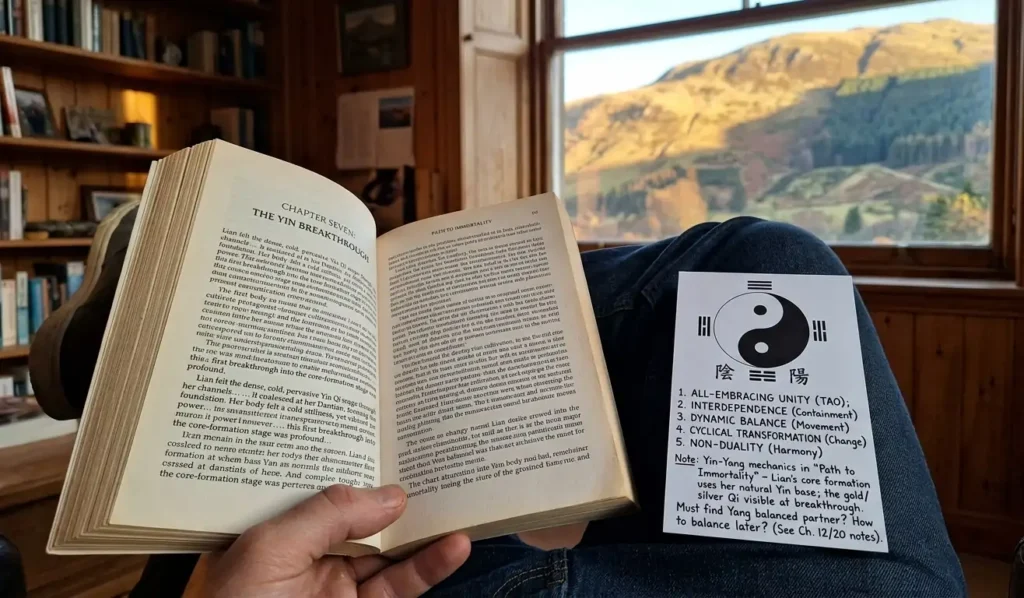
The taijitu, the circular symbol showing a dark swirl and a light swirl interlocked with a small circle of each color within the other, is one of the most information-dense images in philosophical history. Most people who are familiar with it as a decorative object have never been told what it actually communicates.
The symbol encodes five distinct philosophical principles simultaneously.
Mutual arising. The dark and light portions arise together, each giving rise to the other. Neither precedes the other. Neither causes the other. They are co-originating aspects of the same reality.
Interpenetration. The boundary between the dark and light portions is not a straight line but a flowing S-curve, indicating that yin and yang interpenetrate each other rather than being cleanly separated. There is always some yang within yin, always some yin within yang, and the boundary between them is a zone of transition rather than a wall.
The seed of the opposite. The small circle of light within the dark portion and the small circle of dark within the light portion indicate that each pole contains the seed of its opposite at its maximum point. When yang reaches its peak, yin begins to grow within it. When yin reaches its peak, yang begins to emerge. This is the principle behind the seasons, midsummer, the peak of yang, is when the return toward winter begins. Midwinter, the peak of yin, is when the return toward summer begins.
Constant movement. The swirling form rather than static halves indicates that the relationship between yin and yang is perpetually in motion, the boundary between them always shifting. The symbol depicts a process, not a state.
Unity underlying duality. The circular boundary enclosing both portions indicates that yin and yang together constitute a single unified whole. The Tai Ji, the Supreme Ultimate from which the symbol takes its name, is the unity within which yin and yang move as complementary aspects rather than opposing forces.
Cultivation fiction’s taijitu imagery generally captures the first two principles faithfully and ignores the last three almost entirely. The novels that engage with the seed-of-the-opposite principle that the peak of one force initiates the emergence of its counterpart are the ones that use yin-yang most philosophically. It is rarer than it should be and more rewarding when it appears.
Yin Yang in Daoism and the Tao Te Ching
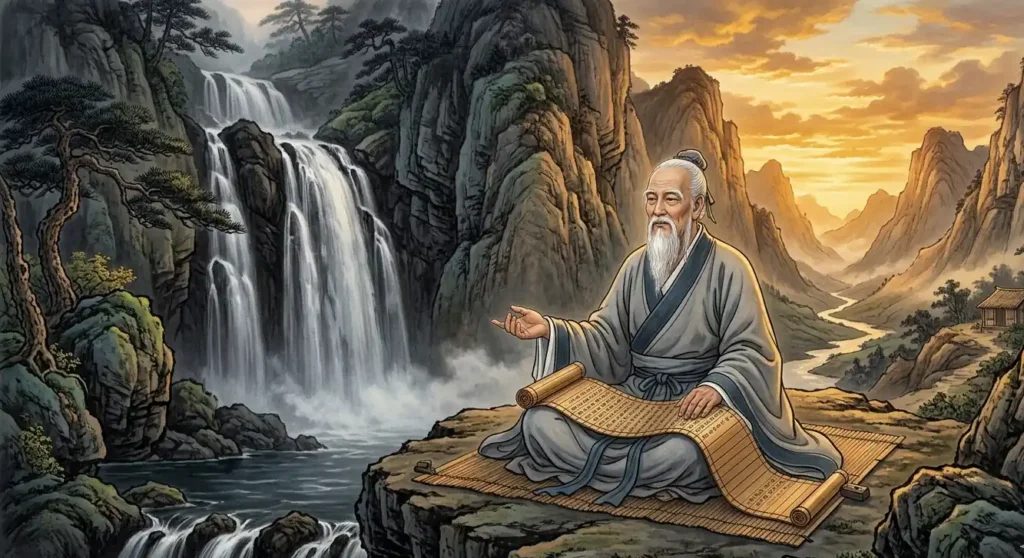
Laozi’s Tao Te Ching, the foundational text of Daoist philosophy, composed in the 4th or 3rd century BCE, engages with yin yang without using those exact terms extensively, embedding the concept instead in its broader description of the Dao’s nature and operation.
The text’s famous opening “The Dao that can be named is not the eternal Dao” establishes the context within which yin-yang makes sense: reality, at its deepest level, is undivided. Yin and yang are the two aspects through which the unified Dao becomes perceptible as the phenomenal world.
Chapter 42 of the Tao Te Ching contains the most explicit cosmogonic statement: “The Dao produces one, one produces two, two produces three, three produces the ten thousand things. The ten thousand things carry yin and embrace yang, and through the blending of qi they achieve harmony.”
This single passage encodes the entire cosmological sequence: from the undivided Dao, through the primary duality of yin and yang, through their interaction producing all of manifest reality, to the principle that harmony, not the elimination of either pole, is the goal.
The above-mentioned statement is one of the most used statements in cultivation novels during the Enlightenment or breakthrough.
The practical implications of this cosmology for cultivation are significant and direct. A cultivation path that seeks to eliminate yin in favor of pure yang, or to maximize yang at the expense of yin, is philosophically incoherent from a Daoist perspective. It is pursuing an imbalance, a departure from the harmony that the Dao’s operation naturally produces. The cultivation ideal in classical Daoist thought is not maximum yang power but harmonious circulation of both yin and yang qi in their proper proportions and sequences.
Zhuangzi, the second great classical Daoist text, extends this understanding with characteristic playfulness. Zhuangzi’s use of yin yang is embedded in his broader project of questioning fixed distinctions and demonstrating the fluidity of all apparent opposites. His stories repeatedly show characters who transcend apparent contradictions by understanding that what seems like opposition is actually complementarity viewed from a limited perspective.
This is yin yang philosophy in narrative form, and it is the direct ancestor of the cultivation protagonist who discovers that the path the world labelled as yin weakness is actually a route to a comprehension that pure yang power cannot reach.
Yin Yang and the I Ching
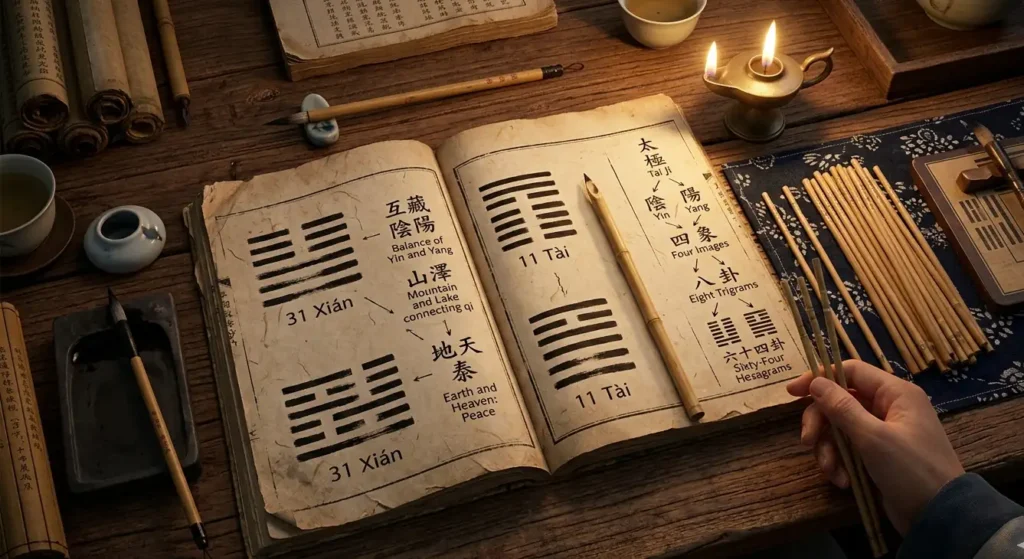
The I Ching (Book of Changes) is the text most directly responsible for translating yin yang philosophy into a practical, systematic framework, and its influence on cultivation fiction’s structural thinking is pervasive even when authors do not acknowledge it explicitly.
The I Ching’s foundational operation is the construction of hexagrams from combinations of yin lines (broken, represented as two segments) and yang lines (unbroken, represented as a single continuous line). Six lines combine to produce 64 hexagrams, each describing a specific configuration of yin and yang energies and the tendencies, opportunities, and challenges that configuration creates.
The Heaven-Earth-Black-Yellow talent-grading system that most xianxia use to classify cultivation aptitudes is derived directly from the I Ching’s classification of hexagrams into four hierarchical groups, with Heaven (Qian, pure yang) at the apex and Earth (Kun, pure yin) as its necessary complement.
The I Ching’s model of change is also directly relevant to how cultivation breakthroughs work in fiction. The classic describes change not as linear progress from point A to point B but as transformation through the interaction of yin and yang forces, with each configuration tending to produce its opposite at its maximum expression. This is precisely the “peak yang contains the seed of yin” principle from the taijitu, applied as a model of how change happens in practice.
Cultivation novels that show a protagonist reaching a seemingly impossible dead end, only to discover that the dead end is actually the transition point to a completely different path, express I Ching cosmology even when they frame it in entirely original xianxia terminology.
Yin Yang and the Five Elements: The Complete Cosmological Picture
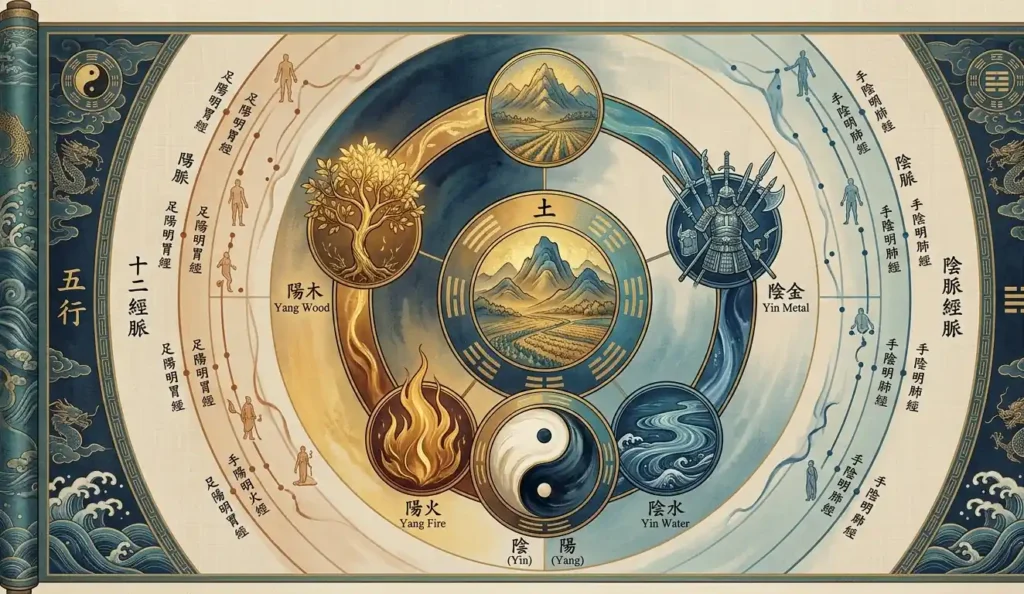
Yin-yang and the five elements are not separate frameworks. They are complementary layers of the same cosmological system, and understanding how they interact gives the complete picture that underpins cultivation fiction’s entire philosophical architecture.
The five elements each carry yin and yang aspects. Fire and Wood are yang elements. Water and Metal are yin elements. Earth, occupying its central position, is in balance. This elemental yin-yang classification determines which elements naturally harmonize, which create productive tension, and which generate the most dramatic conflict both in classical cosmology and in xianxia combat mechanics.
The twelve primary meridians are also classified as yin or yang, with yin meridians running along the interior surfaces of the limbs and torso and yang meridians running along the exterior surfaces. The circulation of qi through the meridian network follows a yin yang sequence.
Qi flows through yin meridians, transitions to yang meridians, completes a circuit, and returns. A disruption of this yin yang balance in the meridian system is the medical explanation for the qi deviation that cultivation novels deploy as a dramatic consequence of incorrect cultivation technique.
The dantian holds yin and yang qi simultaneously, and advanced cultivation requires the cultivator to manage their proportions with increasing precision as they approach higher realms.
The tribulation lightning that descends at major realm transitions is consistently described in most classical xianxia as carrying extreme yang energy, which is why the cultivator must have developed sufficient yin qi reserves to balance and absorb it. This is not genre invention. It is classical Chinese cosmological logic applied to the cultivation novel’s dramatic structure.
How Xianxia Absorbs Yin Yang
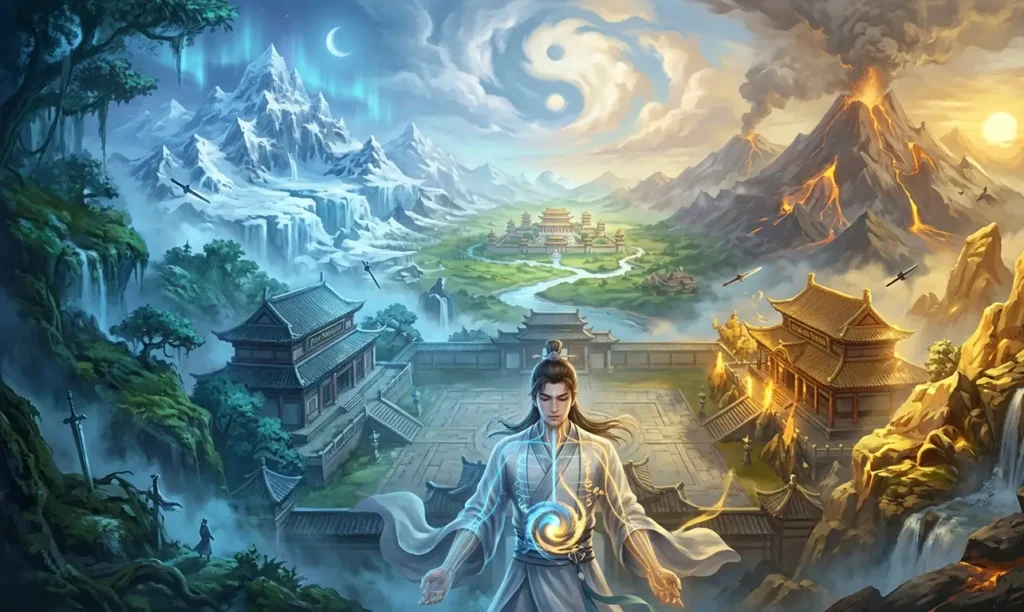
Cultivation fiction’s absorption of yin yang is so complete that it is difficult to identify where the philosophy ends and the genre begins. The concept is present at every level of xianxia’s architecture simultaneously.
At the worldbuilding level, cultivation worlds are typically described as having a fundamental yin yang structure: spiritual energy exists in yin and yang varieties, sacred locations have yin or yang qi concentrations that make them suitable for specific cultivation practices, and the natural world cycles between yin-dominant and yang-dominant periods that affect cultivation speed and difficulty.
This is classical Chinese cosmology translated into fantasy geography.
At the power system level, spiritual roots, constitutions, and cultivation techniques are classified as yin, yang, or balanced, and their interactions follow yin yang logic. Yin techniques gain an advantage against yang-type opponents and face difficulty against other yin-type cultivators. Yang techniques excel in explosive direct combat, while yin techniques favor the long game, attrition, and hidden force. These mechanics are more faithful to the actual yin yang philosophical framework than most readers realize.
At the character level, the yin yang constitution as an innate talent type represents the genre’s most direct use of the concept. A character born with a Yin Body constitution, cold, still, drawing power from the hidden rather than the manifest, faces a world that rewards yang-type aggressive cultivation while possessing a form of power that the standard cultivation hierarchy cannot measure or accommodate.
This is the yin yang principle of the seed-within-the-opposite extended into character design. The apparent weakness contains an extreme form of its opposite, waiting for the right conditions to emerge.
Yin Yang Across Major Cultivation Series
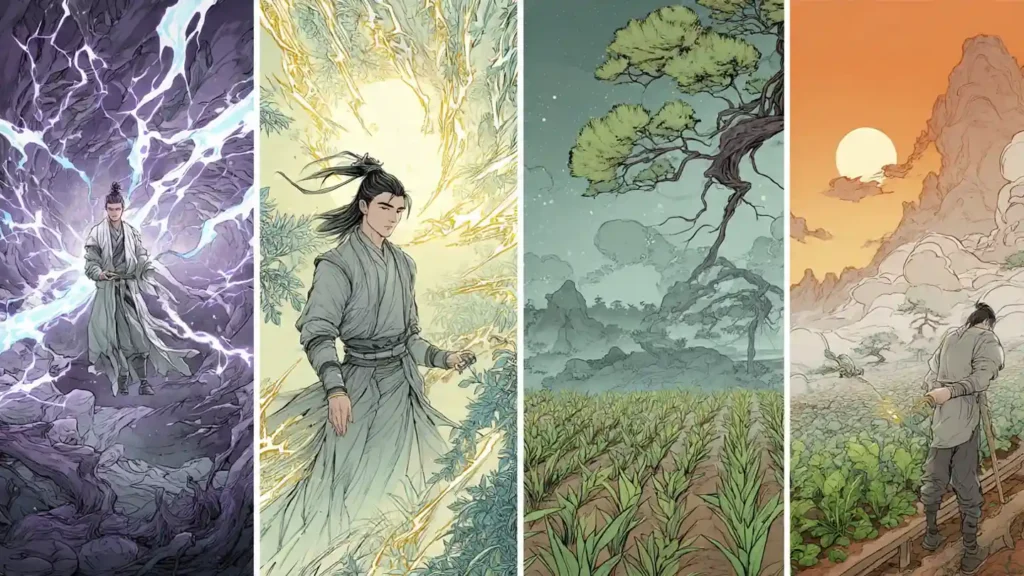
I Shall Seal the Heavens engages with yin yang at the structural level of its tribulation design. The nine-coloured tribulation lightning that marks the most significant breakthroughs is described in ways that follow classical yin yang logic: extreme yang force that the cultivator must absorb by drawing on accumulated yin reserves rather than opposing it directly. Meng Hao’s cultivation path repeatedly requires him to understand that what appears as opposition is actually complementarity, which is the taijitu’s core philosophical message applied as plot.
A Record of a Mortal’s Journey to Immortality treats yin and yang qi as practical cultivation variables throughout. Han Li’s five-element spiritual root, balanced across yin and yang element types, is eventually revealed as an advantage in cultivation paths that require both yin and yang qi integration. Wang Yu’s treatment is the most TCM-faithful in major xianxia: yin and yang appear as practical energy qualities to be cultivated and balanced rather than as dramatic power-type labels.
Lord of the Mysteries uses yin yang implicitly through its pathway system, with several pathways having distinctly yin or yang philosophical characters even without using those terms. The Fool pathway’s capacity to contain contradictions and work through apparent oppositions reflects yin yang thinking at the level of characterisation and plot design rather than explicit terminology.
Beware of Chicken offers the most quietly philosophical treatment. Jin Rou’s farming cultivation accumulates both yin and yang qi through the natural cycles of agricultural work, the yang exertion of physical labor balanced with the yin receptivity of patient tending, the yang growth of summer crops leading to the yin harvest and rest of autumn. Casualfarmer uses yin yang not as a power system mechanic but as a description of what harmonious cultivation actually looks like in practice. It is, in that respect, the most Daoist treatment of the concept in popular cultivation fiction.
Frequently Asked Questions
What does yin yang mean in Daoism?
In Daoist philosophy, yin yang describes the complementary duality through which the Dao manifests the world. Yin and yang are not opposing forces but interdependent aspects of one reality, each containing the seed of the other. Daoist cultivation seeks harmony through the balanced circulation.
What does yin represent and what does yang represent?
Yang embodies brightness, warmth, activity, expansion, and outward movement, while yin reflects darkness, coolness, stillness, contraction, and inward movement. Nothing is purely yin or purely yang. All things contain both, with their balance shifting according to context and relationship.
What is the taijitu and what does the symbol mean?
The taijitu, the circular yin yang symbol of interlocking dark and light swirls, expresses five principles: yin and yang arise together, contain one another, reach their peak with the seed of the opposite present, transform continuously, and remain unified as complementary aspects of one whole.
How does yin yang relate to cultivation novels and xianxia?
Yin yang underpins nearly every layer of xianxia power systems. Spiritual roots, body constitutions, techniques, tribulations, and dual cultivation all follow yin yang logic. Cultivators refine yin and yang qi in specific proportions, and imbalance often leads to qi deviation, a classic consequence of flawed cultivation.
What is a yin body constitution in cultivation novels?
A yin body constitution is an innate talent marked by concentrated cold yin qi, heightened spiritual sensitivity, and affinity for water or ice aligned cultivation. Though rare and potentially transcendent, it is dangerous if improperly cultivated, reflecting the yin yang principle that extreme imbalance, even when powerful, becomes harmful.
What is dual cultivation and how does it connect to yin yang philosophy?
Dual cultivation is a practice where two cultivators harmonize yin and yang energies to reach levels unattainable alone. Rooted in Daoist internal alchemy, it was later adapted by cultivation fiction with varying depth. More rigorous portrayals treat it as a precise method grounded in yin yang complementarity.
Is yin yang the same concept in Daoism and in popular Western culture?
No. Popular Western interpretations often frame yin and yang as a balance between opposing forces, but classical Daoist thought treats yin and yang as mutually generative, interdependent, and constantly transforming aspects of one unified reality. The Daoist concept is far more philosophically nuanced than its common Western simplification.
Final thoughts
The yin yang symbol is everywhere and genuinely understood almost nowhere. After encountering it in cultivation fiction, in casual conversation, on merchandise, tattoos, and corporate logos, I have come to think that the most interesting thing about it is how much information it contains that most people who display it have never been invited to examine.
The philosophy that produced it is not a simple observation about opposites. It is a framework for understanding how reality works at every level simultaneously: how phenomena arise through relationship rather than independently, how apparent opposition is always also complementarity, how change is driven by the seed of the opposite contained in each extreme, and how harmony is not the absence of difference but the dynamic integration of difference in its proper proportion and sequence.
Related Articles
- The Five Elements Behind Every Holy Beast [Chinese Myth Map]
- Why the Four Holy Beasts Cannot Exist Without Yin Yang
- Yin Yang & the Five Elements: The Hidden Cosmological Link
- Yin Yang, Five Elements & Four Symbols: China’s Complete Cosmos
- The Four Holy Beasts: Baihu, Qinglong, Zhuque & Xuanwu
- Yin Yang Sun & Moon: Duality, Myth & Spiritual Meaning
- Is Yin Yang Demonic? The Truth You Don’t Know
- 7 Misconceptions About Yin Yang You Probably Believe
References
- Stanford Encyclopedia of Philosophy – Daoism
- Joseph Needham, Science and Civilisation in China
- Dao De Jing (Tao Te Ching)
- Zhuangzi
- Daoism and Chinese Culture – Livia Kohn
- Huainanzi
- Yin-Yang and the Nature of Correlative Thinking – Angus Charles Graham
- Lewis, Mark Edward. The Construction of Space in Early China.
- Book of Changes: Yi Jing – Chinese Text Project
- Yinyang: The Way of Heaven and Earth in Chinese Thought and Culture – Robin Wang