
 By
By Quick takeaways:
- Dantian (丹田) translates as elixir field or cinnabar field. It is the body’s internal reservoir for storing, refining, and circulating qi, and its concept originates in classical Daoist philosophy and traditional Chinese medicine
- Daoist tradition recognises three dantians, each governing a different dimension of human existence: the lower dantian for vital physical energy, the middle dantian for emotional and spirit energy, and the upper dantian for consciousness and divine essence
- Xianxia cultivation novels borrowed the dantian primarily from the lower dantian tradition and transformed it into the central power mechanic of the cultivation system: the vessel in which qi is accumulated, refined, and eventually crystallized into a Golden Core or Nascent Soul
- The dantian’s location, quality, and condition directly determine a cultivator’s ceiling, which is why dantian destruction is one of the most dramatically devastating events in the genre
- Understanding the real philosophical source of the dantian reframes dozens of cultivation novel mechanics that otherwise seem like genre invention
- I will use Dantian, the Elixir Field, Pill Field, and Dan Field interchangeably, so don’t get confused. They all mean the same thing.
Early in my reading of A Record of a Mortal’s Journey to Immortality, there is a scene where Han Li examines another cultivator’s dantian and determines, from its condition alone, everything he needs to know about that person’s cultivation level, technique history, and remaining lifespan.
The scene is written with the matter-of-fact precision of a doctor reading an X-ray. I remember thinking: this is not invented lore. This is borrowed from somewhere real.
I was right. The dantian is one of the deepest roots connecting cultivation fiction to living philosophical and medical traditions. It appears in Daoist internal alchemy texts written more than a thousand years before the first xianxia novel, in traditional Chinese medical texts still studied and applied today, and in Daoist meditation and qigong practices that continue to be taught worldwide.
The xianxia genre did not invent the dantian. It inherited it, concentrated it, and built an entire power architecture on top of one part of a much larger system.
Understanding what the dantian actually is and where it comes from makes cultivation fiction significantly richer. This article covers both.
What Dantian Means: The Literal and Philosophical Source
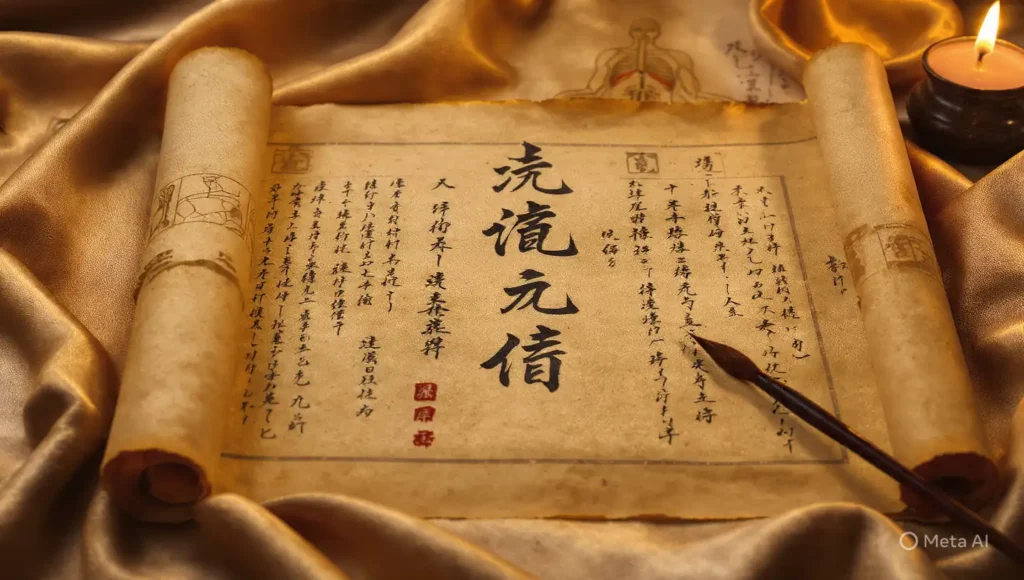
Dantian is composed of two characters. Dan (丹) means cinnabar or elixir (Pill), specifically the red mercuric sulphide compound that ancient Chinese alchemists used in their search for immortality elixirs, which became the symbolic substance of internal spiritual refinement. Tian (田) means field or cultivated land, the image of a plot of earth prepared and tended for productive growth.
Together, dantian means elixir field or cinnabar field: the body’s internal terrain where the sacred substance of spiritual energy is cultivated, stored, and refined.
The agricultural metaphor is deliberate and revealing. A field requires preparation, regular tending, correct conditions, and patience before it yields its harvest. The elixir field demands the same. This is not a passive container but an active site of ongoing cultivation work, which is precisely why cultivation fiction made it central to its power system.
The concept emerges from classical Daoist internal alchemy, a tradition that understood the human body as a microcosm of the universe and sought to refine the body’s internal energies through breath work, meditation, visualization, and physical practice.
Where external alchemy sought immortality by ingesting purified substances, internal alchemy sought it by refining the body’s own Qi, Jing (essence), and Shen (spirit) through disciplined practice. The dan field is the primary site of this internal refinement work.
The Three Dantians of Daoist Tradition
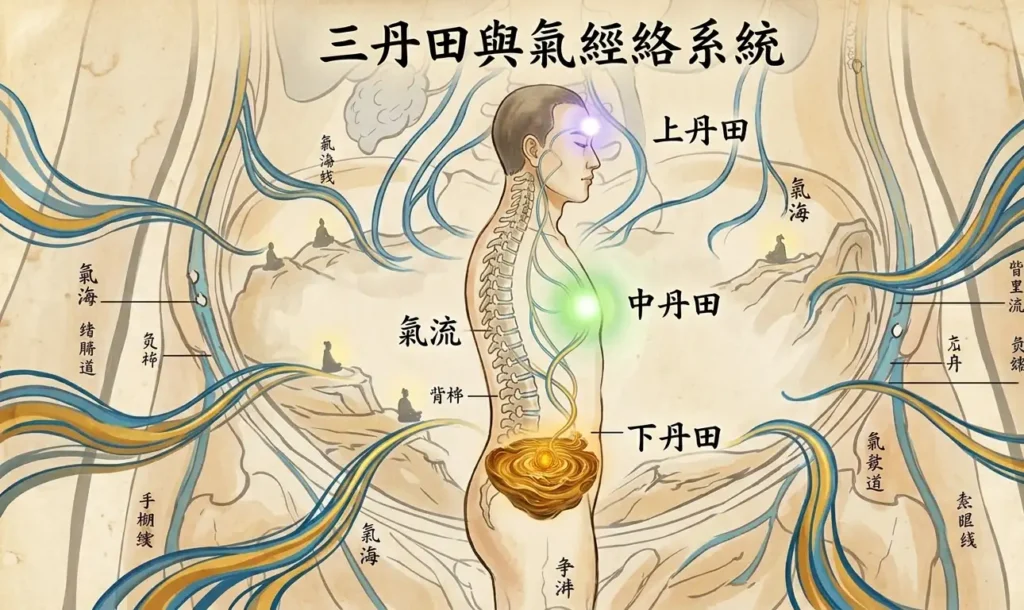
Daoist internal cultivation does not recognise a single elixir field but three, each located in a different region of the body and governing a different dimension of human existence. This tripartite structure is one of the most important things to understand about the pill field concept, because xianxia novels almost always work from one of the three, while the real tradition requires all three to be understood in relation to each other.
The three dantians map onto the three fundamental energies of Daoist internal alchemy: Jing (essential physical vitality), Qi (vital breath and circulating energy), and Shen (spirit, consciousness, and divine essence). Each elixir field is the primary residence and refining ground for one of these energies in the body.
The Lower Dantian: The Qi Sea
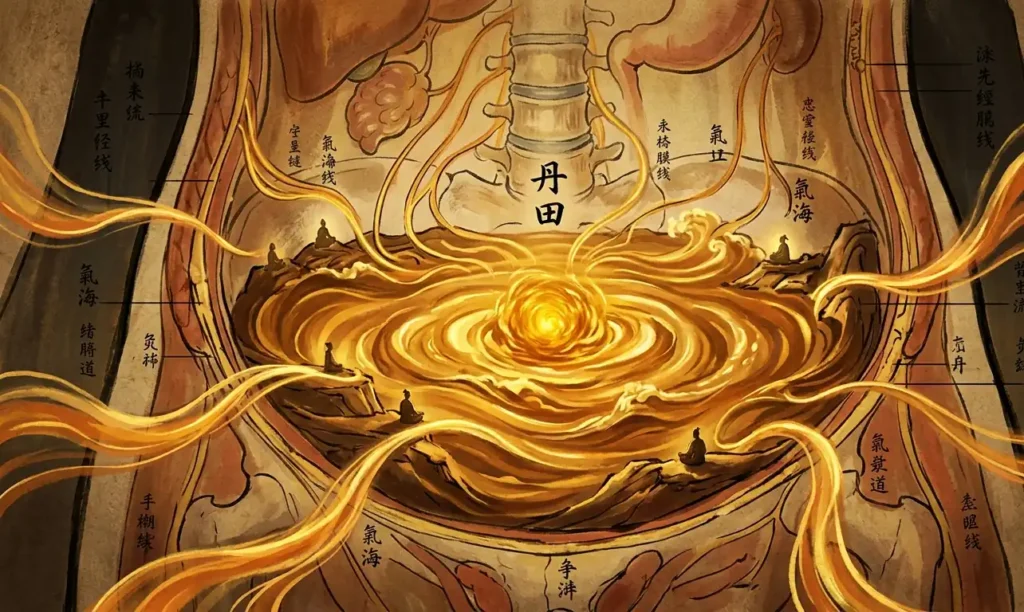
The lower dantian is located approximately three finger-widths below the navel and three finger-widths inward toward the center of the body. Its Chinese name includes the descriptor qi hai, meaning sea of qi. Hai means sea (I picked a few Chinese words over the years of my reading), which gives an immediate sense of its function: it is the vast reservoir from which the body’s vital energy flows and to which it returns.
In Daoist internal cultivation practice, the lower field is where foundational vital essence is stored and where the initial work of internal refinement begins.
Breathing exercises in qigong and Daoist meditation direct attention and breath to the lower elixir field, specifically, accumulating and warming the qi stored there before circulating it through the body’s meridian network. The lower pill field is the starting point of the entire internal cultivation process. The field must be prepared before any harvest is possible.
Lower Dantian in Xianxia
This is the elixir field that xianxia fiction borrowed most directly and most comprehensively. When a cultivation novel refers to the elixir field without specifying which one, it almost always means the lower dan field.
The image of a cultivator sitting in meditation, gathering ambient qi downward into the belly, feeling it accumulate and warm in the body’s center, is a direct literary translation of actual lower dantian cultivation practice into fictional power mechanics.
The lower elixir field association with jing, essential physical vitality, the body’s most fundamental life energy, is why cultivation novels connect elixir field development so directly to physical transformation.
As a cultivator’s lower dan field expands and refines, their physical body changes with it: greater endurance, enhanced healing, and the body becomes capable of withstanding forces that would destroy an ordinary person. This is not genre invention. It reflects the Daoist understanding that jing is the root of physical vitality and that cultivating the lower pill field cultivates the body itself.
The Middle Dantian: The Seat of Spirit

The middle dantian is located at the level of the heart and solar plexus, in the center of the chest. Its Daoist name often includes references to the heart-mind or to the dwelling of the spirit, and it governs the realm between pure physical vitality and pure consciousness: emotion, intention, will, and the relational self.
In internal cultivation practice, the middle elixir field develops after the lower has been sufficiently stabilized. The practitioner’s attention moves upward, and the refining process shifts from physical vitality toward the more subtle energies of emotional and spiritual integration. The middle pill field is where qi interacts with intention, where practice moves from physical discipline into something that could be called character cultivation.
Middle Dantian in Xianxia
Xianxia novels use the middle dantian less consistently as a discrete location than TCM and Daoist practice do, but its influence is visible in how cultivation fiction treats the relationship between a cultivator’s emotional state and their cultivation progress.
The concept that negative emotions, hatred, grief, obsession, and fear create qi blockages that impede advancement is a direct translation of middle dantian theory into narrative mechanics.
When a protagonist’s grief over a dead companion sends them into a cultivation deviation, or when their rage during battle risks shattering their internal qi circulation, the middle pill field is the implied site of that disturbance even when the text does not name it explicitly.
I Shall Seal the Heavens engages with this dimension of dantian cultivation more thoughtfully than most xianxia. Meng Hao’s emotional states are consistently shown as cultivation variables, not just character details. His grief, his longing, his stubbornness, and his love are not separate from his cultivation path but constitutive of it, which reflects a genuinely Daoist understanding of the middle elixir field’s role in the total cultivation system.
The Upper Dantian: The Hall of Mind
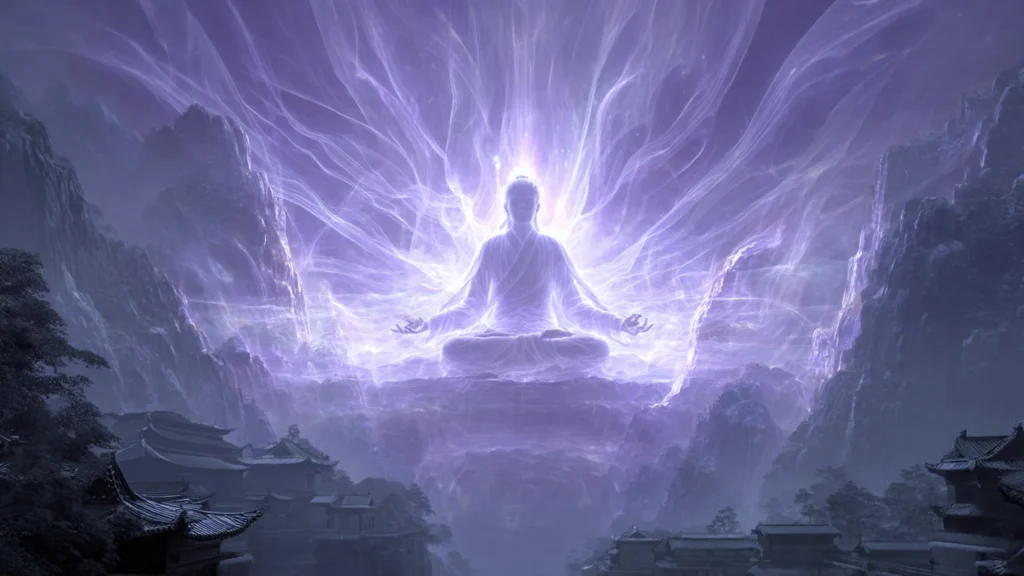
The upper dantian is located in the center of the head, roughly at the level of the space between and slightly behind the eyebrows, the point that Indian yogic tradition also identifies as the third eye and that Daoist tradition calls the Niwan palace, the mud ball palace, the highest and most refined of the body’s internal sacred spaces.
The upper elixir field governs Shen: consciousness, divine essence, spiritual perception, and the aspect of human existence that survives physical death and can potentially achieve immortality.
Cultivation of the upper pill field is the most advanced dimension of Daoist internal alchemy, undertaken only after the lower and middle dantians have been substantially developed, and it leads toward states that classical Daoist texts describe in terms of spiritual illumination, union with the Dao, and transcendence of ordinary human limitation.
Upper Dantian in Xianxia
In xianxia fiction, the upper elixir field influence is clearest in two places. First, in the concept of spiritual sense or divine sense, the cultivator’s ability to extend their consciousness beyond their physical body to perceive the surrounding environment without using ordinary sensory organs.
This ability, which appears in virtually every classical xianxia series as an ability unlocked at certain cultivation stages, maps directly onto upper pill field development in Daoist practice. The cultivation novel’s spiritual sense is the internal alchemy tradition’s Shen refinement translated into a concrete, measurable power.
Second, the upper elixir field influence shows in how cultivation novels treat the Nascent Soul. The Nascent Soul, the spiritual infant that forms within the cultivator’s pill field at the Nascent Soul stage and embodies their accumulated power and consciousness, is philosophically related to the shen refined and concentrated through upper pill field cultivation.
The Daoist internal alchemy tradition describes the goal of the most advanced practice as the crystallisation and cultivation of a refined spiritual essence within the body, and the xianxia Nascent Soul is the genre’s dramatic rendering of exactly this idea.
How Xianxia Transformed the Dantian
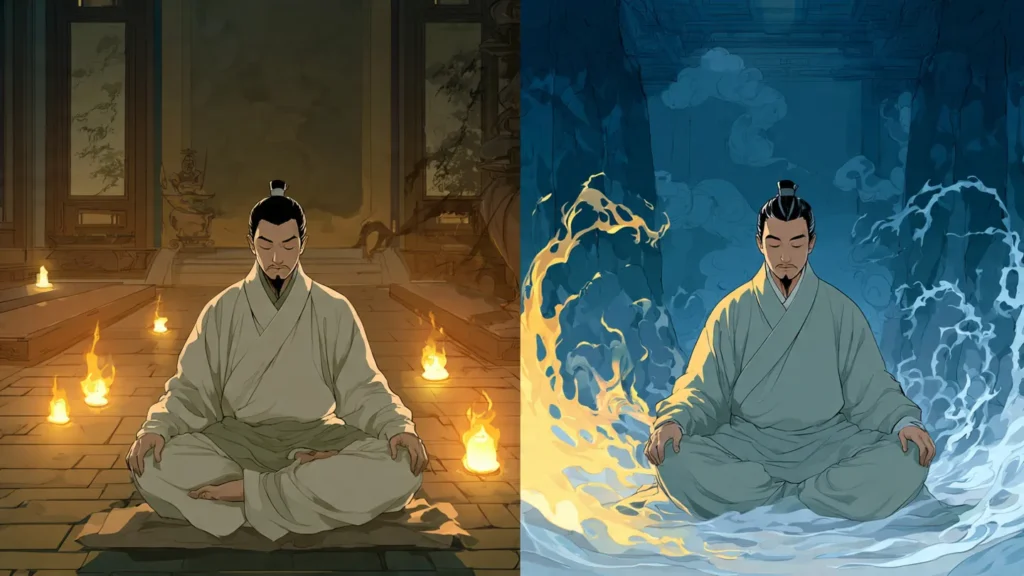
The cultivation fiction genre took the three-dantian framework and made a series of creative decisions that concentrated and dramatised it for narrative purposes.
The most significant decision was consolidation. Rather than working with three distinct dantians in graduated sequence, most xianxia series posit a single primary elixir field. almost always modelled on the lower dan field, which serves as the all-purpose qi reservoir, refinement vessel, and eventual home of the Golden Core and Nascent Soul.
This simplification makes the dantian’s narrative function clearer and more trackable for readers, at the cost of the three-dantian system’s philosophical depth.
The second major transformation was quantification. Real Daoist internal cultivation does not produce measurable, rankable dantian sizes or qi capacities that outside observers can assess. Xianxia does. A cultivator’s elixir field can be large or small, pure or impure, cracked or perfect, and these qualities are legible to sufficiently advanced cultivators who examine it.
The specific quantification creates the novel’s power assessment mechanics, the ability for characters and readers to understand exactly where someone sits in the cultivation hierarchy, but it moves the elixir field from a site of practice into a resource to be managed and upgraded.
The third transformation is the dantian’s role as the physical seat of accumulated cultivation history. In xianxia, the pill field contains not just qi but the record of every technique learned, every breakthrough achieved, every scar left by cultivation deviation or external attack. When a cultivator’s dantian is examined, their entire cultivation history is legible within it.
This is the scene I encountered in A Record of a Mortal’s Journey to Immortality that first made me realize the genre was borrowing from something real, and it is a genuinely creative extension of the Daoist concept of the dantian as a cultivated field, where the history of the cultivation is written in the field’s current condition.
Dantian Destruction: The Cruelest Plot Device
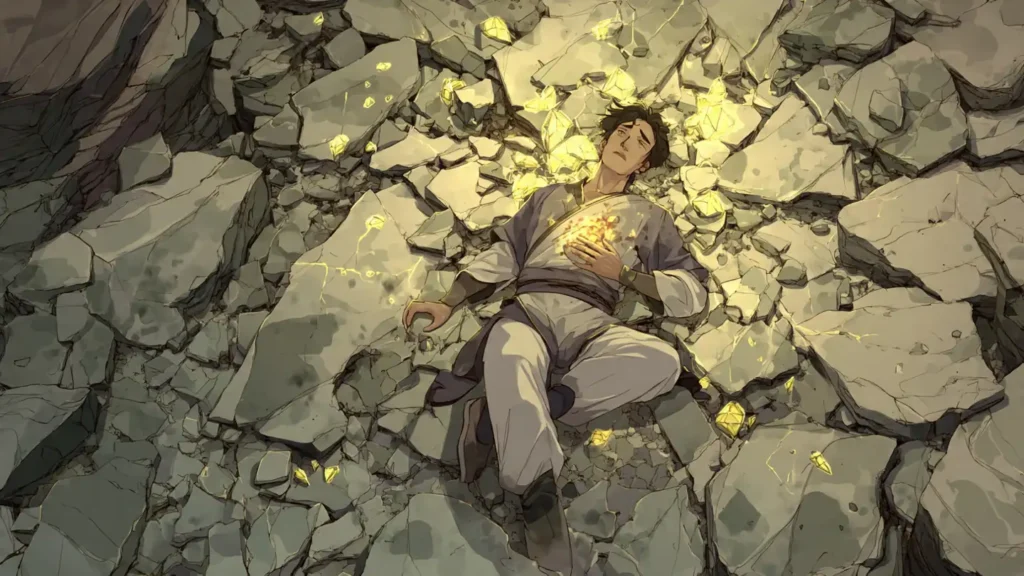
No discussion of the dantian in cultivation fiction is complete without addressing the trope of dantian destruction, because it is one of the genre’s most dramatically potent and most philosophically loaded moments.
In xianxia, a cultivator’s dantian can be destroyed by enemy attack, by cultivation deviation, by forced expulsion of qi, or by deliberate sabotage using external techniques or substances. The result is always catastrophic. A destroyed dantian means the cultivator can no longer store or circulate qi.
Every cultivation achievement, every year of disciplined practice, every realm breakthrough is simultaneously invalidated. The cultivator is reduced to mortal status, often with a damaged body that cannot even perform the baseline functions of someone who never cultivated at all.
After 10 years of reading cultivation fiction, I have witnessed this plot device deployed dozens of times, and its dramatic impact never fully diminishes. The reason is not simply that the protagonist loses power. Power losses and setbacks are common in the genre. The reason is that the elixir field’s destruction strikes at something the cultivation system has made deeply personal. The dan field in a cultivation novel is not just a reservoir of qi.
It is the physical record of who the protagonist has become through years of effort, the site where their potential lives, the organ through which they experience the world at a level beyond ordinary human perception. Destroying it is closer to identity destruction than simple power reduction.
The most interesting narrative uses of elixir field destruction force the protagonist to rebuild not just their cultivation but their relationship to cultivation itself. Battle Through the Heavens does this explicitly with Xiao Yan: the seal on his dantian that strips him of his prodigy talent forces him to understand cultivation as something he must genuinely engage with rather than something that comes naturally.
A Record of a Mortal’s Journey to Immortality uses a subtler version of this theme by giving Han Li a mediocre elixir field quality from the beginning, making his entire cultivation journey an exercise in working with limitation rather than exceptional potential.
The philosophical resonance with the real dantian tradition is precise here. In Daoist internal cultivation, the dantian represents the practitioner’s accumulated work of self-transformation. To have it destroyed is to have that transformation reversed, the field returned to uncultivated ground.
The genre understood instinctively that this was the most devastating thing it could do to a cultivation protagonist, and readers understood instinctively why, because the dantian concept carries enough genuine philosophical weight to make its destruction feel like a real loss rather than a narrative contrivance.
Frequently asked questions
What is a dantian in cultivation novels?
A dantian is the internal qi reservoir within a cultivator’s body, located below the navel in most xianxia representations. It stores the ambient qi the cultivator absorbs, refines that qi through cultivation techniques, and eventually becomes the vessel in which higher cultivation achievements like the Golden Core and Nascent Soul take physical form. Its quality, size, and condition directly determine a cultivator’s ceiling and cultivation speed.
Where does the dantian concept come from?
The dantian originates in classical Daoist internal alchemy and traditional Chinese medicine, where it has been recognized for over a thousand years as a primary site of vital energy in the human body. Daoist tradition recognizes three dantians in the lower abdomen, chest, and head, each governing different dimensions of human vital energy.
What are the three dantians in Daoist tradition?
The three dantians are the lower dantian, located below the navel, which governs vital physical essence and qi storage. The middle dantian, located at the chest level, which governs emotional energy and spiritual will; and the upper dantian, located in the center of the head between and behind the eyebrows, which governs consciousness, divine essence, and the most refined spiritual dimensions of the person.
What happens when a cultivator’s dantian is destroyed?
Dantian destruction in cultivation novels strips the cultivator of all ability to store or circulate qi, effectively reducing them to mortal status and invalidating every cultivation achievement they have accumulated. It is considered more devastating than death in some cultivation worlds because the cultivator survives but cannot pursue the immortality path that gave their life purpose.
What is the difference between the dantian and meridians?
The dantian is the storage and refinement reservoir where qi accumulates and is processed. Meridians are the channels through which qi travels throughout the body, connecting the dantian to every part of the cultivator’s physical and energy body. If the dantian is the qi reservoir, the meridians are the qi circulatory system. Both can be damaged or improved through cultivation, and the quality of both affects a cultivator’s overall power and advancement speed.
What is the Golden Core and how does it relate to the dantian?
The Golden Core is the crystallized form that a cultivator’s accumulated and refined qi takes when they successfully break through to the Core Formation cultivation realm. It forms within the dantian, replacing the diffuse qi accumulation of earlier stages with a concentrated, crystalline structure that dramatically increases the cultivator’s power, lifespan, and access to advanced techniques.
Can the dantian be improved or expanded in cultivation novels?
Yes, and dantian improvement is one of the fundamental goals of early cultivation. Through consistent practice, rare resources, medicinal pills, and cultivation breakthroughs, a cultivator can expand their dantian’s capacity, purify the qi it contains, and improve the efficiency of qi absorption and refinement.
Final thoughts

The dantian is the most load-bearing concept in cultivation fiction’s entire architecture, and it deserves to be understood as what it actually is: a borrowed and transformed version of a concept that real practitioners have worked with for over a millennium.
Daoist internal cultivators sitting in meditation and directing their awareness to the lower dantian, qigong practitioners circulating qi through the three dantians in sequence, traditional Chinese medicine physicians assessing their patients’ qi states through the dantian’s condition, these are not the distant ancestors of xianxia but its immediate intellectual parents.
The genre did not invent the elixir field. It recognized that the elixir field was already one of the most narratively rich concepts in the philosophical tradition it was drawing from, and it built accordingly.
What xianxia added to the dantian tradition is consequence and stakes. The Daoist practitioner’s dantian development is measured in decades of private work, its progress subtle and interior. The xianxia cultivator’s dantian development is measured in dramatic breakthroughs, visible to the world, contested by enemies who want to destroy it, and legible to the reader as a clear map of exactly how far the protagonist has come and how far they still have to go.
Both versions honour something real about the original concept: that the elixir field is cultivated, that cultivation takes time and effort and the right conditions, and that what grows in that field defines what kind of practitioner, and what kind of person, you are becoming.
Related Articles
- Best Xianxia Novels of 2026: From Hidden Gems to Legends
- 13 Best Cultivation Novels With No Harem [2026 Picks]
- 12 Best Cultivation Novels [Ranked by Genre Fans]
- 7 Female MC Cultivation Novels Where the Female MC Shines [2026]
- 9 Best Progression Fantasy Books 2026 [Ranked List]
- 13 Fantasy Genres Ranked: Which One Actually Suits You?
- Meridians in Cultivation: Meaning, Function & Sacred Energy
References
- Stanford Encyclopedia of Philosophy – Daoism
- Joseph Needham, Science and Civilisation in China
- Dao De Jing (Tao Te Ching)
- Zhuangzi
- The Cantong qi (The Seal of the Unity of the Three)
- Wuzhen pian (Awakening to Reality) by Zhang Boduan.
- Huangdi Neijing
- Ling Shu: The Spiritual Pivot
- Nan Jing: The Classic of Difficult Issues – Paul U. Unschuld
- The Web That Has No Weaver