
 By
By Quick takeaways
- Meridians (经脉, jingmai) are the channels through which qi flows throughout the body, connecting the dantian to every organ, limb, and surface point of the body’s internal qi circulatory system
- Traditional Chinese medicine recognizes twelve primary meridians and eight extraordinary meridians, each with specific pathways, organ connections, and functions that xianxia borrowed directly
- In cultivation fiction, the state of a cultivator’s meridians determines how much qi they can circulate, how fast they can advance, and which techniques they can use, making meridian development as important as dantian development
- Meridian opening, meridian washing, and acupoint sealing are three of xianxia’s most distinctive narrative mechanics, all rooted in real TCM and Daoist cultivation practice
- The eight extraordinary meridians, especially the Ren Mai and Du Mai, are the two channels most central to both real Daoist internal cultivation and xianxia power system design
One of the earliest wuxia dramas I saw described a master healer pressing a single finger to a young disciple’s wrist and immediately knowing which of his meridians were blocked, which were damaged, and which were open but running with impure qi. The scene was written as though this examination was as straightforward as checking a pulse. I accepted it the way new readers accept all genre conventions, as part of the furniture.
It took me years to realize that scene was not fiction at all. Traditional Chinese medicine practitioners examine exactly these things through pulse diagnosis and meridian palpation. The blocked meridian producing downstream dysfunction, the impure qi manifesting as specific physical symptoms, the healer reading the body’s channel network through touch, these are practices described in classical medical texts that predate the earliest wuxia novel by more than a thousand years.
Meridians are the most clinically grounded concept that cultivation fiction borrows from real tradition. Understanding where they come from, and what they actually are, makes the genre’s most dramatic meridian moments land with a weight they cannot fully achieve when treated as invented lore.
What Meridians Are: The Real Source
Meridians (经脉, jīng mài) are the channels through which qi, vital energy, circulates throughout the body in traditional Chinese medicine. The word jingmai combines jing, meaning pathway, warp thread, or classic text, and mai, meaning vessel or pulse. Together, they describe both the structural reality of the channel and the flowing quality of what moves through it.
The meridian system is the complete internal architecture of qi circulation in the body. Where the dantian is the storage and refinement center, the meridians are the distribution network: qi flows outward from the dantian through the meridians to reach every organ, every limb, every acupoint on the body’s surface.
Healthy qi circulation requires both a functioning dantian and clear, unobstructed meridians. Either one impaired means the other’s production is wasted.
The classical source text for meridian theory is the Huangdi Neijing, the Yellow Emperor’s Classic of Medicine, one of the foundational texts of traditional Chinese medicine, composed during the Han dynasty and drawing on earlier traditions. The Neijing describes the meridian system’s pathways, their organ connections, and the consequences of blockage or disruption in clinical detail.
This is a living tradition, not an archaeological one. Acupuncture, which works by stimulating specific points along the meridian pathways to influence qi flow, is practiced worldwide and incorporated into medical systems globally as of 2026. The meridians that xianxia cultivators open, wash, and battle across are the same channels that acupuncturists work with daily in clinics from Beijing to London.
The Twelve Primary Meridians
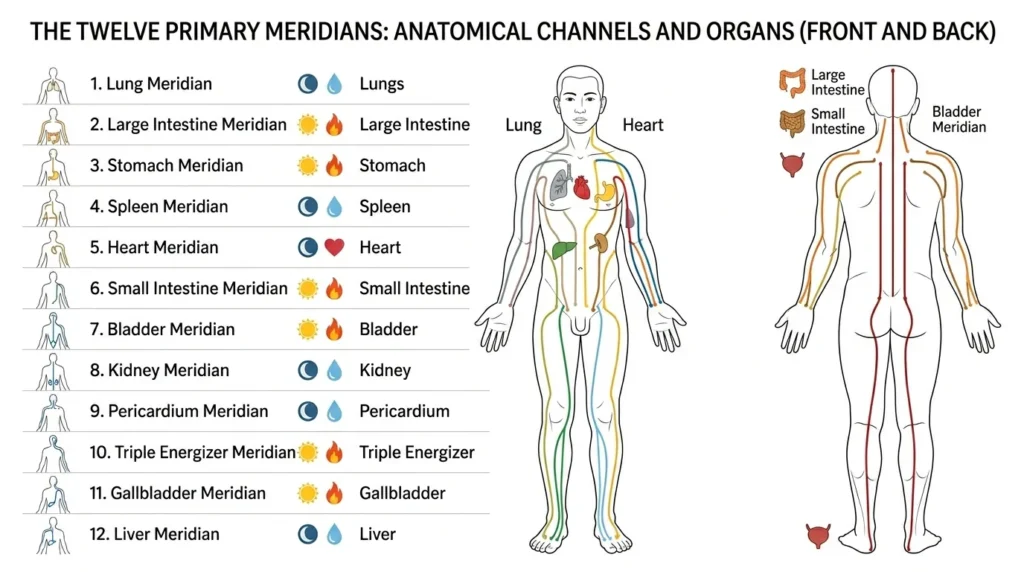
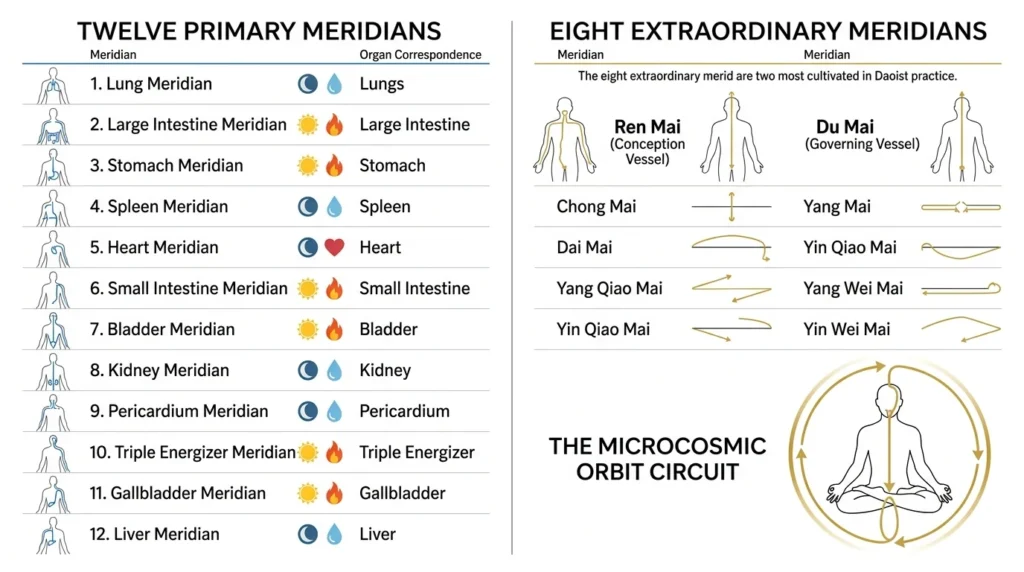
The twelve primary meridians form the core of the body’s qi circulation system in TCM. Each one corresponds to a specific organ, follows a defined pathway through the body, and governs specific physiological functions. The twelve are paired into six yin-yang couples and classified by which of the three body regions they primarily traverse: hand, foot, or both.
The twelve primary meridians are
- The Lung
- Large Intestine
- Stomach
- Spleen
- Heart
- Small Intestine
- Bladder
- Kidney
- Pericardium
- Triple Warmer
- Gallbladder
- Liver meridians
Each travels a specific route from its organ of origin to its surface points, often crossing considerable distances through the body and connecting with multiple other meridians along the way.
12 Meridians in Cultivation Novels
In cultivation fiction, the twelve primary meridians rarely appear by their individual names the genre typically treats them as a collective system whose total capacity and clarity determine a cultivator’s baseline qi circulation.
When a cultivation novel describes a cultivator as having twelve meridians open, thirteen open, or all twenty-four meridians open including the eight extraordinary vessels, it is working directly from this framework of twelve primary meridians as the foundational network to be developed.
One thing I want to make clear is that number of meridians in cultivation novels entirely depends on the author interpretation, there is no universal rule.
The specific organ associations of the twelve meridians are more present in wuxia than in xianxia. Classic wuxia novels in the Jin Yong tradition frequently involve disrupting or treating specific organ meridians to produce clinical effects: pressing the Heart meridian to induce fainting, treating the Kidney meridian to restore damaged vital essence, blocking the Lung meridian to impair breathing during combat.
This precision reflects Jin Yong’s genuine grounding in TCM theory, which he brought to fiction from a real cultural tradition rather than inventing.
The Eight Extraordinary Meridians
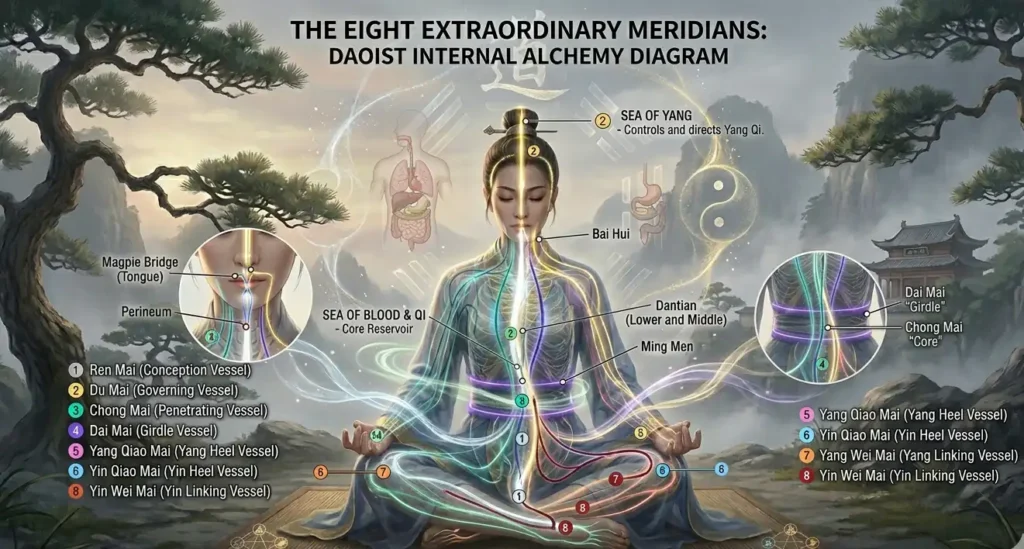
While the twelve primary meridians form the body’s standard qi circulation infrastructure, the eight extraordinary meridians (奇经八脉, qī jīng bā mài) are the channels that cultivation fiction returns to most consistently and invests with the most dramatic significance.
The Eight Extraordinary Meridians Are
- The Ren Mai (Conception Vessel)
- Du Mai (Governing Vessel)
- Chong Mai (Penetrating Vessel)
- Dai Mai (Belt Vessel)
- Yin Qiao Mai
- Yang Qiao Mai
- Yin Wei Mai
- Yang Wei Mai
Unlike the twelve primary meridians, the eight extraordinary meridians do not correspond to specific organs. They function instead as reservoirs that regulate qi distribution across the entire meridian network, filling when the primary meridians are full and releasing when the primary meridians are depleted.
In Daoist internal cultivation practice, the eight extraordinary meridians have a particular significance that goes beyond their TCM regulatory function. The cultivation of the Ren Mai and Du Mai in particular, through a practice known as opening the Microcosmic Orbit, is one of the fundamental exercises of Daoist internal alchemy.
The Microcosmic Orbit circulates refined qi upward along the Du Mai on the back of the body and downward along the Ren Mai on the front, completing a circuit that is understood to dramatically accelerate internal cultivation.
Eight Extraordinary Meridians in Cultivation Fiction
This practice is the direct source of cultivation fiction’s most dramatic meridian breakthrough moments. When a xianxia protagonist achieves a major cultivation advance by completing the circuit of their Ren Mai and Du Mai, they are performing a fictionalised version of exactly the Microcosmic Orbit practice that Daoist cultivators have undertaken for centuries.
The genre’s instinct to make this circuit completion a major milestone was not creative invention. It correctly identified the Ren and Du as the two most significant channels in the actual internal cultivation tradition.
Meridians and the Dantian: The Complete Circuit
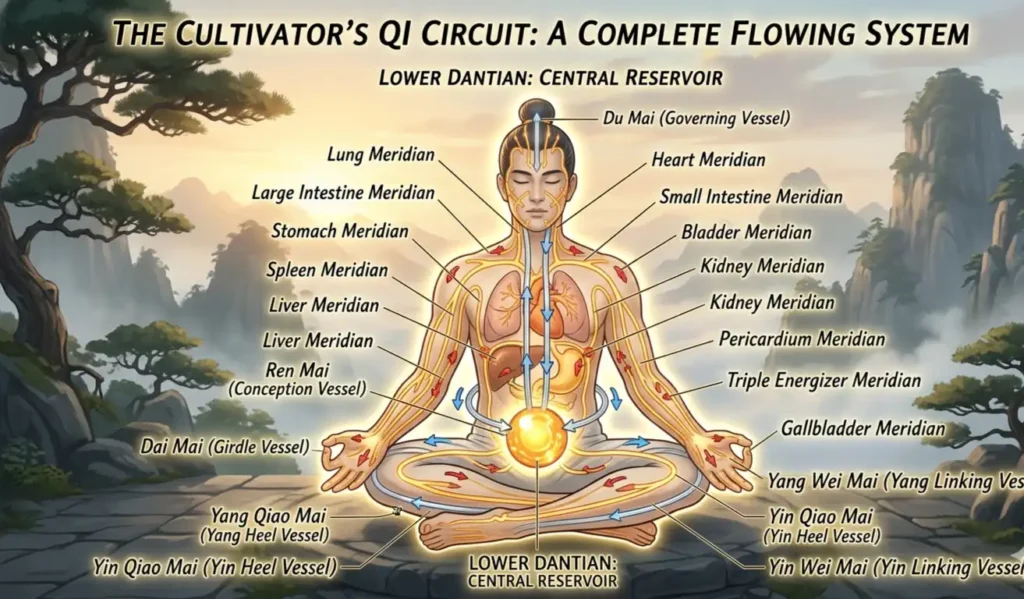
The meridian system and the dantian are not separate concepts but a single, integrated architecture that makes sense only when understood together. This is the most important thing to grasp about both, and the thing that cultivation novels occasionally obscure by treating them as distinct upgrade categories.
Qi originates through breath and food, is refined and stored in the dantian, then flows outward through the meridians to circulate through the body and return to the dantian for further refinement.
This circuit is continuous and reciprocal: a larger dantian can store more qi, but that qi is wasted if the meridians cannot distribute it efficiently. Wider, cleaner meridians can circulate qi faster, but that circulation achieves little if the dantian cannot refine qi quickly enough to keep the channels supplied.
In cultivation fiction, this interdependence is reflected in how the best series design their power systems. A Record of a Mortal’s Journey to Immortality treats dantian capacity and meridian quality as separate variables that both need development, and Han Li’s approach to cultivation involves methodical improvement of both rather than neglecting one in favour of the other.
The novels that handle this dual-system most coherently tend to produce the most believable cultivation mechanics, because they are faithfully representing the actual relationship between the two concepts in the TCM source material.
How Xianxia Transformed the Meridian System
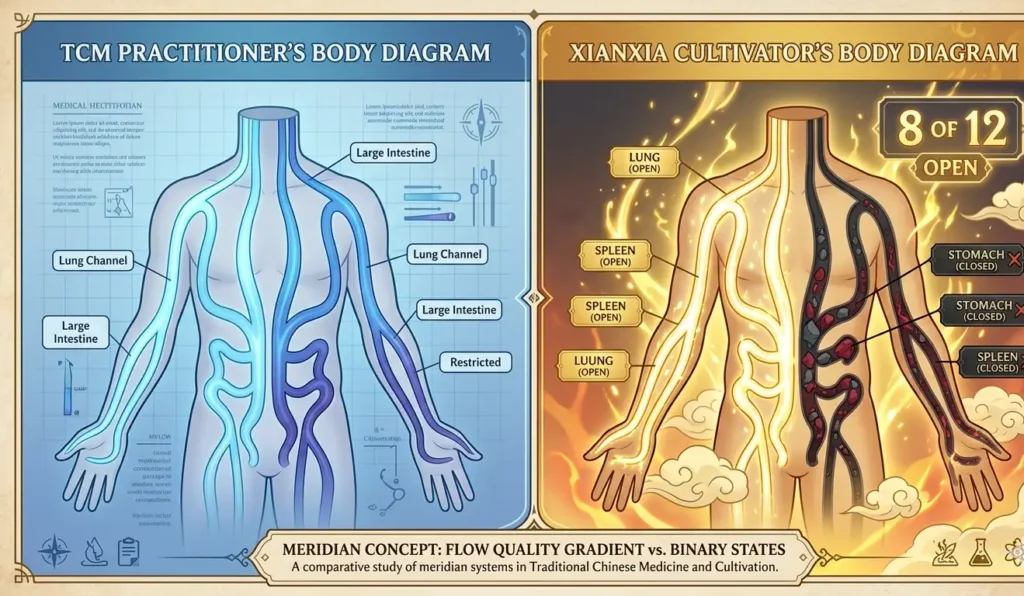
The cultivation fiction genre took the TCM meridian framework and applied the same series of creative choices it used for dantian. Concentration, Quantification, and Dramatization.
The most significant transformation is quantification. Real TCM meridian theory does not describe meridians as things that can be counted as open or closed, with more open meridians equaling more power. The actual system describes qi flow as more or less free, more or less abundant, more or less balanced across the network.
Cultivation fiction turned this into a countable upgrade system. Twelve meridians open is better than eight. Opening all twenty-four primary and extraordinary meridians is a major achievement, and having exceptionally wide or pure meridians is a quality advantage that separates elite cultivators from ordinary ones.
This quantification creates the meridian development mechanics that drive early cultivation arcs. A protagonist who opens a meridian per chapter feels concrete progress in a way that “my qi flows somewhat more freely than it did last week” cannot. The genre correctly intuited that the meridian system needed to be made legible and trackable to serve as narrative scaffolding, even at the cost of some philosophical fidelity.
The second transformation is the introduction of natural meridian variation as a talent indicator parallel to spiritual roots. In real TCM, meridian quality is largely a function of lifestyle, practice, and constitution rather than innate fixed talent.
In xianxia, a person can be born with naturally wider, more numerous, or more pure meridians, making them a cultivation genius in the meridian dimension, separately from their spiritual root quality. This is a genre invention built on the TCM framework’s general principle that constitutional factors affect meridian quality, extended into a fixed innate talent system that the original philosophy does not contain.
Meridian Opening: The Cultivation Milestone
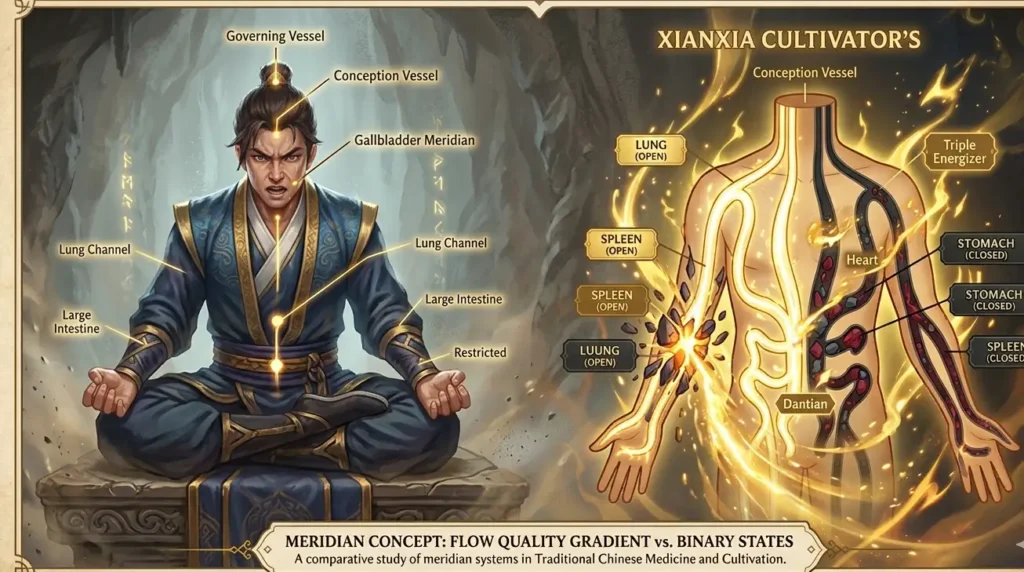
Meridian opening is one of the most distinctive and dramatically rich mechanics in cultivation fiction, and one of the clearest examples of the genre taking a real practice and concentrating it into a narrative event.
In real Daoist internal cultivation and qigong practice, opening a meridian is a gradual process of directing qi through a previously restricted or obstructed channel through repeated practice until the channel flows freely. It is not a discrete event with a clear before and after, so much as a progressive improvement across weeks or months of sustained practice.
The practitioner does not feel an explosive sense of power when the channel clears. They feel a gradual increase in ease and efficiency in their practice.
Cultivation fiction compresses this into a breakthrough moment. The cultivator directs qi into a stubborn meridian, faces resistance, pushes through the blockage in a climactic scene, and emerges on the other side with a perceptibly expanded power ceiling.
The event is discrete, legible, and emotionally satisfying in ways that realistic gradual improvement cannot be. Sometimes the MC has to hammer the meridian with qi multiple times while coughing blood.
What the genre preserves from the real practice is the sensation of the breakthrough itself. Cultivation novels describing meridian opening consistently use the same imagery. heat moving through a narrow channel, resistance like a wall of compressed matter, then sudden release and the rush of qi flowing freely where it had not flowed before.
This imagery corresponds closely to what practitioners of qigong and Daoist internal cultivation describe as the actual subjective experience of clearing a previously blocked channel. The novel exaggerates the scale and speed. The phenomenology is borrowed faithfully from real practice accounts.
Meridian Washing and Marrow Cleansing
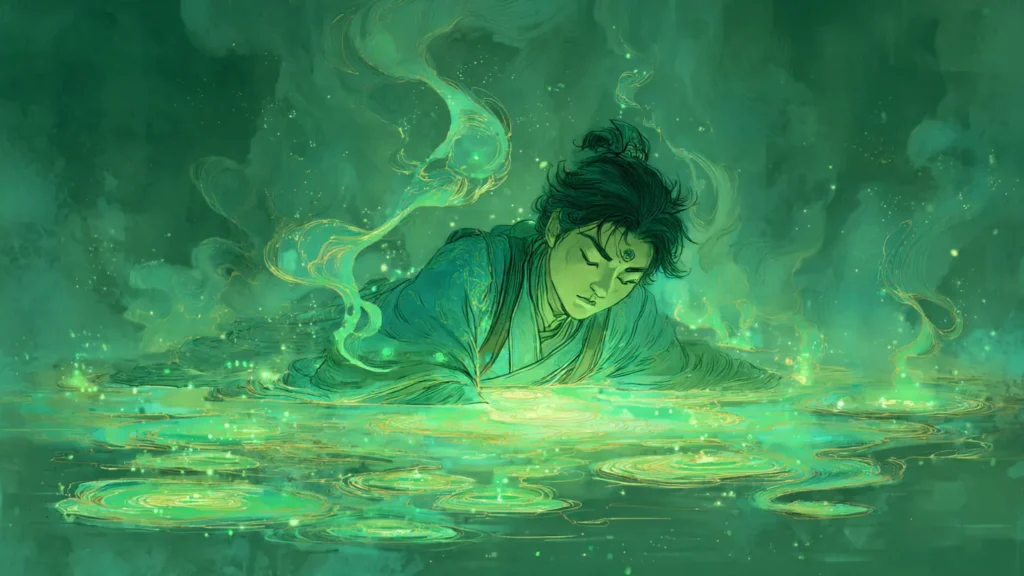
Meridian washing and marrow cleansing are among the most coveted early cultivation treasures in Xianxia, and they represent the genre’s dramatization of a specific Daoist cultivation concept. The purification of the physical body is a prerequisite for advanced spiritual development.
In Daoist internal alchemy, the body’s inherited constitutional impurities, toxins accumulated through lifestyle, and congenital blockages in the meridian network are understood as impediments to cultivation progress. Various practices, specific herbs, and meditative techniques are employed to progressively purify the channels and strengthen the physical foundation.
This purification process is understood as both a physical cleaning of the channels and a spiritual refinement that prepares the body to handle increasingly intense qi without damage.
Cultivation fiction concentrated this gradual purification process into a dramatic single-event resource: the meridian-washing pill, the marrow-cleansing spring, the rare heavenly treasure that purifies and expands all meridians simultaneously.
The protagonist who receives meridian washing before their serious cultivation begins has their congenital limitations removed, their channels expanded to their natural ideal width, and their physical cultivation foundation placed at the highest baseline their innate constitution allows.
The marrow-cleansing component is philosophically significant. TCM understands bone marrow as closely related to the kidney essence, Jing, which is the most fundamental physical vital energy. Cleansing the marrow in TCM practice means purifying and strengthening this foundational essence.
In cultivation fiction, marrow cleansing explicitly upgrades the cultivator’s physical constitution at the most fundamental level, removing whatever congenital limits their birth condition imposed. This is the genre’s translation of the Daoist concept that the body’s inherited limitations can be overcome through the right purification, rendered as a single dramatic event rather than a lifelong practice.
Meridians as Combat Weapons: Sealing Acupoints
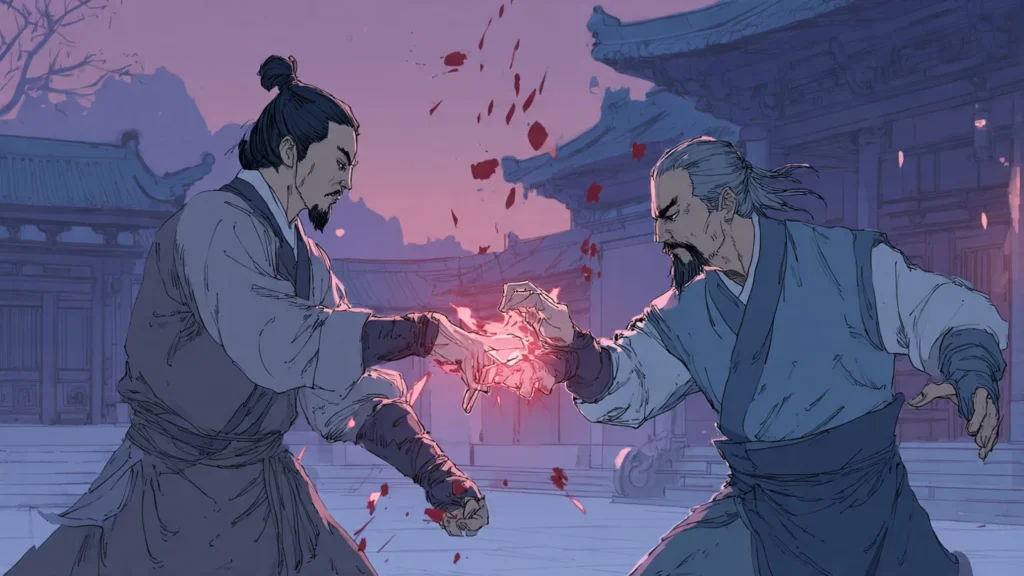
One of wuxia fiction’s most distinctive contributions to the meridian tradition in cultivation fiction is the use of meridian manipulation as a combat weapon. Acupoint sealing, striking, or pressing specific points along the meridian pathways to disrupt, block, or redirect qi flow in an opponent’s body is a combat technique with genuine TCM grounding that wuxia made into one of the genre’s most recognizable martial art applications.
In TCM, acupoints are specific locations along the meridian pathways where qi is particularly accessible at the surface of the body. Acupuncture needles are inserted at these points to influence the flow of qi in the associated meridian and its connected organ. The concept that these same points could be struck or pressed to disrupt qi flow in combat is a logical extension that wuxia authors developed into an elaborate system of combat applications.
Jin Yong’s novels treat acupoint sealing with particular sophistication. Characters in The Legend of Condor Heroes and The Smiling Proud Wanderer use acupoint strikes that produce highly specific effects: temporary paralysis of a specific limb by sealing the relevant motor meridian, loss of voice by sealing the throat channel points, forced internal qi deviation by disrupting the circulation sequence at a critical junction.
This specificity reflects a genuine study of TCM meridian theory and produces combat that feels mechanically grounded rather than arbitrarily magical.
Meridians across major cultivation series
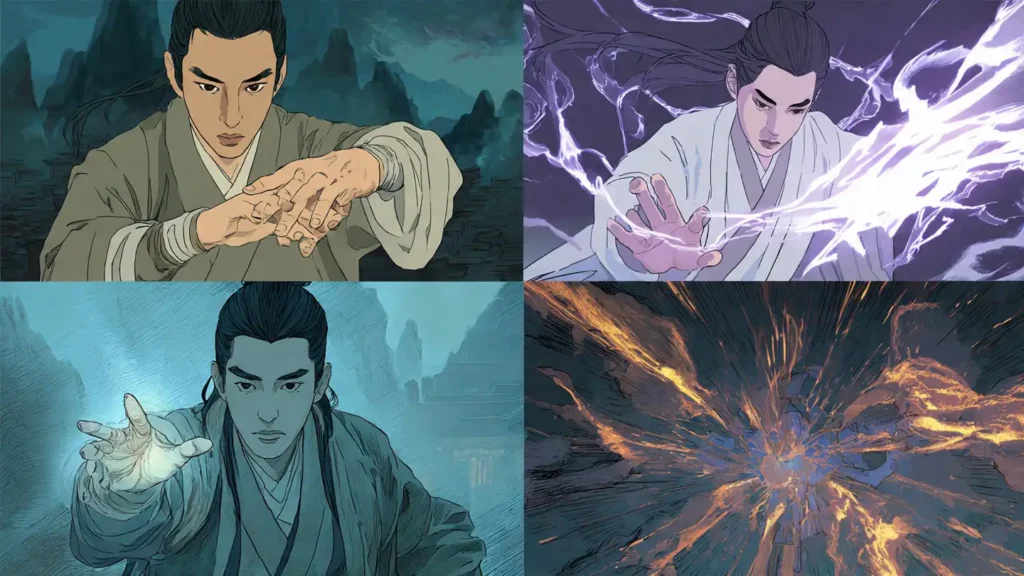
Wuxia – Jin Yong’s tradition: Jin Yong’s novels represent the most TCM-faithful treatment of meridians in Chinese popular fiction. The Eighteen Dragon-Subduing Palms in The Legend of Condor Heroes, the Toad Skill, the Jiu Yin Manual, each of these classic wuxia techniques is described in terms of specific meridian pathways, qi direction sequences, and acupoint applications that reflect genuine study of the source tradition. For readers who want to see the meridian system treated with maximum fidelity to its TCM origins, Jin Yong is the place to start.
A Record of a Mortal’s Journey to Immortality: Wang Yu treats meridian development as a genuine cultivation variable with the same methodical rigour he brings to dantian cultivation. Han Li’s approach to clearing his meridians is characterised by patience, resource management, and the use of specific techniques calibrated to his channel quality rather than generic grinding. The novel does not dramatise meridian opening as explosively as most xianxia, which makes the breakthroughs feel more mechanically credible.
Battle Through the Heavens: The Dou Qi system in Battle Through the Heavens maps onto the meridian framework through its Qi Paths. channels through which Dou Qi circulates that function identically to meridians in their cultivation role. Opening Qi Paths is a discrete milestone event with exactly the dramatic energy of xianxia meridian opening. The series uses the TCM concept faithfully at the structural level while giving it a distinctive terminological identity.
Frequently asked questions
What are meridians in cultivation novels?
Meridians are the internal qi channels through which cultivators circulate spiritual energy throughout their bodies. They connect the dantian to the physical form and determine how much qi can flow, how quickly it moves, and what effects it can produce. Wider and purer meridians allow greater power and stronger techniques.
How many meridians are there in the human body?
The human body is traditionally said to contain 12 primary meridians, each linked to a major organ system, along with 8 extraordinary meridians that regulate and support overall energy flow. Together they form the network through which qi moves throughout the body in traditional Chinese medicine.
What is the difference between meridians and the dantian?
The dantian stores and refines qi while the meridians distribute and circulate it. The dantian is the reservoir, and the meridians are the channels. Both must develop together, since a strong dantian is useless with blocked meridians, and open meridians mean little without enough qi to circulate.
What is acupoint sealing in wuxia and xianxia?
Acupoint sealing is a combat technique that targets specific points along the meridian pathways to disrupt qi flow in an opponent’s body, producing effects ranging from temporary paralysis to severe internal injury. The technique is rooted in real TCM acupoint theory and appears most elaborately in Jin Yong’s wuxia novels, where specific sealed points produce specific clinically accurate effects. Xianxia inherited and scaled the technique into more extreme applications at higher cultivation levels.
What does it mean to open a meridian in cultivation novels?
Opening a meridian means clearing a previously blocked or underdeveloped qi channel so that energy flows through it freely. In cultivation fiction this is a discrete breakthrough event where the cultivator forces qi through the resistant channel, overcomes the blockage in a climactic moment, and gains access to the newly opened channel’s capacity. In real Daoist and qigong practice, the equivalent process is gradual rather than instantaneous but involves the same subjective experience of heat, resistance, and release.
What is meridian washing and why is it important?
Meridian washing is the purification and expansion of all meridian channels simultaneously, usually through a rare pill, treasure, or heavenly resource. It removes congenital impurities and blockages, expands channel width to the cultivator’s innate maximum, and strengthens the physical constitution at a foundational level. It is one of the most coveted early cultivation resources because it raises the ceiling of everything the cultivator can achieve rather than simply advancing one aspect of their development.
Are TCM meridians the same as cultivation novel meridians?
Structurally yes, though with significant adaptations. Traditional Chinese medicine recognises twelve primary meridians and eight extraordinary meridians with specific organ connections, pathways, and functions, all described in classical texts like the Huangdi Neijing. Cultivation fiction borrowed this framework and transformed it through quantification, discrete opening events, and innate talent variation that the real system does not contain. The foundational anatomy is shared; the dramatic mechanics are genre invention built on top of it.
Final thoughts
Every time a cultivation novel describes a cultivator sensing their qi circulation slow at a stubborn point, then pushing through with concentrated will until the channel clears and energy rushes forward, that scene has a real referent. Practitioners of qigong and Daoist internal cultivation describe exactly this experience in accounts written across many centuries.
The xianxia version is faster, more intense, and accompanied by visible power increases. The underlying phenomenology is the same.
This is what distinguishes meridians from most cultivation fiction’s invented mechanics. The spiritual roots system, the realm ladder, and the Golden Core these are creative extrapolations from philosophical concepts. The meridian system is the philosophical concept itself, transposed into fiction with its essential architecture intact.
Ten years of reading wuxia and xianxia gave me deep familiarity with meridian mechanics long before I had any real knowledge of TCM. When I finally read the Neijing descriptions of meridian pathways and compared them to the xianxia frameworks I knew, the correspondence was striking enough to feel like a revelation.
The genre had been faithfully transmitting real anatomical and energetic concepts all along, dressed in the vocabulary of cultivation advancement and power scaling.
The meridians connect us, as readers of cultivation fiction, to a living tradition of thought about the body that is still actively practiced and studied. That connection is not decorative.
It is the source of the specific authority these concepts carry in the fiction, the reason meridian blocking feels genuinely menacing and meridian opening feels genuinely triumphant. The body the genre imagines is a real body. The channels it cultivates are real channels. The tradition it draws from is still alive.
Related Articles
- Best Xianxia Novels of 2026: From Hidden Gems to Legends
- 13 Best Cultivation Novels With No Harem [2026 Picks]
- 12 Best Cultivation Novels [Ranked by Genre Fans]
- 7 Female MC Cultivation Novels Where the Female MC Shines [2026]
- 9 Best Progression Fantasy Books 2026 [Ranked List]
- 13 Fantasy Genres Ranked: Which One Actually Suits You?
- Meridians in Cultivation: Meaning, Function & Sacred Energy
References
- Stanford Encyclopedia of Philosophy – Daoism
- Joseph Needham, Science and Civilisation in China
- Dao De Jing (Tao Te Ching)
- Zhuangzi
- Taoist Alchemy insights on Neidan and Waidan
- The Cantong qi (The Seal of the Unity of the Three)
- Wuzhen pian (Awakening to Reality) by Zhang Boduan.
- Huangdi Neijing
- Damien Keown – Buddhism: A Very Short Introduction