 By
By Quick Takeaways:
- Yin yang and the Five Elements are usually taught as separate but related systems, but they’re actually mutually dependent, and each one has a specific limitation that only the other can solve
- Yin yang provides the cycling dynamic that animates the Five Elements. Without it, the five phases are five static labels with no engine
- The Five Elements provide the qualitative vocabulary that differentiates yin and yang’s changes. Without them, yin-yang is a useful binary that can’t describe the actual texture of natural phenomena
- Every major application of Chinese cosmology, TCM, feng shui, Chinese astrology, and seasonal cosmology requires both systems working together simultaneously
- Once you understand the mutual dependency, both systems become significantly more interesting than they are in isolation
Here are a few titbits I have noticed in my journey. People learn yin yang first, then they learn the Five Elements, and they hold both as interesting but separate things. Related, obviously, yin yang qualities are assigned to each element, but fundamentally distinct topics you can understand independently.
I held that view for longer than I’d like to admit. Then I decided to spend my precious time working through different resources in preparation for a more complete picture, and I kept running into the same problem. The texts assumed you were using yin yang and Wu Xing simultaneously, not alternating between them. Whenever I tried to apply one without the other, the analysis broke down.
That’s when I started working out the actual dependency. And it’s more fundamental than I expected.
Two Systems, Two Specific Limitations
Let me start with the honest acknowledgment that both systems have real limitations when you try to use them alone. This is the foundation of the argument.
What Yin Yang Can’t Do Alone
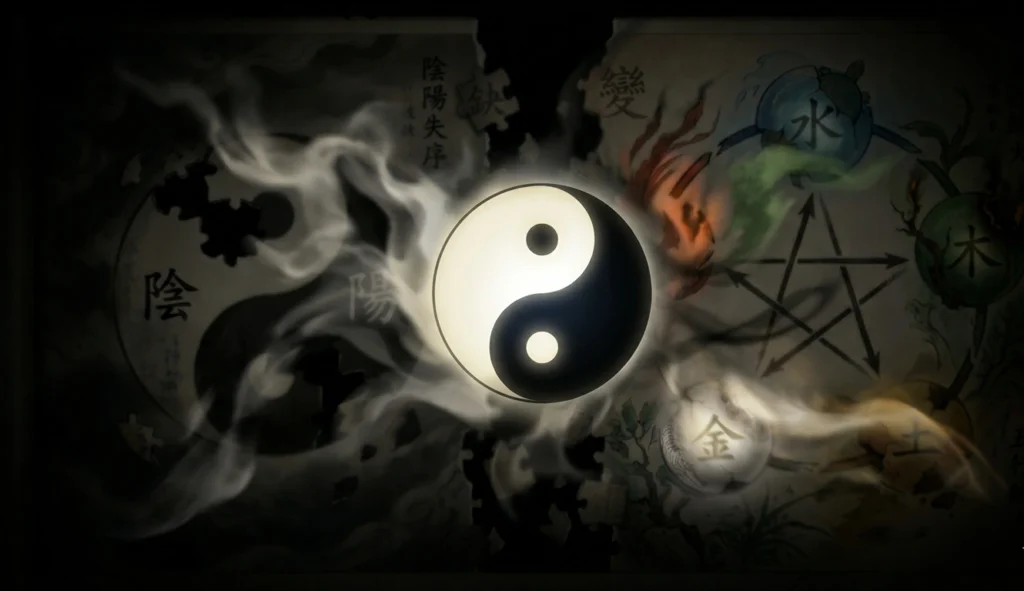
Yin-yang is extraordinary at describing how things change. The cycling between active and receptive, between expansion and contraction, between light and dark, this is a genuinely powerful framework for understanding dynamic processes.
But here’s its limitation: yin yang can only produce two states. Yin or yang. More yin, more yang. Yin becoming yang, yang becoming yin. As a binary, it gives you incredible dynamism but limited qualitative differentiation.
Try describing the difference between fire and water using only yin yang. You can say fire is more yang, water is more yin. But that doesn’t capture that fire transforms things into ash while water carries things along without fundamentally changing them. The binary doesn’t have enough texture.
In practical terms, yin-yang alone can tell you that summer is more yang than winter. It can’t tell you why summer is different from spring, even though both are “more yang than winter.” Both spring and summer are yang phases, but they’re clearly different in character. Yin-yang alone doesn’t have the vocabulary to explain that difference.
What the Five Elements can’t do alone
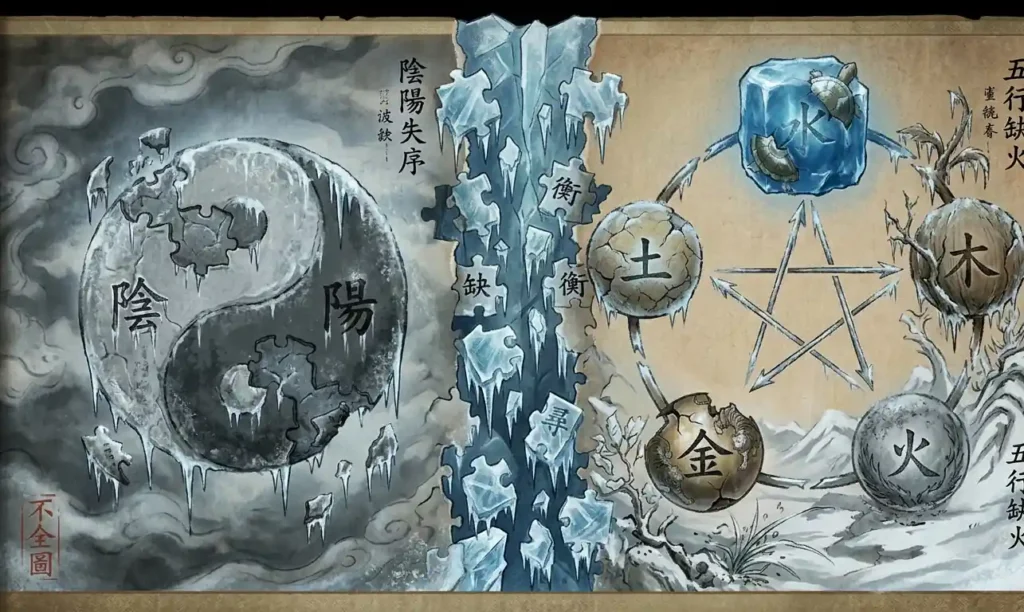
The Five Elements (Wu Xing, 五行) solve the texture problem. Wood, Fire, Earth, Metal, and Water are five distinct qualitative categories that map the full range of natural phenomena with genuine differentiation. Fire is different from Water in a way that “more yang” versus “more yin” can’t fully capture.
But here’s Wu Xing’s limitation: five static categories don’t explain why anything moves. You can label spring as Wood and summer as Fire and autumn as Metal and winter as Water. But why does Wood turn into Fire? Why does the cycle flow in that direction and not the other way? What’s the engine?
Without yin and yang, the Five Elements have no principle of motion. They’re five boxes. Interesting boxes with rich qualitative content, but boxes that things get sorted into, rather than a living dynamic system. The generating cycle (Wood feeds Fire, Fire produces Earth…) tells you the sequence. It doesn’t explain why the sequence has that direction.
The Mutual Dependency
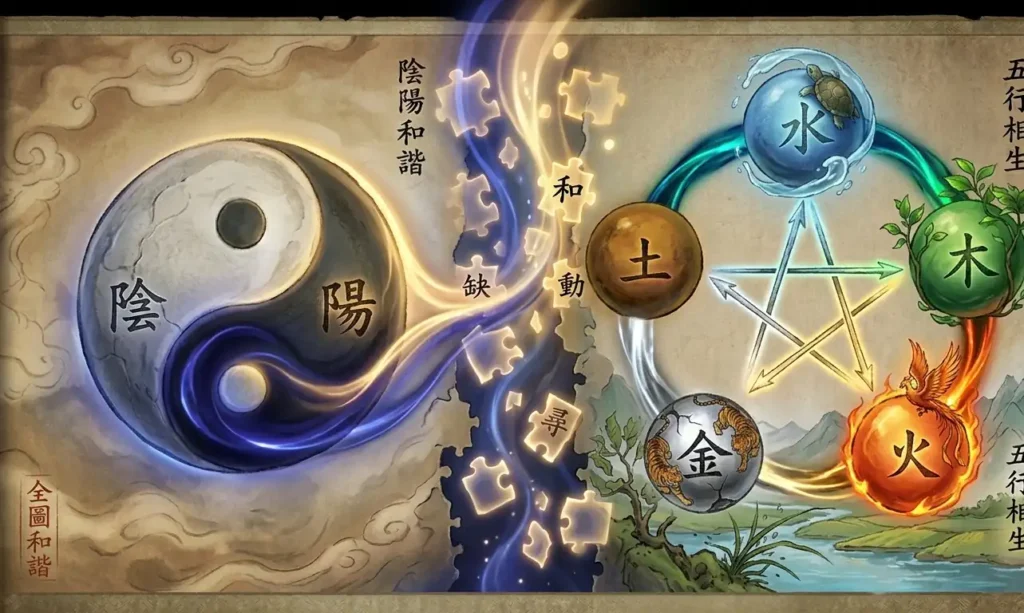
Put the two limitations together and the dependency becomes obvious:
- Yin yang provides dynamic cycling but lacks qualitative differentiation
- The Five Elements provide qualitative differentiation but lack dynamic cycling
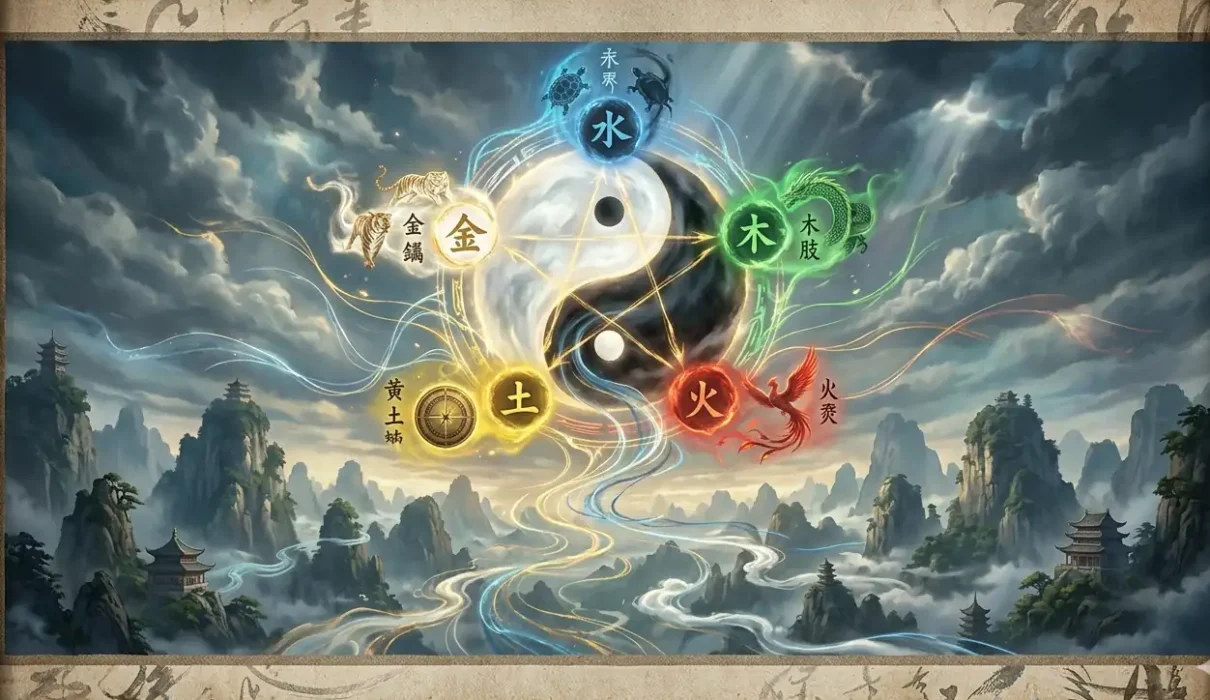
Each system has exactly what the other needs. Together, they form a complete cosmological picture of reality, a living, cycling system that differentiates the full qualitative range of natural phenomena.
That’s not a coincidence. It’s why both traditions developed together and why classical Chinese cosmological thinking has always deployed them simultaneously rather than alternately.
What Yin Yang Actually Contributes to the Five Elements
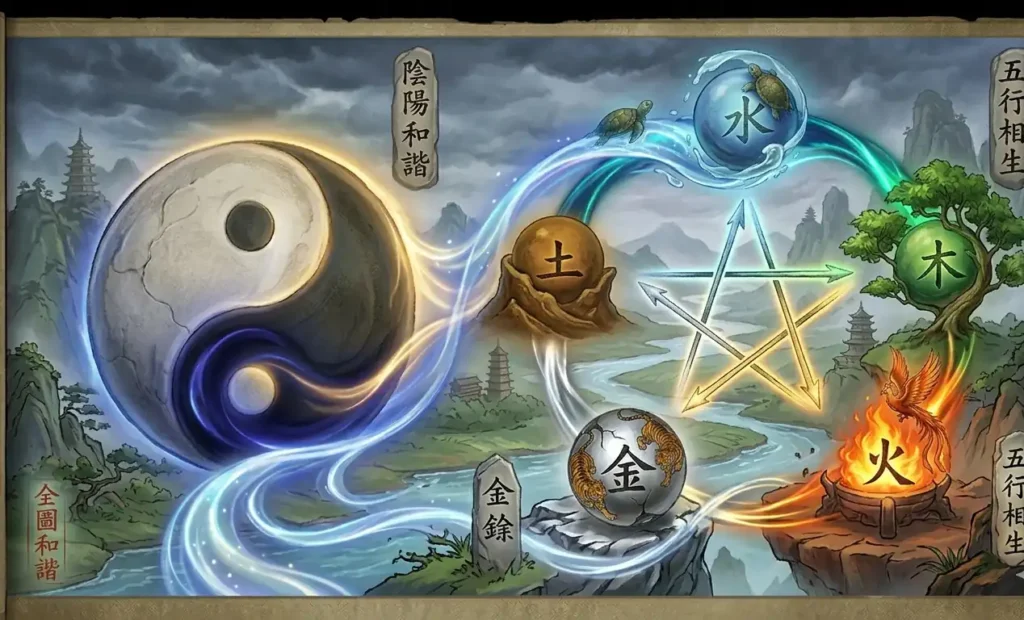
Let me be specific about what yin yang adds to Wu Xing because it’s more than just “labelling each element as yin or yang.”
The Direction of the Cycle
The generating cycle of Wu Xing goes in a specific direction: Wood → Fire → Earth → Metal → Water → Wood. Not the reverse. But Wu Xing itself doesn’t explain why this is the direction rather than the opposite.
Yin yang explains it. The generating cycle moves in the direction of yin-yang transformation:
- Wood (Lesser Yang) feeds Fire (Greater Yang) because this is yin-yang’s natural motion. Lesser Yang transforms toward Greater Yang
- Fire (Greater Yang) generates Earth (balance) because maximum yang initiates the return
- Earth (balance) produces Metal (Lesser Yin) because the balanced centre tilts toward yin
- Metal (Lesser Yin) collects Water (Greater Yin) because Lesser Yin transforms toward Greater Yin
- Water (Greater Yin) nourishes Wood (Lesser Yang) because maximum yin initiates the return toward yang
The generating cycle isn’t arbitrary. It’s the Five Elements expressing yin yang’s fundamental cycling motion. Remove yin yang and the direction of the cycle becomes unexplained.
The Principle of Transformation
Yin yang also explains how elements transform into each other, not just that they do. The transformation isn’t abrupt. It’s the gradual cycling from one yin-yang composition to another.
Spring (Wood, Lesser Yang) doesn’t suddenly become summer (Fire, Greater Yang). Yang gradually increases within the Wood phase until Greater Yang is expressed. The transformation is the yin-yang cycling principle made visible through the qualitative vocabulary of Wu Xing.
The Timing of Transitions
In classical Chinese calendrical thinking, the timing of seasonal transitions, when does spring ends and summer begins? is governed by yin-yang ratios, not by arbitrary calendar dates. When yang reaches a specific proportion relative to yin, the transition occurs. Wu Xing identifies the qualities. Yin yang determines the timing.
What the Five Elements Actually Contribute to Yin Yang
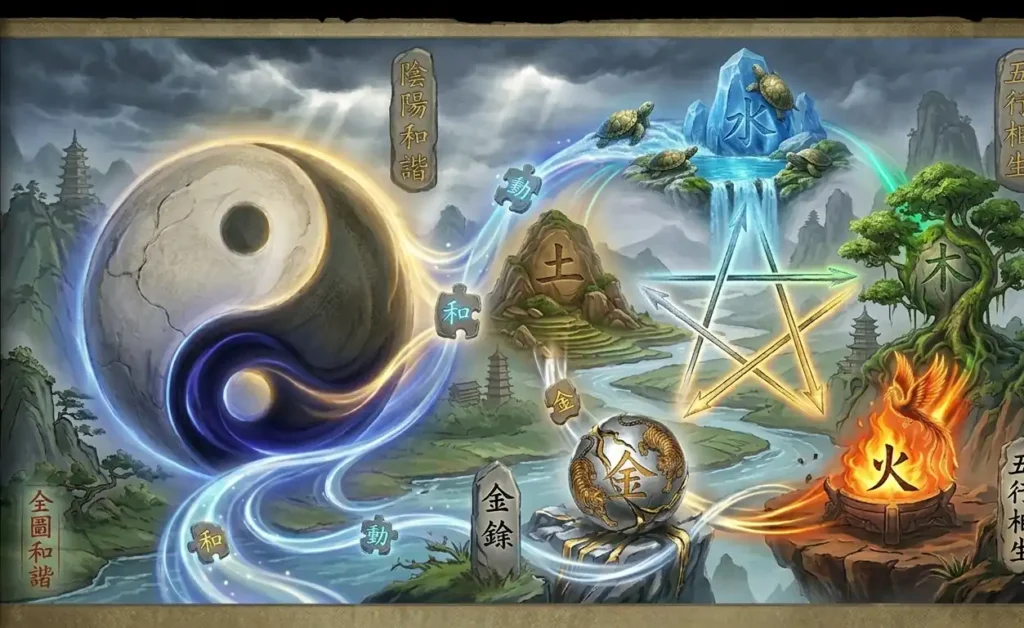
The contribution runs equally the other way, and this is the part that often gets overlooked.
Qualitative Texture for Change
Yin yang can tell you that the world is in a more yang phase right now. What it can’t tell you is what that means for specific phenomena. Is the yang energy of Wood-type (rising, growing) or of Fire-type (blazing, transforming)?
The Five Elements give yin yang’s transitions qualitative content. “Yang is increasing” becomes “yang is increasing in the manner of Wood, upward, vital, flexible.” The element specifies the texture of the yin-yang phase.
The Differentiation of Yin and Yang Themselves
This is something I find genuinely elegant. Within yin yang, there are different kinds of yin and different kinds of yang. Water is yin. Metal is also yin. But they’re clearly different kinds of yin. Water’s yielding depth is completely different from Metal’s sharp contraction.
The Five Elements provide the vocabulary to differentiate within yin and within yang. Without Wu Xing, yin yang can only say “more yin” or “less yin.” With Wu Xing, yin yang can say “yin-of-the-Water-type” or “yin-of-the-Metal-type.” The qualitative differentiation makes yin yang far more precise and applicable.
A Map of Phenomena for Yin Yang to Move Through
Yin yang is a dynamic principle. It needs something to cycle through a terrain it can traverse. The Five Elements provide that terrain. They’re the qualitative landscape through which yin yang’s transformations move.
Without the Five Elements, yin yang cycles through an undifferentiated field. With them, it moves through a richly mapped territory where each phase has a distinct character, associated phenomena, directional qualities, and body correspondences.
The Proof: Why You Need Both to Describe the Seasons
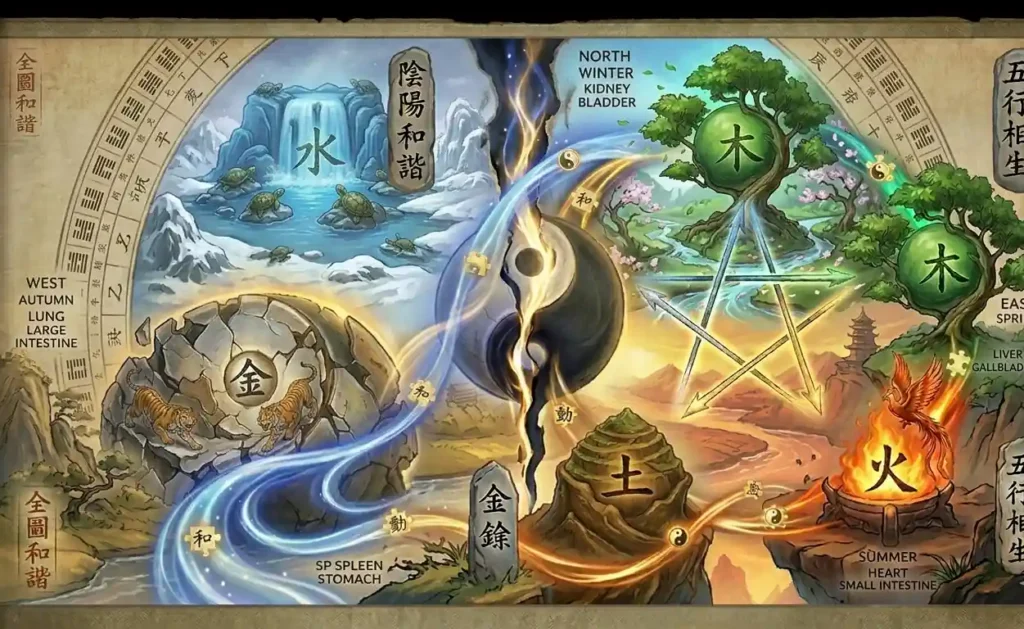
I want to make this concrete with the seasons, because I think it’s the clearest proof of mutual dependency.
Try describing the four seasons using only yin yang:
- Spring: yang increasing
- Summer: yang at maximum
- Autumn: yin increasing
- Winter: yin at maximum
That tells you the direction and intensity of the seasonal yin-yang shift. It doesn’t explain why spring feels different from summer even though both are yang phases. It doesn’t explain the specific quality of spring’s energy (rising, generative, flexible) versus summer’s (blazing, transformative, consuming). The binary isn’t enough.
Now try describing the four seasons using only the Five Elements:
- Spring: Wood
- Summer: Fire
- Autumn: Metal
- Winter: Water
That gives you rich qualitative texture for each season. But it doesn’t explain why the cycle flows from Wood to Fire to Metal to Water rather than in some other sequence. It doesn’t explain what drives the transformation from one season to the next. Without yin yang’s cycling principle, the five seasonal qualities are just five labels.
Now use both together:
- Spring is Wood (Lesser Yang – yang ascending from yin) – rising vital force, upward growth, flexible vitality
- Summer is Fire (Greater Yang – yang at maximum) – blazing outward expression, transformation at its peak
- Autumn is Metal (Lesser Yin – yin ascending from yang) – contraction, refinement, the harvest of what summer produced
- Winter is Water (Greater Yin – yin at maximum) – deep inward stillness, the reservoir before the next spring
Now you have both the quality of each season AND the principle of transformation between them. Spring becomes summer because Lesser Yang naturally transforms toward Greater Yang. Summer becomes autumn because maximum yang initiates the return toward yin. The cycle has both a direction and a texture.
That’s what both systems working together produces. That’s what neither can produce alone.
The Practical Applications That Require Both
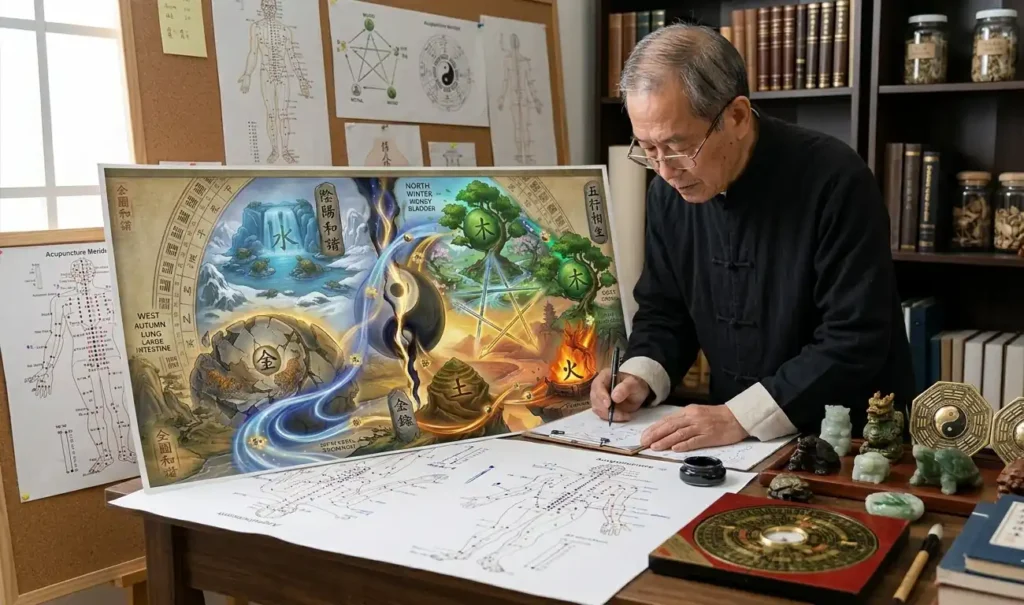
The mutual dependency isn’t just philosophical. it shows up in every major practical application of Chinese cosmological thinking.
Traditional Chinese Medicine
TCM is perhaps the clearest example. Diagnosis in TCM requires assessing both the yin-yang state of the patient AND the elemental character of what’s happening.
A patient presenting with excessive heat might be:
- A Fire element imbalance (too much of the Fire element’s transformative quality)
- A yang excess issue (yin-yang imbalance toward the yang pole)
- Or more specifically: a Wood-type yang excess, where the liver’s upward-moving yang has become excessive
That third diagnosis, which is common in classical TCM, requires both frameworks simultaneously. “Excessive yang in the Wood element domain” uses yin-yang for the directional character (excess, moving outward) and Wu Xing for the qualitative location (in the Wood/liver domain). You can’t make that diagnosis with one system alone.
Feng Shui
A feng shui assessment of a site considers both yin-yang qualities (the site’s overall dynamic character – is the energy active or still, exposed or sheltered?) and five-element qualities (what elemental energies dominate the site’s different sectors?).
Placing a water feature in a specific area of a home is a five-element intervention. Choosing the right size and quality of that water feature relative to the existing yin-yang balance of the space is a yin-yang intervention. Good feng shui practice requires both.
Chinese Astrology and the Calendar
The traditional Chinese calendar operates on a sixty-year cycle produced by combining the Ten Heavenly Stems (which encode yin-yang and five-element combinations) with the Twelve Earthly Branches. Each year in the cycle has both a yin-yang character and a five-element character. This year’s elemental and yin-yang qualities together determine its specific character. Neither dimension alone is sufficient.
The Unified Framework: What Both Systems Together Describe
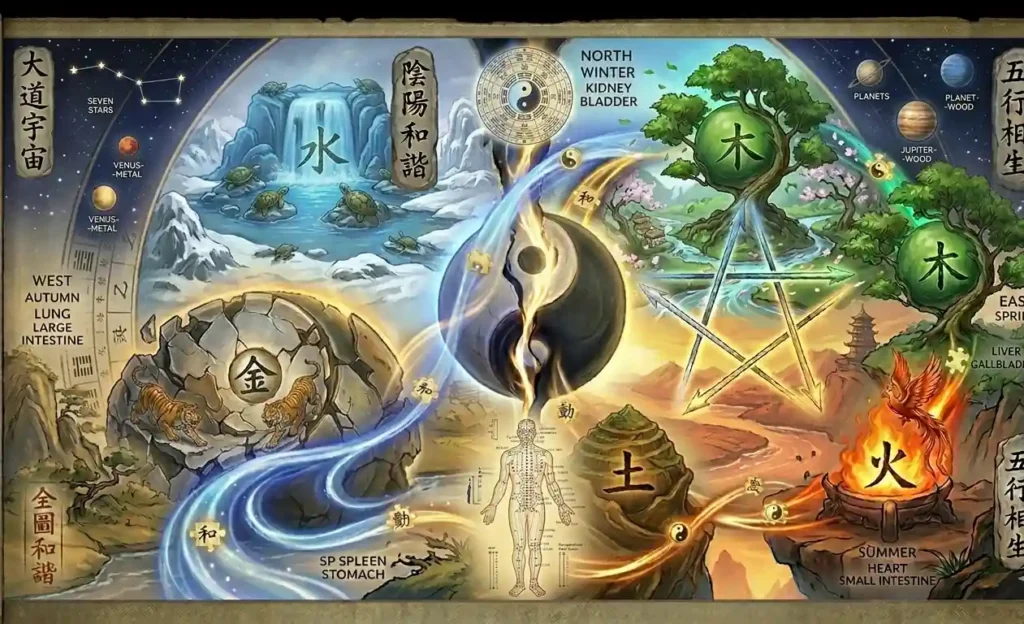
When I think about what yin yang and Wu Xing together actually describe, my working answer is this: the complete dynamic and qualitative structure of natural processes.
Yin-Yang describes:
- The direction of change
- The cyclical nature of transformation
- The complementary relationship between any two opposite phases
- The principle that maximum expression of one quality initiates the return toward the other
The Five Elements describe:
- The qualitative texture of each phase of change
- The five distinct types of natural process
- The specific generating and controlling relationships between qualities
- The concrete phenomena (seasons, organs, directions, colours) associated with each phase
Together they describe:
- Why the natural world changes (yin-yang cycling principle)
- How it changes (transformation through the generating sequence)
- What it’s doing at any given moment (five-element quality + yin-yang phase)
- Where it’s going (the next phase in the yin-yang cycle expressed through the next element)
That’s a remarkably complete picture for a philosophical framework developed over two thousand years ago. And it genuinely only works as a complete picture when both systems are operating together.
Frequently Asked Questions
Which system came first, Yin-Yang or the Five Elements?
By the Han Dynasty, Yin Yang and the Five Elements had merged into one unified cosmological system. Whether one came first matters less than why they needed each other to explain balance, transformation, and the structure of reality.
Can you use yin yang and the Five Elements independently in practice?
You can study them separately, but the analysis stays incomplete. Yin Yang explains direction and change, while the Five Elements reveal quality and transformation. In practices like TCM, feng shui, and Chinese astrology, both work together as one integrated system.
Do yin yang and the Five Elements always agree in their assessments?
In TCM, Yin Yang and the Five Elements offer different layers of diagnosis. One reveals energetic imbalance, the other shows elemental patterns, creating a deeper and more nuanced understanding when used together.
Is there a classical Chinese text that explains their integration?
The Huangdi Neijing uses Yin Yang and the Five Elements together throughout its teachings, showing they were understood as interconnected systems in classical Chinese cosmology and medicine.
How does this integration connect to the Four Holy Beasts?
The Four Holy Beasts unite Yin Yang and the Five Elements through elemental powers and yin yang aspects, embodying the balance and structure of Chinese cosmology as sacred guardian figures.
For more, read my full breakdown on the hidden connection between the Five Elements and the Four Symbols
Final Thoughts
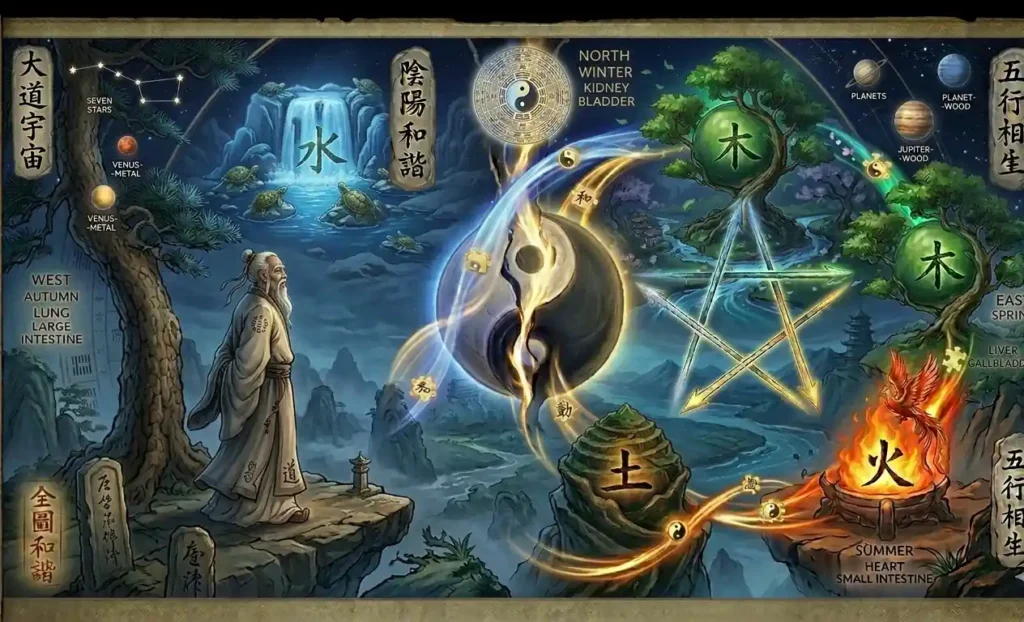
Neither system is incomplete in isolation in an obvious way. You can read extensively about yin-yang and feel like you understand it. You can read extensively about the Five Elements and feel the same. The limitation only becomes visible when you try to use either system for anything beyond surface description.
That’s actually what took me longest to see. The mutual dependency is invisible when you’re just learning the systems. It only becomes apparent when you try to apply them to something real, and you find that yin yang alone doesn’t give you enough texture, and the five elements alone doesn’t give you enough motion.
Together, though? Together they’re one of the most elegant descriptions of natural process that any tradition has produced. A binary cycling principle married to a five-quality map of phenomena, each system providing what the other lacks, both systems together producing something neither could produce alone.
Related Articles
- Is Yin Yang Demonic? The Truth You Don’t Know
- Ba Gua: Eight Trigrams, Meaning & Sacred Origins
- The Four Holy Beasts: Baihu, Qinglong, Zhuque & Xuanwu
- Why The Four Holy Beasts Cannot Exist Without Yin Yang
- Five Elements & The Four Holy Beasts [Hidden Connection]
- 7 Misconceptions About Yin Yang You Probably Believe
- Yin Yang, Five Elements & Four Symbols: China’s Complete Cosmos
References
- Stanford Encyclopedia of Philosophy – Daoism
- Joseph Needham, Science and Civilisation in China
- Dao De Jing (Tao Te Ching)
- Zhuangzi
- Daoism and Chinese Culture – Livia Kohn
- Lüshi Chunqiu (The Annals of Lü Buwei)
- Huainanzi
- Yin-Yang and the Nature of Correlative Thinking – Angus Charles Graham
- Lewis, Mark Edward. The Construction of Space in Early China.
- Huangdi Neijing
- Yinyang: The Way of Heaven and Earth in Chinese Thought and Culture – Robin Wang
- Shanhaijing (Classic of Mountains and Seas).
- Book of Changes: Yi Jing – Chinese Text Project