
 By
By Quick Takeaways:
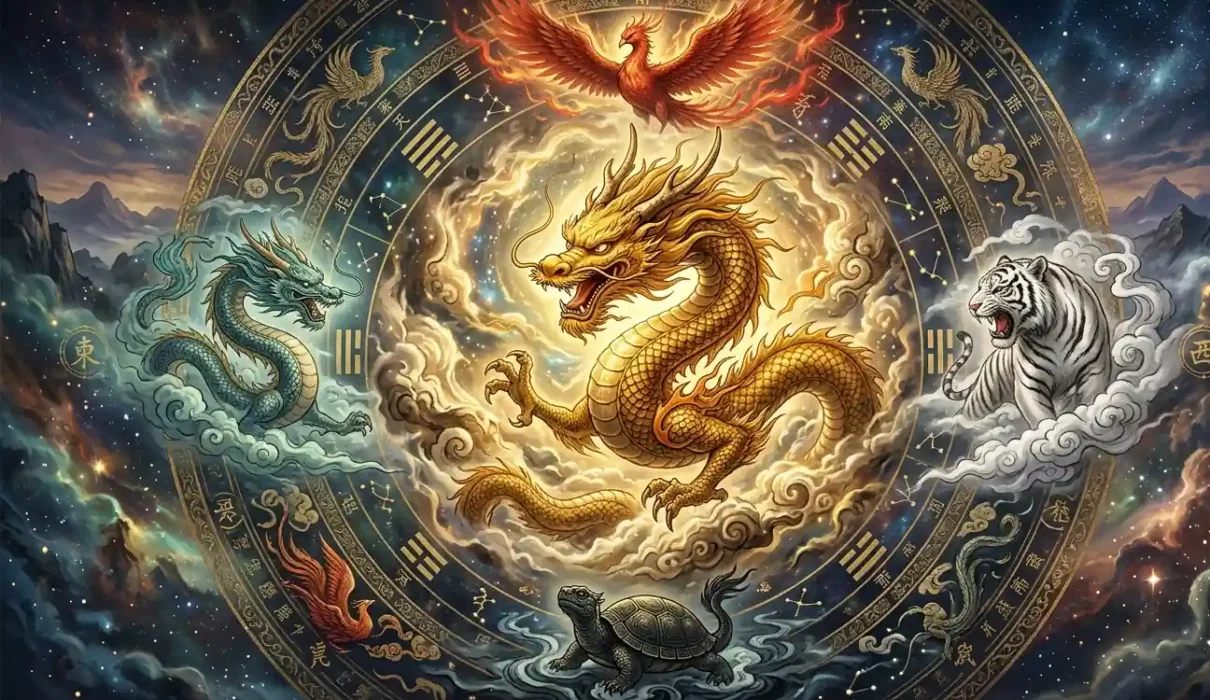
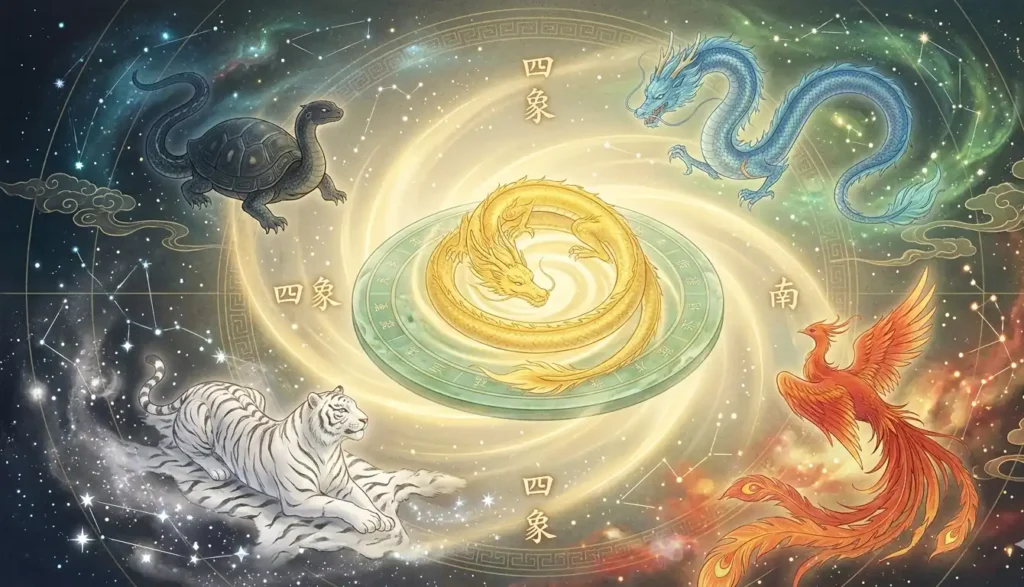
- The Four Holy Beasts of Chinese cosmology, Azure Dragon, Vermilion Bird, White Tiger, Black Tortoise, are actually part of a five-beast system that includes a fifth guardian: the Yellow Dragon
- The Yellow Dragon (Huanglong) governs the Centre, the Earth element, and the transitional periods between seasons rather than any single cardinal direction
- It’s closely associated with imperial authority in Chinese history, particularly the Yellow Emperor Huangdi, from whom it drew enormous symbolic power
- The Yellow Dragon never achieved the same cultural presence as the four directional guardians because it governs a concept, the center, that’s harder to visualize and place in art than a compass direction
- You can still find Yellow Dragon iconography in Chinese imperial architecture, classical texts, and traditional Chinese medicine’s Earth element symbolism
I’d been exploring Chinese mythology for about seven or eight years after I developed an interest in it because of my reading of cultivation novels. I came across a casual reference in my exploration of the Four Symbols about the fifth central guardian. I remember, I was surprised because during my xianxia reading, I did find references to a fifth central guardian, but it was not a Yellow Dragon.
The Azure Dragon, the Vermilion Bird, the White Tiger, the Black Tortoise. I’d spent my precious time working out those four in detail, and suddenly there was a fifth one that apparently nobody talked about. But after some thought and with my previous experience, I thought it made sense as each guardian controls an element and there are five elements so there should be five guardians.
The Yellow Dragon Huanglong (黄龍) is the guardian of the Centre, the ruler of the Earth element, and the most overlooked figure in Chinese cosmological mythology. And the reason it’s overlooked is itself one of the most interesting things about it.
The Fifth Guardian – Yellow Dragon Huanglong?
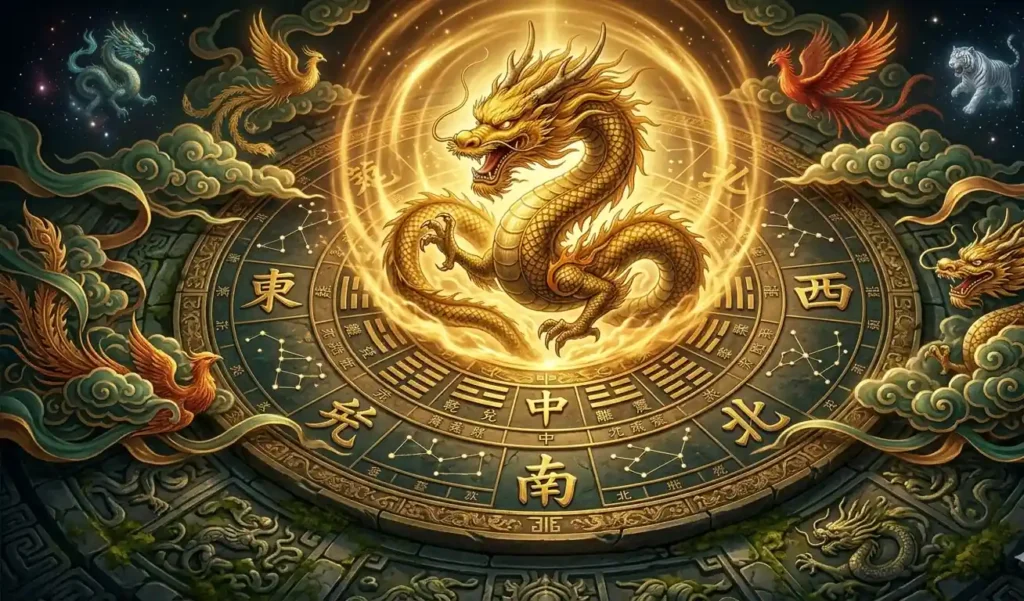
If you’ve spent any time with the Four Holy Beasts (or Four Symbols, or Si Xiang, they go by several names), you might be wondering why you’ve never heard of a fifth guardian. The answer is partly about how Chinese cosmology evolved and partly about the specific problem of representing a center that has no direction.
The system that most people encounter is the Four Symbols: four celestial animals, four cardinal directions, four seasons, four elements. It’s a clean, symmetrical system, and it maps beautifully onto compass directions and seasonal calendars. Four beasts for four directions make immediate intuitive sense.
But classical Chinese cosmological thinking didn’t work in fours. It worked in fives.
The Wu Xing (五行), the five-phase or five-element system, has five elements: Wood, Fire, Earth, Metal, and Water. Five directions: East, South, Centre, West, North. Five seasons, if you include the transitional periods between seasons as a discrete temporal category. Five sacred animals to correspond to all of the above.
The Four Holy Beasts cover the four cardinal directions with their corresponding elements: Wood in the East, Fire in the South, Metal in the West, Water in the North. The Center, with its Earth element, needed its own guardian. That guardian is the Yellow Dragon.
The reason we usually hear about four rather than five is partly that the directional guardians lend themselves much more easily to visual representation and practical application. You can put four guardian beasts on the four walls of a tomb. You can orient a city around four directional guardians.
The Centre is harder to represent. It’s not a wall, it’s a position, and it governs a principle (balance, transition, the stable ground beneath everything else) rather than a specific geographic or temporal reference point.
Yellow Dragon Chinese Mythology
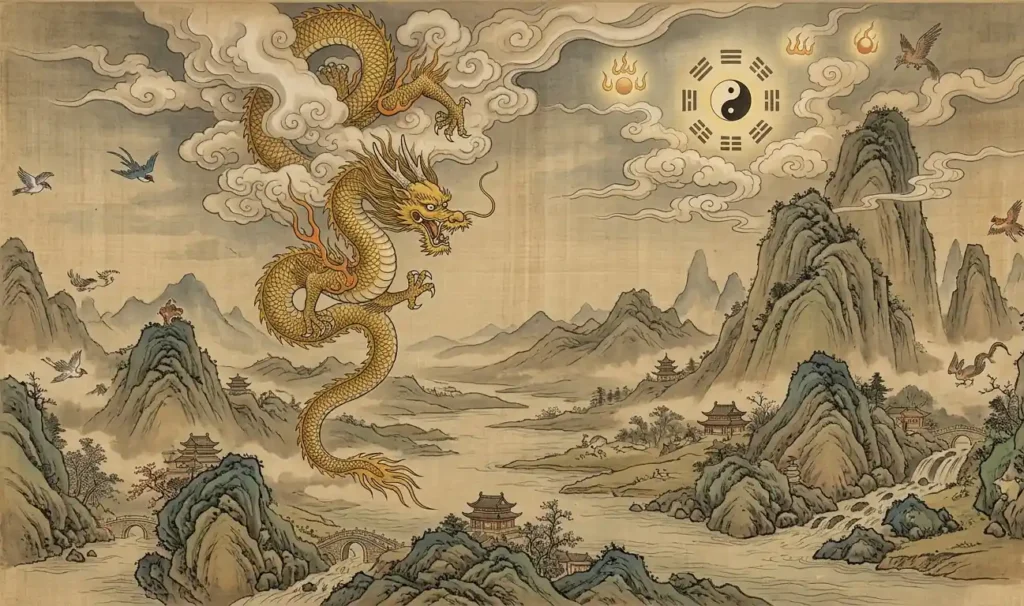
Huanglong is a dragon, specifically a yellow dragon, which matters more than it might sound. In classical Chinese color symbolism, yellow is the color of the center, of the Earth element, and most powerfully, of imperial authority. The emperor’s robes were yellow. The Forbidden City’s roof tiles are yellow-glazed. Yellow is the color of heaven’s mandate made visible on earth.
The Yellow Dragon’s dragon form connects it to the Azure Dragon (Qinglong) of the East, but they’re distinct figures with different cosmological roles. Where the Azure Dragon is one of four directional celestial animals, essentially an astronomical figure whose form can be traced in the eastern lunar mansions, Huanglong is positioned at the center of the entire system.
It’s less a guardian of a specific place and more the axis around which the other four guardians rotate.
Physically, Huanglong is described in classical texts as having scales that shimmer with golden-yellow light, occasionally generating a luminous radiance. Some texts give it five colors across its scales, incorporating all five elemental colors, which makes sense given its role as the integrating center of the five-element system. It’s the one guardian that contains elements of all the others.
The figure I find most fascinating about Huanglong is that it appears in Chinese mythology not just as a cosmological principle but as an actual visitor, a being that shows up at specific historically important moments to deliver a message or a gift. And that brings us to the most important mythological story associated with it.
The Yellow Dragon and the Yellow Emperor: The Founding Myth
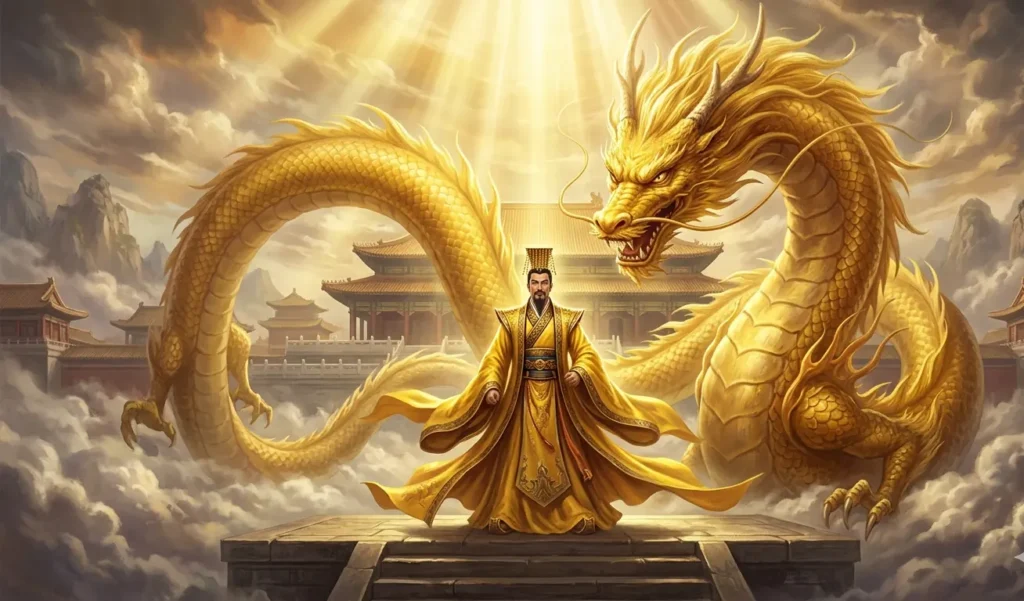
The Yellow Dragon’s deepest mythological roots connect it to Huangdi, the Yellow Emperor, one of the legendary culture heroes and mythological founders of Chinese civilization. This connection is so foundational that it’s worth understanding properly.
According to classical Chinese mythology, the Yellow Dragon appeared to Huangdi on the banks of the Luo River, carrying a He Tu, a diagram or chart of cosmic patterns on its back.
This gift was understood as heaven’s communication to the sage emperor, providing him with knowledge that enabled him to rule in alignment with the cosmic order. Some accounts specifically credit this transmission with the origin of the Chinese writing system, or with the systematic understanding of the five elements, or both.
This is one of Chinese mythology’s most persistent narrative patterns: a divine animal emerges from water bearing a diagram of cosmic knowledge and presents it to a worthy ruler. The same pattern appears with the Luo Shu (a numerical diagram) appearing on a tortoise’s back for the mythological emperor Yu.
In both cases, the divine animal isn’t just a symbol. It’s an active participant in the transmission of civilizational knowledge from the cosmic order to humanity.
What fascinates me about this story is how specifically Chinese it is in its structure. It’s not a god descending to deliver commandments. It’s a cosmic animal delivering a pattern, a diagram of how reality works that a wise human then has to understand and apply. The emphasis is on wisdom, on the ability to read and implement the cosmic order, rather than on divine fiat.
The Yellow Emperor’s name, Huangdi, literally means Yellow Emperor, Huang being the same word as in Huanglong. This naming correspondence isn’t coincidental. It reflects a deep cosmological alignment: the legitimate sovereign of the human realm corresponds to the guardian of the center in the cosmic realm.
The Yellow Dragon is, in a very real sense, the imperial guardian beast, the animal expression of the same centering principle that a just ruler embodies in human governance.
The Yellow Dragon’s Cosmological Role: Earth and the Center
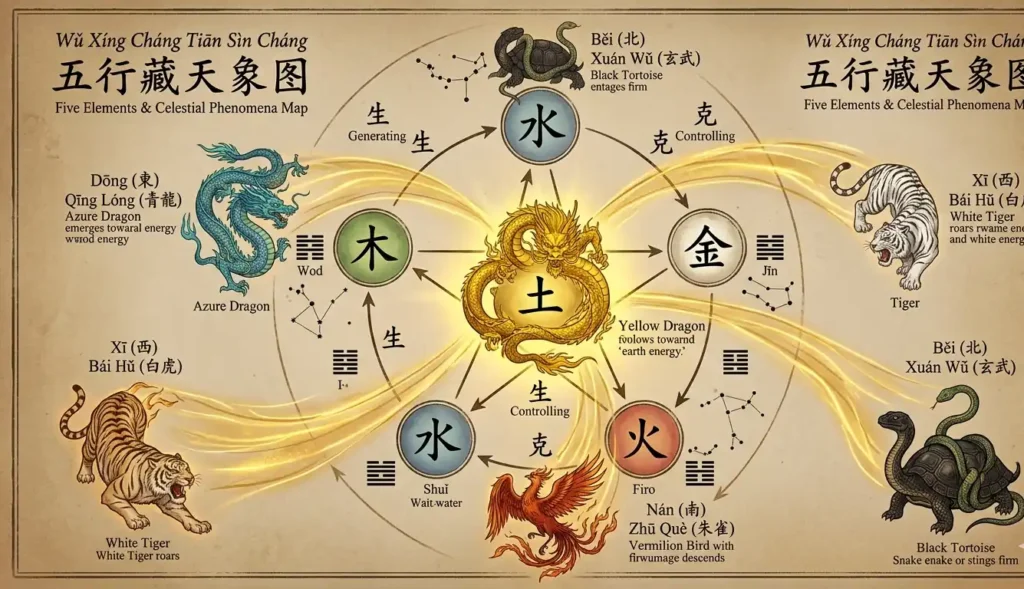
Let’s get specific about what the Yellow Dragon actually governs, because “the Center” can sound abstract until you understand what it means in the five-element framework.
In Wu Xing cosmology, Earth (土, Tǔ) has a unique positional status that distinguishes it from the other four elements:
Earth occupies the center rather than a cardinal direction. While Wood, Fire, Metal, and Water each govern a specific compass direction, Earth governs the center point, the axis around which everything else rotates. In some classical representations, Earth sits between each pair of seasonal transitions rather than having its own discrete season.
Earth governs transition. The four cardinal beasts each own a season: Wood/Spring, Fire/Summer, Metal/Autumn, Water/Winter. Earth governs the eighteen days before each seasonal transition, four periods of eighteen days each, totaling seventy-two days of the year. It’s the element of the threshold, the moment between one state and the next.
Earth is the stabilising force. In the five-element generating cycle (Wood feeds Fire, Fire produces Earth, Earth bears Metal, Metal collects Water, Water nourishes Wood), Earth is produced by Fire and produces Metal. But Earth also serves as the stabilising ground within which the other elements operate. It’s what doesn’t move while everything else cycles.
The Yellow Dragon governing these qualities makes it the guardian of stability rather than of any particular expression of cosmic energy. It’s the still point. The other four guardians are aspects of the cycle. The Yellow Dragon is the axis the cycle turns on.
This cosmological role is sophisticated and genuinely interesting from a philosophical standpoint. Most guardian systems have a supreme guardian, the most powerful figure. Chinese cosmology gives the centering principle to a dragon that governs precisely by not governing any specific direction. Its authority is the authority of balance rather than dominance.
The Yellow Dragon in Chinese Religious and Imperial Tradition
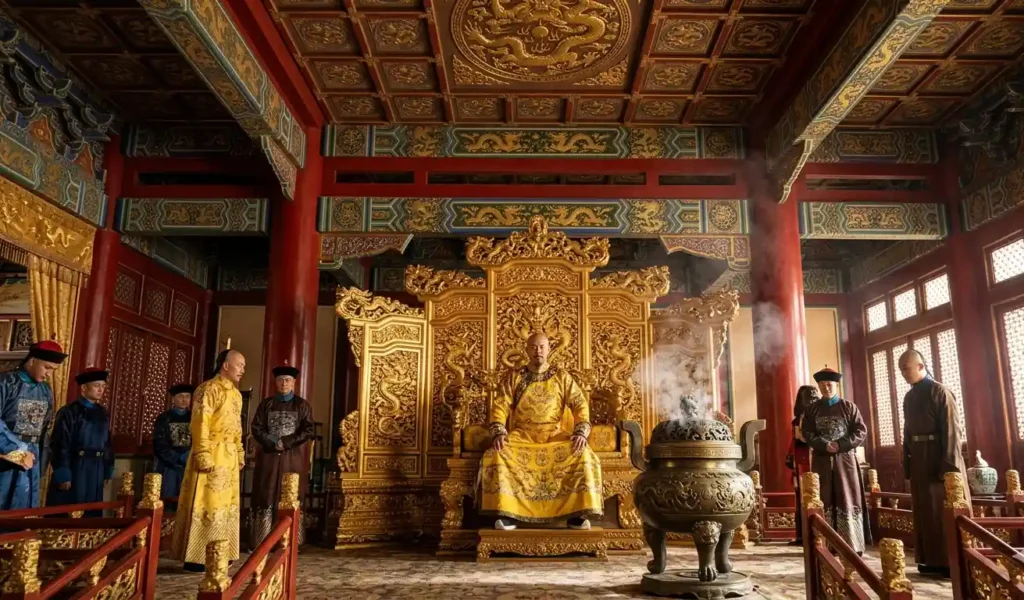
Beyond cosmological philosophy, Huanglong has a real presence in Chinese religious and imperial practice that’s worth knowing about.
Imperial symbolism is where you’ll find Huanglong most prominently. The five-clawed yellow dragon became the exclusive symbol of the Chinese emperor, reserved for imperial use and forbidden to commoners. This wasn’t arbitrary. It connected the emperor directly to the Dragon as the guardian of the center, symbolically positioning the ruler as the human expression of the same centering, stabilizing cosmic principle.
Daoist tradition incorporates Huanglong in its pantheon of divine beings. In Daoist religious practice, the Yellow Dragon appears as a deity of a specific rank and function rather than as a purely philosophical principle. It’s invoked in certain ritual contexts related to Earth element cultivation, to the stabilization of spaces, and to the center direction in directional ritual magic.
The Yellow Dragon Temple (Huanglong Temple) in Sichuan province is one of the most significant physical expressions of Yellow Dragon veneration in China.
The Huanglong Scenic Area, a UNESCO World Heritage Site, takes its name from a legend in which a yellow dragon helped the mythological hero Yu tame the floods that threatened early Chinese civilization, and then settled in the area whose colored mineral pools make it look, genuinely, like the scales of a dragon lying across the landscape. It’s one of those places where mythology and geography meet in a way that makes you understand why the story developed.
Why The Yellow Dragon Got Forgotten
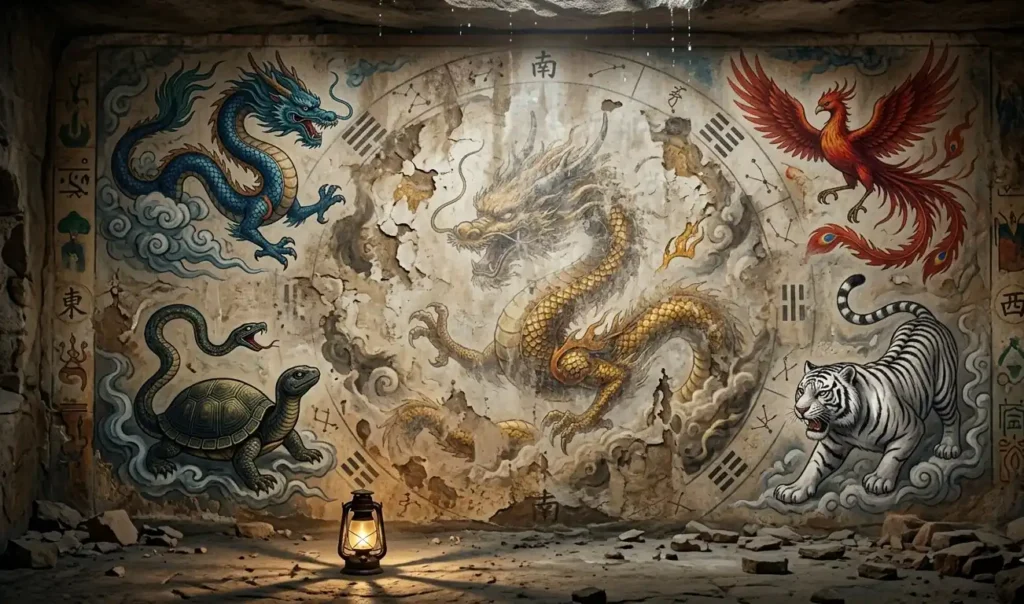
Here’s what I think happened, and I’ll be direct about it being my interpretation rather than established consensus.
The Four Holy Beasts system became culturally dominant over the five heavenly beasts system for one simple practical reason: you can draw it on four walls.
Tomb art, temple orientation, city planning, compass design, all of these applications work beautifully with four directional guardians. You put Qinglong on the east wall, Zhuque on the south, Baihu on the west, and Xuanwu on the north. Done. The system is visually complete, spatially legible, and practically applicable.
Where do you put the Yellow Dragon in that scheme? At the center, which in a room, a tomb, or a city is the inhabited space itself, not a wall or a boundary. The Yellow Dragon governs the space you’re already in. That’s conceptually sophisticated but visually awkward. You can’t put a guardian painting at the center of a room because that’s where people stand.
The cultural transmission that carried the Four Holy Beasts across East Asia to Japan as Byakko, Suzaku, Seiryu, and Genbu; to Korea as Baekho, Jujak, Cheongryong, and Hyeonmu; to Vietnam in their own equivalents carried the four directional guardians because those were the ones with practical application. The fifth guardian, the center guardian, stayed behind.
There’s also something to be said about the difference between visible power and structural power. The Azure Dragon blazes in the eastern sky. The Vermilion Bird blazes in the southern sky. These are spectacular, visually arresting celestial figures. The Yellow Dragon governs the centre, the principle of stability, the axis that doesn’t move. Stability is harder to make dramatic than a blazing fire bird.
Where You Can Still Find the Yellow Dragon
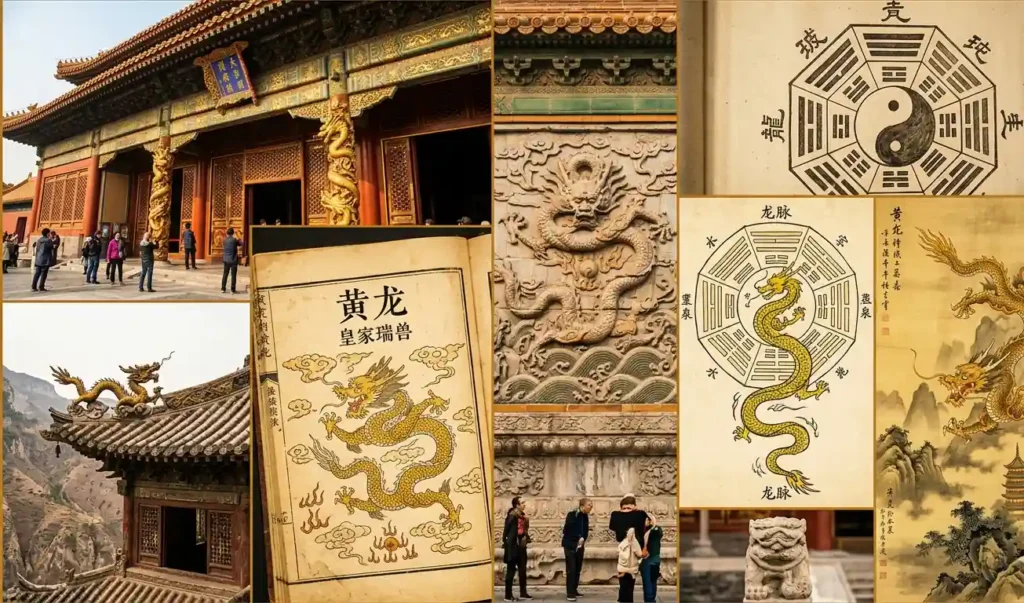
The Yellow Dragon hasn’t disappeared it’s just less prominently signposted than its four companions. Here’s where to look:
Classical Chinese cosmological texts – the five-beast system appears in texts discussing the complete Wu Xing framework. The Huainanzi, the Lüshi Chunqiu, and various classical Han Dynasty texts reference Huanglong explicitly in its centering role.
Imperial Chinese architecture – Yellow dragon imagery saturates the Forbidden City and other imperial complexes. Knowing that the five-clawed yellow dragon is the emperor’s connection to Huanglong as the center guardian transforms the meaning of what you’re looking at.
The Huanglong Scenic Area, Sichuan – If you ever visit, the colored travertine pools really do look like dragon scales. The legend makes much more sense on the ground than it does on the page.
Traditional Chinese medicine – The Earth element and its associated organ systems (spleen and stomach) carry Huanglong’s philosophical signature. TCM’s emphasis on Earth as the digestive center that transforms and distributes nourishment from all the other elements reflects the Dragon’s cosmological role.
Five-directional protective ritual – In Daoist ritual contexts that invoke all five directions (East, South, West, North, Centre) rather than just four, the center invocation is Huanglong’s domain.
Frequently Asked Questions
Is the Yellow Dragon the same as the Azure Dragon (Qinglong)?
is the Azure Dragon of the East, linked to Wood, Spring, and the eastern sky as one of the Four Symbols. Huanglong is the Yellow Dragon of the Centre, tied to Earth, seasonal transitions, and imperial authority. They are separate dragons with distinct cosmological roles in the five element system.
Why is the Yellow Dragon associated with the emperor?
Because the emperor’s authority was seen as the earthly expression of the same centering and stabilizing force embodied by Huanglong. The centre governs the balance of the four directions, just as the ruler governs the realm. Yellow symbolized Earth, the center, and the imperial mandate, while the five-clawed yellow dragon represented this cosmic alignment.
What season does the Yellow Dragon govern?
Rather than ruling a single season, Yellow Dragon governs the transitional periods between them. In traditional Chinese calendrical thought, it presides over the eighteen days before each seasonal change, creating four transition phases across the year that total seventy-two days. It is the guardian of thresholds and balance rather than the seasons themselves.
Is Huanglong actually part of the Four Holy Beasts tradition?
Technically, Yellow Dragon belongs to the Five Holy Beasts tradition, of which the better known Four Holy Beasts system is a subset. The five beast framework reflects the complete Wu Xing five element system, while the four beast framework aligns with the cardinal directions. Both are authentic traditions, though the four beast system became more widespread through art and architecture.
Where does the Yellow Dragon appear in Chinese mythology?
Most prominently in the founding mythology of the Yellow Emperor Huangdi, where it appears bearing the He Tu (cosmic diagram) from the Luo River. It also appears in flood mythology, where it assists the legendary hero Yu in taming the great floods. In Daoist religious tradition, it appears as an active deity rather than a purely cosmological symbol.
Final Thoughts
The Yellow Dragon didn’t get left out because it’s unimportant. It got left out because it governs something that doesn’t translate easily into visual decoration or simple directional symbolism.
But here’s what I keep coming back to: of all five guardians, the Yellow Dragon might be the one with the most philosophically interesting job. The Azure Dragon blazes, the Vermilion Bird dazzles, the White Tiger intimidates, and the Black Tortoise endures. The Yellow Dragon holds the center. It governs balance, transition, the stable ground that makes all the cycling possible.
In a mythology tradition that understands the cosmos as a dynamic, constantly cycling system of complementary forces, the guardian of the still point at the centre of that system is arguably doing the most essential work of all. It just doesn’t make for as dramatic a tomb painting.
Related Articles
- Xuanwu: Black Tortoise of the North Symbolism & Mythology
- Why the Four Holy Beasts Cannot Exist Without Yin Yang
- Yin Yang, Five Elements & Four Symbols: China’s Complete Cosmos
- Are the Four Heavenly Kings & Four Holy Beasts the Same?
- The Four Holy Beasts: Baihu, Qinglong, Zhuque & Xuanwu
References
- Birrell, Anne. Chinese Mythology: An Introduction.
- Eberhard, Wolfram. A Dictionary of Chinese Symbols.
- Major, John. Heaven and Earth in Early Han Thought.
- The Chinese Sky
- Lewis, Mark Edward. The Construction of Space in Early China.
- Kohn, Livia. Daoism and Chinese Culture.
- Allan, Sarah. The Shape of the Turtle.Hanshu (Book of Han).
- Shanhaijing (Classic of Mountains and Seas).
- Shiji (Records of the Grand Historian).
- Falkenhausen, Lothar von. Chinese Society in the Age of Confucius.
- Lü ‘s Spring and Autumn Annals; Volume I: Lüshi Chunqiu – Lü Buwei