
 By
By Quick takeaways:
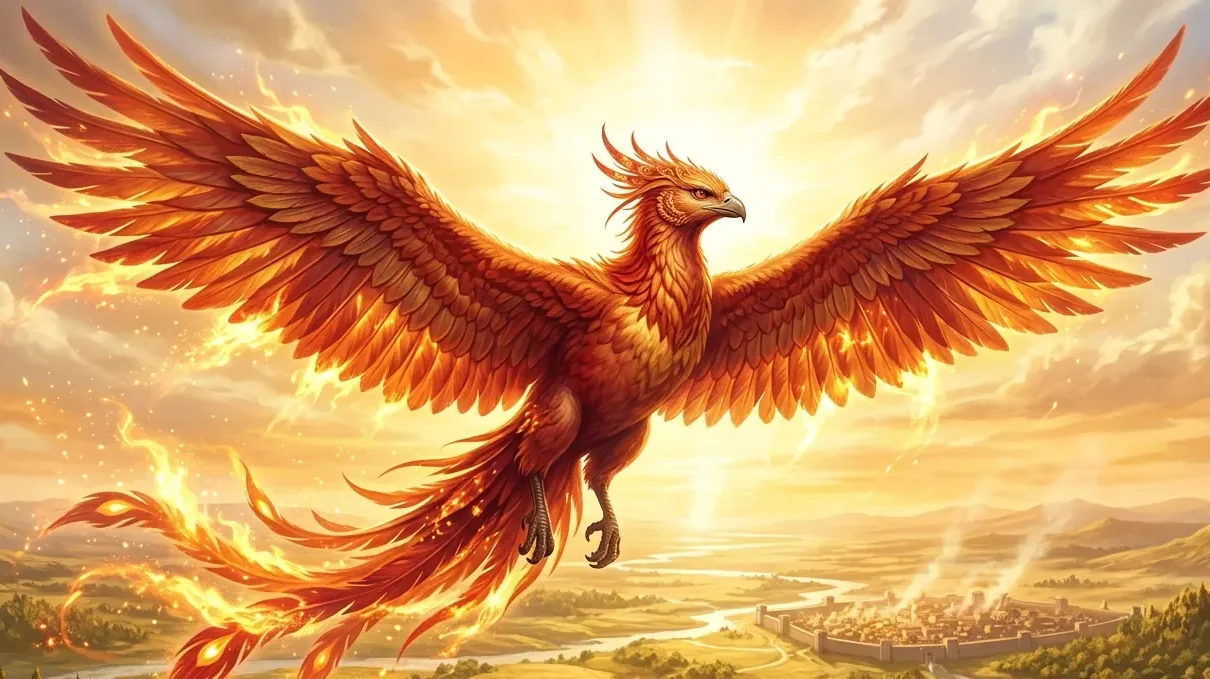
- Suzaku is the Japanese name for the Vermilion Bird, one of the Four Symbols of East Asian cosmology, guardian of the South, and ruler of the Fire element and summer season
- The Vermilion Bird originates in Chinese astronomy and cosmology as Zhuque, one of four celestial guardian beasts governing cardinal directions, elements, and seasons
- Suzaku is frequently mistaken for a phoenix, but is a distinct mythological figure with different origins, attributes, and cosmological roles
- Korea and Vietnam each developed distinct but closely related Vermilion Bird traditions, with Jujak and Chu Tuoc carrying the same guardian function with local cultural inflections
- In xianxia and cultivation fiction, Suzaku and Zhuque appear as divine beasts, fire-element bloodlines, sect patron figures, and the most coveted of all elemental spiritual beast companions
Suzaku is one of the Four Symbols of East Asian cosmology, a figure that China, Japan, Korea, and Vietnam each received, adapted, and honoured in ways that are simultaneously consistent and culturally distinct.
The first time I encountered a Vermilion Bird was not in the cultivation novel, but in a Chinese TV series, Ever Night, I made the same mistake almost every Western reader makes. I assumed it was a phoenix. The blazing red plumage, the fire affinity, the sense of divine magnificence, everything pointed to the phoenix I already knew from Western mythology.
It took several more novels and a deliberate detour into Chinese cosmological texts before I understood that the Vermilion Bird is its own figure entirely, with its own origins, its own cosmological role, and a symbolic depth that the phoenix comparison obscures rather than illuminates.
This is the complete account of Suzaku and the Vermilion Bird: its origins, its meaning across four cultures, its relationship to the phoenix, and why cultivation fiction keeps returning to it across hundreds of series.
Origins: The Four Symbols and the Celestial Map
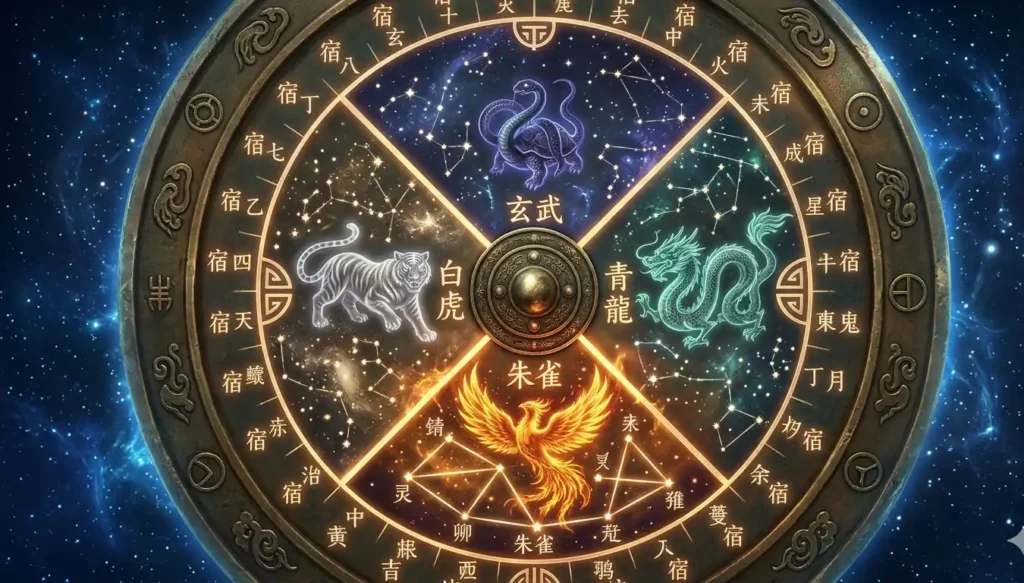
The Vermilion Bird’s story begins in the same place as every one of the Four Symbols, in the ancient Chinese division of the night sky into four celestial quadrants.
Chinese astronomers of antiquity mapped the sky into four groups of seven lunar mansions each, with each group associated with a cardinal direction, a season, an element, a color, and a guardian beast. The four figures produced by this system are the Si Xiang, the Four Symbols:
- Qinglong, the Azure Dragon of the East
- Zhuque, the Vermilion Bird of the South
- Baihu, the White Tiger of the West
- Xuanwu, the Black Tortoise of the North
Together they constitute a complete cosmological map describing not just space but time, elemental energy, and the forces governing the natural world and human affairs.
The Vermilion Bird governs the South, the direction of maximum sunlight, of high noon, of the world at its fullest outward expression. Its season is summer, the peak of yang energy. Its element is Fire, with Fire’s qualities of transformation, illumination, upward movement, and the conversion of matter into energy and light. Its colour is vermilion, the deep red associated in Chinese culture with good fortune, celebration, vital energy, and the active outward force of life.
These attributes give Zhuque a character that is simultaneously regal and transformative. It is not simply a fire creature. It is the embodiment of southern celestial authority, of summer’s abundance and heat, of the principle of maximum outward manifestation.
Zhuque: The Vermilion Bird in Chinese Mythology
Cosmological Role and Celestial Astronomy
Zhuque (朱雀, Vermilion Bird or Vermilion Sparrow) is the Chinese source from which all East Asian Vermilion Bird traditions descend. In classical Chinese cosmological thought, Zhuque is one of the four great guardians of the cosmos, the ruler of the southern heaven, and the presiding spirit over the seven southern lunar mansions whose star positions trace the outline of a bird in flight across the southern sky.
The seven southern lunar mansions assigned to Zhuque are Well, Ghost, Willow, Star, Extended Net, Wings, and Chariot. Together, their star positions were understood by classical Chinese astronomers to form the body, wings, and tail of a great celestial bird. Zhuque does not merely represent or symbolize the southern sky. In classical cosmological thinking, it is the southern sky’s animating spirit, the intelligence behind that portion of heaven’s influence on earth below.
This astronomical grounding gives Zhuque an authority and specificity that purely mythological fire birds often lack. When ancient Chinese scholars looked south at night, they saw a bird written in stars. The mythology follows from that observation rather than preceding it.
Fire, Summer, and the Southern Attributes
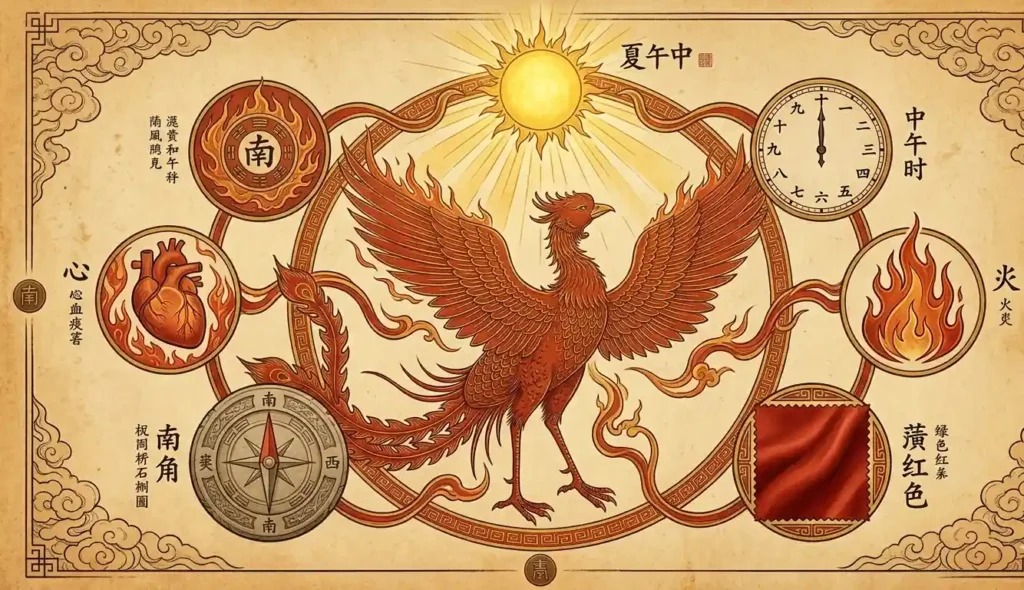
Zhuque’s elemental and seasonal attributes are among the most consistent in the Four Symbols tradition:
- Direction: South, the direction of maximum solar influence
- Season: Summer, the peak of yang energy and outward vital force
- Element: Fire, governing transformation, illumination, and ascending energy
- Colour: Vermilion, the deep warm red of fire, celebration, and vital power
- Celestial quality: Supreme yang, the fullest outward expression of the cosmos
- Time of day: Noon, when the sun reaches its southern peak
These attributes combine to make Zhuque the Four Symbols’ most immediately powerful figure in terms of outward manifestation. Where Baihu’s Metal element governs contraction and refinement, and Xuanwu’s Water element governs storage and depth, Zhuque’s Fire element governs the moment of maximum expression, transformation, and visible power.
This is why fire-element cultivators in xianxia tend to specialise in offensive techniques: they are drawing on Zhuque’s fundamental cosmological character.
Protective Symbolism and Auspicious Meaning
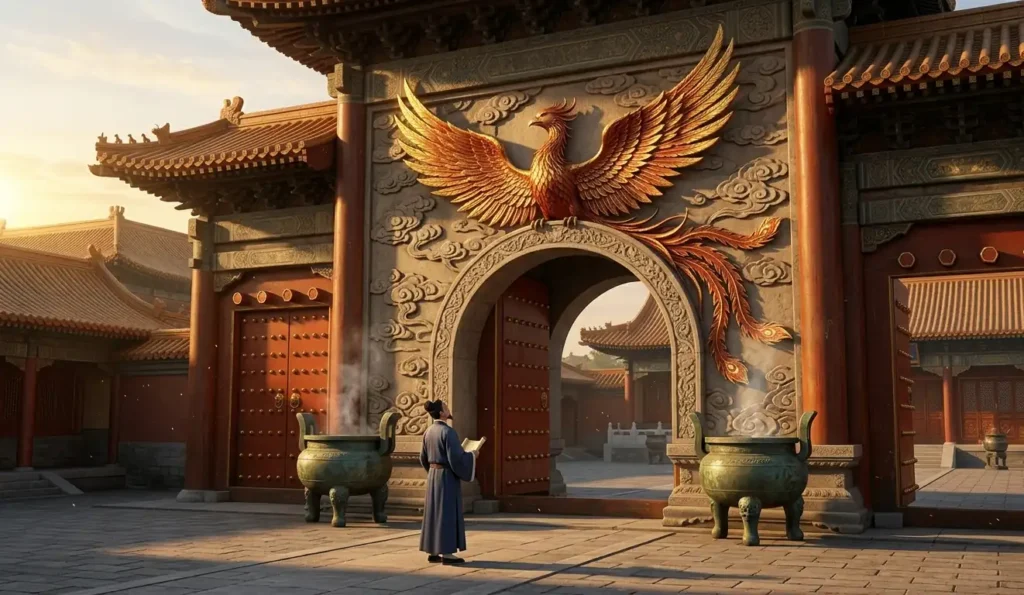
Beyond its cosmological role, Zhuque carries powerful protective and auspicious associations in Chinese cultural tradition:
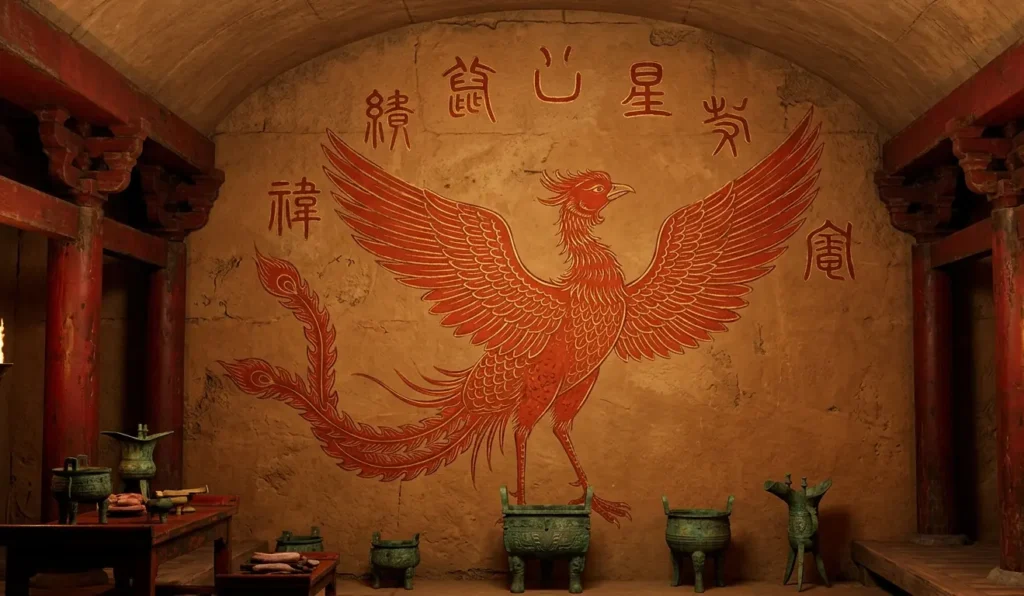
- Tomb protection: Like Baihu, Zhuque images were placed on tomb walls to protect the dead, specifically on the south wall facing the direction of the sun’s maximum power
- Architectural protection: Southern gates of important buildings and cities were placed under Zhuque’s guardianship, the south being the direction of yang vitality and auspicious solar force
- Military symbolism: The southern position in Chinese military formation theory was assigned to Zhuque, whose fire energy represented the attacking force that projects outward from a defended position
- Good fortune: Vermilion colour and bird imagery combined to make Zhuque one of the most auspicious symbols in classical Chinese visual culture, appearing in decorative arts, textiles, and ceremonial contexts
In Daoist cosmology, Zhuque holds a specific internal cultivation correspondence. The Fire element governs the heart and small intestine in traditional Chinese medicine, and Zhuque’s southern, noon, and summer associations connect it to the peak of qi activity in the body’s daily energy cycle.
Daoist internal cultivation texts that work with the four directional energies assign Zhuque’s fire qi to heart cultivation, to practices undertaken at noon or during summer, and to techniques emphasizing outward projection of internal energy.
Suzaku: The Vermilion Bird in Japanese Tradition
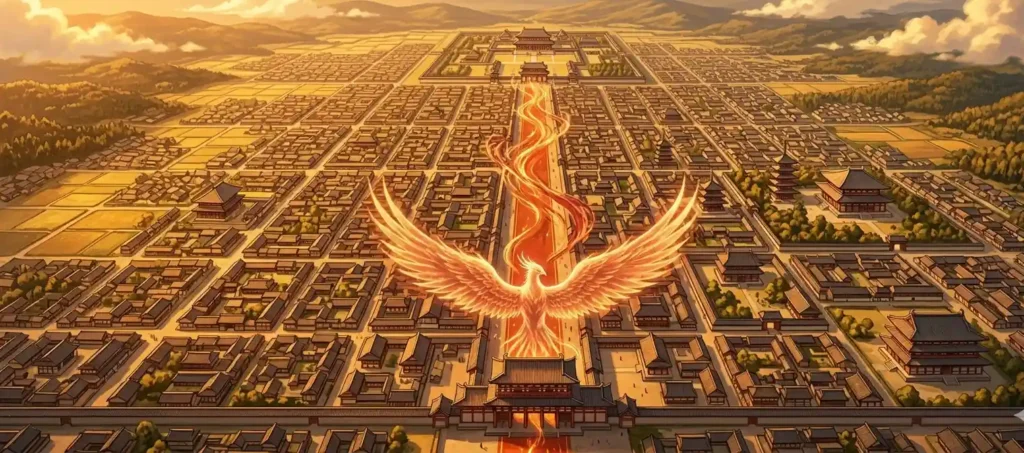
Transmission to Japan and Early Adoption
Suzaku (朱雀) is the Japanese reading of the same characters used for the Chinese Zhuque, transmitted to Japan as part of the broader adoption of Chinese cosmological, medical, and philosophical frameworks during the Asuka and Nara periods, roughly the 6th through 8th centuries CE.
The Four Symbols arrived in Japan as a complete system alongside Buddhism, Chinese geomantic theory, and Chinese astronomical practice. Japanese court culture absorbed them enthusiastically and applied them practically, using the four guardian beasts to orient cities, structure burial practices, and organize ritual space according to the same cosmological logic that had governed Chinese imperial practice for centuries.
Suzaku in Nara, Heian, and Classical Japanese Culture
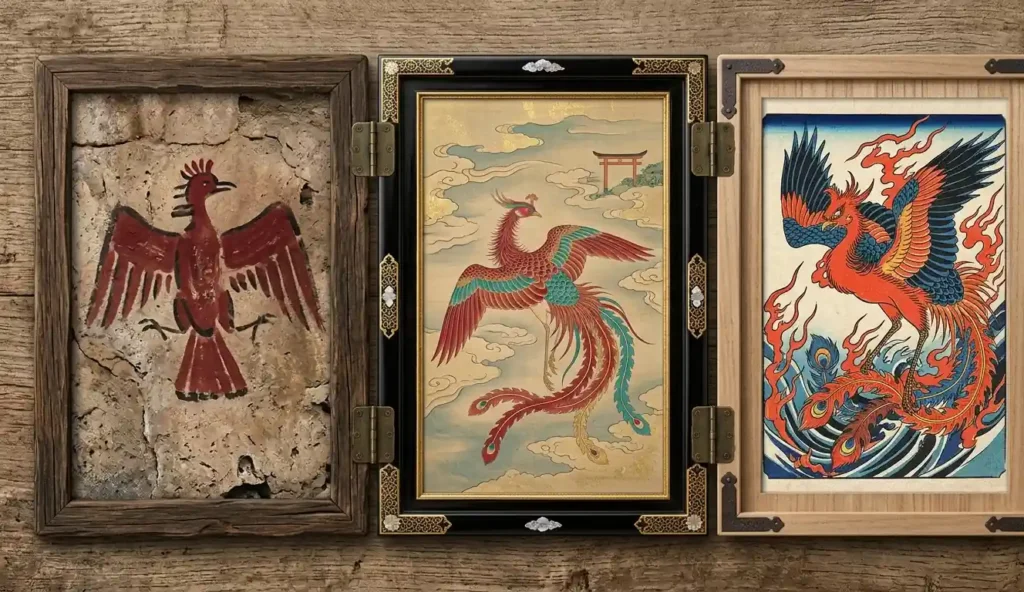
The physical traces of Suzaku’s adoption in Japan are visible in urban geography and in cultural artifacts that have survived to the present day:
Suzaku Avenue (Suzaku-oji): The central north-south boulevard of the ancient capital Nara, established in 710 CE, was named Suzaku Avenue. It ran from the southern Rajomon gate northward to the imperial palace, positioning the city’s central axis under the Vermilion Bird’s southern guardianship. The same avenue name was used in Heian-kyo, the later capital of Kyoto, where Suzaku Avenue remained the city’s primary ceremonial thoroughfare for centuries.
Tomb murals: Japanese burial mounds of the Kofun period, some predating the formal adoption of Chinese cosmology, show Vermilion Bird imagery that suggests either independent development or very early cultural contact.
Palace orientation: The southern gate of the imperial palace in both Nara and Heian-kyo was placed under Suzaku’s guardianship, following the Chinese convention of assigning southern architectural protection to the Vermilion Bird.
Ritual and ceremony: Suzaku’s association with fire, summer, and the southern direction was incorporated into Japanese court ritual calendars, with ceremonies associated with the summer season drawing on Zhuque-derived symbolism through the Suzaku figure.
Suzaku in Japanese Popular Culture and Media
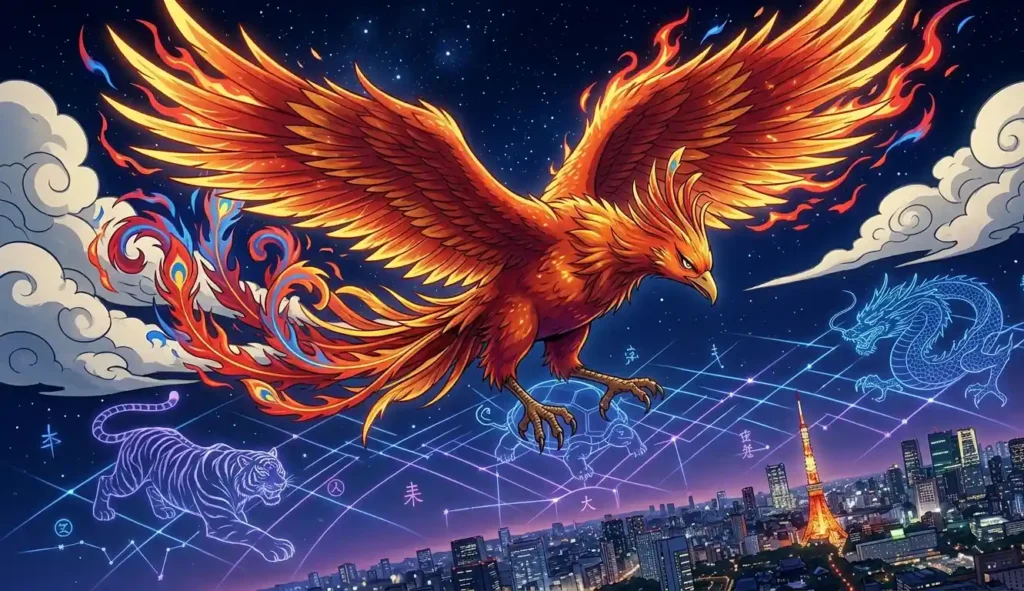
Suzaku has maintained a more active presence in Japanese popular culture than Zhuque has in mainland Chinese popular culture, partly through the medium of manga, anime, and game design that took the Four Gods as consistent reference material throughout the late 20th century:
Fushigi Yuugi (1992 to 1996) by Yuu Watase made Suzaku one of the four celestial gods central to its narrative, with the Suzaku no Miko (Priestess of Suzaku) as a primary protagonist role. This series introduced an entire generation of manga readers to the four-guardian beast system and remains one of the most influential uses of Suzaku in fictional media.
Shaman King, Naruto, and dozens of other manga and anime series reference Suzaku in passing or use Suzaku-derived firebird imagery without direct attribution.
Japanese video game series, including Pokémon (Ho-Oh is widely identified as Suzaku-inspired), various Final Fantasy entries, and the Shin Megami Tensei series, have all incorporated Suzaku as a summonable or opponent entity.
This extensive presence in Japanese popular media created a generation of readers who encountered Suzaku through fictional media before encountering Zhuque through Chinese xianxia, which is worth noting because it means many xianxia readers arrive with a Japan-inflected understanding of the figure rather than a Chinese one.
Jujak: The Vermilion Bird in Korean Mythology
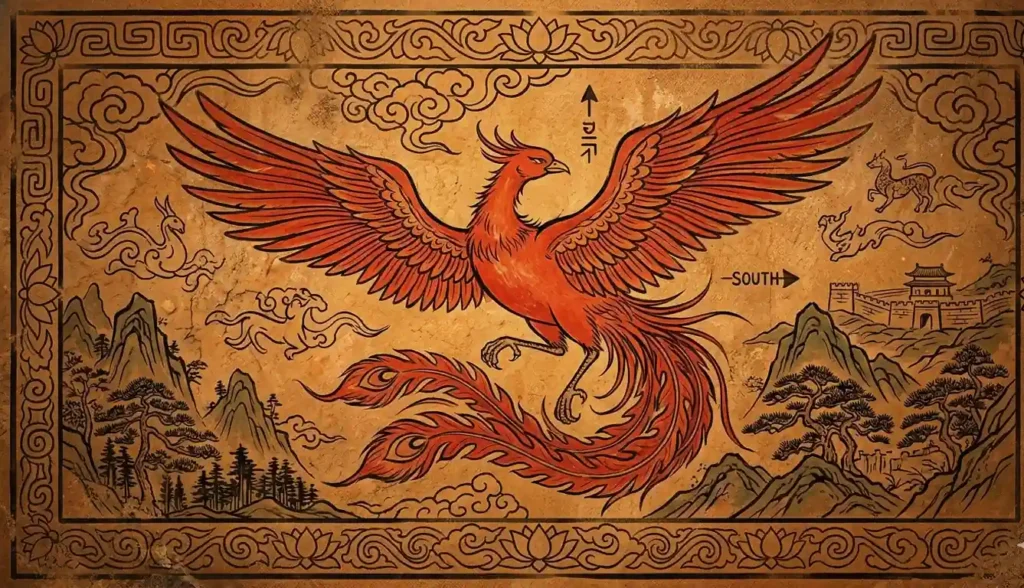
Jujak (주작, 朱雀) is the Korean tradition’s Vermilion Bird, and Korea’s relationship with the Four Symbols carries the same distinctive character it gives to all four guardian beasts, faithful transmission of the Chinese cosmological framework, integration with indigenous Korean spiritual traditions, and a visual record in the form of Goguryeo tomb murals that is among the most significant archaeological evidence of the Four Symbols tradition anywhere in East Asia.
The Goguryeo kingdom, one of the Three Kingdoms of Korea from the 1st century BCE to the 7th century CE, produced elaborate tomb paintings on the walls of royal and aristocratic burial chambers that place the four guardian beasts in their prescribed cosmological positions. Jujak appears on the southern wall of these chambers in the same position and with the same directional symbolism as Zhuque in the Chinese tomb tradition.
These Goguryeo murals were designated a UNESCO World Heritage Site in 2004 and represent the clearest early visual record of the Four Symbols tradition outside China.
Jujak in Korean tradition carries several distinct cultural inflections beyond the Chinese cosmological inheritance:
- Royal symbolism: The Vermilion Bird’s fire and southern energy became associated with royal authority in Korean court culture, appearing in palace architecture and ceremonial contexts that connected the ruler’s power to Jujak’s celestial mandate.
- Shamanic integration: Korean shamanic traditions, which predate the Chinese cosmological import, incorporated bird spirits as important figures. Jujak’s arrival as the supreme southern bird fitted into an existing cultural framework that was already prepared to receive and honour a powerful divine bird figure.
- Martial associations: The fire and yang attributes of Jujak connected it to military virtue and protective force in Korean martial culture, where the four guardian beasts collectively symbolised complete directional protection.
Contemporary Korean culture maintains Jujak’s presence through its appearance in historical dramas, traditional art, and the continued use of the four guardian beast motif in architecture and design that draws on Korea’s classical heritage.
Chu Tuoc: The Vermilion Bird in Vietnamese Tradition
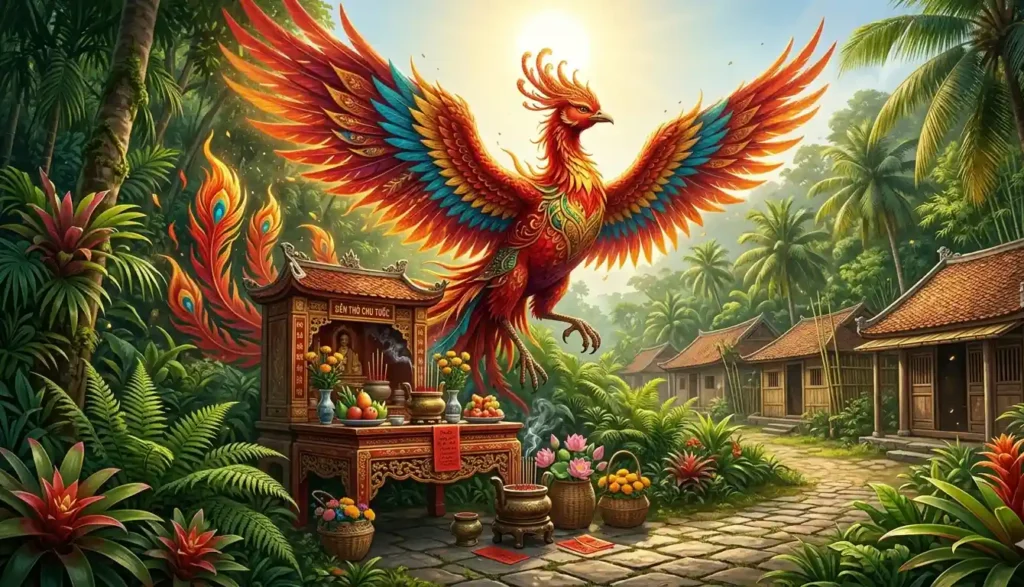
Chu Tuoc (Chu Tước, 朱雀) is the Vietnamese name for the Vermilion Bird, and the Vietnamese tradition represents a faithful transmission of the Chinese cosmological framework adapted through Vietnam’s distinct religious ecology and cultural context.
Vietnamese cosmological thought absorbed the Four Symbols through the same historical channels of Chinese cultural influence that shaped Vietnamese religious and philosophical frameworks over centuries of contact. Chu Tuoc appears in Vietnamese Daoist and folk religious contexts with the same southern directional authority, fire element association, and guardian function as the Chinese Zhuque.
Several aspects distinguish the Vietnamese Vermilion Bird tradition:
Integration with indigenous bird mythology: Vietnam has rich indigenous traditions involving sacred birds, and Chu Tuoc’s arrival as the supreme fire bird found a cultural landscape already prepared to receive it. The integration of Chinese cosmological bird symbolism with existing Vietnamese bird reverence produced a Chu Tuoc tradition with deeper roots in folk practice than a purely cosmological import would have.
Feng shui application: Vietnamese feng shui practice, which draws heavily on Chinese geomantic theory, positions Chu Tuoc as the southern guardian of auspicious sites. Properly oriented buildings and burial sites place the Vermilion Bird to the south, often represented by a view that opens to a lower elevation in that direction, allowing yang solar energy to enter freely.
Ceremonial use: Vietnamese ceremonial and festival traditions associated with fire, summer, and southern solar energy draw on Chu Tuoc’s symbolic associations, often without explicit naming, as part of the broader yin yang and five element cosmological framework that structures Vietnamese traditional practice.
Martial arts symbolism: Vietnamese martial arts traditions that incorporate cosmological symbolism use Chu Tuoc as the patron of southern-direction, fire-element techniques, extending the same martial associations visible in Chinese and Korean traditions.
Suzaku vs The Phoenix: Resolving the Confusion
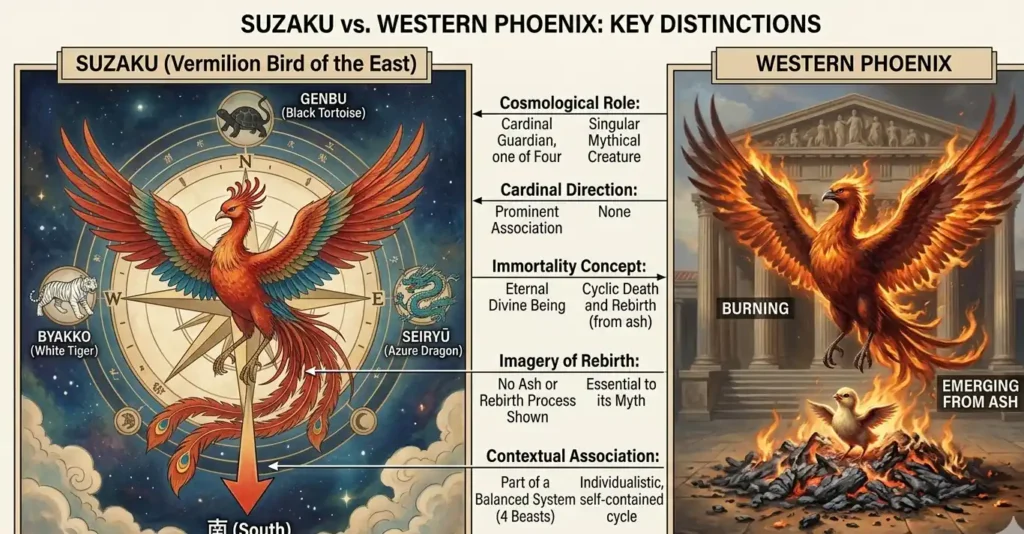
This is the question I most often see in online communities, and it deserves a careful answer because the confusion is understandable, but the distinction is real and important.
Shared Qualities That Cause the Confusion
Suzaku and the Phoenix share enough surface attributes that the mistake is easy to make:
- Both are magnificent birds associated with fire
- Both carry associations with the sun and solar power
- Both represent high ideals of virtue, beauty, and celestial authority
- Both appear in red and gold plumage in most artistic depictions
- Both are understood as rare, sacred, and almost impossibly powerful
For a Western reader encountering either figure for the first time, these shared qualities make the identification feel natural. The phoenix is the fire bird of Western mythology, and Suzaku looks like a fire bird. The identification seems obvious.
Key Differences That Matter
Closer examination reveals that Suzaku and the phoenix are distinct figures with different origins, different cosmological roles, and different symbolic meanings:
- Origin: The phoenix originates in ancient Egyptian and later Greek and Roman mythology as the Bennu bird and its classical derivatives. Suzaku originates in Chinese astronomical observation of the southern sky’s seven lunar mansions.
- Cosmological role: Suzaku is specifically a directional guardian, one of four complementary figures governing the complete compass. The phoenix has no directional role and no companion set.
- Rebirth: The phoenix’s defining characteristic is cyclical self-immolation and rebirth from its own ashes, representing immortality through death and resurrection. Suzaku does not have a rebirth cycle in classical Chinese, Japanese, Korean, or Vietnamese tradition. Its fire symbolism is about transformative power and solar energy, not death and resurrection.
- Singular vs. multiple: Classical traditions typically describe only one phoenix existing at any time, making it the rarest of all creatures. Suzaku is a celestial guardian whose domain is the permanent southern heaven, not a unique individual creature.
- Cosmological pairing: Suzaku is defined by its relationship to its three companion beasts, Qinglong, Baihu, and Xuanwu. The phoenix has no such complementary structure.
Why The Confusion Persists
The confusion between Suzaku and the phoenix persists for several reasons that are worth understanding:
- Chinese Fenghuang: China has its own phoenix-like figure, the Fenghuang (鳳凰), which is sometimes translated as “Chinese phoenix.” The Fenghuang is a separate figure from Zhuque but shares similar visual attributes, and Western readers who encounter the Fenghuang often conflate it with Zhuque and the Western phoenix.
- Xianxia usage: Some cultivation novels use Suzaku and phoenix imagery interchangeably or describe their Vermilion Bird divine beasts as having rebirth abilities borrowed from phoenix mythology, deliberately blending the two traditions for narrative purposes.
- Visual similarity: In artistic representations, fire birds tend to look alike regardless of cultural origin, and artists who are not specialists in the relevant traditions often blend iconographic elements.
The practical reader’s distinction is simple. If the firebird is one of the four directional guardians and governs the South, it is Suzaku or Zhuque. If the firebird self-immolates and is reborn from ash, it is drawing on phoenix mythology.
Many cultivation novels borrow from both simultaneously, which is a creative choice rather than an error, but understanding the distinction makes it possible to recognize what each series is actually doing.
Suzaku in Xianxia and Cultivation Fiction
As a Divine Beast
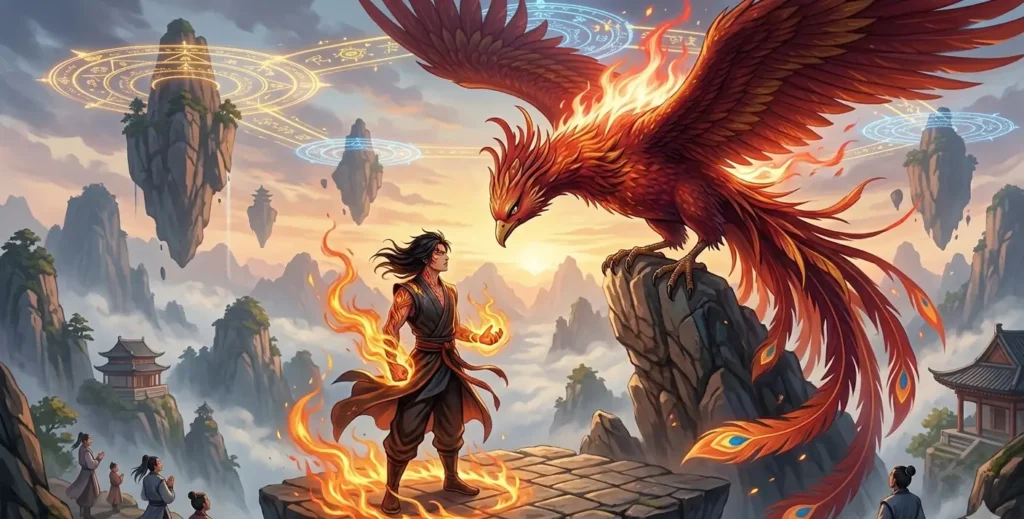
The Vermilion Bird, as a divine beast is among the most coveted spiritual beast companions in Xianxia cultivation fiction. Its Fire element affinity, supreme yang energy, and status as one of the four great guardian beasts of Chinese cosmology give it immediate narrative authority.
In most xianxia power systems, contracting a Vermilion Bird divine beast provides the cultivator with several specific advantages:
- Superior fire-element qi quality far beyond what ordinary fire-affinity cultivation can achieve
- Access to advanced fire-based techniques unavailable to standard fire cultivators
- The divine beast’s celestial fire, which burns at temperatures and with properties that ordinary elemental fire cannot match
- Status recognition within the cultivation world, since Vermilion Bird contract holders are understood to carry celestial guardian authority
As a Bloodline and Constitution
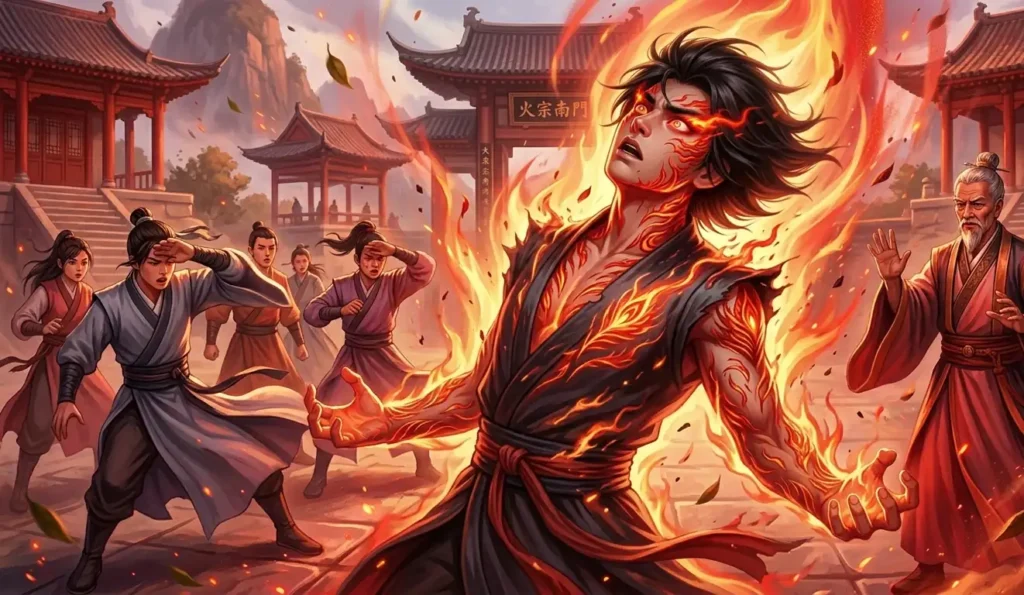
The Vermilion Bird Body and Suzaku Bloodline constitution types appear across numerous cultivation series as rare and extraordinarily powerful fire-element physical cultivation heritages.
Characters born with Vermilion Bird bloodlines typically display the following characteristics:
- Extreme fire qi that manifests even before formal cultivation begins
- Immunity or high resistance to fire-based attacks
- Spontaneous flame generation under emotional intensity in childhood
- A cultivation ceiling far above ordinary fire cultivators, with the bloodline’s potential only fully expressed at high realms
- Physical beauty associated with the Vermilion Bird’s aesthetic authority as one of the four supreme celestial creatures
The bloodline constitution differs from a divine beast contract in that it is innate rather than acquired, carrying the Vermilion Bird’s essence within the cultivator’s own body rather than in a separate companion entity. Both are highly coveted; the bloodline is generally considered rarer and ultimately more powerful because it cannot be separated from the cultivator.
As a Nation’s Protective Symbol and Cultivation Patron
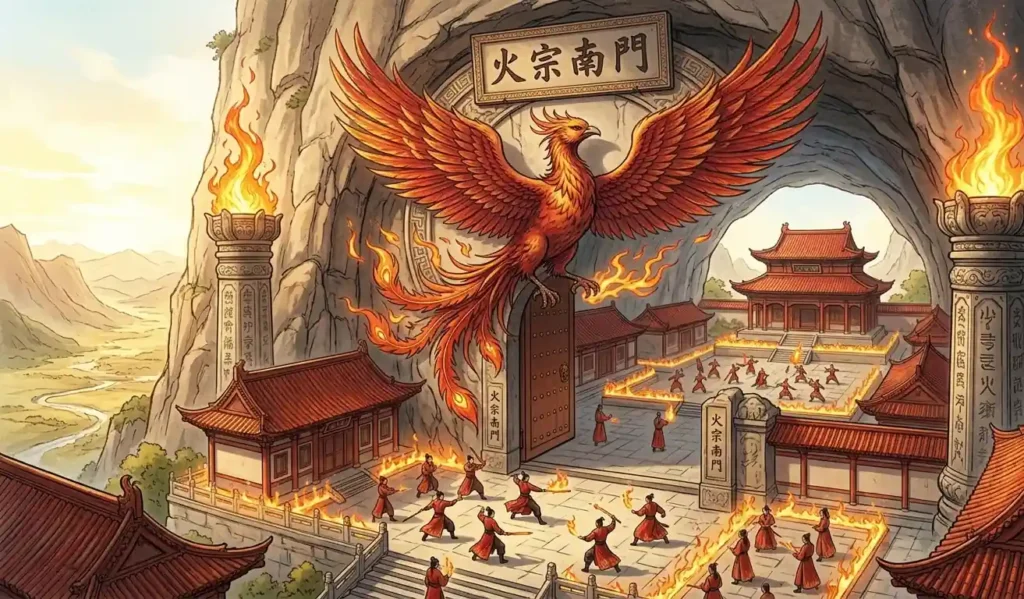
Vermilion Bird nations, fire cultivation lineages under Suzaku’s patronage, and southern-direction cultivation territories marked by Zhuque’s authority are among the most common institutional uses of the figure in cultivation worldbuilding.
When a cultivation world features a kingdom whose banner shows a bird wreathed in flame, whose cultivation hall faces south, and whose signature techniques involve celestial fire rather than ordinary elemental flame, it is drawing on Zhuque’s cosmological role as the southern heaven’s guardian.
This institutional use reflects the real-world precedent. Chinese imperial architecture placed the southern gates under Zhuque’s guardianship, and the Vermilion Bird became a symbol of legitimate authority in the southern position. Cultivation fiction’s empires are following the same spatial logic.
Cross-tradition Comparison
| Attribute | Chinese (Zhuque) | Japanese (Suzaku) | Korean (Jujak) | Vietnamese (Chu Tuoc) |
|---|---|---|---|---|
| Characters | 朱雀 | 朱雀 | 주작 | Chu Tước |
| Direction | South | South | South | South |
| Season | Summer | Summer | Summer | Summer |
| Element | Fire | Fire | Fire | Fire |
| Colour | Vermilion | Vermilion | Vermilion | Vermilion |
| Primary role | Celestial guardian, southern heaven ruler | Celestial guardian, city patron deity | Cosmological guardian, royal symbol | Celestial guardian, feng shui protector |
| Key archaeological evidence | Han Dynasty tomb murals, bronze artifacts | Nara and Heian city planning, Kofun tomb art | Goguryeo tomb murals (UNESCO) | Temple architecture, folk religious artifacts |
| Popular culture presence | Xianxia novels, manhua, game design | Anime, manga, video games, Fushigi Yuugi | Historical dramas, traditional art | Folk festivals, traditional architecture |
| Distinct local tradition | Daoist internal cultivation fire qi | Integration into imperial avenue naming | Fusion with shamanic bird traditions | Fusion with indigenous Vietnamese bird reverence |
| Martial association | Southern military position, attacking force | Fierce protector, fire warrior | Military virtue, royal authority | Southern direction martial techniques |
Frequently Asked Questions
What is Suzaku in Japanese mythology?
Suzaku is the Japanese name for the Vermilion Bird, one of the Four Symbols of East Asian cosmology. Guardian of the South and ruler of fire and summer, it came to Japan from China between the 6th and 8th centuries CE and remains prominent in mythology, history, and popular media.
Is Suzaku the same as a phoenix?
No. Suzaku and the phoenix are distinct mythological figures with different origins, roles, and symbolism. Suzaku is the southern guardian in Chinese cosmology, while the phoenix comes from Egyptian and Greco Roman tradition and is defined by rebirth from ash. Suzaku has no rebirth cycle.
What does the Vermilion Bird symbolize?
The Vermilion Bird symbolises southern celestial authority, Fire energy, summer abundance, yang vitality, and transformative power. It represents good fortune, solar force, and outward manifestation in Chinese cosmology, while also serving as a protector of southern gates, tombs, and important spaces against malevolent forces.
What are the Four Symbols and where does Suzaku fit?
The Four Symbols are the celestial guardian beasts of East Asian cosmology: the Azure Dragon of the East, Vermilion Bird of the South, White Tiger of the West, and Black Tortoise of the North. Each rules a direction, season, element, and color. Suzaku governs the South, summer, Fire, and vermilion red.
How does Suzaku appear in xianxia cultivation novels?
In xianxia, Suzaku commonly appears as a divine beast contracted to elite cultivators, a Vermilion Bird bloodline granting exceptional fire cultivation, or the patron symbol of fire kingdoms. Its celestial fire surpasses ordinary flame, while its presence signals powerful fire alignment and southern cosmological association.
What is the difference between Zhuque and Suzaku?
Zhuque is the Chinese name and Suzaku the Japanese name for the same figure, written with the same characters in both languages. Their core attributes are identical, but Zhuque is tied more closely to Chinese Daoist cultivation theory, while Suzaku has been more heavily developed in Japanese popular media.
Who is Jujak in Korean mythology?
Jujak is the Korean Vermilion Bird, one of the four guardian beasts in Korean cosmology. It appears in Goguryeo tomb murals from the 1st to 7th centuries CE and reflects both Chinese cosmological influence and indigenous Korean shamanic and royal symbolism.
Final Thoughts
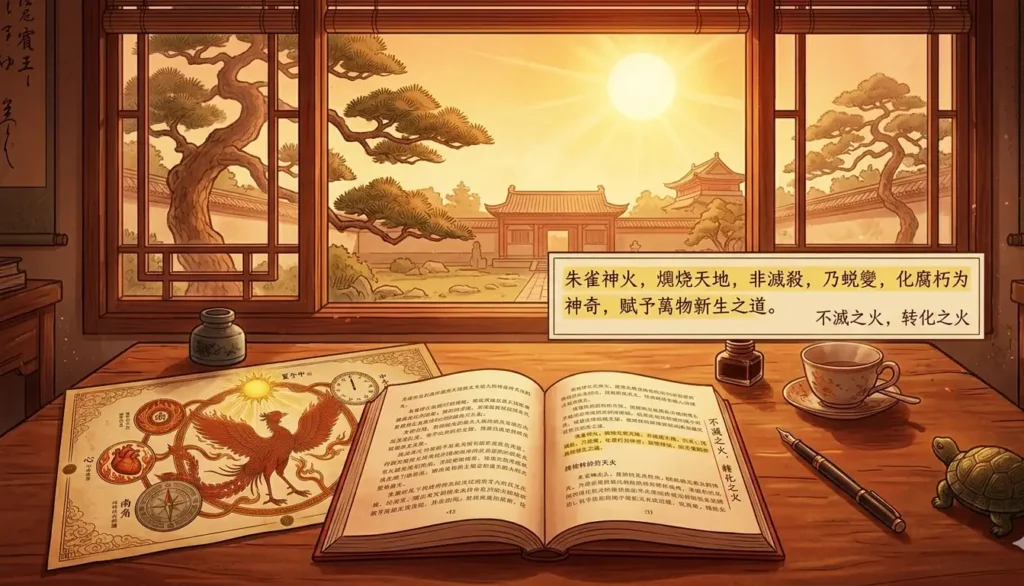
Suzaku is one of those mythological figures that rewards the effort of looking past its surface attributes. Firebird, fire cultivation, fire power, these are the things popular cultures foreground most consistently, and they are not wrong. But they are the least interesting layer of what the Vermilion Bird actually represents.
The figure that sits at the south of the celestial map, presiding over the summer sky at noon, governing the moment of maximum outward expression, embodying the fire that transforms rather than simply burns, that figure carries a philosophical richness that the genre occasionally touches and more often bypasses in favor of spectacular flame effects.
After reading xianxia, the cultivation novels I find most memorable in their Vermilion Bird treatment are the ones that understand transformation as the key attribute. The cultivators who align with Suzaku in the best series are not simply the most powerful fire users. They are the ones who understand that fire’s real nature is not destruction but change, that the summer’s heat is not an attack but an abundance, that the southern sky at noon is not aggressive but fully present.
That distinction, between fire as weapon and fire as transformation, is the gap between a cultivation novel that uses Suzaku as aesthetic and one that uses it as philosophy. The gap is wide, and the series on the right side of it are worth finding.
Related Articles
- Xuanwu: Black Tortoise of the North Symbolism & Mythology
- Yellow Dragon: Myths, Symbolism & the Forgotten Fifth Beast
- Why the Four Holy Beasts Cannot Exist Without Yin Yang
- Yin Yang, Five Elements & Four Symbols: China’s Complete Cosmos
- Are the Four Heavenly Kings & Four Holy Beasts the Same?
- The Four Holy Beasts: Baihu, Qinglong, Zhuque & Xuanwu
References
- Birrell, Anne. Chinese Mythology: An Introduction.
- Eberhard, Wolfram. A Dictionary of Chinese Symbols.
- Major, John. Heaven and Earth in Early Han Thought.
- The Chinese Sky
- Lewis, Mark Edward. The Construction of Space in Early China.
- Kohn, Livia. Daoism and Chinese Culture.
- Allan, Sarah. The Shape of the Turtle.Hanshu (Book of Han).
- UNESCO World Heritage Centre – Complex of Goguryeo Tombs
- The Protocol of the Gods: A Study of the Kasuga Cult in Japanese History – Allan G. Grapard
- The Rites of Zhou – Chinese Text Project
- Shanhaijing (Classic of Mountains and Seas).
- Shiji (Records of the Grand Historian).