
 By
By Quick takeaways:
- Dragon mythology exists on every inhabited continent, making the dragon the single most globally distributed mythological creature in human history
- Eastern dragons and Western dragons are fundamentally different moral figures: Eastern dragons are benevolent celestial beings of water, wisdom, and cosmic order, while Western dragons are typically monstrous adversaries of fire, greed, and chaos
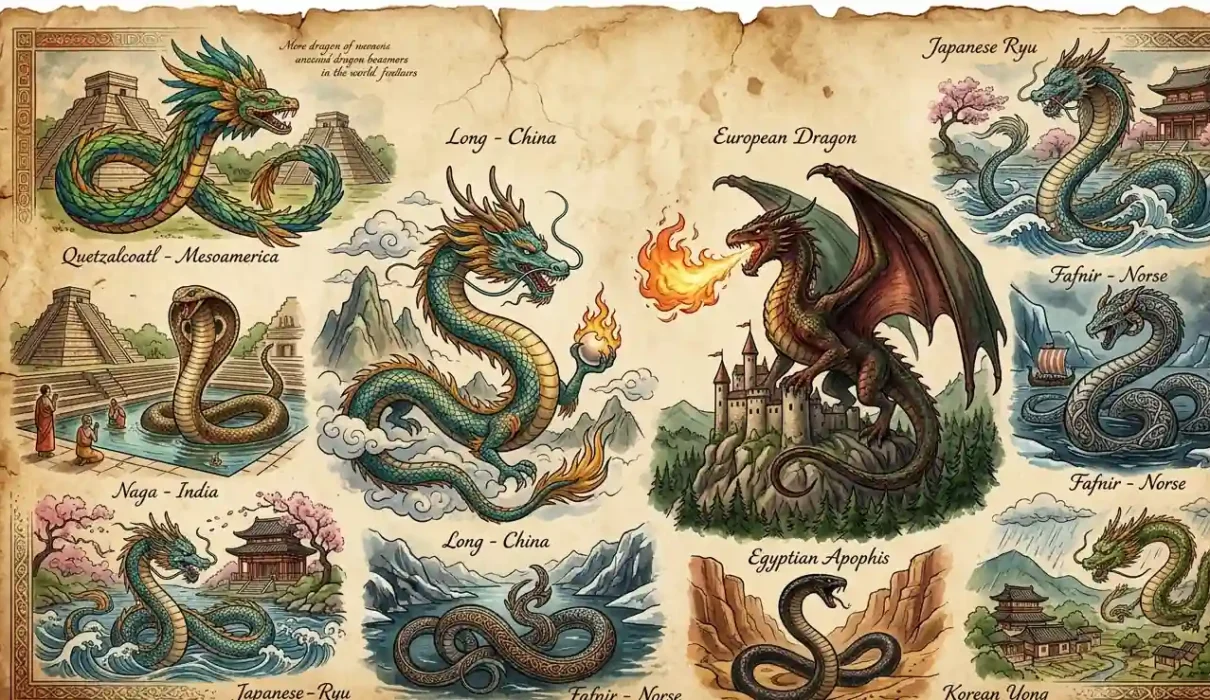
- The dragon appears in Chinese, Japanese, Korean, Vietnamese, Hindu, Buddhist, Bhutanese, Tibetan, Greek, Norse, Welsh, Medieval Christian, Babylonian, Mesoamerican, African, and Aboriginal Australian traditions, each with distinct and internally coherent characteristics
- The universality of dragon mythology is not a coincidence of cultural borrowing but reflects deep and recurring patterns in human cognition, ecology, and the structure of mythological imagination
- Understanding why dragons are universal is ultimately more interesting than cataloguing what they look like in each tradition
Cultural traditions are too varied, too internally complex, too resistant to generalization for sweeping claims to survive close examination. The dragon is the near exception.
Almost Every human culture that has left a substantial mythological record has produced a dragon figure. Not a figure that looks identical to dragons elsewhere, not a creature with the same moral character or the same relationship to human beings, but a figure that occupies the same imaginative position.
A great serpentine or reptilian being of supernatural power that governs elemental forces and stands at the boundary between the human world and whatever lies beyond it. The specifics vary enormously. The category is universal.
This article is the complete account of that universality. What dragons look like across every major world tradition, why the East-West moral divide is so dramatic and so coherent, and what the global distribution of dragon mythology tells us about the human mind that produced it.
What Makes a Dragon?
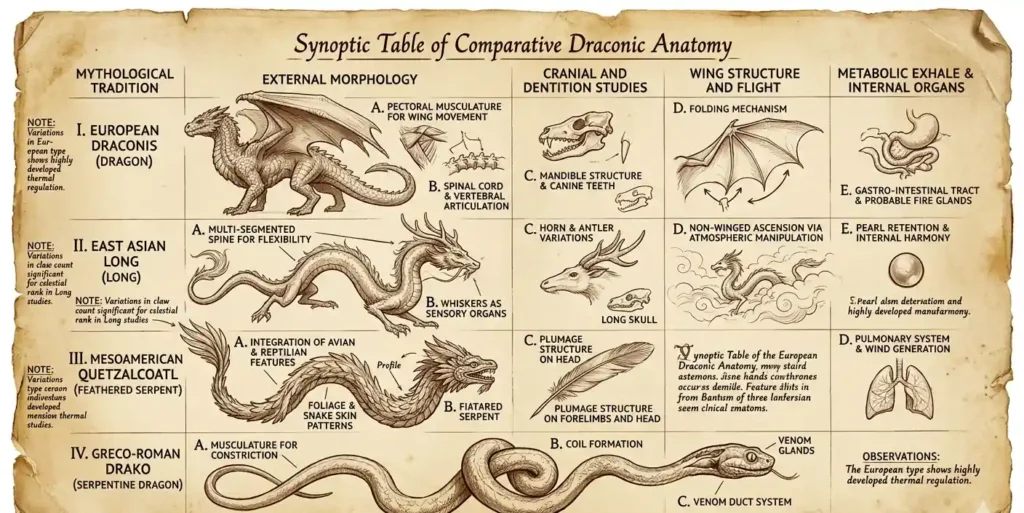
Before crossing cultures, it is worth establishing what the dragon category actually contains, because the variation is so extreme that defining it is genuinely difficult.
Across all traditions, the dragon figure tends to share a combination of the following characteristics, though no single tradition includes all of them:
- Serpentine or reptilian body: The great scaled body, often enormous, is the single most consistent visual element across dragon traditions worldwide
- Supernatural power: Every dragon tradition attributes abilities to its dragon figure that exceed ordinary animal capacities — flight, elemental breath, shapeshifting, prophetic knowledge, or control over natural forces
- Liminal positioning: Dragons typically inhabit the boundaries between worlds, between water and land, between earth and sky, between the divine realm and the mortal one
- Relationship with elemental forces: Water, fire, earth, or storm power characterises most dragon traditions, with the specific element varying by culture
- Sacred or dangerous status: Every culture that has dragons treats them as figures demanding particular response, whether reverence, propitiation, battle, or all three in sequence
What varies most dramatically is the moral character of the dragon figure. This variation is the key to understanding why Eastern and Western dragons feel like completely different creatures despite their shared category membership, which we will address in full later in this article.
East Asian Dragons: The Celestial Tradition
Chinese Dragon: Qinglong and the Dragon Kings
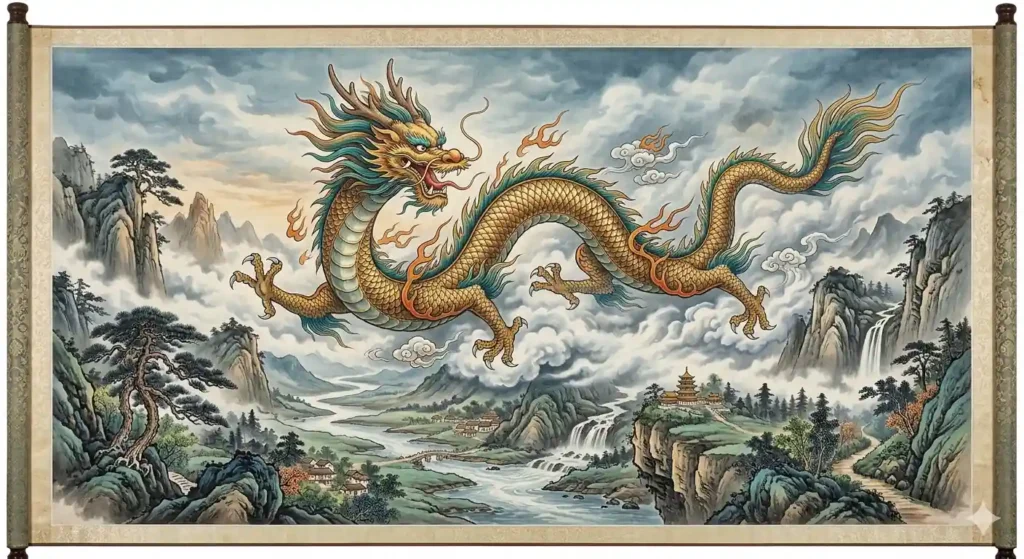
The Chinese dragon, Long (龍), is the most complex and fully developed dragon tradition in the world, and the one that cultivation fiction draws on most directly. Understanding it requires abandoning almost every association the Western dragon carries.
The Chinese dragon is not a monster. It is a divine being, a celestial authority, a symbol of imperial legitimacy and cosmic order. The dragon in Chinese tradition is benevolent, wise, the bringer of rain, and the guardian of rivers, lakes, and seas. Its relationship with water is fundamental.
Chinese dragons are water beings whose proper domain is rivers, oceans, clouds, and rain. They do not breathe fire. They control rainfall, which in an agricultural civilization is the difference between abundance and starvation.
The physical description of the Chinese Long is precise and classical texts describe it in detail. The dragon has nine animal resemblances:
- Antlers of a deer
- Head of a camel
- Eyes of a demon
- Neck of a snake
- Belly of a clam
- Scales of a carp
- Claws of an eagle
- Paws of a tiger
- Ears of a cow
This composite form reflects the Chinese dragon’s role as a synthesis creature, embodying the qualities of multiple powerful animals rather than being a single specific beast. It is the superior form that transcends any individual animal species.
The Dragon Kings (Lóng Wáng) are the most prominent dragon figures in Chinese religion and mythology. Each major body of water has its Dragon King, with the Four Dragon Kings of the Four Seas holding the highest authority over the oceans. They inhabit crystal palaces beneath the water’s surface, command vast armies of aquatic creatures, and control rainfall on behalf of heaven. Dragon King temples were among the most common religious sites in classical China, where farmers prayed for rain during drought.
The Azure Dragon (Qinglong) is the cosmological dragon of particular importance to cultivation fiction. As one of the Four Symbols of Chinese astronomy, Qinglong governs the Eastern sky, the season of spring, the Wood element, and the direction of new beginnings and vital rising force. Unlike the Dragon Kings, who are individual mythological figures, Qinglong is a cosmological principle personified, the eastern sky’s animating intelligence.
The Longmen (Dragon Gate) is perhaps the most narratively important dragon concept in cultivation fiction. The legend describes carp that swim upstream to the Dragon Gate waterfall. Those who successfully leap through are transformed into dragons. This transformation, from ordinary carp to celestial dragon through the heroic completion of an impossible ascent, is the foundational metaphor of the cultivation genre’s entire power escalation structure.
Japanese Dragon: Ryujin and the Water Tradition
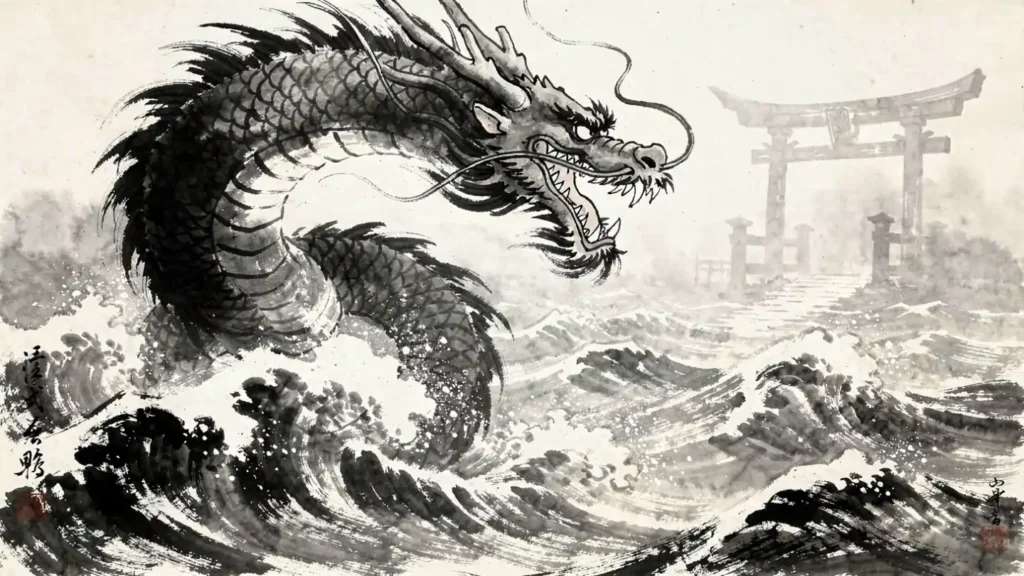
The Japanese dragon, Ryu or Tatsu (龍 or 竜), arrived from China alongside Buddhism and Chinese cultural frameworks but developed distinct characteristics through integration with Japan’s indigenous mythological traditions.
Ryujin (龍神, Dragon God), the Dragon King of the Sea, is the most prominent Japanese dragon figure. He inhabits a palace beneath the ocean called Ryugu-jo and controls the tides through magical tide jewels.
His daughter Toyotama-hime appears in one of Japan’s most famous mythological narratives, marrying a mortal hero and revealing her true dragon form at a forbidden moment. This story of the dragon in human form, the liminal figure who moves between the aquatic dragon world and the mortal human world, is one of Japan’s most enduring dragon narrative patterns.
Japanese dragon iconography emphasizes the three-toed claw, distinguishing the Japanese Ryu from the Chinese Long (which has five toes in its most exalted imperial form) and the Korean Yong (which has four). This toe count distinction is one of the most precise differentiators in East Asian dragon iconography and appears in scholarly and fan discussions of cultivation fiction dragon imagery.
Key aspects of the Japanese dragon tradition include:
- Water dominion: Like Chinese Long, Ryu are primarily water beings governing seas, rivers, lakes, and rain
- Shapeshifting: Japanese dragons frequently take human form, enabling the liminal narrative of the dragon in disguise among humans
- Temple guardianship: Ryu serve as guardians of Buddhist temples and Shinto shrines, their water nature associated with ritual purification
- Benevolent character: Japanese dragons, like their Chinese counterparts, are fundamentally benevolent unless provoked, contrasting sharply with the European tradition
Korean Dragon: Yong and the Imugi
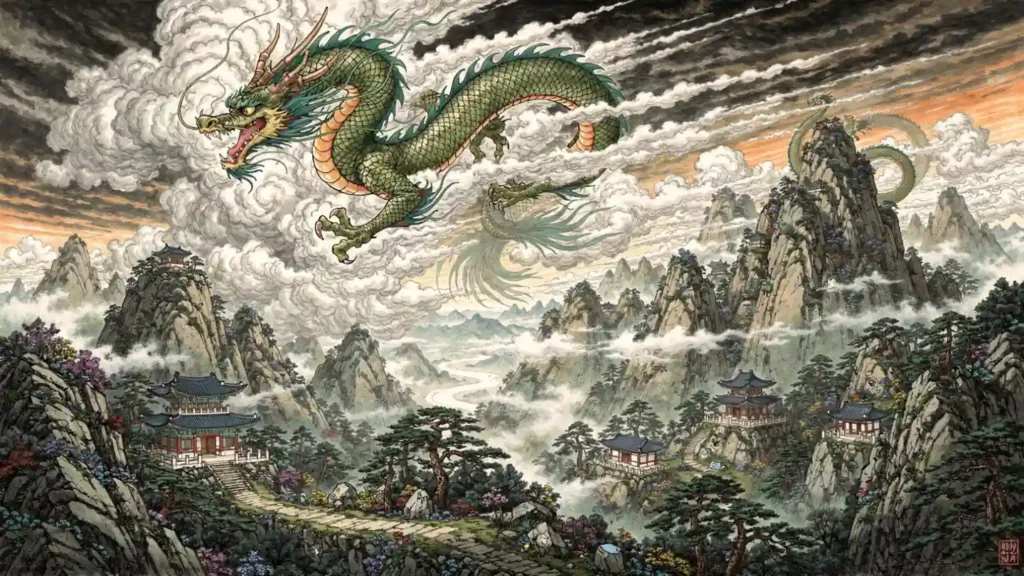
The Korean dragon, Yong or Mireu (용, 미르), follows the East Asian pattern of water-associated benevolence but adds the specifically Korean figure of the Imugi.
The Imugi is a proto-dragon creature, a great serpent that has not yet completed its transformation into a true dragon. According to Korean folk belief, an Imugi must live for a thousand years and catch a Yeouiju (여의주), the magical dragon pearl that grants wishes, before it can ascend and become a full dragon.
This transformation narrative is one of the most important specifically Korean contributions to dragon mythology and maps directly onto cultivation fiction’s cultivation ladder structure: the Imugi is the cultivator not yet at their final form, the ascendant who must complete the impossible task before the transformation becomes real.
The Korean dragon’s four-toe claw count places it between the Japanese three-toe and Chinese five-toe forms, reflecting Korea’s historical position as a cultural bridge between the two civilizations.
Vietnamese Dragon: Rong and the Founding Myth
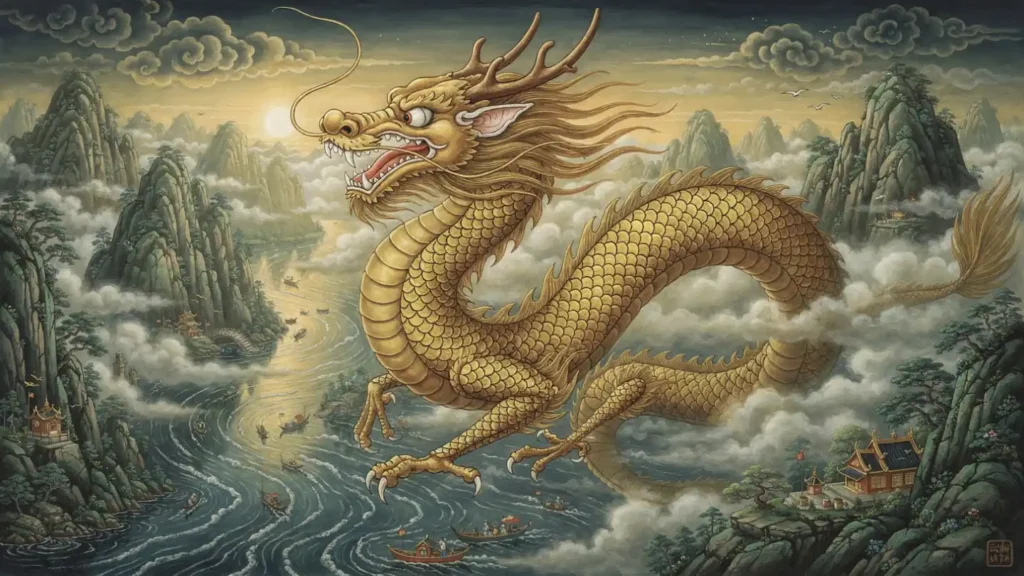
The Vietnamese dragon, Rong (Rồng), occupies a unique position in East Asian dragon mythology because of its direct connection to the Vietnamese national founding narrative.
According to Vietnamese mythology, the nation descended from a union between Lac Long Quan (Dragon Lord of the Lac) and Au Co (a mountain fairy). They had one hundred sons together, with fifty descending with their father to the sea and coast (the lowland Vietnamese people), and fifty ascending with their mother to the mountains (the highland peoples).
This origin myth makes the dragon literally ancestral to the Vietnamese people rather than a cosmological guardian figure, which gives the Vietnamese dragon tradition an intimacy and personal identification that distinguishes it from other East Asian traditions.
Vietnamese dragon iconography evolved distinctly across different dynastic periods, with the Ly Dynasty dragon (11th to 13th centuries) characterised by a sinuous, fish-scale form without legs, and later dynasties incorporating more Chinese-influenced dragon forms with clawed legs.
The diverse visual tradition reflects the dynamic cultural exchange of Vietnam’s historical position at the intersection of Chinese and Southeast Asian influences.
South and Southeast Asian dragons: the Naga Tradition
Hindu and Buddhist Naga: the Divine Serpent
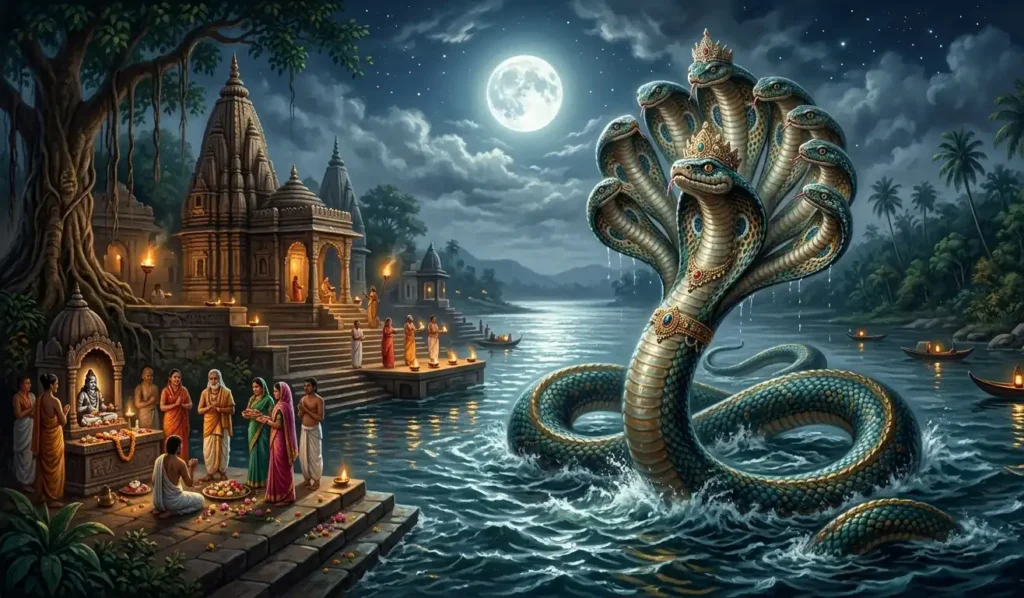
The Naga tradition of Hindu and Buddhist mythology represents one of the world’s richest and most fully developed dragon-adjacent traditions, extending across South Asia, Southeast Asia, and the Buddhist world through cultural transmission.
In Hindu mythology, Nagas are divine serpent beings who inhabit a subterranean realm called Nagaloka or Patala. They are associated with water, fertility, and the protection of underground treasures.
The great Nagas include Shesha (also called Ananta), the cosmic serpent upon whom Vishnu rests between cycles of creation, whose body encircles the universe and whose thousand hoods shelter the god in his cosmic sleep. Vasuki, the serpent used as a rope in the churning of the cosmic ocean (Samudra Manthan), is another of the most prominent Naga figures.
Key Naga characteristics that distinguish the tradition:
- Semi-divine nature: Nagas are divine beings, not monsters, with their own civilisation, royalty, and relationships with the human and divine worlds
- Water and earth sovereignty: Like East Asian dragons, Nagas govern water, rivers, rain, and the subterranean waters that sustain agriculture
- Shapeshifting: Nagas routinely take human form, and Naga-human unions are common in mythology, producing royal lineages throughout South and Southeast Asia
- Protective and dangerous: Nagas can be benevolent protectors of those who honour them and deadly to those who do not, reflecting a complex moral character that goes beyond simple good or evil
In Buddhist tradition, Naga figures appear from the earliest texts. A Naga shelters the meditating Shakyamuni Buddha from rain with its hoods in a famous iconographic tradition. Buddhist temples throughout Southeast Asia, from Thailand to Cambodia to Sri Lanka, incorporate Naga imagery into their architecture, with multi-headed Naga staircases flanking temple entrances as protective figures.
The Naga tradition spread through Southeast Asia with Buddhism and Hinduism, producing distinct regional variants in Thailand (Naga), Cambodia (Neak), Myanmar (Naga), and Indonesia (Naga), each adapted to local cultural contexts while maintaining the fundamental characteristics of the water-associated, semi-divine, shapeshifting serpent being.
Bhutanese dragon: Druk and National Identity
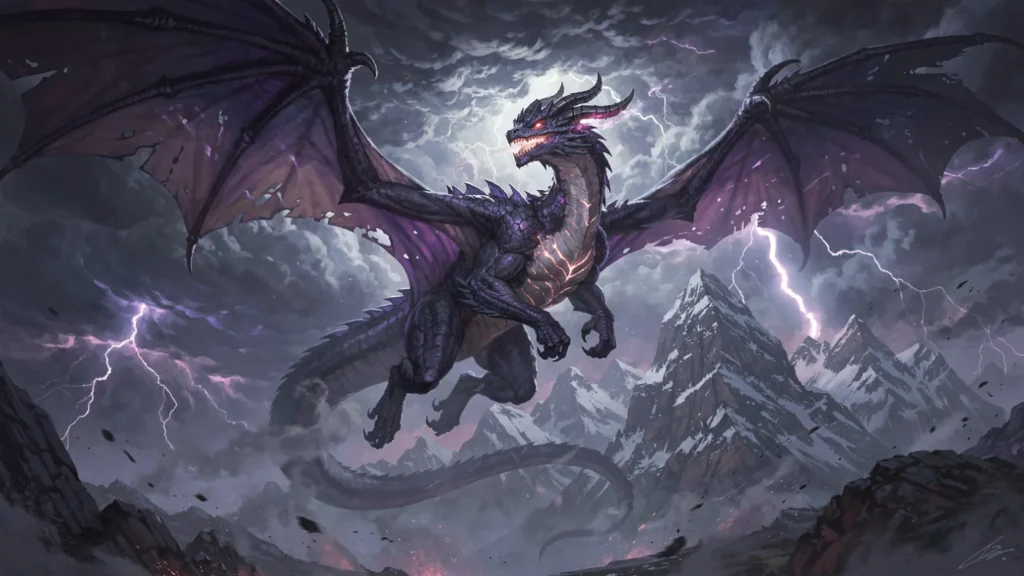
Druk (འབྲུག), the Thunder Dragon of Bhutan, occupies perhaps the most prominent national role of any dragon figure in the world. Bhutan’s official name in Dzongkha (the national language) is Druk Yul, literally the Land of the Thunder Dragon. The national airline is Druk Air. The monarchy is the Dragon Kings. The Druk appears on the national flag, white against an orange and yellow divided field, clutching jewels in its four claws.
The Druk tradition derives from Tibetan Buddhist mythology, where the dragon is associated with thunder (the roar of the dragon) and with the powerful protective forces of the Himalayan tradition. The white colouring of the Bhutanese national dragon signifies purity and loyalty, and its four jewel-clutching claws represent the country’s wealth and protection of the nation’s sovereignty.
Bhutan’s dragon mythology demonstrates how a single mythological figure can become so completely integrated into national identity that it literally names the country and all its major institutions, making the Druk perhaps the most politically powerful dragon in the contemporary world.
Western European Dragons: The Adversarial Tradition
Greek Dragon: Ladon, Python, and the Guardian Serpents
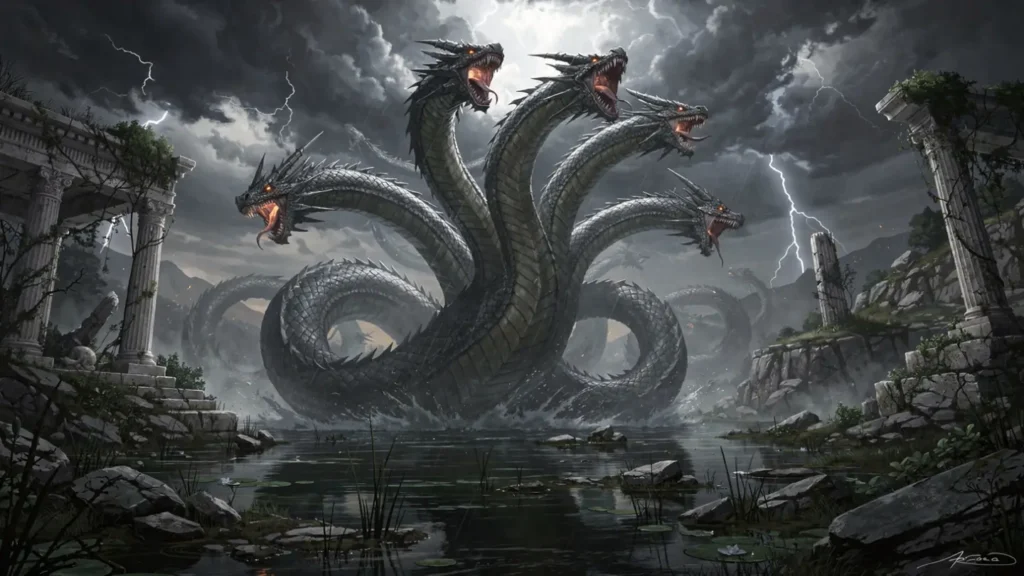
Greek mythology does not have a single unified dragon figure but rather a family of related serpentine monsters whose characteristics collectively define the Greek dragon tradition.
Python, the great serpent of Delphi slain by Apollo, is one of the oldest and most significant Greek dragon figures. Python guarded the oracle site at Delphi and was understood as a chthonic (earth) creature, a representative of the old pre-Olympian order of the earth that Apollo’s solar rationality had to overcome before the oracle could speak the future in service of divine reason. The Python’s death and the establishment of the Delphic oracle represent the victory of Olympian order over primordial chaos in Greek religious thinking.
Ladon, the serpent who guarded the golden apples in the garden of the Hesperides, is another major figure. As with many Greek dragon-serpents, Ladon’s role is guardian rather than active destroyer, its danger residing in its proximity to the sacred rather than in aggressive predation.
The Lernaean Hydra, slain by Heracles as one of his twelve labours, introduces the multi-headed form that becomes one of Western fantasy’s most persistent dragon variations. The Hydra’s regenerating heads, which double when cut, introduces the concept of the dragon as an adversary whose destruction requires not brute force but a specific understanding of its nature.
Key features of the Greek dragon tradition:
- Guardian role: Greek dragons most commonly guard something sacred or valuable rather than simply terrorising the landscape
- Chthonic association: They are earth and underworld creatures, associated with the pre-Olympian divine order
- Overcome by heroes: Dragon-slaying is a heroic achievement that demonstrates the hero’s worthiness, a narrative pattern that shapes the entire Western dragon tradition
Norse dragon: Nidhogg, Fafnir, and the World Serpent
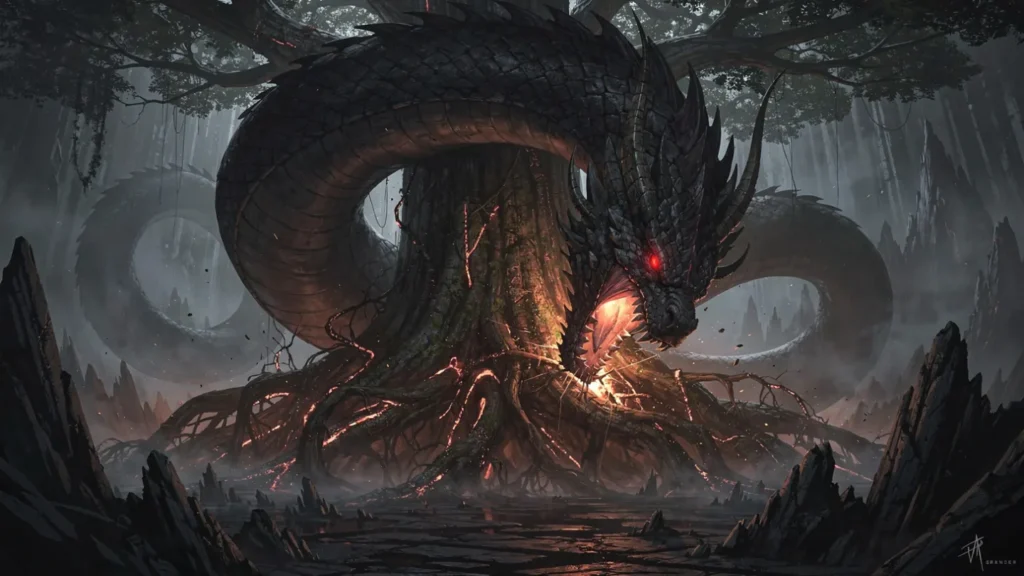
Norse mythology offers the richest and most varied dragon tradition in the Western Germanic world, with three major dragon figures that differ significantly from each other in character and narrative role.
Nidhogg (Níðhöggr, “Malice Striker”) is the cosmic dragon of Norse mythology, the great serpent that gnaws perpetually at the roots of Yggdrasil, the World Tree. Nidhogg is a creature of primordial destruction, working toward the death of the cosmic order from beneath, its constant chewing a slow existential threat to the universe itself. At Ragnarok, Nidhogg flies over the battlefield bearing the bodies of the dead in its wings, a figure of cosmic ending.
Jormungandr, the Midgard Serpent, is the offspring of Loki and the giantess Angrboda. Thrown into the ocean by Odin, Jormungandr grew so vast that it encircles the entire world of Midgard and bites its own tail, making it one of the world’s great ouroboros (world-serpent) figures. Its destiny is to emerge from the ocean at Ragnarok and engage Thor in their mutual destruction, the god killing the serpent and dying from its venom.
Fafnir represents the most unique Norse contribution to dragon mythology. The dragon who was not born a dragon but became one. Originally a dwarf, Fafnir murdered his father to acquire the cursed gold of Andvari and then transformed into a dragon through the corruption of greed.
His story, preserved in the Volsunga Saga and the Poetic Edda, is one of mythology’s most potent tales of what avarice does to a person, and it gives the Norse tradition a psychological depth that most other Western dragon traditions lack. Fafnir was slain by the hero Sigurd (the inspiration for Tolkien’s Sigurd/Turin narratives), who bathed in the dragon’s blood to gain invulnerability.
Welsh Dragon: Y Ddraig Goch and the Red Dragon of Britain
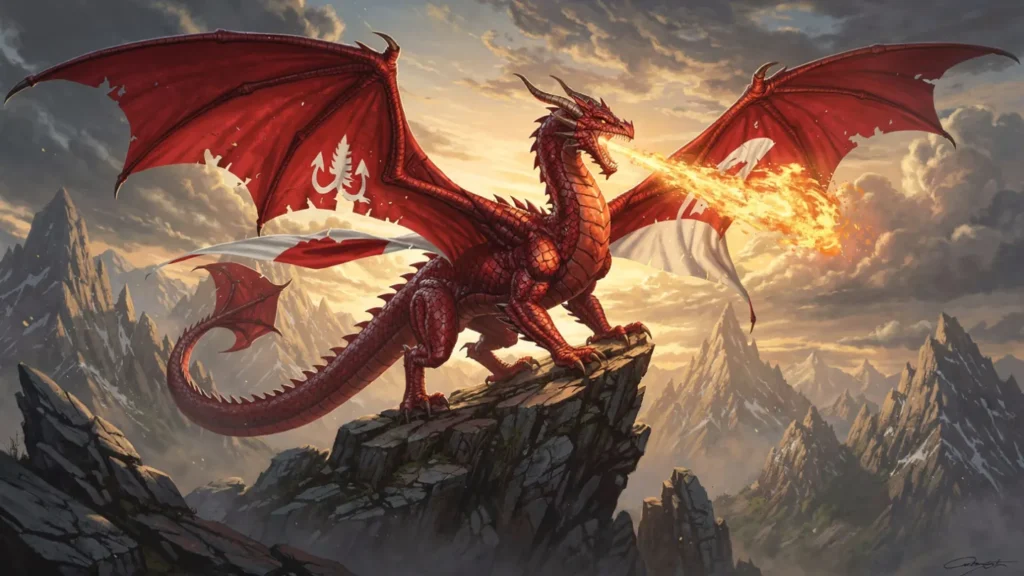
Y Ddraig Goch (The Red Dragon) of Welsh mythology is one of the world’s most famous national dragon symbols, appearing on the Welsh national flag and carrying a specific legendary narrative that gives it historical and political significance.
The core legend, preserved in the Mabinogion and in Geoffrey of Monmouth’s Historia Regum Britanniae, describes a battle between a Red Dragon and a White Dragon beneath the foundations of a castle being built by the usurper king Vortigern. The two dragons, discovered underground by the prophet Merlin (here called Myrddin Emrys), fight until the Red Dragon defeats the White.
Merlin interprets the battle as a prophecy: the Red Dragon represents the Britons (Welsh), the White Dragon represents the Saxons, and the Red Dragon’s ultimate victory prophesies the return of British glory under a great king who will drive out the invaders.
The Red Dragon’s national significance makes it the clearest example of a dragon figure explicitly identified with a people’s collective identity and political destiny, paralleling the Vietnamese Rong’s role in the founding myth but applying this identification to national resistance rather than national origin.
Medieval Christian Dragon: Sin, Chaos, and the Dragon Slayer Saint
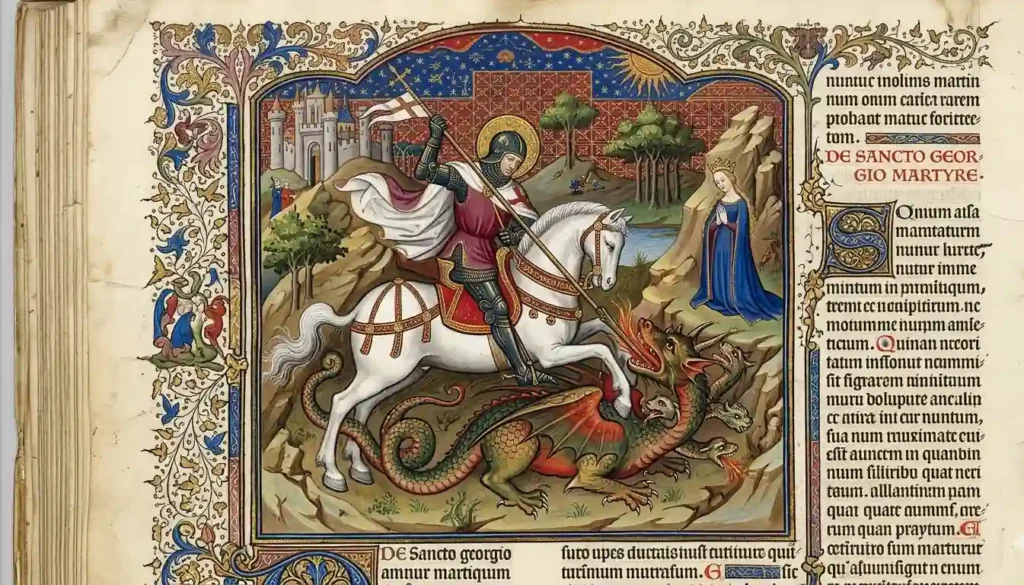
The Medieval European dragon tradition, shaped by Christian theological interpretation, produced the most consistently adversarial dragon figure in world mythology. Medieval Christianity associated the dragon with Satan, with sin, with the chaos that faith overcomes, and with the paganism that Christianity displaced.
Saint George and the Dragon became the paradigmatic Christian dragon narrative: a virgin threatened by a monster, a Christian knight who overcomes the creature through faith and courage, the dragon’s defeat representing the victory of Christian order over pagan chaos. Similar narratives attached to Saints Margaret, Martha, Germain of Auxerre, and dozens of other hagiographic figures across Medieval Europe.
This theological framework explains the sharp moral contrast between the Medieval European dragon and the East Asian dragon. The Chinese Long was a divine being whose cooperation sustained agricultural civilisation. The Medieval European dragon was a figure of evil whose defeat represented the triumph of the sacred. These could not be more different responses to the same basic creature category, and the difference has shaped fantasy literature’s dragon tradition ever since.
Mesoamerican and the Americas: Feathered Serpents
Quetzalcoatl: The Feathered Serpent God
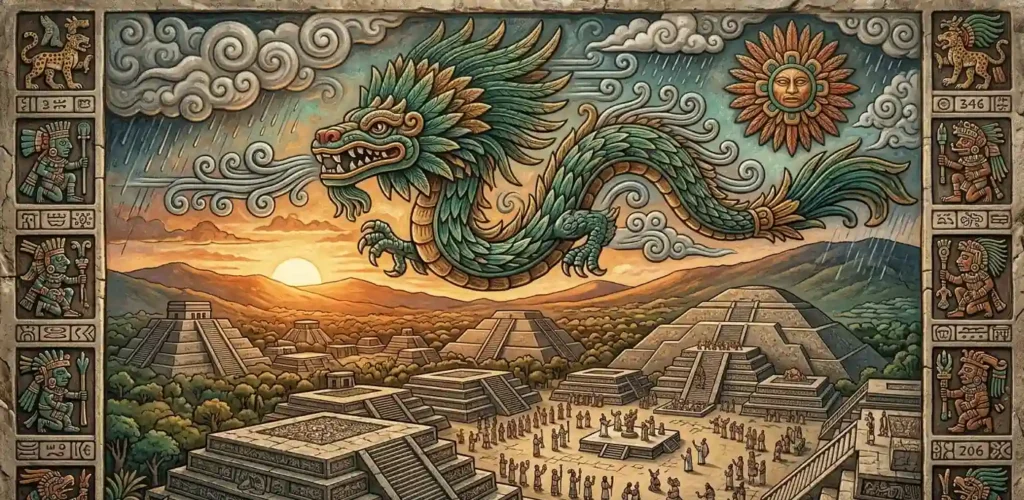
Quetzalcoatl (Feathered Serpent) is one of the most significant and complex mythological figures of the ancient Americas, worshipped by the Aztec, Toltec, Maya (as Kukulkan), and other Mesoamerican civilisations over many centuries.
Quetzalcoatl is a creator deity, a god of wind and learning, the patron of priests and merchants, and in some traditions the creator of humanity itself. The name combines the Nahuatl words for the quetzal bird (associated with beauty and divinity) and coatl (serpent), producing the feathered or plumed serpent whose iconography unites the sky (bird) and earth (serpent) in a single divine body.
The Quetzalcoatl tradition includes:
- Creation mythology: Quetzalcoatl descended to the underworld to retrieve the bones of previous human beings and created the present human race by mixing them with his own blood
- Cultural hero: Quetzalcoatl is credited with teaching humanity agriculture, calendar keeping, writing, arts, and other civilisational skills
- Cyclical return: Aztec tradition held that Quetzalcoatl had departed on a raft of serpents to the east and would one day return, a prophecy whose intersection with the Spanish conquest of 1519 produced one of history’s most studied cases of mythology intersecting with historical event
The feathered serpent tradition appears across Mesoamerican cultures with varying names but consistent attributes: the union of sky and earth, the civiliser who brings knowledge and order, the deity who is simultaneously bird and serpent. This is arguably the Americas’ closest equivalent to the East Asian dragon’s role as a divine being whose power is ultimately in service of human flourishing.
Other American Dragon Traditions
Indigenous dragon traditions across the Americas vary significantly by region and cultural context:
- The Horned Serpent: Found across multiple North American indigenous traditions, particularly among the Great Plains, Great Lakes, and Southeastern peoples, the Horned or Underwater Panther Serpent is a powerful spiritual being governing underwater realms and associated with dangerous but navigable supernatural power
- Piasa Bird: The Illini people of the Mississippi Valley described a great dragon-like creature depicted in cliff paintings along the Mississippi River, combining avian and serpentine features with the liminal quality of many dragon traditions
- Amaru: The Andean serpent deity of Inca and pre-Inca cultures, a great two-headed serpent associated with water and the boundaries between natural and supernatural worlds
Africa, the Middle East, and Oceania
African Dragon Traditions
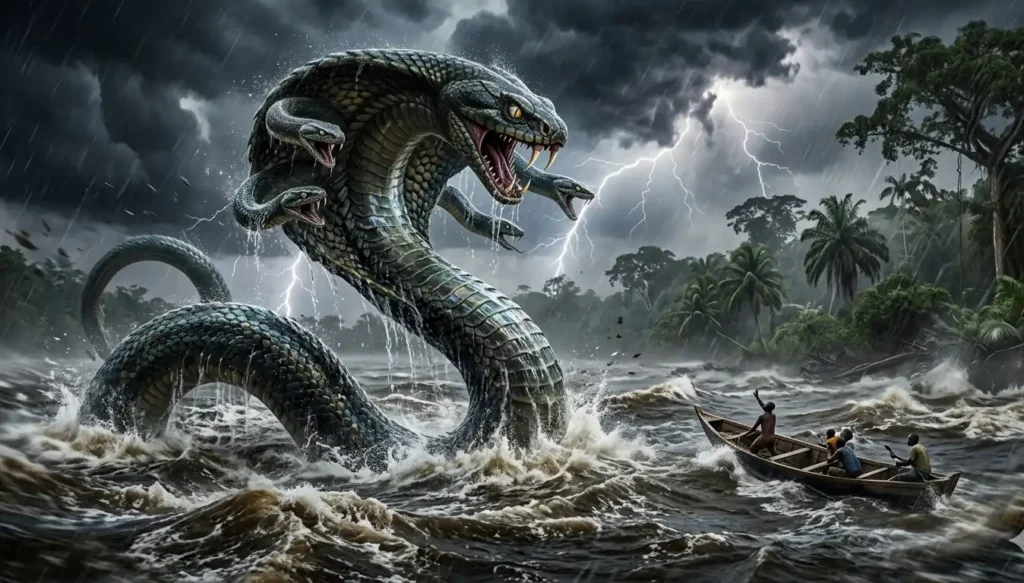
African dragon mythology is less systematically documented in English-language scholarship than other traditions but contains several significant figures.
Ninki Nanka of West African tradition, particularly among the Mandinka and related peoples of The Gambia and surrounding regions, is a great aquatic serpent inhabiting rivers and swamps, associated with disease and death for those who encounter it. Unlike the benevolent East Asian water dragon, Ninki Nanka is a creature of danger rather than of blessing, reflecting a different cultural relationship with the powerful waterways of West Africa.
Grootslang of Southern African tradition is a primordial creature described as combining the most dangerous qualities of elephant and serpent, inhabiting caves and guarding treasure, with some traditions describing it as an error made by the gods in creation’s early stages.
Middle Eastern Dragons: Tiamat and the Leviathan
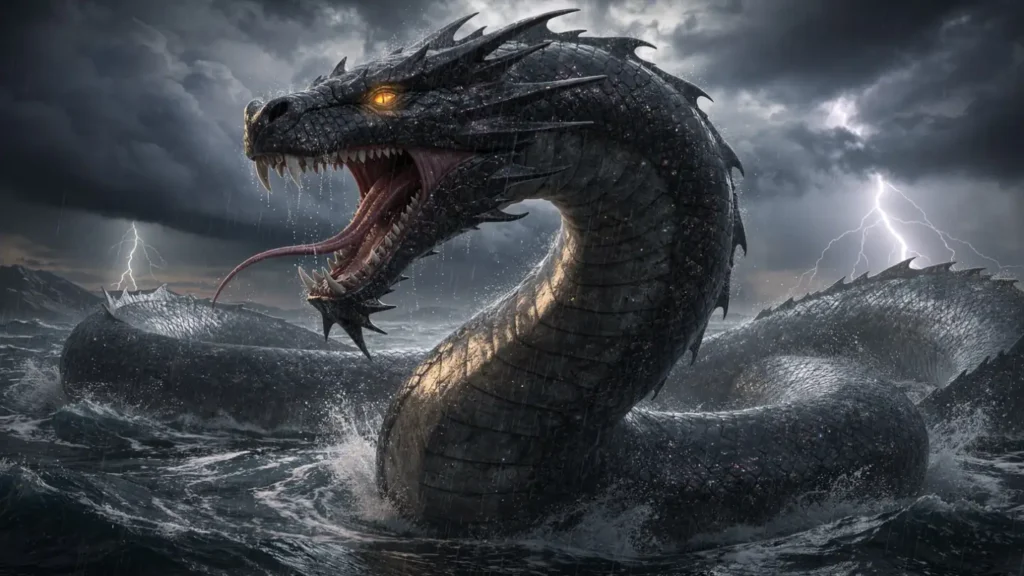
The Middle Eastern dragon tradition includes some of mythology’s oldest dragon figures, predating Greek and European traditions significantly.
Tiamat, the Babylonian primordial dragon of salt water, is one of the world’s oldest named dragon figures, appearing in the Enuma Elish creation epic dating to at least the 2nd millennium BCE. Tiamat is slain by the storm god Marduk, whose victory establishes cosmic order from the chaos of her body. This combat myth, the victory of an ordered divine principle over a primordial chaos dragon, is one of the foundational narrative patterns of Western civilization and underlies many subsequent dragon-slaying traditions.
Leviathan, the great sea monster of Hebrew scripture, appears in the Book of Job, Psalms, and Isaiah as a creature of primordial power that only God can overcome. Leviathan’s later association with Satan in Christian tradition connects it to the Medieval dragon-as-evil tradition and completes the chain from Babylonian Tiamat through Hebrew Leviathan to Christian dragon iconography.
Aboriginal Australian Rainbow Serpent
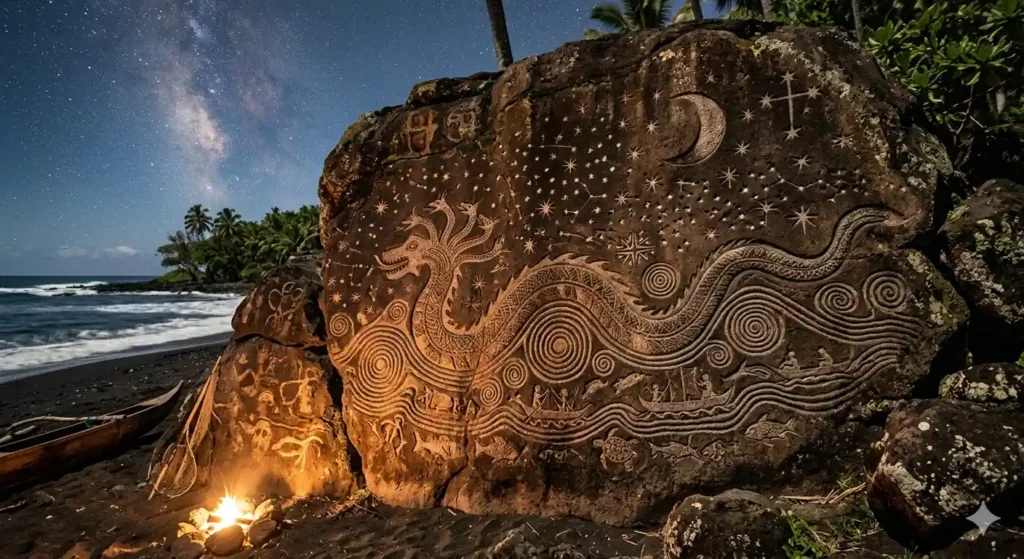
The Rainbow Serpent of Aboriginal Australian mythology is one of the world’s most widespread and long-documented dragon traditions, with rock art depicting serpentine figures in Australia dating back potentially tens of thousands of years.
The Rainbow Serpent appears across numerous Aboriginal language groups and regions with varying names and specific characteristics, but shares several broadly consistent attributes:
- Water authority: The Rainbow Serpent creates and governs waterways, whose sinuous paths through the landscape trace the serpent’s body
- Creation: In many traditions, the Rainbow Serpent shaped the land itself through its movement during the Dreaming, its body forming hills, valleys, and rivers
- Danger and power: Like many dragon traditions, the Rainbow Serpent is both a creative force and a dangerous one, to be respected and not disturbed
The Rainbow Serpent tradition demonstrates that dragon mythology is not confined to the civilizational centers typically associated with formal mythology but extends to every human tradition that has ever existed, including those with tens of thousands of years of continuous cultural practice.
The Great East-West Dragon Divide: Why it Exists
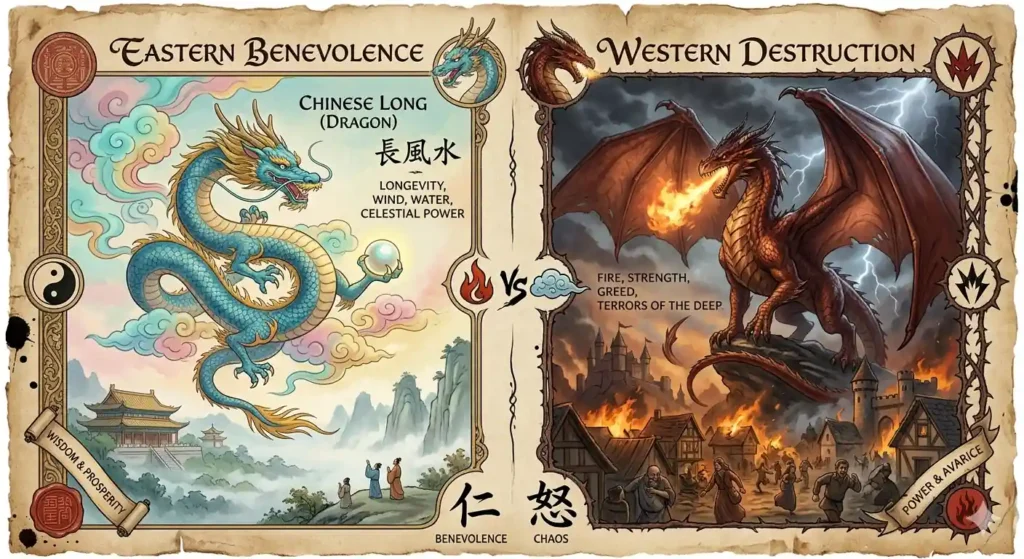
Having surveyed dragon traditions across twelve major world traditions, the single most significant observation this survey yields is the dramatic moral divide between East Asian and Western European dragon characters. This divide is not random and not simply a product of cultural difference. It follows coherently from the specific conditions in which each tradition developed.
Why Eastern Dragons are Benevolent: The Agricultural Argument
The benevolent character of East Asian dragons emerges from an interlocking set of cultural, ecological, and political conditions:
Agricultural dependence on rainfall: Chinese, Japanese, Korean, and Vietnamese civilizations were rice-farming cultures whose survival depended on monsoon rainfall arriving at the right time, in the right quantity. A being that controlled water and rain was, in such a context, the most important divine figure imaginable.
The dragon that brought rain was not powerful in an abstract sense. It was powerful in the sense of being the difference between life and death for millions of people across thousands of years of agricultural civilisation. A being of such power could not be a monster. It had to be a potential ally, a figure to be appeased, revered, and prayed to for the gift that determined survival.
Imperial political theology: Chinese imperial tradition made the dragon the symbol of the emperor’s mandate from heaven, the visible sign of the cosmic order that legitimate rule both expressed and maintained. The Son of Heaven ruled because he embodied the dragon principle of cosmic order. A monster could not symbolize legitimate authority. The dragon had to be divine, beneficent, and aligned with the proper ordering of the world.
Cosmological integration: The Qinglong as one of the Four Symbols was not a creature at all but a cosmological principle given form, the animating intelligence of the eastern sky. Cosmological principles are not monsters. They are the architecture of reality itself.
Why Western Dragons are Adversarial: Three Converging Factors
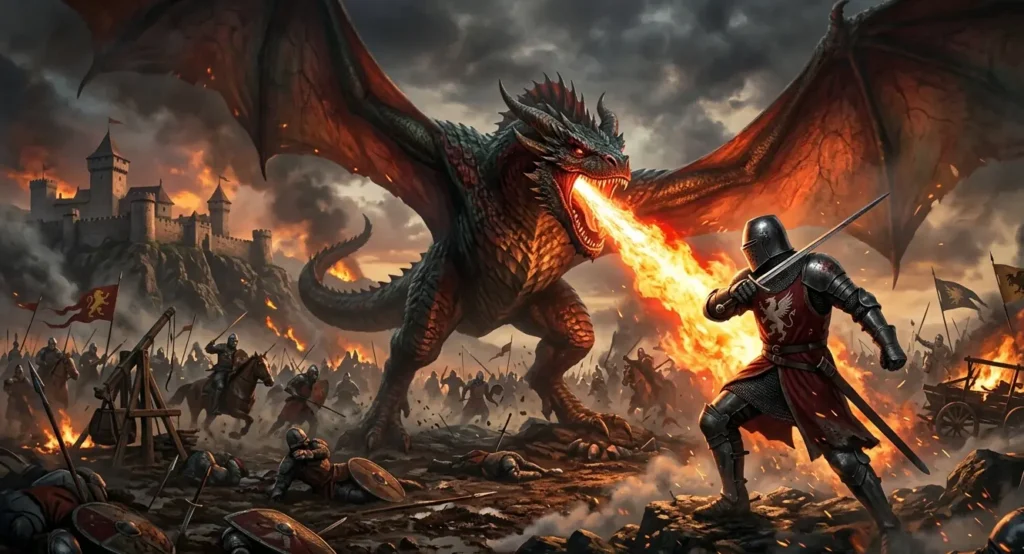
The adversarial character of Western European dragons emerges from an equally coherent set of converging factors:
The Indo-European dragon-slaying myth: Scholars of comparative mythology, including Georges Dumézil and scholars building on his work, identify a recurring narrative pattern across Indo-European mythologies in which a hero or storm god overcomes a great serpent-like adversary, establishing order from primordial chaos.
This pattern appears in Sanskrit (Indra and Vritra), Greek (Zeus and Typhon, Apollo and Python), Norse (Thor and Jormungandr), and Slavic traditions. The structural predisposition toward the serpent as adversary is, on this analysis, older than Western European civilisation itself.
Biblical theological identification: The Old Testament’s serpent in Eden, the Hebrew Leviathan that only God can subdue, and the Book of Revelation’s explicit identification of “the great dragon, that ancient serpent” with Satan created a theological framework in which every serpentine creature in Christian culture carried the shadow of this identification. Medieval Christianity did not create the dragon-as-evil. It inherited a deep structural pattern and gave it explicit theological articulation.
Pastoral rather than agricultural ecology: European cultures were substantially more pastorally based than East Asian rice-farming civilisations. The survival of pastoral communities depended more on protecting flocks from predators (large reptiles, wolves, bears) than on the benevolent provision of rain.
A culture in which large reptiles are threats rather than potential benefactors will produce a very different relationship to the great reptilian mythological figure than a culture in which the reptile-associated being brings the water that sustains life.
The Traditions That Bridge the Divide
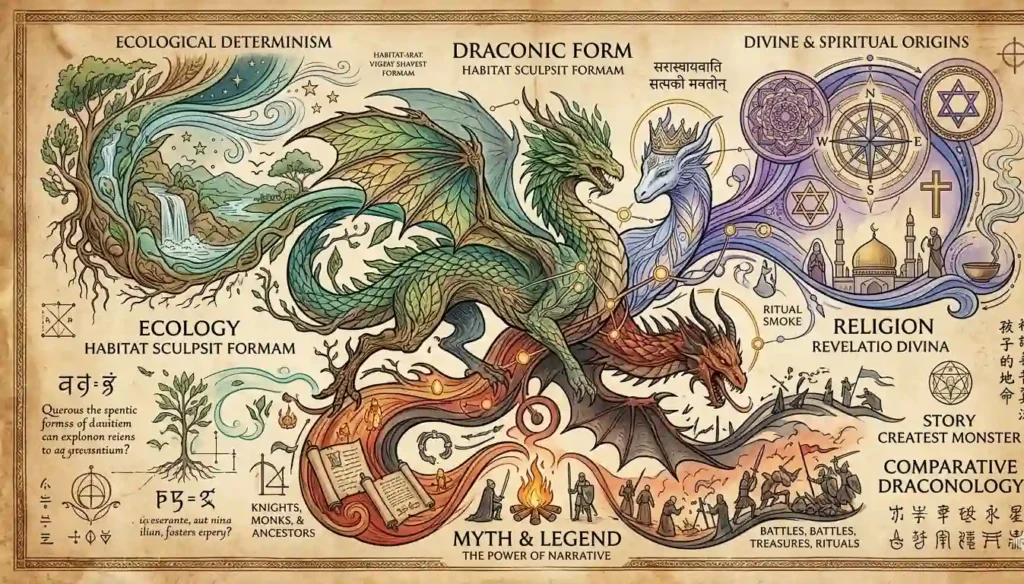
Not all dragon traditions fall neatly on either side of this divide, and the traditions that resist easy categorisation are often the most philosophically interesting:
- The Naga tradition is morally complex in ways that neither simple East Asian benevolence nor simple Western adversarialism captures. Individual Nagas span the full moral spectrum from the cosmically benevolent Shesha to the lethally dangerous Takshaka, reflecting a genuinely pluralistic approach to divine serpent characters.
- The Norse tradition gives us both Jormungandr (adversarial cosmic threat) and the absence of simple heroic resolution: Thor and Jormungandr destroy each other, neither triumphing cleanly.
- The Aboriginal Rainbow Serpent is both creative force and dangerous presence whose relationship with humanity requires ongoing respect and maintenance rather than simple reverence or simple fear.
- Fafnir is the most psychologically sophisticated Western dragon precisely because it was not born a dragon. Its adversarial character is earned through choice and moral corruption, making the creature’s evil legible as something that happened to a being that could have been otherwise.
Cross-cultural Dragon Comparison
| Tradition | Name | Moral character | Primary element | Key role | Most distinctive feature |
|---|---|---|---|---|---|
| Chinese | Long, Qinglong | Benevolent, divine | Water, Wood | Rain bringer, imperial symbol | Nine-animal composite form, five-toed imperial claw |
| Japanese | Ryu, Tatsu | Benevolent, sacred | Water, sea | Sea ruler, temple guardian | Three-toed claw, shapeshifting dragon brides |
| Korean | Yong, Mireu | Benevolent, transforming | Water | National guardian | Imugi transformation narrative |
| Vietnamese | Rong | Benevolent, ancestral | Water | National founding ancestor | Direct ancestral relationship with the Vietnamese people |
| Hindu/Buddhist | Naga | Morally complex | Water, earth | Divine serpent guardian | Full moral spectrum from Shesha to Takshaka |
| Bhutanese/Tibetan | Druk | Benevolent, national | Thunder, sky | National symbol, wisdom embodiment | Most complete national identification of any dragon figure |
| Greek | Drakon | Adversarial guardian | Earth, chthonic | Treasure guardian, hero-proving adversary | Ladon, Python, Hydra; guardian rather than predator |
| Norse | Dreki, Orm | Adversarial, cosmic | Chaos, destruction | Cosmic adversary, existential threat | Fafnir’s transformation through greed; mutual destruction with Thor |
| Welsh | Y Ddraig Goch | Prophetic, national | Earth, battle | National prophetic symbol | Dragon combat as national prophecy |
| Medieval Christian | Draco | Evil, adversarial | Fire, chaos | Symbol of Satan and sin | Saint-slaying narrative; theological identification with evil |
| Mesoamerican | Quetzalcoatl | Benevolent, divine | Sky, earth, wind | Creator deity, cultural hero | Feathered serpent union of sky and earth |
| Babylonian | Tiamat | Primordial, adversarial | Salt water, chaos | Primordial mother whose body becomes the world | World-creation from the dragon’s body |
| Hebrew | Leviathan | Adversarial, cosmic | Sea, chaos | Test of divine power, symbol of chaos | Only God can subdue; later = Satan |
| Aboriginal Australian | Rainbow Serpent | Complex, creative | Water, creation | Land creator, Dreaming law-giver | Oldest documented dragon tradition; landscape creator |
| West African | Ninki Nanka | Dangerous | Water, swamp | Ecological warning, death omen | Sight of it is fatal; shaped by real river danger |
Frequently Asked Questions
What is the oldest dragon mythology in the world?
The Babylonian Tiamat appears in the Enuma Elish, written in the 2nd millennium BCE. Aboriginal Australian Rainbow Serpent rock art may be far older and represents one of the oldest continuous dragon-like traditions. Babylonian is the oldest written record, while Aboriginal Australian may be the oldest cultural tradition.
Why do Eastern and Western dragons look and behave so differently?
Eastern and Western dragons reflect different cultural origins. East Asian rice farming societies depended on rainfall, so dragons became benevolent water bringers. Western traditions, shaped by Indo-European myths and Biblical symbolism, cast dragons as hostile serpent figures. Shared origins diverged as ecology and religion shaped opposite moral roles.
Is Quetzalcoatl really a dragon?
Quetzalcoatl is not labeled a dragon in its own tradition, but it serves a similar mythological role. As a divine feathered serpent, it bridges heaven and earth and influences civilization. Like dragon figures elsewhere, it represents a powerful universal archetype found independently across major world cultures.
What is the Rainbow Serpent and why is it significant?
The Rainbow Serpent is a major figure in Aboriginal Australian mythology, a great serpent that shaped rivers and landscapes during the Dreaming. It may represent one of the oldest continuous dragon-like traditions. As a creator and law-giver, it parallels East Asian water dragons in function despite developing independently.
Did dragon mythology spread from one culture to others, or did it develop independently?
Both processes contribute. Some dragon traditions spread through cultural contact, such as the Chinese Long influencing the Japanese Ryu, Babylonian Tiamat shaping ideas of Leviathan, and the Naga spreading with Hindu and Buddhist traditions. Others likely arose independently in regions without contact, suggesting a mix of cultural transmission and parallel development driven by shared human and environmental factors.
What does the dragon symbolize across different cultures?
Dragon symbolism varies across cultures but often centers on power at the boundary between humans and the unknown. In East Asian traditions, dragons are benevolent forces linked to water, celestial authority, and transformation. In Western traditions, they are adversarial symbols of chaos and greed. Across cultures, dragons mark encounters with powerful forces that shape the natural and cosmic order.
Final Thoughts
Through my reading of mythology, I have come to understand a few universal observations, because genuine universality in human culture is rarer than the human tendency toward pattern recognition suggests. The dragon is one of those rare genuine cases.
Every tradition covered in this article arrived at its dragon figure through its own internal mythological logic, shaped by its specific ecology, its particular theological framework, its unique history of cultural exchange and internal development.
The Chinese Long emerged from agricultural dependence on rainfall and imperial political theology. The Norse Nidhogg emerged from a cosmological vision of a universe in which destruction is built into the architecture of existence.
The Aboriginal Rainbow Serpent emerged from the relationship between a people and the continent whose landscape they understood to have been created by a great serpentine being in the mythological time before human memory. None of these borrowed from each other. All of them produced a dragon.
The observation that the dragon is universal does not flatten these differences or suggest that all dragons are the same figure. The Chinese Long and the Norse Jörmungandr are profoundly different beings with nothing in common except the broad category of large, supernatural serpentine creatures.
What they share is the position they occupy in their respective mythological architectures: the figure that represents the most fundamental powers governing the world, approached with the combination of awe and necessity that such powers demand.
The dragon is universal because the human experience of the world includes the encounter with forces vastly greater than individual human beings, forces that must be understood, related to, appeased, or overcome, depending on what they are and what relationship they offer.
Many cultures that has existed has faced that encounter. Many cultures has produced a dragon to represent it. The specific dragon that emerges tells you, with unusual clarity and precision, exactly what that culture most needed the greatest power in its universe to be.
References & Further Reading
- Birrell, Anne. Chinese Mythology: An Introduction. Johns Hopkins University Press, 1999.
- de Visser, M. W. The Dragon in China and Japan. 1913.
- Doniger, Wendy. Hindu Myths: A Sourcebook Translated from the Sanskrit. Penguin.
- Lindow, John. Norse Mythology: A Guide to the Gods, Heroes, Rituals, and Beliefs. Oxford University Press, 2001.
- Gantz, Timothy. Early Greek Myth. Johns Hopkins University Press, 1993.
- Dalley, Stephanie. Myths from Mesopotamia. Oxford University Press, 2000.
- Lambert, W. G. Babylonian Creation Myths. Eisenbrauns, 2013.
- Jamison, Stephanie W., and Joel P. Brereton. The Rigveda. Oxford University Press, 2014.
- Schwartz, Martin. “Transformations of the Indo-Iranian Snake-man.” Iranian Studies.
- Ford, Patrick K., trans. The Mabinogi and Other Medieval Welsh Tales. University of California Press, 1977.
- Byock, Jesse L., trans. The Saga of the Volsungs. University of California Press, 1990.
- Voragine, Jacobus de. The Golden Legend.
- Russell, Jeffrey Burton. Satan: The Early Christian Tradition. Cornell University Press, 1981.
- Forsyth, Neil. The Old Enemy: Satan and the Combat Myth. Princeton University Press, 1987.
- Carrasco, David. Quetzalcoatl and the Irony of Empire. University of Chicago Press, 1982.
- Nicholson, H. B. Topiltzin Quetzalcoatl. University Press of Colorado, 2001.
- Sugiyama, Saburo. Human Sacrifice, Militarism, and Rulership. Cambridge University Press, 2005.
- Berndt, Ronald M., and Catherine H. Berndt. The Speaking Land: Myth and Story in Aboriginal Australia.
- Boyer, Pascal. Religion Explained. Basic Books, 2001.
- Campbell, Joseph. The Hero with a Thousand Faces.
- Eliade, Mircea. Patterns in Comparative Religion.
- The Metropolitan Museum of Art, “Seven Necessary Dragons.”
- AIATSIS, materials on Aboriginal Australian Rainbow Serpent traditions.
Written by Batin Khan, a curious free spirit who loves reading and exploring the worlds of fantasy, mythology, and ancient stories. Through this blog, Batin hopes to share that sense of wonder with readers while building an exciting future along the way.