
 By
By Quick Takeaways
- Eastern and Western dragons share a name and a reptilian form. That is almost where the similarity ends.
- Eastern dragons are divine, benevolent, and associated with water and cosmic order. Western dragons are adversarial, dangerous, and associated with fire and chaos.
- These are not two versions of the same creature. They are two independent mythological responses to the same deep human instinct.
- The moral difference between them follows directly from what each culture needed its most powerful creature to be.
I’ve been planning to write this comparison post about Western Dragon vs Eastern Dragon for quite some time now and wanted to clear the fog. It still surprises me how completely two traditions can share a category while populating it with opposite figures.
Ask someone in Shanghai and someone in London to describe a dragon. You’ll get two animals that couldn’t share a mythology. The Chinese Long is a rain-bringer, a divine celestial being, and the symbol of imperial virtue. The European wyrm hoards gold, burns villages, and gets slain by saints. Both are called dragons. Almost nothing else about them is the same.
Here’s why.
Where Each Tradition Comes From
The Eastern Dragon: Astronomy, Agriculture, and Rain
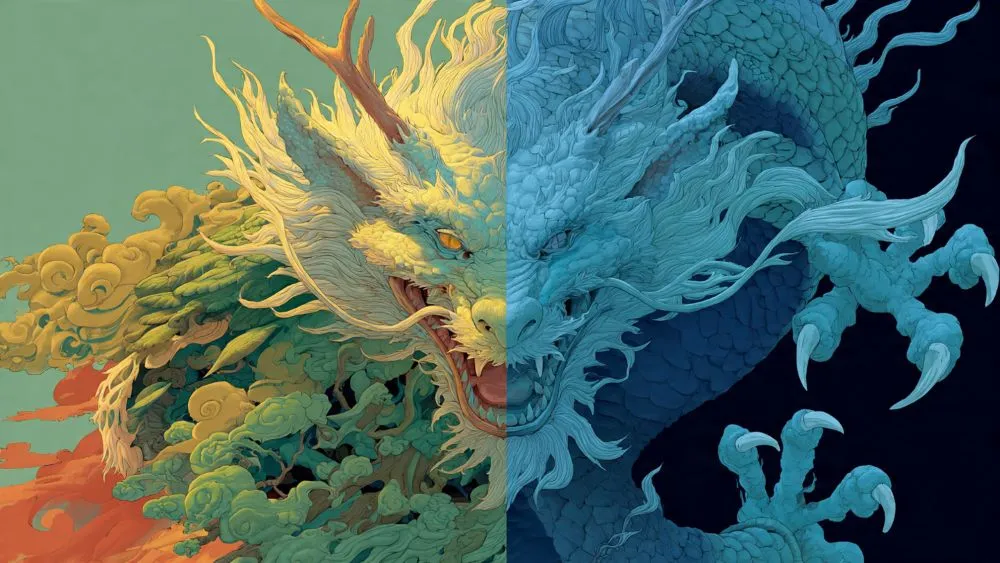
The Chinese Long has roots in ancient astronomical observation. Chinese astronomers divided the night sky into four quadrants and identified four celestial guardian figures, with the Azure Dragon (Qinglong) serving as the guardian of the East and appearing in the spring sky.
This astronomical origin gave the Long something the European dragon never had, a cosmological role that predated narrative mythology. The Long wasn’t invented to appear in stories. It was first identified in the stars, then later personified into the Dragon Kings who governed China’s rivers and seas.
For an agricultural civilization entirely dependent on monsoon rainfall, a water-controlling celestial being had to be benevolent. The Long brought rain. Farmers prayed to Dragon King temples during drought. You don’t pray to your enemy.
The Western Dragon: Chaos, Combat, and the Hero’s Test
The Western dragon has a completely different genealogy.
Its oldest traceable origins are in the Babylonian creation epic Enuma Elish, where Tiamat, the primordial salt-water dragon, is slain by the storm god Marduk, and her body becomes the world. Dragon slaying as the establishment of cosmic order runs throughout the Indo-European mythological tradition. Zeus defeats Typhon. Apollo kills Python. Thor fights Jormungandr.
This combat myth structure, where the hero overcomes the dragon and order emerges from chaos, became the Western dragon’s defining narrative role. It exists to be overcome. Its danger measures the hero’s worth.
Medieval Christianity later gave this adversarial dragon an explicit theological identity. The Book of Revelation’s “great dragon, that ancient serpent, who is called the Devil and Satan” transformed the creature into a symbol of evil itself. Saint George, Saint Michael, and Saint Margaret all became famous dragon slayers.
The Five Key Differences
1. Moral Character
This is the fundamental divide, and everything else flows from it.
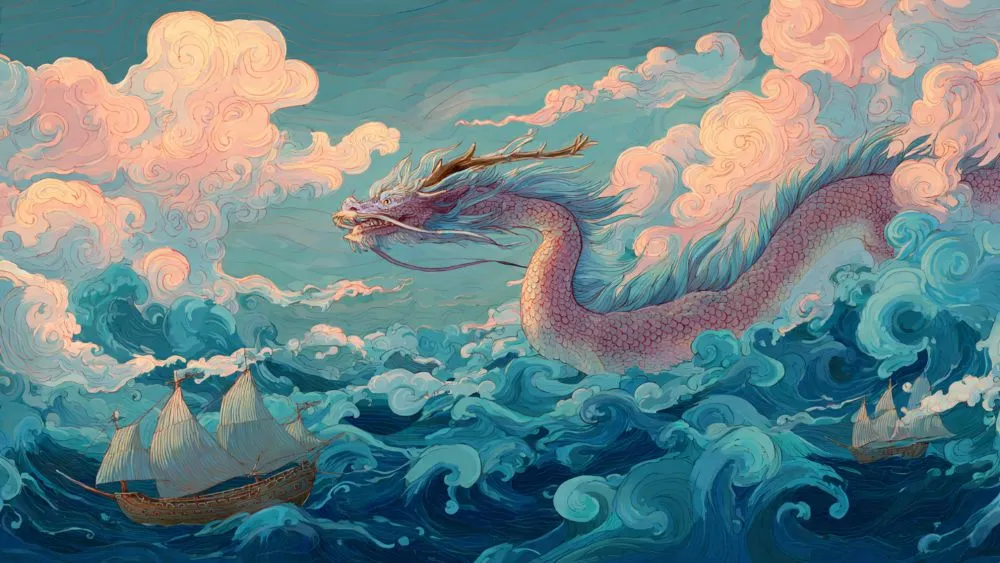
Eastern dragon: Benevolent, divine, and a cosmic guardian. Revered, prayed to, and regarded as a symbol of imperial legitimacy and virtue.
Western dragon: Dangerous, adversarial, and representative of chaos or evil. Feared, slain, and viewed as the obstacle heroism must overcome.
The moral difference is not incidental. It reflects the core cultural function each dragon serves.
2. Elemental Association
Eastern dragon: Water. It governs rainfall, rivers, lakes, and seas. The Dragon Kings control the weather, and prayers for rain are directed to them.
Western dragon: Fire. Fire breathing is so deeply embedded in European tradition that it feels inseparable from the creature itself. Fire destroys, and the dragon’s flames serve as a weapon.
The elemental opposition mirrors the moral one. Water nourishes. Fire destroys. The rain-bringing Long and the flame-breathing wyrm express their respective roles through these elements.
3. Physical Form
| Feature | Eastern Dragon | Western Dragon |
|---|---|---|
| Body | Serpentine, long, sinuous | Large, bulky, quadrupedal |
| Wings | Usually absent | Standard feature |
| Claws | Eagle-like (3, 4, or 5 toes by rank) | Massive, predatory |
| Horns | Deer-like antlers | Ram-style horns |
| Expression | Fluid, elegant, dancing | Aggressive, threatening |
| Coloring | Multiple colors, often gold or green | Red, black, or earth-toned scales |
The physical differences reflect their functions. The Long is graceful because it embodies cosmic harmony. The wyrm is massive and threatening because it represents the greatest possible danger.
4. Relationship with Humans
Eastern dragon: Cooperative, protective, and responsive to human prayer. People seek blessings from Dragon Kings. Dragons provide rain, bestow gifts, and safeguard communities.
Western dragon: Predatory and antagonistic. Dragons demand tribute, hoard wealth that should circulate through society, and threaten human settlements.
The narrative difference is striking. Eastern mythology often features heroes befriending dragons. Western mythology usually celebrates heroes who slay them.
5. Cosmological Role
Eastern dragon: Essential to cosmic order. Dragon Kings maintain the water cycle. The Azure Dragon governs the East within the Four Symbols system. Remove the dragons, and the cosmological structure collapses.
Western dragon: Opposed to cosmic order. Order emerges only after the dragon is defeated. Marduk creates the world from Tiamat’s body, making the dragon something that existed before order rather than sustaining it.
The Origin Question: Why Both Exist

My years of studying comparative mythology has convinced me that both traditions respond to the same deep human phenomenon, but from opposite directions.
Evolutionary psychologist David E. Jones proposed that dragons emerged from humanity’s combined fear of three ancestral predators: large snakes, birds of prey, and powerful predatory mammals. These merged within the human mind into one composite threat featuring a serpentine body, aerial dominance, and a predatory face.
This theory helps explain why both traditions independently created similar composite creatures. Human biology remained constant across cultures.
What differed was each civilization’s cultural needs.
East Asian agricultural societies depended on reliable rainfall. Their most powerful mythical creature needed to cooperate with humanity rather than oppose it. The biological dragon template evolved into a divine, benevolent force associated with water and cosmic harmony.
European cultures inherited Indo-European traditions where heroic identity formed through overcoming monstrous adversaries. Their greatest mythical creature became the ultimate challenge, embodying chaos, greed, and destruction.
The same psychological template produced two opposite mythological outcomes.
The Moments of Overlap
The East versus West distinction is useful, but it is not absolute.
The Norse dragon Fafnir is one of the West’s most psychologically complex dragons. Originally a dwarf, he transformed into a dragon through greed. When Sigurd kills him, he gains wisdom from Fafnir’s dying words and dragon blood. This interaction resembles Eastern dragon stories more than many Western examples.
Japan’s Yamata no Orochi presents the opposite exception. This eight-headed serpent demands maidens as tribute and is eventually defeated by the storm god Susanoo. Its narrative closely resembles Western dragon-slaying myths despite originating in East Asia.
These exceptions remind us that the dominant patterns are not universal rules.
Why the Distinction Matters
This comparison matters for more than mythology.
First, dragons reveal cultural values.
The Eastern rain-bringing dragon reflects a civilization that viewed the greatest power as something humanity should cooperate with.
The Western dragon reflects a civilization that viewed greatness as emerging through overcoming powerful opposition.
Second, this distinction explains a common modern misunderstanding.
When Chinese dragons appear in Western media, they are often treated as if they were simply another version of the European dragon. Their associations with rain, harmony, divine authority, and cosmic order are frequently replaced with Western ideas of fire, danger, and destruction.
The Chinese Long is not a friendlier version of the European dragon. It is an entirely different answer to the same mythological question.
Frequently Asked Questions
Do Eastern dragons breathe fire?
Generally, no. Fire breathing is primarily a Western dragon characteristic. Eastern dragons are associated with water, rain, rivers, storms, and weather. Some traditions connect dragons with lightning or thunder, but not with fire breathing.
Which tradition is older?
Both traditions have ancient roots. Chinese dragon imagery appears in Neolithic jade carvings dating to at least 5000 BCE. Written accounts of the Babylonian Tiamat tradition date to around 2000 BCE. Neither tradition can definitively claim to be older. For more, check out my post about the oldest dragons in world mythology.
Are there evil Eastern dragons?
Yes, although they are not the norm. Japan’s Yamata no Orochi is openly hostile, and some Buddhist traditions include malevolent naga figures. In Chinese mythology, however, dragons are generally benevolent by default.
Why do Eastern dragons not have wings?
Eastern dragons fly through magical power and control of wind and clouds rather than physical wings. This reflects their connection to heavenly and natural forces. For more, why not read my post where I discuss how eastern dragons fly without wings
Why are Eastern dragons associated with emperors?
In Chinese culture, the dragon symbolized imperial power and the mandate of heaven. Emperors were called “Son of the Dragon,” linking them directly to divine authority.
Final Thoughts

The same creature inspired two completely different mythological traditions.
The Eastern Long looks at the most powerful imaginable being and says, this force should guide and protect us.
The Western wyrm looks at the same figure and says, this force must be confronted and overcome.
Both perspectives make sense within their historical and cultural contexts. Both created rich and enduring mythological traditions. Understanding the difference offers one of the clearest windows into how civilizations define power, order, and the relationship between humanity and the unknown.
Related Articles
- Dragon Mythology: How Dragons Are Depicted Across Cultures
- Chinese, Japanese & Korean Dragons: How They Actually Differ
- 7 Eastern Dragon Facts Most People Believe But Are Wrong
- 9 Eastern Dragon Myths That Sound Too Strange to Be True
- 11 Eastern Dragon Legends Still Shaping Fantasy Today
- 15 Japanese Dragon Legends Hollywood Has Been Ignoring
- 11 Oldest Dragons in World Mythology: Sumeria to China
Sources
- Jones, David E. An Instinct for Dragons. Routledge, 2000.
- Calvert Watkins – How to Kill a Dragon: Aspects of Indo-European Poetics (Oxford, 1995)
- The Dragon in China and Japan – Willem de Visser
- Enuma Elish
- Book of Revelation (12:9)
- Poetic Edda
- Theogony (Hesiod)
- Shanhaijing (Classic of Mountains and Seas).
- Birrell, Anne. Chinese Mythology: An Introduction.