 By
By Quick takeaways:
- Xuanwu is the Chinese Black Tortoise, one of the Four Symbols of East Asian cosmology, guardian of the North, ruler of the Water element, and sovereign of the winter season
- Xuanwu is unique among the Four Symbols because it evolved from a cosmological figure into a fully developed Daoist deity with temples, an imperial patron role, and active religious worship, a transformation no other Symbol underwent to the same degree
- The Black Tortoise is depicted as a tortoise intertwined with a serpent, a dual-beast form that carries its own distinct symbolic meanings about longevity, wisdom, and the relationship between the stable and the fluid
- Korea, Japan, and Vietnam each developed distinct but closely related Black Tortoise traditions. Hyeonmu, Genbu, and Huyen Vu, respectively. each adapting the guardian’s cosmological role to local cultural contexts
- In Xianxia and cultivation fiction, Xuanwu appears as a divine beast, a water-element bloodline, a northern sect symbol, and the patron of the genre’s most philosophically profound cultivation paths
Of the four great celestial guardians of East Asian cosmology, Genbu is the one who most consistently surprises first-time readers. The Azure Dragon is expected. The Vermilion Bird is spectacular. The White Tiger is fearsome.
But the Black Tortoise, a great tortoise intertwined with a serpent, slow and ancient and northern, governing winter and deep water and the darkness before dawn, carries a weight and a philosophical depth that the more visually dramatic guardians do not quite reach.
More than a decade of reading cultivation fiction gave me the Xuanwu I expected. The North Guardian, the water-element kingdom patron, the slow and vast divine beast that the impatient protagonist underestimates. Tracing it back through the actual mythological and religious tradition revealed something considerably more interesting.
Of all the Four Symbols, Xuanwu alone made the journey from cosmological principle to living deity, from the animating intelligence of the northern sky to an actively worshipped Daoist god whose temples still stand on Wudang Mountain and whose influence shaped the religious politics of the Ming Dynasty.
That transformation is one of Chinese religious history’s most fascinating stories, and it makes the Black Tortoise the Four Beasts’ most philosophically complex figure.
Xuanwu Origins: The Four Symbols and the Northern Guardian
Xuanwu’s story begins in the same place as those of the other Four Symbols, in the ancient Chinese division of the night sky into four celestial quadrants.
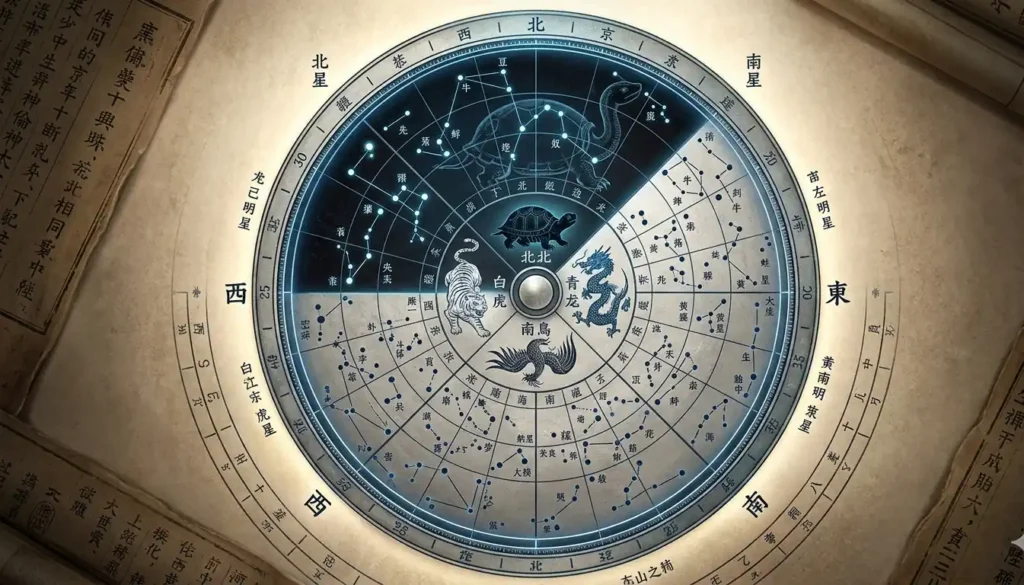
Chinese astronomers of antiquity organised the twenty-eight lunar mansions into four groups of seven, each associated with a cardinal direction, a season, an element, a colour, and a guardian beast. The four figures produced by this system are the Si Xiang, the Four Symbols:
- Qinglong, the Azure Dragon of the East
- Zhuque, the Vermilion Bird of the South
- Baihu, the White Tiger of the West
- Xuanwu, the Black Tortoise of the North
Xuanwu’s cosmological assignments are precise and internally coherent:
- Direction: North, the direction of darkness, of cold, of the deep winter sky
- Season: Winter, when yang energy has retreated to its minimum and yin is at its maximum expression
- Element: Water, governing depth, stillness, flow, and the hidden potential beneath the surface
- Colour: Black, associated in Chinese cosmology with the North, with water’s depth, and with the yin principle at its fullest
- Time of day: Midnight, the deepest point of darkness before the return of light
These attributes give Xuanwu a character that is simultaneously the most yin-dominant of the Four Symbols and the most philosophically interesting.
While the Azure Dragon governs spring’s new growth and the Vermilion Bird governs summer’s blazing peak, Xuanwu governs the moment of maximum stillness, the deep winter midnight when everything has contracted to its most inward point and the next cycle has not yet begun. This is the moment of maximum potential precisely because nothing has yet been expressed.
The seven northern lunar mansions assigned to Xuanwu trace the outline of a tortoise in the northern sky, making Xuanwu not merely a symbol of the north but its astronomical reality: the living figure drawn across the northern heaven in stars.
Xuanwu in Chinese Mythology and Daoism
Cosmological Role and the Northern Sky
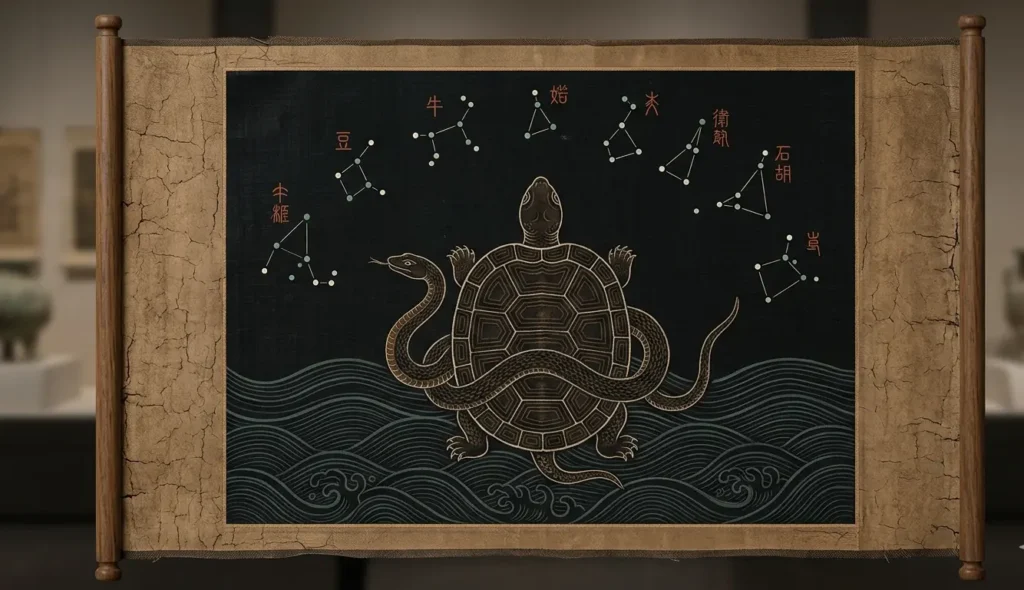
As a cosmological figure, Xuanwu (玄武, literally “Dark Warrior” or “Mysterious Warrior”) presides over the seven northern lunar mansions whose star positions trace its form across the winter sky. The name combines xuan (玄, meaning dark, mysterious, or profound) with wu (武, meaning martial, warrior, or powerful), creating a name that carries a specific philosophical resonance.
The darkness that is also a form of strength, the mystery that is also a form of mastery.
This naming distinguishes Xuanwu from its companions in philosophically important ways. The Azure Dragon’s name evokes vitality and movement. The Vermilion Bird’s name evokes brightness and fire. The White Tiger’s name evokes purity and ferocity. Xuanwu’s name evokes the profound, the hidden, and the martially disciplined, a combination that sits at the heart of classical Chinese thinking about the relationship between stillness and power.
Physical Description and the Serpent Intertwining
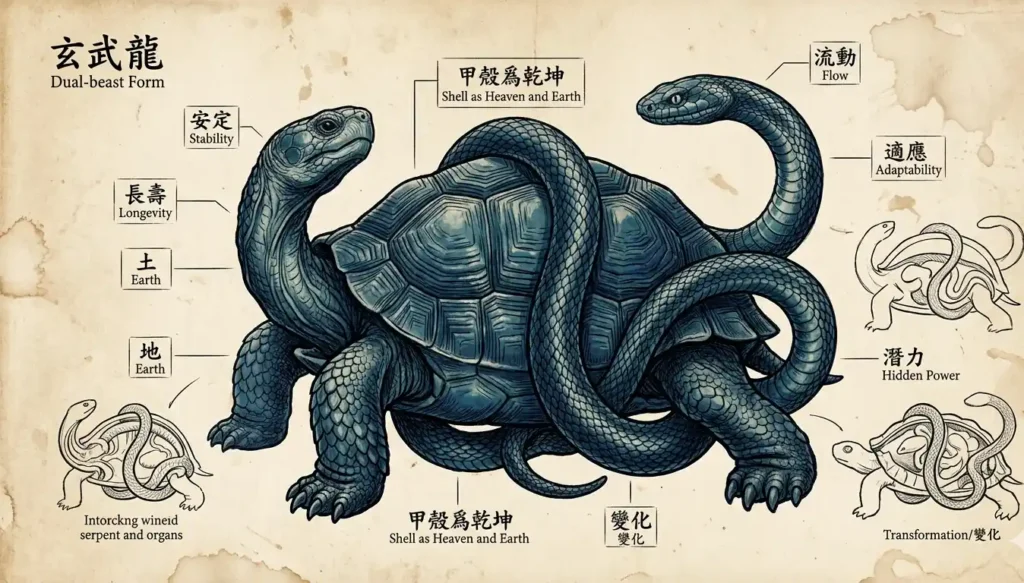
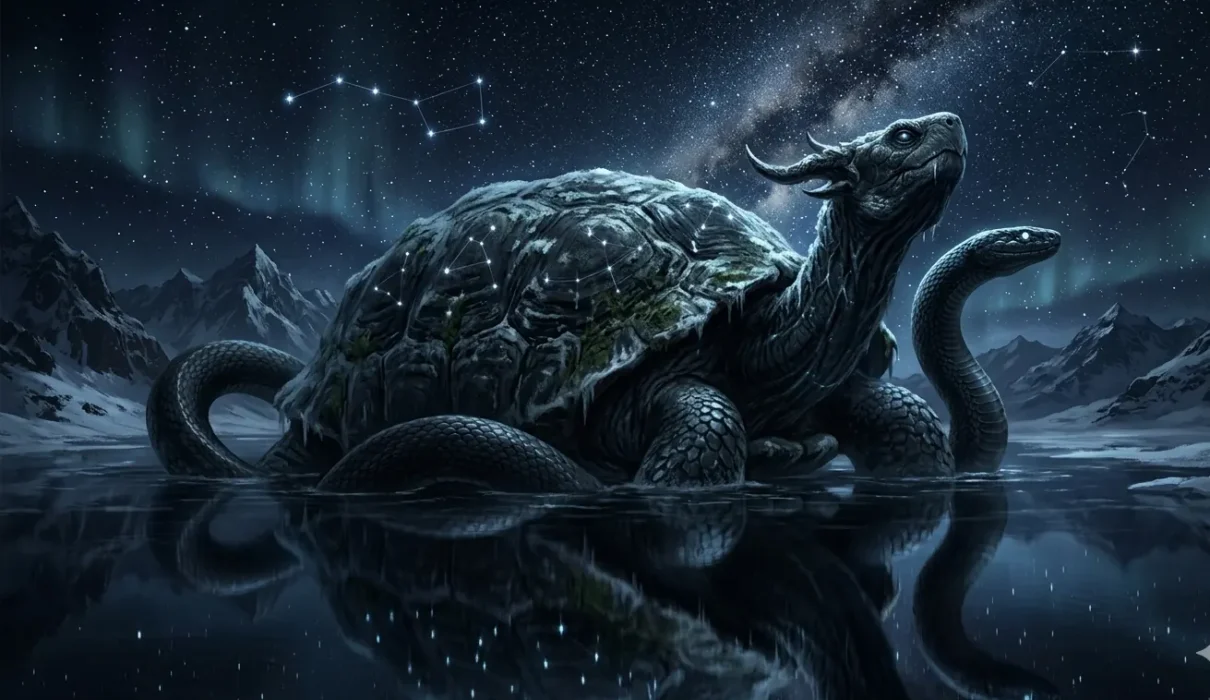
Xuanwu’s most distinctive visual characteristic sets it apart from every other major mythological figure in the East Asian tradition. It is depicted not as a single animal but as two animals intertwined, a tortoise and a serpent, their bodies coiled together in a relationship that is part combat, part embrace, and part cosmic union.
The standard iconographic description is specific:
- A great black tortoise with a domed shell, ancient and massive
- A serpent wrapped around or emerging from beneath the tortoise’s shell
- The two creatures facing each other, or with the serpent’s head rising above the tortoise’s shell
- Both rendered in black and deep water-colours, their combined form suggesting the northern deep
The tortoise and serpent each carry their own distinct symbolic values in Chinese tradition:
The tortoise symbolises:
- Longevity and immortality – the tortoise’s extreme lifespan made it the classical symbol of long life in Chinese culture
- Stability and endurance – its shell is the image of something that cannot be overwhelmed by external force
- Wisdom accumulated through age – what survives long enough carries the knowledge that only time produces
- The earth and its solidity – the tortoise shell was used in classical Chinese divination, making it a mediator between heaven and earth
The serpent symbolises:
- Adaptability and flow – the serpent takes every shape its environment requires
- Hidden power and sudden action – the serpent strikes from stillness with speed the observer does not anticipate
- Transformation and renewal – the serpent’s shedding of its skin is the classical image of cyclical self-renewal
- The water element’s fluid quality – the serpent’s movement through grass and water embodies the flow that the tortoise’s solidity does not
Together, the tortoise and serpent are two aspects of the northern water principle. Stability and flow, permanence and transformation, endurance and adaptability. Their intertwining is not a battle but a cosmological statement about the nature of the northern power they together embody.
From Cosmological Symbol to Daoist Deity
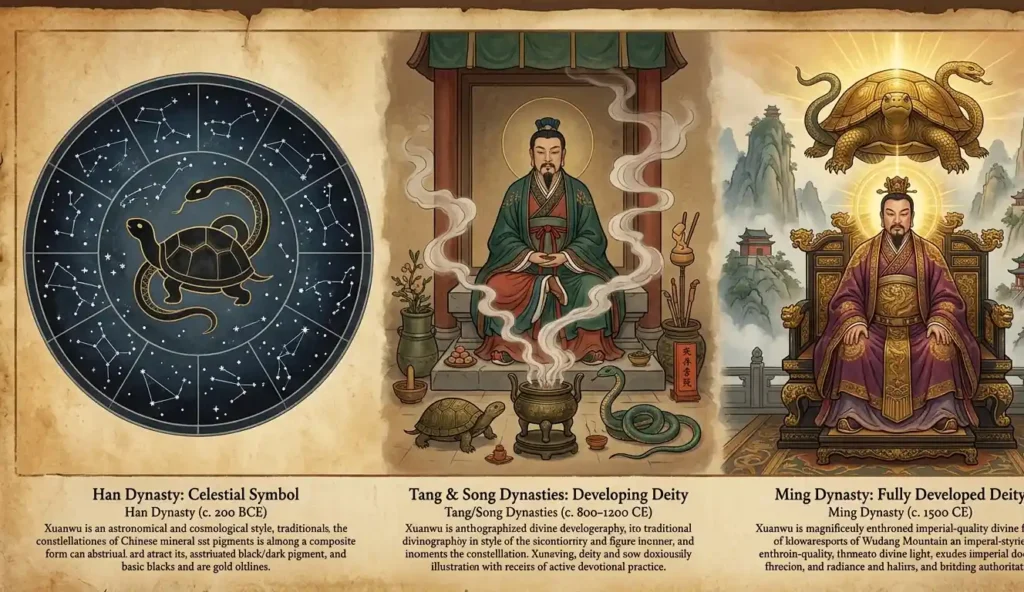
Xuanwu’s evolution from a cosmological figure into a fully developed Daoist deity is the most remarkable transformation in the Four Symbols tradition and one of Chinese religious history’s most interesting case studies.
The process began gradually during the Han Dynasty and accelerated through the Tang and Song periods, as Daoist practitioners began associating Xuanwu with specific divine functions beyond its cosmological guardian role:
- Protection of the North became protection of the entire realm, with Xuanwu understood as a guardian deity whose power could be invoked for military protection and territorial security
- Water governance connected Xuanwu to weather control, flood prevention, and maritime safety
- Exorcism and demon-quelling developed from its martial warrior name, with Xuanwu understood as a powerful force against malevolent spirits
- Longevity and immortality connected the tortoise’s extreme lifespan to Daoist cultivation goals
The mythos surrounding Xuanwu as a deity developed accordingly. In Daoist tradition, Xuanwu was not always a god but became one through cultivation, a narrative with obvious resonance for cultivation fiction readers.
Various Daoist texts describe Xuanwu’s divine biography as a prince who abandoned his royal life to pursue cultivation, who achieved immortality through dedicated practice, and who eventually ascended to become the supreme deity of the North. This cultivation-origin narrative is unique among the Four Symbols and may be one of the reasons Xuanwu transferred so naturally into cultivation fiction’s conceptual framework.
Xuanwu as Daoist God and the Wudang Connection
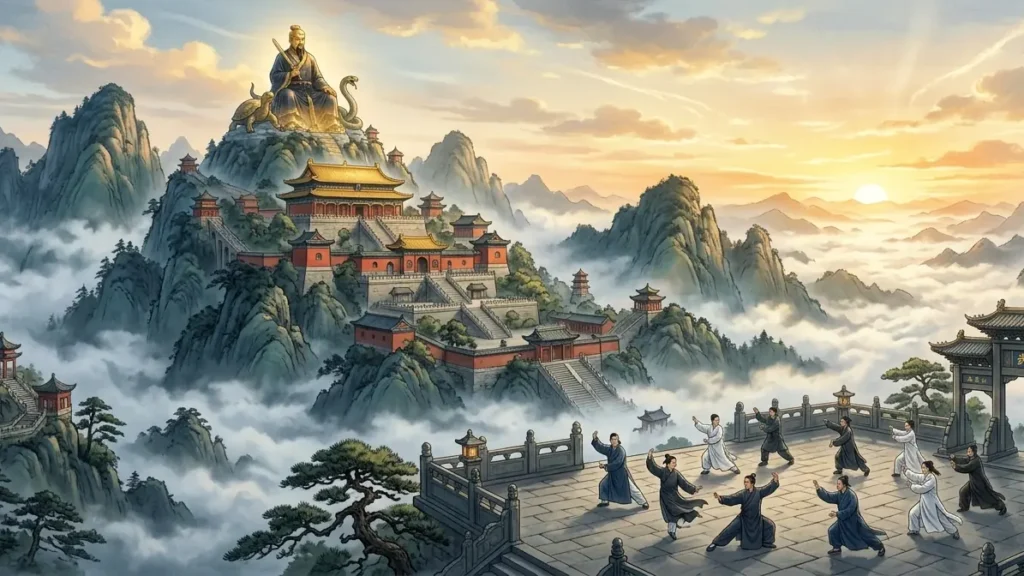
Xuanwu’s status as a fully developed Daoist deity reached its peak during the Ming Dynasty (1368 to 1644 CE), when the founding Yongle Emperor Zhu Di adopted Xuanwu as his divine patron and protector. The emperor’s adoption of Xuanwu carried specific political dimensions.
Zhu Di had seized the throne from his nephew in a civil war and needed divine legitimation for his rule. Xuanwu, the martial dark warrior who had himself achieved power through a combination of cultivation, military virtue, and northern authority, was the ideal patron deity.
Emperor Yongle commissioned the construction of a massive temple complex on Wudang Mountain (武當山) in Hubei Province, one of the most significant Daoist sacred sites in China, as a centre of Xuanwu worship.
The name Wudang itself encodes Xuanwu’s presence: Wu (武) is the martial component of Xuanwu’s name, making Wudang literally “the mountain worthy of Wu.” The Wudang complex, a UNESCO World Heritage Site, remains an active centre of Daoist practice and martial arts cultivation today, its Xuanwu temples still in use after more than six centuries.
The Wudang martial arts tradition, which includes the internal martial arts styles associated with Wudang Mountain, developed in direct connection with Xuanwu worship. The Wudang internal martial arts styles emphasise:
- Stillness as the foundation of power
- Yielding and flowing rather than direct confrontation
- The cultivation of internal energy (qi) through slow, deliberate practice
- The integration of Daoist philosophy with martial application
These principles are direct expressions of Xuanwu’s philosophical character: the northern winter principle, water’s yielding power, the tortoise’s patient endurance. The Wudang martial arts tradition is Xuanwu’s symbolic meaning made into physical practice.
Protective and Auspicious Meaning
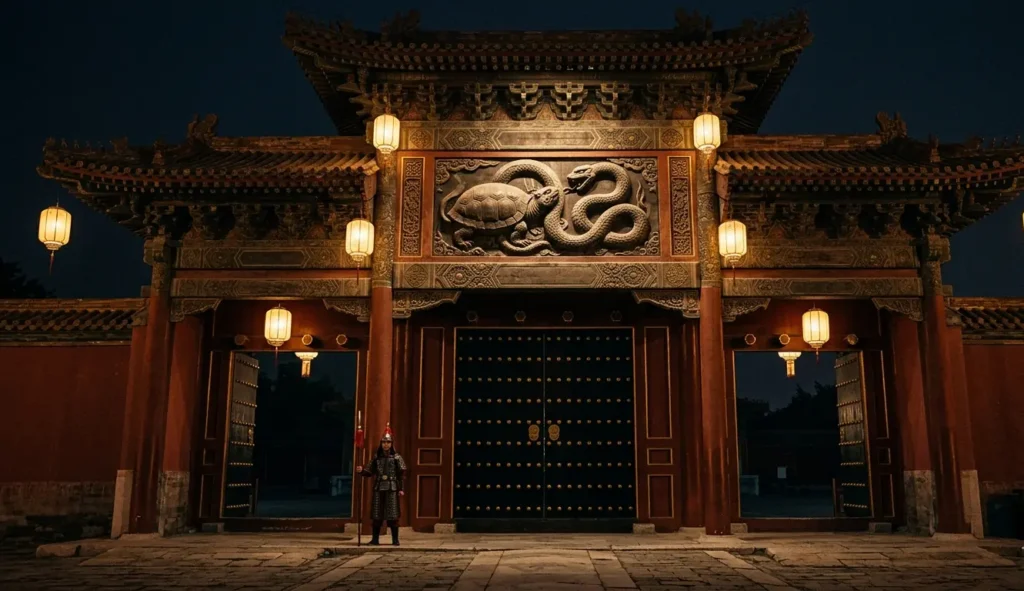
Beyond its cosmological and deity roles, Xuanwu carries a complex of protective and auspicious meanings in Chinese cultural tradition:
- Northern gate protection: Like Zhuque at the south, Xuanwu is the traditional guardian of northern gates and northern walls of important buildings, palaces, and cities
- Tomb protection: The four guardian beasts appear on the four walls of classical Chinese tombs, with Xuanwu on the northern wall protecting the dead from malevolent northern forces
- Military protection: The martial component of Xuanwu’s name made it a patron of military forces, and generals prayed to Xuanwu for martial power and victory
- Water safety: Xuanwu’s water governance made it the patron of sailors, fishermen, and all who worked on or near water
- Longevity blessings: The tortoise’s extreme lifespan made Xuanwu an auspicious symbol for birthday celebrations and longevity wishes, its image appearing on gifts intended to bestow long life
Genbu: The Black Tortoise in Japanese Tradition
Transmission to Japan and Cultural Adoption
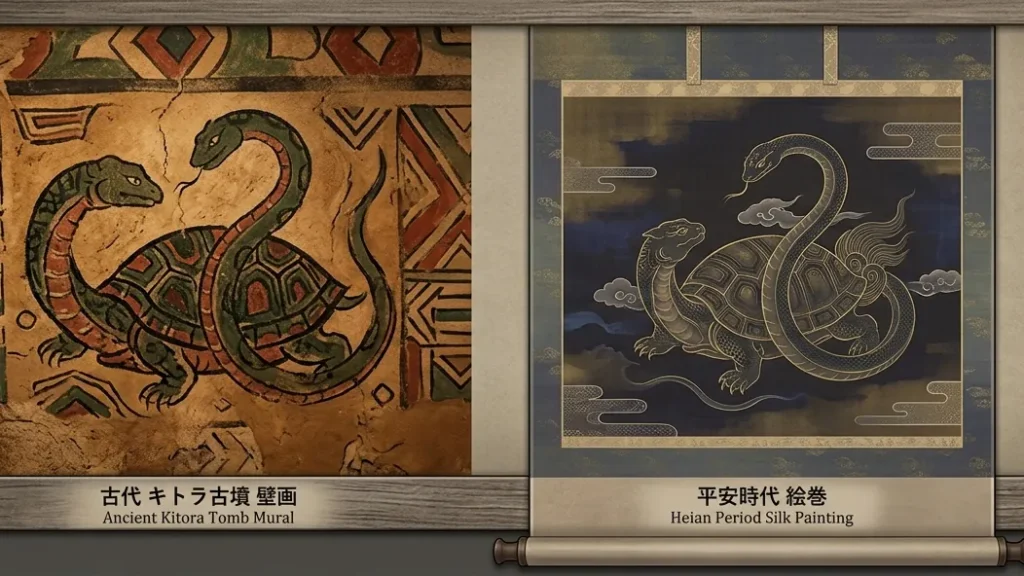
Genbu (玄武) is the Japanese reading of the same characters used for the Chinese Xuanwu, transmitted to Japan as part of the comprehensive adoption of Chinese cosmological frameworks during the Asuka and Nara periods (roughly 6th through 8th centuries CE).
The Four Symbols arrived in Japan as a complete cosmological system alongside Buddhism and Chinese geomantic theory, and Japanese court culture applied them practically and immediately. Genbu took its prescribed position as the northern guardian, and the physical layout of the ancient capitals was organised around its directional authority alongside its three companion guardians.
Genbu in Nara, Heian, and Classical Japanese Culture
Genbu’s presence in classical Japanese culture is documented through several significant physical and textual traces:
Tomb murals: Like the Korean Goguryeo tomb tradition, Japanese burial mounds of certain periods incorporate four guardian beast imagery. The Kitora Tomb in Nara Prefecture, a 7th-century burial mound discovered in the late 20th century, contains ceiling murals of celestial maps and wall murals of the four guardian beasts, with Genbu on the northern wall. The Genbu in the Kitora Tomb is one of the finest surviving examples of early Japanese four guardian beast art.
Capital orientation: The ancient capitals of Nara and Heian-kyo (Kyoto) were laid out with Genbu’s northern authority incorporated into their spatial design. In classical Chinese geomancy applied to city planning, the ideal site has a mountain to the north (Genbu’s position), hills to the east and west (Dragon and Tiger positions), and open land to the south (Vermilion Bird position).
Kyoto’s Genbu: The city of Kyoto’s northern direction is associated with Mount Funaokazan as Genbu’s positional mountain, making the actual topography of one of Japan’s most important historical cities a direct expression of four guardian beast cosmological geography.
Genbu in Japanese Popular Culture
Genbu has maintained a consistent presence in Japanese popular media, though less prominent than Suzaku or Byakko, which tend to draw more visual spectacle:
- Fushigi Yuugi, which made all four guardian gods central to its narrative, gave Genbu a distinct personality and constellation of characters associated with its northern domain
- Japanese video game series, including multiple Shin Megami Tensei entries and various RPGs, incorporate Genbu as a summonable entity or boss character, typically emphasizing its water affinity and ancient wisdom
- The turtle-serpent composite form makes Genbu one of the most visually distinctive of the four guardian beasts in game and anime art, its unusual dual nature providing character designers with more creative flexibility than the single-animal forms of its companions
Hyeonmu: The Black Tortoise in Korean Mythology
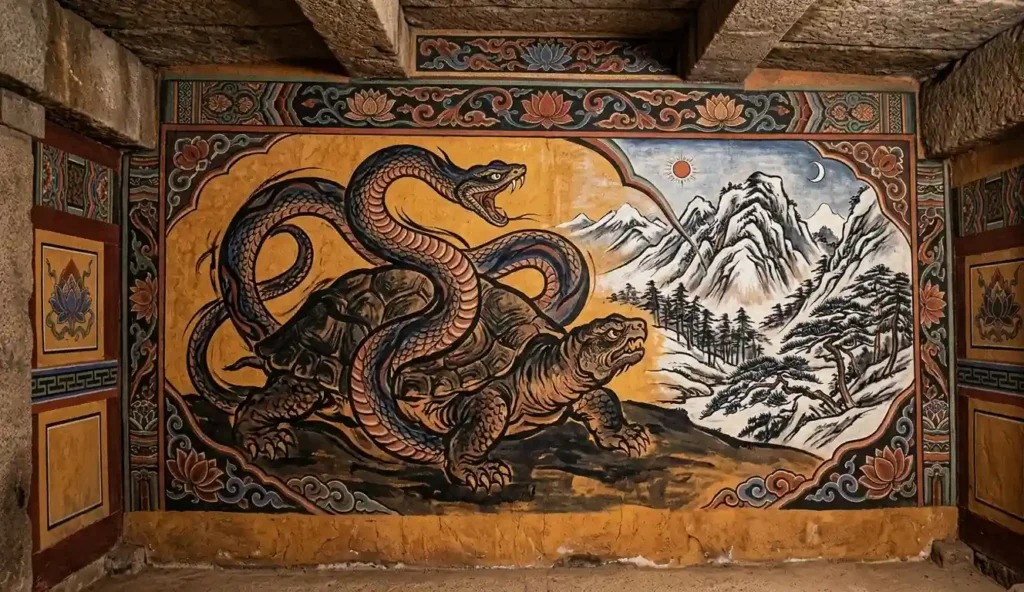
Hyeonmu (현무, 玄武) is the Korean Black Tortoise, and Korea’s relationship with the guardian beast tradition carries the same distinctive character visible across all four of the Korean guardians. Faithful cosmological transmission, deep integration with indigenous Korean spiritual sensibilities, and a visual record in Goguryeo tomb murals of extraordinary historical significance.
The Goguryeo tomb murals, produced by the Goguryeo kingdom between roughly the 4th and 7th centuries CE and designated a UNESCO World Heritage Site in 2004, include some of the finest surviving depictions of all four guardian beasts anywhere in East Asia.
The Hyeonmu murals show the tortoise-serpent composite in a dynamic, energetic style characteristic of Goguryeo funerary art, the serpent and tortoise intertwined with visible tension and vitality, their combined form filling the northern wall of the burial chamber with protective northern energy.
Hyeonmu’s distinctly Korean characteristics include:
Integration with Korean water deity traditions: Korean folk religion has extensive traditions of water deities governing rivers, lakes, and seas. Hyeonmu’s water governance connected naturally with these existing traditions, giving the imported cosmological figure deeper roots in Korean religious practice than a purely cosmological import would have.
Military and shamanic connections: In Korean shamanic practice, the northern direction is associated with specific spiritual forces that Hyeonmu’s authority encompasses, connecting the guardian figure to indigenous Korean spirit world geography.
Longevity emphasis: The tortoise’s longevity symbolism is as significant in Korean culture as in Chinese, making Hyeonmu appear frequently in contexts related to long life, especially in art produced for aristocratic patrons who wished for extended years.
Paired with the dragon: In some Korean artistic traditions, Hyeonmu and the Dragon appear as the primary pair among the four guardians, reflecting a specific Korean emphasis on the water element’s two great expressions, the flowing, ascending dragon and the deep, stable tortoise-serpent.
Huyen Vu: The Black Tortoise in Vietnamese Tradition
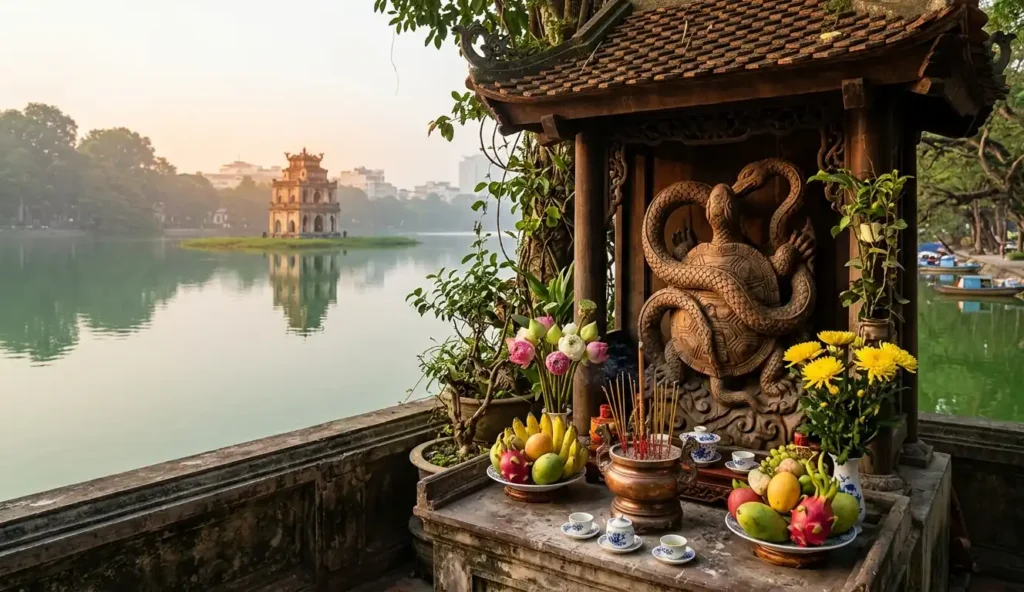
Huyen Vu (Huyền Vũ, 玄武) is the Vietnamese Black Tortoise, and the Vietnamese tradition represents both a faithful transmission of the Chinese cosmological framework and a distinct cultural adaptation shaped by Vietnam’s particular relationship with water and its rich indigenous tortoise mythology.
Vietnamese cosmological thought absorbed the four guardian beasts through centuries of Chinese cultural influence, and Huyen Vu appears in Vietnamese Daoist and folk religious contexts with the same northern directional authority, water element association, and protective function as the Chinese Xuanwu.
Several aspects distinctly characterise the Vietnamese Black Tortoise tradition:
The golden tortoise mythology: Vietnam has its own distinctive tortoise mythology in the Kim Qui (Golden Tortoise) legend, which intersects with the four-guardian beast tradition. The most famous is the Legend of the Restored Sword, in which a magical sword given by the Golden Tortoise to the legendary king Le Loi helped drive out Chinese invaders, and the tortoise later reclaimed the sword by taking it back into Hoan Kiem Lake in Hanoi. This indigenous Vietnamese tortoise mythology gave Huyen Vu a cultural resonance in Vietnam that went beyond its cosmological import.
Water governance in a river delta civilization: Vietnam’s civilization developed along river systems and the Mekong Delta, making water governance a matter of existential cultural significance. Huyen Vu’s water domain resonated deeply in this context, connecting the cosmological guardian to real agricultural and safety concerns.
Feng shui integration: Vietnamese feng shui practice, drawing directly on Chinese geomantic theory, maintains Huyen Vu’s northern protective function in the orientation of buildings, tombs, and sacred sites throughout Vietnam.
Temple presence: Vietnamese folk religion includes Xuanwu temples alongside the broader presence of Chinese religious traditions that Vietnamese culture absorbed and adapted over centuries, with some temples dedicated specifically to Huyen Vu or incorporating Xuanwu worship within broader Daoist temple complexes.
The Serpent and Tortoise: Interpreting the Dual-Beast Form
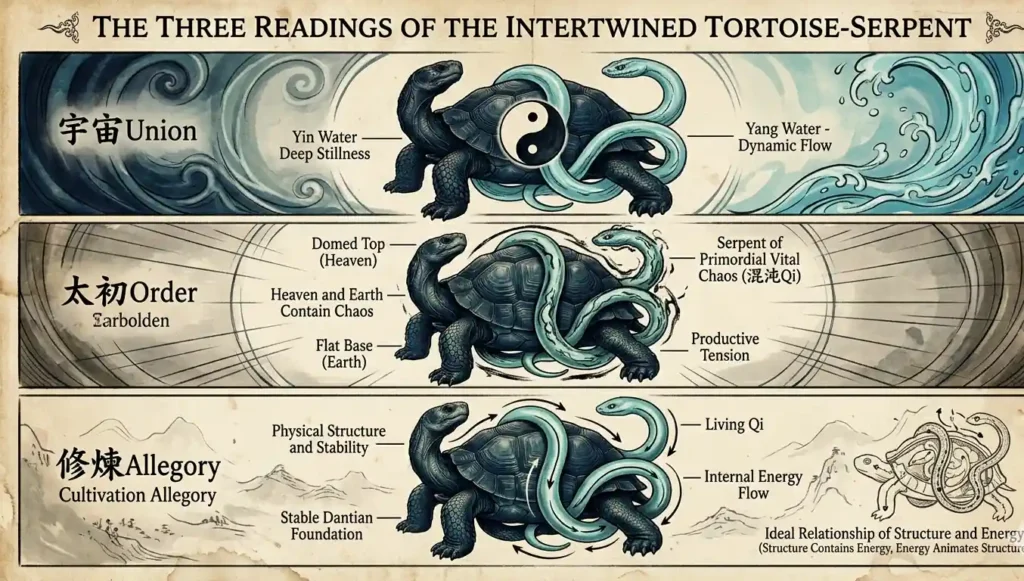
Xuanwu’s dual-beast form, the tortoise intertwined with the serpent, is the most philosophically interesting and most frequently misunderstood aspect of the figure. Several interpretive traditions have developed around it, and understanding them enriches the figure considerably.
The Cosmological Union Interpretation
The most classical interpretation understands the tortoise and serpent as the two aspects of the northern Water principle united in a single figure:
- The tortoise embodies yin Water: stillness, depth, endurance, the earth beneath the water
- The serpent embodies yang Water: flow, movement, change, the water itself in motion
Their intertwining is the yin-yang union of the water element’s two complementary expressions. Together they constitute a more complete representation of Water’s nature than either could provide alone. This interpretation connects the dual-beast form directly to yin-yang philosophy and makes Xuanwu the Four Symbols’ most explicitly philosophical figure.
The Primordial Chaos Interpretation
A second interpretation, found in some classical Daoist texts, understands the tortoise and serpent as representatives of the primordial forces from which order emerged. In this reading:
- The tortoise shell is the image of heaven and earth its domed top represents heaven, its flat base represents earth
- The serpent is the primordial chaos that was brought to order by the establishment of the cosmos
Their intertwining in Xuanwu represents the ongoing relationship between cosmic order (the tortoise’s stable shell) and the primordial vitality that cosmic order channels rather than eliminates (the serpent’s living movement).
The Cultivation Allegory Interpretation
A third interpretation, particularly relevant to cultivation fiction, reads the tortoise-serpent intertwining as a cultivation allegory:
- The tortoise represents the cultivator’s foundational stability: the established dantian, the trained meridian network, the accumulation of decades of disciplined practice
- The serpent represents the cultivator’s vital qi: the living energy that flows through that stable foundation, the active principle that the foundation exists to contain and direct
Their intertwining is the ideal relationship between foundation and energy in advanced cultivation, the stability that makes the flow possible, the flow that gives the stability its purpose.
Xuanwu in Xianxia and Cultivation Fiction
As a Divine Beast
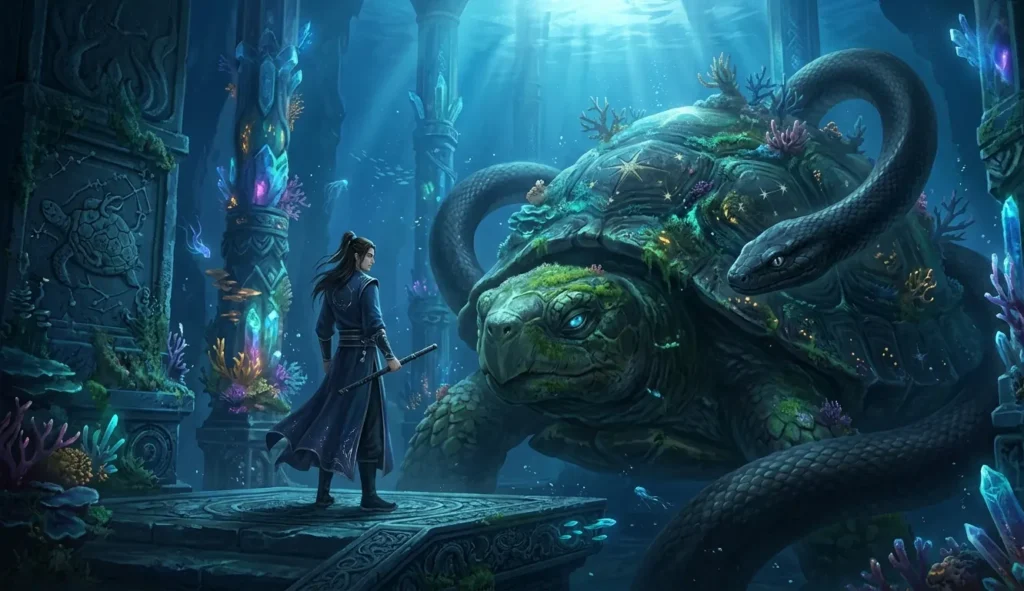
The Black Tortoise divine beast in xianxia cultivation fiction draws on the full depth of the Xuanwu tradition, carrying different implications than the more immediately spectacular dragon or Vermilion Bird contracts.
A cultivator who contracts a Xuanwu divine beast or its descendants gains:
- Extreme defensive capability: The tortoise shell’s invulnerability in mythology translates into the cultivation fiction divine beast’s primary combat role. The Black Tortoise divine beast is the genre’s supreme defensive contract, its shell-based techniques among the most difficult to penetrate
- Water element mastery: Classical Xuanwu water domain translates into comprehensive water element qi access, including techniques governing ice, deep water pressure, tidal forces, and the hidden erosive power of sustained water contact
- Longevity and endurance: The tortoise’s legendary lifespan translates into enhanced longevity cultivation benefits and the ability to endure sustained combat attrition that shorter-lived contracts cannot withstand
- Hidden power: The serpent component of Xuanwu translates into a counterintuitive offensive capability that opponents who focus on the defensive tortoise aspect consistently underestimate
The Black Tortoise divine beast is narratively positioned as the choice of the patient, the strategic, and the philosophically serious cultivator, those who understand that the most durable power is not the most spectacular.
As a National Symbol and Northern Guardian
Northern cultivation empires, water-element lineages, and deep-ocean cultivation territories in Xianxia are almost invariably associated with Xuanwu, following the same spatial logic that placed Xuanwu on the northern walls of Chinese palaces and tombs:
- Sects oriented to the north carry Xuanwu iconography on their gates and ceremonial halls
- Deep ocean cultivation grounds and underwater palace cultivation locations are typically under Xuanwu’s cosmological authority
- Winter cultivation methods that use the season’s maximum yin energy are philosophically Xuanwu-alig
Cross-Tradition Comparison
| Attribute | Chinese (Xuanwu) | Japanese (Genbu) | Korean (Hyeonmu) | Vietnamese (Huyen Vu) |
|---|---|---|---|---|
| Characters | 玄武 | 玄武 | 현무 | Huyền Vũ |
| Direction | North | North | North | North |
| Season | Winter | Winter | Winter | Winter |
| Element | Water | Water | Water | Water |
| Colour | Black | Black | Black | Black |
| Form | Tortoise intertwined with serpent | Tortoise intertwined with serpent | Tortoise intertwined with serpent | Tortoise intertwined with serpent |
| Primary role | Celestial guardian, Daoist deity, northern heaven ruler | Celestial guardian, city orientation patron | Cosmological guardian, tomb protector | Celestial guardian, feng shui protector |
| Key evidence | Wudang Mountain temples, Han Dynasty tomb murals | Kitora Tomb murals, capital orientation | Goguryeo tomb murals (UNESCO) | Temple architecture, Kim Qui folk tradition |
| Unique development | Only Four Symbol to become fully developed Daoist deity | Integration with Japanese capital geomancy | Goguryeo artistic tradition, shamanic water deity fusion | Intersection with Kim Qui golden tortoise mythology |
| Martial association | Wudang martial arts tradition, military patron | Temple guardian, northern defensive force | Military virtue, protective ward | Northern direction martial protection |
| Longevity role | Strong – tortoise as an immortality symbol | Present | Present | Present, enhanced by Kim Qui legend |
| Cultivation fiction role | Divine beast, bloodline, water cultivation patron, deep philosophy | Primarily beast contract | Historical and artistic influence | Folk religious resonance |
Frequently Asked Questions
What is Xuanwu in Chinese mythology?
Xuanwu, the Black Tortoise, is one of the Four Symbols of East Asian cosmology and guardian of the northern heaven, associated with the North, winter, and Water. Unlike the other Symbols, Xuanwu became a major Daoist deity, worshipped in temples and revered by the Ming emperor Yongle, who patronized Wudang Mountain.
Why does Xuanwu have both a tortoise and a serpent?
The tortoise and serpent together embody the dual nature of the northern Water principle. The tortoise signifies stability, endurance, depth, and water’s still yin aspect, while the serpent represents flow, adaptability, hidden power, and water’s active yang force. Their union expresses Water’s full nature through intertwined yin and yang.
What is the difference between Xuanwu and Genbu?
Xuanwu in Chinese and Genbu in Japanese refer to the same figure, written with the same characters and sharing identical core attributes: North, winter, Water, black, and the tortoise serpent form. The difference is cultural development: Xuanwu became a major Daoist deity in China, while Genbu remained more architectural and symbolic in Japan.
What does the Black Tortoise symbolize in xianxia cultivation fiction?
In Xianxia, the Black Tortoise symbolizes supreme defense, water mastery, longevity, hidden power, and a cultivation path built on patience and depth over explosive growth. Its bloodlines and contracts grant endurance and water affinity, while Xuanwu-aligned sects embody stillness, resilience, and strength through yielding rather than force.
What is Wudang Mountain and what is its connection to Xuanwu?
Wudang Mountain in Hubei is the foremost sacred site of Xuanwu worship and the spiritual center of his cult. Dedicated to Xuanwu by the Ming emperor Yongle in the early fifteenth century, its vast temple complex remains active today. Wudang martial arts developed there, reflecting Xuanwu’s ideals of stillness, yielding, and fluid power.
Who is Hyeonmu in Korean mythology?
Hyeonmu is the Korean form of the Black Tortoise, one of the four guardian beasts in Korean cosmology. Prominent in Goguryeo tomb murals, Hyeonmu blends the Chinese northern guardian with the Korean water deity and shamanic traditions. In Vietnam, Huyền Vũ intersects with indigenous tortoise mythology, especially the Kim Quy tradition.
How does Xuanwu relate to the Tao Te Ching’s water philosophy?
Xuanwu’s governance of Water embodies the Daoist principle that softness overcomes hardness, as water wears down stone through patience and persistence. Wudang martial arts express this through yielding, fluid movement over brute force, and xianxia extends the same ideal into cultivation: depth, endurance, and restraint surpass explosive power.
Final Thoughts
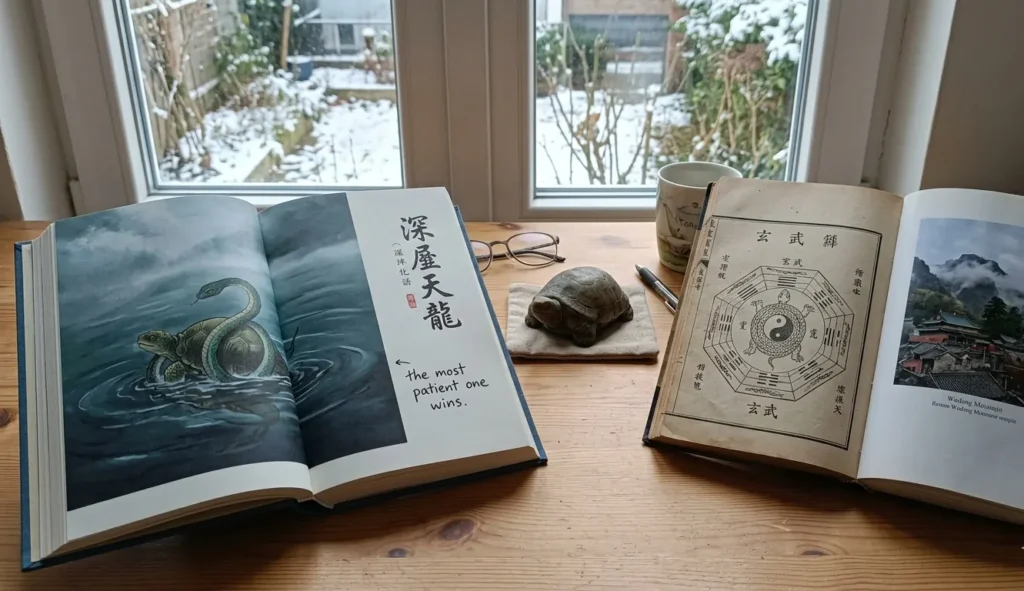
Xuanwu is the Four Symbols’ most underrated figure, and understanding it fully reveals why.
The Azure Dragon blazes with vitality. The Vermilion Bird blazes with fire. The White Tiger blazes with martial ferocity. Xuanwu does not blaze. It endures. It deepens. It waits.
And in waiting, it becomes something none of the more spectacular guardians ever quite achieve. A living religious tradition, a martial arts philosophy, a mountain of temples still in use six hundred years after the emperor who built them, and a cultivation path that the best xianxia uses to ask whether the most powerful force in a world of spectacular breakthroughs might be the one that never had to break through anything because nothing could penetrate it in the first place.
The Black Tortoise and the intertwined serpent are the image of a specific kind of power that every cultivation system needs and almost every cultivation protagonist underestimates at least once: the power of what is too deep to measure, too old to be surprised, and too patient to ever run out of time.
Related Articles
- Xuanwu: Black Tortoise of the North Symbolism & Mythology
- Yellow Dragon: Myths, Symbolism & the Forgotten Fifth Beast
- Why the Four Holy Beasts Cannot Exist Without Yin Yang
- Yin Yang, Five Elements & Four Symbols: China’s Complete Cosmos
- Are the Four Heavenly Kings & Four Holy Beasts the Same?
- The Four Holy Beasts: Baihu, Qinglong, Zhuque & Xuanwu
References
- Birrell, Anne. Chinese Mythology: An Introduction.
- Eberhard, Wolfram. A Dictionary of Chinese Symbols.
- Major, John. Heaven and Earth in Early Han Thought.
- The Chinese Sky
- Lewis, Mark Edward. The Construction of Space in Early China.
- Kohn, Livia. Daoism and Chinese Culture.
- Allan, Sarah. The Shape of the Turtle.Hanshu (Book of Han).
- UNESCO World Heritage Centre – Complex of Goguryeo Tombs
- The Protocol of the Gods: A Study of the Kasuga Cult in Japanese History – Allan G. Grapard
- Shanhaijing (Classic of Mountains and Seas).
- Shiji (Records of the Grand Historian).