
 By
By Quick Takeaways:
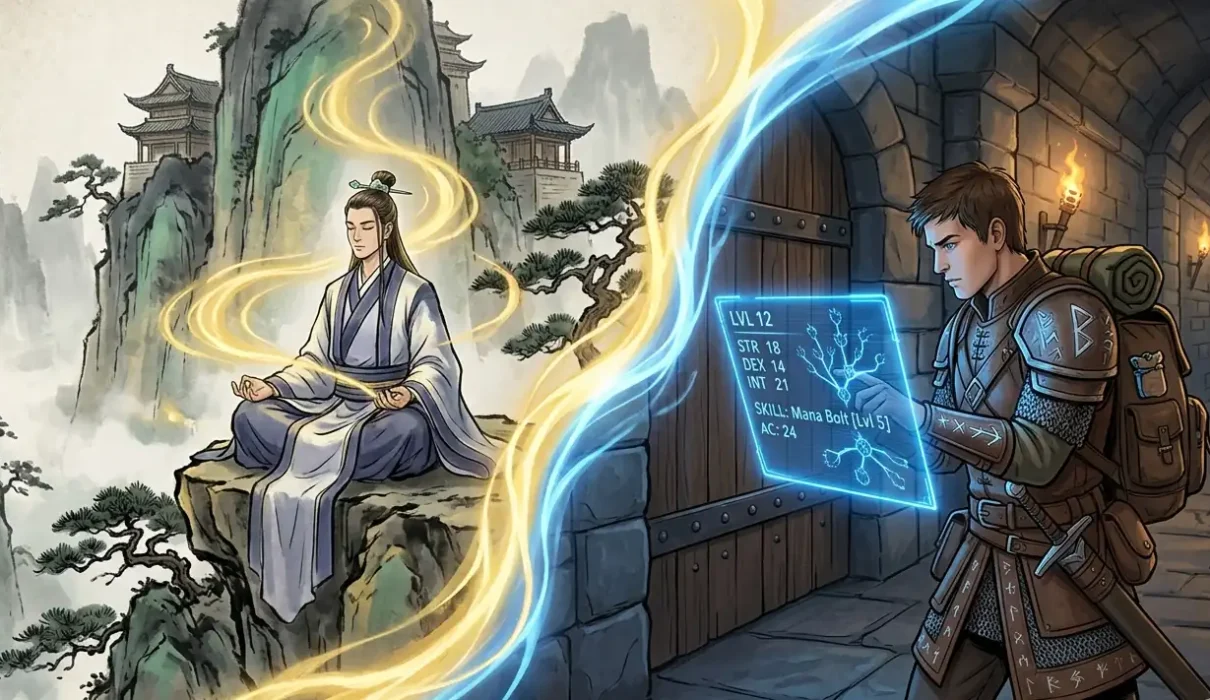
- Cultivation novels are the Eastern genre: rooted in Chinese Daoist philosophy, qi cultivation, realm ladders, and the spiritual transformation of the practitioner toward immortality
- Progression fantasy is the Western genre: rooted in game mechanics, statistical advancement, skill systems, and the power fantasy of watching a character’s numbers go up in measurable, legible ways
- The two genres overlap significantly enough that most fans of one enjoy the other, but their philosophical DNA, cultural roots, and narrative priorities are genuinely different
- Cultivation novels tend to prioritize the philosophical dimension of power (what does it mean to understand the Dao?), while progression fantasy tends to prioritize the legibility of power (how much stronger am I than yesterday?)
- The genres are converging: Western authors writing cultivation fiction and Eastern authors incorporating game-system elements have produced a growing overlap space where the best of both traditions meet
About three years into reading cultivation fiction seriously, I picked up a Western progression fantasy novel on a recommendation from a forum thread comparing the two genres. Within a hundred pages I understood why the comparison existed, and within a few hundred more I understood why it was only partially correct. The surface similarities are real. The underlying differences are more interesting than most comparisons acknowledge.
Reading both genres has given me a clear picture of what distinguishes them, where they share roots, and most importantly, how to choose between them based on what you actually want from a reading experience rather than what the genres are named. That is what this article is for.
Defining the Terms Clearly
Before comparing anything, the terms need precise definitions, because both genre labels are used loosely enough that the comparison can become confused before it begins.
What is a Cultivation Novel?
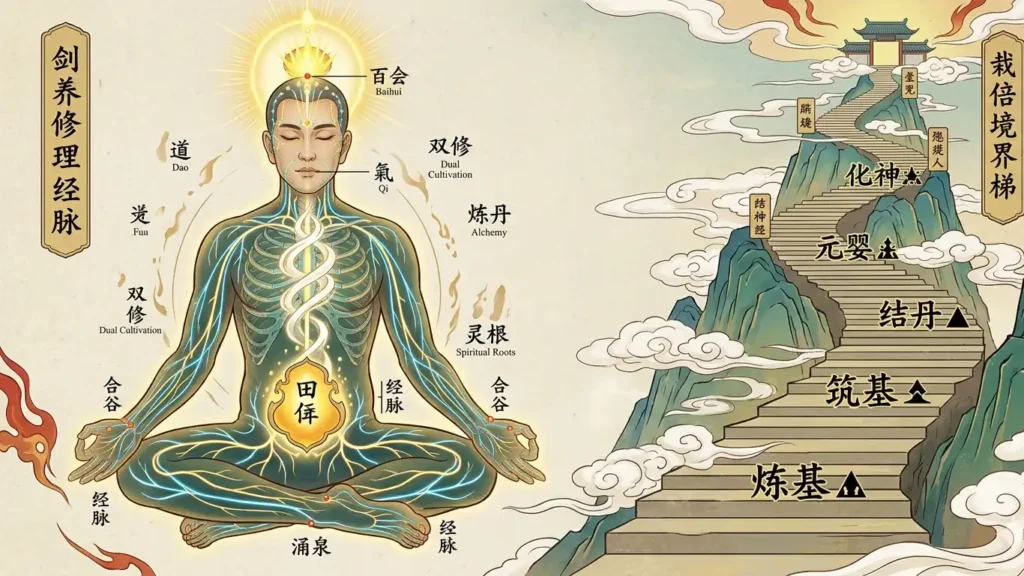
A cultivation novel is a work of Chinese fantasy fiction in which the protagonist advances in power through a practice of spiritual and physical self-cultivation rooted in Chinese Daoist, Buddhist, and traditional medical philosophy.
The key elements that define the genre:
- Qi cultivation: The practitioner absorbs, refines, and circulates spiritual energy (qi) through a dantian and meridian system drawn from real Daoist internal alchemy
- Realm ladder: Power is organised into named cultivation realms that represent qualitative transformations of the practitioner’s nature, not simply quantitative increases in capability
- The Dao: At the genre’s philosophical core, advancement requires understanding genuine comprehension of the principles underlying reality, not just mechanical practice
- The cultivation world: A social and political ecosystem built around cultivation, with sects, resources, ancient legacies, and the constant competition for the pills, techniques, and treasures that accelerate advancement
- The long game: Cultivation toward immortality is the ultimate goal, measured across centuries of fictional time for the most advanced practitioners
Cultivation novels include xianxia (immortal hero), wuxia (martial hero), and xuanhuan (mysterious fantasy) as subgenres, with xianxia being the most directly relevant to the cultivation mechanics described above.
What is Progression Fantasy?
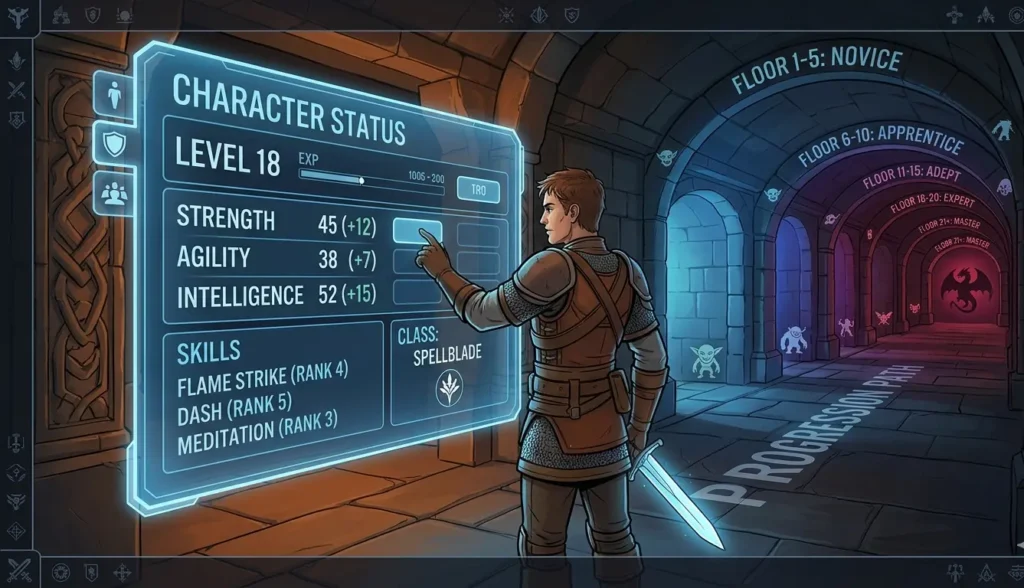
Progression fantasy is a Western genre label, formalised as a distinct category in English-language web fiction communities (primarily Reddit’s r/progressionfantasy and Royal Road) in the 2010s, describing fantasy fiction in which a character’s power advancement is the primary narrative focus and is presented through legible, often game-inspired mechanics.
The key elements that define the genre:
Measurable advancement: Power increases are tracked through explicit system levels, stats, skill trees, classes, ranks, or other legible numerical or categorical frameworks
System transparency: The reader understands exactly what the protagonist gained from any given advancement, how it compares to their previous state, and roughly how it compares to other characters
Game-adjacent language: Whether or not the world literally has game mechanics (the LitRPG subgenre), progression fantasy uses the vocabulary and logic of game design to structure its power systems
Western fantasy foundation: The genre emerged from Western fantasy traditions, often set in worlds that draw more from Tolkien, D&D, and video game RPGs than from Asian philosophical traditions
Competence as appeal: The satisfying watch of a character becoming systematically better at what they do, with each session of training, each dungeon cleared, each level gained producing a perceptible and documented improvement
Progression fantasy includes LitRPG (literal game mechanics in the world), portal fantasy (protagonist transported to a fantasy world with game-like systems), and cultivation-adjacent stories where Western authors use Eastern-inspired power systems.
Where Each Genre Came From
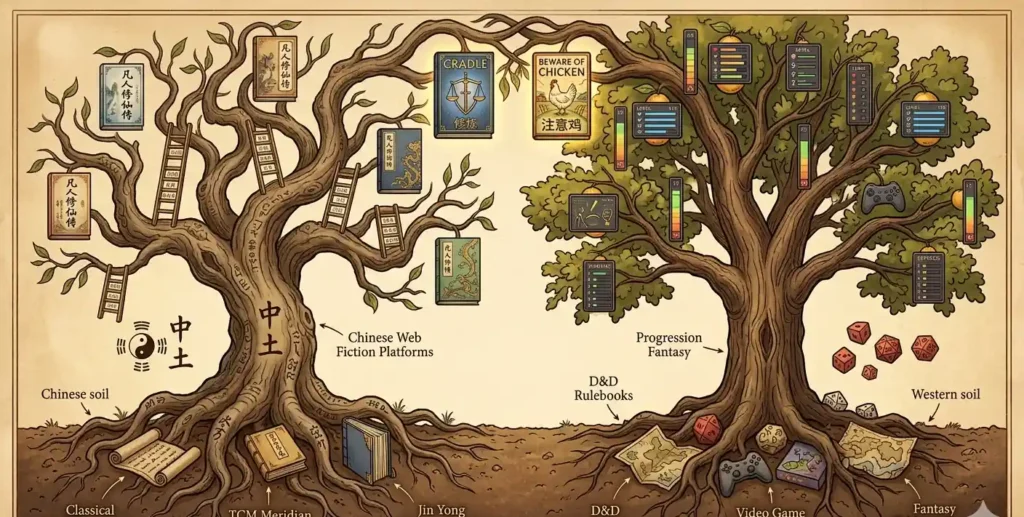
Understanding the genealogy of each genre explains why they feel the way they feel.
The Cultivation Novel’s Genealogy
Cultivation novels emerged from Chinese web literature in the late 1990s and early 2000s, primarily through platforms like Qidian (起点中文网, founded 2002). They drew on several centuries of Chinese literary and philosophical tradition:
- Classical Daoist internal alchemy texts describing the refinement of jing, qi, and shen through meditation and cultivation practice
- Wuxia fiction, the martial arts novel tradition pioneered by Jin Yong and Gu Long in the mid-20th century
- Classical Chinese mythology, including the journey to immortality narratives that appear in texts like Journey to the West
- Traditional Chinese medicine, whose meridian and dantian framework became the genre’s physiological architecture
The result is a genre whose power systems are rooted in an actual living philosophical and medical tradition, giving even its most fantastical elements a cultural depth that invented systems do not carry.
Progression Fantasy’s Genealogy
Progression fantasy emerged from Western web fiction communities in the 2010s, drawing on:
- Role-playing games, particularly Dungeons and Dragons and its descendants, which introduced the concept of the level, the stat, and the skill tree as ways of measuring character power
- Video game RPGs, particularly Japanese RPGs (ironically) like Final Fantasy and Dragon Quest, which popularised the numerical power progression interface
- Western epic fantasy, which provided the world-building vocabulary of dungeons, monsters, magical systems, and heroic journeys
- LitRPG fiction, the Russian and later American genre of fiction in which characters literally exist within game-like systems
The result is a genre whose power systems are rooted in game design principles rather than philosophical traditions, giving them a different kind of legibility, the satisfaction of the well-designed game rather than the depth of the ancient text.
Read: 13 Fantasy Genres Ranked: Which One Actually Suits You?
The Five Structural Differences
1. The Philosophy of Power
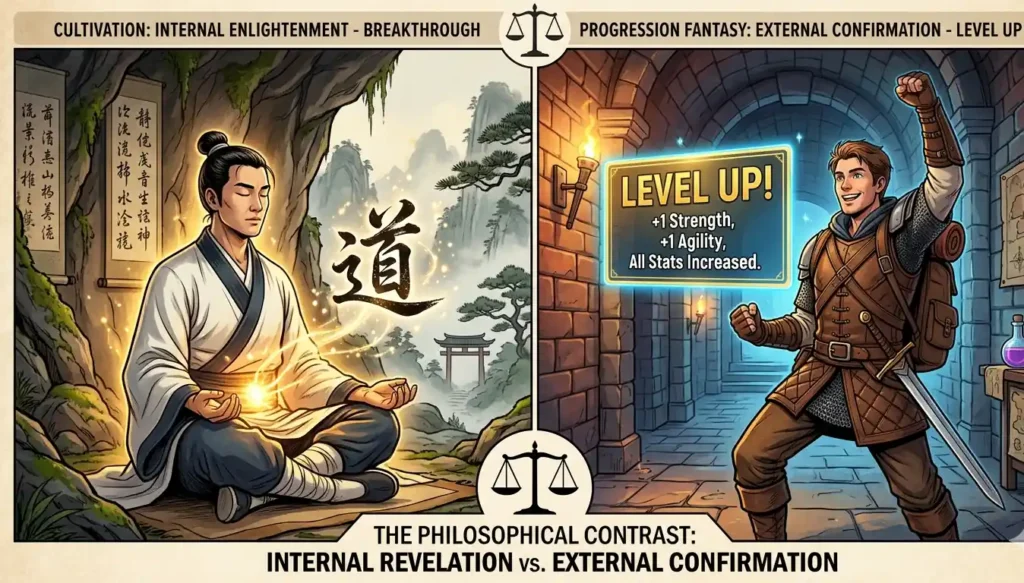
This is the deepest and most consequential difference between the two genres.
In cultivation fiction, power is understood as the expression of understanding. Realm advancement is not simply a quantitative increase in how much qi the cultivator can generate. It is a qualitative transformation in the cultivator’s comprehension of reality.
The Dao, the cultivator’s personal understanding of the fundamental principles of existence, is the actual engine of advancement. You cannot break through to the next realm by grinding more hours of cultivation practice if you have not achieved the insight that the breakthrough requires. Power and wisdom are philosophically intertwined.
In progression fantasy, power is understood as the expression of accumulation. Levels go up through experience points. Stats improve through training. Skills unlock through use. The mechanic is transparent, predictable, and fundamentally quantitative: more of the right inputs produce more of the desired outputs.
There is a version of insight in progression fantasy (class evolutions, skill combinations, finding the right build), but it tends to be tactical intelligence rather than philosophical comprehension.
This difference has narrative consequences. Cultivation novels tend to have breakthrough moments of genuine internal revelation, moments where the character understands something that changes everything. Progression fantasy tends to have milestone moments of measurable achievement, where the numbers confirm what the character has earned. Both produce reader satisfaction, but through different psychological mechanisms.
2. The Relationship with Culture
Cultivation novels are culturally specific in ways that progression fantasy is not. They draw on Chinese Daoist philosophy, traditional Chinese medicine, Chinese astronomical tradition, Chinese mythology, and the Chinese concept of the cultivation world’s social structure (sect systems, resource hierarchies, ancient legacies). Reading cultivation fiction with any depth requires at least some engagement with this cultural context.
Progression fantasy is culturally generic in ways that lower the barrier to entry. It draws on globally shared gaming language and Western fantasy conventions familiar to most English-speaking readers. You do not need to know what a dantian is to understand a level-up.
This difference is neither a strength nor a weakness in itself. The cultural specificity of cultivation fiction is part of what gives it depth. The cultural genericness of progression fantasy is part of what makes it accessible. Each serves a different reader relationship with the material.
3. The Time Scale of Advancement
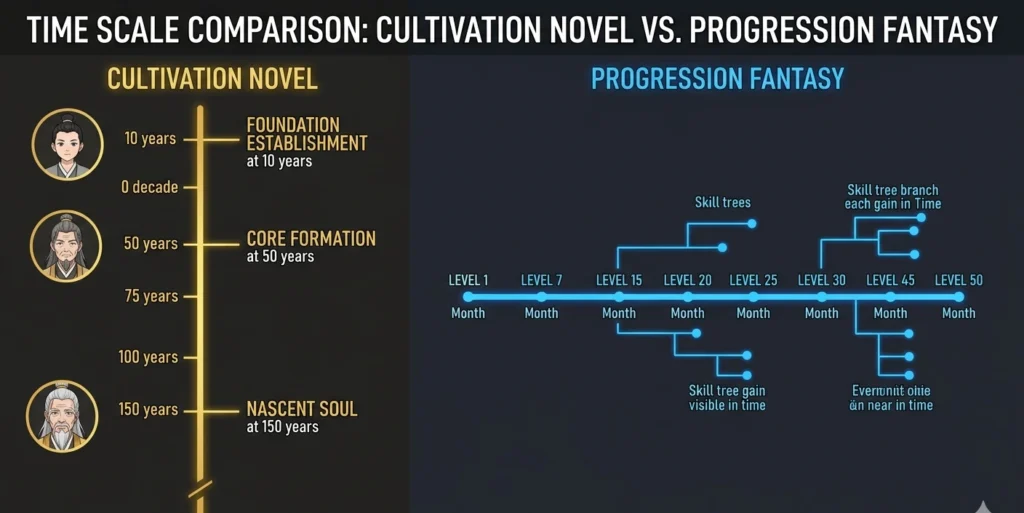
Cultivation fiction tends to operate on geological time scales. A cultivator might spend decades at a single realm before achieving the breakthrough to the next. The Nascent Soul cultivator who reaches Body Integration after three centuries of effort is not unusual. The genre’s relationship with time is fundamental to its philosophical character: cultivation is not a sprint but a life’s work, and the patience required is itself part of what is being cultivated.
Progression fantasy tends to operate on compressed time scales. Levels rise faster. Breakthroughs come more frequently. The reader feedback loop is shorter and more regular. This is partly a function of the game design logic underlying the genre (games need to reward players frequently enough to maintain engagement) and partly a function of the different reader expectations each genre has trained.
4. The Nature of the Power System
Cultivation fiction’s power systems are characterized by qualitative stages and philosophical dimensions. The difference between Foundation Establishment and Core Formation is not simply “more qi,” it is a fundamental change in what kind of being the cultivator is, what their relationship to the laws of reality is, and how their body and consciousness function. The realm names encode philosophical content, not just power tiers.
Progression fantasy’s power systems are characterized by quantitative measures and systemic legibility. The difference between level 20 and level 21 is precisely expressible: the character has these stats, these skills, these advantages. The system is transparent and internally consistent in ways that allow comparison, calculation, and optimization. This is the appeal of the well-designed game made fictional.
5. The Source of Authority
In cultivation fiction, the ultimate authority is the Dao, the principle of reality itself. The cultivation world’s hierarchies are secondary to the cultivator’s relationship with this fundamental principle. A cultivator who genuinely comprehends a higher dao can overturn the hierarchy built on accumulated power. The world bows to truth.
In progression fantasy, the ultimate authority is the system, the game-like structure that governs advancement. Most progression fantasy worlds have an actual system, an actual interface, an actual set of rules that cannot be escaped. The protagonist’s task is to understand and optimize within that system, not to discover a truth that transcends it.
The Three Things They Share
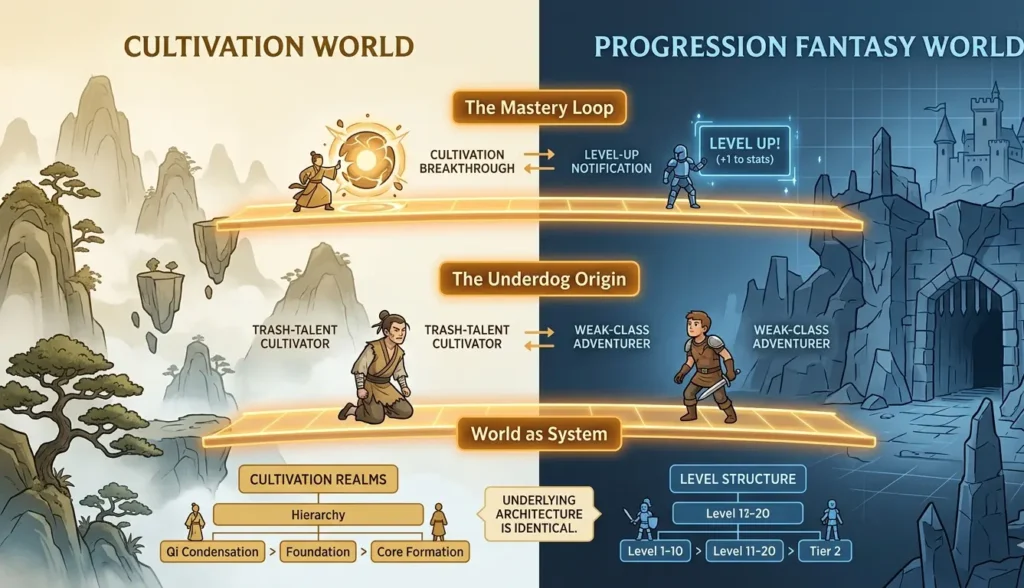
Despite their differences, cultivation novels and progression fantasy share enough structural DNA that fans of one reliably enjoy the other. Understanding what they share explains why.
1. The Mastery loop
Both genres are built on the same psychological engine: the mastery loop. Challenge → effort → breakthrough → reward → new challenge. The cultivation novel’s breakthrough from one realm to the next and the progression fantasy’s level-up after a difficult dungeon are structurally identical in terms of the psychological satisfaction they produce. Both genres understood, independently, that this loop is one of fiction’s most powerful engagement mechanisms.
2. The Underdog Origin
Both genres default to protagonists who begin at or near the bottom of the power hierarchy and work their way up against the odds. The xianxia trash-talent protagonist and the progression fantasy’s weak-class starting character are the same narrative archetype translated across cultural contexts. The reader’s investment in the climb is identical in both cases.
3. The World as a System
Both genres build worlds that function as systems with legible internal logic. In cultivation fiction, the reader learns how spiritual roots work, how realms relate to each other, how sects control resources, how combat power is calculated.
In progression fantasy, the reader learns how the level system works, how classes interact, how dungeon difficulty scales, how the economy of power functions. Both genres reward the reader who pays attention to the system with a deeper experience than the reader who does not.
Where the Genres are Converging
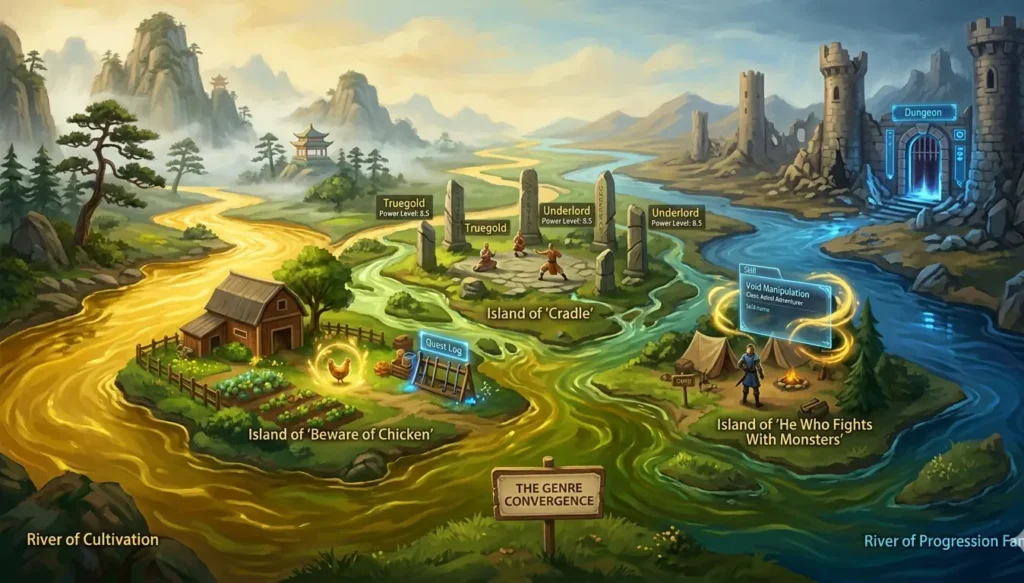
The boundary between cultivation fiction and progression fantasy has been blurring for several years, and the current state of both genres reflects genuine creative exchange between them.
Western Authors Writing Cultivation
Beware of Chicken by Casualfarmer is written by a Canadian author and published on Royal Road, a progression fantasy platform, but is unmistakably a cultivation novel in its power system logic, its philosophical orientation, and its use of qi and dantian mechanics. It is the clearest single example of a Western author working genuinely within the cultivation tradition rather than imitating its surface features.
Cradle by Will Wight uses a cultivation-style realm ladder (Copper, Iron, Jade, Gold, Sage, Monarch) but is structured with progression fantasy’s narrative pacing and competence-appreciation appeal. It is the genre’s most commercially successful hybrid and the series most often recommended to progression fantasy readers as an entry point to cultivation-adjacent fiction.
He Who Fights With Monsters by Jason Cheyne uses an explicit skill and class system (progression fantasy) within a world that incorporates cultivation-adjacent qi mechanics and realm-like advancement stages. It is the English-language series that most directly bridges both communities.
Eastern Authors Incorporating Game Systems
The System (系统) subgenre of Chinese web literature incorporates game-like interfaces, status screens, and measurable advancement metrics directly into xianxia-style cultivation narratives.
Novels like Reincarnation of the Strongest Sword God and many others in the isekai-adjacent Chinese web literature space feature protagonists whose cultivation advancement is tracked through explicit numerical systems with the legibility of progression fantasy alongside the philosophical and cultural content of cultivation fiction.
This convergence is producing a growing middle space where neither pure label applies and both communities find something to enjoy.
Who Should Read Which
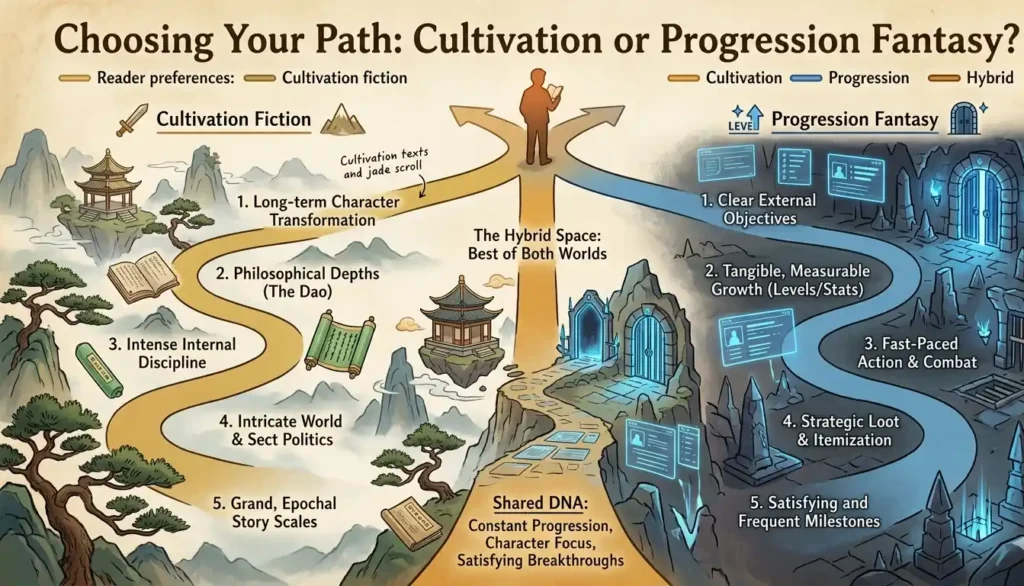
Rather than a definitive answer, my honest recommendation is matching reader preference to genre strength:
Read cultivation novels if you want:
- A power system with genuine philosophical depth rooted in actual tradition
- A long-term investment in a protagonist’s total transformation across a vast fictional time scale
- Cultural richness and the specific texture of a world built on East Asian cosmological thinking
- Breakthrough moments that feel like genuine internal revelations rather than measurable achievements
- Series that reward close attention to mythology, philosophy, and the dao’s implications for character
Read progression fantasy if you want:
- Transparent, legible power mechanics that allow clear comparison and optimisation
- Faster advancement loops and more frequent reward beats
- World-building drawn from familiar Western fantasy and gaming conventions
- The satisfaction of watching a protagonist systematically improve with measurable precision
- Shorter series with tighter narrative arcs compared to multi-thousand-chapter xianxia epics
Read both if you want:
- Maximum coverage of what power fantasy fiction can achieve
- The ability to appreciate hybrid series like Cradle and He Who Fights With Monsters fully
- The experience of seeing the same psychological appeal expressed through two fundamentally different philosophical vocabularies
Best Entry Points for Each Genre
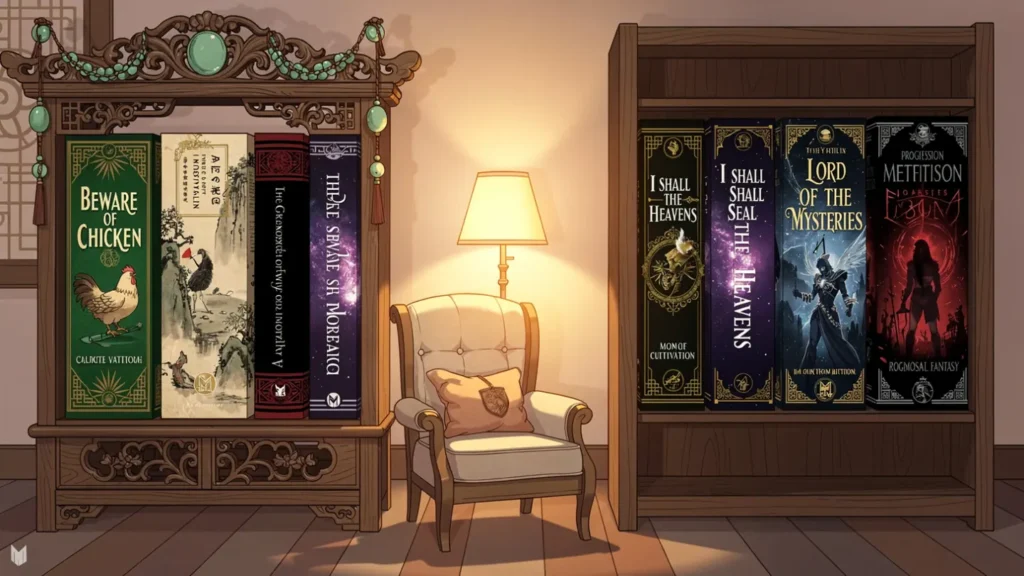
Best Entry Points for Cultivation Novels
| Series | Why start here | Type |
|---|---|---|
| Beware of Chicken | Warmest, most accessible, no genre literacy required | Cozy cultivation |
| A Record of a Mortal’s Journey to Immortality | Best classical xianxia for new readers | Classical xianxia |
| I Shall Seal the Heavens | Best emotional peak in the traditional genre | Classical xianxia |
| Lord of the Mysteries | Best for readers who want literary quality | Xuanhuan |
Best Entry Points for Progression Fantasy
| Series | Why start here | Type |
|---|---|---|
| Cradle (Will Wight) | Most cultivation-adjacent, easiest crossover | Western cultivation-adjacent |
| He Who Fights With Monsters | Best for Australian voice and hybrid mechanics | Western hybrid |
| The Wandering Inn | Deepest world-building in the English-language genre | Portal fantasy |
| Dungeon Crawler Carl | Most entertaining voice in the genre | LitRPG |
| Sufficiently Advanced Magic | Best for readers who want magic system depth | Western system fantasy |
Comparison Table
| Dimension | Cultivation novels | Progression fantasy |
|---|---|---|
| Cultural origin | Chinese web literature, Daoist tradition | Western web fiction, RPG game design |
| Primary platform | Wuxiaworld, Webnovel, Qidian | Royal Road, Amazon KU, Kindle |
| Power system basis | Qi, dantian, meridians, dao comprehension | Levels, stats, skills, classes |
| Advancement logic | Qualitative transformation plus philosophical insight | Quantitative accumulation plus tactical optimisation |
| Time scale | Decades to centuries of fictional time | Days to years of fictional time |
| Series length | Often thousands of chapters | Typically hundreds of chapters |
| Cultural specificity | High – requires engagement with East Asian tradition | Low – uses globally familiar gaming language |
| Philosophical depth | High – dao, yin yang, five elements, TCM | Moderate – game design logic, optimization philosophy |
| Breakthrough feel | Internal revelation, philosophical insight | Earned milestone, numerical confirmation |
| Genre exemplars | ISSTH, ARMJTOI, Lord of the Mysteries | Cradle, HWFWM, The Wandering Inn |
| Best hybrid | Beware of Chicken, Cradle | Beware of Chicken, Cradle |
Frequently Asked Questions
What is the difference between cultivation novels and LitRPG?
LitRPG is a progression fantasy subgenre where the world includes visible game mechanics like stats, levels, and experience. Cultivation novels instead focus on Daoist-inspired advancement through internal power systems rather than game logic, though some modern stories blend both through system-based cultivation settings.
Is Cradle a cultivation novel or progression fantasy?
Cradle sits in the hybrid space between cultivation fiction and progression fantasy. It uses a cultivation style advancement ladder and qi-based sacred arts, but its Western pacing, structure, and lack of traditional Daoist philosophy place it closer to progression fantasy. It is best described as cultivation adjacent progression fantasy and remains the most common bridge recommendation between both genres.
Can Western readers enjoy cultivation novels without knowing Chinese culture?
Yes, though the experience deepens with cultural context. Most major cultivation novels are fully accessible to Western readers without prior knowledge of Chinese culture, and series like Beware of Chicken were specifically written for Western audiences. Understanding the philosophical background of qi, the five elements, and the Dao enriches the reading experience but is not required to enjoy the genre.
What is the best cultivation novel for someone who only reads progression fantasy?
Beware of Chicken is often the top recommendation for progression fantasy readers entering cultivation fiction because it keeps core cultivation mechanics while presenting them in a style more familiar to Western fantasy audiences. Cradle is the alternative for readers who want a stronger cultivation feel while staying within a Western authorial voice.
Are cultivation novels longer than progression fantasy series?
Yes, usually by a wide margin. Cultivation novels often span thousands of translated chapters because traditional xianxia follows a daily serialization model built for extremely long runs. Progression fantasy can also be lengthy, especially on Royal Road, but the average series is still much shorter, making this one of the biggest practical differences for time-conscious readers.
Why do fans of one genre usually enjoy the other?
Both genres appeal to the same core fantasy: the mastery loop. Readers get the satisfaction of watching a weak character struggle, improve through effort and insight, and eventually overcome challenges that once seemed impossible. Cultivation and progression fantasy deliver that payoff in different ways, but the underlying appeal is the same, which is why fans of one often enjoy the other.
Final Thoughts
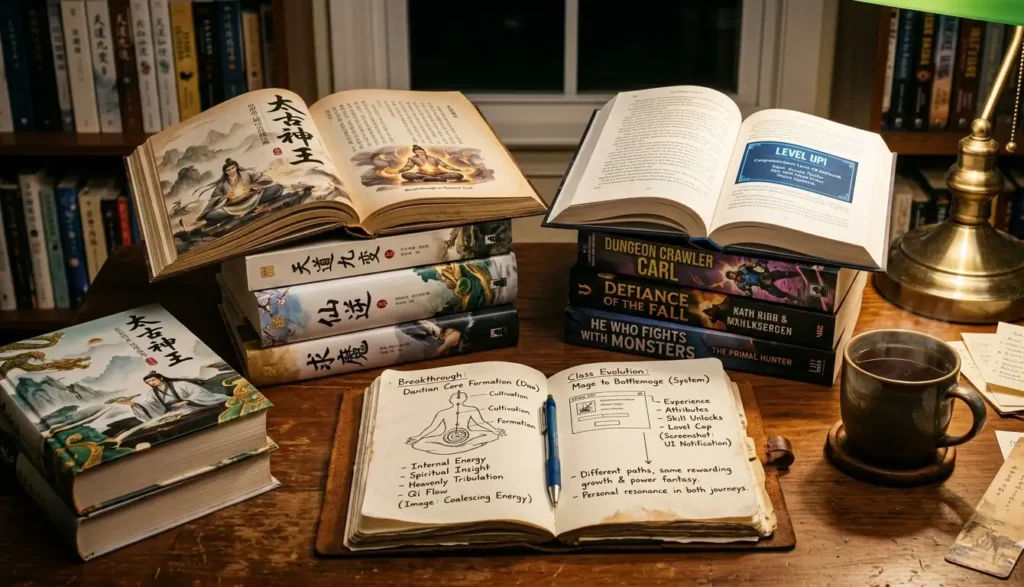
The cultivation novel and progression fantasy comparison is worth making carefully precisely because the surface similarity obscures a genuine philosophical difference that matters for what you get out of each genre.
Cultivation fiction is, at its best, a genre that uses power fantasy as the vehicle for exploring what it means to genuinely transform as a person to develop not just strength but understanding, not just capability but wisdom, not just the power to overcome obstacles but the comprehension of what those obstacles actually are. The dao is not a plot device. It is the genre’s central philosophical commitment.
Progression fantasy is, at its best, a genre that uses power fantasy as the vehicle for exploring the satisfaction of competence of systematic improvement, of finding the right approach to a difficult problem, of watching the careful application of intelligence and effort produce measurable results. The level is not a gimmick. It is the genre’s honest acknowledgment that watching someone get better at things is one of fiction’s most reliable pleasures.
Both of those things are genuinely worth having. The readers who benefit most are the ones who do not make themselves choose.
Related Articles
- Why Your Brain Loves Progression Fantasy & LitRPG
- 9 Best Progression Fantasy Books 2026 [Ranked List]
- 13 Best Progression Fantasy Books You’ll Get Addicted To
- How Fast Would You Die in a Cultivation Novel World?
- What If Cultivation Was Real, Starting Tomorrow?
- LitRPG vs GameLit: Where One Ends and One Begins
- 9 Progression Fantasy Books With Female Leads [2026]
- What Is LitRPG? The Genre Where Games Meet Fiction
Written by Batin Khan, a curious free spirit who loves reading and exploring the worlds of fantasy, mythology, and ancient stories. Through this blog, Batin hopes to share that sense of wonder with readers while building an exciting future along the way.