 By
By Quick takeaways:
- The association of the sun with yang and the moon with yin is intuitive and ancient, but it is not universal. Several major world mythologies reverse the gendered solar-lunar assignment entirely
- The classical Chinese tradition does associate the sun with yang and the moon with yin, but within a philosophical framework far more nuanced than the simple opposition most people assume
- The classical Chinese Yin Yang Sun & Moon mythologies, from the archer Yi who shot down nine suns to the moon goddess Chang’e in her palace, encode profound ideas about the proper expression of yin and yang forces that cultivation novels draw on directly
- Ancient Egypt, India, Greece, Japan, and the Norse world each developed distinct solar and lunar mythologies that reveal what their cultures most needed these celestial bodies to represent
- The European alchemical tradition made the sun and moon its central symbolic pair, using their conjunction as the image of the great work’s completion
- The deepest philosophical problem with treating the sun and the moon as opposites is that yin-yang philosophy itself insists they are not opposites but complementary aspects of a unified whole, a distinction most popular treatments never make
The pairing of sun and moon as the celestial image of yin and yang is so intuitive that most people who encounter it never question whether it is actually correct.
The sun blazes and dominates, the moon is cool and reflective. The sun governs the day, the moon governs the night. The sun seems active and outward, the moon passive and inward. Yang and yin, respectively, in the most natural-feeling assignment imaginable.
The most natural-feeling assignments are the ones most worth interrogating. The sun-yang, moon-yin pairing is deeply rooted in several major traditions, genuinely coherent within the philosophical frameworks that produced it, and the first thing to notice about it is how many major world mythologies assign the sun to a female deity and the moon to a male one, precisely reversing the gendered dimension of the yin-yang pairing that popular culture treats as universal.
In this post, I am going to give you the full account of solar and lunar mythology in Chinese Mythology, and what the philosophical tradition that produced the yin-yang concept actually says about their relationship, which is considerably more interesting than the simple opposition that most treatments offer.
The Natural Pairing: Why Sun and Moon Feel Like Yin and Yang
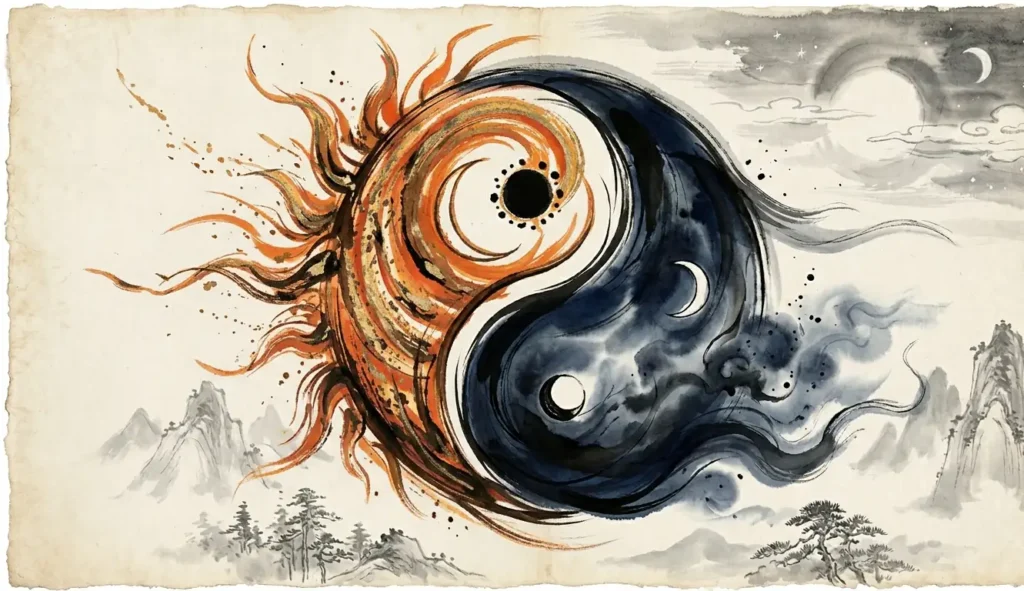
Before examining any specific tradition, it is worth acknowledging why the sun-yang, moon-yin association feels so natural, because the feeling has a real basis even if it is more complicated than it seems.
The sun and moon are the two dominant light sources visible to the unaided human eye, and their qualities genuinely correspond to the basic yin-yang attribute lists with striking consistency:
The sun’s yang qualities:
- Intense, active, overwhelming light
- Extreme heat
- Upward and outward energy (the sun rises, its light projects outward in all directions)
- Governs the daytime, when activity is natural
- Singular, consistent, unchanging in its basic character across seasons
- Associated with consciousness and clarity
The moon’s yin qualities:
- Reflected, soft, receptive light
- Coolness (particularly associated with the cold of clear nights)
- Inward energy (the moon’s light seems to invite reflection rather than action)
- Governs the night, when rest and interiority are natural
- Multiple, changing, cycling through phases that mirror biological cycles
- Associated with the unconscious and mystery
This correspondence was recognized independently by multiple traditions across the world, which is itself significant. When cultures with no contact reach the same symbolic pairing through separate observation, it suggests that the pairing reflects something real about the qualities of the two objects themselves rather than simply a cultural convention.
Classical Chinese Solar and Lunar Mythology
In classical Chinese cosmological thinking, the association of the sun with yang and the moon with yin is established but considerably more nuanced than its popular reception suggests.
The sun (太陽, Tàiyáng, literally “Great Yang”) and the moon (太陰, Tàiyīn, literally “Great Yin”) carry their yin-yang designations in their very names in classical Chinese. This is not metaphorical naming. It is a cosmological classification.
The sun is understood as the supreme expression of yang energy in the visible sky, the moon as the supreme expression of yin energy. The naming reflects a cosmological judgment rather than a mere poetic association.
Classical Chinese mythology around the sun and moon is rich and internally coherent. The solar mythology includes:
The Ten Suns and the Archer Yi

One of China’s most significant solar myths involves not one sun but ten. In the beginning, there were ten suns, children of the solar deity Dijun and his wife Xihe. The ten suns were supposed to take turns crossing the sky, each one resting while the others worked, so that the world received light without being overwhelmed.
One day, all ten rose simultaneously, and the combined solar force began to scorch the earth to death. crops withered, rivers dried, and the world itself was threatened with annihilation by the excess of solar energy.
The divine archer Yi (Hou Yi) was sent to solve the problem. He shot down nine of the ten suns with his bow, leaving the single remaining sun to govern the sky alone.
This myth encodes a cosmological principle of direct relevance to cultivation fiction. Uncontrolled yang is catastrophic. The proper expression of solar energy is singular, measured, and regulated by a structure that prevents its excess. Cultivation novels that show a protagonist’s solar or fire cultivation going out of control, threatening to consume them or the world around them, are echoing this mythological logic.
Yang that exceeds its proper bounds destroys rather than illuminates. The cultivation system’s purpose is partly to create the structure that makes yang expression sustainable.
Yi himself carries another resonance deeply familiar to Xianxia readers like me. His wife Chang’e took the immortality elixir he had been given and ascended to the moon, leaving him behind on earth. Yi becomes the greatest mortal archer in history, striving and heroic and ultimately alone, while Chang’e inhabits the cool solitude of the moon in a loneliness of her own.
The separation of the great solar hero and the lunar goddess, the gap between the blazing active world and the cool reflective one, is one of Chinese mythology’s most affecting stories and one of its most precise encodings of the yin-yang principle: yang and yin at their maximum expression cannot fully occupy the same space. They complement each other across a distance.
Chang’e and the Moon Palace
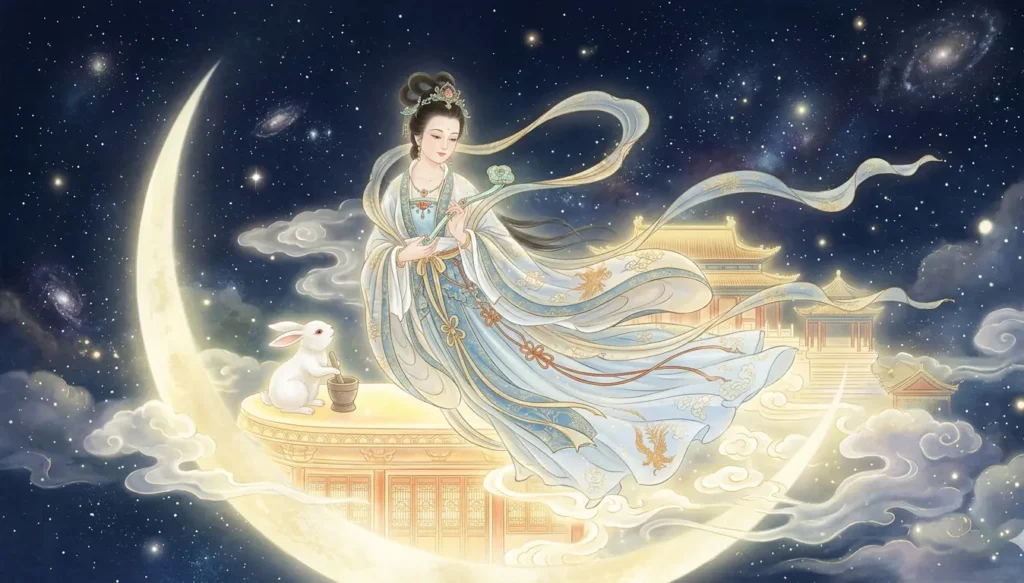
Chang’e (嫦娥) is the Moon Goddess who inhabits the Moon Palace (Guanghan Palace, “Cold Vast Palace”) with the Jade Rabbit who pounds the herbs of immortality in a mortar and the Wu Gang, an immortal condemned to chop endlessly at a self-healing cassia tree. The Moon Palace is luminous and cold and beautiful and profoundly isolated. It is everything that yin is at its most fully expressed: perfection without warmth, beauty without comfort, immortality without the messy vitality of mortal life.
Chang’e’s mythology has been absorbed by cultivation fiction in several ways. The Moon Palace, as a cultivation location, a peak yin environment where lunar qi concentration enables extraordinary cultivation speed for those with lunar affinities, appears across multiple series.
The jade rabbit’s herb-pounding as an alchemical activity connects lunar mythology to cultivation’s pill-making traditions. And Chang’e herself, the most exquisitely beautiful and most profoundly lonely figure in Chinese mythology, has become a template for the archetypal lunar-constitution female character in xianxia: cold exterior, tremendous power, isolation as both strength and wound.
The Philosophical Nuance: Not Opposites but Complements
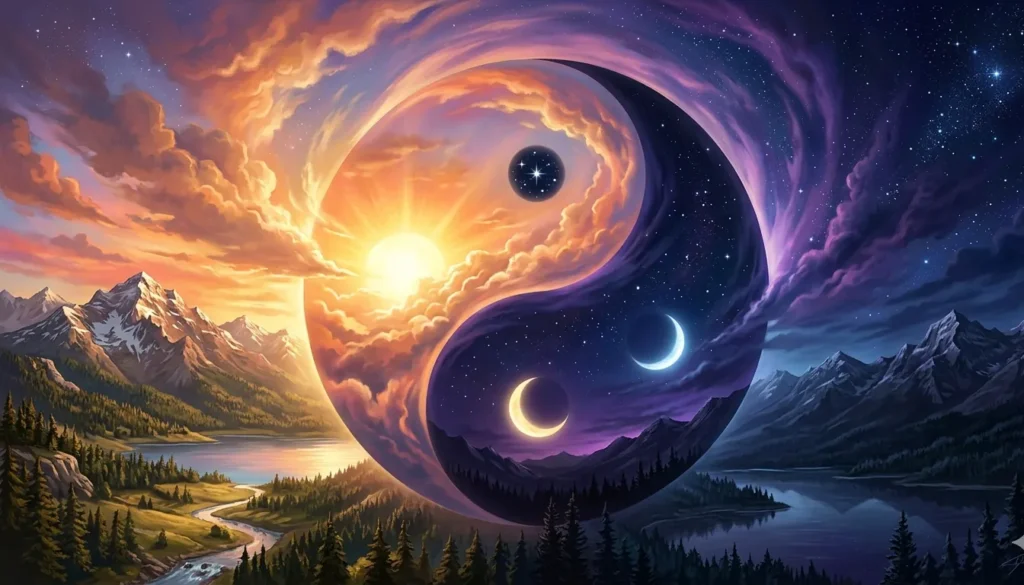
The deeper philosophical point is this. Within the yin-yang framework, the sun and moon are not opposites that cancel each other but complementary expressions of the same cosmic reality.
The sun does not negate the moon. The moon does not negate the sun. Each is the fullest natural expression of its respective quality, and the rhythm of their alternation day following night, following day is itself the most visible expression in nature of the yin-yang cycling principle.
The taijitu’s seed of the opposite within each pole finds its natural image in the moon’s reflected solar light (yin carrying yang within it) and the darkness of space in which the blazing sun floats (yang within an infinite yin).
This is the most important philosophical correction to make about the sun-moon pairing, and it is one that the yin-yang tradition itself insists upon with its central symbol. The taijitu’s S-curve boundary shows that the line between yang and yin is a zone of transition rather than a wall.
The small circle of each colour within the other shows that each pole contains the seed of its complement at its fullest expression. The circular form enclosing both shows that they are two aspects of a single unified reality.
The Chinese tradition’s naming of the sun as Taiyang (Great Yang) and the moon as Taiyin (Great Yin) does not make them opposites. It makes them the supreme natural expressions of two qualities that are always already present in everything, always in dynamic relationship, always containing each other’s seed.
The moon carries reflected solar light (yin containing yang). The sun exists in the infinite darkness of space (yang within yin). The alternation of day and night is not the battle of two opposing forces but the rhythmic expression of a single cosmic principle cycling through its own two aspects.
Traditional Chinese medicine extends this solar-lunar correspondence through the body. The Du Mai (Governing Vessel), the primary yang meridian running along the spine, is associated with solar energy. The Ren Mai (Conception Vessel), the primary yin meridian running along the front midline, is associated with lunar energy.
The Microcosmic Orbit meditation that circulates qi through both channels is, in this symbolic framework, a practice that internalizes the sun and moon’s cosmic circuit within the practitioner’s own body.
Over the years because of my study, I became increasingly suspicious of any framework that treats the great cosmic dualities as oppositions rather than as the two aspects of a single thing, as the traditions that produced those dualities almost invariably intend them to be.
Cultivation novels that treat solar and lunar as simple opposing types miss this entirely. The ones that understand it produce the genre’s most interesting solar-lunar character arcs: the solar cultivator who discovers that their greatest power requires the stillness they have always avoided, the lunar cultivator who discovers that the blazing expression they have always suppressed is the final key to their breakthrough.
Sun and Moon Across World Mythology
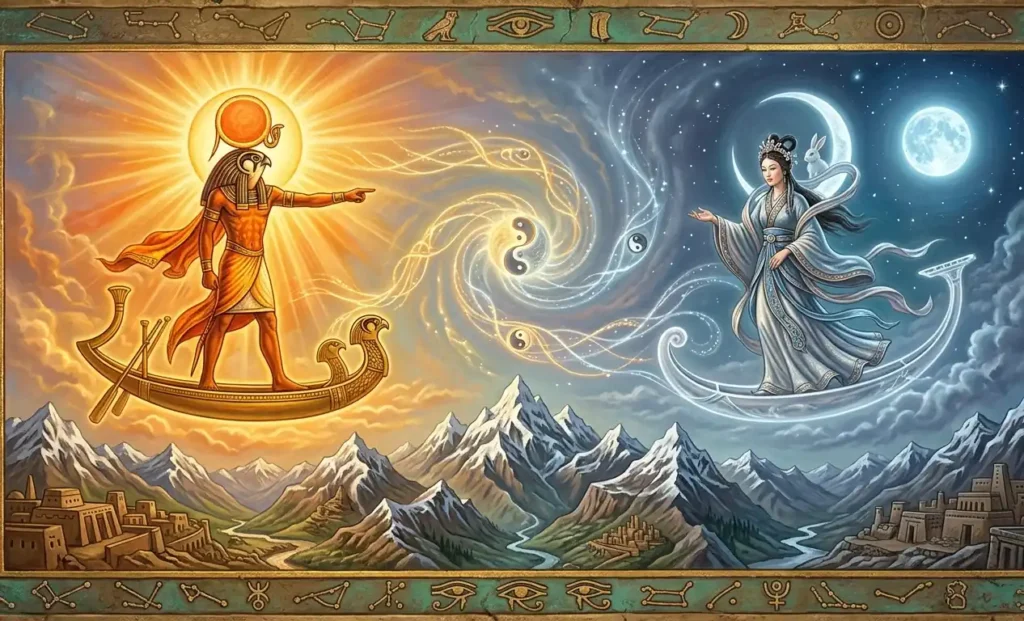
I came across the sun and the moon duality many times in my exploration of world mythologies.
Hindu tradition maps the solar-lunar duality onto the body’s energy channels. Pingala Nadi (right channel, solar, active, masculine) and Ida Nadi (left channel, lunar, receptive, feminine) run alongside the central Sushumna. Hatha Yoga, whose name literally means sun-moon union, is the practice of balancing these two channels.
For the cultivation reader, this is the Microcosmic Orbit of Daoist practice expressed in Sanskrit vocabulary: the circulation of solar and lunar qi through the body’s central channel as the foundation of advanced practice.
Japanese tradition gives us Amaterasu, the sun goddess, and her estranged brother Tsukuyomi, the moon god. Their estrangement, caused by Tsukuyomi’s murder of the food goddess, which Amaterasu found so horrifying, she vowed never to face him again, is the mythological explanation for why the sun and the moon never appear together in the sky. If you are a Japanese anime fan like me, you might have heard of Amaterasu and Tsukuyomi. The Uchiha Clan made them famous,
Ancient Egyptian tradition gives us Ra, whose nightly journey through the underworld and daily rebirth is the engine of all renewal. Ra’s death at sunset and resurrection at dawn is the solar principle at its most mythologically complete: yang contains within it the yin journey through darkness that makes the next yang expression possible. The ten suns myth’s regulated solar energy finds its Egyptian parallel in Ra’s precisely ordered solar journey.
Frequently Asked Questions
Is the sun yin or yang, and is the moon yin or yang?
In classical Chinese tradition, the sun is Taiyang, Great Yang, and the moon is Taiyin, Great Yin. This reflects the belief that the sun embodies warmth, activity, and outward force, while the moon embodies coolness, receptivity, and inward reflection, together expressing the fundamental balance of yin and yang within the cosmos.
Why do some cultures have a female sun and a male moon?
In Chinese mythology, the identities of the sun and moon reflect how their qualities were understood within the broader logic of cosmic order. The sun was aligned with yang for its radiance, heat, and active force, while the moon was aligned with yin for its stillness, coolness, and reflective nature. Their symbolism emerged from the qualities Chinese thought were most essential to the harmony of the cosmos.
What do the sun and moon together symbolize in mythology?
Together, the sun and moon symbolize the complete cycle of existence and the harmony through which all things are generated. In Chinese cosmology, their union reflects the dynamic balance of yin and yang, the complementary principles whose interaction sustains time, governs transformation, and gives rise to the fertility and ordered rhythm of the universe.
What is the relationship between the sun and the moon in Hinduism?
In Hindu tradition, both solar and lunar principles are masculine. Surya is the male sun god and Chandra (Soma) is the male moon god. This duality appears in yoga through Pingala Nadi (solar, right channel) and Ida Nadi (lunar, left channel). Hatha Yoga means sun-moon union, while Shiva’s crescent moon unites solar fire with lunar wisdom.
What does the moon represent in yin-yang philosophy?
In yin-yang philosophy, the moon (Taiyin, Great Yin) embodies receptivity, coolness, inward reflection, and cyclical time through its phases. Yet yin and yang are not opposites but interdependent aspects of a unified whole, each containing the seed of the other. The moon’s reflected light naturally expresses yin, carrying yang within it.
Final Thoughts
he sun and moon have been the most constantly present symbolic pair available to every human culture that has ever existed. No mythology has been unable to look up and see them. No tradition has failed to make something of their alternation, their difference, their rhythm.
What each culture makes of them is almost always the most compressed possible statement of that culture’s deepest values and deepest cosmological commitments. The Egyptian tradition that makes Ra’s nightly death and rebirth the engine of all renewal is telling you something about how Egypt understood the relationship between death and life.
The yin-yang framework’s contribution to this universal symbolic conversation is specific and valuable. It insists that the relationship between the solar and lunar principles is not opposition but complementarity, not battle but rhythm, not the victory of one over the other but the cycling of a single reality through its own two faces. This is philosophically more sophisticated than most popular treatments of the subject acknowledge, and it is genuinely different from the frameworks of several traditions covered above.
The sun and moon are not opposite. They are two aspects of the single rhythm that measures all of time, lights all of existence, and makes the world’s cycles possible. Every tradition that has ever looked up at the sky and wondered has known this in its own way, with its own vocabulary, shaped by its own deepest needs.
The sky keeps providing the same two lights. The traditions keep finding in them exactly what they most need to see.
Related Articles
- The Five Elements Behind Every Holy Beast [Chinese Myth Map]
- Why the Four Holy Beasts Cannot Exist Without Yin Yang
- Yin Yang & the Five Elements: The Hidden Cosmological Link
- Yin Yang, Five Elements & Four Symbols: China’s Complete Cosmos
- The Four Holy Beasts: Baihu, Qinglong, Zhuque & Xuanwu
- Yin Yang Sun & Moon: Duality, Myth & Spiritual Meaning
- Is Yin Yang Demonic? The Truth You Don’t Know
- 7 Misconceptions About Yin Yang You Probably Believe
References
- Dao De Jing (Tao Te Ching)
- Zhuangzi
- Daoism and Chinese Culture – Livia Kohn
- Huainanzi
- Yin-Yang and the Nature of Correlative Thinking – Angus Charles Graham
- Lewis, Mark Edward. The Construction of Space in Early China.
- Book of Changes: Yi Jing – Chinese Text Project
- Yinyang: The Way of Heaven and Earth in Chinese Thought and Culture – Robin Wang
- Birrell, Anne. Chinese Mythology: An Introduction.
- Sun Xiaochun & Jacob Kistemaker. The Chinese Sky During the Han.
- The Kojiki
- Wilkinson, Richard H. The Complete Gods and Goddesses of Ancient Egypt.