
 By
By Quick takeaways:
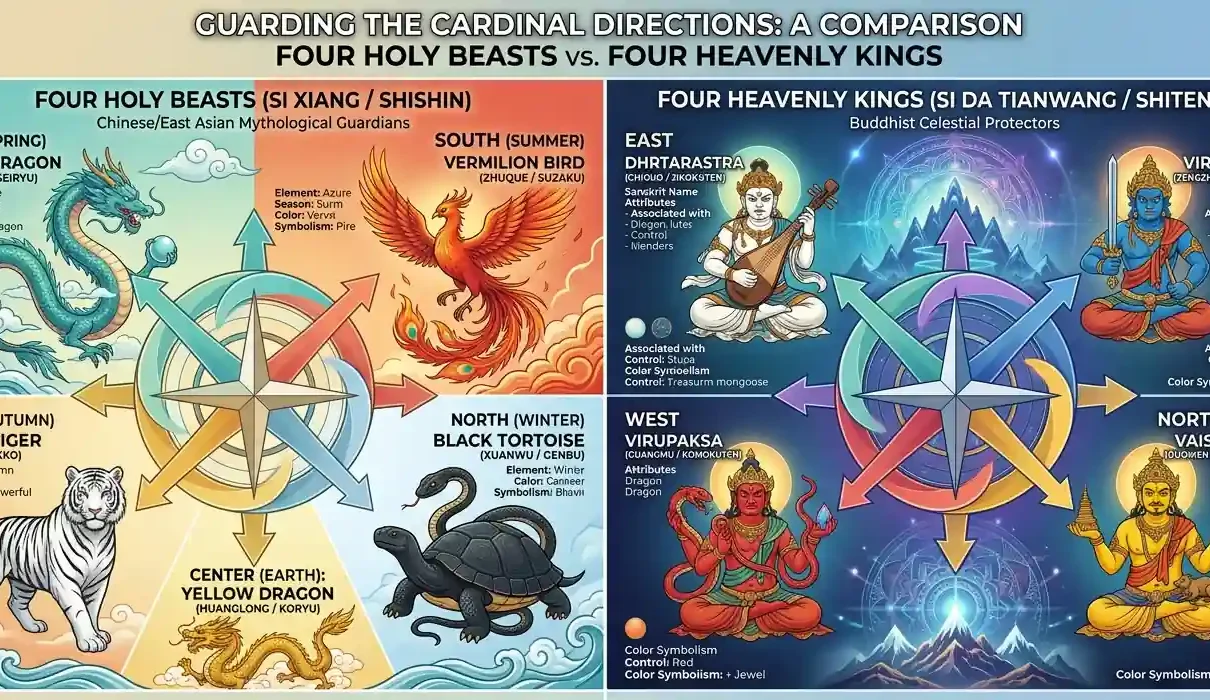
- The Four Holy Beasts (Si Xiang) and the Four Heavenly Kings (Si Da Tian Wang) are two entirely separate groups from two entirely separate traditions, one from Chinese cosmological astronomy, one from Indian Buddhist theology
- The Four Holy Beasts are celestial animals: Qinglong the Azure Dragon, Zhuque the Vermilion Bird, Baihu the White Tiger, and Xuanwu the Black Tortoise. They govern the four cardinal directions, four seasons, and four elements in Chinese cosmology
- The Four Heavenly Kings are Buddhist guardian deities: Dhrtarastra, Virudhaka, Virupaksha, and Vaishravana. They guard the four directions of Mount Meru, the cosmic mountain at the centre of Buddhist cosmology
- Both groups govern four cardinal directions, which is the primary reason they are so frequently confused, but their origins, nature, functions, and symbolic meanings are completely different
- Both traditions spread across East Asia together with Buddhism, which is how they ended up in the same temples and the same cultural conversations, deepening the confusion
I first encountered the Four Holy Beasts, Qinglong, Zhuque, Baihu, Xuanwu, through my readings of cultivation novels, and spent a long time working out what each one represented before feeling confident I understood the tradition.
During my exploration of the Four Guardians of Chinese mythology, I came across the Four Heavenly Kings, and the confusion hit me immediately. Both groups had four members, both governed four directions, and both appeared in East Asian religious and artistic contexts. Were these the same figures under different names? Different regional versions of the same tradition? Entirely separate things that happened to share a structural similarity?
The answer is entirely separate things that happen to share a structural similarity, and that is exactly what makes them so persistently confusing for anyone exploring East Asian mythology seriously.
This article is the clear, definitive comparison I wish I had found immediately. By the end of it, you will be able to distinguish the two groups confidently, understand why each exists and what each means, and know exactly where you will encounter each in the wild.
Why The Confusion Happens
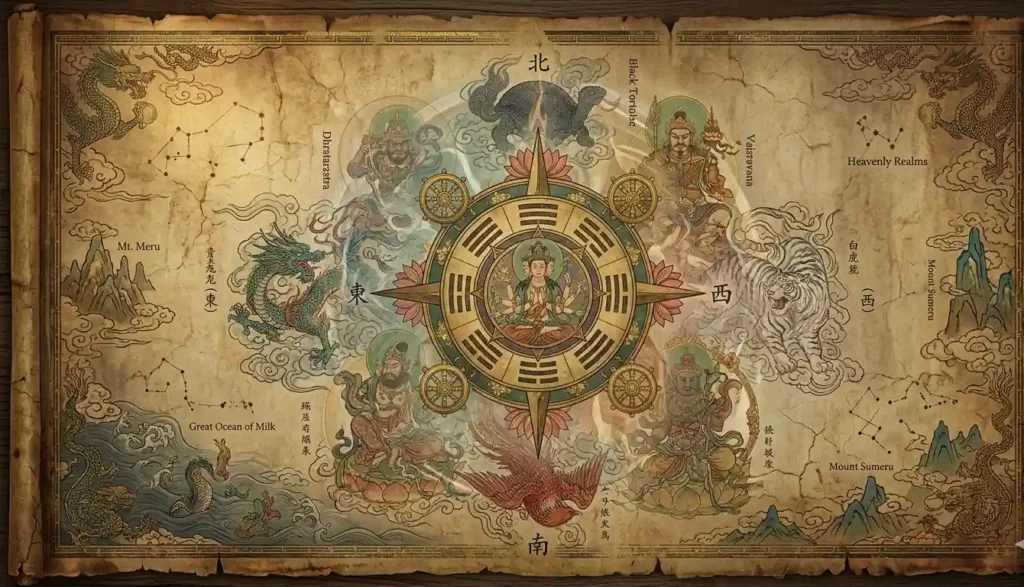
Before separating the two groups, it is worth understanding why the confusion arises so reliably, because knowing the reason makes the distinction easier to retain.
The confusion has four specific causes:
1. Both Groups Have Four Members Governing Four Cardinal Directions
This is the primary source of confusion. Any group of four divine figures governing north, south, east, and west will be conflated with any other such group, especially when both appear in the same cultural context. Four directional guardians is a cosmological structure that feels like it should refer to one specific tradition, so encountering two separate traditions with this structure produces an immediate sorting problem.
2. Both Traditions Spread Through The Same East Asian Cultural Sphere
Chinese cosmological tradition (home of the Four Holy Beasts) and Indian Buddhist tradition (home of the Four Heavenly Kings) both became dominant cultural forces across China, Japan, Korea, and Vietnam.
They did not spread to separate regions. They spread to the same regions, often through the same cultural transmission routes, and ended up coexisting in the same temples, the same texts, and the same artistic programs. Seeing them side by side over centuries made them feel like parts of a single unified system even when they are not.
3. Both Groups Appear in Temple Contexts
Walk into a traditional Buddhist temple in China, Japan, Korea, or Vietnam, and you will frequently encounter both groups represented in the same space.
The Four Heavenly Kings appear as large statue guardians at the temple entrance. The Four Holy Beasts appear in architectural decoration, compass orientation, and cosmological diagrams elsewhere in the complex. Both seem to be doing similar guardian work from a visitor’s perspective, which makes the distinction feel academic rather than real.
4. Both Influenced Each Other Over Centuries of Cultural Contact
The two traditions were not simply parallel. Over centuries of coexistence in East Asian religious culture, they influenced each other’s iconography, were sometimes consciously associated with each other, and in some specific local traditions were partially merged. This genuine interpenetration makes clean separation feel difficult even after the basic distinction is understood.
The Four Holy Beasts (Si Xiang)
What They Are and Where They Come From
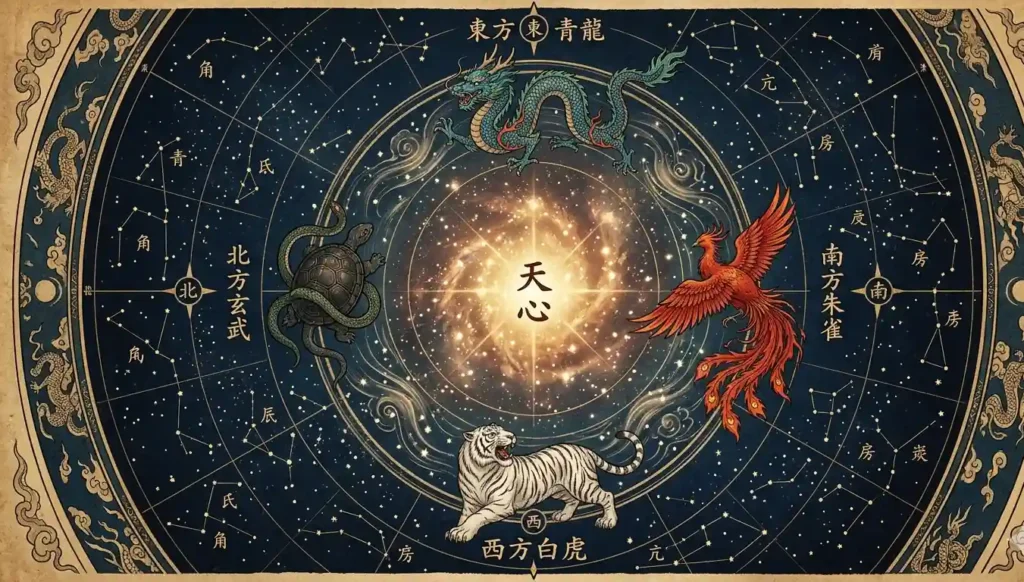
The Four Holy Beasts, known in Chinese as Si Xiang (四象, literally Four Symbols or Four Images) or Si Shen (四神, Four Divine Spirits), are the four celestial guardian animals of classical Chinese cosmological astronomy.
They originate in the ancient Chinese division of the night sky into four quadrants, each containing seven of the twenty-eight lunar mansions (宿, xiù) that constitute the Chinese astronomical system’s division of the ecliptic. Each quadrant of seven lunar mansions was associated with a cardinal direction, a season, an element, a colour, and a guardian animal whose form could be traced in the star positions of that quadrant.
The tradition is ancient. The earliest clear archaeological evidence of the four directional animals appears in Han Dynasty tomb art (206 BCE to 220 CE) and possibly earlier, with some scholars tracing elements of the tradition to the Warring States period. The four animals and their cosmological assignments are:
| Beast | Direction | Season | Element | Colour |
|---|---|---|---|---|
| Qinglong (Azure Dragon) | East | Spring | Wood | Azure/Green |
| Zhuque (Vermilion Bird) | South | Summer | Fire | Vermilion/Red |
| Baihu (White Tiger) | West | Autumn | Metal | White |
| Xuanwu (Black Tortoise) | North | Winter | Water | Black |
Their Nature
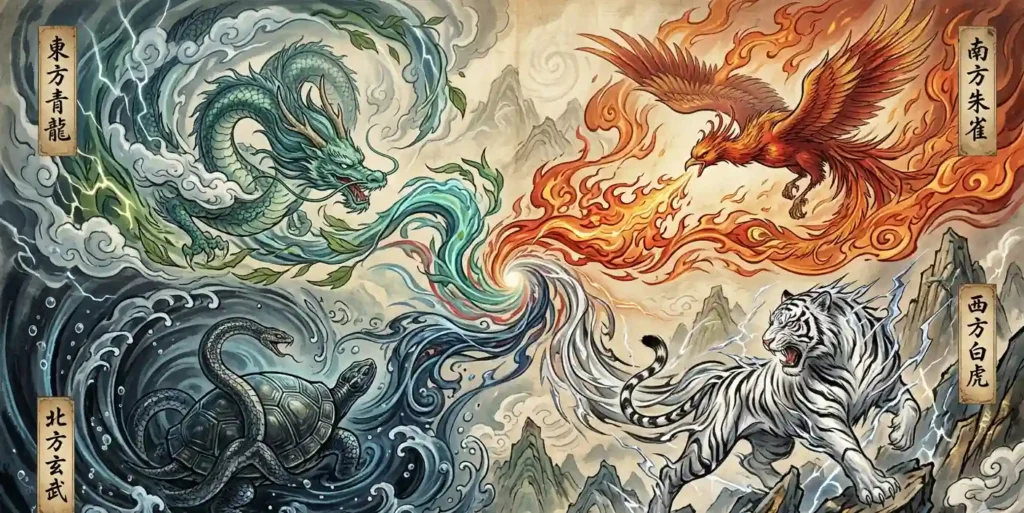
The Four Holy Beasts are:
- Celestial animals, not deities in any personal or devotional sense
- Cosmological principles given animal form, each one is the animating intelligence of its sky quadrant
- Natural forces governing elemental cycles, seasonal transitions, and directional energies
- Astronomical figures whose forms are traced in the star positions of their respective sky quadrants
They are not worshipped in the way that deities with personalities, biographies, and devotional relationships are worshipped. They are revered and invoked, particularly in geomantic and protective contexts, but the relationship is more like the human relationship with natural forces than with personal divine beings.
You do not pray to Qinglong the way you pray to a god. You orient your home or tomb appropriately relative to Qinglong’s eastern position because that orientation aligns your space with natural cosmological forces.
Their Primary Functions
The Four Holy Beasts serve the following primary functions in their tradition:
- Cosmological map: They organise the sky, the seasons, the elements, and the cardinal directions into a unified framework
- Directional protection: They are placed at the four walls of tombs, important buildings, and cities to protect each direction with the appropriate elemental force
- Geomantic orientation: Feng shui practice uses the four animals to assess the qualities of sites based on their relationship to topographic features in each direction
- Temporal markers: Their rising and setting marks seasonal transitions in the traditional Chinese astronomical calendar
The Four Heavenly Kings (Si Da Tian Wang)
What They Are and Where They Come From
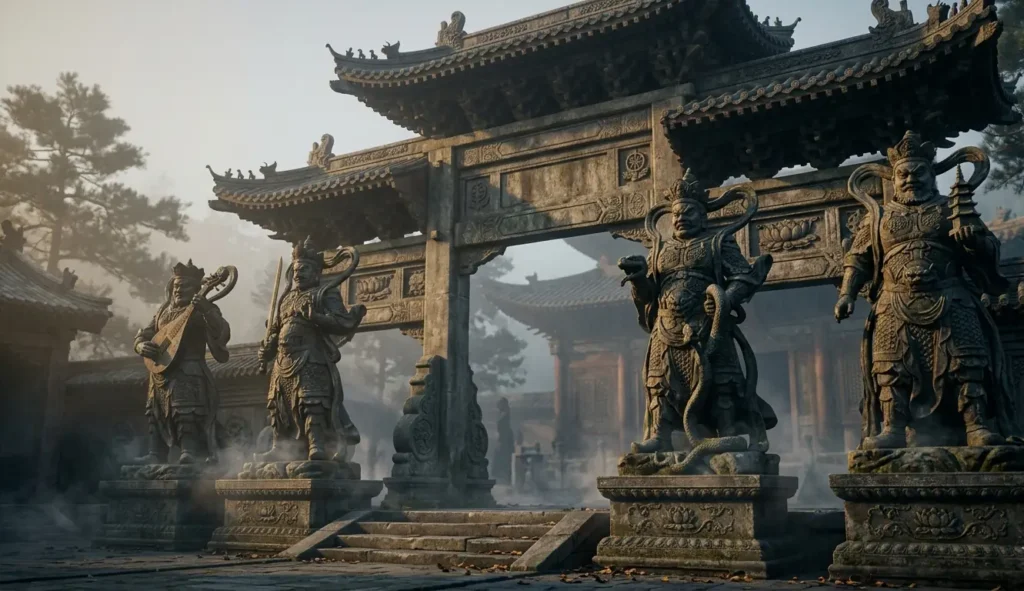
The Four Heavenly Kings, known in Chinese as Si Da Tian Wang (四大天王, Four Great Heavenly Kings), in Japanese as Shitenno (四天王), in Korean as Sacheonwang (사천왕), and in Sanskrit as Lokapala (World Guardians), are Buddhist guardian deities who originate in ancient Indian cosmological theology.
They come from a completely different tradition than the Four Holy Beasts. Specifically, from the cosmological framework of early Indian Buddhism, which organized the universe around Mount Meru, the cosmic mountain at the center of all existence. The Four Heavenly Kings dwell on the four slopes of Mount Meru’s lower levels, each governing one of the four cardinal directions relative to that cosmic axis.
Their Sanskrit names and directional assignments are:
| King | Sanskrit name | Direction | Domain |
|---|---|---|---|
| King of the East | Dhrtarastra | East | Gandharvas (celestial musicians) |
| King of the South | Virudhaka | South | Kumbhandas (goblins) |
| King of the West | Virupaksha | West | Nagas (serpent beings) |
| King of the North | Vaishravana (Kubera) | North | Yakshas (nature spirits) |
Their Nature
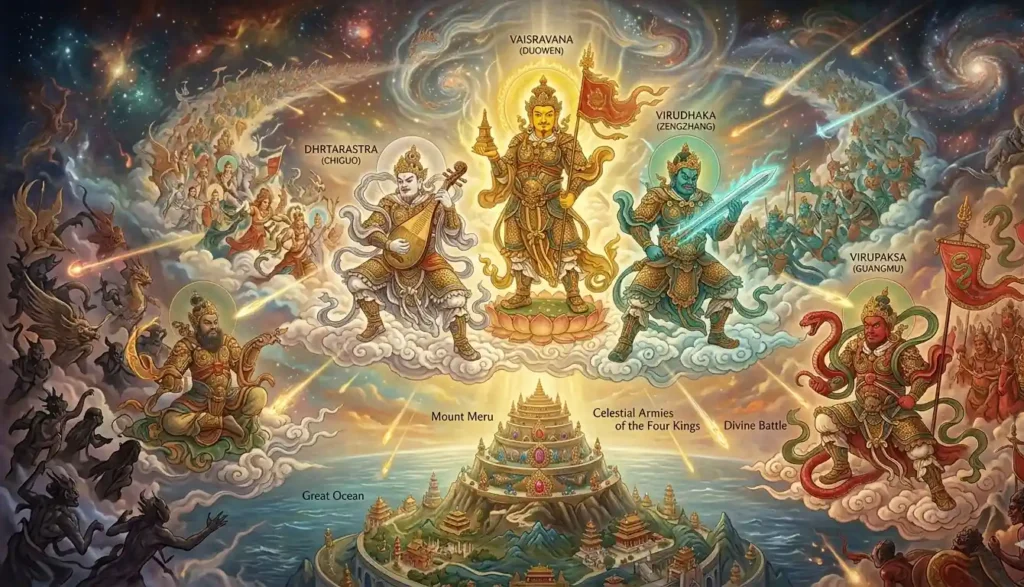
The Four Heavenly Kings are:
- Personal deities with individual names, appearances, weapons, attributes, and divine personalities
- Buddhist cosmological beings who exist within the Buddhist understanding of the universe’s multi-layered divine hierarchy
- Active guardians who exercise divine will, make decisions, engage in cosmic combat against demonic forces, and protect the dharma (Buddhist teaching)
- Devotional figures who are actively worshipped, prayed to, and represented in temple iconography as objects of religious veneration
They inhabit the lowest of the six heavens of the realm of desire in Buddhist cosmology, making them divine beings of relatively accessible spiritual rank, powerful enough to be worth invoking for protection but not so far removed from the human realm as to be unreachable through devotion.
Their relationship with the practitioner is fundamentally different from the Four Holy Beasts’ relationship with humans. You can appeal to the Four Heavenly Kings. You can request their protection. They can choose to respond. They are beings with will, agency, and the capacity for relationship.
Their Iconography and Attributes
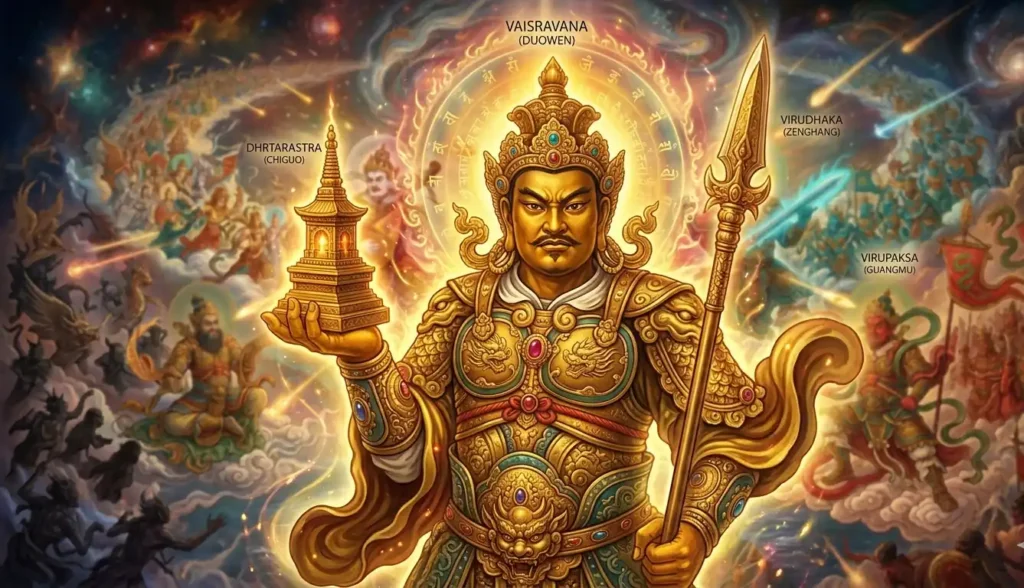
The Four Heavenly Kings have highly specific, individually recognizable iconographic attributes that make them visually distinct from each other in temple art:
Dhrtarastra (East):
- Carries a lute or pipa (musical instrument)
- White or green body
- Governs celestial musicians and the harmony of the realm
Virudhaka (South):
- Carries a sword
- Blue body
- Governs spiritual growth and the protection of those who follow the Buddhist path
Virupaksha (West):
- Carries a dragon or a red cord/rope
- Red body
- Governs serpent beings and the power of vision and observation
Vaishravana (North):
- Carries a pagoda (miniature stupa) and often an umbrella
- Green or black body, often depicted in full armour
- Governs yaksha spirits, wealth, and is the most powerful of the four
- Also independently worshipped as Bishamonten in Japan, Pishamen in Chinese Buddhism
Their Primary Functions
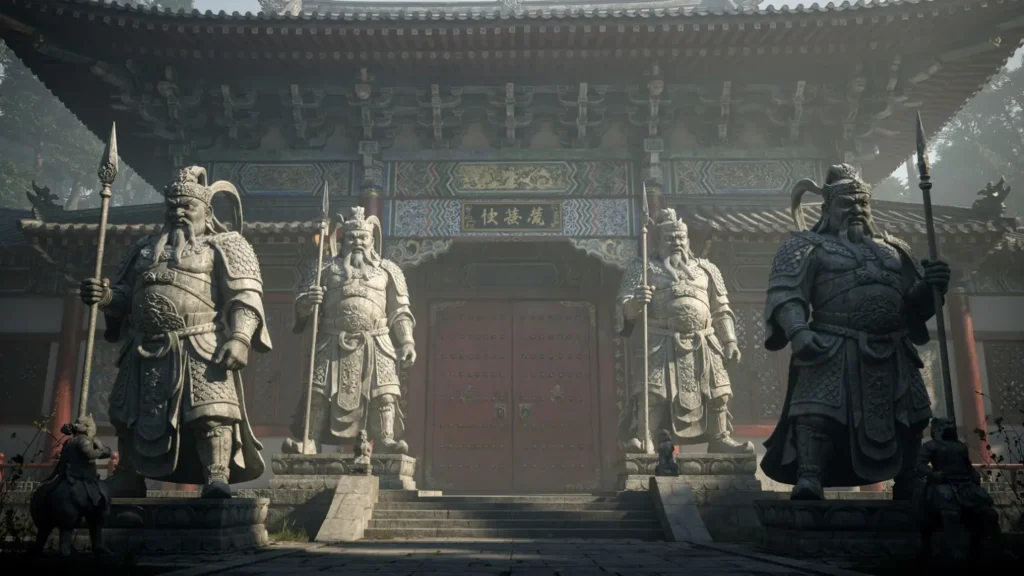
The Four Heavenly Kings serve the following primary functions in their tradition:
- Temple guardians: They are placed at the entrance of Buddhist temples to protect the sacred space from demonic interference. Their large, fearsome statues are among the first things a visitor sees
- Dharma protectors: They actively defend the Buddhist teaching and those who follow it
- Cosmic military commanders: They command vast armies of divine beings against the forces of evil and delusion
- Directional protectors: They guard the four directions of the cosmic mountain and by extension the four directions of any sacred space modelled on that cosmological template
- Devotional objects: They receive prayers and offerings in exchange for protection, success, and health
Side-By-Side Comparison: Every Dimension
| Dimension | Four Holy Beasts (Si Xiang) | Four Heavenly Kings (Si Da Tian Wang) |
|---|---|---|
| Origin tradition | Chinese cosmological astronomy | Indian Buddhist theology |
| Nature | Celestial animals / cosmological principles | Personal deities with will and agency |
| Number | Four | Four |
| Directions governed | North, South, East, West | North, South, East, West |
| Primary text source | Chinese astronomical and cosmological texts, Han Dynasty | Buddhist Pali Canon, Sanskrit sutras |
| Forms | Animals (dragon, bird, tiger, tortoise-serpent) | Armoured divine kings in human form |
| Personalities | None, they are forces, not persons | Full individual personalities, names, attributes |
| Worship style | Invocation and geomantic alignment | Active devotional worship, prayer, offerings |
| Temple placement | Architectural decoration, compass orientation | Large statues at temple entrance gates |
| Relationship with elements | Direct – each rules a specific element | Indirect – no elemental classification |
| Relationship with seasons | Direct – each rules a specific season | No seasonal assignments |
| Cultural origin | China | India, transmitted through Central Asia |
| Spread | China, Korea, Japan, Vietnam through Chinese cultural influence | India → Central Asia → China → Korea, Japan, Vietnam through Buddhism |
| Living religious practice | Geomancy, feng shui, architectural orientation | Active Buddhist temple worship worldwide |
| Most famous example | Qinglong (Azure Dragon) | Vaishravana/Bishamonten (North King) |
What They Share: And Why That Causes The Confusion
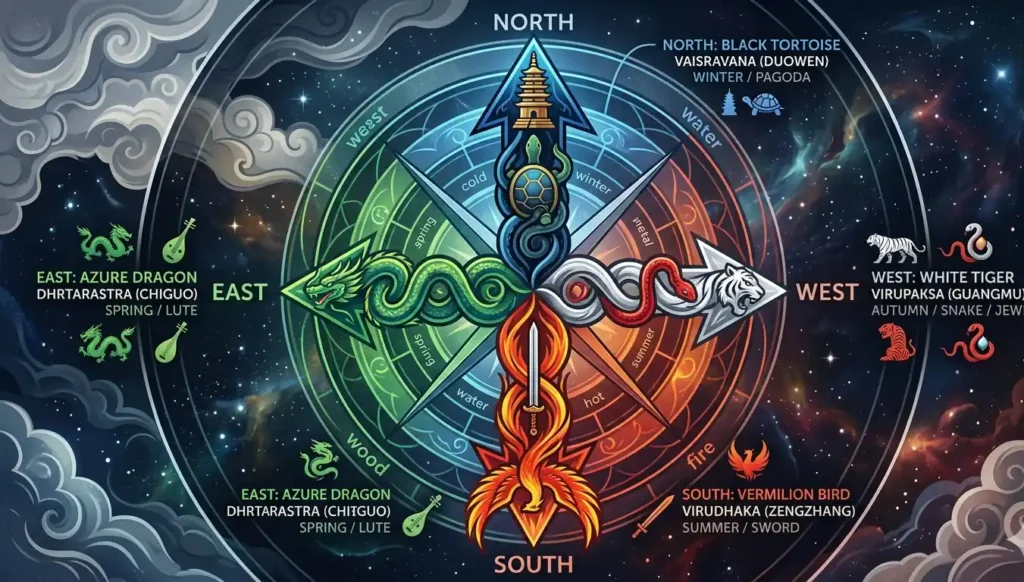
Despite their entirely different origins and natures, the Four Holy Beasts and the Four Heavenly Kings share several structural features that make confusion almost inevitable for anyone who encounters both.
The Number Four and the Cardinal Directions
Both groups organize four guardians across four cardinal directions. This structural parallel is the deepest source of confusion because it makes both feel like answers to the same question. Who guards the four directions? The answer is that two entirely different traditions each developed their own answer to this question independently, one from astronomical observation and one from theological cosmology, and both answers involve four figures.
This parallel directional structure is not accidental. The number four and the four cardinal directions are among the most fundamental organising principles in human cosmological thinking globally. Multiple traditions independently arrived at four directional guardians because the structure is inherent to the problem of cosmological organisation around a central point.
Coexistence in East Asian Religious Culture
Both traditions spread across China, Korea, Japan, and Vietnam, often through the same cultural channels. Buddhism brought the Four Heavenly Kings to East Asia, but also transmitted itself through cultural networks already shaped by Chinese cosmological thinking that included the Four Holy Beasts.
The two traditions arrived in the same cultural space and have coexisted for over a thousand years, which is long enough for genuine interpenetration.
Guardian Function
Both groups perform guardian functions for sacred spaces. The Four Holy Beasts protect directional approaches to tombs, palaces, and cities. The Four Heavenly Kings protect the entrances of Buddhist temples. Seeing both groups in protective roles in religious contexts makes them feel interchangeable to the casual observer.
Genuine Artistic and Conceptual Association
In some East Asian religious contexts, particularly in certain periods of Chinese and Japanese religious art, the Four Heavenly Kings and the Four Holy Beasts were consciously associated or depicted in proximity. Some artists and temple designers understood both groups as complementary layers of the same protective cosmological structure rather than as unrelated systems. This conscious association by practitioners of the tradition deepens the confusion for modern researchers.
Where You Will Find Each in the Real World
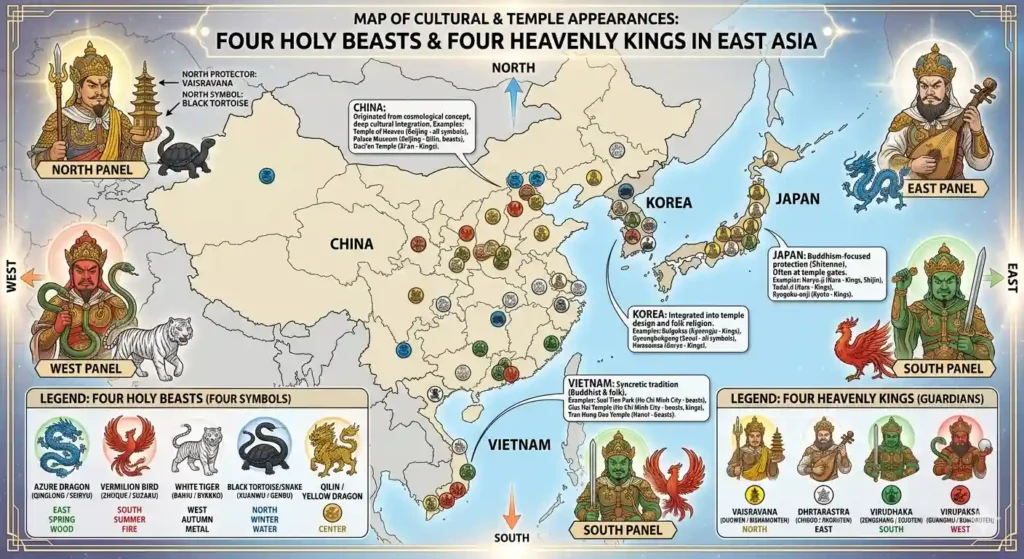
Knowing where each group typically appears makes identification straightforward in practice.
Where You Find the Four Holy Beasts
- Goguryeo tomb murals (Korea): Some of the finest surviving examples of all four beasts, painted on the four walls of aristocratic burial chambers from the 4th through 7th centuries CE
- Chinese tomb art: Han Dynasty and later tomb tiles, paintings, and grave goods depicting the four animals in their directional positions
- Feng shui references: Compass directions, site assessment, and architectural orientation in geomantic practice
- Traditional architecture: Palace gates, city walls, and important buildings oriented relative to the four animals
- Heraldic and decorative use: Imperial robes, ceremonial objects, and decorative arts incorporating the four animals as cosmological symbols
- Wudang Mountain: Xuanwu specifically has an entire temple complex dedicated to its developed deity form
- East Asian cosmological charts and astronomical diagrams: The lunar mansion system and its four quadrant animals
Where You Find the Four Heavenly Kings
- Buddhist temple entrance halls: Large, imposing painted or sculpted guardian statues flanking the entrance of virtually every significant Buddhist temple across East Asia
- Toshodai-ji and Kofuku-ji temples, Japan: Home to some of the finest surviving Shitenno (Four Heavenly Kings) statuary from the Nara period
- Bulguksa Temple, Korea: Features significant Four Heavenly Kings guardian imagery
- Chinese Buddhist temples: The Devaraja Hall (天王殿, Tian Wang Dian) is specifically the hall dedicated to the Four Heavenly Kings in Chinese Buddhist temple architecture. Almost every major Buddhist temple has one
- Buddhist canonical art and manuscripts: The Four Heavenly Kings appear extensively in illustrated Buddhist texts and cosmological diagrams
- Japanese popular culture: Bishamonten (Vaishravana) in particular, has an extensive independent cultural presence in Japan
- Prayers and devotional practice: Active worship in Buddhist contexts, particularly Vaishravana/Bishamonten for wealth and protection
How The Two Traditions Interact in East Asian Religious Culture
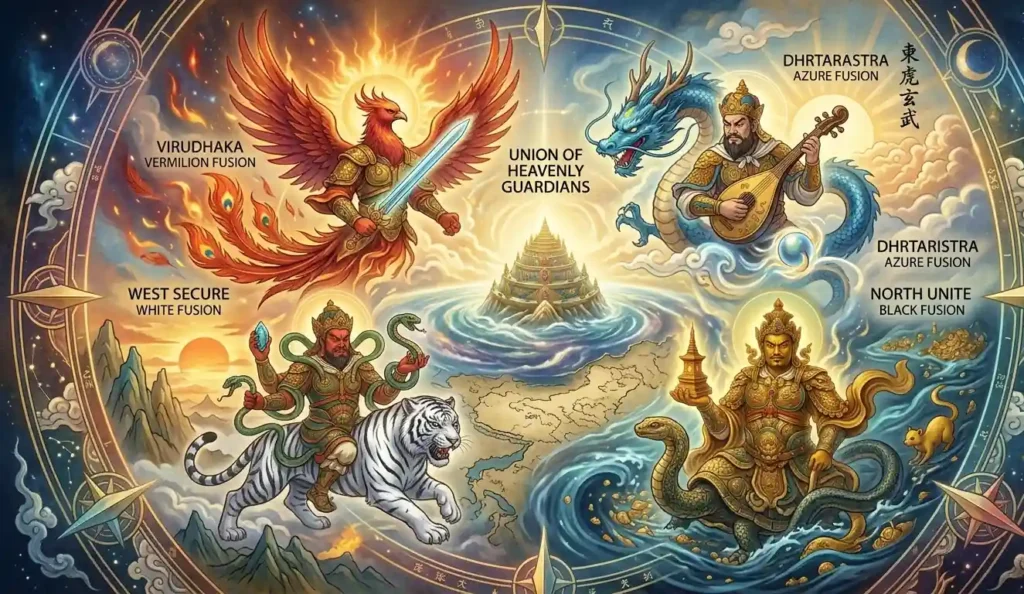
The relationship between the Four Holy Beasts and the Four Heavenly Kings in East Asian religious culture is not simply one of parallel existence. Over centuries of coexistence, several patterns of interaction developed.
Complementary Layering
In sophisticated Buddhist temple design, particularly in Tang Dynasty China and Nara period Japan, religious planners sometimes used both groups as complementary layers of cosmic protection.
The Four Heavenly Kings at the entrance provided Buddhist devotional protection. The Four Holy Beasts in the architectural orientation and decoration provided cosmological protection. Both layers working together was understood to create a more complete protective environment than either alone.
Partial Identification
In certain Chinese Buddhist syncretic contexts, attempts were made to identify or associate members of the two groups with each other. These associations were never standardised and varied by region and period. They reflect the general tendency of religious synthesis in East Asia to find correspondences between traditions rather than maintaining strict separations.
Independent Parallel Operation
In most contexts, however, the two groups simply operated in parallel in the same cultural space without explicit connection. A Chinese Buddhist temple would have Four Heavenly Kings statues at the entrance and be oriented geomantically relative to the Four Holy Beasts without either tradition making specific claims about the other.
Two separate cosmological frameworks coexisting in the same space without merging, which is the most common pattern of how East Asian religious traditions handle internal plurality.
Frequently Asked Questions
Are the Four Heavenly Kings and the Four Holy Beasts the same thing?
The Four Holy Beasts and the Four Heavenly Kings come from entirely different traditions. The Four Holy Beasts are Chinese cosmological creatures tied to directions, seasons, and elements. The Four Heavenly Kings are Buddhist guardian deities from Indian theology who rule the four slopes of Mount Meru. Their shared directional symbolism is why people often confuse them.
Which group is older?
The Four Holy Beasts tradition is older within Chinese culture, with clear evidence appearing in Han Dynasty tomb art from 206 BCE to 220 CE. The Four Heavenly Kings originated earlier in Indian Buddhism between the 5th and 3rd centuries BCE, but they only became part of East Asian tradition after Buddhism spread into China around the 1st century CE.
Why do both groups govern four cardinal directions?
The four cardinal directions and the number four have long been central to human cosmology across many cultures. Chinese astronomers who developed the Four Holy Beasts and Indian Buddhist theologians who shaped the Four Heavenly Kings were solving the same idea independently. how to organize sacred or cosmic forces around a central point, leading both traditions to create four directional guardians.
Do the Four Holy Beasts and Four Heavenly Kings correspond to each other?
There is no standardised correspondence between the Four Holy Beasts and the Four Heavenly Kings, and attempts to pair them have never reached consensus. While both traditions assign guardians to the cardinal directions, the figures themselves serve entirely different roles. Xuanwu is a northern water-aligned cosmological beast, while Vaishravana is a northern Buddhist war deity and commander of yaksha spirits. Their only real similarity is directional association.
Where are the Four Heavenly Kings most visibly present today?
The Four Heavenly Kings remain highly visible across Buddhist East Asia. Chinese Buddhist temples commonly include a Devaraja Hall dedicated to them as a standard part of temple architecture. In Japan, Bishamonten developed an important independent role as a deity of wealth and military victory. In Korea, large statues of the Four Heavenly Kings continue to guard the entrances of Buddhist temples throughout the country.
What is Bishamonten and how does it relate to the Four Heavenly Kings?
Bishamonten is the Japanese name for Vaishravana, the King of the North and one of the Four Heavenly Kings. In Japan, he developed an independent devotional role beyond that framework and is also worshipped as part of the Seven Gods of Fortune as a deity of wealth, warriors, and good fortune. This makes him the most culturally prominent of the Four Heavenly Kings, often recognized without reference to the others.
How did both groups end up in the same cultural traditions?
Chinese cosmological tradition, including the Four Holy Beasts, developed natively in China over many centuries. The Four Heavenly Kings come from the Indian Buddhist tradition and entered China through the spread of Buddhism in the early centuries CE via the Silk Road and maritime routes. Once Buddhism became established, both systems coexisted in Chinese religious life, and this combined cultural framework later spread to Korea, Japan, and Vietnam through broader East Asian cultural transmission
Final Thoughts
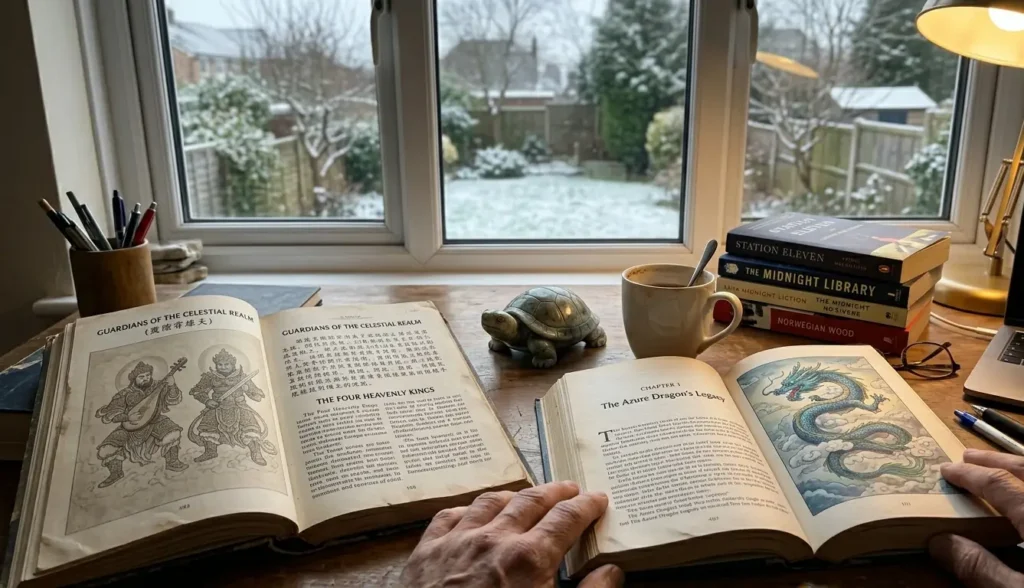
The Four Holy Beasts and the Four Heavenly Kings occupy the same cultural space in East Asia the way two rivers occupy the same landscape, flowing parallel for long stretches, occasionally mingling, always distinct in origin and nature, even when they are difficult to tell apart from a distance.
This kind of parallel existence, two separate traditions solving similar cosmological problems through structurally similar but fundamentally different answers, is one of the most interesting patterns in comparative religious history. It is not a coincidence that both traditions organized cosmic protection around four cardinal directions.
It reflects something deep about how human beings structure their understanding of space, protection, and divine order. But the fact that two traditions arrived at similar structures from entirely different directions is part of what makes each tradition worth understanding on its own terms rather than collapsing them into each other.
The clearest practical summary to retain is this:
Four animals, Chinese cosmology, sky quadrants, seasonal and elemental forces: 4 Holy Beasts.
Four armoured divine kings, Buddhist theology, Mount Meru, guardian deities with personalities: 4 Heavenly Kings.
Both are fascinating. Both repay serious study. Neither is a version of the other.
Related Articles
- Xuanwu: Black Tortoise of the North Symbolism & Mythology
- Yellow Dragon: Myths, Symbolism & the Forgotten Fifth Beast
- Why the Four Holy Beasts Cannot Exist Without Yin Yang
- Yin Yang, Five Elements & Four Symbols: China’s Complete Cosmos
- Are the Four Heavenly Kings & Four Holy Beasts the Same?
- The Four Holy Beasts: Baihu, Qinglong, Zhuque & Xuanwu
References
- Birrell, Anne. Chinese Mythology: An Introduction.
- Eberhard, Wolfram. A Dictionary of Chinese Symbols.
- The Chinese Sky
- Allan, Sarah. The Shape of the Turtle.Hanshu (Book of Han).
- UNESCO World Heritage Centre – Complex of Goguryeo Tombs
- Shanhaijing (Classic of Mountains and Seas).
- Shiji (Records of the Grand Historian).
- Digha Nikaya Full English
- Damien Keown – Buddhism: A Very Short Introduction
- Religion in Japanese History – Joseph M. Kitagawa