 By
By Quick Takeaways:
- The Four Symbols don’t just have yin-yang associations. They literally emerge from yin yang through a specific cosmological sequence described in ancient Chinese texts
- The I Ching’s cosmogonic formula makes this explicit: Tai Ji (Supreme Ultimate) → Two Principles (yin and yang) → Four Symbols → Eight Trigrams
- Each guardian beast’s directional, seasonal, elemental, and philosophical character is determined by its specific yin-yang composition. Nothing about the four beasts is arbitrary
- Without yin yang’s dynamic cycling principle, the Four Symbols would be a static classification rather than a living cosmological system
- Understanding this dependency doesn’t just illuminate the beasts, it completely reframes what yin yang actually is
One aspect of Chinese cosmology that continues to fascinate me is how elegantly the Four Symbols emerge from yin and yang. At first glance they look like separate traditions. The classical texts suggest otherwise.
Most people who are interested in Chinese mythology and cosmology encounter yin yang and the Four Symbols as separate topics. You read about yin yang in one place, you read about the Azure Dragon and its companions in another. They’re clearly related. The beasts have yin and yang qualities assigned to them, but the relationship feels like labelling. Like someone looked at the existing guardian beasts and said, “Right, the dragon is yang, the tortoise is yin,” and tagged them accordingly.
That’s not what happened. The relationship runs much deeper, and understanding it properly changes how you see both systems entirely.
The Cosmological Ladder: The Ancient Argument
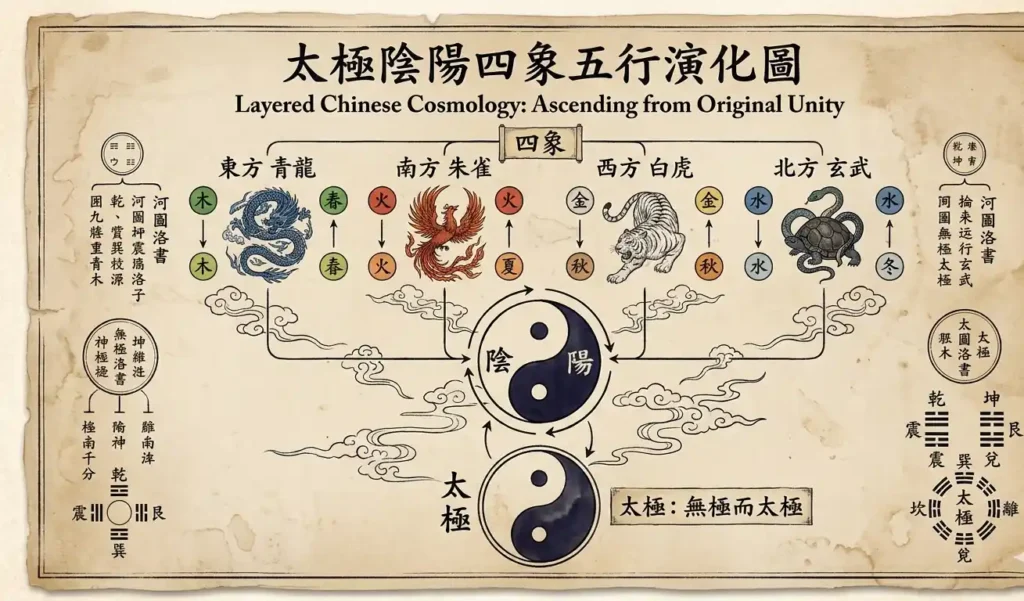
The ancient Chinese cosmological tradition doesn’t leave the yin yang → Four Symbols connection implicit. It states it explicitly, in one of the most famous passages in Chinese philosophical literature.
The passage comes from the Xici commentary of the I Ching (Book of Changes), and it goes like this:
“Therefore in the Yi there is the Supreme Ultimate (Tai Ji), which produces the Two Principles (Liangyi). The Two Principles produce the Four Symbols (Si Xiang). The Four Symbols produce the Eight Trigrams (Bagua).”
That’s a cosmological sequence of creation. And the Four Symbols sit precisely in the middle of it, produced by the Two Principles (yin and yang) and themselves producing the Eight Trigrams.
Let me walk you through each step, because the logic is beautiful once you see it.
The Tai Ji: The Undivided Whole
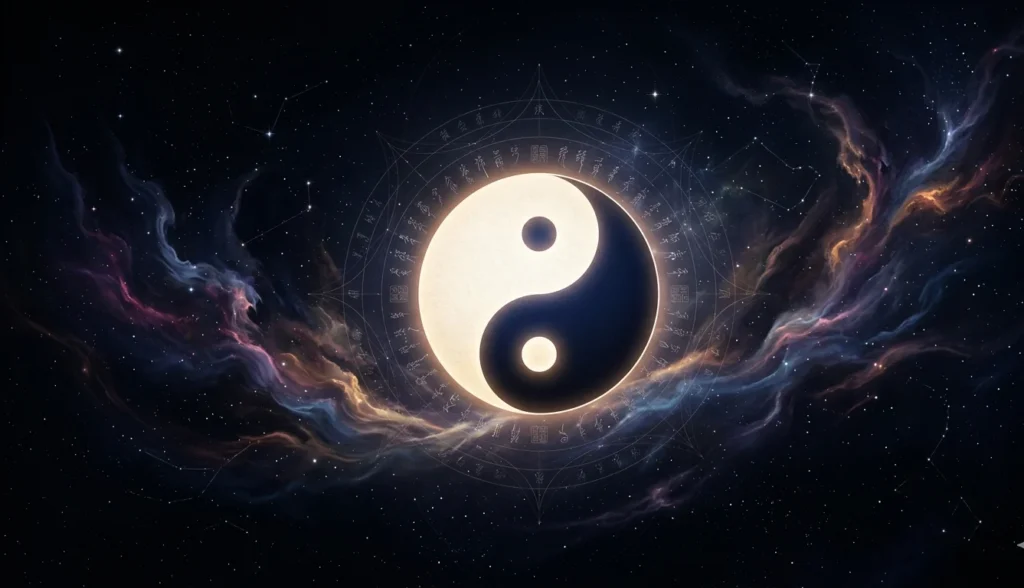
The Tai Ji (太極, Supreme Ultimate) is the starting point of the undivided, undifferentiated totality before any distinction exists.
It’s what you see in the yin yang symbol before you notice the two halves. The whole circle. The unity that precedes duality.
I think of it as the moment before you turn on a light in a dark room. Nothing is defined yet. All possibilities exist, but none are actualised. From this undivided totality, the first distinction emerges.
Yin and Yang: The Two Principles
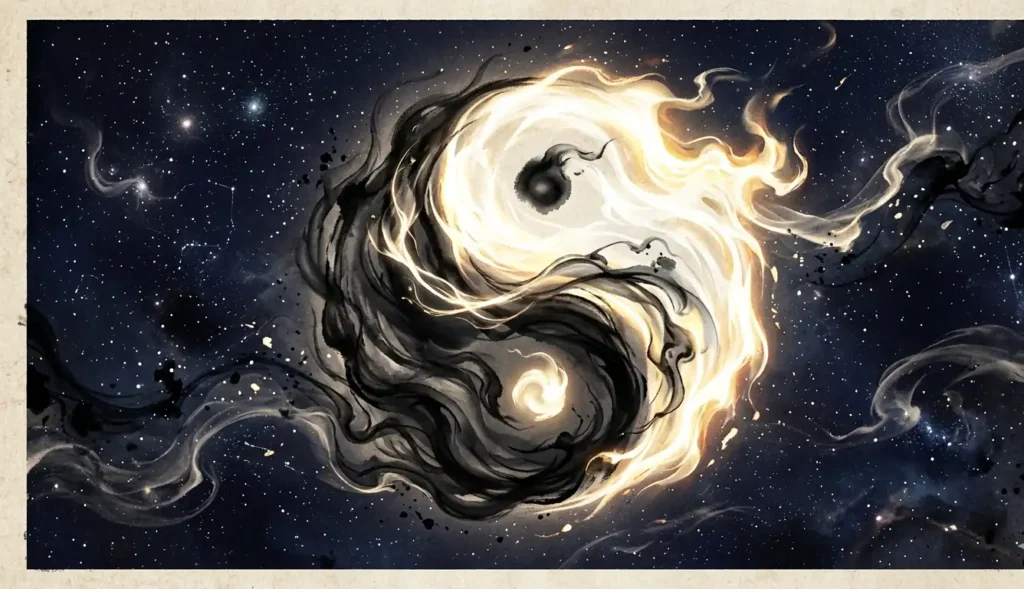
The first distinction that emerges from the Tai Ji is the Liangyi (兩儀), the Two Principles, which are yin and yang.
This isn’t yin and yang as complementary forces you need to balance. At this cosmogonic level, it’s simpler than that. Yin and yang are simply the first two possibilities: the receptive and the active, the dark and the light, the broken line and the unbroken line.
In I Ching notation, yang is an unbroken line (⚊) and yin is a broken line (⚋). Just two symbols. From these two, everything else in the system is generated.
What I love about this is its mathematical simplicity. Two states. Binary. And from binary, the entire Chinese cosmological system unfolds.
The Two Become Four: How the Symbols Emerge
Here’s where it gets genuinely interesting.
If you take the two principles, yin (⚋) and yang (⚊), and combine them into pairs, you get exactly four possible combinations:
- Yang over yang (⚊⚊) – Greater Yang (Taiyang)
- Yin over yang (⚋⚊) – Lesser Yin (Shaoyin)
- Yang over yin (⚊⚋) – Lesser Yang (Shaoyang)
- Yin over yin (⚋⚋) – Greater Yin (Taiyin)
These four combinations are the Four Symbols (Si Xiang, 四象). Not named after the guardian beasts preceding them. The Four Symbols in their abstract form are simply the four possible combinations of the yin-yang binary.
This is the mathematical foundation that makes “the Four Symbols cannot exist without yin yang” literally true. They’re not assigned to yin yang after the fact. They’re generated by yin yang through exhaustive binary combination.
The cosmological sequence is:
- 1 (Tai Ji) → 2 (yin and yang) → 4 (Four Symbols) → 8 (Eight Trigrams) → 64 (hexagrams)
Each step doubles the previous one. The Four Symbols sit at the second doubling.
How Yin Yang Determines the Character of Each Symbol
Once you understand that the Four Symbols emerge from yin-yang combinations, something else becomes clear: the character of each Symbol isn’t arbitrary. It’s determined by its yin-yang composition.
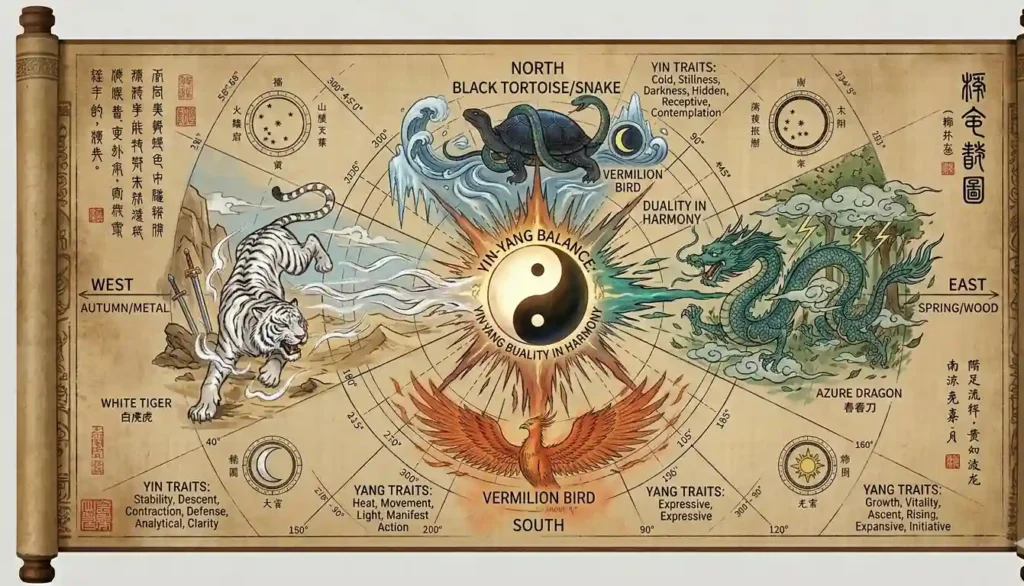
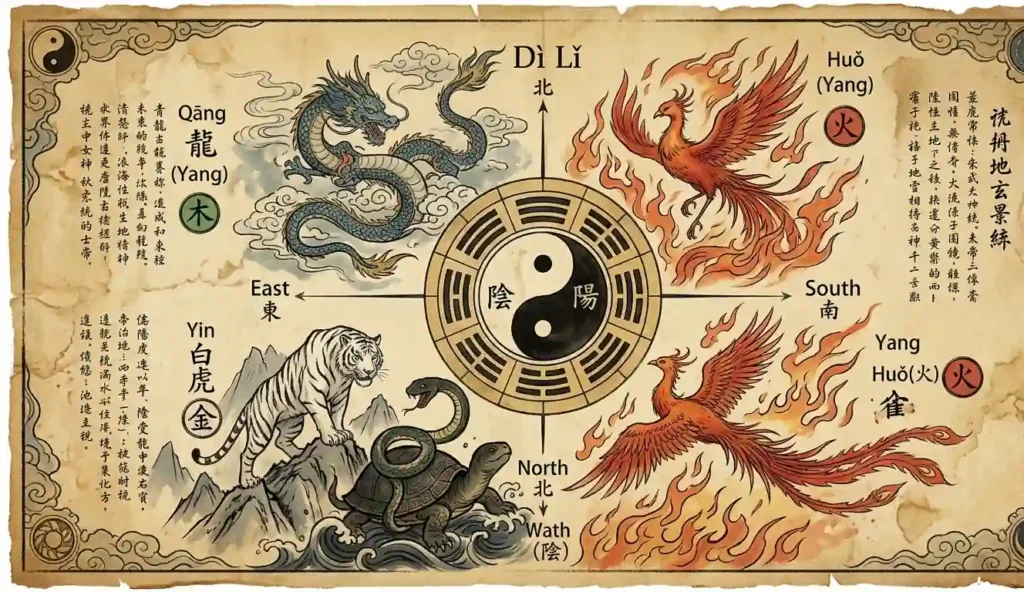
- Greater Yang (Taiyang) is yang-yang – maximum yang energy, the fullest outward expression. Its season is summer. Its direction is south. Its guardian beast is the Vermilion Bird, blazing with fire at the peak of its expression.
- Lesser Yin (Shaoyin) is yin over yang – yang energy beginning to be overtaken by yin. Its season is autumn. Its direction is west. Its guardian beast is the White Tiger, whose precision and contraction reflect the energy of yang drawing inward.
- Lesser Yang (Shaoyang) is yang over yin – yin energy, beginning to be overtaken by yang. Its season is spring. Its direction is east. Its guardian beast is the Azure Dragon, whose rising vital force reflects the first emergence of yang from winter’s yin.
- Greater Yin (Taiyin) is yin-yin – maximum yin energy, the fullest inward contraction. Its season is winter. Its direction is north. Its guardian beast is the Black Tortoise, deep and still at the bottom of yin’s cycle.
The Yin-Yang Character of Each Beast
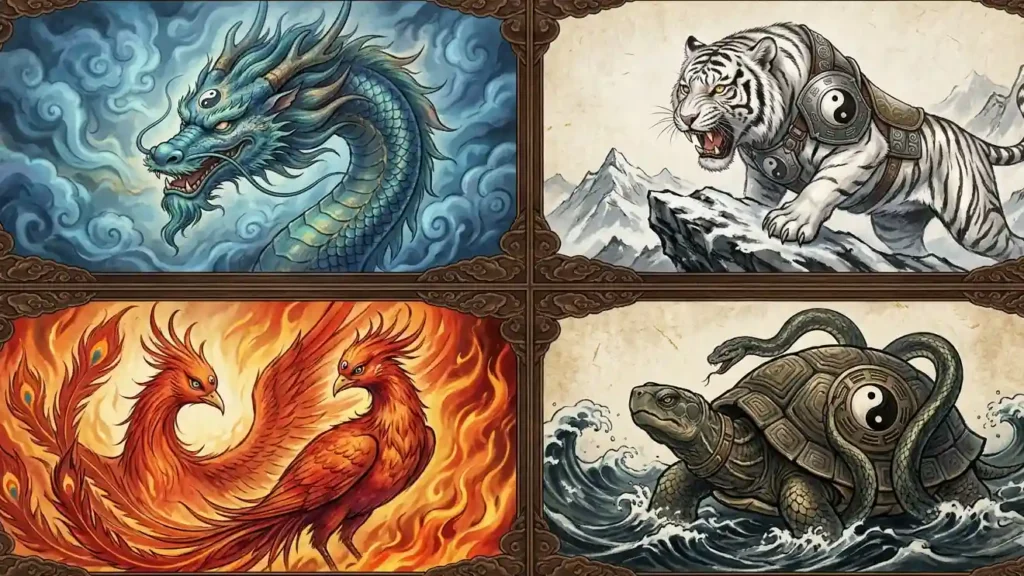
Let me make this explicit for each guardian:
Azure Dragon: Lesser Yang (Yang over Yin)
- Yang is emerging from yin, but hasn’t reached its peak
- This is spring: the vital force rising through the remnants of winter
- The dragon’s characteristic quality, upward movement, new growth, rising vital force is precisely the character of yang emerging from yin
- The Azure Dragon isn’t just a yang creature. It’s yin-transforming-into-yang, which is why it governs spring rather than summer
Vermilion Bird: Greater Yang (Yang over Yang)
- Both lines are yang – this is yang at absolute maximum
- This is summer: the blazing peak of outward expression
- The Vermilion Bird’s blazing fire character is the cosmological expression of yang at its fullest, the moment before yin begins its return
- What I find philosophically precise about this is the implied seed of yin at maximum yang. The summer solstice is when the return toward winter begins, which is the taijitu principle made temporal
Want to learn more about the Vermillion Bird? Read my detailed post here
White Tiger: Lesser Yin (Yin over Yang)
- Yin is emerging from yang but hasn’t reached its peak
- This is autumn: yang contracting, yin rising, the harvest and the gathering
- The tiger’s precision, its Metal-element contraction toward essence, and its white color of completion are all determined by yin emerging from yang
- The White Tiger governs the transition from yang to yin, which is why its Metal element quality is refinement rather than destruction
Black Tortoise: Greater Yin (Yin over Yin)
- Both lines are yin – this is yin at absolute maximum
- This is winter: the deep inward stillness, the point of maximum contraction before yang begins its return
- The Black Tortoise’s patient depth, its Water-element yielding power, its midnight and northern darkness all expressions of yin at its fullest
- And again, the philosophical precision: at maximum yin, the seed of yang begins to stir. Winter contains the impulse of spring
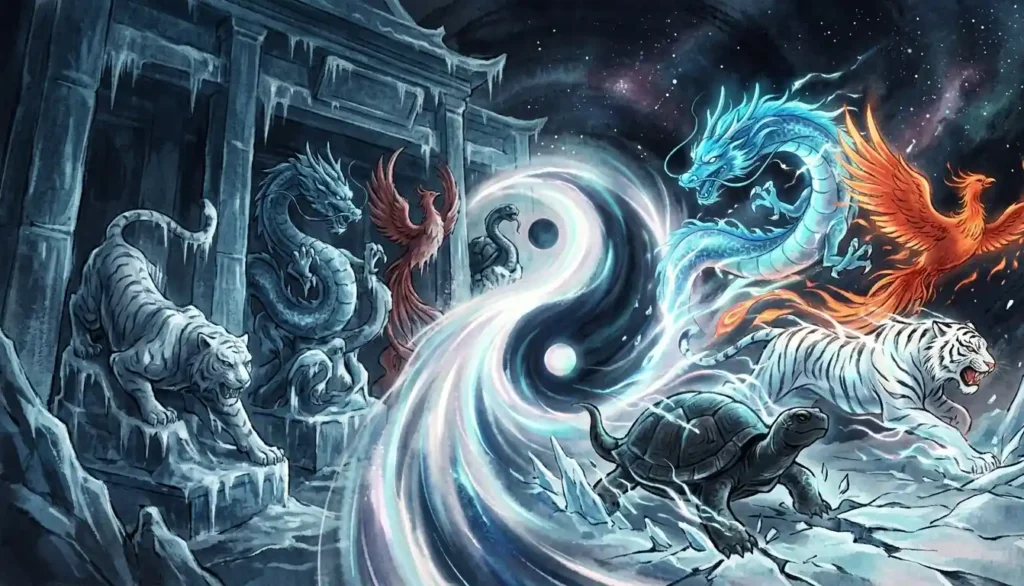
The Dynamic Principle: Without Yin Yang, The Symbols Are Dead
Here’s the argument I find most compelling, and it took me the longest to articulate clearly.
If the Four Symbols were just four categories, four labels applied to four compass directions, they’d be a static classification system. Useful for organizing things, but not philosophically deep.
What makes them a living cosmological system is the yin-yang cycling principle that underlies them.
Because the Four Symbols emerge from yin and yang in specific combinations, they inherit yin yang’s fundamental character: they are always in motion relative to each other.
Lesser Yang transforms into Greater Yang (spring becomes summer). Greater Yang transforms into Lesser Yin (summer becomes autumn). Lesser Yin transforms into Greater Yin (autumn becomes winter). Greater Yin transforms back into Lesser Yang (winter becomes spring).
This is the seasonal cycle. And it’s identical to the yin-yang cycling principle expressed through four stages.
Without Yin Yang
- The Azure Dragon is just “the east”
- The Vermilion Bird is just “the south”
- The White Tiger is just “the west”
- The Black Tortoise is just “the north”
With yin yang, the four guardians are phases in a living cycle of transformation, each one containing the seed of the next, each one arising from what precedes it. The dragon doesn’t just stand in the east. It embodies the specific phase of yin-yang transformation that spring represents, and that means it’s always in a dynamic relationship with the other three guardians.
The Seasonal Cycle as Proof
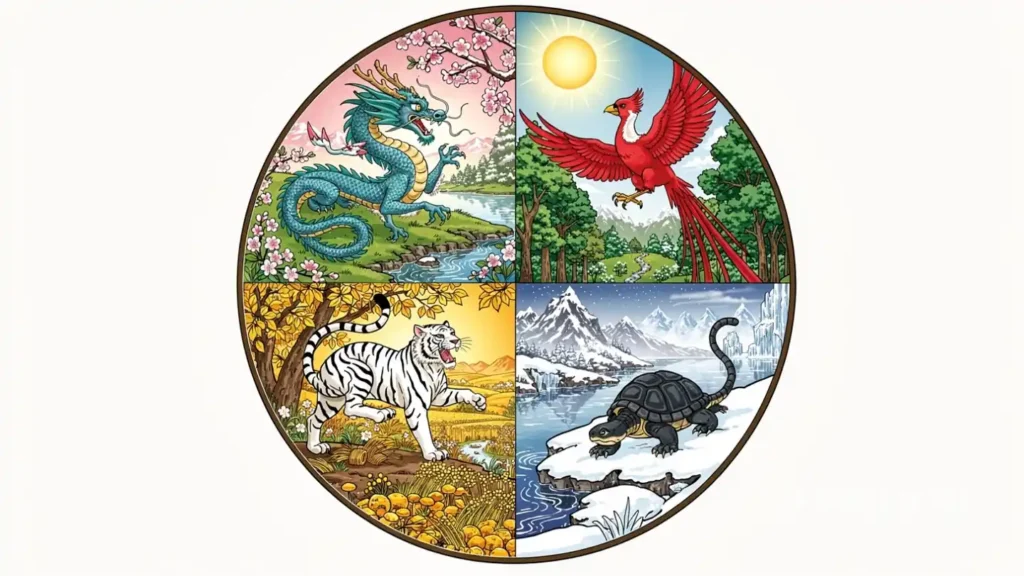
I want to make this concrete with an example that I think is the most elegant proof of the yin-yang dependency.
The Chinese seasonal cycle understood through the Four Symbols goes like this:
- Winter (Black Tortoise, Greater Yin): Yin at maximum. Everything contracted to its most inward point. But within maximum yin, as the taijitu shows us with its small yang circle, the seed of yang is present. The return begins.
- Spring (Azure Dragon, Lesser Yang): Yang is emerging. Yin is still present, but yang is now ascending. This is why spring isn’t simply “yang”. It’s the complex phase where both forces are active, yin retreating as yang advances.
- Summer (Vermilion Bird, Greater Yang): Yang at maximum. The peak of outward expression. But at yang’s peak, the seed of yin is present. The solstice turns.
- Autumn (White Tiger, Lesser Yin): Yin is emerging. Yang is still present, but yin is now ascending. The harvest, the contraction, the precision of Metal, all the expression of this specific dynamic phase.
What you’re reading there isn’t four separate seasons described by four separate beasts. It’s the yin-yang cycling principle, the fundamental motion of the taijitu, expressed as four named phases with four guardian presences.
Take yin-yang out of that description, and the seasonal cycle becomes four arbitrary boxes with animal mascots. Keep yin yang in it, and you have a coherent cosmological description of how time moves through a living cycle of complementary forces.
Why This Matters for Understanding Chinese Cosmology
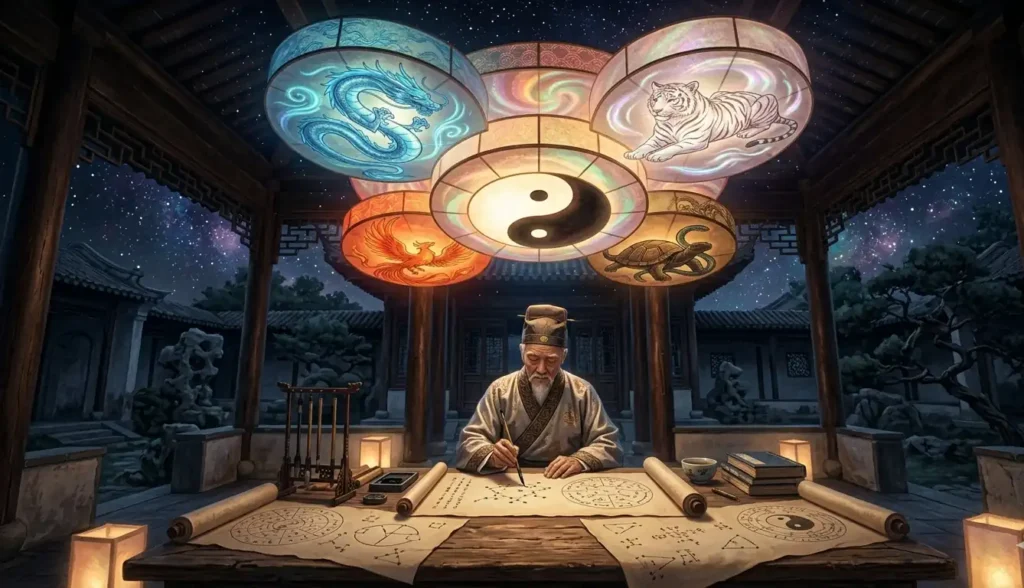
I want to be honest about why I find this argument worth making, beyond the philosophical elegance.
Most people who encounter Chinese cosmology pick up the symbols in isolation, the yin yang symbol here, the Four Holy Beasts there, the Five Elements somewhere else, and hold them as separate, interesting things that are vaguely related.
The yin yang → Four Symbols dependency is the architectural principle that shows how these systems connect. Once you understand it, you see that:
The Four Symbols are not four separate inventions. They’re four expressions of one underlying binary dynamic.
The guardian beasts are not arbitrary animal symbols. Each one’s character, the dragon’s vitality, the bird’s blazing peak, the tiger’s precision, the tortoise’s depth, is the philosophical character of its specific yin-yang composition expressed as a living being.
The seasonal cycle is not a metaphor. It’s yin yang’s fundamental motion expressed through time, with four guardian presences marking the four phases of the cycle.
And more broadly: the Chinese cosmological tradition isn’t a collection of separate interesting ideas. It’s a coherent system built on a small number of generative principles, primarily yin yang, that produce the rest of the framework through consistent logical expansion.
That coherence is what has made me appreciate most about this tradition. It rewards serious engagement in a way that very few symbolic systems do.
Frequently Asked Questions
What does “Si Xiang” literally mean?
Si Xiang (四象) literally means “four images” or “four symbols.” The word xiang means image, symbol, or phenomenon, something that makes an invisible principle visible. The Four Symbols are, in the most literal sense, the four visible images produced by the yin-yang binary. The name encodes the yin-yang dependency directly.
Is the Tai Ji, Two Principles, Four Symbols sequence actually in the I Ching?
Yes, it’s in the Xici (Great Treatise), one of the ten commentaries traditionally appended to the I Ching. The specific passage “Tai Ji produces Liangyi, Liangyi produces Si Xiang, Si Xiang produces Bagua” is one of the most cited passages in classical Chinese cosmological philosophy. It’s the explicit ancient statement of the dependency this article describes.
Do the Four Symbols appear in the I Ching itself?
In their abstract form as the four yin-yang combinations, yes, they’re the building blocks between the two principles and the eight trigrams. In their guardian beast form, the I Ching doesn’t name them specifically. The guardian beast associations developed in parallel with I Ching cosmology through Chinese astronomical and cosmological tradition rather than within the I Ching texts themselves.
Can you understand the Four Holy Beasts without knowing yin yang?
You can learn the names, the directions, and the basic attributes without understanding yin yang. But you’ll be missing the philosophical architecture that explains why each beast has the character it does, why the tortoise is deep and still, why the dragon rises, why the bird blazes, why the tiger contracts. Those characters are determined by the beasts’ yin-yang compositions. Without that layer, the guardian beasts are four impressive animals. With it, they’re a philosophical description of the universe’s fundamental motion.
How does this connect to the Eight Trigrams and I Ching divination?
The Four Symbols are the intermediate step between yin-yang and the Eight Trigrams in the cosmological ladder. Each of the four yin-yang combinations gets extended with a third line, either yin or broken, producing eight possible three-line combinations (trigrams). Each trigram has its own rich associations and forms the basis of I Ching divination. The Four Symbols are where the system transitions from the abstract binary of yin-yang into the more complex symbolic vocabulary of the trigrams.
Final Thoughts
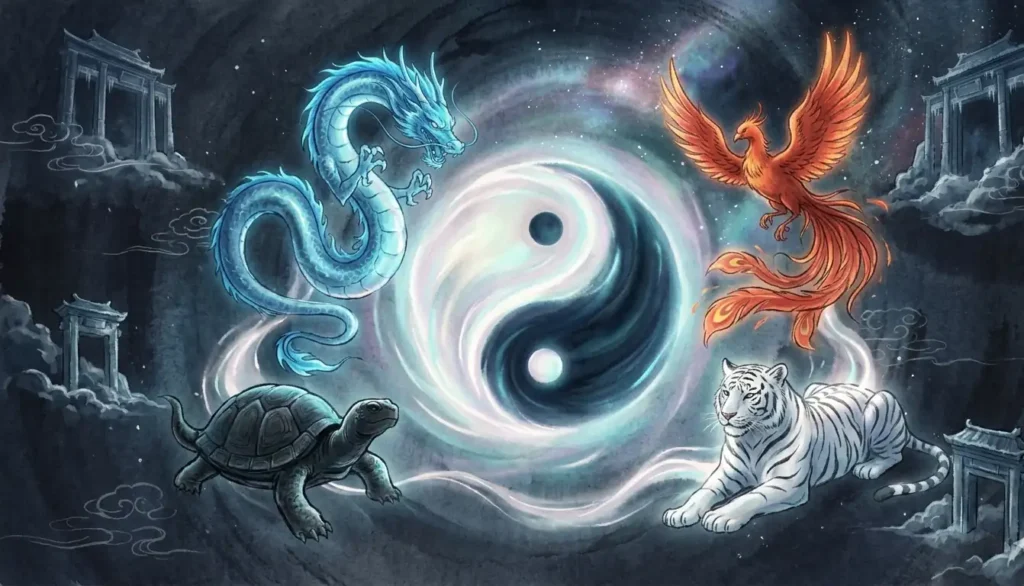
The Yin Yang → Four Symbols dependency remains one of my favorite pieces of philosophical architecture in any tradition.
It’s elegant in the mathematical sense: a simple binary generates four states through exhaustive combination. It’s elegant in the philosophical sense: those four states inherit yin yang’s cycling character, making the Four Symbols a living temporal system rather than a static classification. And it’s elegant in the mythological sense: the four guardian beasts aren’t decorative, they’re the philosophical characters of the four yin-yang phases made visible as living beings.
The argument in the title is meant literally. The Four Symbols cannot exist without yin-yang because they are yin-yang. Yin Yang extended through one step of binary combination, given four faces and four guardian presences and four seasons and four compass directions and four elemental characters.
What I hope you take away from this is not just the specific philosophical connection but the broader point it illustrates. Chinese cosmology isn’t a collection of separate interesting symbols. It’s a coherent generative system that produces its complexity from a small number of deeply understood principles. Yin yang is the most fundamental of those principles. The Four Symbols are one of its most beautiful expressions.
Understanding the connection between them isn’t just intellectually satisfying, though it genuinely is. It’s the key to understanding how the whole Chinese cosmological framework works.
Related Articles
- The Five Elements Behind Every Holy Beast [Chinese Myth Map]
- Is Yin Yang Demonic? The Truth You Don’t Know
- Are the Four Heavenly Kings & Four Holy Beasts the Same?
- Ba Gua: Eight Trigrams, Meaning & Sacred Origins
- 7 Misconceptions About Yin Yang You Probably Believe
- Yin Yang and the Five Elements: Why Neither Works Alone
- Yin Yang, Five Elements & Four Symbols: China’s Complete Cosmos
References
- Stanford Encyclopedia of Philosophy – Daoism
- Joseph Needham, Science and Civilisation in China
- Dao De Jing (Tao Te Ching)
- Zhuangzi
- Daoism and Chinese Culture – Livia Kohn
- Lüshi Chunqiu (The Annals of Lü Buwei)
- Huainanzi
- Yin-Yang and the Nature of Correlative Thinking – Angus Charles Graham
- Lewis, Mark Edward. The Construction of Space in Early China.
- Huangdi Neijing
- Yinyang: The Way of Heaven and Earth in Chinese Thought and Culture – Robin Wang
- Shanhaijing (Classic of Mountains and Seas).
- Book of Changes: Yi Jing – Chinese Text Project