
 By
By Quick Takeaways:
- Xianxia and Isekai are not equivalent categories. Xianxia is a genre, isekai is a narrative device, and understanding this distinction resolves most of the confusion between them
- Xianxia is Chinese fantasy fiction centred on qi cultivation, spiritual advancement, and the pursuit of immortality, rooted in Daoist philosophy and Chinese cultural tradition
- Isekai is a Japanese term for stories where a protagonist is transported, reincarnated, or summoned into another world it is a plot mechanism, not a genre with a fixed power system or cultural framework
- They overlap in one significant area: Chinese transmigration and reincarnation xianxia novels use an isekai-style narrative device inside a xianxia genre framework. This is the specific category that causes the most confusion
- Most people who think they are comparing two equivalent genres are actually comparing a genre to a narrative device, which is why the comparison never quite resolves
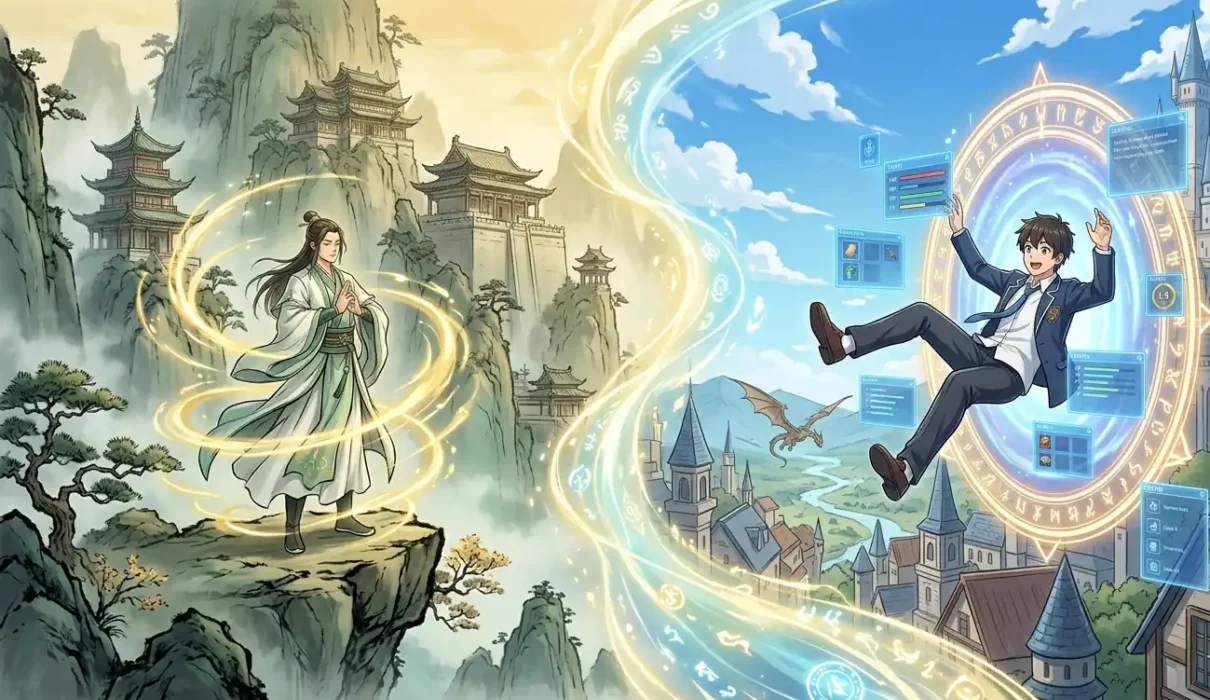
When I started reading cultivation fiction seriously, isekai was just beginning its rise to global popularity as a recognizable category. For the first few years of following both traditions, I treated them as parallel tracks in East Asian web fiction Chinese cultivation novels over here, Japanese reincarnation fantasy over there, occasionally overlapping.
10 plus years later, I understand them well enough to know that the comparison most readers try to make between them is built on a category error, and that the category error is genuinely interesting once you see it.
Xianxia and isekai are not the same kind of thing. Once you understand what each one actually is, the relationship between them becomes much clearer and much more useful for deciding what to read.
The Fundamental Distinction: Genre Versus Narrative Device
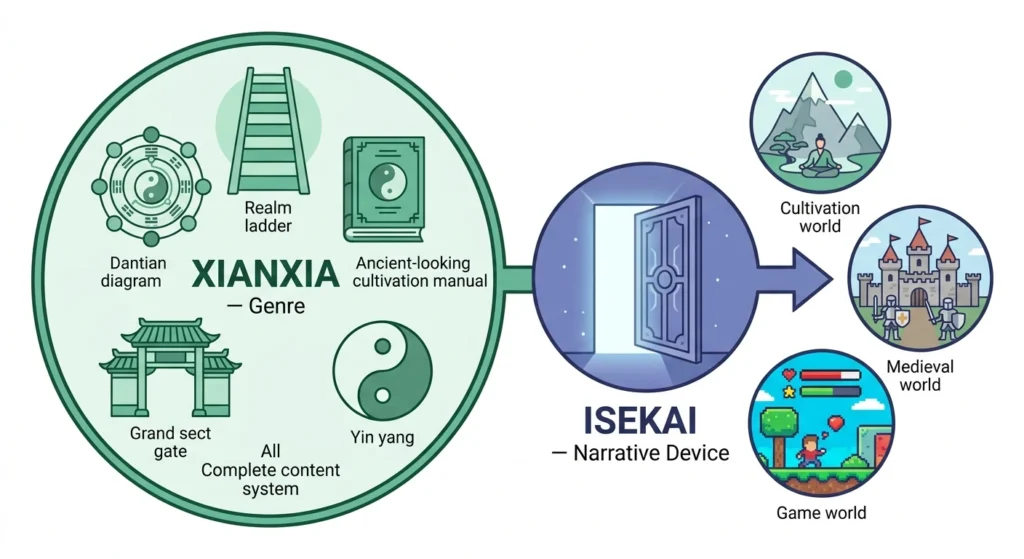
Here is the core insight that most comparisons between xianxia and isekai miss, and it is the one worth spending a moment on before anything else.
Xianxia is a genre.
- It has a fixed setting type – cultivation worlds built on Chinese cosmological tradition,
- A fixed power system – qi cultivation, dantian, meridians, realm ladders),
- A fixed philosophical framework – Daoist internal alchemy, the Dao, spiritual transformation,
- A fixed cultural origin – Chinese web literature
A xianxia novel is defined by all of these things together, not by any single feature.
Want to read the best cultivation novels? Check out my list of top Xianxia novels here
Isekai is a narrative device. It describes a specific story mechanism, a protagonist who is transported, reincarnated, or summoned from their home world into another world. Isekai does not specify what the other world is, what power system it uses, what cultural framework underlies it, or what the protagonist does once they arrive. It is a plot mechanism, not a genre.
The difference matters because it means you cannot directly compare them as though they are equivalent categories. Asking “xianxia or isekai?” is a bit like asking “mystery or flashback?” One is a genre. The other is a structural technique that can appear inside any genre.
This does not mean the comparison is useless. It means the comparison needs to be framed correctly to be useful. What most people are actually asking when they compare xianxia and isekai is one of the following:
- What is the difference between Chinese and Japanese web fantasy fiction?
- What is the difference between cultivation-based power systems and game-system-based power systems?
- What is the difference between staying-in-the-same-world xianxia and travel-to-another-world fantasy?
All three are real questions with real answers. The xianxia vs isekai framing collapses them together, which is why the comparison tends to get muddy. This article separates them.
What Xianxia Actually Is
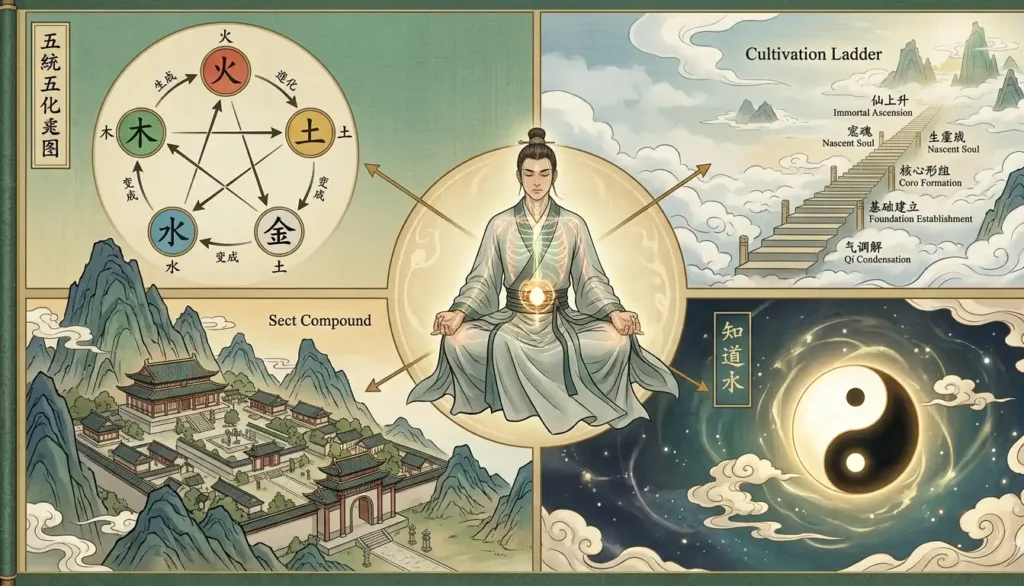
Xianxia (仙侠, literally “immortal hero”) is a genre of Chinese fantasy fiction in which the protagonist advances in power through a system of spiritual cultivation rooted in Daoist internal alchemy, traditional Chinese medicine, and Chinese cosmological tradition.
The genre’s defining features are specific and consistent across series:
The cultivation system. Qi is absorbed from the environment, stored in the dantian, refined through practice, and circulated through the body’s meridian network. This produces physical and spiritual transformation across a series of named cultivation realms from early stages like Qi Condensation through Core Formation, Nascent Soul, and ascending immortal tiers. The power system is rooted in actual Daoist philosophy and TCM concepts that have existed for centuries.
The Dao. At the genre’s philosophical core, cultivation advancement is not purely mechanical. It requires genuine comprehension of the principles underlying reality. You cannot simply grind your way to the next realm. You need insight. This philosophical dimension distinguishes xianxia from power fantasy that uses similar-looking mechanics without the philosophical scaffolding.
The cultivation world. The protagonist inhabits a world built around cultivation with sects, ancient legacies, spirit stones, medicinal pills, and a social hierarchy determined by cultivation realm. This is not a world that happened to have cultivation. It is a world whose entire civilization is organized around cultivation.
The cultural framework. Xianxia is specifically Chinese. Its cosmology draws on Wu Xing (five elements), yin yang, the four guardian beasts, traditional Chinese medical theory, Daoist internal alchemy, and Chinese mythological tradition. This cultural specificity is not incidental, it is part of what gives the genre its depth.
The long game. Xianxia operates on vast timescales. Cultivation toward immortality is measured in centuries for advanced practitioners. The genre is comfortable with stories that unfold across thousands of chapters and fictional decades.
What xianxia is not, crucially, is defined by where the protagonist started. A xianxia novel’s protagonist might be native to the cultivation world, might have been reincarnated into it from another life, or might have transmigrated from a modern world. The protagonist’s origin does not define the genre. The cultivation system, the cultural framework, and the philosophical dimension are what define it.
What Isekai Actually Is
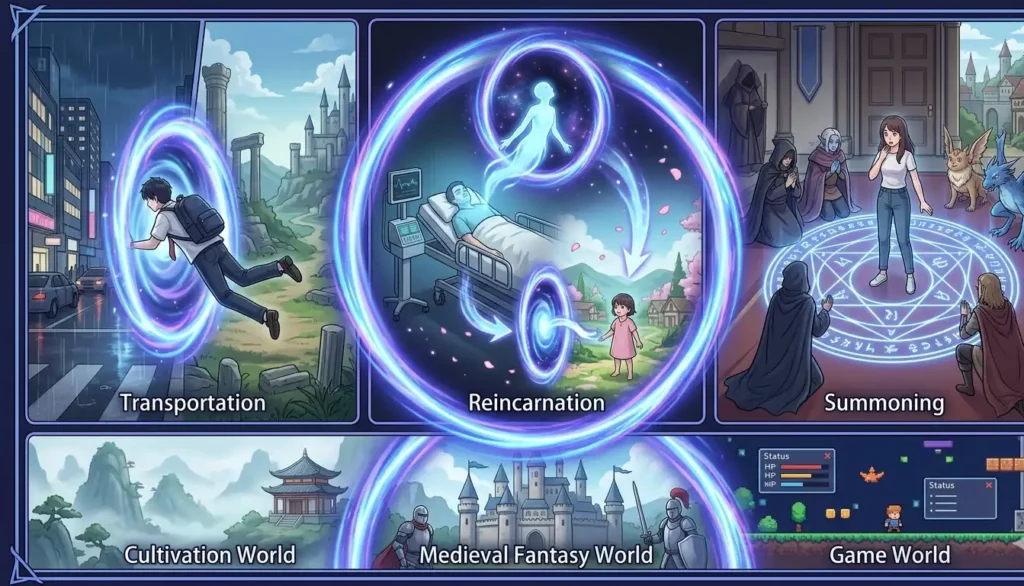
Isekai (異世界, literally “different world”) is a Japanese term for stories in which a protagonist is transported to, reincarnated in, or summoned into a world different from their original one.
The narrative device has a few standard variants:
Transportation. The protagonist is physically moved from their home world to another world through a portal, a truck kun, a magical accident, or an unexplained transition. They arrive as themselves, with their memories and personality intact.
Reincarnation. The protagonist dies in their home world and is reborn in another, typically retaining memories of their previous life. This is one of the most common variants in both Japanese light novels and Chinese web fiction.
Summoning. The protagonist is deliberately called to another world by its inhabitants, often as a hero destined to save the realm from a demon lord or equivalent threat.
System grant. The protagonist arrives in another world (or their own world transforms) and receives a game-like status system that quantifies their abilities.
What isekai does not specify is what the other world looks like, what power system governs it, what the protagonist does there, or what cultural tradition underlies the world’s construction. An isekai story can feature:
- A game-like JRPG world with levels and stats
- A Western medieval fantasy world with magic systems
- A Chinese cultivation world with qi and realms
- A world of magic academies and noble politics
- A world of slime monsters and goblin villages
The isekai label tells you the protagonist came from somewhere else. It says nothing about where they went or what they did when they got there.
This is why isekai is better understood as a narrative device than as a genre. It is a setup, not a content specification.
The Five Real Differences
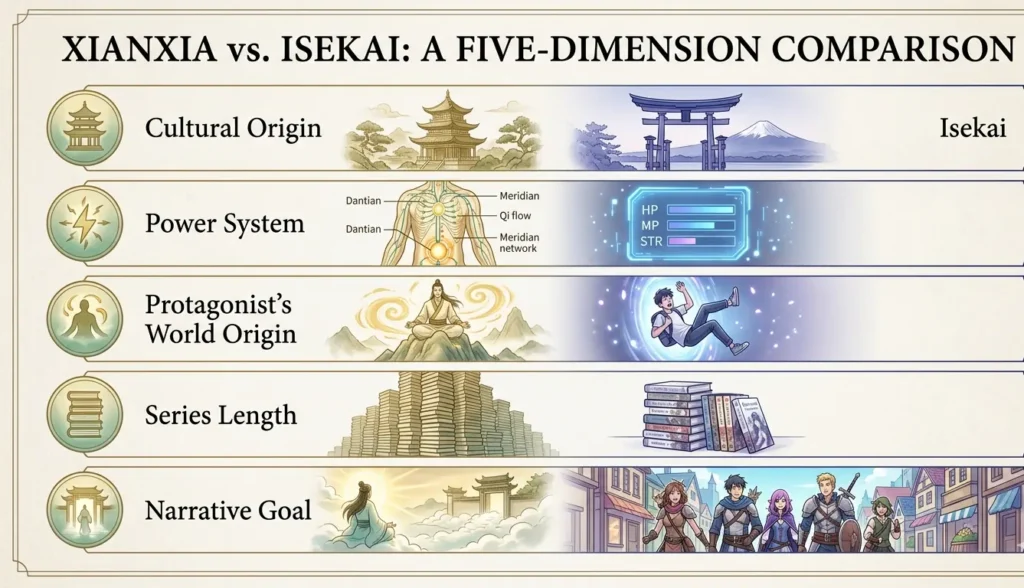
Now that the categories are clear, here are the five genuine differences between what people typically mean when they compare xianxia and isekai:
1. Cultural origin and framework
Xianxia is Chinese, drawing on Daoist philosophy, traditional Chinese medicine, Chinese cosmological tradition, and Chinese literary history. Its cultivation system is rooted in an actual cultural practice that has existed for centuries.
Isekai as a dominant form is Japanese, emerging from Japanese light novel and manga culture in the early 2000s and accelerating through the 2010s. The worlds protagonists travel to in most popular isekai are constructed from JRPG aesthetics, Western medieval fantasy conventions, and Japanese cultural assumptions about heroism and social dynamics.
The cultural frameworks produce very different reading experiences. Xianxia has philosophical depth that comes from drawing on living traditions. Mainstream isekai often has a more game-adjacent, aesthetically eclectic sensibility.
2. Power System Architecture
Xianxia uses cultivation systems rooted in philosophy, qi, dantian, meridians, dao comprehension, and realm ladders that represent qualitative transformations of the practitioner’s nature.
Most popular isekai uses game-adjacent systems, levels, stats, skills, classes, and status screens that make power measurable and legible in the way a video game interface does. This is not universal (some isekai use unique original magic systems), but it is the dominant pattern.
This difference in power system architecture is often what readers are actually pointing to when they feel xianxia and isekai are “different in atmosphere.” The philosophical cultivation system produces different dramatic moments than the game-stat system.
3. The Protagonist’s Relationship to the World
In most xianxia, the protagonist is native to the cultivation world or was reincarnated into it as an infant and grew up within it. Their relationship to the world is one of belonging. Even when they are an underdog, they understand the world’s rules, they have relationships within it, and they have roots. The story is about rising within a world they are part of.
In isekai, the protagonist’s defining characteristic is being an outsider. Their knowledge of their home world is a source of advantage or perspective. The story is often about adapting to a world they arrived in from outside, using outsider knowledge to navigate or transform it.
This is a genuine structural difference that produces different narrative dynamics, insider-underdog versus outsider-adapter.
4. Series Length and Pacing
Xianxia runs long. Very long. Thousands of chapters, multiple years of serialisation, narrative arcs that span vast fictional time. The genre is comfortable with the slow accumulation of power and understanding across an enormous canvas.
Isekai light novels and manga tend toward shorter, more episodic structures, with light novel series often running ten to thirty volumes and manga adaptations compressing the narrative further. The pacing is faster, the reward loops are shorter, and the reader commitment is typically lower.
This is a practical difference that matters for choosing what to read based on available time and patience.
5. Narrative Goal
Xianxia is fundamentally about the transformation the protagonist cultivates toward a higher state of being, ultimately pursuing immortality as both a literal goal and a philosophical aspiration. The journey is the story, and the journey takes the shape of genuine self-transformation.
Most isekai is fundamentally about adaptation and competence, the protagonist figuring out the rules of their new world, using their unique advantages to thrive, building a life, or completing a mission in an unfamiliar environment. The story is often about being good at things and the satisfaction that produces.
Both are psychologically compelling. They engage different aspects of reader satisfaction.
Where They Overlap
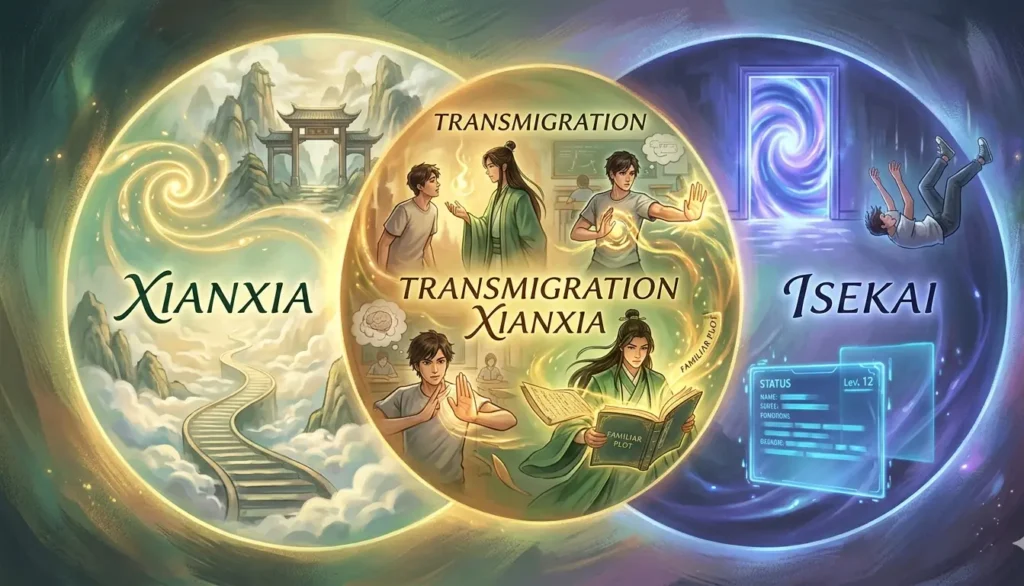
The two traditions overlap in one specific and important area: transmigration xianxia and reincarnation xianxia Chinese cultivation novels, in which the protagonist reincarnates or transmigrates into the cultivation world from a previous life or a modern setting.
This category is enormous. It includes some of the most popular xianxia and danmei novels in the genre:
- Tales of Demons and Gods – Nie Li reincarnates into his own past with future knowledge
- Battle Through the Heavens – Xiao Yan transmigrates into the new world of Dou Qi in a cultivation novel
- Dozens of other major series where the protagonist arrives in the cultivation world from a previous existence
These novels use the isekai narrative device, a character who comes from somewhere else and carries knowledge or experience that shapes their approach to the new world, inside a xianxia genre framework. The cultivation system is xianxia. The power philosophy is xianxia. The cultural context is xianxia. The narrative setup is isekai-adjacent.
This overlap is the specific category that causes the most confusion between the two terms, and it is worth naming clearly: transmigration xianxia is xianxia that uses an isekai-style device, not isekai that uses xianxia mechanics. The genre is determined by the content of the world, not the mechanism by which the protagonist arrived in it.
Read: What Is Fantasy? Do Cultivation Novels Actually Qualify?
The Transmigration Xianxia: The Hybrid That Confuses Everyone
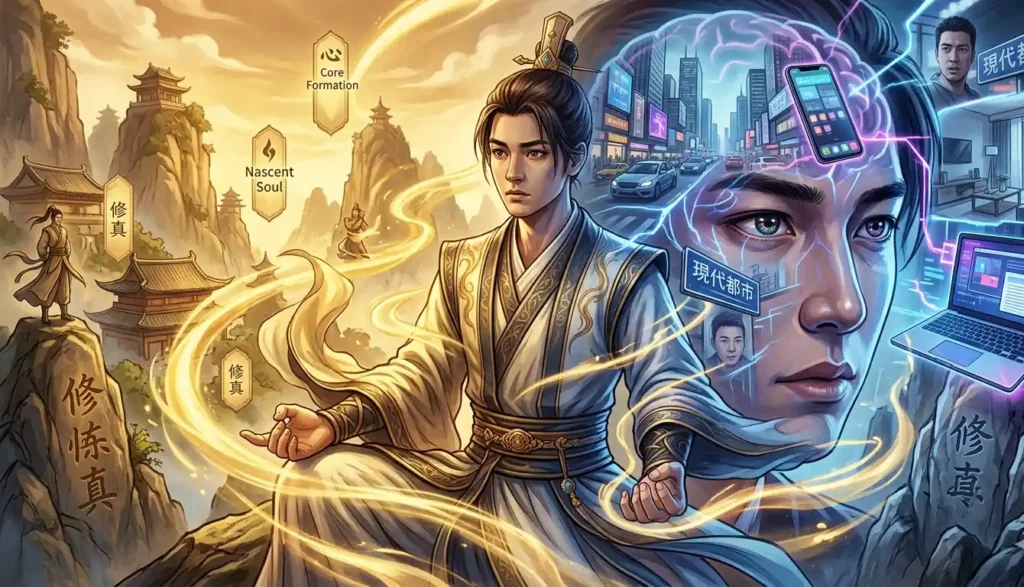
The transmigration and reincarnation subgenre of xianxia deserves its own section because it genuinely sits at the intersection of both traditions and has its own distinct character.
A modern person reincarnating into a cultivation world brings a specific narrative dynamic that traditional xianxia does not have: the gap between what the protagonist knows and what the world around them expects. A protagonist who grew up in a modern world and finds themselves in a cultivation world where sect elders have the power to end lives casually, where women may have limited rights, where power is everything and mercy is weakness, has a specific response to that world’s values that a native protagonist does not.
This cultural friction is often one of transmigration xianxia’s most interesting narrative elements. The outsider perspective of what a person formed by modern values does when dropped into a pre-modern cultivation world generates story possibilities that straight xianxia cannot access. When it is handled thoughtfully, it produces some of the genre’s most interesting character work.
Where it is handled less carefully, it produces the worst isekai cliché in xianxia clothing: a protagonist who is simply better than everyone at everything because they carry modern knowledge, and a cultivation world that exists to be impressed by them.
The best transmigration xianxia uses the outsider perspective as a genuine source of character complexity. The protagonist’s modern formation creates real friction, real ethical difficulty, and real questions about what it means to adapt to a world whose values differ fundamentally from the one that shaped you.
Read: 12 Best Dragon Books of 2026 [From the Hobbit to Seraphina]
Which Should You Read First?
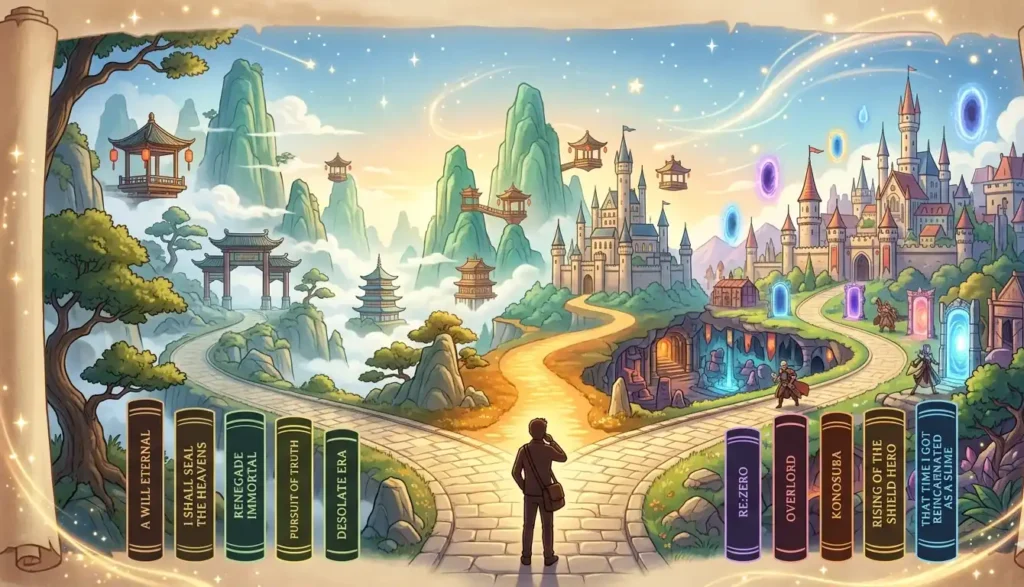
If you have read neither and want to start somewhere:
Start with xianxia if you want:
- A deep, philosophically grounded power system with real cultural roots
- Long-form narrative investment with enormous payoffs
- A world whose entire civilisation is built around the cultivation framework
- The specific kind of satisfaction that comes from watching someone genuinely transform through understanding rather than simply accumulating power
Start with isekai if you want:
- Faster pacing and shorter overall commitment
- A protagonist whose outsider perspective is the story’s central dynamic
- More variety in world type and power system
- The specific pleasure of watching a character adapt and thrive in an unfamiliar environment
Start with transmigration xianxia if you want both: Tales of Demons and Gods or Battle Through the Heavens both provide accessible entry points that combine the isekai setup with xianxia content.
My personal starting recommendations:
For traditional xianxia: Beware of Chicken for accessibility, A Will Eternal for immediate enjoyment, Lord of the Mysteries for literary quality.
For isekai: Re:Zero for emotional depth, That Time I Got Reincarnated as a Slime for warm world-building, The Rising of the Shield Hero for underdog narrative.
For the hybrid space: Soul Land sits comfortably between both traditions and is one of the most enjoyable entry points to either.
Comparison Table
| Dimension | Xianxia | Isekai |
|---|---|---|
| Category type | Genre | Narrative device |
| Cultural origin | Chinese | Japanese (dominant form) |
| Power system | Qi cultivation, dao, realm ladders | Variable – often game-stat based |
| Protagonist’s world origin | Usually native or reincarnated as infant | Always outsider from another world |
| Philosophical depth | High – rooted in Daoist tradition | Variable – often game-adjacent |
| Typical series length | Very long (thousands of chapters) | Shorter (light novel volumes or manga) |
| Core narrative drive | Transformation toward immortality | Adaptation and competence in new world |
| Cultural specificity | High – specifically Chinese | Moderate – often generic medieval Western |
| Overlap zone | Transmigration and reincarnation xianxia | Isekai set in cultivation worlds |
| Best examples | ISSTH, ARMJTOI, Lord of the Mysteries | Re:Zero, Mushoku Tensei, Shield Hero |
Frequently Asked Questions
Is isekai Chinese or Japanese?
Although isekai is a Japanese term rooted in anime and light novel culture, Chinese web fiction developed its own massive transmigration and reincarnation tradition using similar narrative devices within Chinese fantasy frameworks. Both evolved largely in parallel, with Chinese stories also responding to the popularity of Japanese isekai.
Are transmigration xianxia novels considered isekai?
In Japanese and Western fandom, isekai usually refers to Japanese or Japanese inspired stories. Chinese transmigration novels are generally classified under Chinese web fiction genres like xianxia, xuanhuan, and danmei, even when they use the same other world premise. Isekai describes a Japanese cultural genre, while transmigration is a broader narrative device shared across traditions.
What is the difference between transmigration and reincarnation in xianxia?
Transmigration involves a protagonist whose soul or consciousness enters another person’s body in a different world, effectively taking over an existing life. Reincarnation involves a protagonist dying and being reborn as a new person while retaining memories of a past life. Both are major tropes in Chinese web fiction.
Which genre is more popular globally?
Japanese style isekai has broader global mainstream recognition, largely due to anime adaptations distributed through international streaming platforms. Xianxia also has a massive global audience, though it remains more concentrated within Asian markets and web fiction communities. That gap is gradually shrinking as xianxia translations, donghua, and manhua adaptations reach wider Western audiences.
Can a story be both xianxia and isekai?
Yes, transmigration xianxia can be considered both. A story where a modern protagonist enters a cultivation world filled with qi, dantian, and cultivation realms is xianxia in genre and isekai adjacent in narrative structure. Most fandom classifications prioritise genre over mechanism, so these stories are usually labelled xianxia or transmigration xianxia rather than isekai.
What should I read if I love isekai but have never tried xianxia?
Start with Battle Through the Heavens. Its transmigration premise feels familiar to isekai readers while introducing a full xianxia cultivation world. Tales of Demons and Gods is another strong entry point, using reincarnation to ease readers into cultivation lore. From there, A Will Eternal and Beware of Chicken are excellent next steps into broader xianxia.
Final Thoughts
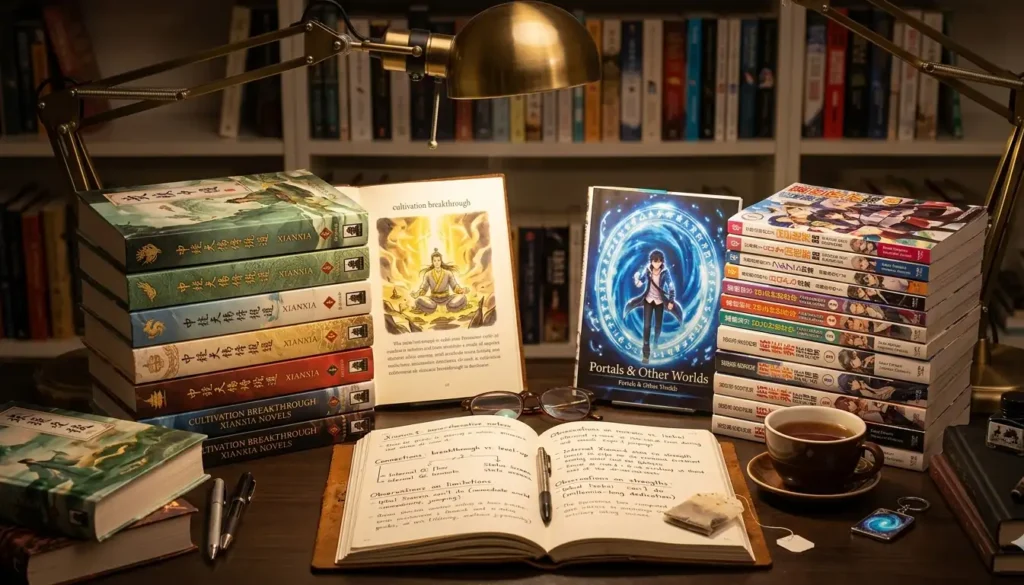
Xianxia and isekai are not competing genres in the same category. They are different kinds of things, one a genre with a fixed cultural framework and power system, the other a narrative device that appears across many genres.
Understanding that distinction does not make the comparison useless. It makes it more useful, because it lets you ask the right questions: what world do I want to inhabit, what power system do I want to follow, what kind of protagonist dynamic do I want to read, and how much time am I willing to invest?
My years of reading both traditions has given me a deep appreciation for what each does well. Isekai’s outsider-adaptation dynamic is a reliable source of story energy when handled thoughtfully. Xianxia’s philosophical cultivation framework produces a depth of reading experience that few other genre structures match when its best authors engage it seriously.
The best news is that you do not have to choose. The transmigration xianxia hybrid is an entire subgenre specifically designed for readers who want both. And the two traditions’ separate strengths are complementary enough that readers of one reliably enjoy the other when they cross over.