

 By
By Quick Takeaways:
- Yin yang is a pre-theistic Chinese cosmological philosophy about complementary natural forces. It has no deity, no evil force, no devil, and no supernatural agency of any kind
- Is Yin Yang demonic? comes from specific theological frameworks, primarily certain strands of conservative Christianity, that classify any non-Christian spiritual symbol as potentially occult
- Whether yin yang is problematic for a specific believer depends entirely on their own theological tradition’s framework. This is a religious question, not a factual one about what Yin Yang is
- The yin-yang symbol has no connection to Satan, demons, or any entity in Abrahamic theology. These categories do not exist in the Daoist philosophical framework that produced it
- Studying mythology and philosophy produce one consistent conclusion: the “demonic” classification of yin yang reflects a misunderstanding of what yin yang actually is
The question deserves a straight answer, so here it is upfront: No, yin-yang is not demonic. It is a pre-theistic cosmological philosophy describing how complementary natural forces interact to produce all phenomena in the universe. It has no devil, no demon, no evil entity, and no supernatural agency of any kind within its own framework.
That is the factual answer. The longer answer, which this article provides, addresses where the concern comes from, why it has some internal logic within specific theological frameworks, what yin yang actually contains that might reasonably concern a religious person.
I have to make one thing clear to my dear readers. I do not intend to discredit any religion or prove it wrong. In fact, I respect them. If I unknowingly hurt someone’s feelings, I apologize.
What Yin Yang Actually Is: The Philosophical Foundation
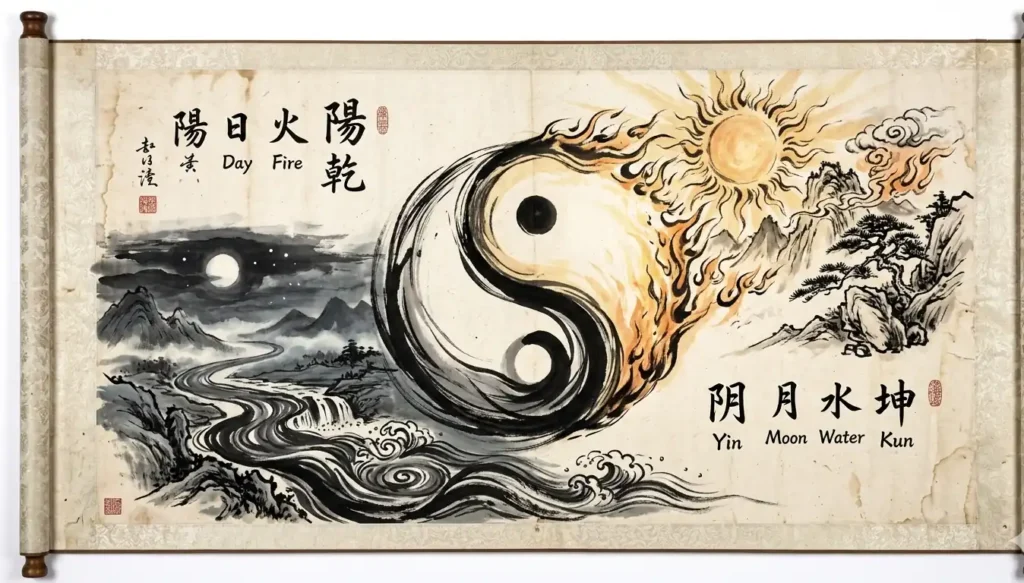
Before addressing whether yin-yang is demonic, the question of what yin-yang actually is must be answered precisely. This is where the most popular treatments fail. They either defend yin-yang superficially or attack it without understanding it.
Yin yang is a descriptive cosmological framework, not a religion, not a deity system, and not an occult practice.
The words yin and yang originally described the shaded and sunlit sides of a single hill, concrete geographical observations about light and shadow that ancient Chinese thinkers gradually formalized into a comprehensive framework for understanding how all phenomena in the natural world operate.
The framework proposes that every observable phenomenon has two complementary aspects. Activity and rest, heat and cold, expansion and contraction, light and darkness, and these aspects are not in opposition but in a dynamic, mutually generative relationship.
The philosophical framework that developed from this observation, systematised during the Warring States period (475 to 221 BCE) and integrated into Daoist thought, has several specific characteristics that are directly relevant to the “demonic” question:
It is pre-theistic. Yin-Yang philosophy developed independently of any deity framework. There is no god in yin yang. There is no devil in yin yang. There is no supernatural entity of any kind in the original yin-yang philosophical framework. It is a description of how natural forces interact, closer in character to a proto-scientific cosmological model than to a religion.
It makes no moral claims about the forces it describes. Yin is not evil, and yang is not good. Neither is good, neither is evil. Both are natural, both are necessary, both are aspects of the same reality. The darkness is not more sinful than the light. Winter is not more sinful than summer. Rest is not more sinful than activity. This is fundamentally different from frameworks that assign moral valence to darkness and light.
It has no deity to worship and no entity to invoke. Classical yin-yang philosophy requires no prayer, no ritual, no sacrifice, and no relationship with any supernatural being. It is a philosophical framework for understanding reality, not a devotional practice.
It is descriptive, not prescriptive. Yin-Yang philosophy describes how the world works. It does not command practitioners to worship anything, serve any entity, or adopt any specific moral framework.
Is Yin Yang Demonic?
The concern that yin yang is demonic comes from specific theological sources, and understanding those sources honestly is necessary to address the question properly.
The Occult Classification Framework
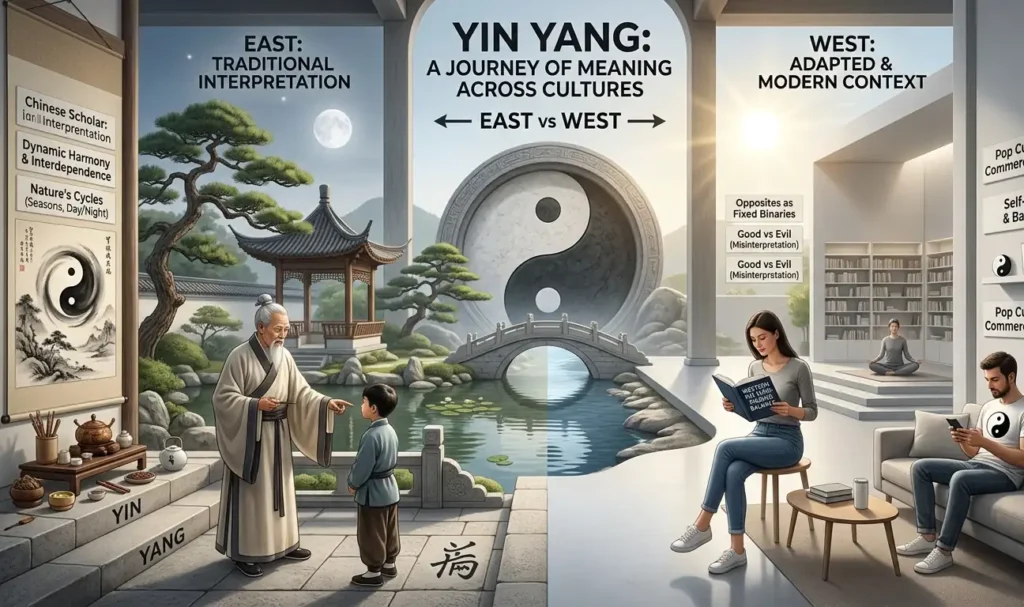
Certain strands of conservative Christianity, particularly within evangelical, charismatic, and fundamentalist traditions, operate from a theological framework that classifies spiritual or religious symbols originating outside biblical Christianity as potentially occult. The word occult literally means “hidden” and, in this theological framework, refers to any spiritual knowledge or practice that derives its authority from sources other than God as revealed in scripture.
Within this framework, the reasoning about yin-yang typically runs as follows:
- Yin yang is a spiritual or metaphysical symbol from a non-Christian tradition
- Non-Christian spiritual traditions are understood as either human invention or demonic deception
- Therefore, yin yang has either no spiritual reality (making it harmless but meaningless) or its spiritual reality is demonic in origin
- The yin yang symbol, as the representation of this non-Christian metaphysical framework, carries that spiritual association
This reasoning is internally consistent within its own framework. The problem is not that it is irrational. It follows logically from its premises. The problem is that its premises include a theological claim (that all non-Christian spiritual traditions are demonic in origin) that is itself a matter of theological dispute, not established fact.
The Specific Associations That Concern Believers

Beyond the general occult classification, several specific associations drive the demonic concern about yin yang in particular:
The symbol’s use in occult and New Age contexts. Yin yang imagery appears extensively in Western New Age, esoteric, and occult literature and practice. For Christians who associate these movements with demonic influence, the symbol’s presence in that context creates a guilt-by-association problem. The yin yang symbol used in New Age contexts is a real thing. The question is whether this secondary use changes what the symbol originally is and means.
The association with Daoism. Yin yang is associated with Daoism, which is a religious and philosophical tradition. For theological frameworks that view non-Christian religious traditions as spiritually dangerous, this association is significant regardless of the actual content of Daoist philosophy.
The darkness component. The yin yang symbol’s incorporation of darkness, the black half of the taijitu, triggers concern in theological traditions that associate darkness with evil and demonic forces. This association is natural within a theological framework shaped by the Genesis creation narrative (God separates light from darkness), the Gospel of John (God is light, in him there is no darkness), and Revelation imagery. Within that framework, any positive valuation of darkness feels suspicious.
The Specific Theological Arguments and the Specific Responses
Argument 1: Yin Yang is Eastern Spirituality, and Eastern Spirituality is Demonic
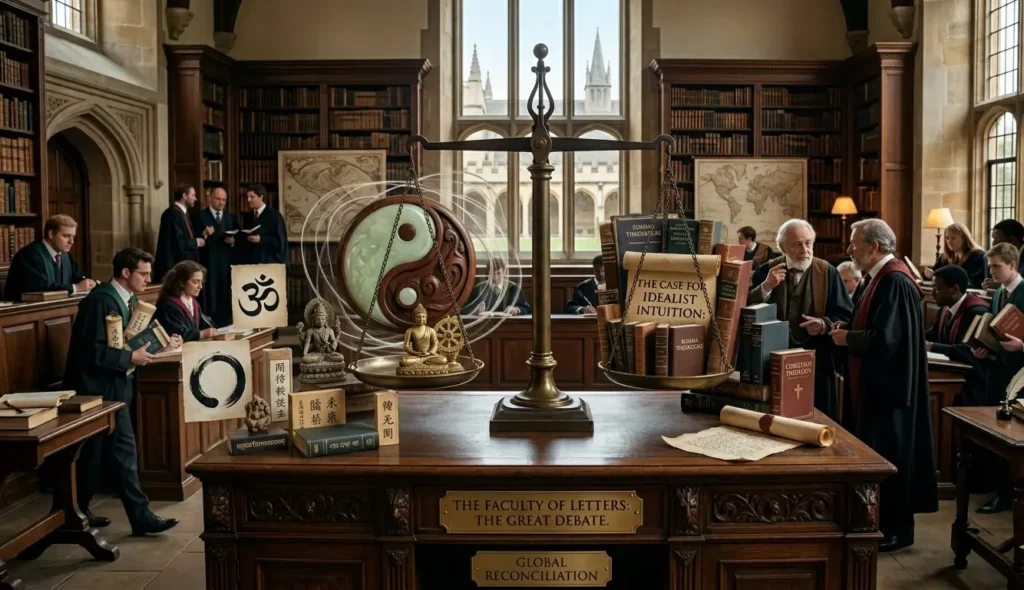
The argument: Any spiritual or metaphysical system outside biblical revelation is either deceptive or demonically inspired. Yin yang is part of Eastern spirituality. Therefore yin yang is potentially demonic.
The specific response: This argument proves too much. Applied consistently, it would classify all pre-Christian Greek philosophy as demonic, including the natural philosophy of Aristotle that medieval Christian theologians like Thomas Aquinas integrated into Christian theology as foundational to natural law theory.
It would classify Stoic philosophy, which directly influenced early Christian writers, including Paul, as demonic. It would classify the Egyptian cosmological framework that Jews lived within during their centuries in Egypt as demonic.
The early church fathers made careful distinctions between pagan religious practice (sacrificing to idols, invoking pagan deities) and pagan philosophical reflection on the natural order of reality.
The former they opposed as idolatry. The latter they engaged, debated, and often incorporated. Yin yang, as a philosophical framework about the natural order of reality rather than a devotional practice involving the invocation of deities, belongs in the second category rather than the first.
Argument 2: Yin Yang Represents a False God or Demonic Entity
The argument: The yin-yang symbol represents something spiritually real, a force or entity, that is not the God of the Bible. It represents something demonic.
The specific response: This misunderstands what yin yang represents within its own philosophical framework. Yin and yang are not gods, spirits, or entities of any kind. They are descriptive categories for types of natural processes and qualities, like warm and cold, or active and passive.
Saying yin yang represents a demonic entity is like saying that the concept of entropy represents a demonic entity: the category error is in assigning personal supernatural agency to a descriptive philosophical concept.
There is no yin yang god. There is no yin yang spirit. There is no entity in the classical Daoist yin yang framework to invoke, worship, or be influenced by. Asserting that one exists requires importing a supernatural entity into the framework from outside it.
Argument 3: The Symbol’s Use in Occult Contexts Proves Its Demonic Nature
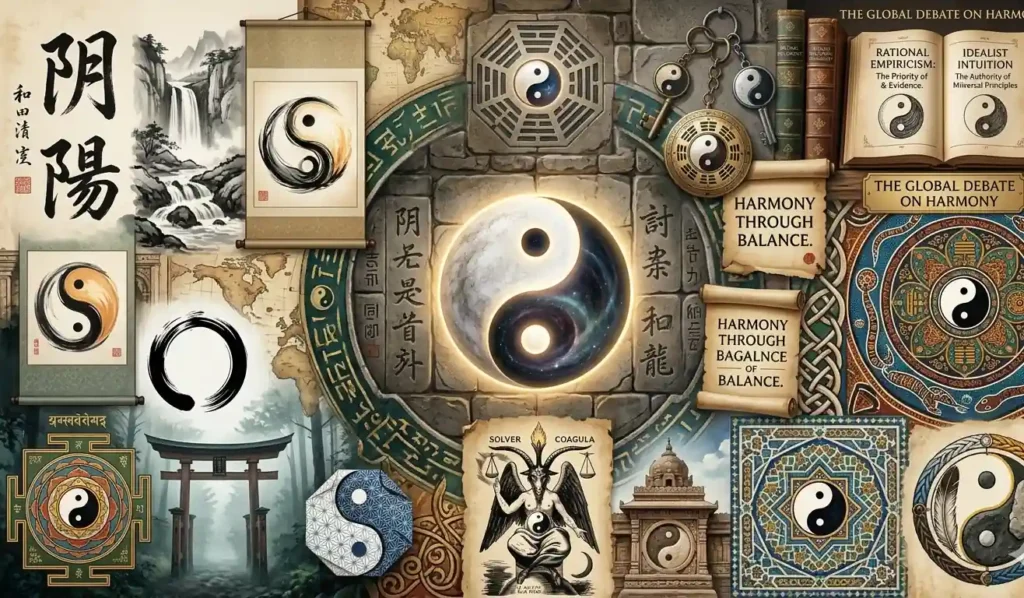
The argument: The yin yang symbol appears extensively in occult and New Age contexts. Occult practices are demonic. Therefore the yin yang symbol is demonic.
The specific response: The cross appears extensively in occult and esoteric contexts, inverted, incorporated into dark ritual imagery, used by traditions that Christians would consider spiritually dangerous. This does not make the cross demonic. The meaning of a symbol is determined by its original framework and its specific use in context, not by every secondary context in which it has ever appeared.
The yin yang symbol was used in Chinese cosmological philosophy for over two thousand years before Western New Age movements began incorporating it. Its appearance in New Age contexts reflects those movements’ practice of borrowing symbols from non-Western traditions, not anything inherent to the symbol’s original meaning.
Argument 4: Yin Yang Teaches That Good and Evil are Equal, a Demonic Lie
The argument: The yin yang symbol teaches moral relativism that good and evil are equal complements of the same reality, that there is good in evil and evil in good. This is a specific demonic deception that contradicts biblical moral teaching.
The specific response: This is the most sophisticated version of the demonic argument and deserves the most careful response.
It is true that yin yang philosophy does not assign absolute moral valence to any natural force or quality. This is not because it teaches that good and evil are equal. It is because yin and yang are not moral categories at all. They are cosmological categories describing patterns of natural process.
Yin yang philosophy is not saying “evil is as good as good.” It is saying “darkness is as natural as light, winter is as natural as summer, rest is as natural as activity.” These are observations about physical and natural reality, not moral prescriptions.
The moral question, what is right and what is wrong, is a different question from the cosmological question of how natural forces interact. A physicist who describes how nuclear forces work is not thereby endorsing nuclear weapons. A philosopher who describes how natural complementary forces interact is not thereby endorsing moral relativism.
Whether yin yang philosophy is compatible with specific religious moral frameworks is a separate, legitimate question. But it is not the same as asking whether yin yang is demonic.
What Yin Yang Is Not
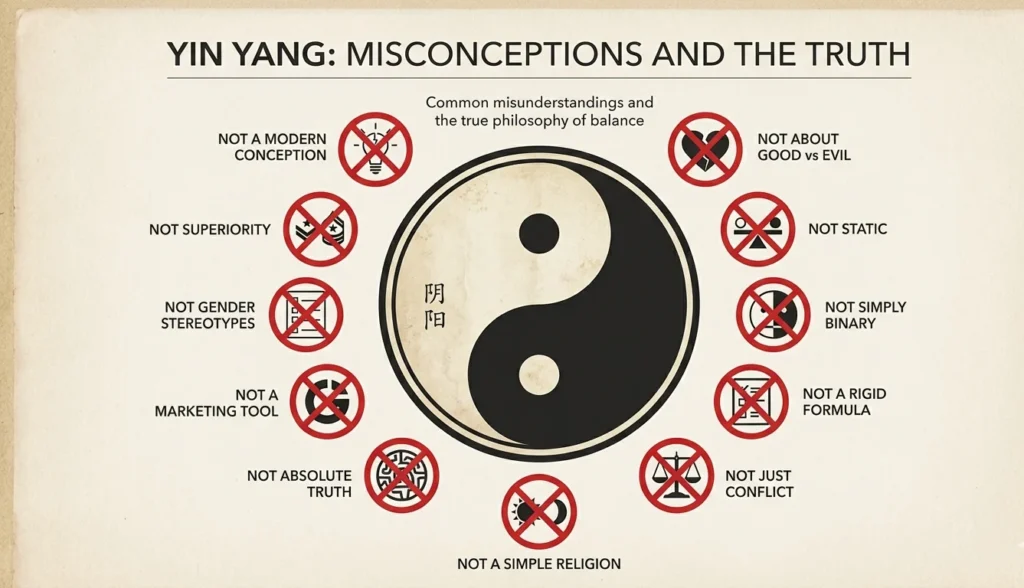
To be precise, what yin-yang is, it helps to be equally precise about what it is not:
Yin yang is not a religion. It has no deity, no creation account, no salvation narrative, no afterlife theology, no priesthood, no scripture in the devotional sense, and no membership or conversion requirement.
Yin yang is not devil worship. The concept of a personal evil being opposing God does not exist in classical Daoist yin yang philosophy. The framework has no Satan, no Lucifer, no Iblis, no demonic hierarchy. These are Abrahamic theological concepts that do not transfer to the Daoist framework.
Yin yang is not an invitation to demonic influence. Wearing or displaying a yin yang symbol is philosophically equivalent to displaying a representation of the Fibonacci spiral or a mandala. It represents a cosmological and mathematical observation about natural patterns, not an invocation of any spiritual entity.
Yin yang is not moral relativism. It does not teach that all moral choices are equivalent. It describes natural complementary forces. Moral philosophy is a separate domain that yin yang philosophy does not directly address.
Yin yang is not in conflict with monotheism by definition. It is possible to hold yin yang as a useful descriptive framework for natural processes while also holding monotheistic beliefs. Many Christians, Muslims, and Jews engage with Aristotelian physics, Stoic ethics, and other pre-Christian philosophical frameworks without considering this theologically compromising. Whether yin yang falls in this category is a question for individual theological discernment, not a settled matter.
What Different Religious Traditions Actually Say
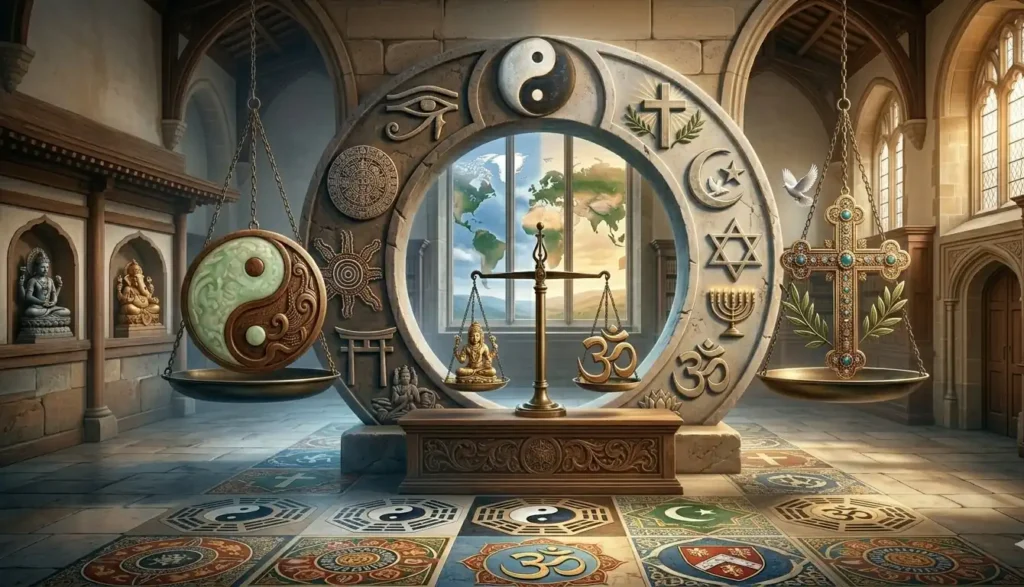
Traditional Christianity
There is no unified Christian position on yin-yang. The range runs from:
Strict avoidance: Some conservative evangelical, charismatic, and fundamentalist Christians consider any engagement with yin yang symbolism spiritually dangerous and counsel complete avoidance. This position is internally consistent with a theological framework that classifies all non-biblical spiritual systems as occult.
Philosophical engagement: Many mainstream Protestant, Catholic, and Orthodox theologians distinguish between yin yang as a philosophical framework for describing natural reality (which can be engaged intellectually without spiritual compromise) and Daoist religious practice (which involves worship, ritual, and relationship with non-Christian divine figures). Thomas Aquinas’s model of engaging Greek philosophy as a gift of natural reason available to all humanity, regardless of revelation, provides the most developed framework for this approach.
No position: Many Christians have never considered the question and have no position on it.
“The Catholic Church has not issued an official teaching declaring the Yin–Yang symbol itself to be demonic. The Church has published documents on New Age movements and their concerns, which sometimes mention Eastern philosophical symbols, but these documents focus on the New Age context of use rather than on classical Daoist philosophy.
Islam
Classical Islamic theology distinguishes between shirk (associating partners with God) and philosophical inquiry about the natural world. Yin Yang as a pre-theistic cosmological framework does not necessarily constitute shirk because Yin–Yang does not posit another deity alongside God.
Some Muslim scholars distinguish it from shirk when it is discussed purely as a philosophical model. Others discourage engagement because of its association with non-Islamic religious traditions
Judaism
Jewish theological tradition has a long history of engaging with Greek, Roman, and Persian philosophical frameworks and selectively integrating them with Torah thought. Talmudic and medieval Jewish philosophy engaged extensively with Aristotelian and Neoplatonist frameworks.
Whether yin yang philosophy is compatible with Jewish thought is a question for halakhic and theological discernment. Classical Jewish sources do not treat Yin–Yang as a category of demonic practice, though individual rabbis may differ on its religious appropriateness.
The Honest Bottom Line

Here it is, without hedging:
Historically and philosophically, Yin–Yang developed as a cosmological framework describing complementary natural forces rather than as a system centered on demons, Satan, or evil spiritual beings
What is true is this: whether yin yang is spiritually problematic for a specific believer is a theological question that depends on that person’s specific religious tradition and their tradition’s framework for evaluating non-Christian philosophical systems.
A believer in a tradition that classifies all non-biblical spiritual frameworks as occult may have genuine theological reasons to avoid yin yang symbolism. A believer in a tradition that distinguishes between philosophical engagement and devotional practice may have no theological problem with it whatsoever.
This is a matter for individual theological discernment within each tradition, not a settled factual question with a universal answer.
What is not true, is that yin-yang is demonic in the sense of being connected to, representing, or invoking demonic entities. The demonic classification imports categories from Abrahamic theology into a philosophical framework that was produced entirely independently of those categories and contains none of them.
It is a category error applying a framework to a concept that the framework was not designed to address and that the concept does not recognize.
The yin yang symbol represents a two-thousand-year-old philosophical observation that natural forces operate in complementary pairs. That observation is not demonic. It is, in fact, consistent with the kind of natural law reasoning that Aquinas and other Christian theologians considered a gift of reason available to all human beings regardless of their access to revelation.
Frequently Asked Questions
Is Yin Yang Sinful?
Whether wearing a Yin Yang symbol is sinful depends on your theological tradition and personal conscience. Some Christians view non-Christian spiritual symbols as incompatible with their faith, while others see Yin Yang as a philosophical symbol of balance rather than worship. There is no universal theological consensus.
Is Yin Yang Satanist?
No. Classical Daoist philosophy and Yin Yang theory do not contain a concept equivalent to Satan, fallen angels, or a cosmic adversary opposing God. Those are Abrahamic theological categories. Associating Yin Yang with satanic or demonic forces requires imposing concepts onto a philosophical framework that originally developed without them.
Is Yin Yang Evil?
Some churches view all non-biblical spiritual systems as potentially occult or demonic, so within that framework, labeling Yin Yang as demonic is internally consistent. The deeper question is whether that premise is historically and theologically sustainable. Many Christian thinkers, including Thomas Aquinas, argued that natural philosophical reflection is accessible to all humanity through reason, not inherently demonic.
Is Daoism itself demonic?
This is primarily a theological question, so the answer depends on one’s religious framework. Religious Daoism includes ritual practice, deities, and spiritual traditions beyond the philosophical Yin Yang concept. Whether that is compatible with a person’s faith is a legitimate theological discussion. But the Yin Yang framework itself is a philosophical model of balance and duality, not a demonic system.
Can a Christian believe in or use yin yang philosophy?
This depends on how a Christian tradition defines acceptable philosophical engagement. The Christian tradition of natural theology has historically allowed engagement with non-Christian philosophical systems through reason and observation of the natural world. Whether Yin Yang philosophy fits within that category is interpreted differently across Christian traditions and is not universally settled by a single church authority.
Is the yin yang symbol occult?
The term “occult” can mean “hidden,” but in theological use it usually refers to practices or systems understood to draw authority from non-divine or esoteric spiritual sources. The Yin Yang symbol, in its original context within classical Daoist cosmology, represents a philosophical model of balance and interdependence in nature. In some modern Western esoteric traditions, it has been adopted into occult frameworks, so classification depends on context, tradition, and intent rather than the symbol itself having an inherent fixed meaning.
Final Thoughts

The question “is yin yang demonic” deserves a serious answer, and the serious answer requires making a distinction that popular treatments usually avoid.
As a matter of history, philosophy, and comparative religion: yin yang is not demonic. It is a pre-theistic cosmological framework with no deity, no evil entity, no supernatural agency, and no connection to the categories of demonic theology. The claim that it is demonic requires importing Abrahamic theological categories into a framework that predates them, does not contain them, and does not recognise them.
As a matter of individual theological discernment: whether engaging with yin yang is spiritually appropriate for a specific believer is a question that depends on their tradition, their conscience, and their theological framework for evaluating non-Christian philosophical systems. This is a legitimate question that does not have a universal answer.
My observation is the most common source of genuinely confused theological claims about non-Western traditions is the application of theological categories to frameworks that do not contain those categories. Yin-yang was not produced within an Abrahamic theological framework. It does not contain Abrahamic categories. Evaluating it as though it does produces conclusions that reveal more about the evaluating framework than about Yin-Yang itself.
The honest, specific answer to “is yin yang demonic?” is: no, and the reason it seems that way to some people is that they are reading a non-Abrahamic philosophical framework through an Abrahamic theological lens. When you remove the lens and read the framework on its own terms, what you find is a description of how natural forces interact. That is all it has ever been.
Related Articles
- The Five Elements Behind Every Holy Beast [Chinese Myth Map]
- Why the Four Holy Beasts Cannot Exist Without Yin Yang
- Yin Yang & the Five Elements: The Hidden Cosmological Link
- Yin Yang, Five Elements & Four Symbols: China’s Complete Cosmos
- The Four Holy Beasts: Baihu, Qinglong, Zhuque & Xuanwu
- Yin Yang Sun & Moon: Duality, Myth & Spiritual Meaning
- Is Yin Yang Demonic? The Truth You Don’t Know
- 7 Misconceptions About Yin Yang You Probably Believe
References
- Stanford Encyclopedia of Philosophy – Daoism
- Dao De Jing (Tao Te Ching)
- Daoism and Chinese Culture – Livia Kohn
- Yinyang: The Way of Heaven and Earth in Chinese Thought and Culture – Robin Wang
- The Religious Traditions of Asia: Joseph Kitagawa
- The Jewish Study Bible – Adele Berlin
- The Study Quran
- Vatican. Jesus Christ, the Bearer of the Water of Life: A Christian Reflection on the New Age (2003).
- Book of Changes: Yi Jing – Chinese Text Project
- Wing-tsit Chan – A Source Book in Chinese Philosophy