 By
By Quick Takeaways:
- The Five Elements & the Four Holy Beasts aren’t two separate systems that happen to overlap. They’re two views of the same underlying cosmological architecture
- Each beast doesn’t just “own” an element. The element determines the beast’s fundamental nature, personality, and cosmic role
- The generating and controlling cycles of Wu Xing mean the beasts are in active cosmological relationship with each other, not just parallel guardians of the four compass points
- Most people know about four beasts and four elements, but the complete system has five of each, and the fifth, the Yellow Dragon and Earth, is the key that makes everything else make sense
- Once you see this connection, you can’t unsee it, and it changes how you read both systems
If you are like me, who grew up reading Western fantasy and mythology, you might have heard about the Four Elements of Nature and how they are the building blocks of all things. But this is a Western concept originating from the Greek philosopher Empedocles. The Chinese take this a step further by including metal, bringing the total to five elements.
I’d been studying Chinese mythology for years after I developed an interest in reading cultivation novels and learning about Qi. I first discovered the four symbols and the five elements during my reading of cultivation novels. And it took me some time to realize they were the same system seen from two different angles. Like looking at a three-dimensional object from the side and thinking it’s flat, then walking around it and suddenly seeing the whole shape.
The connection goes much deeper than “each beast has an element.” Once I understood it properly, everything about both systems clicked into place in a way it hadn’t before. That’s what this article is about.
Five Elements & The Four Holy Beasts: Two Systems, One Cosmology
Most people encounter the Four Holy Beasts and the Five Elements separately.
You find the Four Holy Beasts in discussions of Chinese astronomy, tomb art, and feng shui:
- The Azure Dragon of the East
- The Vermilion Bird of the South
- The White Tiger of the West
- The Black Tortoise of the North
You find the Five Elements (Wu Xing, 五行) in discussions of traditional Chinese medicine, Daoist philosophy, and Chinese astrology: Wood, Fire, Earth, Metal, Water.
They feel like separate topics. But they’re not.
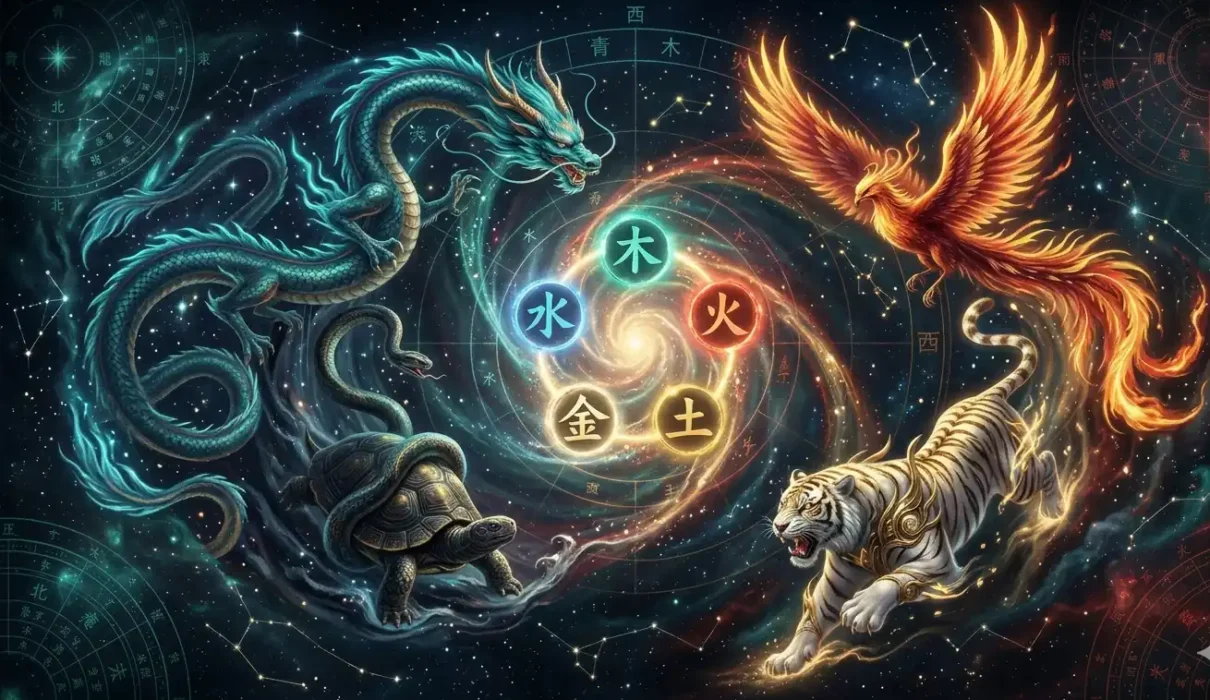
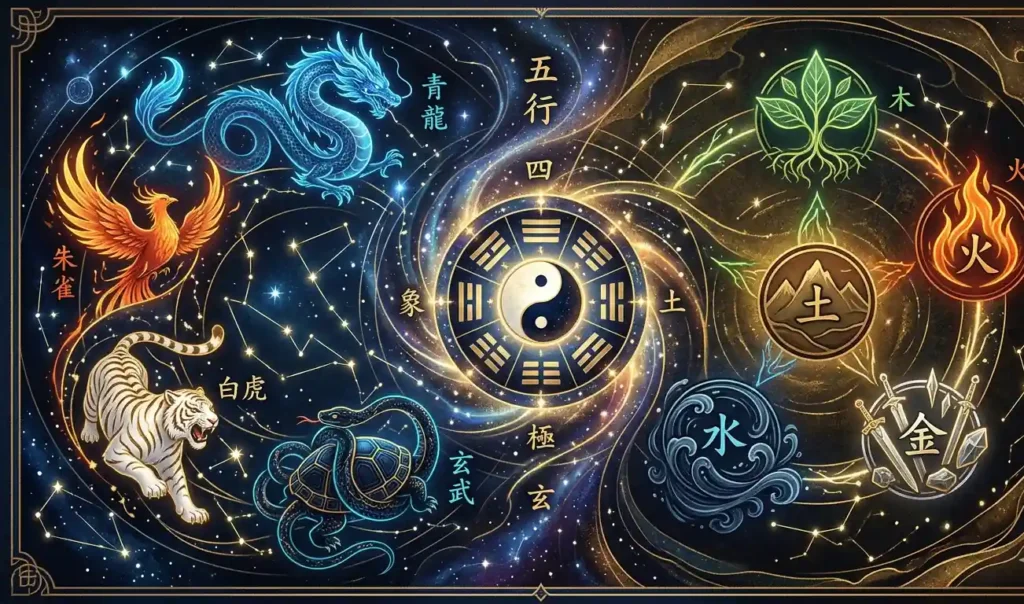
Both systems were developed by Chinese cosmological thinkers working on the same fundamental question: how does the universe organise itself? The Five Elements is the answer expressed as forces or phases. The Holy Beasts are the answer expressed as living beings. Same cosmology, different vocabulary.
The formal connection happens through the five directions of Chinese cosmological geography: East, South, Centre, West, and North. Each direction has both an element and a guardian beast. The two systems are literally mapped onto the same spatial framework.
Once you see that, everything that follows makes sense.
The Four Holy Beasts and Their Elements
Let me walk you through each beast-element pairing properly, not just naming which element belongs to which beast, but showing you why the element explains everything about the beast.
This is the part that genuinely changed how I understand both systems.
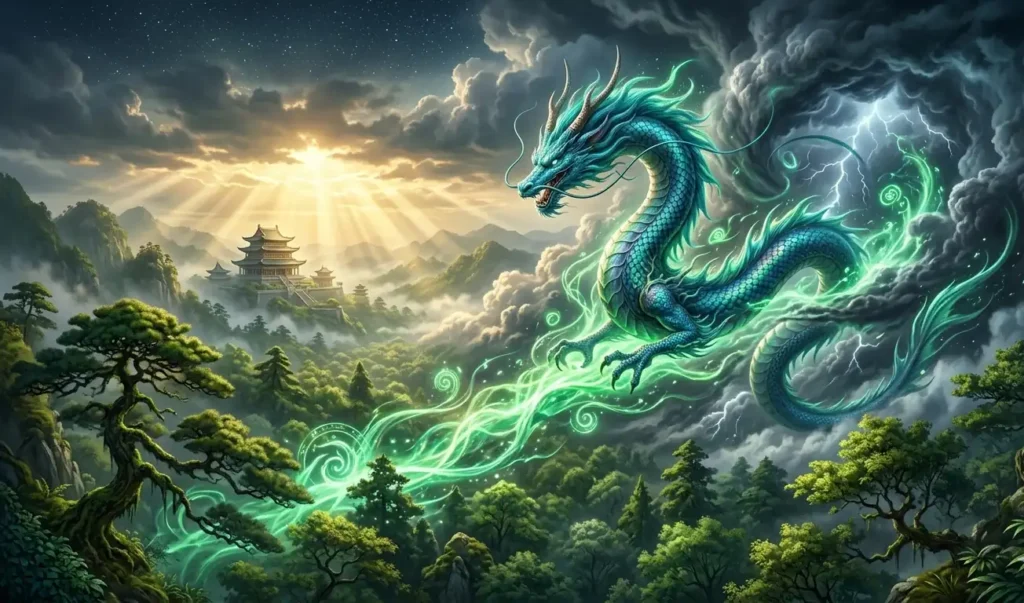
Qinglong: Azure Dragon and Wood
The Element
Wood (木, Mù) isn’t just about trees. In Wu Xing thinking, Wood is the quality of upward vital movement, of new growth pushing through resistance, of spring’s expansive rising energy. It’s the force of life asserting itself before anything has been established.
The Beast
The Azure Dragon governs the East, the direction of the rising sun, of beginnings. Its season is spring. And if you think about those qualities together with Wood’s character, the Azure Dragon makes complete philosophical sense.
A dragon that blazes with vital upward energy, that rises and expands and embodies the force of new growth, that’s not arbitrary imagery. That’s the Wood element made into a living being.
The Wood-Dragon Connection Runs Deep
A few specific correspondences worth knowing:
- Direction: East – where the sun rises, where cycles begin
- Season: Spring – Wood’s outward-pushing vital force at its most visible
- Body correspondence in TCM: Liver and gallbladder – which TCM associates with the smooth flow of vital energy and the capacity to plan and initiate
- Philosophical quality: The will to grow despite obstacles, to rise toward light regardless of what blocks the path
The Azure Dragon isn’t just assigned Wood. It is Wood – the Wood principle given eyes, wings, and a roar.
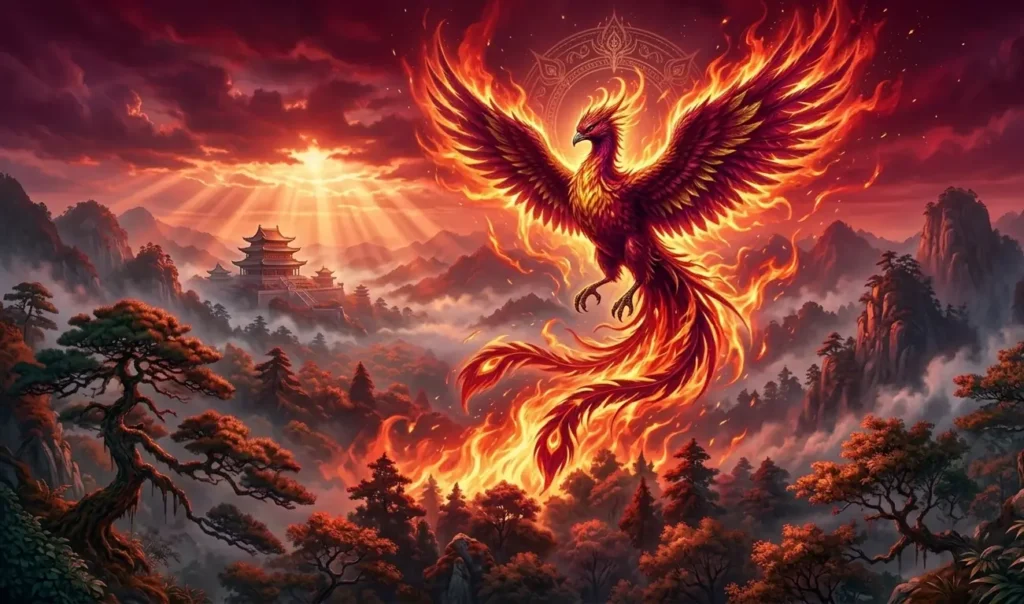
Zhuque: Vermilion Bird and Fire
The Element
Fire (火, Huǒ) in Wu Xing is transformation and maximum outward expression. It’s not destruction, it’s conversion, the moment when potential becomes fully kinetic. Fire is the peak of yang energy, the point where everything is fully expressed before the cycle begins its return.
The Beast
The Vermilion Bird governs the South, the direction of maximum solar intensity, of high noon, of the world at its most blazing. Its season is summer.
A firebird presiding over the south and summer isn’t a poetic decoration. It’s the direct cosmological expression of Fire at maximum yang, which is exactly what the Vermilion Bird represents.
The Fire-Bird Connection
- Direction: South – maximum solar influence, the sun at its highest arc
- Season: Summer – Fire’s peak expression in the natural year
- Body correspondence in TCM: Heart and small intestine – the seat of consciousness and the transformation of nourishment
- Philosophical quality: The principle of full outward manifestation, of nothing held back
What I find personally fascinating about Zhuque is the word “vermilion” itself. It’s not red. It’s a specific deep, warm, celebratory red, the color of fire at its most vital, of celebration, of life force fully expressed. The color is doing cosmological work.
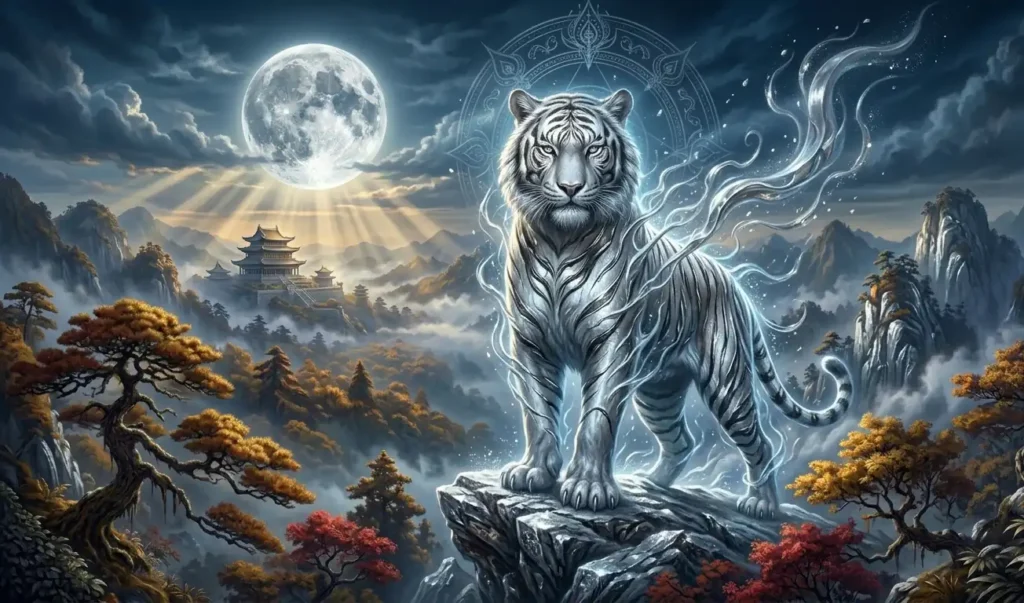
Baihu: White Tiger and Metal
The Element
Metal (金, Jīn) might be the most misunderstood of the five elements. People hear “metal” and think iron and weapons. But in Wu Xing, Metal is the quality of refinement, contraction, and the reduction of things to their essential form. It’s what autumn does to summer’s excess, strips away what isn’t needed, and leaves only what endures.
The Beast
The White Tiger governs the West, the direction of the setting sun, of harvest, of completion. Its season is autumn.
And suddenly, the white tiger makes total philosophical sense. A creature of precision, ferocity, and disciplined force that’s Metal’s character. The tiger doesn’t waste movement. It contracts to its essential power and then acts with complete precision.
The Metal-Tiger Connection
- Direction: West – completion, the gathering of what summer produced
- Season: Autumn – the stripping away, the return toward essence
- Body correspondence in TCM: Lungs and large intestine – the breath that draws in and releases, the function of purification
- Philosophical quality: The martial precision that emerges from reduction to essence, the power of what remains when all the unnecessary has been removed
The white coloring is cosmologically meaningful, too. White in Chinese tradition is the color of Metal, of mourning, of the completion of life cycles. The tiger’s white fur isn’t arbitrary. It’s the correct color for a Metal-element guardian.
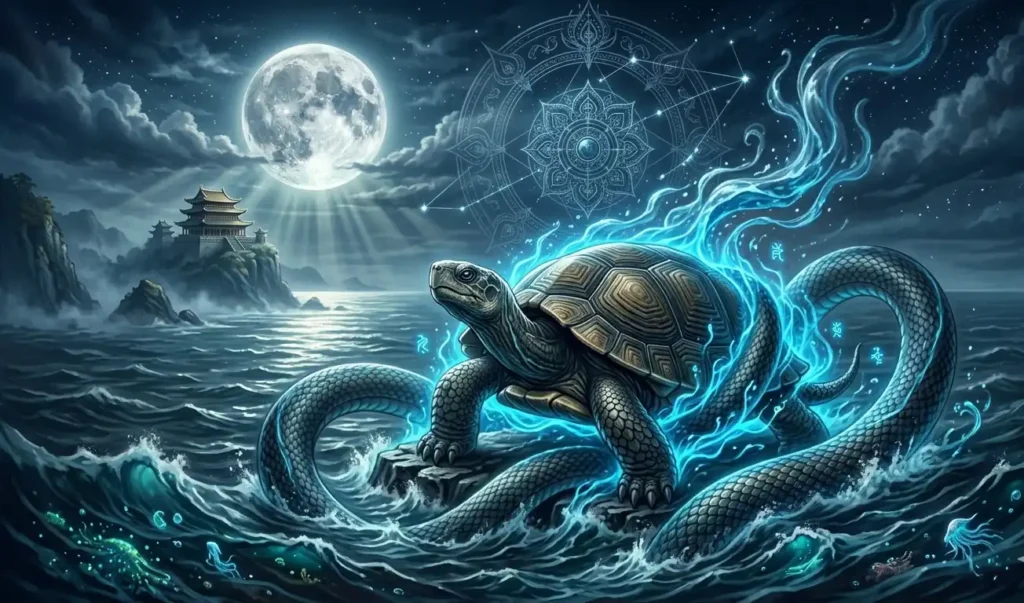
Xuanwu: Black Tortoise-Serpent and Water
The Element
Water (水, Shuǐ) in Wu Xing is depth, flow, hidden potential, and the accumulated power of patient persistence. It governs the deep winter when everything has contracted to its most inward point. Water yields to everything and eventually overcomes everything. Think of rivers carving canyons.
The Beast
The Black Tortoise governs the North, the direction of darkness, cold, and the depths of winter. Its dual form, tortoise and serpent intertwined, is itself a Water-element statement: the tortoise is stable depth, the serpent is fluid movement. Together, they’re the two aspects of Water’s nature in a single figure.
The Water-Tortoise Connection
- Direction: North – maximum yin, the deep of the night sky
- Season: Winter – Water’s inward contraction at its fullest expression
- Body correspondence in TCM: Kidneys and bladder – the seat of vital essence, the deepest reservoir of constitutional energy
- Philosophical quality: The paradoxical strength of yielding, the irresistibility of patient accumulation
There’s a reason the Tao Te Ching uses water as its primary image for virtuous action. Water is Xuanwu’s element, and Xuanwu is the most philosophically rich of the four guardians precisely because Water’s philosophical character is so rich.
The Fifth Beast Among the Five Heavenly Beasts
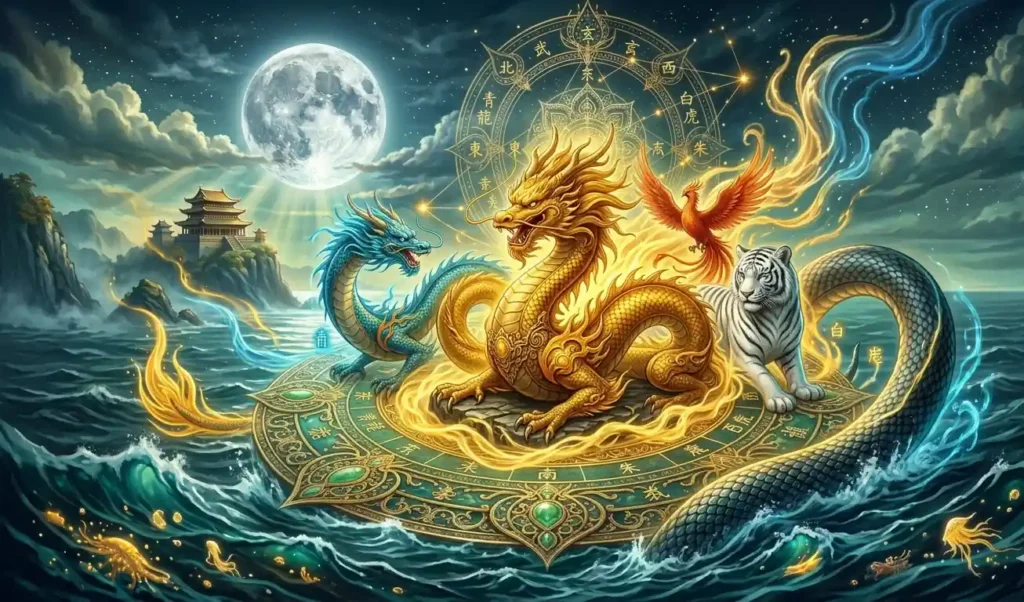
Here’s the thing most people don’t know: the system isn’t complete with four beasts.
Wu Xing has five elements, not four. Wood, Fire, Earth, Metal, Water. And there are five directions in Chinese cosmological geography: East, South, Centre, West, North.
The four guardian beasts cover four of those. The fifth Earth and the Centre belong to the Yellow Dragon, Huanglong.
I wrote extensively about Huanglong in the Yellow Dragon Article, but here’s the specific connection that matters for understanding the five-element system:
- Earth governs the Centre – not a compass direction but the axis everything else rotates around
- Earth governs the transitional periods between seasons – the eighteen days before each seasonal shift
- Earth is the stabilising ground within which all four other elements operate
- The Yellow Dragon at the Centre is what makes the four directional guardians a complete and coherent system rather than four separate things
Think of it this way. The Four Holy Beasts are the spokes of a wheel. The Yellow Dragon is the hub. Without the hub, the spokes don’t constitute a wheel. They’re just four separate pieces of wood.
The Generating Cycle: How the Beasts Feed Each Other
Here’s where the “hidden connection” I am talking about is. It’s fascinating how ancient Chinese came up with the idea.
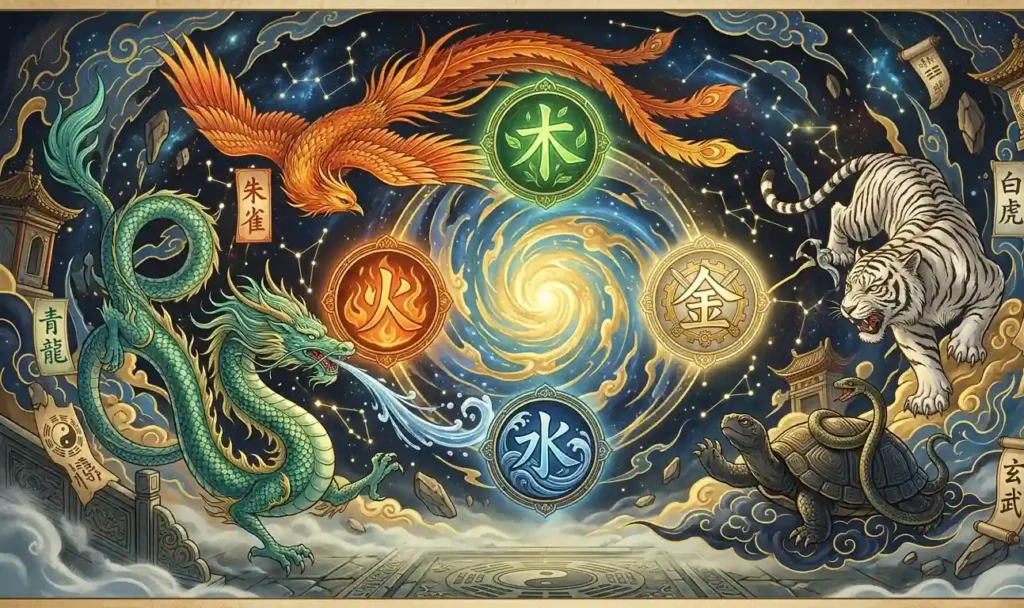
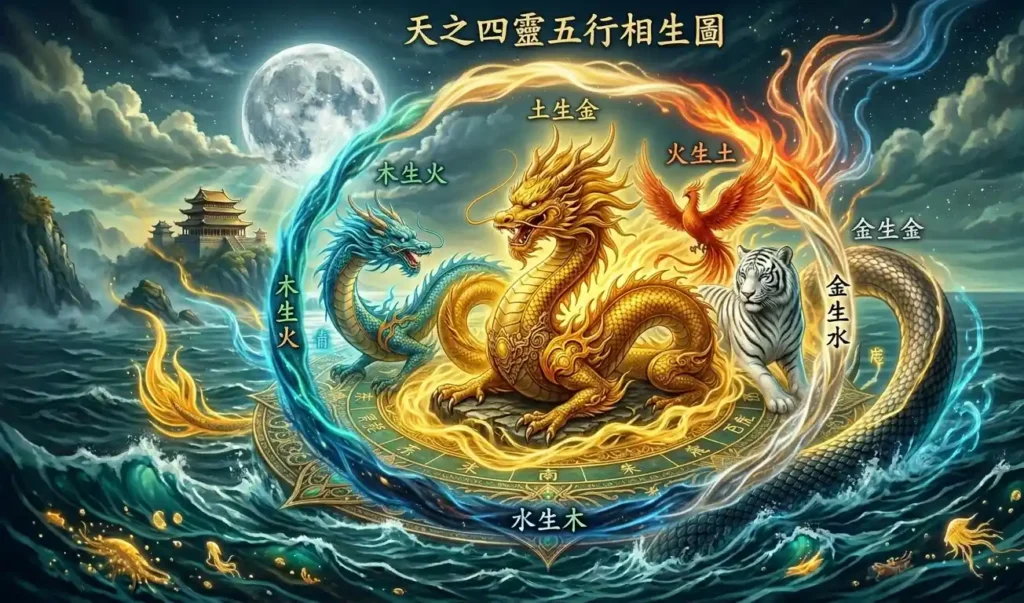
The Five Elements aren’t static categories. They exist in dynamic relationship through two great cycles: the generating cycle (相生, xiāngshēng) and the controlling cycle (相克, xiāngkè). And because the Holy Beasts are the Five Elements expressed as living beings, those cycles describe active cosmological relationships between the guardians themselves.
The generating cycle works like this:
- Wood feeds Fire – fuel burns
- Fire produces Earth – ash returns to soil
- Earth bears Metal – ore forms within rock
- Metal collects Water – condensation on cold metal
- Water nourishes Wood – roots drink
Now translate this into guardian beast language:
- The Azure Dragon (Wood) feeds the Vermilion Bird (Fire) – spring’s rising vital force provides the fuel for summer’s blazing peak
- The Vermilion Bird (Fire) produces the Yellow Dragon (Earth) – summer’s maximum expression generates the stabilizing center
- The Yellow Dragon (Earth) bears the White Tiger (Metal) – the stable ground produces the autumn’s precision and harvest
- The White Tiger (Metal) collects the Black Tortoise (Water) – autumn’s refinement produces winter’s deep reservoir
- The Black Tortoise (Water) nourishes the Azure Dragon (Wood) – winter’s depth feeds spring’s new growth
This is genuinely beautiful once you see it. The guardian beasts aren’t just standing at their compass points doing separate jobs. They’re in a living cycle of mutual nourishment. Spring feeds summer. Summer produces the stable center. The center yields autumn. Autumn deepens into winter. Winter births spring.
The four seasons, the five elements, and the five guardian beasts are all describing the same underlying cycle of cosmic time and energy.
The Controlling Cycle: The Beasts in Cosmic Tension
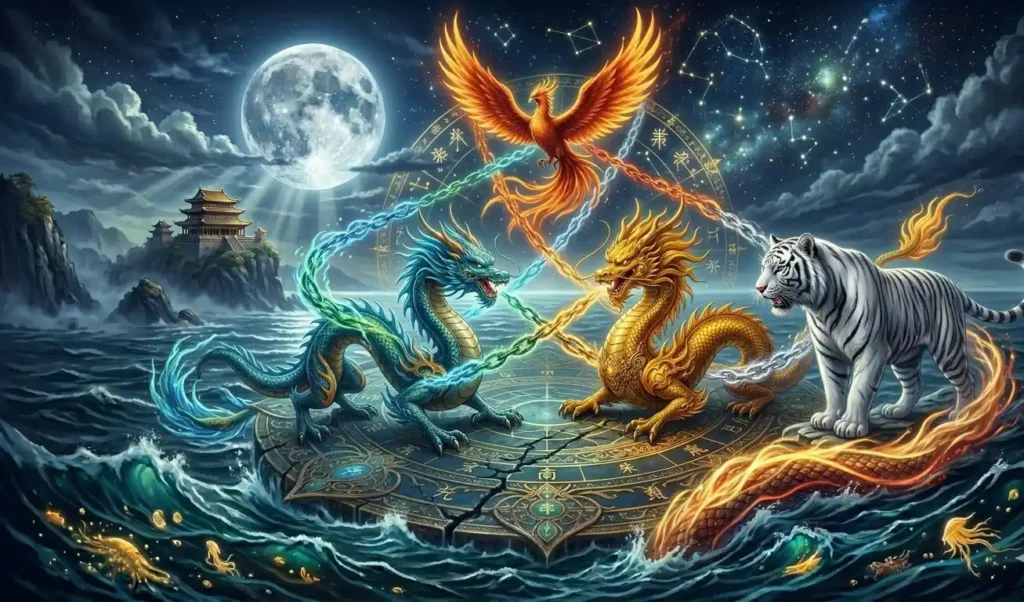
The controlling cycle is where the cosmological drama lives.
Alongside the generating cycle, Wu Xing describes a second set of relationships where each element controls or suppresses another:
- Wood parts Earth – roots break through soil
- Earth absorbs Water – ground drinks rivers
- Water extinguishes Fire – the obvious one
- Fire melts Metal – heat transforms the refined back to fluid
- Metal cuts Wood – the blade harvests the forest
In guardian beast terms, this means:
- The Azure Dragon (Wood) has natural authority over the Yellow Dragon (Earth)
- The Yellow Dragon (Earth) has natural authority over the Black Tortoise (Water)
- The Black Tortoise (Water) has natural authority over the Vermilion Bird (Fire)
- The Vermilion Bird (Fire) has natural authority over the White Tiger (Metal)
- The White Tiger (Metal) has natural authority over the Azure Dragon (Wood)
This controlling cycle is the reason Chinese cosmological thinking never treats the guardian beasts as simply parallel or equal. Each one is simultaneously nourished by one guardian, nourishes another, controls one, and is controlled by one. The system is in dynamic, living tension.
What I find most interesting about this is what it says about the nature of cosmic order. The controlling cycle isn’t destructive. It’s regulatory. The element that controls another prevents that element from running out of balance. Water doesn’t destroy Fire. It prevents Fire from becoming the ten-sun apocalypse of Chinese solar mythology. Control is what keeps the cycle coherent.
The Seasons: The Beasts as Time Itself
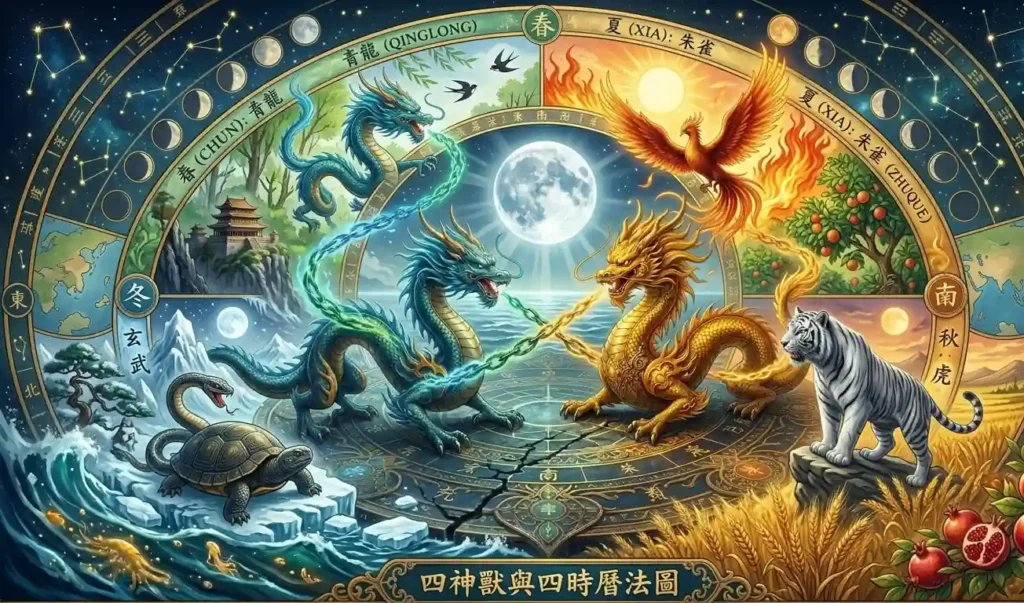
One of the things that took me longest to fully appreciate is how completely the five-beast system maps onto the Chinese understanding of time.
The four directional guardians each govern a season:
- Azure Dragon – Spring (the expanding upward force of Wood)
- Vermilion Bird – Summer (the blazing outward peak of Fire)
- White Tiger – Autumn (the contracting refining force of Metal)
- Black Tortoise – Winter (the deep inward stillness of Water)
And the Yellow Dragon governs the transitions between seasons, specifically the eighteen days before each seasonal shift. Four transitions per year, eighteen days each. Seventy-two days total out of a 360-day traditional Chinese calendar.
This makes the Yellow Dragon the guardian of thresholds, the keeper of the moments when one cosmic state is giving way to the next. It’s the Earth beneath every seasonal shift, the stable ground that makes the transitions possible without chaos.
What this means is that the five guardian beasts aren’t just spatial (governing compass directions), they’re temporal. They govern the movement of the year itself. When you understand this, the five-beast system becomes something more profound than a cosmological map. It’s a description of time as a living cycle of five personalities taking turns presiding over reality.
Why This Connection Changes How You See Both Systems
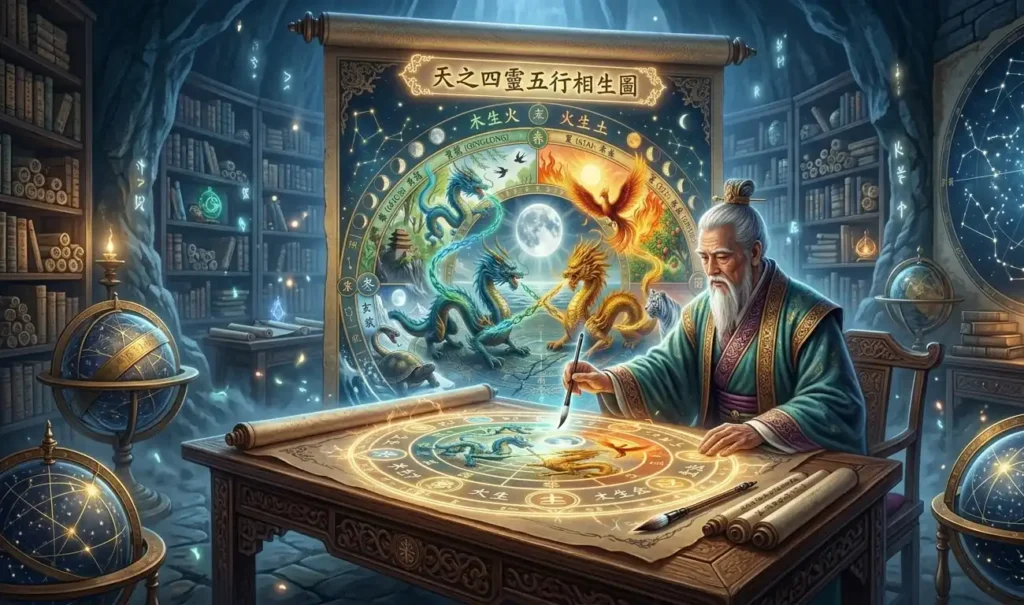
Let me be direct about why I think this connection matters.
If you understand Wu Xing as a system of five natural forces in dynamic relationship, generating and controlling, cycling through time, but you’ve been thinking of the Holy Beasts as four separate guardian figures standing at compass points doing independent jobs, you’ve been seeing only part of what each system actually is.
The Holy Beasts aren’t just animal symbols for four directions. They’re the Five Elements made visible as living beings, and because they’re expressions of the Five Elements, they carry all the relational complexity of the Wu Xing system. They generate each other. They control each other. They cycle through time in sequence. They form a living cosmological system rather than a set of four independent guardians.
And the Five Elements aren’t just abstract philosophical categories. When you understand them through the lens of the Holy Beasts, they acquire personalities, visual force, and mythological weight. Water isn’t just a philosophical concept. It’s the patient Black Tortoise that will still be here long after everything else has cycled past. Fire isn’t just a transformation. It’s the blazing Vermilion Bird at the peak of summer noon.
Both systems become richer when you see the connection. That’s the best evidence I know that the connection is real and important rather than a scholarly construction.
Frequently Asked Questions
Do all Chinese cosmological texts treat the Five Elements and Four Symbols as connected?
Classical Chinese cosmological texts often connect both systems through the five-direction framework, showing the relationship as an established part of traditional cosmology.
Why is the Earth element left out of most discussions of the Four Holy Beasts?
The four beast system became more widely used because it fit practical applications like tomb art, city planning, and compass directions. The five beast system remained the more philosophically complete cosmological model centered on balance and the five directions.
Does the controlling cycle mean some beasts are stronger than others?
The controlling cycle represents balance rather than dominance. Each beast both controls and is controlled within the elemental system, creating a continuous regulatory relationship. In feng shui, these elemental interactions become important because certain spatial arrangements can strengthen or weaken specific energies.
Is there a specific classical text I can read to understand this connection?
The Huainanzi and Lüshi Chunqiu both discuss five direction cosmology and elemental correspondences in detail. Classical astronomical texts on the twenty eight lunar mansions are also key sources for understanding the Four Holy Beasts, and many are available in English academic translations.
How does this connect to traditional Chinese medicine?
Traditional Chinese Medicine uses the same five element cosmological framework associated with the Four Holy Beasts. Each beast aligns with specific organs and elemental energies, linking mythology, medicine, and philosophy within one interconnected symbolic system.
Final Thoughts
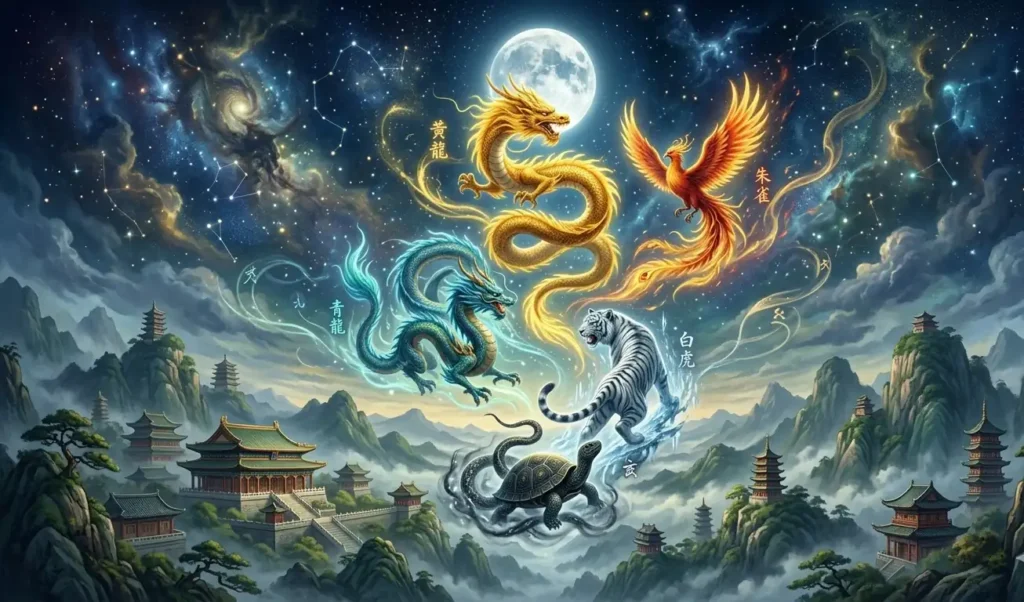
The Five Elements and the Four Holy Beasts were two of the first Chinese cosmological concepts I learned about. For years, I held them as related but separate. Then the five-direction connection clicked, and I spent an embarrassingly satisfying afternoon connecting everything I thought I knew about both systems.
The cosmological architecture here is elegant in a way I genuinely admire. Five elements, five directions, five guardian beings, five seasons, all expressions of the same underlying framework for understanding how reality organizes itself. The generating cycle shows the beasts feeding each other throughout the year. The controlling cycle that keeps any one element from consuming the others. The Yellow Dragon at the center holding the axis steady while everything else turns.
This is one of those cosmological systems that rewards the more time you spend with it. You can engage with the surface layer, four guardian beasts, and four compass points, and get something genuinely valuable. But when you engage with the full five-element, five heavenly beasts, two-cycle system, you’re engaging with one of humanity’s most sophisticated pre-modern attempts to describe how the natural world works.
Related Articles
- The Five Elements Behind Every Holy Beast [Chinese Myth Map]
- Why the Four Holy Beasts Cannot Exist Without Yin Yang
- Yin Yang & the Five Elements: The Hidden Cosmological Link
- Yin Yang, Five Elements & Four Symbols: China’s Complete Cosmos
- The Four Holy Beasts: Baihu, Qinglong, Zhuque & Xuanwu
- Xuanwu: Black Tortoise of the North Symbolism & Mythology
- Yellow Dragon: Myths, Symbolism & the Forgotten Fifth Beast
- Why the Four Holy Beasts Cannot Exist Without Yin Yang
References
- Stanford Encyclopedia of Philosophy – Daoism
- Joseph Needham, Science and Civilisation in China
- Dao De Jing (Tao Te Ching)
- Zhuangzi
- Daoism and Chinese Culture – Livia Kohn
- Lüshi Chunqiu (The Annals of Lü Buwei)
- Huainanzi
- Yin-Yang and the Nature of Correlative Thinking – Angus Charles Graham
- Lewis, Mark Edward. The Construction of Space in Early China.
- Huangdi Neijing
- Yinyang: The Way of Heaven and Earth in Chinese Thought and Culture – Robin Wang
- Shanhaijing (Classic of Mountains and Seas).