
 By
By Quick Takeaways:
- Western Dragon vs Wyvern – The core distinction between them in Western tradition is anatomical: a dragon has four legs and two wings, while a wyvern has two legs and two wings
- The word wyvern comes from Old French and ultimately from the Latin vipera, meaning viper, tying the creature linguistically to serpents rather than to the broader dragon category
- Medieval bestiaries and early heraldic rolls didn’t draw this line consistently. The strict two-leg rule is largely a product of later, more systematized heraldic tradition
- The wyvern has a well-documented place in English heraldry, while its modern association with Wessex involves later interpretations of earlier dragon imagery.
- Related creatures like the lindworm and the cockatrice complicate the picture further, showing that medieval imagination organized dragon like beings along a spectrum rather than a strict binary
I get it. It can be confusing to differentiate between a Western dragon and a wyvern, especially for someone new to the Western mythology circle. They take the wyvern with two legs for a dragon without giving much thought. They think it’s a mistake.
The four-legged dragon and two-legged wyvern distinction is a real convention in later European heraldry, but it isn’t nearly as ancient or universal as modern fantasy often makes it seem.
Let me walk you through what actually separates a dragon from a wyvern, where the rule comes from, and where it gets complicated.
What Actually Separates a Dragon from a Wyvern
The Physical Distinction
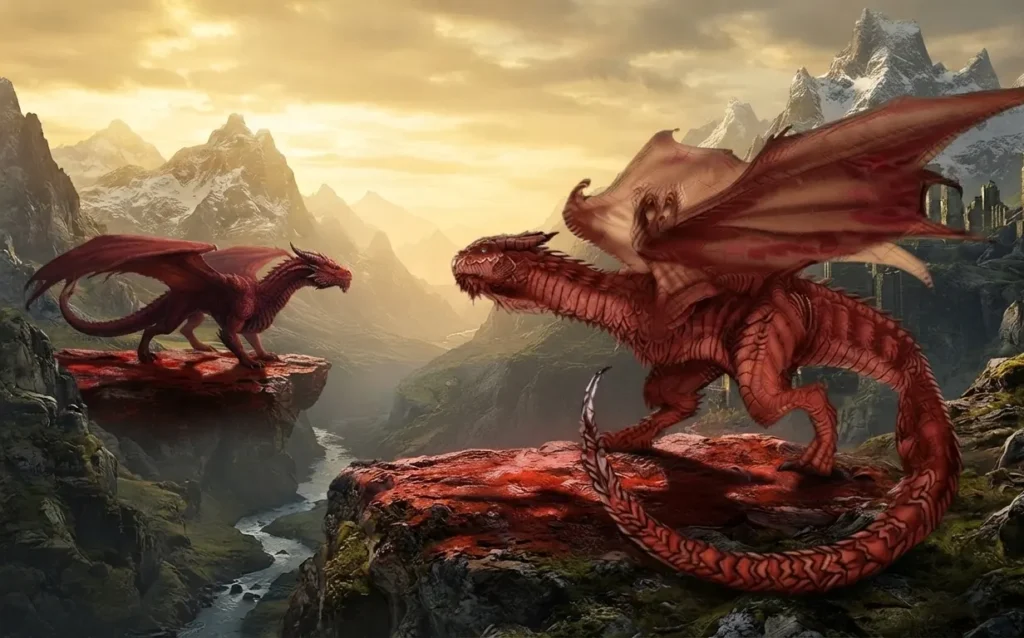
In Western tradition, particularly in the formalized world of European heraldry, the distinction comes down to limb count.
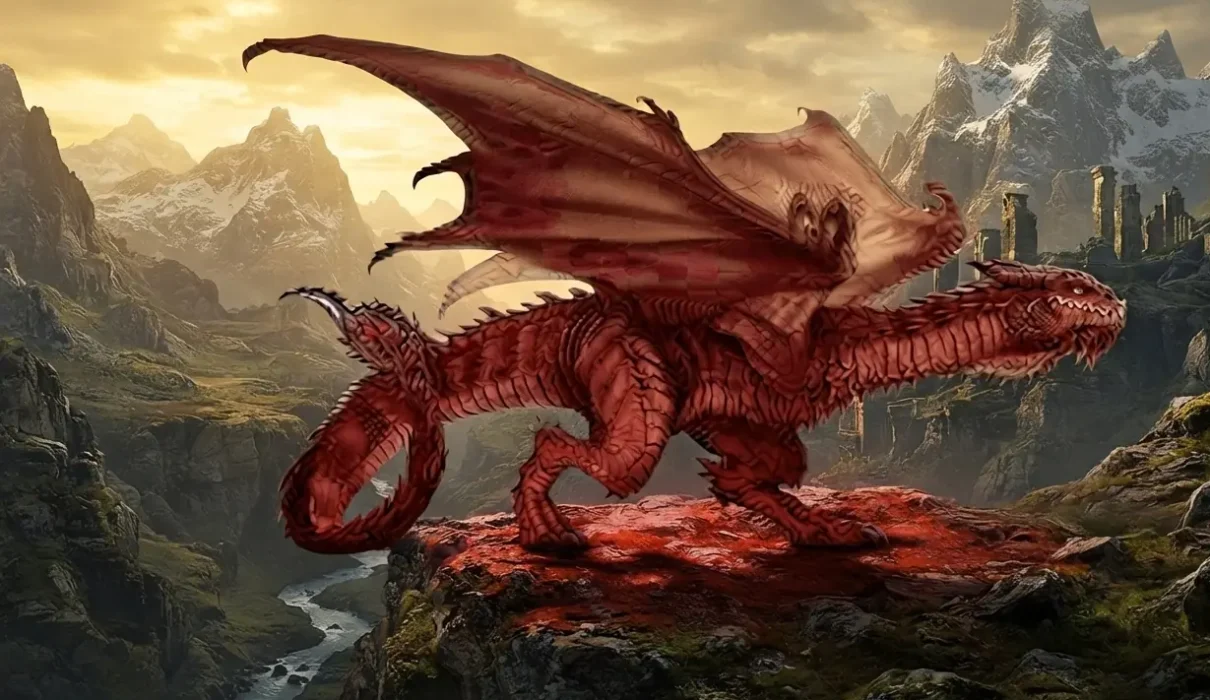
A dragon is depicted with four legs and two wings, giving it six total limbs. It typically has a long serpentine tail, a barbed tongue, and the composite reptilian features that most people picture when they hear the word dragon.
A wyvern is depicted with two legs and two wings, giving it four total limbs. The two legs are hind legs specifically. Where a dragon’s forelimbs would be, the wyvern instead uses its wings to bear weight when it’s not flying, more like a bat’s wing structure doing double duty as a forelimb.
The wyvern’s tail is also distinctive. It’s usually shown barbed, knotted, or ending in a stinger-like point, sometimes coiled around itself in heraldic depictions. This tail detail appears often enough in formal heraldry that it functions as a secondary identifying feature alongside the leg count.
Why Two Legs Instead of Four
The two-legged form is best understood as a particular heraldic convention rather than as evidence of a single ancient anatomical tradition. Earlier European dragon imagery was considerably more varied, and the wyvern’s later heraldic form should not automatically be projected backward onto medieval folklore.
This matters because it connects the wyvern to an earlier layer of European folklore, the winged serpent, rather than positioning it as simply a smaller or weaker version of the dragon. The wyvern isn’t a baby dragon or a lesser dragon in its original conception. It’s a related but distinct creature with its own anatomical logic.
Where the Word Wyvern Comes From
The Viper Root
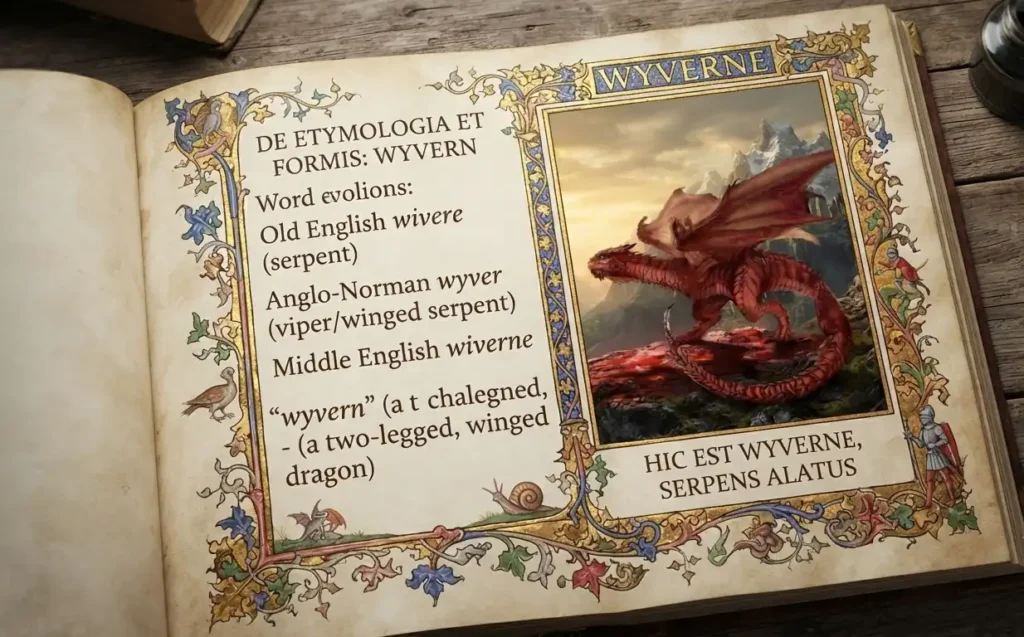
The etymology here is genuinely illuminating. Wyvern traces back through Anglo-Norman and Old French forms, wivre and guivre among them, to the Vulgar Latin vipera, meaning viper.
This is the same root that gives English the word viper directly. The wyvern’s name literally means, at its linguistic core, something like serpent or viper creature. The etymology preserves a linguistic connection with the viper or serpent, although etymology alone does not establish how medieval writers consistently conceptualized the creature.
How the Term Entered English
The word entered Middle English as wyvere or wyver during the medieval period, gradually taking its modern spelling and pronunciation as English heraldic and literary tradition developed. By the time heraldry became a formalized discipline in England, wyvern had settled into its specific technical meaning: the two legged, winged serpent creature distinct from the four legged dragon.
A History That Wasn’t Always So Tidy
Medieval Bestiaries Didn’t Draw the Line Consistently
Here’s the part of this story that most quick explanations skip over, and it’s the part I find most interesting after two decades of reading medieval sources directly.
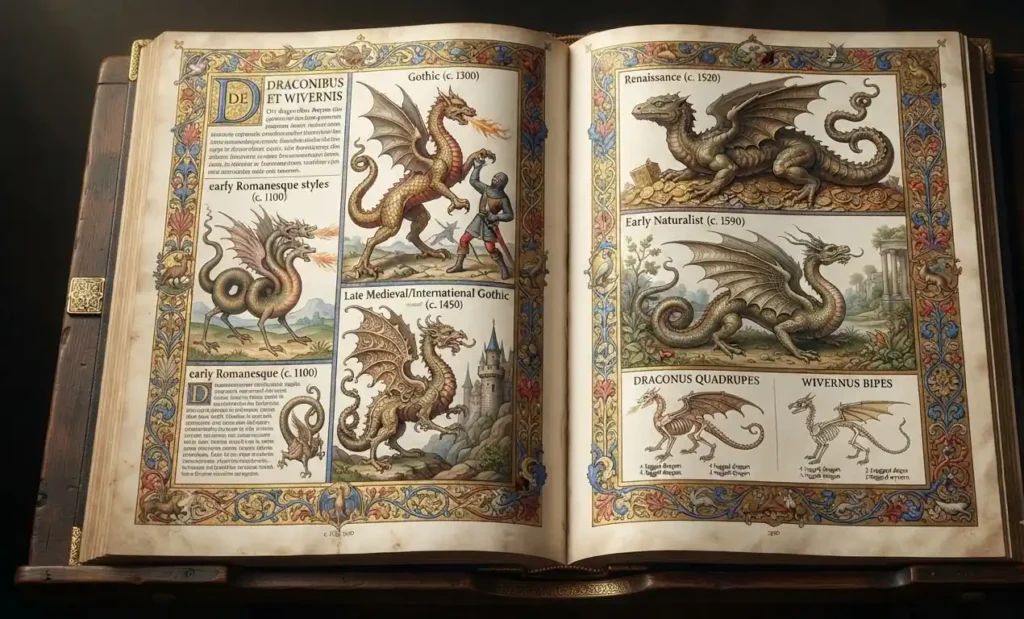
Medieval bestiaries, the illustrated compendiums of real and fantastic animals that circulated throughout Europe from roughly the twelfth century onward, were not consistent about limb count when depicting dragon like creatures.
Illustrations from different manuscripts, sometimes even within the same manuscript tradition, show dragons with two legs, four legs, or no legs at all, existing alongside each other without any apparent concern for taxonomic consistency.
The terms used in Latin and vernacular texts were similarly fluid. Draco, the Latin term underlying dragon, was applied broadly to serpentine monsters of varying description. The surviving medieval evidence does not show the same consistently standardized dragon-versus-wyvern distinction found in later heraldic tradition.
How Heraldry Formalized the Distinction
The rigid two leg versus four leg rule is largely a product of later heraldic systematization, particularly as English heraldry developed into a more codified discipline from the late medieval period into the early modern era.
As heraldic treatises multiplied and heralds needed consistent, reproducible symbolic vocabulary for blazoning coats of arms, precise and stable definitions became genuinely useful. A herald describing a coat of arms in formal blazon needed unambiguous terms, and fixing dragon at four legs and wyvern at two legs gave the profession exactly that kind of precision.
Standard heraldic reference works from the nineteenth and twentieth centuries, including Arthur Charles Fox-Davies’s widely used A Complete Guide to Heraldry, codify this distinction as the accepted rule within formal heraldic practice, even while acknowledging that earlier and less formal usage was considerably looser.
The Wyvern in British Heraldry
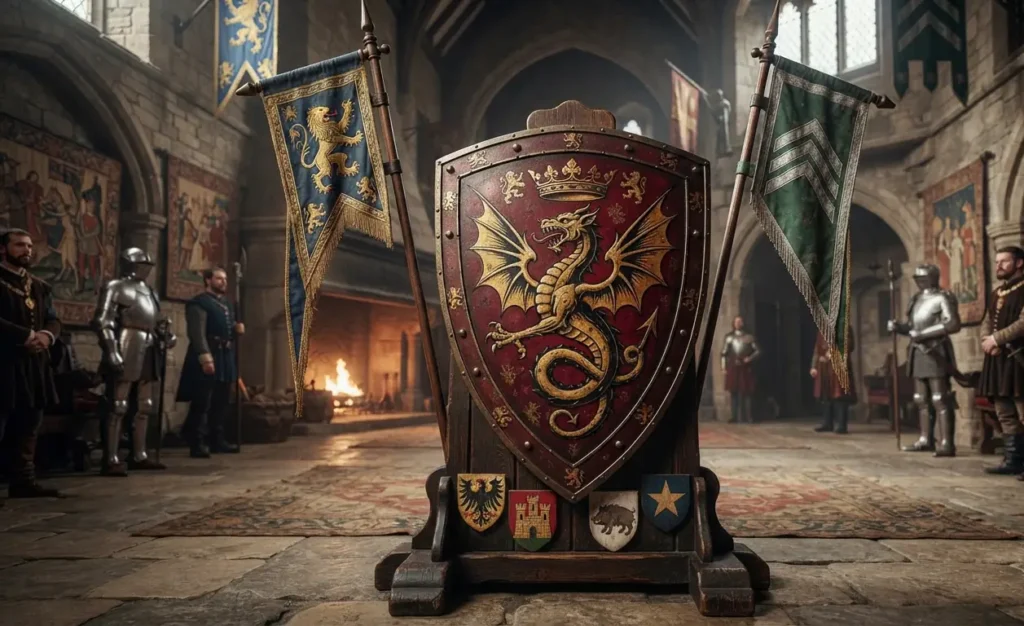
The Wyvern of Wessex
The most historically significant wyvern in English tradition is the Wyvern of Wessex, associated with the historic Anglo-Saxon Kingdom of Wessex.
The connection traces partly to interpretations of the Bayeux Tapestry, which depicts a fallen dragon like standard near King Harold at the Battle of Hastings in 1066. Antiquarians and heralds in later centuries identified this fallen standard with the golden dragon banner associated with Wessex in earlier Anglo-Saxon sources, and the wyvern form became the specific heraldic identity attached to that historical association.
I want to be honest about the uncertainty here, because it matters for accurate mythology writing. The Bayeux Tapestry’s dragon standard isn’t labeled precisely enough for modern scholars to confirm with certainty that it was specifically a two legged wyvern rather than a more generic dragon image.
The specific Wyvern of Wessex as we know it today reflects a considerable amount of later heraldic revival and reconstruction layered onto an older and less precisely documented tradition.
That said, the wyvern remains actively used as a regional symbol connected to Wessex in modern contexts, including on regional flags and in military heraldry connected to regiments historically associated with the area.
What the Wyvern Symbolized
Beyond its regional Wessex association, the wyvern carried specific symbolic connotations in heraldic tradition that differed somewhat from the broader dragon.
Given its etymological connection to the viper, the wyvern was frequently associated with pestilence, envy, and war rather than the fuller range of meanings, including guardianship and sovereignty, that attached to the four legged dragon in heraldic symbolism. This distinction in meaning reinforces that heralds genuinely treated these as separate symbolic vocabularies rather than simply variant drawings of the same underlying concept.
Related Creatures That Complicate the Picture

The Lindworm
The lindworm, prominent in Germanic and Scandinavian tradition, adds a third category to this taxonomy and shows that European dragon like creatures existed along a genuine spectrum rather than a strict two option system.
A lindworm is typically depicted as wingless and serpentine, sometimes with a single pair of forelimbs and no hind legs at all, sometimes with no legs whatsoever. It moves more like a genuinely enormous snake than like a flying reptile.
Scandinavian folklore and heraldry, particularly in regions like Sweden where the lindworm remains a recognized heraldic figure, treat it as its own distinct creature rather than as a variant dragon or wyvern.
The existence of the lindworm as a third documented category is a useful reminder that the dragon and wyvern distinction, however tidy it looks in a heraldry textbook, sits within a much messier and more varied medieval imagination about what serpentine monsters could look like.
| Creature | Legs | Wings | Typical tradition |
|---|---|---|---|
| Dragon | 4 | 2 | Later European heraldry |
| Wyvern | 2 | 2 | Later European heraldry |
| Lindworm | Varies | Usually no | Germanic/Scandinavian |
| Cockatrice | 2 | 2 | Medieval/early modern |
| Wyrm | Usually serpentine | Usually no | English/Germanic usage |
The Cockatrice
The cockatrice adds another layer of complication. This creature is typically depicted with a wyvern’s two legged, winged body combined with a rooster’s head and comb, and its legendary power, a lethal gaze or breath, borrows heavily from the related basilisk tradition.
Heraldic sources sometimes describe the cockatrice explicitly as a wyvern with a cock’s head, which tells you something important: medieval and early modern imagination treated the wyvern body plan as a kind of base template that other hybrid creatures could be built from, rather than as an entirely sealed off category unrelated to anything else in the bestiary.
Does the Distinction Hold Up in Fantasy Fiction Today
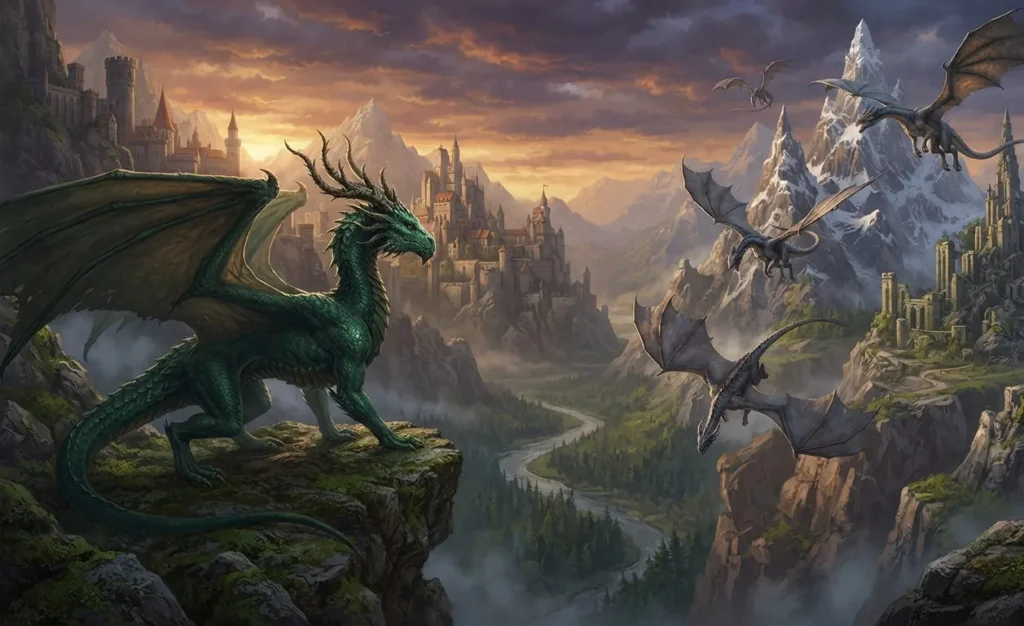
Modern fantasy has effectively created its own creature taxonomy, which doesn’t always match medieval heraldry.
Some authors and illustrators maintain the strict heraldic rule deliberately, using wyvern specifically for two legged, venom associated creatures distinct from their four legged dragons. Others use wyvern more loosely as simply a smaller, wilder, less intelligent cousin to the dragon, regardless of leg count, which reflects popular usage more than formal heraldic precision.
It’s worth noting, since readers ask about this constantly, that many readers and critics have observed that the dragons depicted throughout George R.R. Martin’s A Song of Ice and Fire, with their two legs and two wings, actually match the traditional heraldic wyvern body plan rather than the four legged dragon.
Whether this reflects deliberate authorial choice or simply the visual convention that illustrators and adapters gravitated toward is genuinely debated among readers, and I don’t think there’s a definitive public statement from Martin settling the question either way.
How to Actually Tell Them Apart at a Glance
If you want a quick practical checklist for identifying which creature you’re looking at in a piece of art, a coat of arms, or a description, here’s what to check:
- Count the legs. Four legs plus wings means dragon. Two legs plus wings means wyvern.
- Check the tail. A barbed, knotted, or stinger tipped tail leans wyvern. A long, smooth, serpentine tail without a distinct barb leans dragon.
- Look at the forelimbs. If the creature’s wings appear to double as forelimbs when the creature is grounded, that’s the wyvern’s distinctive anatomy.
- Consider the context. Formal heraldic sources will almost always apply the strict rule. Popular fantasy fiction and illustration may use the terms more loosely.
Frequently Asked Questions
Is a wyvern technically a dragon?
In casual usage, wyverns are often grouped under the broader dragon category. In heraldry and modern fantasy usage, wyvern is often treated as a distinct form of dragon-like creature, defined specifically by having two legs rather than four and by their etymological connection to the viper rather than the broader draco tradition.
Why do wyverns have two legs instead of four?
The two legged body plan reflects an older conception of the creature as an enormous winged serpent rather than a fully reptilian four legged beast. This anatomy connects the wyvern to earlier European folklore about giant venomous serpents rather than to the composite, multi limbed dragon that later imagery developed.
What does the word wyvern actually mean?
Wyvern derives from Old French and Anglo Norman forms ultimately rooted in the Latin vipera, meaning viper. The name essentially identifies the creature as a giant, winged viper rather than as a dragon variant, which reflects how medieval speakers likely understood its fundamental nature.
Are Game of Thrones dragons wyverns or dragons?
Many readers and critics have pointed out that the dragons in A Song of Ice and Fire, with two legs and two wings, technically match the heraldic wyvern body plan rather than the traditional four legged dragon. Whether this was a deliberate choice remains genuinely debated among fans and reviewers.
What’s the difference between a wyvern and a lindworm?
A wyvern has two legs and two wings. A lindworm, prominent in Germanic and Scandinavian tradition, is typically wingless and serpentine, sometimes with a single pair of forelimbs and no hind legs, sometimes with no legs at all. Both are distinct from the four legged, winged dragon.
Final Thoughts
The dragon and wyvern distinction remains one of my favorite small corners of Western mythology precisely because it’s genuinely documented rather than invented after the fact. The etymology holds up. The heraldic rule holds up. The historical messiness underneath the tidy modern rule holds up too, and that messiness is honestly the more interesting part.
Next time you’re looking at a coat of arms, a carved gargoyle, or an illustrated dragon, count the legs first. It’ll tell you more about what you’re actually looking at than almost any other single detail available.
References & Further Reading
- Arthur Charles Fox-Davies – A Complete Guide to Heraldry
- Eve, G. W. Heraldry as Art: An Account of Its Development and Practice, Chiefly in England. 1907.
- Boutell, Charles. The Handbook to English Heraldry. Revised by A. C. Fox-Davies.
- British Library – “The Anatomy of a Dragon”
- British Library – “What is a bestiary?”
- Wyvern – Oxford English Dictionary
Related Articles
- Why Dragons Exist In Almost Every Culture On Earth
- Why Dragons Are The Most Beloved Fantasy Creatures
- Western Dragon vs Eastern Dragon [Myth, Power & Origin]
- 15 Most Iconic Fantasy Creatures: East & West Mythology
- 11 Oldest Dragons in World Mythology: Sumeria to China
- Why Dragons Are Almost the Perfect Mythological Creature
- What If Dragons Were Real? Here’s What Would Happen