
 By
Here’s a fact that should reframe how you picture Hera.
At two of her most important cult sites, Samos and Argos, archaeologists date the earliest monumental temples to roughly 800 BCE, among the oldest such structures anywhere in Greek religion.
If anyone deserves to be introduced by their relationship to someone else, the dating runs the other direction.
The Temples Came Before the Reputation
Samos, and the Oldest Enclosed Sanctuary in Greek Religion
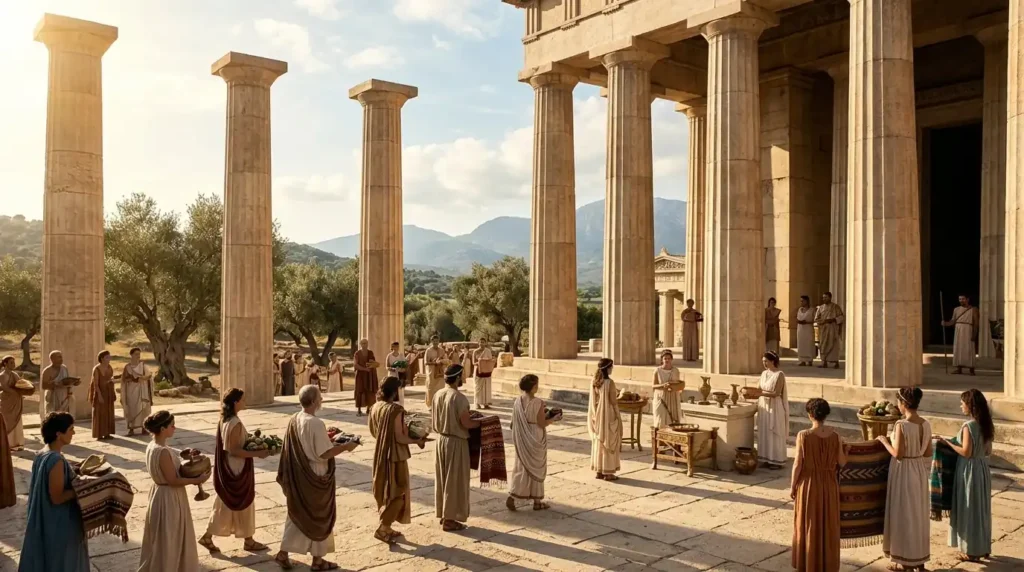
The Heraion of Samos traces cult activity back to late Mycenaean material in the second millennium BCE, with the first proper monumental temple constructed around 800 BCE. Some scholars identify this as possibly the first enclosed, roofed temple sanctuary the Greeks ever built, for any deity.
That’s not a minor footnote. It means the physical architecture of organized Greek temple worship may have developed first specifically around Hera, not around Zeus or any other Olympian.
Argos Tells the Same Story
The Argive Heraion, standing between the old Mycenaean centers of Argos and Mycenae, shows the same roughly 800 BCE dating for its earliest monumental phase.
Two of her most significant cult centers, geographically distant from each other, both reach back to the same early period independently.
A Goddess Before She Was a Wife
The Early Cult Was Dominated by Women Specifically
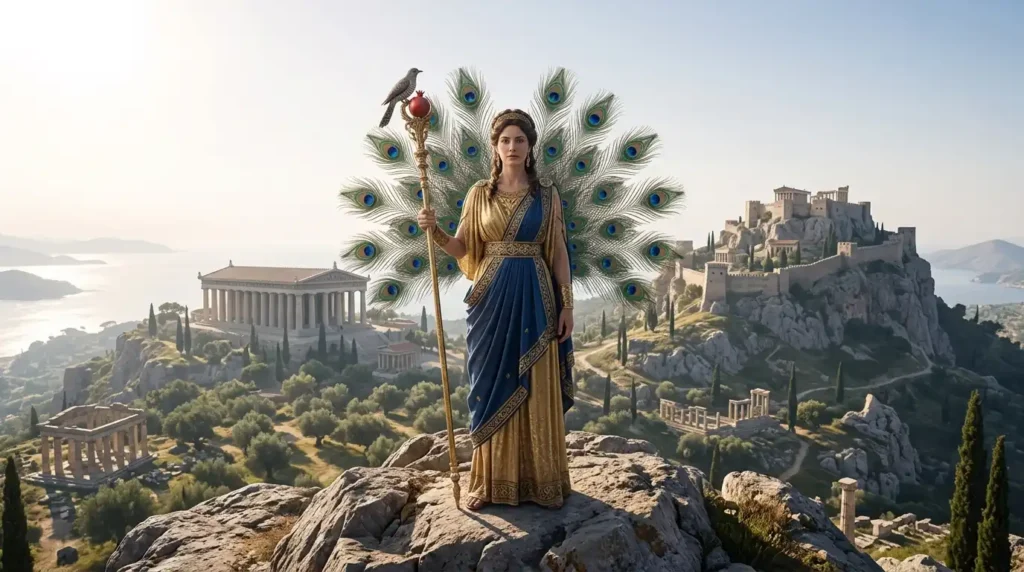
A detail that rarely makes it into popular retellings. The oldest stage of Hera’s worship at Samos shows a cult dominated by women, with distinctly male forms of dedication, miniature votive boats specifically, only appearing in the archaeological record later.
That sequencing matters. Before Hera’s story became fully entangled with Zeus’s infidelities, her worship on Samos functioned as something women specifically maintained and shaped.
Pomegranates, Not Wedding Rings
Hera’s imagery at Samos consistently depicts her holding pomegranates, a fertility symbol, and her worshippers offered pomegranates made of clay and ivory as dedications.
That’s consistent with scholarship describing her original role there as a chthonic fertility goddess and protectress, independent of her later betrothal narrative entirely.
The marriage to Zeus isn’t where Hera starts. It’s a layer added onto a goddess whose own cult was already old and already serving a different, more foundational purpose.
Marriage Wasn’t a Domestic Role. It Was a Cosmic Institution
The Hieros Gamos, Properly Explained
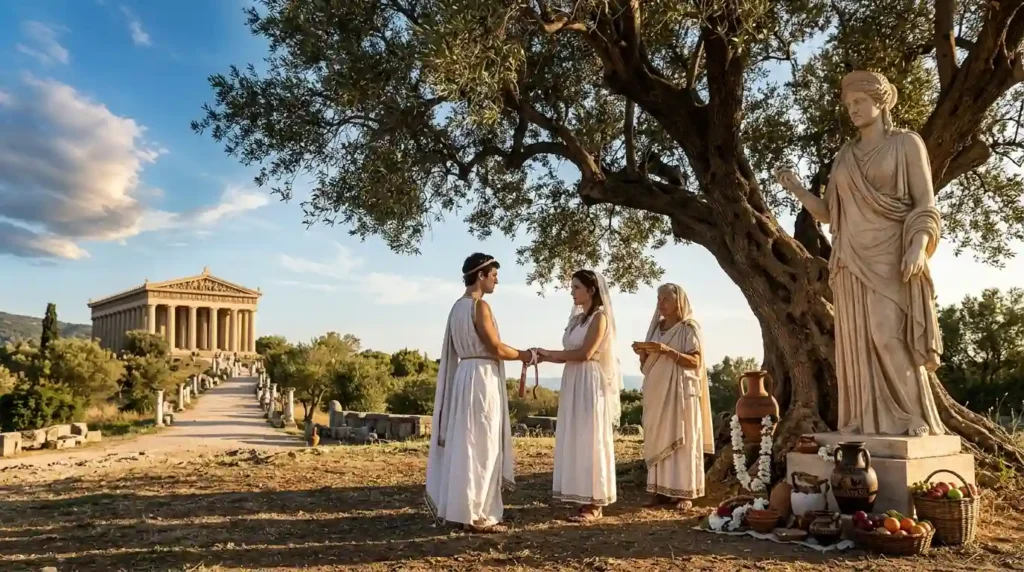
The Hieros Gamos, the sacred marriage, was reenacted ritually at the Heraion of Samos, with human participants or symbolic representations standing in for the gods themselves.
This wasn’t theater. It functioned as a fertility rite, tying the renewal of agricultural and social order directly to the ritual reaffirmation of this specific divine union.
Why This Reframes Zeus Teleios and Hera Teleia
Ancient commentary on Aeschylus directly explains that Hera Teleia and Zeus Teleios were honored together specifically in wedding ceremonies, since they presided jointly over marriage as an institution.
It’s a significant theological role, not a domestic footnote. An entire society’s weddings were conducted under her specific authority.
Treating marriage goddess as a lesser title than war god or sky god says more about modern assumptions than about how a culture that depended entirely on marriage for legitimate inheritance, political alliance, and social continuity weighted the role.
Reframing the Anger
She Punishes the System’s Violation, Not Just Her Own Hurt Feelings
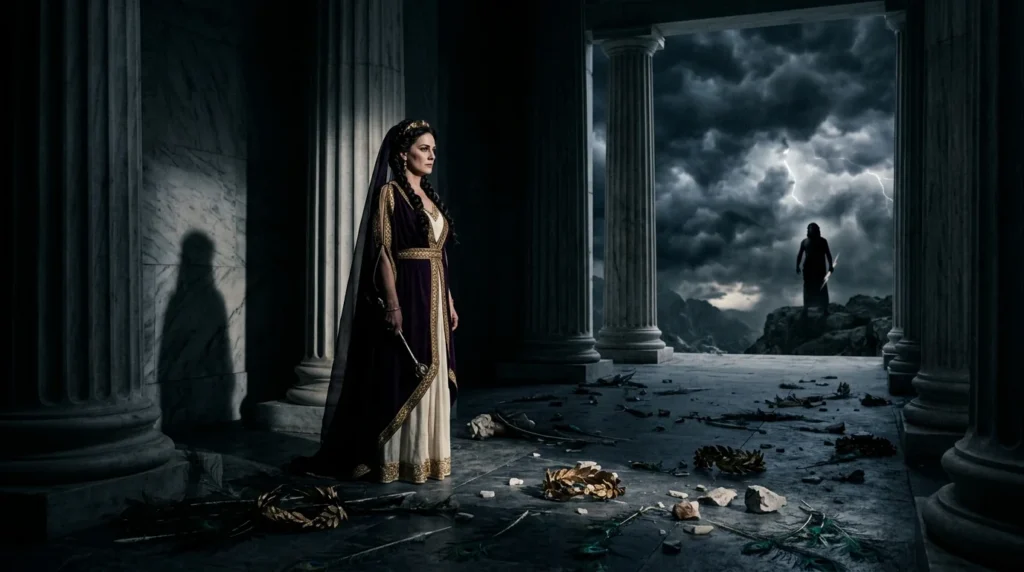
Hera’s consistent pattern, punishing Zeus’s partners and offspring rather than Zeus himself. I want to push that observation one layer deeper here.
If Hera functions as the presiding authority over marriage as a sacred institution, her repeated response to its violation reads less like personal jealousy and considerably more like a goddess enforcing the exact law she was worshipped to uphold.
Io, Callisto, Semele, every documented punishment targets a breach of the specific order she was installed to protect.
That Doesn’t Make the Punishments Fair
I want to be direct that this reframing explains the mechanism without excusing where the consequences actually land.
A goddess enforcing marital order by punishing the women Zeus pursued, rather than Zeus himself, is still a goddess whose justice falls overwhelmingly on the less powerful party.
Understanding her motive as institutional rather than petty doesn’t make the distribution of consequence any less unbalanced.
An Honest Counterargument
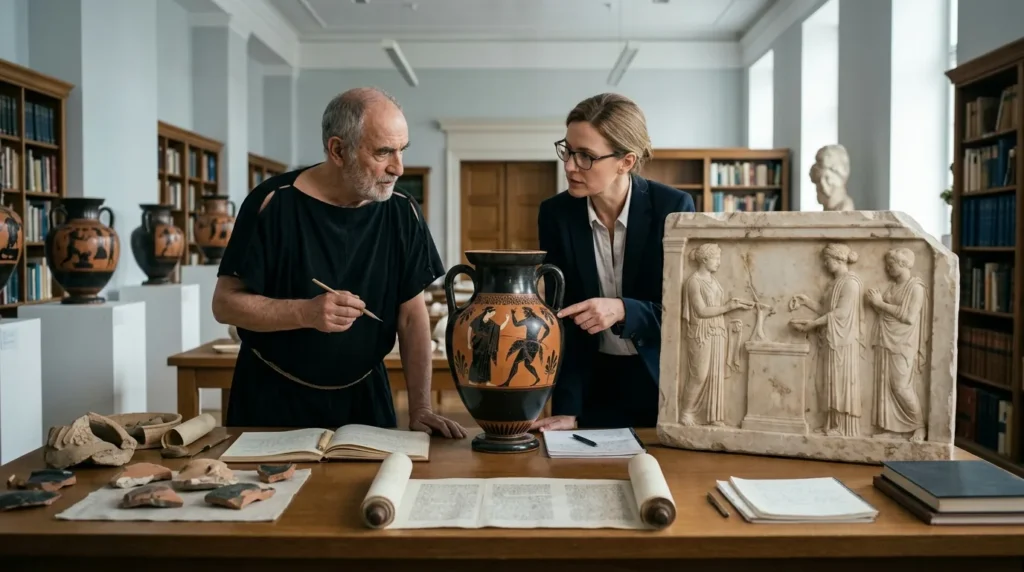
I want to apply real scrutiny to the matriarchal origins reading rather than let it stand as settled fact, because this is contested academic territory.
Broader theories proposing a widespread prehistoric matriarchal religion across old Europe, particularly associated with the work of archaeologist Marija Gimbutas, have faced substantial pushback from later archaeologists and historians.
They argue that the evidence for a matriarchal social structure, rather than simply goddess-centered religious imagery, is considerably thinner than the theory’s popular version suggests.
Applying that same caution here, the fact that Hera’s cult predates her marriage narrative, and that her earliest Samian worship skewed female, is documented.
Concluding from that evidence alone that Samos once had matriarchal political structure, rather than simply a religious tradition centered on a goddess within a society organized differently, is a bigger claim than the archaeology alone can carry.
I’d rather state the dating plainly, which is solid, and treat the fuller social reconstruction built on top of it as a real but contested interpretation rather than settled fact.
What This Changes
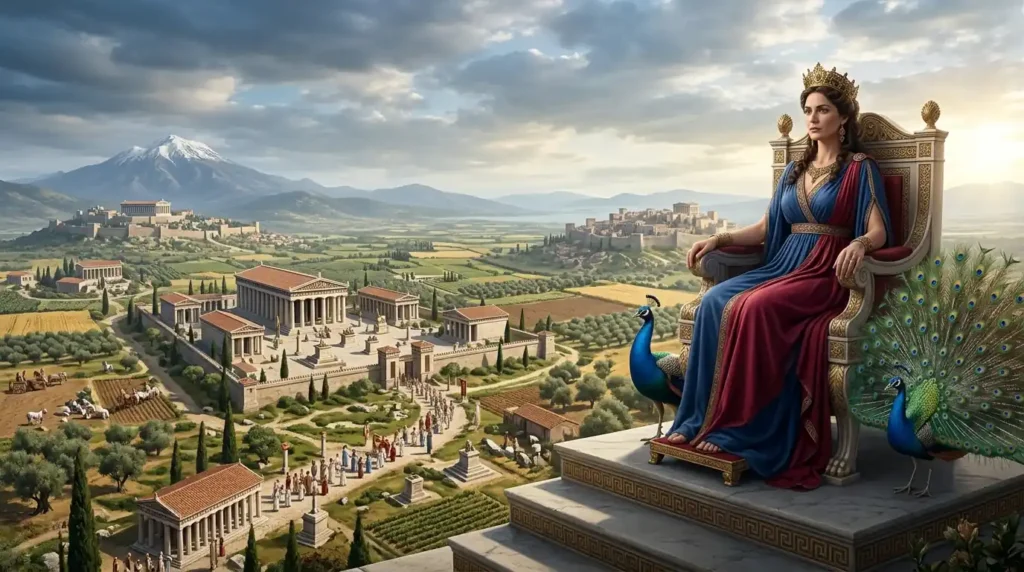
Hera’s temples predate her marriage story’s dominance in how she’s remembered. Her earliest worship centered women specifically.
Her marriage to Zeus, when it does appear, functioned as cosmic and agricultural order rather than domestic arrangement, reenacted annually by an entire community rather than treated as a private relationship.
None of that erases the difficult parts of her mythology, the punishments that land on victims rather than perpetrators.
It does mean that introducing her primarily as someone’s jealous wife gets the actual historical sequence backwards, and flattens a goddess whose own cult likely predates the husband she’s constantly measured against.
Frequently Asked Questions
Is there archaeological evidence for Hera’s cult specifically at a third major site beyond Samos and Argos?
Yes. Hera also had a significant sanctuary at Olympia, where her temple is documented as predating the later Ionic temple built for Zeus at the same site, adding a third location where her worship appears to establish precedence before his.
What happened to the physical cult image of Hera at Samos over time?
Did the matriarchal origins theory for Hera specifically originate with Marija Gimbutas, or is it a separate line of scholarship?
It draws on a broader tradition of goddess centered prehistoric religion scholarship that predates and extends beyond Gimbutas specifically, though her work remains the most widely cited and most heavily critiqued version of the larger argument.
Is the Heraia festival still studied as a specific, reconstructable set of rituals today?
Scholars have reconstructed general outlines involving sacrifice, procession, and offering based on archaeological and textual evidence, though the complete original ritual sequence isn’t fully recoverable given the fragmentary nature of surviving sources from this period.
Did Hera’s Roman counterpart Juno inherit this same emphasis on marriage as a cosmic institution?
Yes, and arguably with even greater civic weight. Roman religious and social life placed marriage, household, and family at a particularly central position, which gave Juno’s cult significant ongoing importance throughout Roman religious practice.
Final Thoughts
Hera’s temples were standing before the stories that reduce her to a supporting role in someone else’s infidelities fully took shape.
Not a minor correction, and It’s close to the true historical order these myths got told in, reversed.
Related Articles
- How Zeus Overthrew His Father to Rule Olympus
- The 12 Olympian Gods: Powers, Symbols & Key Stories
- Greek Mythology 101: Gods, Heroes & Monsters
- Who Were the Titans? Names, Powers & Their Downfall
- 13 Legendary Greek Heroes, Ranked by Their Feats
- Gaia: Greek Mythology’s Original Mother Goddess
- Rhea: The Titaness Who Tricked a God-Eating Titan
- Poseidon: The God of the Sea, Earthquakes & Horses
- Athena: Why the Goddess of Wisdom Was Also a Warrior
Sources & Further Reading
- The Princeton Encyclopedia of Classical Sites, SAMOS Greece.
- The Significance of Votive Offerings in Selected Hera Sanctuaries – Jens David Baumbach
- The Old Temple Terrace at the Argive Heraeum and The Early Cult of Hera in the Argolid | The Journal of Hellenic Studies
- Marriage, Sacred | Oxford Classical Dictionary | Oxford Academic
- Aeschylus, Eumenides
- The Archaeological site of Olympia
Written by Batin Khan, a curious free spirit who loves reading and exploring the worlds of fantasy, mythology, and ancient stories. Through this blog, Batin hopes to share that sense of wonder with readers while building an exciting future along the way.