
 By
By I’ve written on this blog about Cronus’s specific strategic error, choosing to swallow his children rather than kill or exile them, and about Gaia’s consistent pattern of opposing whoever currently suppresses her offspring.
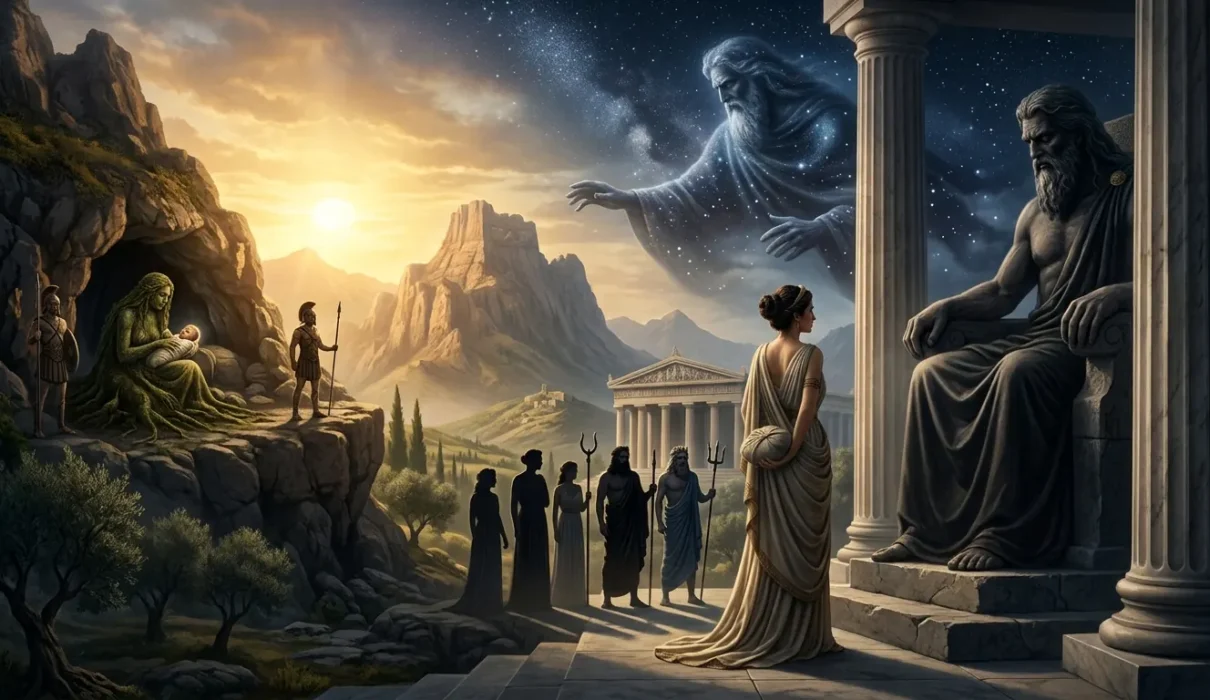
What neither of those pieces properly covered is the person actually living inside that household, watching five of her own children disappear one at a time, who then had to pull off something considerably harder than a single clever trick.
She had to keep living with the man she was deceiving, for years, without ever slipping.
What Hesiod Actually Says About Her
Daughter, Sister, and Eventually Wife of the Same Generation
Hesiod’s Theogony places Rhea among the twelve Titans, born to Gaia and Ouranos alongside Cronus, Oceanus, Themis, and the rest. She marries Cronus, her own brother, which was simply how divine succession worked in this particular family tree.
Together they produce Hestia, Demeter, Hera, Hades, Poseidon, and Zeus, in that specific order, and Cronus swallows every one of the first five the moment Rhea delivers them.
The Detail Most Retellings Skip
Hesiod doesn’t dwell on what those five successive losses actually did to her. He moves through the list quickly, functionally, the way a genealogy is supposed to move.
But five children in a row, watched, delivered, and immediately gone, is not a minor detail to skip past quickly, and I think the speed of that passage tells you something about what ancient epic considered worth lingering on and what it didn’t.
The Actual Plan, and Who Supplied It

She Didn’t Improvise Alone
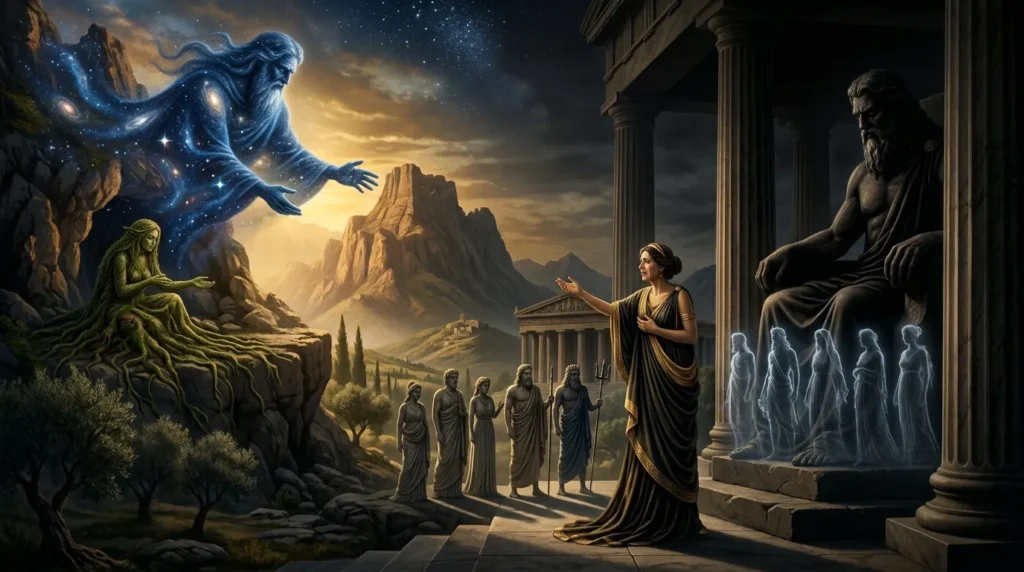
When Rhea was pregnant with her sixth child, she went to Gaia and to Ouranos, the very father Cronus had castrated and asked for their help preventing the same fate for this one.
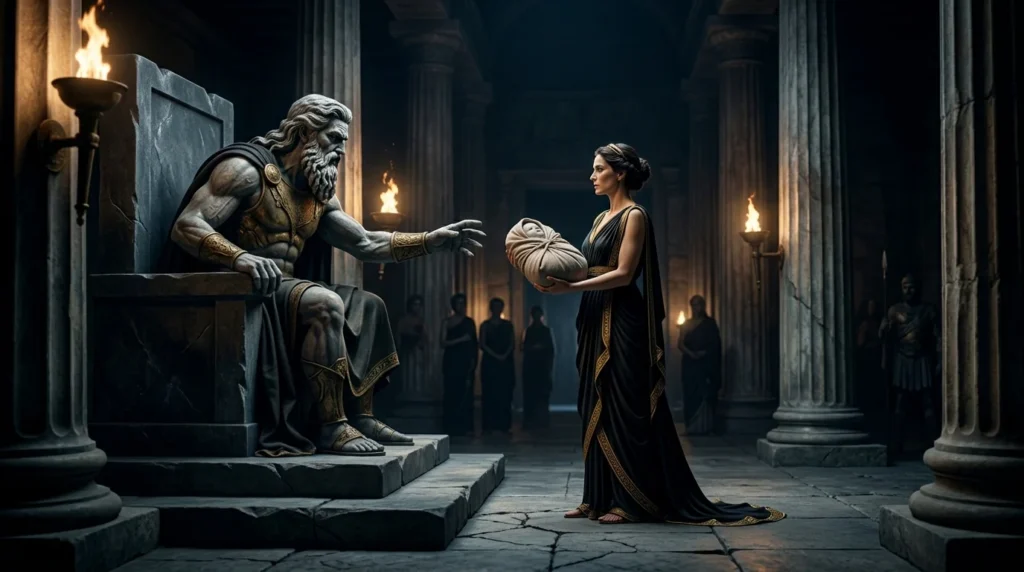
Gaia sent her to Crete specifically to give birth in secret. The stone substitution, wrapped in swaddling cloth and handed to Cronus in place of the infant, is the plan’s actual mechanism, and Cronus swallowed it without checking, exactly as he’d swallowed five real children before it.
Why Crediting Only the Trick Undersells the Achievement
Most summaries stop here, treating the swallowed stone as the whole story. That’s the easy, one-time part. The truly difficult part started immediately afterward, and it’s the part I think deserves real attention rather than a passing mention.
The Part That Actually Required Nerve
Living the Lie, Not Just Telling It Once
Rhea didn’t simply pull off a single deception and move on. She had to continue existing as Cronus’s wife, in his household, for years, while her actual youngest child grew up on a different island entirely, hidden specifically from the man she went home to.
That’s a fundamentally different kind of difficulty than the stone trick itself. A single successful deception requires cleverness in one moment. Sustaining one requires never once breaking character across an indefinite stretch of ordinary domestic time, grief and secrecy both held perfectly still behind an entirely normal seeming marriage.
The Kouretes Solved the Part She Couldn’t Control From a Distance
Rhea couldn’t personally guard Zeus every moment while also maintaining her life beside Cronus, so the plan required other hands entirely. The Kouretes, sometimes numbered as three, five, or nine, were rustic spirits appointed specifically to guard the infant god in a cave on Mount Ida.
Their actual method is specific and worth describing properly rather than gesturing at vaguely. They danced in armor, clashing spear against shield in a rhythmic, sustained performance, drowning out an infant’s crying loud enough that Cronus, wherever he was, wouldn’t hear it.
This Wasn’t Purely Myth. It Became Living Ritual
Historical cult practice on Crete genuinely reenacted this dance, the Pyrrhic dance specifically, performed by priests representing and commemorating the Kouretes’ original act.
That’s a real, documented religious practice, not simply a narrative detail invented for the story’s own sake, which tells you the deception itself was treated as sacred enough to physically repeat, generation after generation, long after anyone believed Cronus was still listening for it.
Where Rhea Blurs Into Cybele, and Why That’s Interesting

Two Goddesses, One Set of Attendants
Ancient sources themselves aren’t fully consistent about where Rhea ends and the Phrygian goddess Cybele begins.
Euripides and the geographer Strabo both used the same terms, Kouretes and Korybantes, for the attendants of both goddesses interchangeably, which tells you the ancient world itself experienced these as overlapping figures rather than two cleanly separate ones.
Euripides’ Bacchae has Dionysus himself describe the tambourine as an invention shared between himself and mother Rhea, then immediately shifts into praising the righteous orgies of the great mother Kybele in the very same passage, treating the two names as functionally continuous.
Rome Imported the Blurred Version, Deliberately
In 204 BCE, during the Second Punic War, Rome consulted the Sibylline Oracles and was told the foreign invader would be driven from Italy only if the Idaean Mother was brought to the city from Anatolia.
The Roman political elite arranged exactly that, bringing a specific meteoric stone understood to embody the goddess into the city and eventually building her a temple on the Palatine Hill, dedicated in 191 BCE.
That’s a real, documented, dated historical event, not myth. A city at war deliberately imported a mother goddess whose own iconography, armed dancers protecting a hidden infant, was already understood as continuous with Rhea’s own story on Crete centuries earlier.
An Honest Complication: How Much of This Is Actually Hers

Gaia Supplies the Strategy in Every Version That Survives
I want to be direct about something the celebratory framing of this whole story tends to skip. In Hesiod’s own account, Rhea seeks help and receives a plan already worked out by Gaia and Ouranos. She isn’t credited with independently devising the stone substitution herself.
That’s worth sitting with honestly rather than smoothing over for a tidier heroic narrative. The specific cleverness, in the earliest surviving source, belongs to her mother and the grandfather Cronus had already overthrown once before.
What Does Belong to Rhea Alone
What the sources do consistently and specifically credit her with is everything that came after the plan was handed to her. She’s the one who carried the pregnancy, delivered in secret, handed over the substitute, and then continued living inside a marriage built on a secret only she was maintaining in real time, day after day, for years.
Strategy and execution aren’t the same achievement, and I think giving Rhea proper credit means being precise about which one is actually hers. The idea may have come from elsewhere. The sustained nerve required to live it, without a single documented slip across an indefinite stretch of time, was entirely her own.
Frequently Asked Questions
Is there archaeological evidence connecting the Kouretes to a real historical cult on Crete rather than pure literary invention?
Yes. Historical sources describe an actual, ongoing priestly tradition performing the Pyrrhic dance in commemoration of the Kouretes’ mythical act, indicating a real, sustained religious practice rather than a detail existing only within literary retellings of the myth.
Did Rhea have her own independent temples, separate from her later identification with Cybele?
Ancient sources describe her as worshipped fairly widely as an earth and fertility goddess in her own right across the Greek world, though her cult became increasingly intertwined with Cybele’s over time, making a fully separate, unmixed Rhea cult difficult to isolate cleanly by the later classical period.
What was Rhea’s Roman equivalent, separate from the later Cybele importation?
Rhea was also associated with Ops, a Roman fertility and harvest deity, giving her two distinct points of Roman religious contact, the older native Ops identification and the later, more elaborate imported Cybele cult, existing somewhat separately within Roman religious tradition.
Why do ancient sources specifically emphasize armor and weapons in the Kouretes’ protective dance rather than a quieter method of hiding the infant?
The armed, rhythmic dance specifically doubled as a coming-of-age warrior initiation ritual, the Pyrrhic dance, connecting infant Zeus’s protection directly to a broader cultural tradition celebrating martial readiness rather than functioning purely as a practical, silent concealment method.
Did the Romans view Cybele’s arrival in 204 BCE as directly resolving the Second Punic War?
Roman sources connected her arrival to the war’s eventual favorable outcome, and the temple and games established afterward reflect genuine gratitude, though attributing outright military victory purely to a religious import oversimplifies the war’s actual, considerably more complicated historical resolution.
Final Thoughts

The stone trick gets remembered because it’s the part of the story you can tell in a single sentence.
The years afterward, an armed dance repeated on a mountainside and a marriage sustained on top of a secret that never once slipped, are the part that actually took nerve, and they’re the part this article wanted to give back to her properly.
Related Article
- How Zeus Overthrew His Father to Rule Olympus
- Chaos: The Primordial Void Before the Greek Gods
- How Norse & Greek Mythology Built Modern Dark Fantasy
- 13 Legendary Greek Heroes, Ranked by Their Feats
- The 12 Olympian Gods: Powers, Symbols & Key Stories
- Greek Mythology 101: Gods, Heroes & Monsters
Sources & Further Reading
- HESIOD, THEOGONY
- Diodorus Siculus – Book V Chapters 47‑84
- Strabo’s Geography – Book X Chapter 3
- Hymn of the Curetes inscription – Heraklion Archaeological Museum
- RHEA-CYBELE ESTATE & ATTRIBUTES – Greek Mythology
- CULTS OF THE MOTHER OF THE GODS AND RHEA-CYBELE (CHAPTER VI) – The Cults of the Greek States
Written by Batin Khan, a curious free spirit who loves reading and exploring the worlds of fantasy, mythology, and ancient stories. Through this blog, Batin hopes to share that sense of wonder with readers while building an exciting future along the way.