

 By
Quick Takeaways:
- The Iliad opens with Apollo’s plague, and the cure is a song to the same god. The poem treats sending and stopping disease as one power.
- My reading is that his shared trait is distance and aim. He strikes from afar, so he can also hold the arrow back.
- Greek plague response was ritual purification first. Medicine came later and mostly through his son Asclepius.
- The “double face” may be older than Greece, but those Near Eastern links are suggestive rather than proven.
The first thing that happens in the Iliad is not a battle. It’s a priest on a beach, praying for his daughter back, and a god who answers by sending a plague.
I’ve mentioned Apollo’s mixed portfolio in my piece on the twelve Olympians. Here I want to slow down on the question that always nags me when I read that opening. Why would one god be trusted with both the disease and the cure?
The First Plague in Western Literature

Mules and Dogs First
Chryses, a priest of Apollo, comes to the Greek camp to ransom his daughter Chryseis. Agamemnon, who holds her as a prize, threatens him and sends him away. The old man walks along the shore and prays to Apollo.
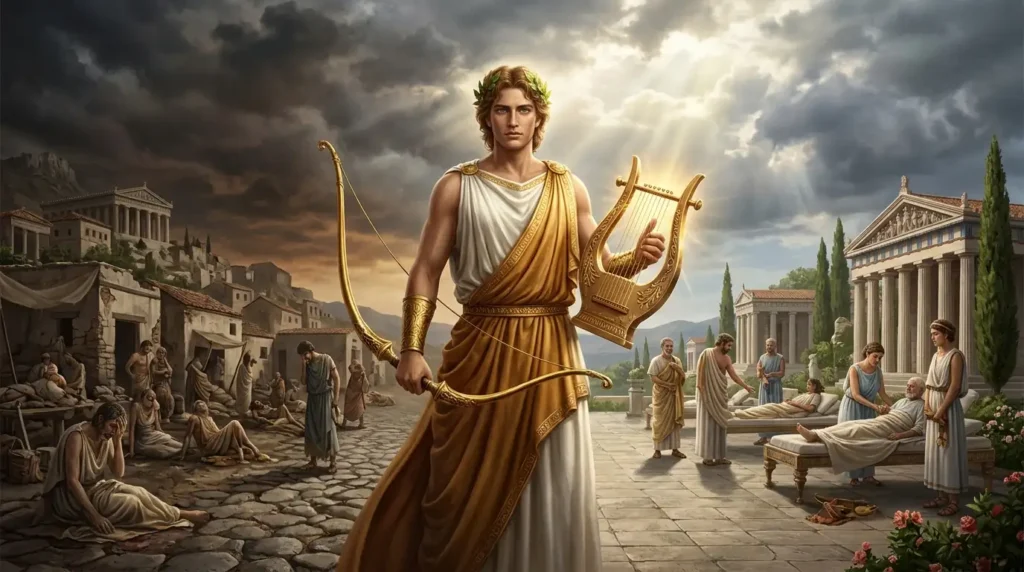
The god comes down from Olympus with his silver bow, and the arrows rattle on his shoulder. The plague strikes mules and dogs first, then the men, and the pyres burn without pause.
I think that order is a clue. Whoever composed the scene knew pestilence spread through animals before people, or at least dressed the story with that observation.
Nine Days, Then a Diagnosis
The arrows fall for nine days. On the tenth, Achilles calls an assembly, and the seer Calchas explains that Apollo is angry over the insult to his priest.
The fix is specific. Return the girl without ransom, and send a hecatomb to Chryse. Nothing in the diagnosis involves morality in the modern sense. It’s a violated relationship between a god and his servant.
The Cure Is a Song
After Odysseus returns Chryseis, the Greeks spend the day propitiating Apollo with a paean, a song of praise and healing. The poem says the god’s heart was pleased when he heard it.
Paean was also the name of a divine physician in Homer, who heals wounded gods. Later writers treat it as an epithet of Apollo. The same word names the doctor and the hymn that appeases the one who sent the sickness.
What Smintheus Might Mean
In the opening scene, the priest calls him Smintheus. Ancient commentators, Strabo among them, linked the title to a word for mouse.
Some modern writers have wondered whether that hints at rodent borne disease. I’d file it under speculation, since the etymology itself is debated.
Why One God Has Both
The Far Shooter
Apollo’s standard epithets include hekebolos and hekatebolos, which mean something like “far shooter.” He fights and kills from a distance, and he never closes with his target.
His twin Artemis shares the bow. In the Iliad, when Niobe boasts about her many children, Apollo kills the sons and Artemis the daughters with arrows, and they lie unburied for nine days.
Sudden Death Had a Return Address
The Odyssey uses the same idiom for ordinary deaths. When Menelaus’s helmsman Phrontis dies suddenly at sea, the poem says Apollo’s gentle arrows reached him.
So for a Greek listener, an unexplained sudden death was an arrow from Apollo or Artemis. Plague was that same event on a large scale.
My Reading: Withholding Is the Healing
Here’s the idea I keep returning to. A god who acts by aim can aim elsewhere. If the arrow is the plague, healing is the arrow not shot, or a shot recalled.
I’m offering this as an interpretation. No Greek source states the logic in those terms, but the cure in the Iliad fits it. The remedy works by appeasing the archer, not by neutralizing the disease.
Cure Meant Purification First

Pollution Was the Medical Model
The Greeks had a word, miasma, for the stain brought by killing, birth, death, and certain offenses. Contact with it was dangerous, and ritual cleansing removed it.
Apollo was the god people consulted about that cleansing. In Aeschylus’ Eumenides, he purifies Orestes at Delphi with the blood of a piglet before sending him to Athens.
Delos, Cleaned Out
Thucydides reports that in the winter of 426 BCE, during the plague years, the Athenians purified the island of Delos, Apollo’s birthplace. They dug up the graves and declared that no one could be born or die on the island.
The sick and the pregnant were moved to a neighboring island. That’s a striking policy, and it tells you how seriously they took the connection between death, pollution, and the god’s sanctuary.
I’d caution that Thucydides himself doesn’t spell out the plague link in that passage. Scholars connect the two because of the timing and the god involved.
The Son Who Took Over the Medicine

Asclepius and the Raven
Pindar’s third Pythian ode tells how Apollo’s lover Coronis took another man. Apollo killed her, then rescued the unborn Asclepius from her pyre and gave him to the centaur Chiron to raise.
Asclepius became so skilled that he could bring the dead back to life. Zeus struck him down with a thunderbolt for crossing that line, and Apollo, furious, killed the Cyclopes who forged it.
A Punishment for the Father
According to Apollodorus, Zeus made Apollo serve a mortal, King Admetus, for a year as a herdsman. It’s a rare case where the god of plague pays a price for avenging a healer.
The myth also shows a transfer. The healing in the family moves from the father to the son, and Asclepius gets the cult that ordinary sick people actually visited.
The Oath Still Starts With Apollo
The Hippocratic Oath opens by swearing by Apollo the Physician, then Asclepius, Hygieia, and Panacea. The first name invoked in the medical profession’s founding text is the plague god.
I find that more telling than any myth. Even when doctors were trying to distinguish themselves from priests, they still began with him.
Athens Imports a New Healer
Athenian tradition brought Asclepius to the city from Epidaurus around 420 BCE. Scholars often connect that move to the experience of the plague a decade earlier, though I’d call the link plausible rather than proven.
If it’s right, the city that had prayed to Apollo for relief went shopping for a specialist.
Temples Built From Gratitude

Averter of Evil
Pausanias reports that the Athenians gave Apollo the cult title Alexikakos, Averter of Evil, for turning the plague away. He mentions a statue by the sculptor Calamis.
I’d note that the statue’s date is debated, and Pausanias, writing about six centuries later, may be tying an older image to a famous event.
The Mountain Temple at Bassae
Pausanias also describes a temple of Apollo Epikourios, the Helper, at Bassae in Arcadia. He says the god earned the name by helping the people of Phigaleia in a plague, just as at Athens, and names Ictinus, the architect of the Parthenon, as its builder.
The temple survives in good condition on a high mountain slope, and its construction is placed somewhere between roughly 450 and 400 BCE. Pausanias’s plague connection is the traditional explanation.
A Competing Reading of the Name
The word epikouros means helper or ally, and in Greek it also names an auxiliary soldier. Some scholars read the title as military, tied to Phigaleia’s struggles with Sparta.
I can’t settle that. The plague story is the one the ancient guide gives us, and the war reading is a respectable alternative.
What Thucydides Saw
Thucydides lived through the plague at Athens in 430 BCE and says that prayers in temples and consultations of oracles did no good. He also reports that an oracle told the Spartans Apollo would fight beside them if they fought with all their might.
Elsewhere he notes the old verse that war would come with a “loimos,” a plague, and people argued over whether the word was originally “limos,” famine. The historian is already treating religious explanation with distance, and that’s useful context for the cult material.
Where Did This Double Face Come From?

A Name From the East
Hittite documents from around 1280 BCE include a treaty with Alaksandu of Wilusa that lists a god called Appaliunas. Some scholars connect the name to Apollo, which would put him in western Anatolia centuries before Homer.
This remains debated, but it fits other clues. Apollo’s cult titles include Lykios, and his sanctuary at Chryse in the Troad is exactly where the Iliad’s plague begins.
Plague Arrows Across Cultures
An inscription from Idalion on Cyprus pairs the Phoenician plague god Reshef Mikal with Apollo Amyklos, and Walter Burkert and others have used such evidence to argue for Near Eastern influence on Apollo.
Reshef was a god associated with plague and with arrows. The parallel is attractive, but the evidence is thin, and I’d hold it loosely.
Similar Logic Elsewhere
Plague and cure sharing a source shows up in other traditions. The Vedic god Rudra carries deadly arrows and is also praised in the Rig Veda as the best of healers.
Egyptian Sekhmet, a lion goddess, could send pestilence, and her priests are linked with medical practice. Hittite king Mursili II’s plague prayers, composed around 1320 BCE, beg the gods to stop the epidemic they sent.
These look like independent solutions to the same human problem. If a god can cause the sickness, appeal to the same god for the cure.
Healing Might Not Be Central to Apollo at All

I’ve been treating plague and healing as two ends of one power. In his actual cult, Apollo is much more a god of oracles, music, purification, and young men’s rites of passage.
The medical side is real, but the cures happen at Asclepius’s sanctuaries, and the Apollo evidence is mostly about avoiding or ending disasters. The tidy symmetry may be my own pattern imposed on a more varied god.
The Cult Titles Are Late and Local
Most of my cult evidence comes from Pausanias in the second century CE, filtered through local stories about Athens and Arcadia. Those stories explain names after the fact, and a single plague explanation can cover for older meanings.
Even the Odyssey’s arrow idiom could be a poetic convention for sudden death and not a theory about disease.
The Greeks Pushed Back
The Hippocratic treatise On the Sacred Disease argues that epilepsy is no more divine than any other illness. By the late fifth century, some physicians were already rejecting the whole premise that disease came from a god’s arrow.
So the same culture that built Apollo temples also produced writers who said the temples were beside the point. A tidy “Greek view of plague” doesn’t exist.
What I Take From This
I think Apollo’s double face looks paradoxical only if you assume healing and harm are opposites. In the Iliad they’re one skill with two settings, the archer’s control over where the arrow lands.
That also explains why the cure in the story is a gesture of respect. When the Greeks sing the paean on the beach, they’re not curing a disease. They’re asking the archer to lower his bow.
Frequently Asked Questions
Did Rome worship Apollo as a healer?
Yes. Livy reports that a temple to Apollo was vowed during a plague in 433 BCE and dedicated in 431 BCE. Apollo was the first Greek god to receive an official temple in Rome, with the title Medicus, the physician.
Why is the medical symbol Asclepius’s rod, not Apollo’s?
The single snake on a staff belonged to Asclepius, whose cult was the main healing tradition. Apollo’s snake story is different, since at Delphi he kills the serpent Python. The two-snake caduceus belongs to Hermes.
Did Hippocratic doctors reject divine causes entirely?
Not all of them. On the Sacred Disease argues that epilepsy has a natural cause, but other texts still make room for prayer, and the Oath invokes Apollo. The tradition mixed rational and religious elements.
What exactly is a paean?
It began as a song to Apollo or Paean for healing or deliverance and became a general hymn of thanks. Greek armies sang paeans before and after battle, and the word later broadened to mean any joyful song of triumph.
Do we know which disease struck Athens in 430 BCE?
No. Thucydides gives a detailed description of symptoms, but identifications of the disease, including typhoid and typhus among others, remain debated. Without a certain diagnosis, no one can say what the plague actually was.
Final Thoughts

Apollo’s plague in the Iliad ends with a song, and the temples he later received for ending real ones are some of the best preserved in Greece.
What I carry away is how practical it all was. The Greeks didn’t ask whether a god of disease could also be a god of healing. They asked how to get the arrows to stop.
Related Articles
- Chaos: The Primordial Void Before the Greek Gods
- 13 Legendary Greek Heroes, Ranked by Their Feats
- Gaia: Greek Mythology’s Original Mother Goddess
- Rhea: The Titaness Who Tricked a God-Eating Titan
- Why Aphrodite Was More Than the Goddess of Love
- Hera: The Goddess Reduced to “Zeus’s Jealous Wife”
- Poseidon: The God of the Sea, Earthquakes & Horses
- Hades Was Never the Devil: The Real God of the Underworld
- Who Was Ares? The War God the Greeks Didn’t Love
Written by Batin Khan, a curious free spirit who loves reading and exploring the worlds of fantasy, mythology, and ancient stories. Through this blog, Batin hopes to share that sense of wonder with readers while building an exciting future along the way.