

 By
Quick Takeaways:
- Most retellings say Demeter’s sadness caused winter. The Homeric Hymn describes something harder: she stopped the grain, and the gods lost their sacrifices.
- Zeus can overrule almost anyone in myth, but he can’t make seed grow. That’s why he’s the one who has to negotiate.
- The settlement didn’t just return Persephone. It created the Eleusinian Mysteries.
- The neat “winter and summer” explanation has real problems, and I’ll lay them out.
Most people tell this myth as a story about grief. A mother loses her daughter, the world mourns, and winter arrives.
The oldest full version we have, the Homeric Hymn to Demeter, is angrier than that. It’s about a goddess who wasn’t consulted, found out who signed off on it, and made the whole cosmos feel the cost.
I’ve touched on parts of this in my pieces on Hades and on the twelve Olympians. This article follows what happens once Demeter finds out.
Nine Days With Torches

The Abduction, Briefly
In the Hymn, Persephone is picking flowers with the daughters of Oceanus when she reaches for a narcissus. Gaia had grown it as a lure, by the will of Zeus, and the ground opens beneath her.
Demeter hears her daughter’s cry echo from the mountains. The poem says she didn’t taste ambrosia or nectar and didn’t wash for nine days.
Hecate Heard, Helios Saw
On the tenth morning, Hecate meets her and says she heard the scream but didn’t see who took the girl. They go to Helios, who sees everything from the sky.
Helios tells her straight: Zeus gave Persephone to Hades, and Hades is no unworthy husband. In the Hymn, that’s the moment Demeter’s grief hardens.
Where the Anger Points
The poem says Demeter was struck by a savage grief and angry with Zeus. She leaves Olympus and goes among mortals, in disguise.
I think that detail gets lost in popular retellings. She doesn’t confront Hades, whom she barely blames. She turns on the god who made the decision.
The Famine Had a Target
What the Hymn Says Happened
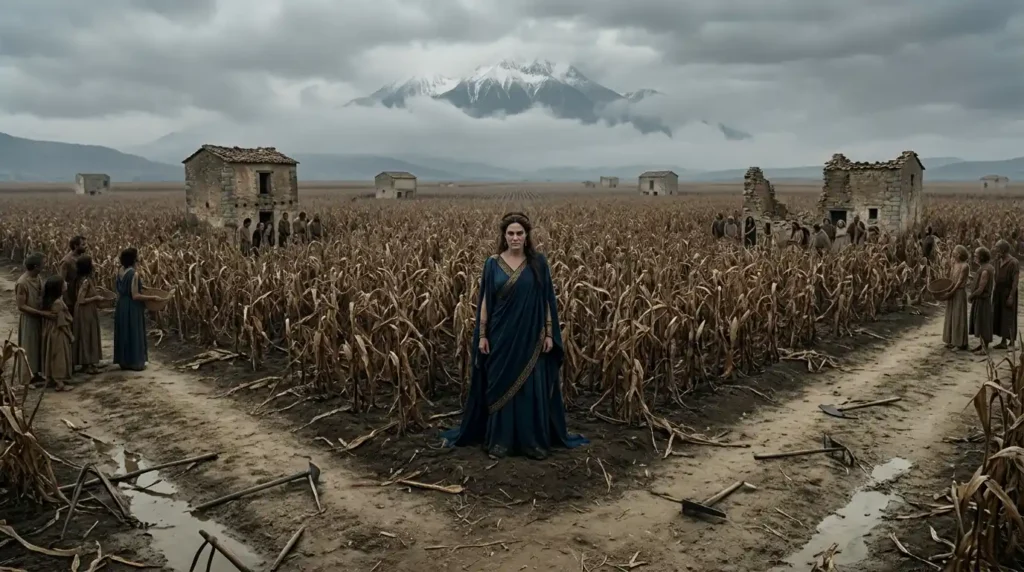
Demeter makes the year terrible for humans. The earth won’t send up seed because she’s hiding it, and oxen drag plows over fields for nothing.
The poem says she would have wiped out the whole human race with famine. And she would have deprived the gods of the honors that come with sacrifice.
Why Zeus Noticed
That last point is what gets Zeus’s attention. A Greek god’s status depended on offerings from mortals, which the Greeks called timai, honors.
Starve the farmers and the temples go empty. The poem is blunt that this is the danger Zeus sees.
The Gods Try Bribes
Zeus sends Iris to talk to her, and then sends the other gods one by one with gifts and honors. Demeter refuses each of them.
She swears she won’t set foot on Olympus or let the crops grow until she sees her daughter. The whole pantheon fails to move her.
My Reading: A Strike With Leverage
I read the famine as a kind of work stoppage. Demeter controls an input the divine system can’t run without, and she withholds it until her demand is met.
That comparison is mine, and I’d flag it that way. But the Hymn is explicit about why the gods cave: they stand to lose their honors.
A Cost Worth Naming
The people who suffer are mortals, who did nothing. Demeter’s leverage works because she’s willing to starve the innocent to pressure the powerful.
The Hymn doesn’t linger on that. I think it should be named, because it complicates the picture of a sympathetic mother.
An Old Woman at a Well

Disguise at Eleusis
Demeter arrives at Eleusis disguised as an old woman and sits by a well under an olive tree. The Hymn names it the Maiden Well.
The daughters of King Celeus come for water, find her, and take her home. The queen, Metaneira, hires her as a nurse for her infant son Demophon.
The Drink That Became a Ritual
Metaneira offers her red wine, and Demeter refuses. She asks instead for a mixture of barley, water, and pennyroyal, a relative of mint, which the Hymn calls kykeon.
That plain drink becomes part of the Eleusinian rite. A grain goddess who won’t take wine and asks for barley water is making a point about her own gifts.
The Joke That Broke the Spell
Demeter sits silent, refusing to eat or drink, until a servant woman named Iambe makes jokes. The Hymn says she made the goddess smile and laugh.
Later accounts say the Eleusinian procession included ritual jeering at a bridge on the road, which many scholars link to Iambe’s jokes. I’d treat that link as plausible rather than certain.
The Child in the Fire
At night, Demeter anoints Demophon with ambrosia and hides him in the fire to burn away his mortality. When Metaneira sees it, she screams, and Demeter drops the child.
The goddess drops her disguise, tells the queen she was about to make the boy immortal, and says it’s too late now. She orders the Eleusinians to build her a temple and says she’ll teach them her rites.
Why the Detail Matters
It’s a second failed attempt to give a mortal what the gods have. Demeter tries to cross the boundary and a mother’s panic stops her.
I find it moving that the goddess cooperates with grief, humor, and a nursing job before she demands anything. She’s still working inside the human world while she plans to break it.
Zeus Blinks First
The Messenger Goes Down
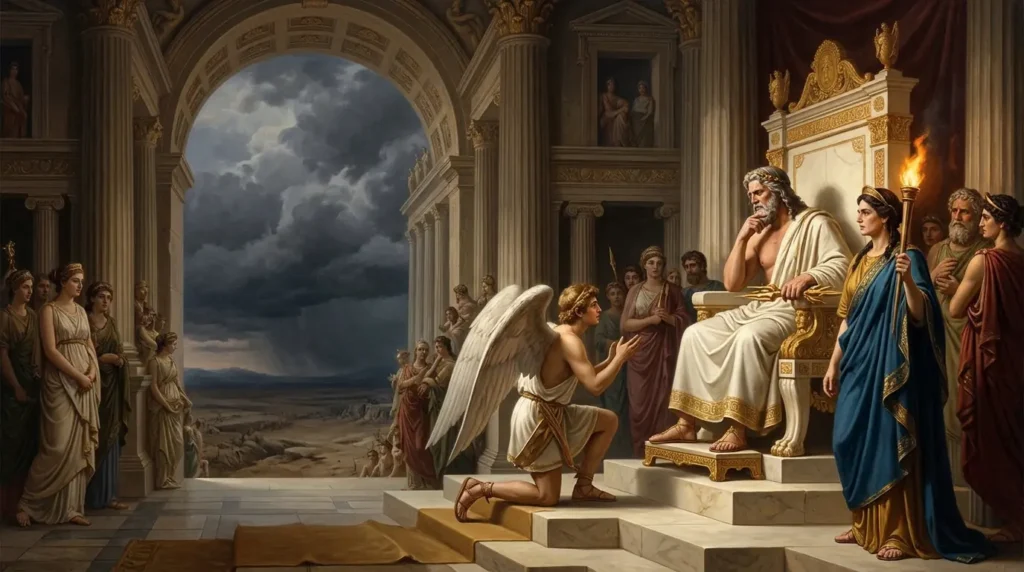
With no way to move her, Zeus sends Hermes to Hades with an order to bring Persephone back. Hades agrees without a fight.
That alone tells you something. The ruler of the dead doesn’t resist when Zeus gives the word.
The Seed
Before she leaves, Hades gives her a honey sweet pomegranate seed to eat. Persephone later tells her mother he forced it on her, and that she swallowed it unwillingly.
The Hymn treats the seed as binding. In later versions, the number of seeds and who is to blame change, as I noted in my Hades article.
The Settlement
Mother and daughter embrace, and Zeus sends Rhea to deliver the terms. Persephone will spend a third of the year below and two thirds with her mother and the other gods.
Demeter makes the fields bloom. The Hymn says the first grain appears on the Rharian plain at Eleusis, which had gone barren.
What She Got
Look at the outcome as a negotiation. Demeter gets her daughter back for most of the year and a new cult that honors her.
Zeus gets the sacrifices back and keeps his arrangement with Hades. Nobody is punished, which I think is the poem’s quiet point: the king of the gods lost the argument and paid in a compromise.
Eleusis Turned a Deal Into a Religion

What the Hymn Founds
After the settlement, Demeter visits the Eleusinian kings and teaches them her rites. The Hymn says the person who has seen these things is blessed, and the one who hasn’t has no share of such good things after death.
The poem ends by making the myth into a membership offer. The famine becomes the reason for an institution.
The Procession
The Greater Mysteries took place in autumn. Initiates walked the Sacred Way from Athens to Eleusis, a distance of roughly twenty kilometers, after purifying themselves in the sea and fasting.
At the end, they drank kykeon and entered the hall of initiation. Many sources report ritual joking along the route, which echoes Iambe.
Secrecy That Held
We don’t know what was shown inside. The initiation was secret, and ancient writers mostly kept it.
Alcibiades was accused of parodying the Mysteries at private parties in 415 BCE, the same summer the herms were mutilated, as I described in my Hermes article. The charges show how seriously Athens took the rule of silence.
How Long It Lasted
By some counts the sanctuary operated for roughly two thousand years, though how continuous the Bronze Age use was is debated. Romans were initiated too, and the Mysteries ended in the late fourth century CE under imperial edicts, with the sanctuary damaged by raiders soon after.
That’s a long run for a religion founded by a negotiated settlement over grain.
Demeter’s Second Strike
Black Demeter in Arcadia
Pausanias reports a different story from Phigaleia in Arcadia. Poseidon pursues Demeter, and she turns herself into a mare to hide among horses, but he takes the form of a stallion.
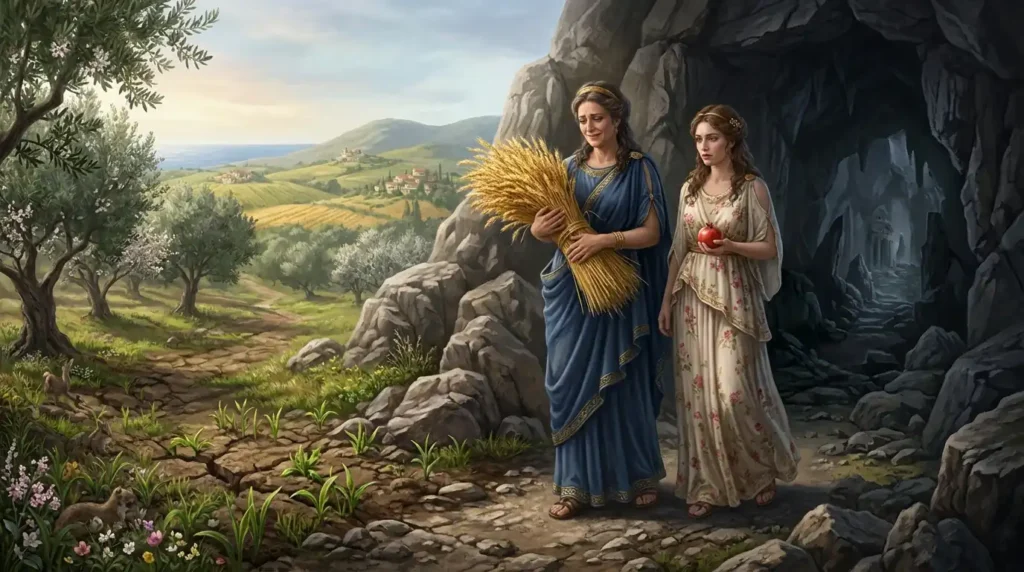
Furious, she puts on black clothing and shuts herself in a cave. The crops fail, and Pan eventually finds her and tells Zeus, who sends the Fates to persuade her out.
The Same Pattern
Notice the sequence. Demeter is wronged, withdraws, famine follows, the gods negotiate, and she returns.
It’s the same structure as the Hymn with a different trigger. I’d call that evidence the grain goddess’s withdrawal was a standard way to explain famine and its cure.
A Warning About the Source
Pausanias wrote in the second century CE, about local lore centuries older. The statue itself was described as an ancient wooden image that was lost and replaced, so what he saw may not match what earlier worshippers did.
The Women’s Festival
Athenian married women also celebrated the Thesmophoria, a festival for Demeter and Persephone. A late commentary on Lucian says piglets were thrown into pits and their remains retrieved later and mixed with seed.
That fits the myth’s theme of burying and recovering, but the description comes from a much later source. I’d hold the details loosely.
What the Season Story Gets Wrong

Winter Doesn’t Fit Greece
Popular summaries say Persephone’s time below equals winter. But the Hymn gives her a third of the year underground, and it never mentions winter.
In Greece, grain grows in the cool, wet months and the dry summer is the barren stretch. A neat winter story doesn’t match the farming year.
The Silo Theory
Martin Nilsson proposed that Persephone’s absence reflects grain being stored in underground silos over the summer, until sowing in autumn. I find that attractive because it’s tied to real storage practice.
It’s still one theory among several. Scholars have also treated Persephone’s descent as an initiation story, a death and rebirth pattern, or a mix of ideas.
Was the Drink Drugged?
You may have heard that the kykeon contained a hallucinogen from ergot, a fungus that grows on barley. R. Gordon Wasson, Albert Hofmann, and Carl Ruck argued this in their 1978 book The Road to Eleusis.
Most scholars remain unconvinced. No ancient text mentions a drug, and ergot is dangerous to drink. I’d file it as a bold hypothesis, not a finding.
Where My Own Reading Could Be Wrong
My strike interpretation treats the Hymn as an account of leverage. That may impose a modern economic frame on a poem whose main purpose is explaining why Eleusis has its rites.
The text does stress honors and sacrifices, so I think the reading has support. Still, the poem’s stated aim is aetiological, and a modern reader can overshoot.
What I Take From All This
Most Greek myths give Zeus the last word. This one shows him bargaining, because the one resource he can’t compel is a harvest.
I like that the myth turns a goddess’s grief into the first union of farmers and gods. The deal she forces is why Greeks had a ritual meant to make the end of life look less lonely.
Frequently Asked Questions
Who was Roman Ceres?
Ceres was the Roman grain goddess, identified with Demeter. Her Aventine temple, shared with Liber and Libera, is traditionally dated to 493 BCE, and the English word cereal comes from her name.
Why is Persephone also called Kore?
Kore means maiden. At Eleusis, the pair were called the Two Goddesses, with Kore as the daughter before her descent and Persephone as the queen of the dead, though sources use the names for the same figure.
Who was Triptolemus?
An Eleusinian prince in the Hymn’s list of those Demeter instructs. Later tradition has her give him grain to spread agriculture, and Athenian vases show him in a winged chariot drawn by serpents.
Are there similar myths elsewhere?
Yes. A Hittite myth tells of the god Telepinu, who storms off in anger, so crops fail and animals stop breeding. The gods search for him, a bee finds him, and a ritual restores him, a close structural parallel.
What happens to Hecate after the return?
The Hymn says Hecate meets Persephone on her return and becomes her attendant and companion. She goes before and after the young queen, which ties her to both worlds in later Greek tradition.
Final Thoughts
Demeter stopped the grain, and a god who could overrule everyone had to sit down and bargain. I think that’s why the story lasted.
Everything else in it, the torches, the kykeon, the child in the fire, grows from that one reversal of power. It’s the myth where the person with the least rank on Olympus has the one thing nobody can take.
Written by Batin Khan, a curious free spirit who loves reading and exploring the worlds of fantasy, mythology, and ancient stories. Through this blog, Batin hopes to share that sense of wonder with readers while building an exciting future along the way.