

 By
Quick Takeaways:
- Hermes started, at least in cult, as stone pillars at roads and doors, and the ancient world’s best documented attack on a god was an attack on those pillars.
- The Homeric Hymn makes the thief a god by turning his theft into a trade. Zeus’s settlement is where his messenger job comes from.
- Thief, messenger, and guide of the dead look unrelated, but each moves something across a boundary. That’s my reading, and I’ll flag where it’s mine.
- The tidy version has holes. The Hymn is comic literature, and the oldest layer of the god may be a pile of stones.
One summer morning in 415 BCE, the people of Athens woke up to a city full of smashed faces.
The stone pillars of Hermes that stood at doorways and crossroads had been mutilated overnight. The fleet was about to sail for Sicily, and nobody knew who’d done it or what it meant.
I covered Hermes’s birth and his cattle theft in my piece on the twelve Olympians. This time I want to ask how one god ended up with a thief’s reputation, a herald’s job, and a duty at funerals.
A God Made of Stones

What a Herm Actually Was
A herm was a squared stone pillar topped with a carved head, often with a phallus on the shaft. Greeks put them along roads, at crossroads, in courtyards, and in town squares for good luck.
They marked boundaries and thresholds. Scholars cite herms in connection with border monuments, and Athens had them at private doors as well as public places.
The Name Might Be a Pile of Stones
The Greek word herma means a stone heap or pillar, and many scholars think the god’s name comes from it. On that view, Hermes began as the thing marking the road and only later became a person.
I’d hold that loosely. Etymologies of Greek god names are a field where confident claims age badly, but the link between the god and the stones is the most natural reading I know.
Athens Was Crowded With Them
One modern guide describes a cluster of herms near the Agora that became so well known the whole area took their name. It served as a landmark for cavalry rallies, shop locations, and the limits of Socrates’s meeting place.
A dialogue transmitted under Plato’s name credits the tyrant Hipparchus with setting up herms halfway between city and country demes, carved with moral sayings. I’d treat that attribution cautiously, but it shows how ordinary the objects were.
The Night Athens Lost Its Faces

What Thucydides Says
Thucydides reports that in one night, most of the stone herms in Athens were mutilated about the face. It happened shortly before the great expedition to Sicily sailed.
Later accounts add that the phalluses were hacked off, and one summary dates the morning of discovery to June 7, though I’d treat the exact day as a modern reconstruction.
Panic and a Convenient Suspect
The Athenians read the act as an omen and as a plot against the democracy. Informers also charged that people were parodying the Eleusinian Mysteries in private houses, and Alcibiades, the expedition’s chief advocate, was implicated.
He was recalled from the fleet, and the culprits of the herm attack were never settled. Modern scholarship has fixated on who did it and why, and a Cambridge Classical Journal article complains that the literature has been narrow about everything else.
My Reading, Flagged
Hermes protects travelers, and the fleet was about to leave. Smashing the god of safe passage the night before a voyage is almost too pointed to be random.
That’s an interpretation, and the same Cambridge article warns against explaining the event from a single feature of the herm. I find the travel link plausible without thinking it explains everything.
Born at Dawn, Thieving by Night

The Newborn Who Wouldn’t Stay in the Cradle
The Homeric Hymn to Hermes tells how the infant son of Zeus and Maia slips out of his mother’s cave on Mount Cyllene and finds a tortoise. He turns the shell into a lyre the same day.
That evening he goes to Pieria and steals fifty of Apollo’s cattle. He makes them walk backward so the tracks mislead anyone following.
The Invention of Sacrifice
Then he does something I find stranger than the theft. He rubs two sticks together, invents fire, roasts two of the cattle, and offers the meat to the gods without eating any himself.
Some scholars read this as an origin story for animal sacrifice. For a god who’s about to be called a thief, it’s an odd moment of restraint.
The Trial and the Trade
Apollo tracks him down, and the dispute goes before Zeus, who finds it funny. Hermes plays the lyre, Apollo is entranced, and the two trade the instrument for the herd.
The reconciliation is where the roles are assigned. According to the Hymn, Zeus confirms the pact between the half brothers and makes Hermes the messenger of the gods, and the closing lines also give him the job of messenger to Hades.
What I Take From the Scene
The thief doesn’t get punished. He gets a title.
His theft is converted into an exchange, and the exchange becomes his office. That conversion matters for everything that follows.
The Thief Who Keeps Oaths

The Family Business
Hermes’s cunning isn’t isolated. In the Odyssey, Autolycus is the maternal grandfather of Odysseus, and the poem says Hermes himself gave him his skill at theft and at swearing oaths.
So Odysseus, the favorite of Athena I wrote about in my piece on her, descends from Hermes through Autolycus. Cleverness runs in two directions in that family.
Words That Fool
Hesiod’s Works and Days has Zeus tell Hermes to give Pandora a shameless mind and a deceitful nature, along with lying words. The messenger god supplies the part of her that persuades.
I find that telling. The same skill that carries a true message can also carry a false one.
A Windfall Belonged to Him
Greek had a phrase for lucky finds, hermaion, a gift of Hermes. As later writers report it, a person who found something could shout a phrase roughly meaning “shared Hermes,” so a companion could claim a half.
I’m working from secondary reports for that one, so check it against a lexicon if you plan to cite it. It still shows a god of gain who expects a cut.
Messenger of Zeus and Helper of People
The Midnight Escort
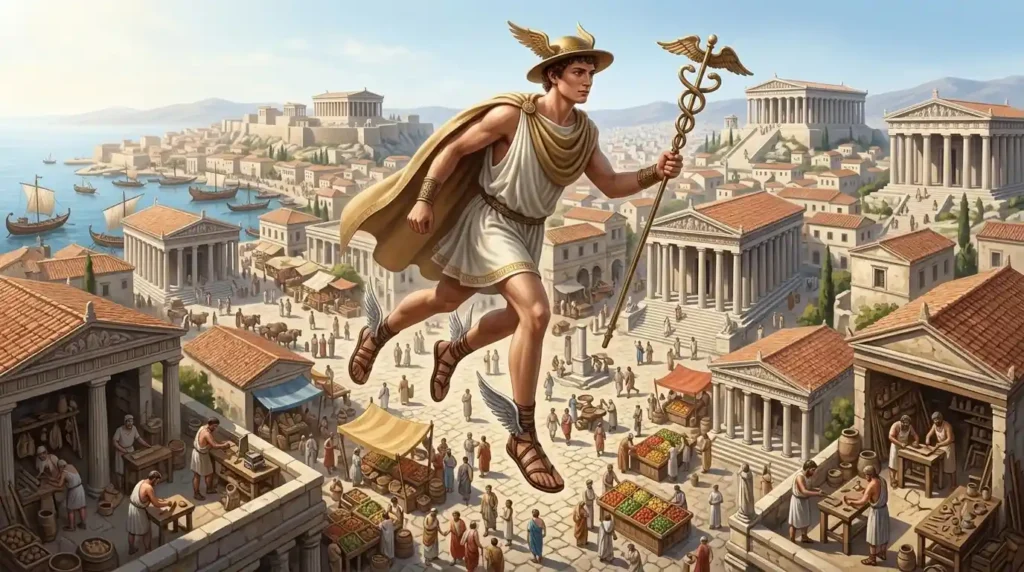
My favorite Hermes scene is in Iliad 24. Priam wants to ransom Hector’s body, and Zeus sends Hermes to guide the old king safely through the Greek camp.
Hermes appears as a young Myrmidon, lulls the guards to sleep, and drives Priam’s wagon to Achilles’s hut. At the threshold, he reveals who he is and says he can’t go inside, because it would be improper for a god to be seen openly helping mortals.
The Rule That Binds Him Too
That line made me think of Artemis in Euripides’s Hippolytus, who has to leave before a death because gods can’t look on the dying. Even gods that cross lines have places they can’t enter.
I read Hermes’s refusal the same way. He moves through every domain but doesn’t make a show of it.
The Herb Against Circe
In Odyssey 10, Hermes meets Odysseus on the road and gives him the herb moly to resist Circe’s drugs. He explains what to do and then vanishes.
That’s a typical pattern. He turns up at the threshold, hands over the tool, and leaves.
Guide of the Dead

The Bats
The Odyssey’s last book opens with Hermes calling the souls of the dead suitors to the underworld with his golden wand. They follow, gibbering, like bats in the back of a cave.
I love that simile. It’s the least dignified picture of death in Greek literature, and Hermes just walks them down.
Eurydice and Persephone
In a famous relief now in Naples, Hermes steadies Eurydice’s hand as she turns back to the underworld after Orpheus looks around. He’s present at the failure, but doesn’t judge it.
In the Homeric Hymn to Demeter, he’s the god sent down to bring Persephone back up. Moving in both directions is his specialty.
Not a Judge
In my piece on Hades, I noted that the judging belongs to others. Hermes isn’t a ruler of the dead either. He’s the escort, and Athenian funerary vases often show him in that role.
That’s a distinction worth keeping. The terrifying jobs belong to other gods, and he handles transportation.
My Reading: Exchange at the Edge

One Job, Three Costumes
Here’s the connection I see. Cattle change owners, messages change hands, and souls change realms. Hermes oversees each handoff.
The thief is the same god acting outside the rules. Theft is exchange without consent, and the Hymn shows him being brought inside the system by oath and trade.
Why the Herm Fits
A herm marks the place where one territory ends and another begins, and where travelers and goods cross. It’s a physical sign that this spot is where exchange happens safely.
I want to be clear that this is my synthesis. No ancient source says “Hermes is the god of exchange,” and I’m offering it as a way to see why the roles cluster.
The Tidy Theory May Be Backwards

If Hermes began as a stone heap or an Arcadian herdsman’s god, the boundary and exchange roles could be later growths on an older, simpler figure. The Hymn places his birth on Cyllene in Arcadia, and the oldest imagery includes a god carrying a ram.
In that case, I’m reading a late system back into an early figure, which is a trap I’ve warned about in other articles.
The Hymn Is a Joke
The Homeric Hymn to Hermes is comic and playful, and its date is debated. It shows how Greeks told the story, but it’s not a statement of cult doctrine.
Treating its settlement scene as theology may give it more weight than a funny poem deserves.
The 415 Mystery Stays Open
My reading of the herm attack connects it to travel, but scholars have argued about who did it and why for generations. A political conspiracy, a drunken prank, and a religious protest all have defenders.
I don’t have a way to decide among them, and I’d distrust anyone who says they do.
The Egyptian Hermes Is Someone Else
Later writers also identified Hermes with the Egyptian god Thoth, producing Hermes Trismegistus. That figure belongs to a different tradition and shouldn’t be mixed up with the Archaic Greek god described here.
What I Take From This
Hermes is the god I’d least want to meet in a dark alley and the first I’d pray to before a trip. He steals, delivers, and escorts, and the common thread is that things pass through him.
The mutilated herms of 415 BCE make a strange memorial. Athens smashed its road gods and then sent a fleet that didn’t come home.
Frequently Asked Questions
How does Roman Mercury differ from Hermes?
Mercury’s name connects to merx, the Latin word for goods, and his role leaned toward commerce. A temple to him was traditionally dated to 495 BCE, near the Circus Maximus, making him a god of merchants before he took on the Greek mythology.
What are hermetic texts and why is Hermes in the name?
The Corpus Hermeticum is a collection of Greek texts attributed to Hermes Trismegistus, a figure merging Hermes with Egyptian Thoth. Marsilio Ficino translated it into Latin in 1463, and the phrase hermetically sealed comes from alchemical tradition that credited Hermes with the technique.
Did Hermes have children?
Yes. Pan is his son in the Homeric Hymn to Pan, and Ovid names Hermaphroditus as his child with Aphrodite. The names of both gods, and Hermes’s role in the Hymn, show how closely he’s tied to herding and fertility.
What does hermeneutics have to do with Hermes?
Hermeneutics comes from the Greek word hermeneus, meaning interpreter. Plato’s Cratylus links the word to Hermes, the god who carries messages between realms, though modern scholars treat the etymology as uncertain.
Was there a festival for Hermes?
The Hermaia was a festival held in the gymnasia, with athletic contests and sacrifices. Later sources describe a Cretan version in which slaves and masters switched roles, though I’d treat that detail as a late report.
Final Thoughts

The Athenians woke up to a city of ruined faces and understood something about their god at once. Hermes held the roads, and they’d been caught with the roads unguarded.
I think that’s why he’s easy to forget and hard to do without. He lives in the handoff, and everything the Greeks valued, from trade to news to the last journey, depended on it.
Related Articles
- Chaos: The Primordial Void Before the Greek Gods
- 13 Legendary Greek Heroes, Ranked by Their Feats
- Rhea: The Titaness Who Tricked a God-Eating Titan
- Hera: The Goddess Reduced to “Zeus’s Jealous Wife”
- Who Was Ares? The War God the Greeks Didn’t Love
- Poseidon: The God of the Sea, Earthquakes & Horses
Written by Batin Khan, a curious free spirit who loves reading and exploring the worlds of fantasy, mythology, and ancient stories. Through this blog, Batin hopes to share that sense of wonder with readers while building an exciting future along the way.