
 By
By Here’s the thing that took me embarrassingly long to understand: the Chaos in Greek Mythology doesn’t mean chaos.
Not the way you and I use the word. Not disorder, not confusion, not a mess. Ancient Greek χάος(Khaos) meant something much stranger and much more specific, and once you see it, the whole Greek creation story reads differently.
I’ve spent about countless hours reading and rereading this material, and frankly, the gap between what Hesiod actually wrote and what most retellings say he wrote is wider than almost anywhere else in Greek mythology.
So let’s go to the text itself.
What Chaos in Greek Mythology Actually Means
The Word Comes From “Yawning,” Not “Disorder”
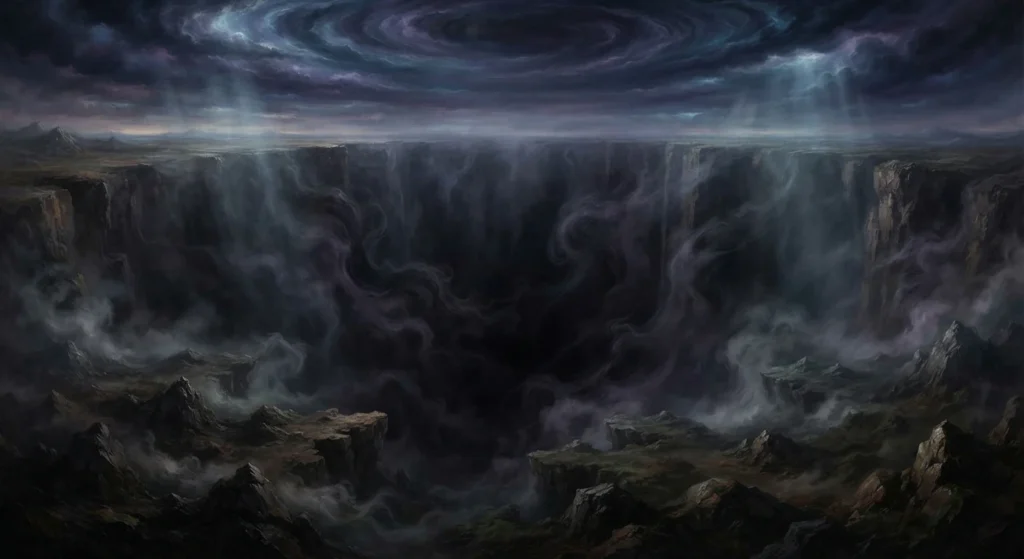
Χάος derives from the verbs χαίνω and χάσκω, both meaning “to gape” or “to be wide open.” The root goes back to Proto-Indo-European, and it’s a cousin of a word you use constantly.
That word is “yawn.” Same root, same image: a mouth opening wide, a gap appearing where there wasn’t one.
The related Greek noun χάσμα gives us “chasm” in English, which is much closer to the original sense than “chaos” is.
This is why some translators refuse to render it as “Chaos” at all. M. L. West, whose 1966 commentary on the Theogony remains a standard reference, translates the word as “Chasm.”
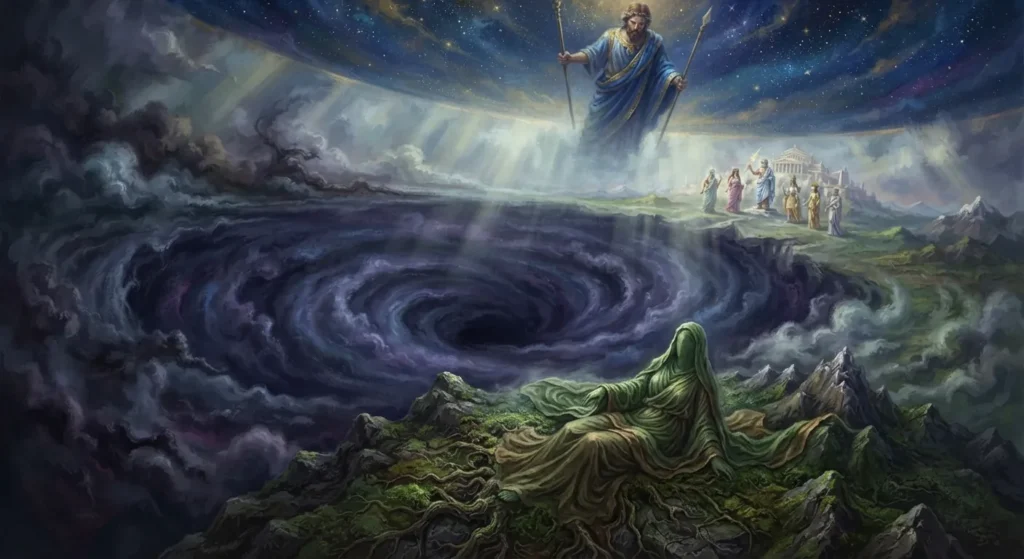
So when Hesiod says Chaos came first, he isn’t describing a churning soup of unformed matter. He’s describing a gap. An opening. Emptiness with edges.
Why The Modern Meaning is Basically Ovid’s Fault
Here’s where the story gets interesting, and where I think most popular accounts skip the most useful part.
The meaning you know of chaos as a disordered, jumbled mass doesn’t show up in Greek at all. It shows up in Latin, roughly seven hundred years after Hesiod.
Ovid opens the Metamorphoses, written around 8 CE, with a description of the world’s beginning. He calls it “rudis indigestaque moles,” a rough and unsorted mass.
In Ovid’s version, everything already exists, all mixed together and fighting: cold against hot, wet against dry, soft against hard. A god or “kindlier nature” then sorts it out.
That’s a completely different concept from a gap. It’s a full pantry with no shelves, not an empty room.
Glenn Most, who edited the current Loeb edition of Hesiod, has made this point directly in public lectures: the modern meaning of “chaos” isn’t attested in any surviving ancient Greek or Latin text before Ovid uses it.
Two millennia of European writers then inherited Ovid rather than Hesiod. The English word we use today descends from the Roman poet, not the Greek one.
What Hesiod Wrote
The Opening of the Theogony
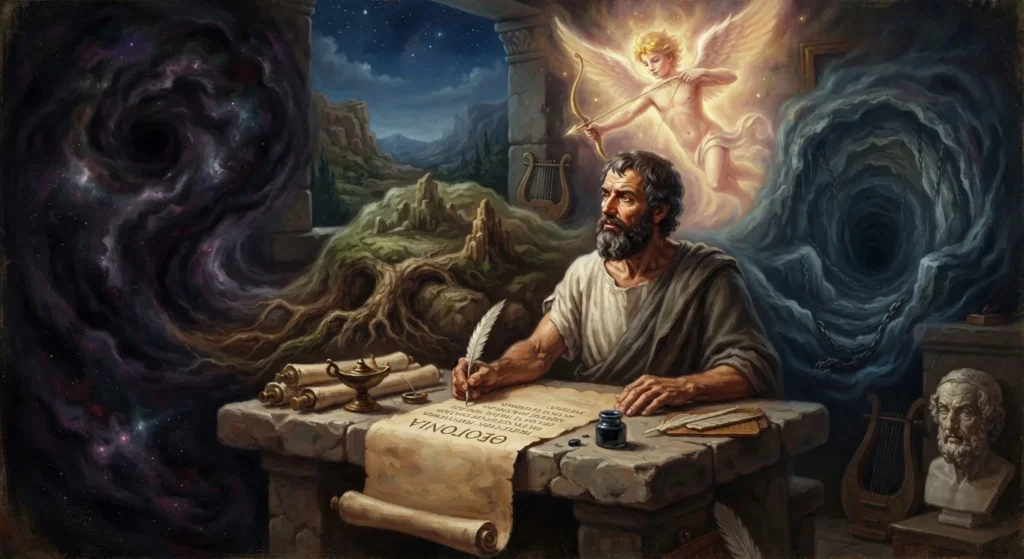
The Theogony was composed in Boeotia around 700 BCE and runs to just over a thousand lines. It’s the earliest surviving systematic account of how the Greek cosmos came together.
At line 116, Hesiod writes the sentence everything else rests on: first of all, Chaos came to be.
Then, in order: Gaia (Earth), Tartarus (the deep place beneath the earth), and Eros (Desire).
Note what that sequence is not. It’s a list of what appeared, in what order, not a family tree.
Chaos Did Not Give Birth to Gaia (Earth)
This is the single most common error I see repeated, and it’s worth being precise about.
Gaia is not the daughter of Chaos. Hesiod lists her as coming next, not as coming out. Same for Tartarus and Eros.
Chaos does have offspring, and it’s a much smaller set:
- Erebus, the darkness of the underworld
- Nyx, Night
Those two then produce their own opposites. From the union of Erebus and Nyx come Aether, the bright upper air, and Hemera, Day.
Look at the shape of that. Darkness comes out of the gap, and light comes out of darkness.
The Greek cosmos doesn’t begin with a creator switching on the lights. It begins with a gap that differentiates itself, step by step, into things that can be told apart.
Britannica’s entry on Chaos makes the same distinction about Gaia’s parentage, and so does the standard scholarly literature. It’s not a fringe reading. It’s just one that popular retellings flatten.
The Detail Most Retellings Miss: Chaos is a Place
The part I find genuinely startling, and it’s the reason I keep coming back to this text.
Chaos appears four times in the Theogony, not once. And the later three appearances tell you something the first one doesn’t.
During the Titanomachy, when Zeus unleashes his thunderbolts, Hesiod says an astounding heat seized Chaos (687 Titanomachy, Hesoid Theogony).
Later, he places the imprisoned Titans on the far side of dark Chaos (807 Cosmography, Hesoid Theogony).
Sit with that for a second. You can’t heat an abstraction. You can’t put prisoners on the other side of a concept.
Whatever Hesiod meant, Chaos in his poem is somewhere. It has a location relative to earth and Tartarus, it can be affected by cosmic events, and things can be positioned across it.
Kirk, Raven, and Schofield, whose survey of the Presocratics is still the standard reference, work through all four passages and land on Chaos as a vast gap between earth and sky.
That reading fits the etymology perfectly. It also explains why Hesiod can talk about it as terrain later in the poem without contradicting himself.
If you take only one thing from this article, take that one. Chaos is closer to a canyon than to a mood.
So What Existed Before Chaos?

Now the question in the title, answered honestly rather than confidently.
Hesiod doesn’t say. Not vaguely, not symbolically. He simply doesn’t address it.
And the verb he uses makes this stranger rather than simpler. He writes that Chaos “came to be,” which implies a beginning which implies something before it.
Then he moves on and never returns to the point.
I want to be direct about this: anyone who tells you the Greeks had a settled answer for what preceded Chaos is filling a hole in the evidence with their own plaster.
The ancient philosophers noticed the same gap. Aristotle, working through the concept of space in Physics Book Four, pushes back on reading Hesiod’s Chaos as simple void or empty place.
Pherecydes of Syros, writing in the sixth century BCE, took a different route and interpreted chaos as water: formless, but material, and capable of being differentiated.
Ancient traditions really disagreed here. Some treated Chaos as eternal and uncreated. Others treated it as something that itself came into being.
That disagreement isn’t a failure of the sources. It’s the real state of the evidence, and I’d rather hand you that than a tidy fiction.
The Rival Versions the Greeks Told
Something worth internalizing about Greek mythology in general: there was never one official version of anything.
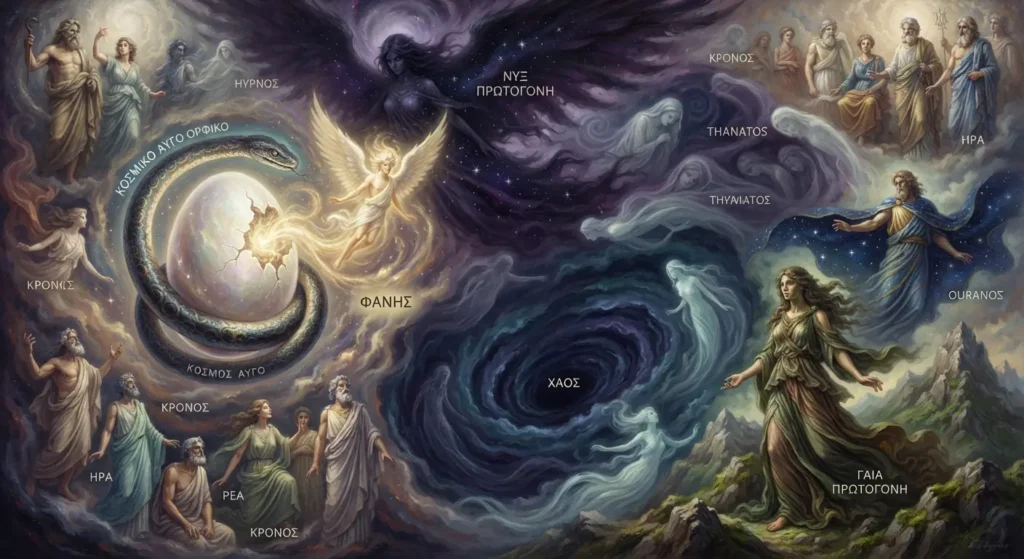
Hesiod is our fullest early account, which is very different from being the only one. At least three other beginnings circulated, and they don’t agree with him or with each other.
Homer Puts Ocean at the Origin
In Book 14 of the Iliad, during the episode where Hera sets out to seduce and distract Zeus, she describes Oceanus as the origin of the gods and Tethys as their mother.
A few lines later, Sleep independently calls Oceanus the origin of all things.
That’s a water cosmogony, not a gap cosmogony. In Hesiod, by contrast, Oceanus is merely one of the Titans, a child of Earth and Sky.
Later thinkers took this seriously rather than dismissing it. Aristotle discusses the Oceanus and Tethys tradition in the Metaphysics, and Plato references it in both the Theaetetus and the Cratylus.
The same book contains another detail I love: Hypnos recalls that Zeus once backed down from an angry pursuit because the fugitive took refuge with Night, and Zeus didn’t want to displease her.
Night outranking Zeus is not how the Olympian system is supposed to work. It’s a fossil of an older arrangement, poking through.
The Orphic Cosmic Egg
The Orphics, a mystery religion tradition, told something a lot weirder.
In their account, Chronos (Time) and Ananke (Necessity) coil around each other in serpent form and split a cosmic egg. Out of it comes Phanes, also called Protogonos, the First-Born.
Phanes is androgynous, golden-winged, and radiant, and rule passes down a chain from him: Phanes to Nyx, Nyx to Ouranos, then Kronos, then Zeus.
Ancient commentators found this un-Greek, and modern scholars have often echoed that judgment, sometimes in language that hasn’t aged well.
One important caution here, because a lot of websites get it wrong: much of the detailed Orphic material comes from the late compilation known as the Rhapsodies.
Earlier evidence, particularly the Derveni Papyrus, presents variants where the order and identifications differ. Treating the Rhapsodic version as a single fixed Orphic doctrine overstates what we actually have.
Aristophanes turns it into a Joke
In 414 BCE, Aristophanes staged Birds, and his chorus delivers a cosmogony that’s clearly playing with this material for laughs.
In their telling, there was Chaos, Night, Erebus, and Tartarus. Black-winged Night lays a wind egg in the depths of Erebus, and golden-winged Eros hatches from it.
Eros then mates with Chaos, whom Aristophanes gives wings, an innovation with no basis in Hesiod. Their offspring are the birds.
The punchline is a status claim: the birds are therefore older than the Olympians and should be worshipped instead.
Comedy needs a target its audience recognizes. Aristophanes could only make this joke because Athenian theatergoers already knew the serious versions well enough to catch him bending them.
Where The Debate Stands

I’ve been arguing for the gap reading throughout, so let me lay out the honest counterposition.
The main competing interpretations of Hesiod’s Chaos are these:
- The gap between earth and sky, created when the two separated from an original unity
- The space below the earth, the void the earth rests on top of
- An undifferentiated primordial mass, closer to the Ovidian reading
The third is a minority view among specialists, but it isn’t absurd. Pherecydes read it materially in the sixth century BCE, which means the interpretation is ancient, not a modern misreading.
The second has real textual support. The Titans beyond dark Chaos, sits comfortably with a subterranean location. [807 Cosmography, Hesoid Theogony]
My own view, for whatever it’s worth: the etymology is doing more work than any competing argument I’ve seen. A word built from “gaping” describes an opening.
But I hold that loosely, and frankly, I’d distrust anyone in this field who doesn’t.
Why Any of This Matters
Strip away the details and Greek cosmogony makes a claim that’s genuinely unusual among ancient creation stories.
There’s no creator. Nobody plans this, nobody builds it, nobody speaks it into being. Things simply come to be, in sequence, and keep differentiating.
Compare that to the Babylonian Enuma Elish, where Marduk constructs the world from a defeated enemy’s body. Or to Genesis, where a deliberate agent creates by command.
Hesiod’s cosmos has no such figure at the start. Zeus arrives late, wins power through succession and violence, and inherits a universe already well underway.
This distinction matters for how you read everything downstream. Greek gods aren’t the source of existence. They’re extremely powerful residents of a reality that predates them.
Worth flagging one boundary here, since it’s frequently overstated online: scholars including M. L. West have established substantial Near Eastern influence on the Theogony.
The strongest parallels, though, are for the succession myth, the Ouranos-to-Kronos-to-Zeus sequence, which lines up with Anu-to-Kumarbi-to-Teshub, and with Anu-to-Ea-to-Marduk.
Chaos itself isn’t the well-documented borrowing. Be skeptical of anyone who tells you otherwise without showing their evidence.
Frequently asked questions
Was Chaos worshipped in ancient Greece?
There’s no evidence of an organized cult, temples, or festivals for Chaos. Unlike Gaia or Nyx, who received some cultic attention, Chaos functions in poetry and cosmology rather than in practiced religion.
Is Chaos male, female, or neither?
The Greek noun is grammatically neuter, and Hesiod gives Chaos no gender, body, or personality. English translations sometimes assign “she,” which is an importation. Later Orphic and comic sources treat it more loosely.
How does Chaos relate to the Norse Ginnungagap?
Both names describe a gaping void, and Ginnungagap similarly sits between opposing regions. The parallel is striking, but no direct borrowing is established. Comparative mythologists treat it as a shared image rather than proven transmission.
Did any Greek philosopher build on Hesiod’s Chaos?
Anaximander’s apeiron, the boundless, is often compared to it, though he was doing natural philosophy rather than theology. Scholars debate how much continuity exists between mythological Chaos and Presocratic first principles.
Which translation of the Theogony works best for a newcomer?
Glenn Most’s Loeb edition prints Greek and English on facing pages. M. L. West’s translation is the scholarly standard and renders Chaos as “Chasm,” which puts the argument in this article directly on the page.
Sources & Further Reading
Primary Sources
- Hesiod – Theogony
- Homer – Iliad 14
- Ovid – Metamorphoses
- Aristophanes – Birds
- Aristotle – Physics IV
- Derveni Papyrus
Major Modern Scholarship
- Theogony: Edited with Prolegomena and Commentary by M.L. West – Hésiode
- Timothy Gantz – Early Greek Myth
- Kirk, Raven & Schofield – The Presocratic Philosophers
- M. L. West – The East Face of Helicon
- Radcliffe G. Edmonds III – Redefining Ancient Orphism
- Early Greek Philosophy, Volume I: Introductory and Reference Materials
Related Article
- How Zeus Overthrew His Father to Rule Olympus
- 13 Legendary Greek Heroes, Ranked by Their Feats
- Cronus: The Titan Who Feared His Own Children
- Rhea: The Titaness Who Tricked a God-Eating Titan
- Poseidon: The God of the Sea, Earthquakes & Horses
Written by Batin Khan, a curious free spirit who loves reading and exploring the worlds of fantasy, mythology, and ancient stories. Through this blog, Batin hopes to share that sense of wonder with readers while building an exciting future along the way.