
 By
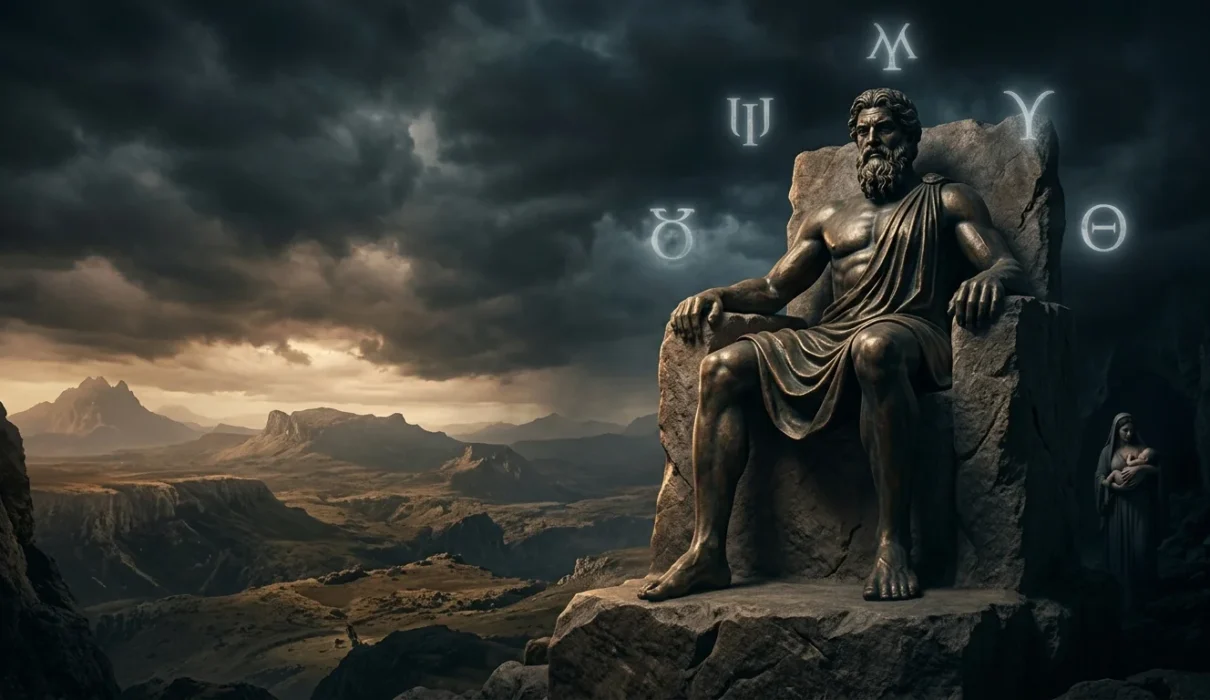
By The prophecy never mentioned swallowing. Gaia and Ouranos told Cronus one thing only, that a son of his would overcome him, and the specific horror everyone remembers was entirely his own contribution.
He had options. The one he chose kept every one of his enemies alive, together, and retrievable, which is the exact circumstance his opponent later needed to win.
What the Prophecy Actually Said
The Warning Came From His Own Parents
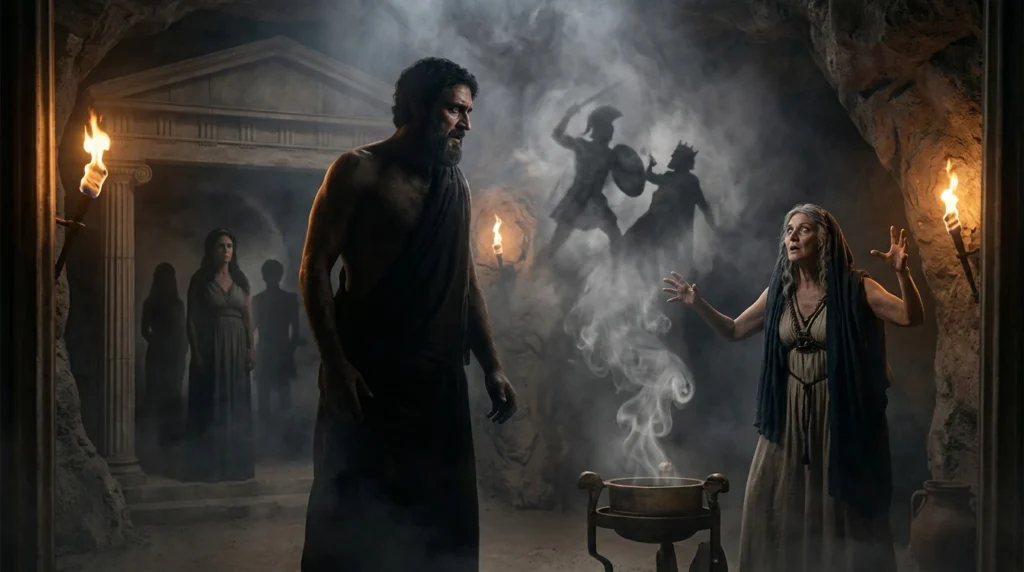
Hesiod’s Theogony has Gaia and Ouranos deliver the warning, telling Cronus he was destined to be overcome by his own child despite his strength.
There’s a detail here worth pausing on. Ouranos is the father Cronus had just castrated with Gaia’s adamantine sickle. The man delivering the prophecy had personal reason to enjoy delivering it.
What the Prophecy Left Out
It specified an outcome. It didn’t specify a method, a timeline, or which child.
That gap is enormous, and everything that follows happens inside it. Cronus received a conclusion without any instructions and had to invent his own prevention strategy from nothing.
Prevention Was Always Going to Be the Problem
A prophecy naming a specific threat can be guarded against specifically. A prophecy naming an entire category, any son you father, forces a response aimed at the category itself.
That’s why the response escalated to something as extreme as it did. He wasn’t defending against a person. He was defending against a possibility.
Why He Chose Swallowing
The Options He Didn’t Take
He could have killed them. He could have exiled them to some remote corner of a cosmos he ruled. He could have stopped having children with Rhea entirely.
Any of those would have addressed the prophecy at least as directly as what he actually did.
What Swallowing Uniquely Offered
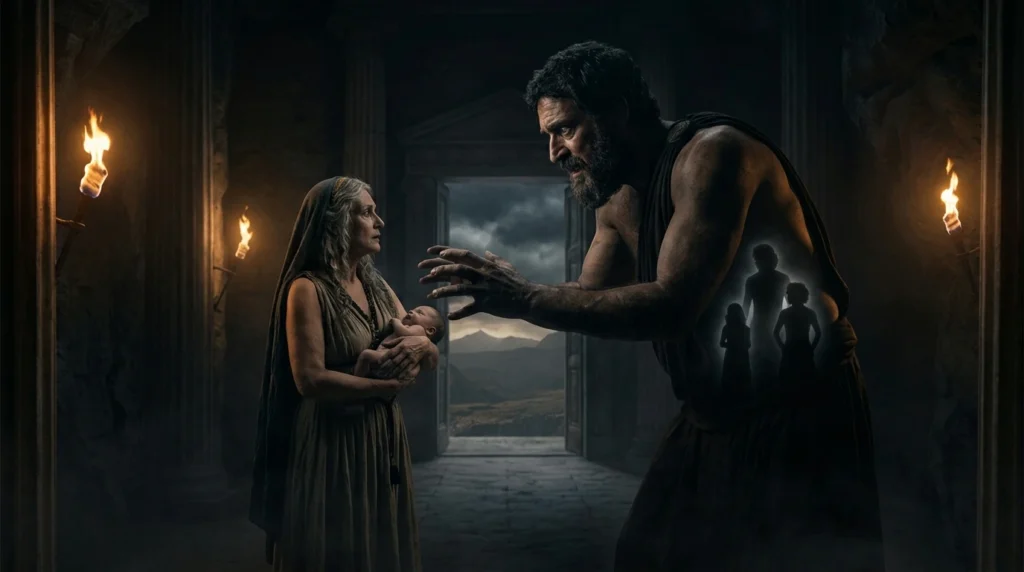
Swallowing gave him something the alternatives didn’t, which is total, continuous, personal custody.
A killed child might be avenged. An exiled child might return or be found. A child inside his own body couldn’t be rescued by anyone without going through him first, and he’d know immediately if anything changed.
Read that way, it’s not madness. It’s the most secure containment available to someone who couldn’t trust any location or any guard.
The Older Version Suggests Swallowing Was Never About Destruction
The Hurrian and Hittite Song of Kumarbi, which contains a strikingly similar succession sequence predating Hesiod’s version.
In that account, Kumarbi swallows the genitals of the sky god Anu and becomes pregnant as a result, eventually having to be cut open to deliver the storm god who overthrows him.
Swallowing in this whole myth family doesn’t destroy things. It contains them, and what’s contained keeps developing inside. That pattern is worth holding onto, because it’s exactly what happens next in Hesiod.
The Method Was the Mistake
He Built a Container, Not a Grave
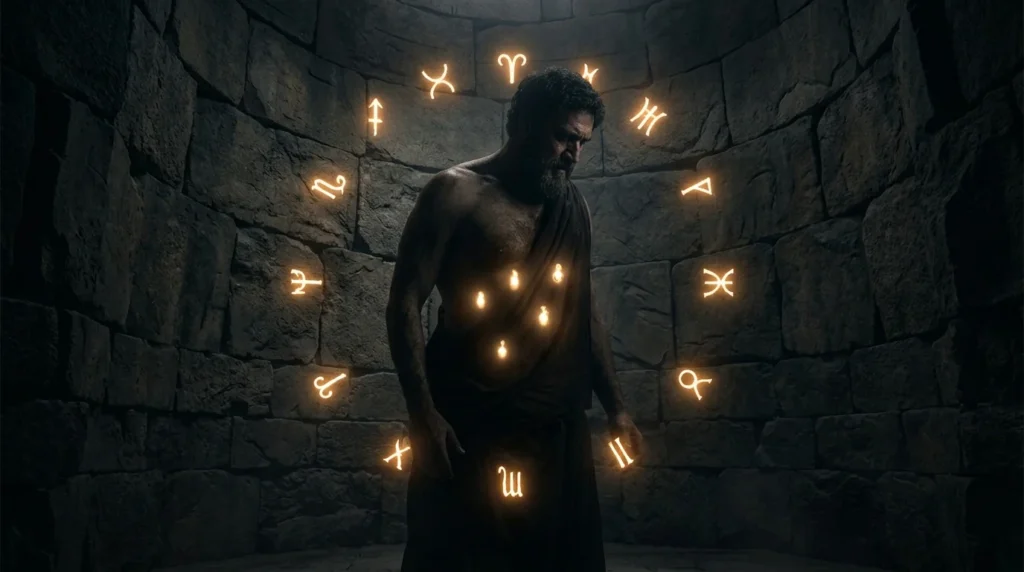
Hestia, Demeter, Hera, Hades, and Poseidon all went down, in that order, and every one of them was still alive in there.
Hesiod is explicit that Cronus swallowed them rather than killing them, and the story requires this, because when Zeus eventually forces him to disgorge them, they come out intact and fully grown.
He Stored His Enemies in One Place
Now consider what Zeus actually needed to win.
The Titanomachy ran ten years. Zeus didn’t fight it alone. He fought it with his siblings, plus the Cyclopes and Hecatoncheires he freed from Tartarus on Gaia’s advice.
Where did the siblings come from? A single disgorging, all at once, all adults, all with an identical and entirely justified grievance against the same person.
The Counterfactual Is Genuinely Instructive
If Cronus had killed his children instead, Zeus would have grown up as an only child in hiding, facing the Titans with the Cyclopes and Hecatoncheires alone.
If he’d scattered them, Zeus would have needed to find and recruit each one individually, across a cosmos his enemy controlled.
Instead, Cronus kept them safe, kept them together, and handed them over in one batch to the exact person prophesied to destroy him. His containment method doubled as a delivery system.
The Prophecy Fulfilled Itself Through the Prevention
This is the specific structure worth naming. Nothing about the prophecy required Cronus to create his own opposition army.
The warning said a son would overcome him. His attempt to prevent that produced the five allies that son needed, gave Rhea a motive to hide the sixth, and supplied all six with a shared reason to want him gone.
Remove the swallowing and the prophecy has no obvious path to fulfillment. The prevention was the mechanism.
The Stone
Rhea’s Substitution
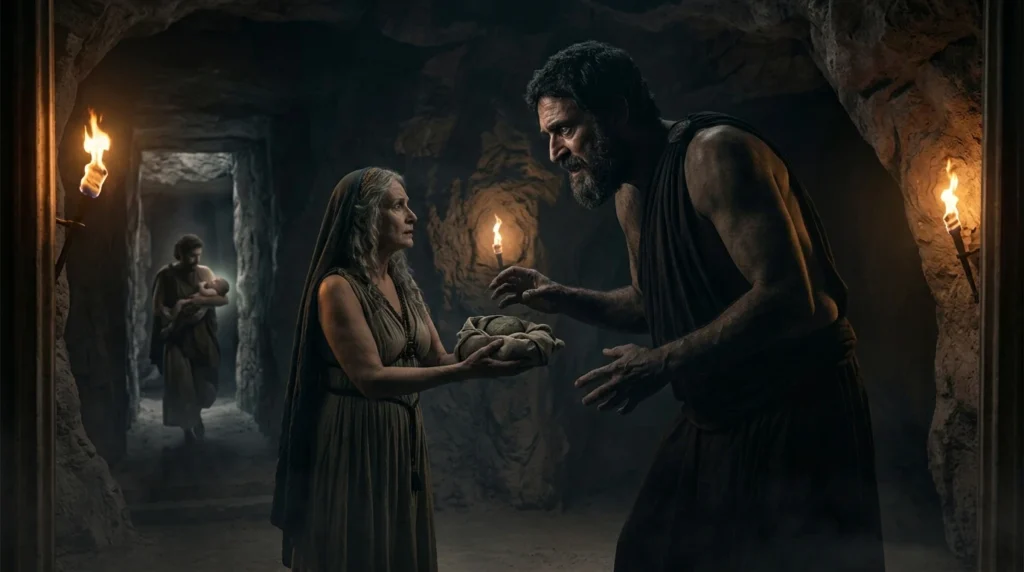
Pregnant with Zeus, Rhea sought help from Gaia and Ouranos and gave birth in secret on Crete. She wrapped a stone in swaddling cloth and handed it to Cronus, who swallowed it without inspection.
The detail that he didn’t check is doing quiet work. A ruler this vigilant, this many children in, had stopped actually looking.
It Came Back Up First
When Zeus forced the disgorging, Hesiod specifies that the stone emerged before any of the children.
Zeus set it at Pytho, beneath the slopes of Parnassus, as a marker and a wonder for mortals.
Pausanias Says He Saw It
The geographer Pausanias, writing his travel account of Greece in the second century CE, describes a stone at Delphi that the locals identified as the one Cronus swallowed, and reports that they anointed it with oil daily.
Whatever that object actually was, real visitors could stand next to it and be told this story. That’s a genuinely different relationship to myth than pure narrative provides.
The Correction Almost Nobody Makes
Cronus Is Not Time
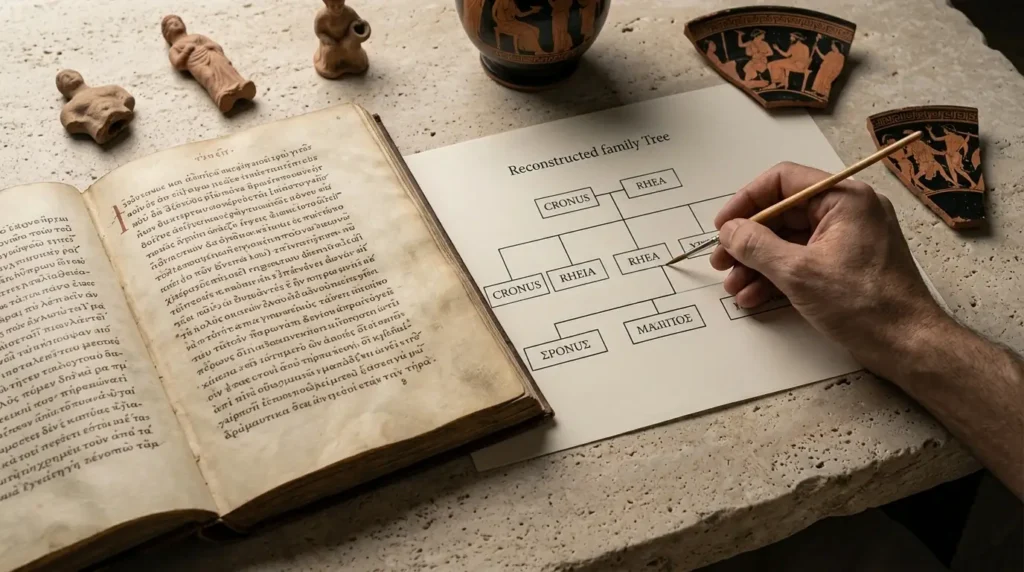
This one comes up constantly and it’s wrong. Cronus, Κρόνος, and Chronos, Χρόνος, the personification of time, are different words with different etymologies.
The Greeks distinguished them. The conflation developed later, and it’s now so widespread that the harvest and time associations feel original when they aren’t.
Where the Confusion Came From
Two things fed it. The later blurring of the two similar sounding names, and the Roman identification of Cronus with Saturn, a genuine agricultural deity in Roman religion with his own independent history.
Through Saturn, the sickle became a harvest implement. Through Chronos, the harvester became Time. Father Time with his scythe is the end product of both mergers, and none of it is in Hesiod.
The Sickle in Hesiod Is a Weapon
Gaia made it from adamant specifically for one purpose, and Cronus used it for that purpose against his father.
It isn’t a farming tool that happened to be handy. It’s a custom weapon, commissioned by a mother who wanted her husband stopped.
Hesiod Also Called His Reign a Golden Age
Works and Days Says Something Completely Different
Here’s a tension in the source material I find genuinely fascinating, because it comes from the same author.
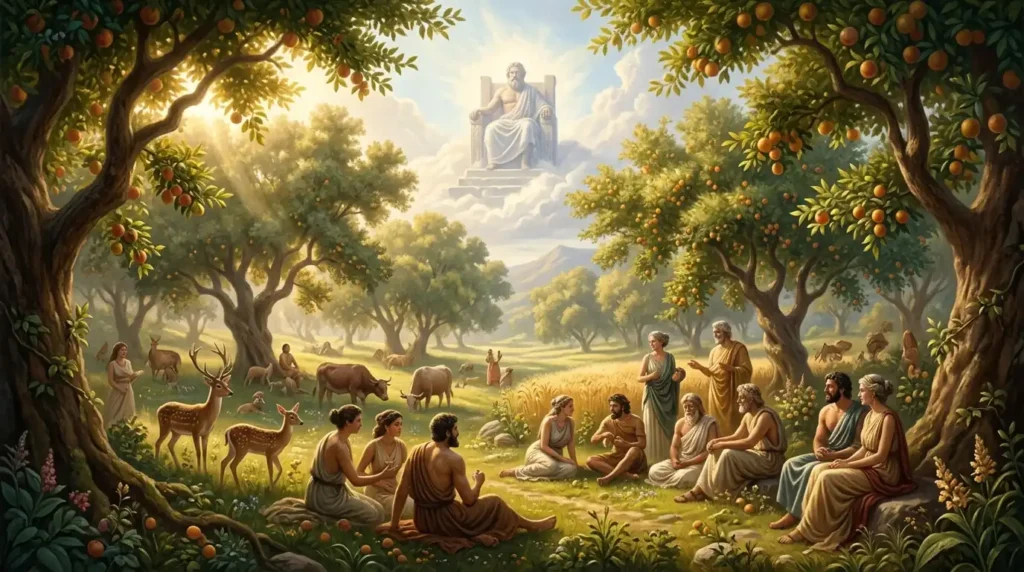
In Works and Days, Hesiod describes the golden race of men who lived when Cronus was king in heaven. They lived like gods, free from toil and sorrow, and the earth bore fruit abundantly for them without cultivation.
That’s the child swallowing tyrant of the Theogony, described by the same poet as presiding over humanity’s happiest era.
Two Poems, One Poet, Two Cronuses
I don’t think this can be fully reconciled, and I’m suspicious of readings that try too hard to make it cohere.
The most honest explanation is probably that Hesiod inherited two separate traditions about Cronus and used each where it suited the poem he was writing, without any obligation to make them agree.
Later Sources Let Him Out
The Theogony leaves him in Tartarus. Others don’t.
Pindar suggests Zeus eventually released him to rule over the Isles of the Blessed. The Roman Saturnalia celebrated Saturn with an explicit golden age framing, social inversions, gift giving, and a temporary suspension of ordinary hierarchy.
The tyrant tradition and the golden king tradition ran alongside each other for centuries without either one winning.
Honest Scrutiny
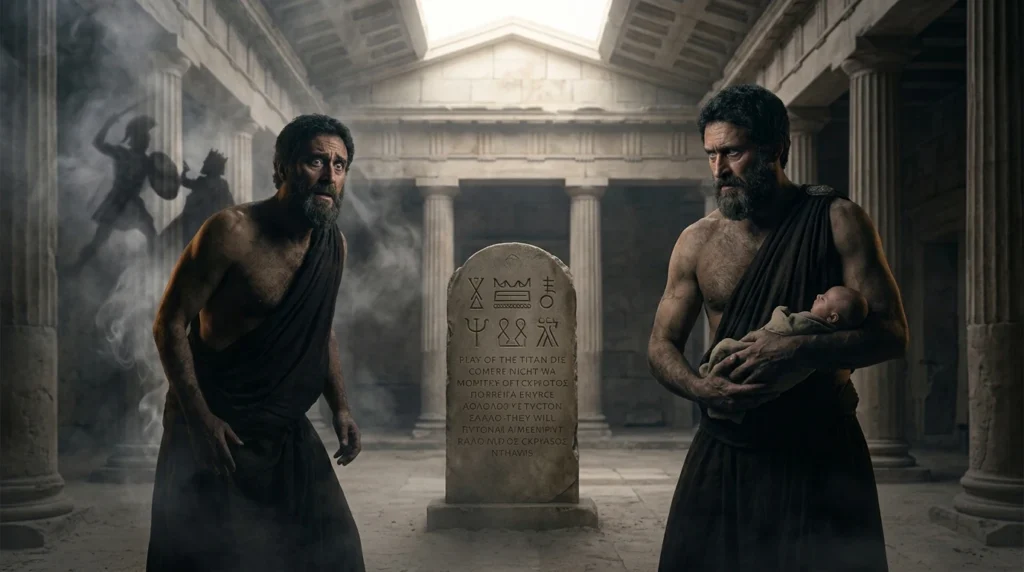
My reading of the swallowing as a strategic error deserves real scrutiny, because it applies a logic Hesiod almost certainly wasn’t using.
The Theogony isn’t a thriller and Hesiod isn’t writing a villain who makes a tactical mistake. He’s compiling inherited traditions into a genealogy, and the swallowing was already part of that inheritance before he touched it.
Treating it as a decision I can second guess imposes a modern analytical frame on material that predates the frame entirely.
The swallowing may also encode something I’m flattening completely. Seasonal cycles, ritual practice, or symbolic material about generation and containment that made obvious sense to an eighth century BCE audience and simply doesn’t translate into strategy.
The golden age problem cuts the same way. If the same poet describes Cronus as both tyrant and benevolent king, then trying to build a coherent character portrait from the Theogony alone is already selecting one tradition and ignoring another.
Greek myth resists this kind of unification, and this article isn’t exempt from my own objection.
Frequently Asked Questions
How did Zeus actually force Cronus to disgorge the children?
Accounts vary. Hesiod says Cronus was overcome by Gaia’s cunning and his son’s strength, while Apollodorus gives a more specific version in which Metis administers an emetic drug that makes Cronus vomit up the stone and the children.
Did Cronus have children besides the six Olympians?
Yes. He fathered the centaur Chiron with the Oceanid Philyra, and some traditions attribute other offspring to him. Chiron is notable as a genuinely wise and benevolent figure, unusual among centaurs generally.
Is Cronus depicted in surviving Greek art?
He appears far less frequently than the Olympians, though depictions exist of the stone handover and related scenes on vases and reliefs. His comparative artistic scarcity reflects limited independent cult worship compared to major Olympian deities.
What exactly was the Omphalos at Delphi supposed to represent?
Beyond the swallowed stone identification, the Omphalos was understood as the navel of the world, marking Delphi as the earth’s center, a claim tied to a legend about two eagles Zeus released from opposite ends of the world meeting there.
Did Cronus receive any actual worship in ancient Greece?
Limited cult evidence exists, including the Kronia festival in Athens, a harvest festival featuring social inversions where masters and slaves dined together, structurally similar to the later Roman Saturnalia and connected to his golden age associations rather than his tyranny.
Final Thoughts

Cronus heard he’d be overthrown by a son and responded by keeping six of them alive inside his own body for years, then handing them over fully grown to the one he’d missed.
The stone Rhea substituted came up first, and somebody was still pouring oil on a rock at Delphi eight centuries later because of it. Whatever else the story is doing, it clearly mattered enough to keep an object anointed for that long
Related Article
- How Zeus Overthrew His Father to Rule Olympus
- Chaos: The Primordial Void Before the Greek Gods
- How Norse & Greek Mythology Built Modern Dark Fantasy
- 13 Legendary Greek Heroes, Ranked by Their Feats
- The 12 Olympian Gods: Powers, Symbols & Key Stories
- Greek Mythology 101: Gods, Heroes & Monsters
Sources & Further Reading
- HESIOD, THEOGONY
- Hesiod, Works and Days
- APOLLODORUS, THE LIBRARY BOOK 1
- Hittite Myths – Harry A. Hoffner
- Pausanias´ Description of Greece
- The Extant Odes of Pindar by Pindar
- Song of Kumarbi by Anonymous
Written by Batin Khan, a curious free spirit who loves reading and exploring the worlds of fantasy, mythology, and ancient stories. Through this blog, Batin hopes to share that sense of wonder with readers while building an exciting future along the way.