
 By
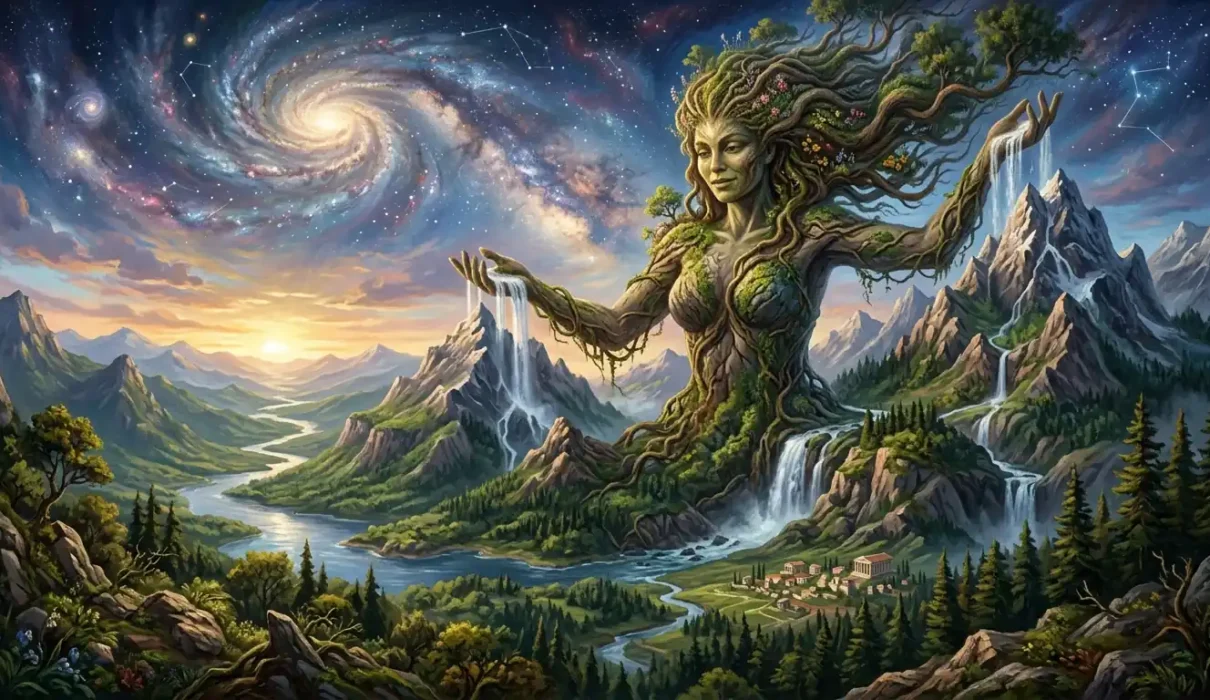
By Gaia gets remembered as the nurturing earth, the gentle mother from whom everything grew. Her actual record in Hesiod is four attempted regime changes, three of them successful, including one against the very government she personally installed.
She armed the son who castrated her husband. She hid the grandson who overthrew that son. Then she produced a monster specifically to destroy the grandson she’d protected.
She Made the Sky, Then Married It
Everything Started Without a Partner
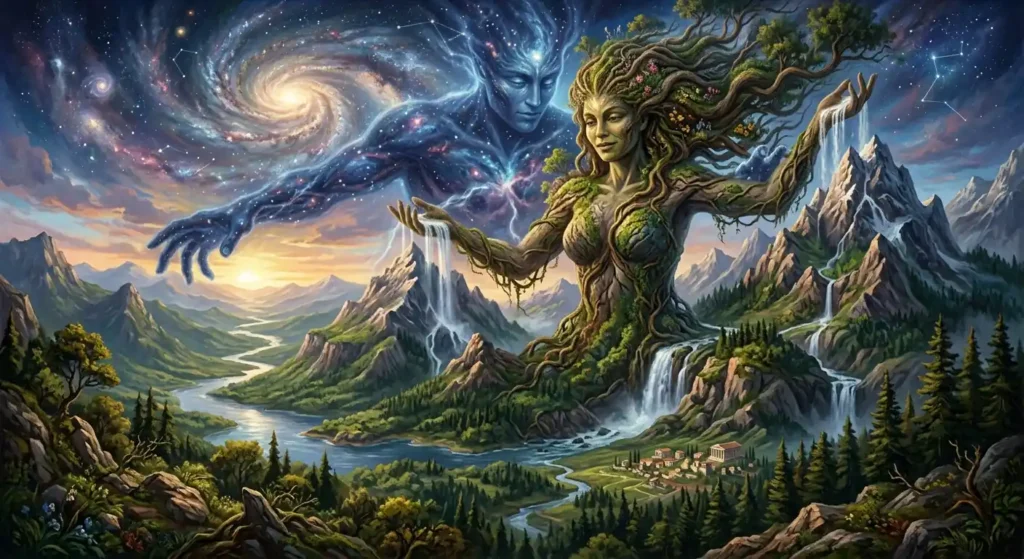
Hesiod’s Theogony places Gaia immediately after Chaos, and her first act is generation without any male involvement whatsoever.
She produces Ouranos, the starry sky, entirely on her own. She produces Pontus, the sea. She produces the Ourea, the mountains. Three fundamental features of the cosmos, parthenogenetically, before any partnership exists.
Then She Took Her Own Creation as Consort
With Ouranos, whom she made, she produces twelve Titans, three Cyclopes, and three Hecatoncheires, hundred handed giants of enormous strength.
The Olympians descend from these children. Every god anyone worships in Greek tradition traces back through this pairing between the earth and the sky she generated herself.
What This Ordering Actually Argues
Read the sequence carefully and it makes a specific cosmological claim. Earth comes first. Sky is derived from earth rather than existing independently or ruling over it.
That’s genuinely unusual among ancient cosmologies, many of which position sky gods as primary and earth as receptive or secondary. Hesiod’s arrangement makes the sky a product of the ground, which quietly establishes Gaia as the more fundamental of the two before their conflict even begins.
Regime Change One: She Arms a Son Against His Father
The Offense
Ouranos hated the children and pushed each one back into Gaia’s depths as they were born, refusing to let them emerge. Hesiod describes her resulting pain in physical terms, a body strained past what it could bear.
The Weapon
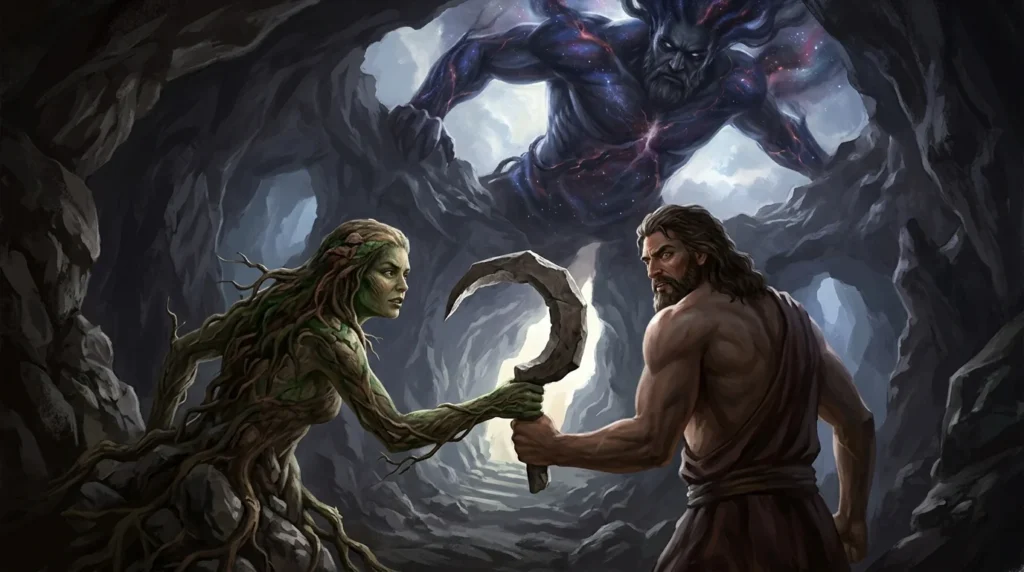
Gaia produced adamant, fashioned a jagged sickle from it, and asked her children which would act against their father.
Every one of them refused out of fear. Only Cronus, the youngest Titan, took the weapon.
The Result
Cronus ambushed Ouranos and castrated him, throwing the severed genitals into the sea, where the gathering foam produced Aphrodite.
The blood falling back onto Gaia produced the Erinyes, the Giants, and the Meliae. Even the violence she orchestrated became generative, which is a genuinely strange property no other figure in this mythology shares.
Regime Change Two: She Does It Again to Cronus
He Repeated the Crime
Cronus took the throne and immediately developed his father’s fear. Warned by Gaia and Ouranos that his own child would overthrow him, he swallowed each newborn as Rhea delivered them.
The crime is functionally identical to Ouranos’s. Suppressing children to preserve a throne.
Her Response Is Identical Too
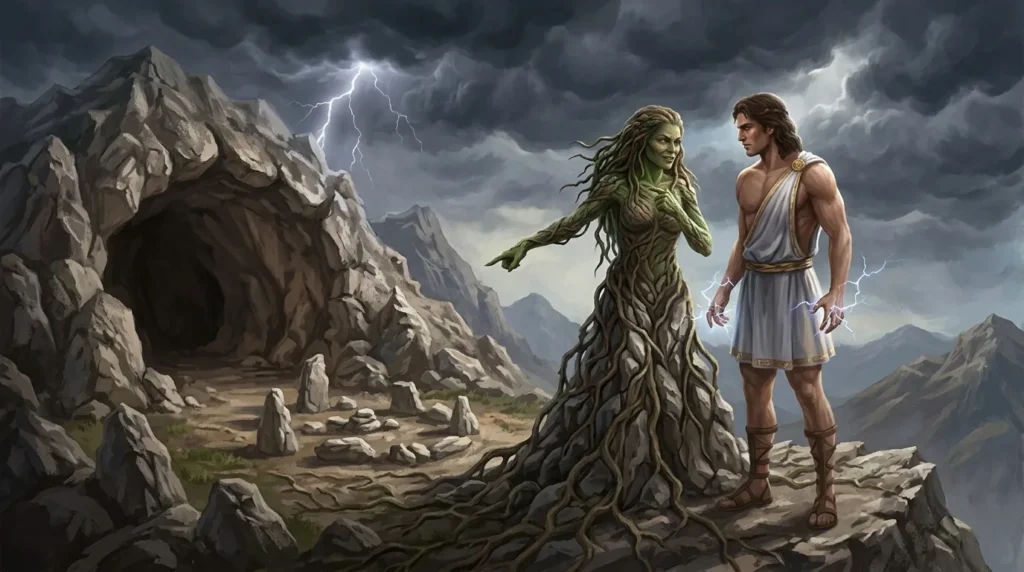
Pregnant with Zeus, Rhea sought help from Gaia and Ouranos. Gaia received the infant and concealed him, and Rhea handed Cronus a stone wrapped in swaddling cloth, which he swallowed without checking.
Second son armed against a father. Second successful overthrow.
Regime Change Three: She Hands Zeus the Winning Move
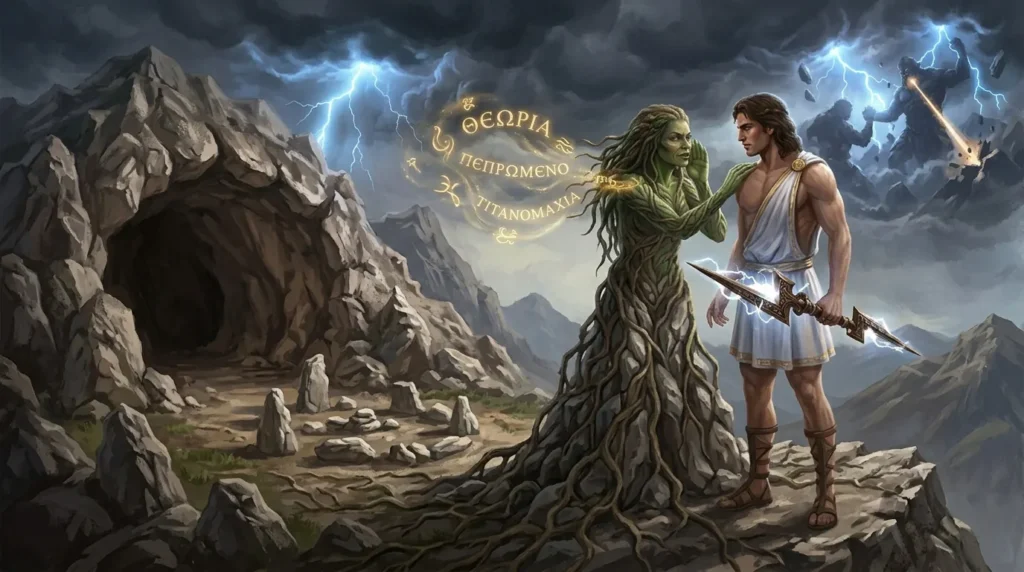
The Titanomachy ran ten years with neither side able to force a conclusion, and Zeus won it on Gaia’s advice.
She counselled him to free the Cyclopes and the Hecatoncheires from Tartarus, where Ouranos had confined them and Cronus had left them. The Cyclopes gave Zeus the thunderbolt. The Hecatoncheires entered the fighting hurling three hundred stones at once, and the Titan line broke.
She wasn’t finished helping either. Gaia and Ouranos later warned Zeus that Metis would bear a son greater than himself, which is why Zeus swallowed Metis and ended the succession cycle permanently.
Three regimes. Three times Gaia supplied the decisive intervention.
Then She Tried to Destroy What She Built
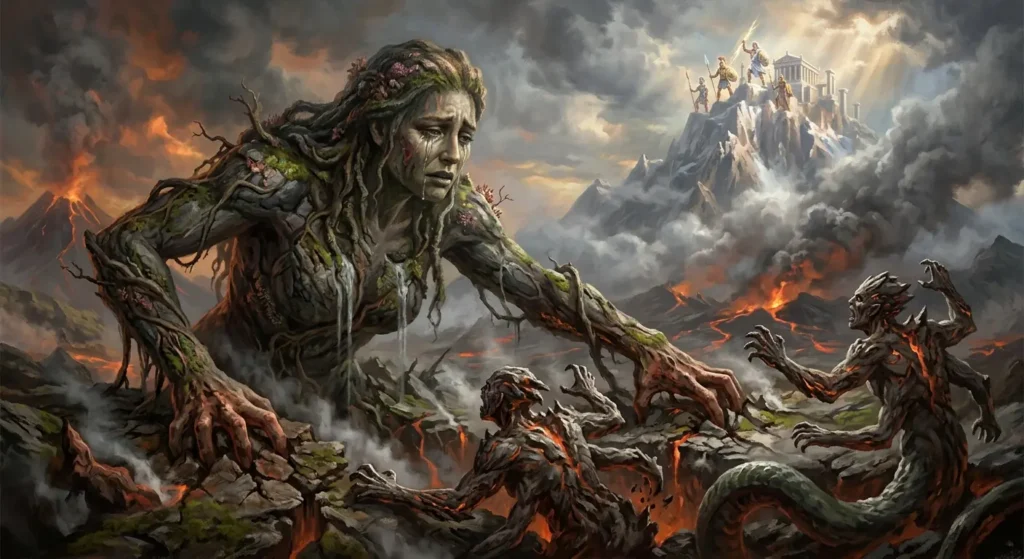
Typhon
Angered by the Titans’ imprisonment, Gaia coupled with Tartarus and produced Typhon, the last and most dangerous challenge Zeus ever faced.
Hesiod has Zeus defeating him with thunderbolts. Later sources including Apollodorus add a considerably harder version, with Typhon overpowering Zeus at Mount Kasios and cutting out his sinews before Zeus recovered and won.
The Giants
Source accounts diverge here in a way worth flagging. Hesiod has the Giants born from Ouranos’s spilled blood during the first castration, long before any conflict with the Olympians.
Apollodorus gives a more developed version in which Gaia, in wrath over the Titans’ imprisonment, brings forth the Giants specifically against the Olympian regime.
He adds a detail I find truly revealing. Gaia sought a herb that would make the Giants invulnerable to mortal weapons, and Zeus forbade the sun, moon, and dawn to shine so he could harvest it first himself.
That’s Zeus treating Gaia as an opponent capable of winning if given time. Not a nurturing background presence. A serious strategic threat requiring preemptive action.
Two Failures
Both attempts against the Olympians failed. Her record against Ouranos and Cronus was perfect. Her record against Zeus is zero for two.
Her Motive Never Actually Changed
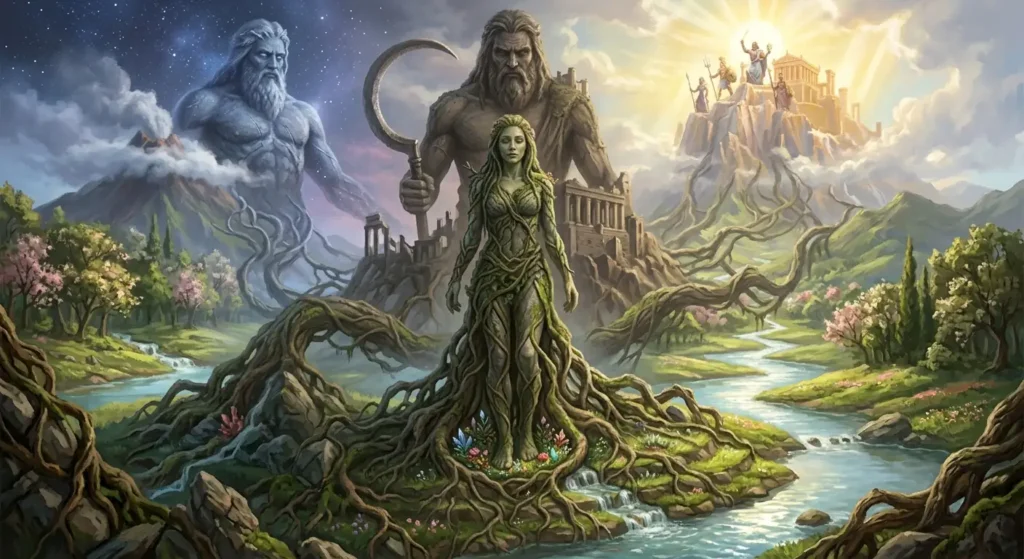
Here’s the pattern I think most treatments of Gaia miss entirely, and it makes her considerably more coherent than the standard reading allows.
One Principle, Applied Four Times
Ouranos imprisoned her children inside her body. She destroyed him.
Cronus swallowed her grandchildren. She helped destroy him.
Zeus imprisoned her children, the Titans, in Tartarus. She tried to destroy him too.
That’s not fickleness or a switch from benevolent to hostile. It’s the same rule enforced against a third offender who happened to be the one she’d previously installed.
She Has No Loyalty to Regimes
Gaia never supported Zeus because she approved of Zeus. She supported him because Cronus was suppressing children and Zeus was the available instrument for stopping it.
The moment Zeus became the one doing the imprisoning, he inherited the same treatment his father and grandfather received. Her allegiance was never to a ruler. It was always to whoever was currently being confined.
Which Makes Her the Permanent Opposition
Reading her this way turns Gaia into something actually distinctive across world mythology. Not a mother goddess in the nurturing sense at all, but a fiercely partisan one, permanently aligned against whatever authority is currently doing the suppressing, with no capacity to be satisfied by any settlement.
She Never Once Tried to Rule
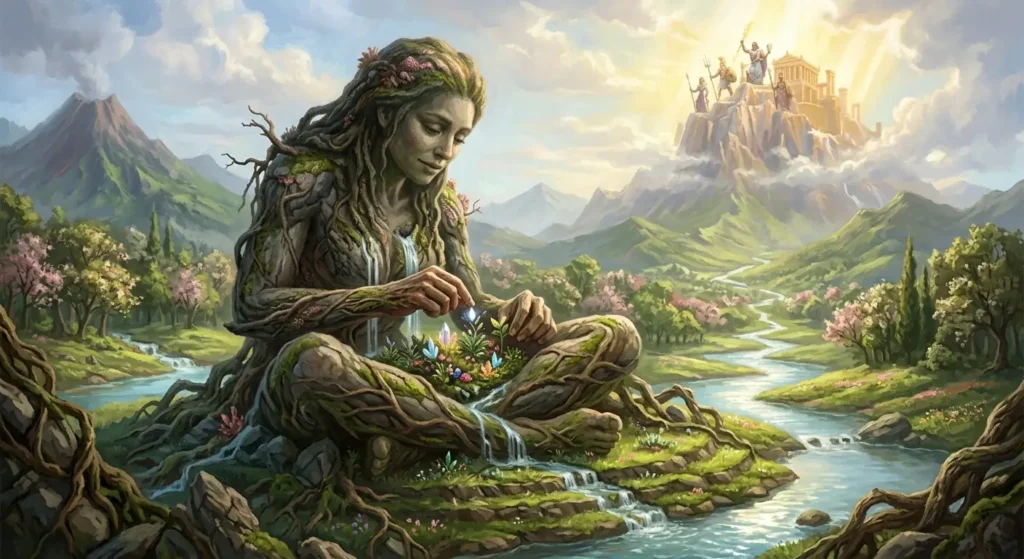
This is the detail that convinces me the reading above is right.
Four regime changes, and Gaia never attempts to take the throne herself in any of them. She has more foreknowledge than anyone, produces weapons nobody else can make, and consistently identifies the winning strategy before the eventual winner does.
She installs Cronus. She installs Zeus. She never installs herself.
Whatever she is, she isn’t ambitious in the way the male succession figures are. She’s something closer to a force that reacts to a specific condition, confinement of her offspring, and stops acting once that condition is addressed.
Which is exactly why she can’t be bought off with a settlement. There’s nothing she wants that a throne would provide.
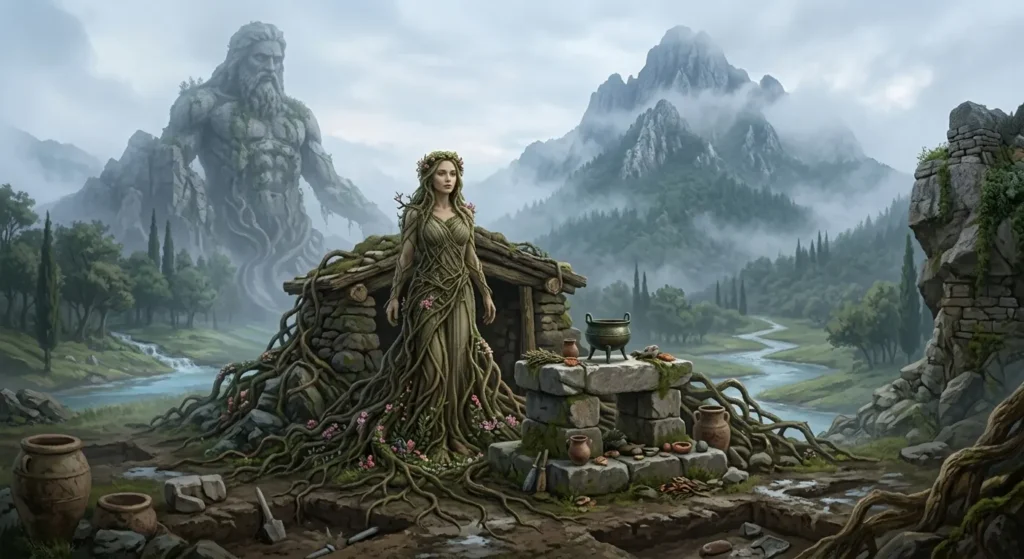
Delphi Was Hers Before It Was Apollo’s
The Peaceful Version
Aeschylus opens the Eumenides with the Pythia reciting Delphi’s chain of ownership, and Gaia comes first. She held the oracle, then Themis, then the Titaness Phoebe, and Phoebe gave it to Apollo as a birth gift.
That’s an orderly, voluntary transmission across four holders, with no violence anywhere in it.
The Violent Version
The Homeric Hymn to Apollo tells it differently. Apollo arrives at the site and kills the serpent guarding it, the creature later tradition calls Python, before establishing his oracle there.
Why the Disagreement Is the Interesting Part
Two major sources give incompatible accounts of how the most important religious institution in the Greek world changed hands.
One describes inheritance. The other describes conquest. Both were circulating in the same culture, and neither ever displaced the other.
My own suspicion is that the peaceful version served the sanctuary’s interest in continuity while the violent version served Apollo’s heroic profile, but I can’t prove that, and the sources genuinely don’t resolve it.
What both agree on is the starting point. Before Apollo, before Themis, the oracle belonged to the earth.
Scrutiny Is Required
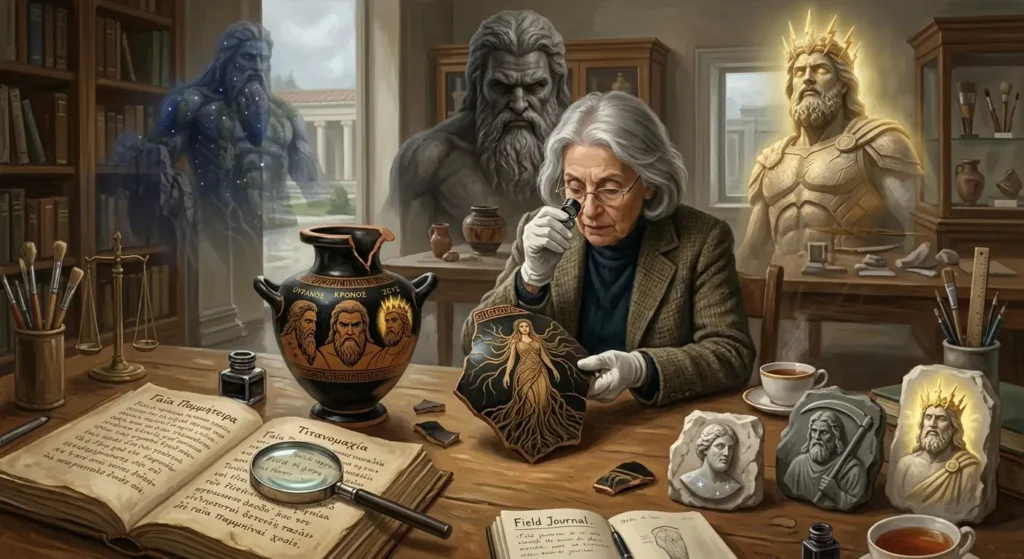
The consistent motive reading is my synthesis, and it deserves scrutiny rather than acceptance.
Hesiod never states a principle. He doesn’t have Gaia explain herself, and the Theogony compiles inherited oral traditions rather than composing a single coherent character study. The pattern I’ve traced may be an artifact of separate stories getting assembled into one poem rather than a portrait anyone intended.
The Gigantomachy material specifically comes largely from Apollodorus, writing centuries after Hesiod, which means part of my four regime pattern draws on a considerably later source than the rest of it.
There’s also a fair objection that I’ve made Gaia more coherent and more interesting than the material supports, essentially writing a character arc the ancient sources didn’t have in mind.
Greek mythology resists that kind of unification, and treating it as internally consistent usually means imposing something. This article isn’t exempt from that criticism.
Gaia Outside the Myths
She Had Genuine Worship
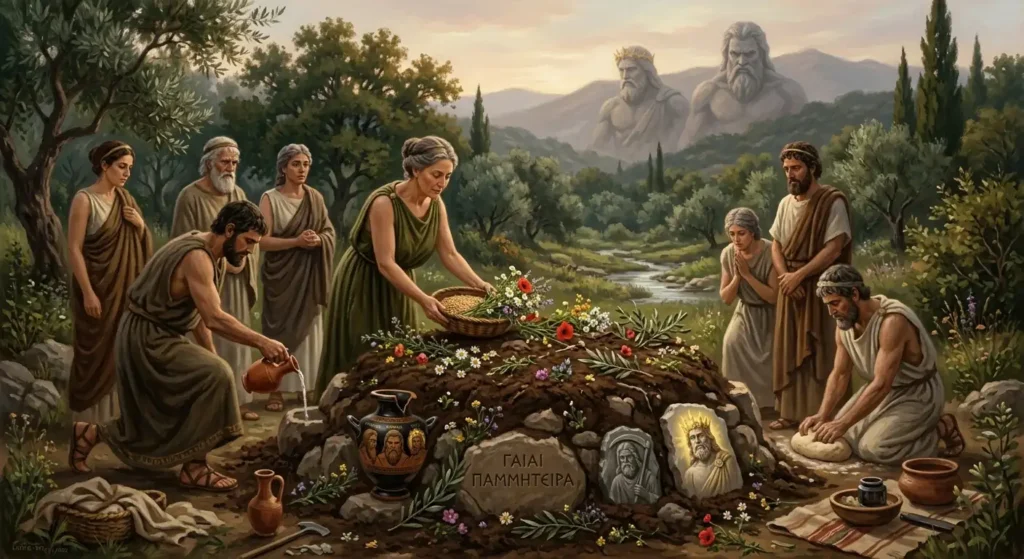
Gaia wasn’t purely literary. She received cult worship, appears in oath formulas, and has her own Homeric Hymn, number thirty, addressed to Earth the mother of all.
Her Roman counterpart is Terra, also called Tellus, who held her own place in Roman religious practice rather than functioning purely as a translated import.
Her Name Reached Modern Science
James Lovelock developed the Gaia hypothesis in the 1970s, proposing that Earth’s living organisms and inorganic surroundings function as a single self regulating system.
The name came from his neighbour in Wiltshire, the novelist William Golding, who suggested it.
A goddess who spent Greek cosmology overthrowing governments ended up naming a theory about planetary equilibrium, which is either fitting or deeply ironic depending on which Gaia you have in mind.
Frequently Asked Questions
Was Gaia ever depicted in Greek art, and how?
Yes, though considerably less often than the Olympians. She typically appears as a matronly figure emerging partially from the ground rather than standing fully upright, a convention that visually emphasises her identity as the earth itself rather than a being who walks on it.
Did the Greeks make sacrifices to Gaia differently than to Olympian gods?
Chthonic deities, those associated with the earth and underworld, generally received offerings poured into the ground or given at ground level altars, distinct from the raised altars and burnt offerings used for Olympian worship, though practices varied considerably by site.
Is Gaia the same figure as Rhea or Demeter?
No, though all three carry earth or fertility associations. Rhea is Gaia’s daughter and Zeus’s mother, while Demeter is Gaia’s granddaughter and governs cultivated grain specifically rather than the earth as a primordial entity.
Does Gaia appear in Homer as prominently as in Hesiod?
No. Homer references her in oath formulas and passing mentions, but the Iliad and Odyssey are concerned with human and Olympian affairs rather than cosmogony, which is why Hesiod’s Theogony remains the essential source for her narrative role.
Are there surviving temples specifically dedicated to Gaia?
Archaeological evidence points to sanctuaries and altars associated with her at several sites including Athens and Olympia, though dedicated temple structures for her alone were far less common than for major Olympian deities with larger civic followings.
Final Thoughts
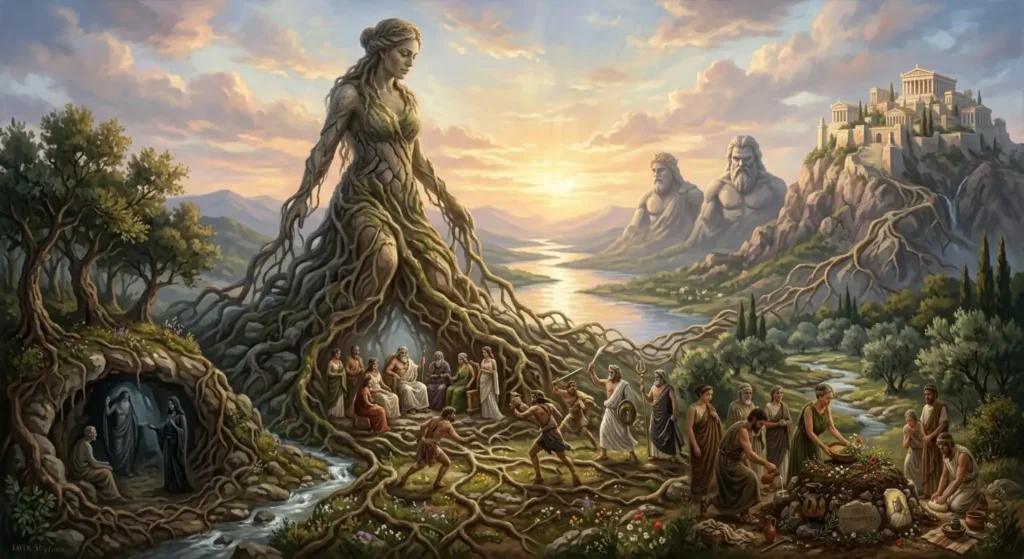
She generated the sky without help, married it, armed a son to destroy it, armed a grandson to destroy that son, then built a monster to destroy the grandson.
Four attempts, one unchanging reason, and never once a bid for the throne herself. Whatever Greek tradition meant by calling the earth a mother, it clearly wasn’t gentleness.
Further Reading
Written by Batin Khan, a curious free spirit who loves reading and exploring the worlds of fantasy, mythology, and ancient stories. Through this blog, Batin hopes to share that sense of wonder with readers while building an exciting future along the way.