

 By
By The usual answers to this question are thin. Escapism. Wish fulfillment. Emotional connection. All true enough to be useless, and none of them explain why this particular romantasy genre, at this particular moment, is doing something earlier romance apparently didn’t.
An academic went looking for a better answer forty years ago, and what she found had almost nothing to do with the books themselves.
The Study That Answered This in 1984
Radway Went to Smithton
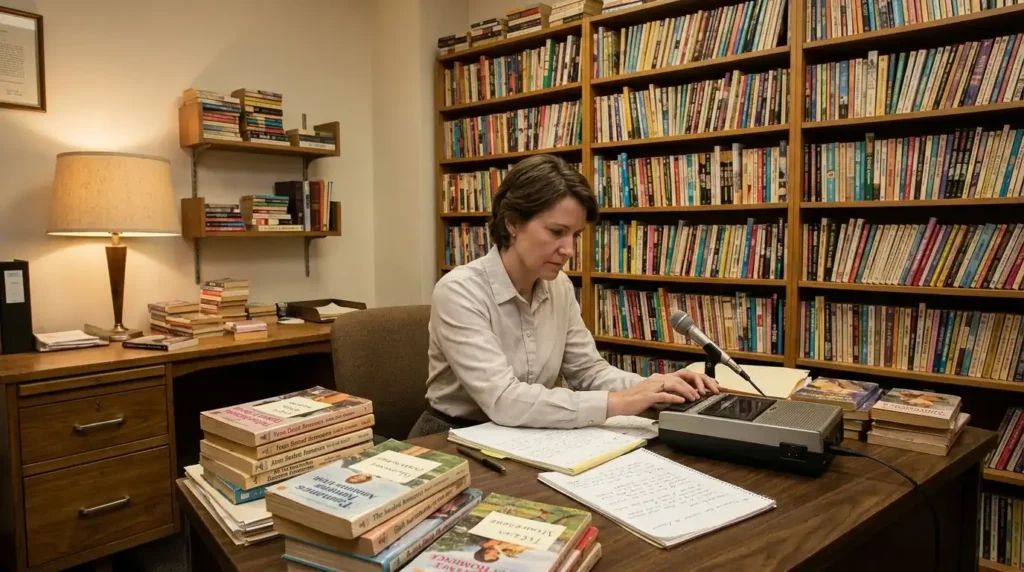
Janice Radway published Reading the Romance: Women, Patriarchy, and Popular Literature in 1984 through the University of North Carolina Press. It’s an ethnography of 42 romance readers in a Midwestern commuter suburb she pseudonymed Smithton.
She reached them through a bookstore clerk she called Dot, who wrote a newsletter recommending romances and had become a genuine authority figure among local readers. Most of the women were white, middle class, and married mothers.
Radway used questionnaires, interviews, and observation, and she compiled lists of twenty ideal and twenty failed romances drawn from the readers’ own judgments rather than her own.
The Finding Nobody Expected
Here’s what she actually found, and it isn’t what most summaries lead with. What mattered most to these women wasn’t the quality or content of the novels at all.
It was the act of reading itself.
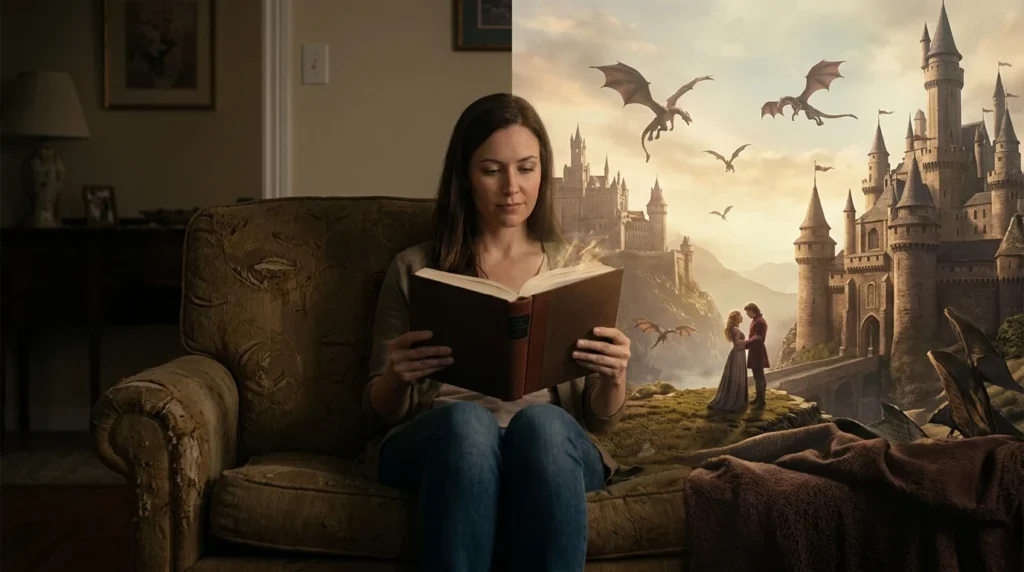
Reading gave them a period of the day that belonged to nobody else. Radway describes it as a way of declaring themselves temporarily off limits to the people who otherwise had continuous claim on their attention.
Reading as a Boundary Rather Than an Escape
That distinction matters more than it might seem. Escape suggests fleeing somewhere else. What Radway documented is closer to territory being claimed.
A woman with a book in her hands is visibly unavailable. The book functions as a physical, socially legible signal that this stretch of time has an owner, and the owner isn’t the household.
The Gap Between the Act and the Content
The Act Was Assertive
Everything above describes something genuinely self assertive. Claiming time, refusing availability, insisting on a private interior life inside a role structured around serving other people’s needs.
Radway Argued the Content Frequently Wasn’t
Her analysis, and this is where her book becomes an argument rather than a description, was that the novels these women read often reinscribed the very structures the reading act was pushing against.
Heroines whose value came from being chosen. Plots resolving through a man’s eventual recognition of a woman’s worth rather than through her own acquisition of anything.
That tension sits at the center of her book. The reading was a form of resistance. The read material, in her reading of it, frequently wasn’t.
Romantasy Genre Closes That Gap

Here’s my actual argument, and it’s the reason I think this question deserves a better answer than escapism.
The Content Now Models What the Act Was Always Doing
If Radway was right that the act of reading was itself an assertion of self, then romantasy is arguably the first mainstream romance adjacent genre where the content on the page matches the shape of the act.
Violet Sorrengail crosses a parapet where falling means dying, in a school that kills a percentage of its students on purpose, and survives through her own adaptation rather than through anyone’s protection.
Vin, in Mistborn, enters the story already shaped by survival instincts she developed before anyone taught her anything.
Jude, in The Cruel Prince, is a human in a faerie court that despises humans, and her response is to become genuinely dangerous rather than to be rescued.
None of these protagonists is waiting to be recognized. Each one is acquiring capability.
The Fantasy Is Power Without Permission
This is the specific thing I think the genre is delivering, and it’s narrower than generic empowerment.
The romantasy protagonist typically gains ability that nobody granted her. She isn’t given a position by an institution or awarded status by a man’s recognition. She develops magic, survives training designed to kill her, or discovers something in herself that predates anyone’s assessment of her worth.
That’s structurally identical to what Radway’s readers were doing with an hour and a paperback. Claiming something without asking whether it was permitted.
Why This Lands Differently Than Category Romance Could
Category romance operates within a contemporary or historical social world, which means a heroine’s power has to be negotiated against realistic constraints, workplace hierarchies, family expectations, financial dependence.
Fantasy removes that ceiling entirely. A secondary world can simply grant a woman the capacity to level a building, and then ask what she does with it. The genre’s fantastic elements aren’t decoration on a romance. They’re the mechanism that lets the power fantasy operate without realistic limits arguing it down.
Length Is Part of the Point
These Books Are Enormous
Romantasy runs long. Six hundred page volumes, series commitments spanning years, world building that demands sustained attention across multiple books.
That’s a genuine departure from the category romance format Radway’s readers were consuming, which was built for shorter, faster reads.
If Radway Was Right, Length Isn’t Incidental
Follow her finding to its conclusion. If reading functions as a claim on time, then a longer book is a larger claim.
A woman reading a seven hundred page fantasy novel across three weeks is asserting something more sustained than a woman reading a two hundred page category romance in an evening. The genre’s physical scale is, on this reading, an escalation of exactly the function Radway documented, not a coincidence of publishing fashion.
I find this genuinely interesting because nobody designed it that way. Doorstopper length came from fantasy’s own conventions, and it happens to intensify a function romance readers were already using books for.
The Privacy Radway Found Has Completely Inverted
Her Readers Valued Reading Because It Was Private
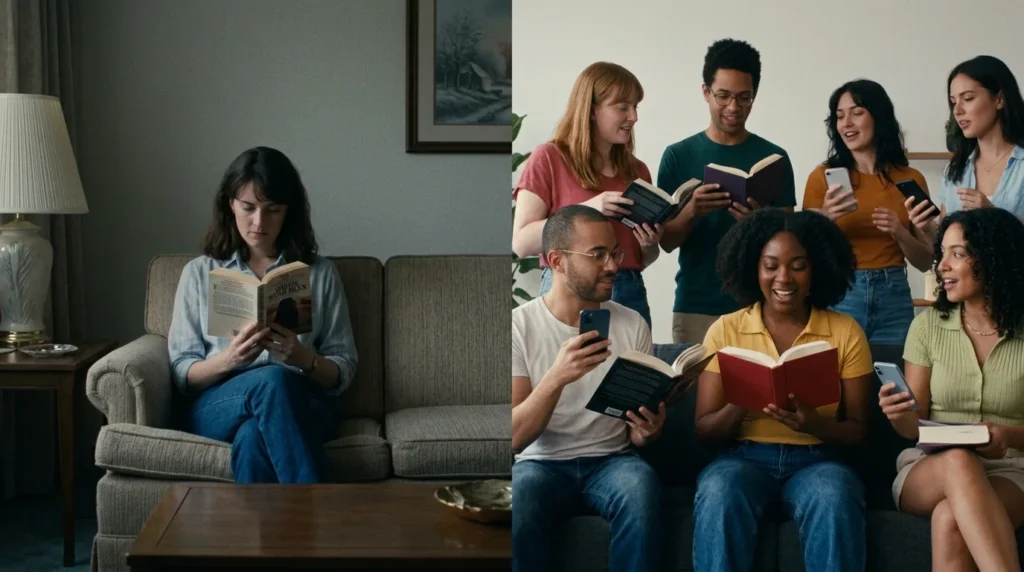
One detail from her study stands out sharply against the present moment. Few of the Smithton women knew each other before Radway brought them together for interviews.
Most had never discussed romance novels with a community of fellow readers at all. Radway notes they valued reading precisely because it was an intensely private act.
BookTok Made the Same Act Maximally Public
Compare that to now. Sprayed edge special editions displayed on shelves. Annotation culture, where readers tab and mark books and photograph the results. Buddy reads, reading vlogs, and hashtags running into the billions of views.
The same act Radway’s readers performed in isolation is now performed visibly, communally, and often as content.
What Changed and What Didn’t
The boundary function persists completely. A woman reading is still claiming time that belongs to her.
The isolation is gone, and I’d argue that’s the single biggest shift between Radway’s readers and the current ones. Her subjects were doing something quietly, individually, and somewhat defensively. Current readers are doing the same thing openly, with several million people confirming it’s worth doing.
Radway’s Study Has Real Methodological Problems

I’ve built a substantial argument on a forty-year-old ethnography, and it deserves scrutiny rather than deference.
Forty-two women, nearly all recruited through a single bookseller, in one suburban community, is not a representative sample. That skew was acknowledged by Radway herself but doesn’t disappear because it was acknowledged.
Helen Sterk’s 1986 review made a sharper criticism, arguing that Radway committed the same error with her readers that she accused literary critics of committing with romance novels, speaking over her subjects rather than letting them speak.
Romance authors including Kathleen Gilles Seidel and Laura Kinsale objected in 1992 to her characterization of the genre and its readers.
Radway herself, in her 1991 introduction to the second edition, conceded that her ethnography couldn’t have been purely empirical, since her descriptions of her interviewees’ self understanding were shaped by her own conceptual framework.
There’s also a genuine tone problem running through the book. These were scholars studying housewives, and the framing occasionally shows it.
Generalizing About Female Readers Is Its Own Trap
The second problem is with the question itself rather than with Radway.
Romance readership is majority but not exclusively women, and treating millions of individual readers as a single interpretive category risks exactly the essentializing that made earlier romance criticism condescending in the first place.
Plenty of women read romantasy because dragons are cool and the pacing is good. Not every reading choice is a response to social role pressure, and a framework that insists otherwise is doing the same thing Sterk criticized Radway for, explaining readers to themselves rather than listening.
I still think the Radway finding illuminates something real. I’d just rather offer it as one useful lens than as the explanation for anyone’s reading life.
Frequently Asked Questions
Has anyone conducted a large scale ethnographic study of romance readers since Radway?
Romance scholarship has expanded considerably, with the Journal of Popular Romance Studies launching in 2010 and substantial academic work published since, though the abundance of online reader communities has made the sampling challenge one of overwhelming variety rather than scarcity.
Who was Dot, and how significant was her role in the study?
Dorothy Evans was a bookstore clerk who wrote a print newsletter recommending romance novels and functioned as a trusted local authority. Scholars have noted she was effectively an early influencer, and her modern equivalent would likely run a review blog or social account.
Did the Smithton women read anything besides romance?
Radway’s study focused on their romance reading specifically, and her interest was in that genre’s function within their daily lives rather than in mapping their complete reading habits across all categories of fiction and nonfiction.
Is there scholarship examining romance reading among men?
Some research exists, though it remains considerably less developed than scholarship on women readers, partly reflecting the genre’s demographic skew and partly reflecting where academic attention has historically concentrated within romance studies.
How did Romance Writers of America factor into Radway’s work?
RWA was only four years old when Radway conducted her research, and she mentions it near the book’s conclusion as an early sign of organized romance community forming, well before the online reader networks that dominate the genre’s culture today.
Final Thoughts

Forty two women in a Midwestern suburb, reading paperbacks in stolen hours, and one researcher who noticed the reading mattered more than what was being read.
Romantasy’s protagonists are now doing on the page what those readers were already doing in their living rooms. Taking something back without asking whether they were allowed to, and refusing to hand it over when someone else wanted the time.
Related Articles
- What Is Romantasy? The Genre Taking Over Fantasy
- Why Dragons Took Over Romantasy, Thanks to Fourth Wing?
- Fourth Wing Review: Enjoyable, Not Groundbreaking
- Why Fated Mates Are So Hard to Put Down
- Why Enemies To Lovers Works So Well in Romantasy
- Why Romantasy Solves a Problem Traditional Romance Has
- Would You Be Able to Survive in the Fourth Wing World?
Further Reading
- Reading the Romance – Janice A. Radway
- Reading the Romance: Women, Patriarchy, and Popular Literature – Second Edition – Janice A. Radway
- Confluent Love and the Evolution of Ideal Intimacy: Romance Reading in 1980 and 2016
- Reading the Romance: A Thirtieth Anniversary Roundtable, Editor’s Introduction – Journal of Popular Romance Studies
- BookTok: A Narrative Review of Current Literature and Directions for Future Research – Dera – 2024
Written by Batin Khan, a curious free spirit who loves reading and exploring the worlds of fantasy, mythology, and ancient stories. Through this blog, Batin hopes to share that sense of wonder with readers while building an exciting future along the way.