
 By
By Open any current romantasy release calendar and dragons are everywhere: bonded to war college cadets, guarding fated mates, showing up on covers in numbers that would have looked strange five years ago.
Publishers Weekly reported that Circana BookScan dubbed 2023 “the year of romantasy,” reflecting how quickly the category had moved from a loose reader label into a major publishing phenomenon.
Romantasy itself is a blend of romance and fantasy structured so that neither genre works as decoration for the other. The romance has to be load-bearing for the plot, and the fantasy world has to be equally load-bearing rather than scenery.
Why Dragons Are Having a Moment in Romantasy?
My thesis here is specific rather than vague. Dragons didn’t suddenly become popular in a vacuum. A publishing breakthrough, a much older fictional tradition, and a real structural shift in what dragon bonding is actually being used to do all converged at once, and I want to trace each piece separately rather than credit one book with inventing all three.
Fourth Wing Was the Commercial Breakthrough
The Numbers
Fourth Wing published on May 2, 2023, through Red Tower Books, Entangled Publishing’s newer imprint. By year’s end, it had won the Goodreads Choice Award for Best Romantasy with 397,565 votes, beating a seriously crowded field that included Hannah Nicole Maehrer’s Assistant to the Villain and Jennifer L. Armentrout’s A Soul of Ash and Blood.
That award’s own description credits the book specifically with helping popularize the emerging consensus term for that year’s hottest hybrid genre: romantasy itself. That’s a documented claim about vocabulary, not just sales.
Release Phenomenon and BookTok
The series went on to generate midnight release parties and dedicated bookstore sections, a retail response usually reserved for a handful of releases per year across all of publishing.
BookTok became an important part of the book’s discovery and marketing cycle, with publishing reports identifying Yarros as one of the authors who benefited from the platform’s ability to amplify entire subgenres rather than individual books.
How Publishers Responded
The publishing response wasn’t simply a matter of publishers copying Fourth Wing after it became a hit. Entangled had already created Red Tower in late 2022 as an imprint focused on new-adult fantasy and science-fiction romance, and Fourth Wing became its inaugural title. Publishers Weekly later reported that Entangled had committed to a 315,000-copy first hardcover print run before publication.
The sheer density of comparable titles that followed within two years also helped: Fireborne, The Serpent and the Wings of Night, Bloodwing Academy, The Moonfall, all positioned explicitly toward readers who finished Fourth Wing and wanted more.
Standard publishing timelines mean several of these were likely already in development before Fourth Wing’s full scale became clear, but the marketing language around all of them leaned into the comparison immediately once it did.
But the Dragon Romance Formula Is Much Older
Pern Started This in 1968
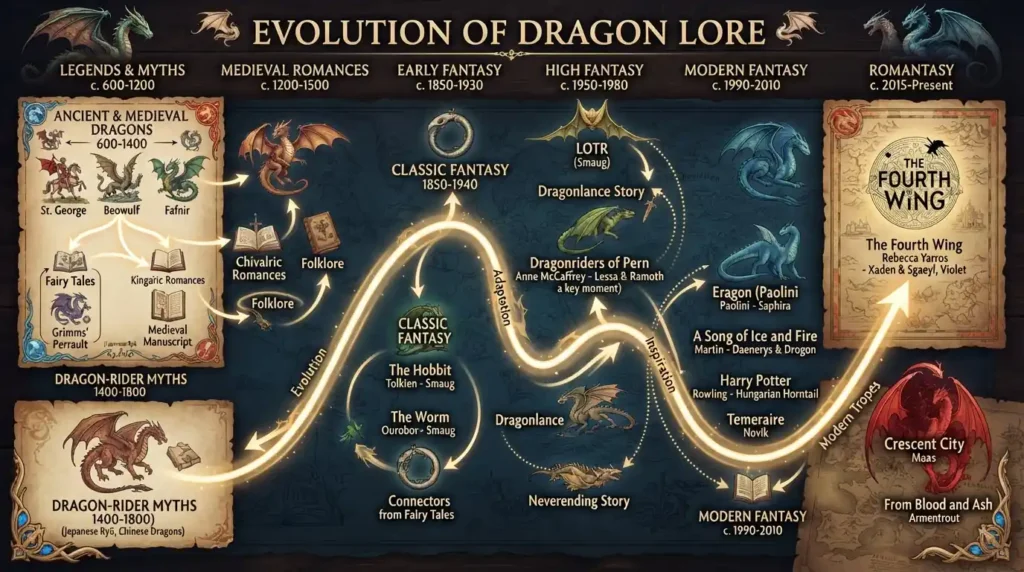
Anne McCaffrey’s Dragonriders of Pern, beginning with Dragonflight, built real emotional and telepathic intimacy into dragon bonding decades before romantasy existed as a term.
Readers discussing Fourth Wing today still reach for Pern as the direct comparison point, often naming McCaffrey outright as the foundational figure in dragon literature.
I want to name the uncomfortable part directly rather than skip it. Pern’s specific mating flight mechanic, where a dragon’s mating urges compel a corresponding encounter between bonded riders, has drawn real, fair criticism for its consent problems, since riders experience compulsion rather than choice.
Current dragon romantasy has largely moved away from replicating that particular mechanic, while keeping the underlying premise that a dragon bond can carry genuine romantic weight.
Dragon Shifter Romance Is a Separate, Also Older Lineage
Paranormal romance has had dragon shifter heroes for well over a decade before Fourth Wing: human characters who transform into dragons, structured the same way werewolf shifter romance works.
Zodiac Academy is a useful current example of this lineage still actively publishing (dragon shifters in an academy setting), mechanically distinct from Fourth Wing’s bonded companion structure even though both currently sit on the same romantasy shelf.
A Rough Timeline
| Year | Development | Evidence |
|---|---|---|
| 1968 | Dragonflight | McCaffrey/Pern |
| 2004 | Dragon Lords demonstrates established dragon-shifter romance | Michelle Pillow |
| 2019 | Zodiac Academy combines academy + dragon-shifter romance | Publisher/Google Books |
| 2020 | From Blood and Ash demonstrates large-scale fantasy romance without dragons | PW/Blue Box |
| 2023 | Fourth Wing combines dragon riding + fantasy romance at breakout scale | Goodreads/Entangled/PW |
Armentrout’s From Blood and Ash becomes a major bestseller within the broader romantasy wave, though without dragons specifically. 2023: Fourth Wing fuses the bonded dragon structure with romance at a scale none of its predecessors reached.
How the Dragon Changed From Companion to Romantic Fantasy Engine
This is the actual historical mechanism worth tracing carefully, because it’s a real structural shift, not just more books featuring dragons.
Stage One: The Dragon as Obstacle
Classical and early fantasy dragons (Beowulf’s dragon, Tolkien’s Smaug) exist in pure opposition to the human protagonist. No bond, no relationship, nothing to trace here toward romance.
Stage Two: The Dragon as Vehicle
A large amount of mid-twentieth-century fantasy treats dragons functionally: transportation and weaponry with scales, closer to an armored vehicle than a character. Emotional content is minimal to absent.
Stage Three: The Dragon as Real Companion, Still Platonic
Pern’s telepathic bond, Eragon and Saphira, and Novik’s Temeraire all establish something new: a dragon relationship with real mutual respect, loyalty, and emotional stakes. Crucially, none of these direct that emotional intensity toward commenting on the protagonist’s separate human romantic life. The bond is the relationship, full stop.
Stage Four: The Dragon as Romantic Barometer
This is what changed, and it’s a specific, traceable mechanism rather than a vague evolution. Once stage three had proven a dragon bond could carry romantic-level intimacy, later fiction became able to split that intimacy into two separate channels.
Keeping the dragon bond’s emotional legitimacy while redirecting the actual romance plot toward a separate human pairing, and repurposing the dragon as an outside validator of that pairing.
Tairn’s reaction to Xaden in Fourth Wing does exactly this. The dragon’s own independent judgment of a potential love interest becomes a plot signal the reader trusts, something neither Violet nor Xaden could self report with the same credibility.
That’s a distinctly different narrative function than anything Pern or Temeraire were built to do, and it only became available once the earlier stage had established that dragon intimacy could plausibly stand in that kind of relationship to human romance at all.
Why Dragons Are Having a Moment in Romantasy – Why It Works
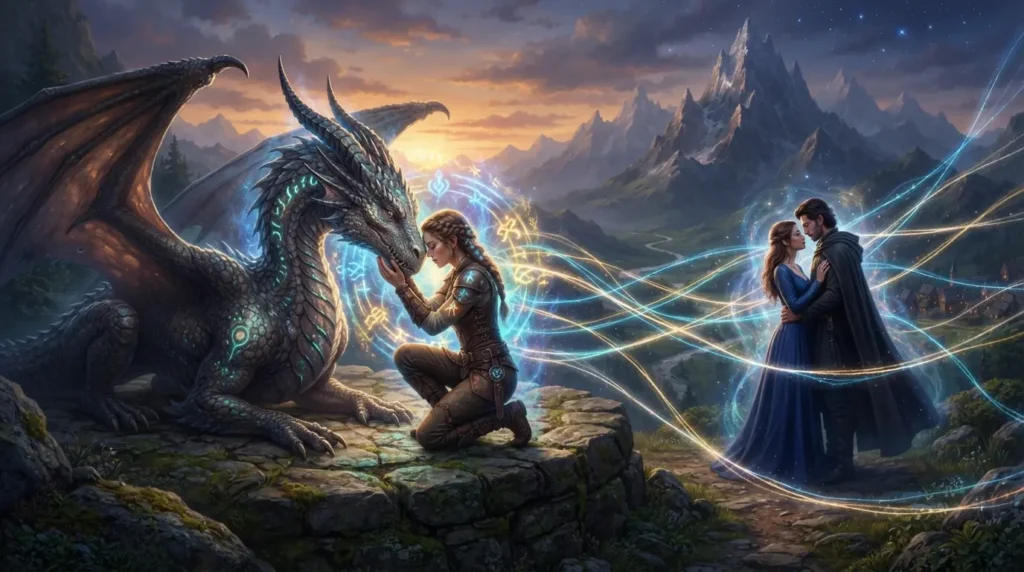
Bond and intimacy. A telepathic or magically mediated connection gives an author direct access to a character’s interior state without needing another human character to extract it through dialogue, a real structural convenience romance writing benefits from constantly.
Danger. A creature capable of real destruction raises the stakes of every scene it appears in without requiring a separate villain to generate tension.
Loyalty. The bond is typically exclusive and permanent, which mirrors the emotional promise romance itself is built around: one person, one commitment, made explicit through the dragon relationship before it’s ever confirmed through the human one.
Power and independence. A dragon with its own will, its own occasional disagreement with its rider, reads as a real character rather than an extension of the protagonist, which keeps the bond interesting past a first introduction.
Dual relationships. Running two significant relationships simultaneously (human romance and dragon bond) gives a single book two separate sources of emotional payoff instead of one, which is a genuinely efficient structure for sustaining reader investment across a long series.
Why BookTok and Publishing Were Finally Ready

Genre Boundaries Had Already Softened
Romance and fantasy shelving had been drifting toward each other for years before 2023, driven partly by Sarah J. Maas’s earlier crossover success, which trained both readers and retailers to expect fantasy elements and genuine romantic plotting in the same book without treating either as a compromise.
TikTok’s Discovery Mechanism Fit This Category Specifically
BookTok rewards content that names a specific, searchable emotional beat: enemies-to-lovers, fated mates, one bed. Dragon bonding gives creators an immediately visual, easily clipped hook that performs well in short video format.
Cover Design Became a Real Signal
Illustrated, stylized covers, often with special sprayed-edge editions, became a recognizable visual shorthand for romantasy specifically, letting a reader identify the genre and rough content level from a thumbnail before reading a single review.
Reader Communities and Publishing Economics
Independent authors were already proving this audience existed and was willing to pay for it, with romance and fantasy combined accounting for a large share of self-published ebook sales even before Fourth Wing’s traditional publishing breakthrough.
Traditional publishers had real commercial evidence the appetite was there before committing marketing budgets at this scale.
Is Fourth Wing Responsible?
The Counterargument, Stated Directly
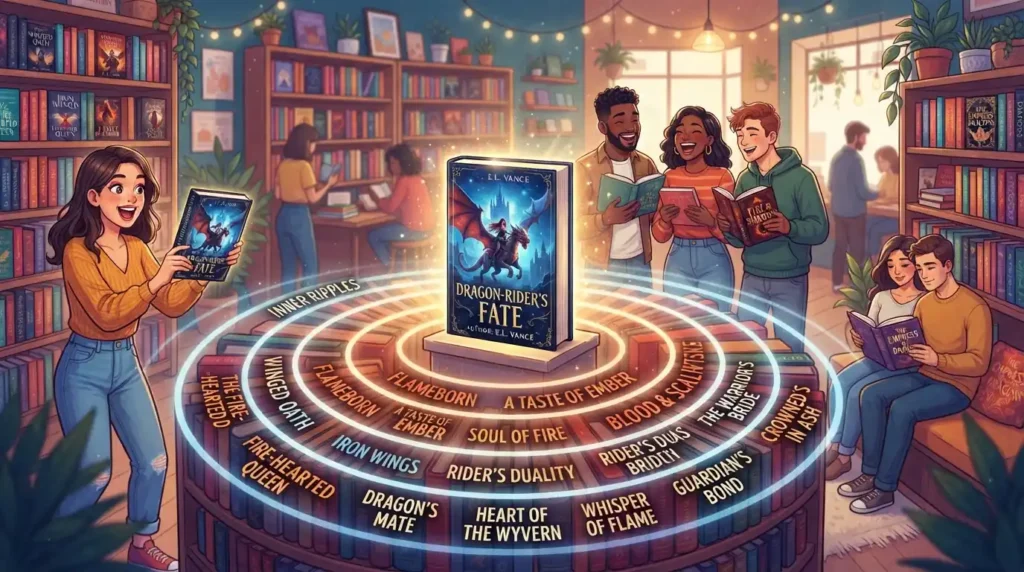
Crediting Fourth Wing alone risks erasing real prior work. Sarah J. Maas’s A Court of Thorns and Roses, first published in 2015 and reaching real viral scale on TikTok around 2020 and 2021, arguably built the crossover fantasy romance audience Fourth Wing then had waiting for it.
Jennifer L. Armentrout’s From Blood and Ash, published March 2020 through Blue Box Press, became a major bestseller three years before Fourth Wing existed, proving high-spice fantasy romance could reach massive commercial scale without a single dragon in it.
Add the pre-existing dragon shifter paranormal romance tradition and McCaffrey’s own decades-old foundation, and the honest picture is a genre that was already primed to explode, with Fourth Wing arriving at exactly the right moment rather than single-handedly creating the conditions for its own success.
Why Fourth Wing Still Matters Specifically
What Fourth Wing did that Maas and Armentrout’s books didn’t was fuse this already primed romantasy audience specifically with dragon bonding, at a commercial scale, all at once. Being in the right place at the right cultural moment is a real, specific achievement, distinct from originating the underlying appetite.
How to Tell Whether a Dragon Is Doing Narrative Work
Here’s the dragon-specific, romance-specific test to check whether the dragon is doing the narrative work, broken into four checks.
The removal test. Could you replace the dragon with a loyal human soldier or companion character without changing the plot’s real mechanics? If yes, the dragon is decoration wearing scales.
The validation test. Does the dragon’s own independent reaction to the love interest function as a genuine plot signal, something the human characters couldn’t credibly tell you themselves? If the dragon never reads anyone independently, it isn’t doing stage four work.
The cost test. Does the bond carry a specific, named cost if broken, following Pern’s own established stakes, rather than functioning as a relationship you could simply walk away from with no consequence? Real stakes require a real, stated price.
The asymmetry test. Does the dragon ever disagree with its rider, show its own preferences, or express something closer to Tairn’s own well-documented impatience with human nonsense, rather than existing purely to agree with and validate the protagonist at every turn? A dragon that never pushes back is a mirror, not a character.
Run a book you’re considering through these four checks before assuming every dragon on a current cover is doing the same kind of work. Some genuinely are. Plenty are simply there because the cover sells.
Final Thoughts
Fourth Wing didn’t invent the appetite for dragon bonding treated as romantically significant. Pern proved that idea could work in 1968. Dragon shifter romance kept a parallel version of it alive for decades afterward. Maas and Armentrout proved fantasy romance itself could reach massive scale before a single dragon was involved.
What Fourth Wing actually did was make an appetite that already existed fully visible to an entire publishing industry at once, converting a real but scattered readership into a category publishers could suddenly see clearly enough to acquire for. That’s not the same claim as inventing the trend, and it’s a much more interesting one once you actually trace where the appetite came from first.
Related Articles
- 13 Overlooked Dragon Books Worth Reading in 2026
- 15 Best Dragon Books for Adults [Dark & Epic Picks of 2026]
- Why Dragons Are Almost the Perfect Mythological Creature
- 15 Elemental Dragon Types in Fantasy: Fire, Ice & Beyond
- Why Romantasy Connects So Deeply With Female Readers
- Would You Be Able to Survive in the Fourth Wing World?
- Why Romantasy Solves a Problem Traditional Romance Has
- Why Romantasy Readers Love Dangerous Men
Sources & Further Reading
- YA Romantasy: True Love or Passing Fancy? – Publisher Weekly
- Fourth Wing – Entangled Publishing
- Readers’ Favorite Romantasy 2023 – Goodreads Choice Awards
- How TikTok Has Transformed Romance Publishing
- Dragonriders of Pern
- In Blood and Ash, Blue Box Press Finds a Big Hit
- Eragon by Christopher Paolini – Reading Guide
Written by Batin Khan, a curious free spirit who loves reading and exploring the worlds of fantasy, mythology, and ancient stories. Through this blog, Batin hopes to share that sense of wonder with readers while building an exciting future along the way.