
 By
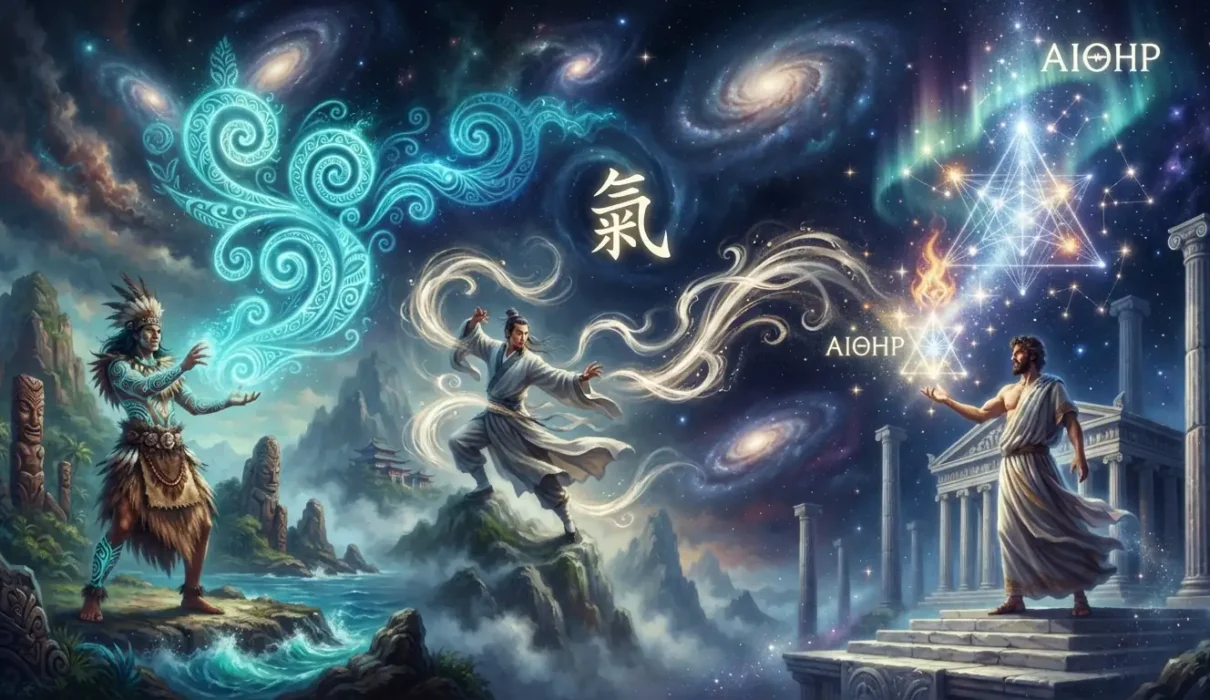
By Three words Mana, Chi & Aether from three unconnected parts of the world, used more or less interchangeably in modern fantasy to mean magical fuel. The obvious question is whether that interchangeability is lazy or whether these traditions were genuinely circling the same idea.
I went in expecting to argue the first one. The etymology pushed me somewhere stranger.
The Convergence Is Real, and It Runs Through Breath

Qi Started With Vapor
The traditional character for qi, 氣, combines a component associated with rice below a component depicting rising vapor or air. The concept’s oldest sense sits close to steam, mist, and breath rather than to any abstract energy.
Chinese medical and philosophical tradition built enormously on that root, but the root itself is physical and observable. Something you can watch leave a cooking pot on a cold morning.
Prana Means Breathing Forth
Sanskrit prana breaks down almost literally. The prefix pra plus the verbal root an, to breathe, giving something close to breathing forth or forward breath.
Yogic practice built pranayama directly on this, a discipline whose name pairs prana with control or extension. The breath connection was never metaphorical in origin.
Pneuma and Ruach Do the Same Thing
Greek pneuma means breath, and Stoic philosophy elevated it into a cosmic organizing principle without ever losing the bodily sense underneath.
Hebrew ruach covers breath, wind, and spirit simultaneously, with no clean division between the three. Latin spiritus works the same way, which is how English ended up with spirit, respiration, and inspiration all sharing one origin.
Aether Was the Air the Gods Breathed
Greek aither appears in Homer and Hesiod as the pure upper air, distinguished from aer, the thicker air mortals actually breathe. Aristotle formalized it in On the Heavens as a fifth element, incorruptible, composing the celestial spheres.
Even the outlier that eventually became a physics hypothesis started as a kind of air.
Mana Should Break the Pattern, But Doesn’t
This is where I expected to find the exception that ruined the tidy story. Mana, in every popular account, is about efficacy and prestige: power attached to chiefs and objects and successful outcomes. Nothing to do with breath at all.
What Blust Found in the Cognates
Linguist Robert Blust published an article in Oceanic Linguistics in 2007 titled Proto-Oceanic *mana Revisited, arguing that anthropological debate had spent a century arguing about interpretation while ignoring the word’s actual etymology.
His finding: cognates across Oceanic languages carry meanings like thunder and wind. Blust argued Proto-Oceanic *mana did not originally denote a detachable supernatural power that a person could possess, but referred instead to powerful natural forces: storm winds and thunder, understood as the visible expression of an unseen agency behind them.
As Oceanic-speaking peoples moved eastward, that unseen agency became detached from the physical weather that inspired it and took on a life of its own. The abstract, possessable mana that Codrington documented in 1891 is the endpoint of that drift, not its starting condition.
Blust’s reconstruction wasn’t the end of the linguistic argument. Juliette Blevins revisited the evidence in 2008, adding lexical material from Oceanic and Malayo-Polynesian languages and proposing a somewhat different reconstruction that preserves both supernatural efficacy and associations with ancestral inheritance
The Pattern Holds
So mana traces back to storm wind. Qi traces back to vapor. Prana traces back to breath. Pneuma and ruach trace back to breath and wind. Aether traces back to upper air.
Five traditions with no meaningful contact between most of them, all starting from moving air.
Same Seed, Very Different Buildings

Here’s where the title’s premise starts to strain. A shared root does not mean a shared concept, and what each tradition constructed on top of that root diverges completely.
Qi Became a Medical System
The Huangdi Neijing, the Yellow Emperor’s Inner Canon, systematized qi into a working diagnostic framework. Traditional Chinese medicine distinguishes yuan qi inherited at conception, gu qi extracted from food, and kong qi drawn from breathing, which combine into further refined forms including defensive and nutritive qi.
Add the jingluo, the channel network qi is theorized to circulate through, and you have a framework precise enough to support acupuncture point selection. Qi was answering a specific question: why is this person unwell, and what do we do about it.
Aether Became a Physics Hypothesis
Aristotle’s fifth element was a claim about what the sky is physically made of. Nineteenth-century physicists then revived the term for the luminiferous aether, a hypothesized medium light waves were thought to require for propagation.
The Michelson-Morley experiment of 1887 failed to detect it, and Einstein’s relativity eventually made the concept unnecessary. Aether was answering: what is the universe built out of, and what does light travel through.
Mana Became a Social Accounting System
By the time Robert Henry Codrington documented it in The Melanesians in 1891, mana had become something attached to specific people and specific objects, explaining why a particular chief succeeded, why a particular fishing hook kept working, why a lineage carried authority.
Blevins, extending Blust’s work in 2008, notes a possible connection to a Proto-Western-Malayo-Polynesian form meaning inheritance, which fits that prestige and lineage dimension neatly. Mana was answering: why did this person’s efforts work when that person’s didn’t.
Three Questions, Not One
| Concept | Root Sense | Developed Into | Question It Answers |
|---|---|---|---|
| Qi | Vapor, breath | Medical and cultivation framework | Why is this body unwell |
| Prana | Breathing forth | Yogic discipline | How do I control my own vital state |
| Aether | Upper air | Cosmology, then physics | What is the universe made of |
| Mana | Storm wind, thunder | Social and religious efficacy | Why did this person succeed |
Medicine, discipline, physics, social explanation. Four genuinely different intellectual projects sharing a common starting image and almost nothing else.
The Flattening Has a Documented History
Marett Said the Quiet Part Openly
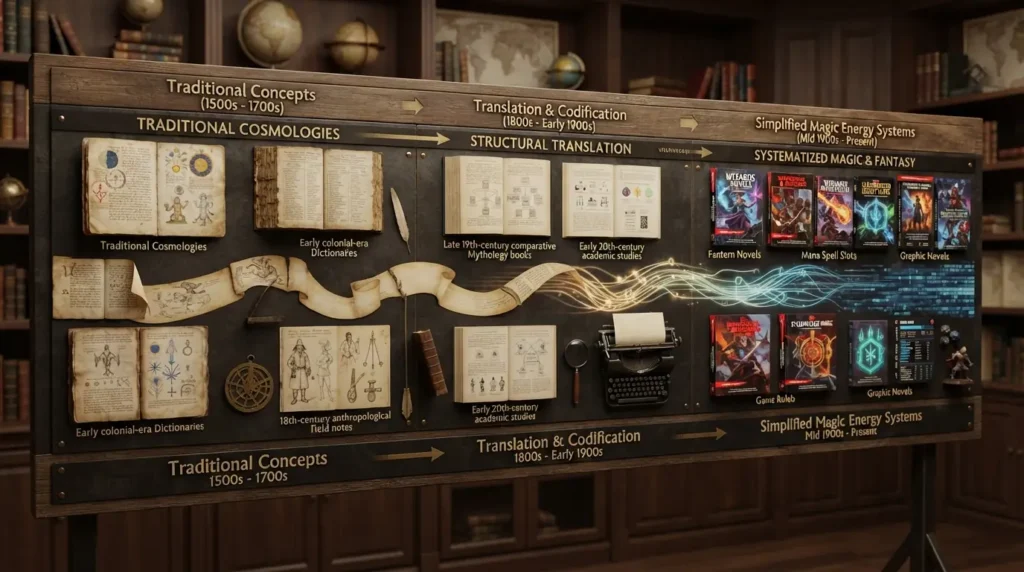
R.R. Marett’s 1909 book The Threshold of Religion took Codrington’s culture-specific observation and elevated mana into a supposed universal category underlying all early religion.
He wrote explicitly that comparative religion, when borrowing a native term like mana, is obliged to disregard to some extent its original or local meaning. That is a scholar announcing in print that he intends to strip a word from its context.
Mauss and Hubert Built on the Stripped Version
Marcel Mauss and Henri Hubert constructed a general theory of magic on that universalized mana in the early 1900s, treating it as a cross-cultural constant rather than a Melanesian-specific concept.
Lévi-Strauss Pushed Back
Claude Lévi-Strauss later critiqued the whole approach, treating mana in this generalized usage as something closer to a floating signifier, a term with so little fixed content that it could absorb any meaning a theorist needed it to carry.
That critique stuck. Anthropological confidence in universal mana collapsed, and later scholars have continued documenting how much the term actually varies from island to island.
What Fantasy Inherited

Modern fantasy did not receive these concepts from their source traditions. It received them through the flattened, universalized version that comparative religion and later esoteric movements had already produced.
That inheritance explains the interchangeability. If your source treats mana, qi, prana, and od as four labels for one universal energy, then using them as synonyms in a novel is simply reproducing what you were handed.
It’s worth noting how differently the three actually function once they reach fiction: mana as a depleting meter, chi as something cultivated over years, aether as an ambient medium.
Those fictional differences track the original traditions better than the flattened synonym usage does, which suggests some genre instinct survived the flattening even where the scholarship did not.
Things Worth Noting

The anthropological critique may have overcorrected. Blust’s etymological work suggests the cross-cultural convergence is genuinely real at the root: storm wind and breath and vapor recurring across unconnected traditions, which is exactly what Marett claimed and what Lévi-Strauss’s critique made unfashionable to say.
Humans breathe. Breathing stops at death. Wind moves things without being visible. Any culture paying attention has the raw material for a vital force concept, and noticing that pattern is not automatically colonial projection.
Where Marett still went wrong is scope. He flattened the developed concepts, not the roots. A shared etymological starting point does not license treating a Chinese medical framework, a Greek cosmological element, and a Melanesian theory of social efficacy as one interchangeable thing. The seed was shared. The buildings were not.
Frequently Asked Questions
Did Blust’s etymology settle the mana debate, or is it still contested?
Still contested. Juliette Blevins extended his work in 2008 with additional lexical data supporting a related reconstruction, and scholarship since has continued examining how mana functions in living Pacific communities today rather than treating the question as historically closed.
Is there an equivalent concept in African or Indigenous American traditions?
Various terms have been proposed by outside scholars, including Lakota wakan and Iroquoian orenda, though these were frequently collected during the same era of universalizing comparative religion and carry the same risk of having been flattened to fit a theory.
Why does Japanese ki differ from Chinese qi if they share a character?
Ki is a direct borrowing of the same character, but Japanese usage developed its own emphases through martial arts and everyday idiom, appearing in common expressions about mood, attention, and intention rather than staying primarily medical.
Was od or orgone ever taken seriously by scientists?
Baron von Reichenbach’s odic force in the 1840s and Wilhelm Reich’s orgone in the twentieth century both sought scientific legitimacy, and both failed to gain it. Neither has experimental support, and Reich’s work was the subject of significant legal action in the United States.
Does traditional Chinese medicine still teach the classical qi framework today?
Yes. The Huangdi Neijing framework remains foundational in TCM education and practice worldwide, though it operates as a traditional theoretical model rather than one validated by biomedical research into qi as a measurable substance.
Final Thoughts

Five traditions that never spoke to each other all reached for the same image, air in motion, and then built a hospital, a meditation practice, an astronomy, and a theory of political authority on top of it.
The convergence is more real than I expected when I started digging. The differences are more real than the word synonym allows. And the etymologies still occasionally reverse an argument I thought I was about to make, which is most of why I keep checking them.