
 By
Quick Takeaways:
- Athena’s wisdom is practical cunning, not quiet reflection. The Greeks had a word for it, metis, and it’s also the name of her mother.
- She uses intelligence in five repeatable ways: timing, persuasion, disguise, strategy, and craft.
- Her favorite mortal is the cleverest, not the best-behaved, and the Odyssey says so directly.
- Her intelligence can be partisan, vindictive, and limited. The sources show that too.
The first time Athena appears in the Iliad, she grabs Achilles by his golden hair. He has half drawn his sword to kill Agamemnon. She’s visible only to him, she tells him to stop, and he does.
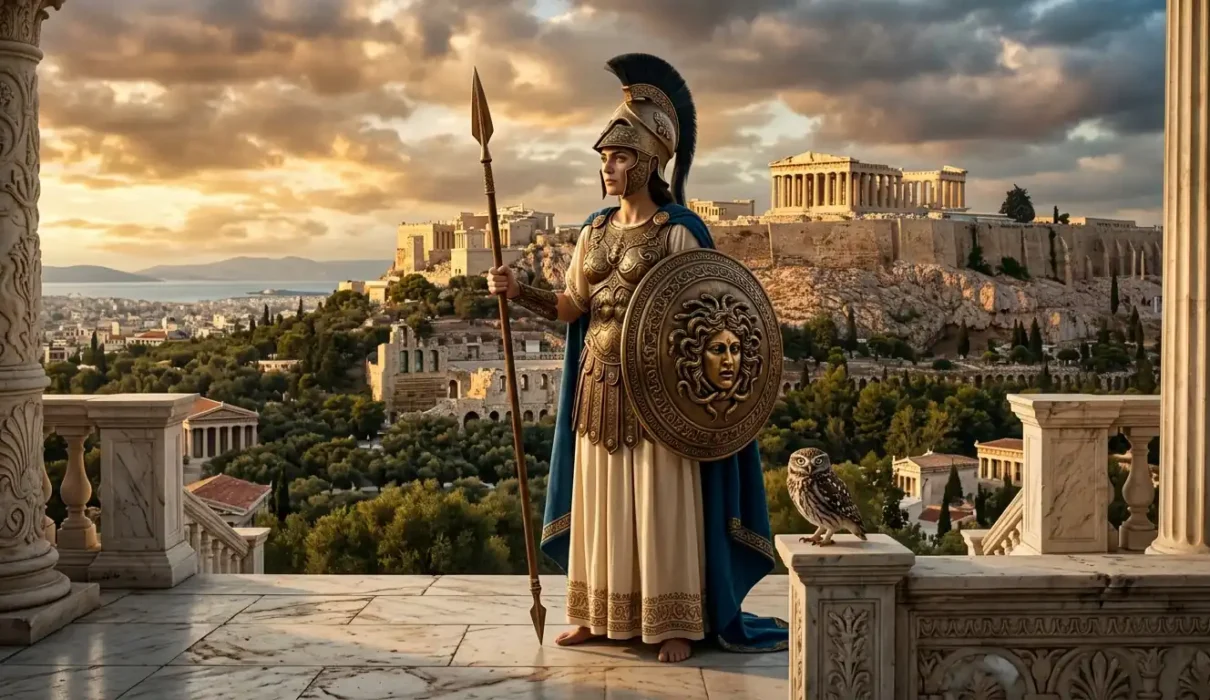
That’s the scene I think about when someone calls her the goddess of wisdom. She doesn’t lecture him. She stops a killing with one hand and a promise, and the whole camp keeps living. That’s wisdom as a weapon, and it’s the pattern in almost every story she’s in.
I’ve written about her birth, her contest with Poseidon, and her harsh punishments on this blog. This piece asks a different question: what does her kind of intelligence actually do?
Her Wisdom Isn’t the Quiet Kind
Metis Is Not Philosophy
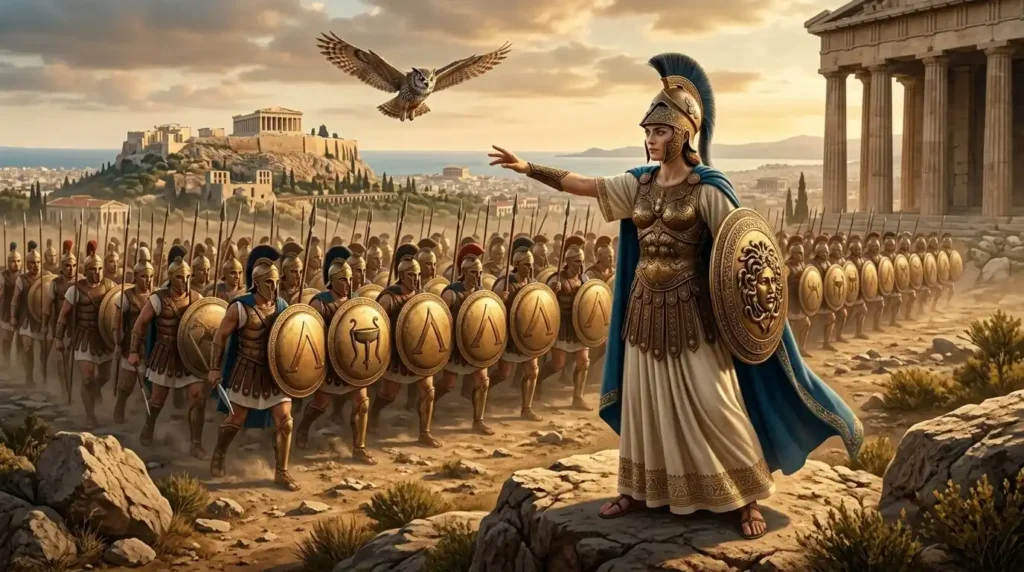
The Greek word metis means cunning intelligence: the skill of finding a way through a problem that force can’t solve. Marcel Detienne and Jean Pierre Vernant built a whole book around it, Cunning Intelligence in Greek Culture and Society, first published in French in 1974.
Their argument is that metis belongs to the weaker party. It’s the pilot steering through a storm, the craftsman fitting a joint, the fox outwitting the hound. It’s what you use when you can’t win by being bigger.
Her Mother’s Name Is the Clue
The myth says Zeus swallowed Metis while she was pregnant, and Athena was born from his head. One modern reading calls Athena “Metis, swallowed but not digested.” I like that image because it explains why her intelligence feels so practical.
I’d treat it as interpretation rather than ancient doctrine. It’s still a useful way to see the connection: the goddess’s skill and her mother’s name are the same word.
Weapon One: Restraint
Stopping Achilles
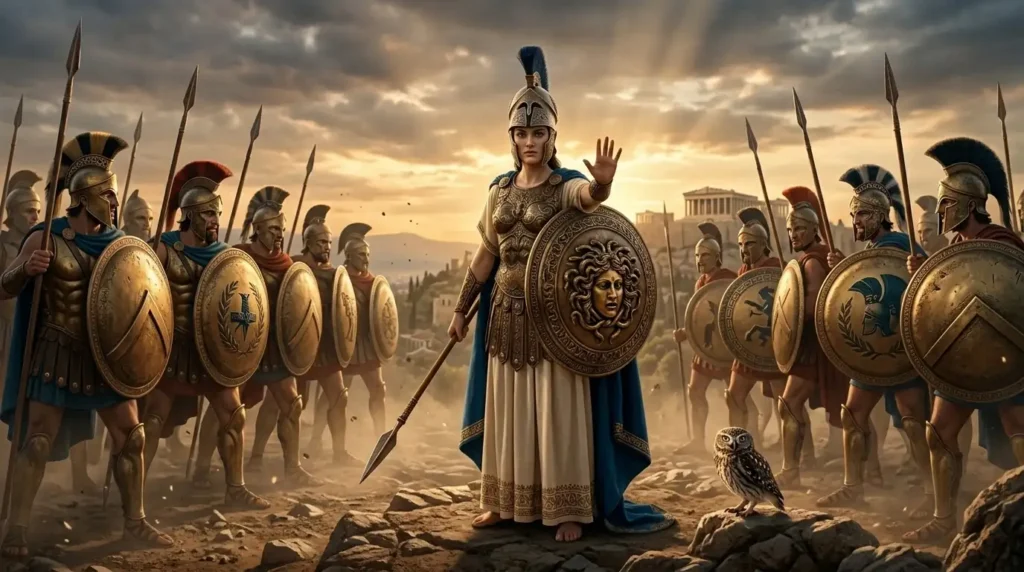
In Iliad Book 1, Hera sends Athena to Achilles, and Athena grabs his hair as he starts to draw his sword. She tells him she’ll bring recompense later, and that he should insult Agamemnon with words instead.
She saves Agamemnon’s life by persuading a furious warrior to wait. The wise move is the postponed one, and she makes it without force.
Holding Back in the Great Hall
In Odyssey Book 22, Athena is present as Odysseus fights the suitors, but she doesn’t take over immediately. She holds back her full power for a while, then reveals the aegis and the suitors panic.
One summary of the scene calls it Athena intentionally letting Odysseus prove himself first. That’s my reading as well: she times her intervention, which is itself a form of intelligence.
Weapon Two: Persuasion
She Handles Zeus With His Own Words
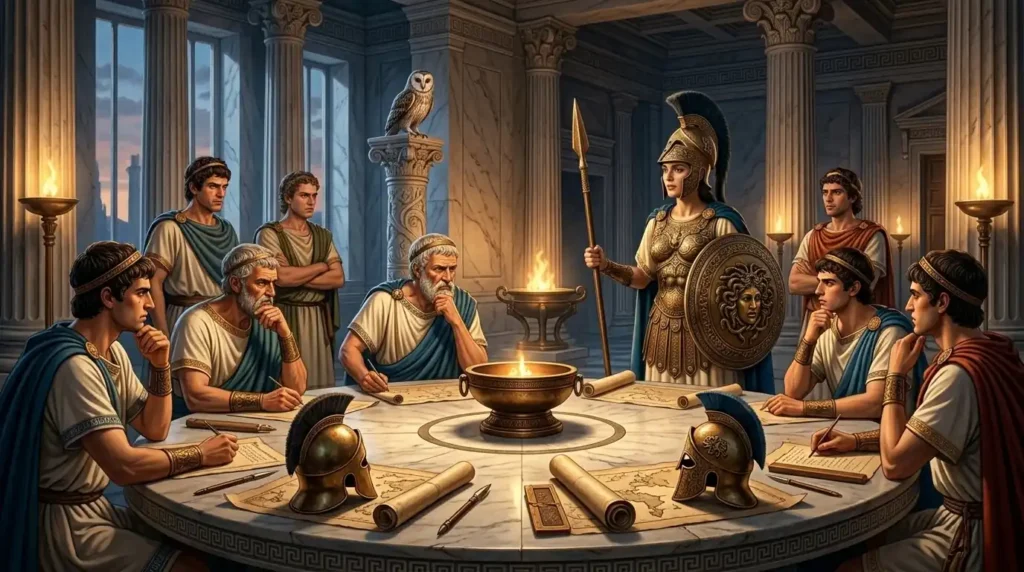
In Odyssey Book 1, Athena wants Odysseus freed from Calypso’s island. She opens by agreeing with Zeus’s condemnation of Aegisthus and only then turns to Odysseus’s suffering.
She never says Zeus has been unfair. She steers him toward the conclusion herself, which is a skill she shares with Odysseus.
Turning the Furies
In Aeschylus’ Eumenides, Athena sets up a court of citizens to judge Orestes, then breaks the tie in his favor. The Furies, enraged, threaten to blight Athens.
She doesn’t banish them. She offers them honors and a permanent home, with some hints of threat behind it, and converts the Erinyes into the Eumenides, the Kindly Ones.
A Fair Warning About That Vote
Commentators have pointed out that her vote looks political. Athena says no mother bore her and she sides with the male, which some readers find more like prejudice than neutral judgment.
I think both things are true. She ends a cycle of revenge killings, and she does it with a rationale that’s hard to defend. Her wisdom isn’t pure.
Weapon Three: Disguise
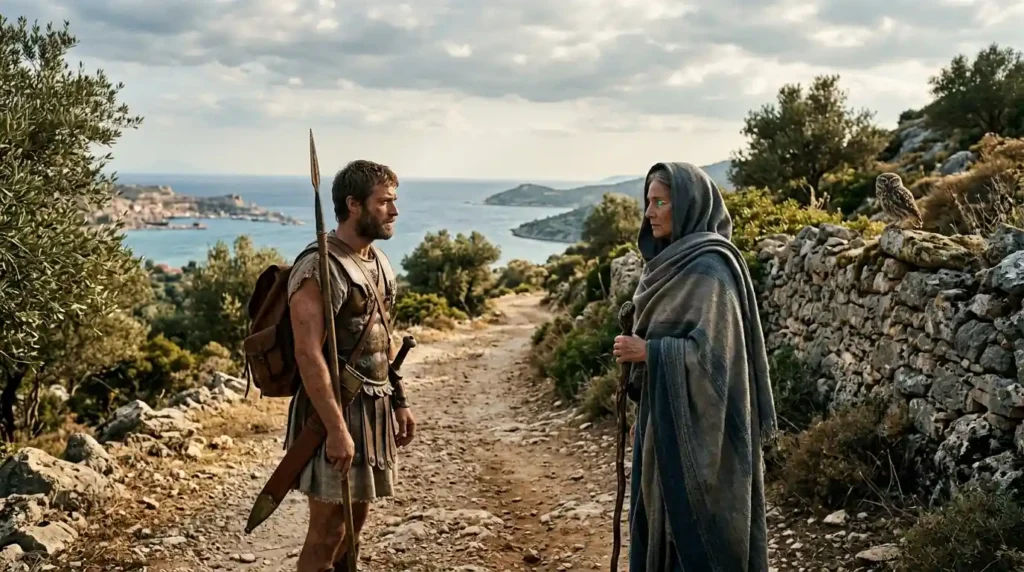
The Shepherd Boy
When Odysseus finally reaches Ithaca, he doesn’t recognize it. Athena meets him in disguise as a young shepherd, and he lies to her with a made up story.
She smiles, changes back, and tells him he’s the best of men at counsel and stories while she’s famous among gods for wisdom and cunning wiles. Paraphrasing a translated line, it’s the clearest statement of her philosophy in the epic.
Mist, Mentor, and More
She also shrouds him in mist so no one on the road sees him, appears to Telemachus as Mentor, and helps Odysseus pose as a beggar. One analysis counts her appearances as a bird, a young girl with a pitcher, and a shepherd boy.
Disguise is how she works at close range. It’s an intelligence that operates by changing what other people can see.
Weapon Four: Strategy Against Brute Force
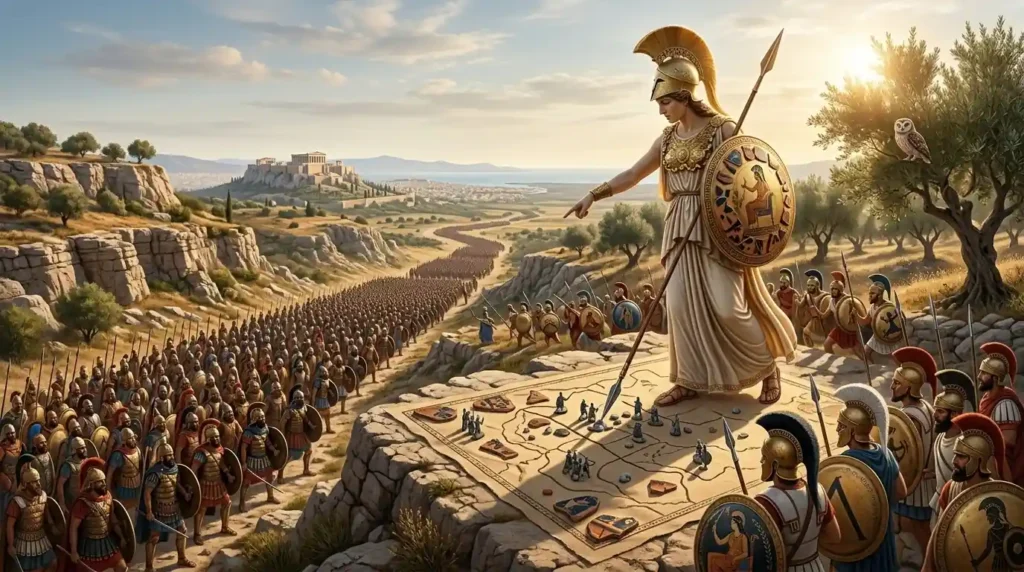
What She Does to Ares
In Iliad Book 5, Athena helps Diomedes by lifting the mist from his eyes so he can tell gods from men. She also drives his spear into Ares, who bellows and retreats to Olympus.
In Book 21, she knocks Ares down with a boulder. The god of raw violence loses to the goddess of planning, and the poem treats it as natural.
The Pattern Is Consistent
Ares charges. Athena observes, times her strike, and uses whatever’s at hand. I think this is why the Greeks could call both of them war gods without contradiction: they were two approaches to the same problem, and the poems consistently favored hers.
Weapon Five: Craft
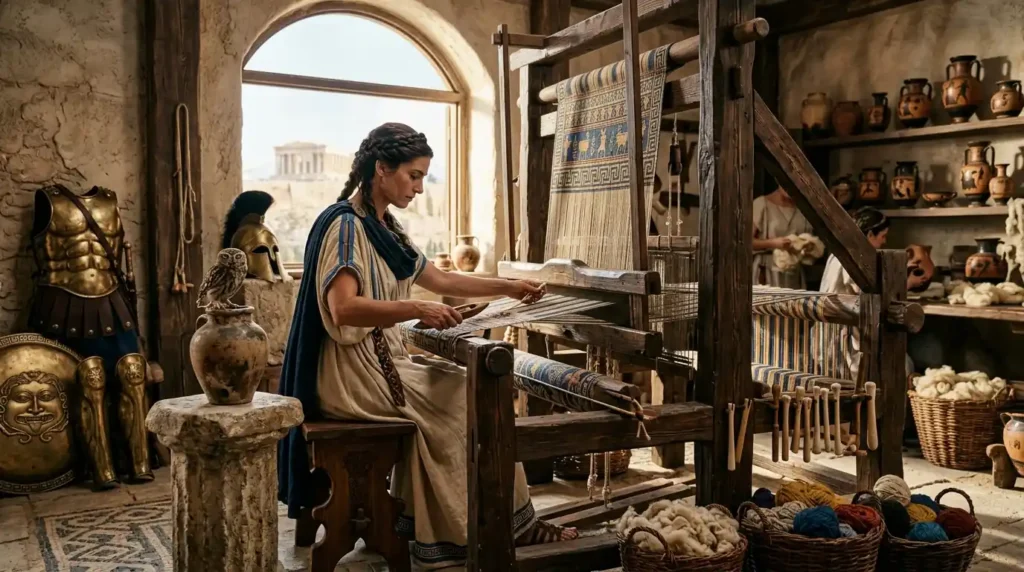
Athena Ergane
One of her cult titles was Ergane, the worker. Craftsmen honored her because her skill was making things, not just beating enemies.
She’s tied to weaving, to ship building, and to tools. Wisdom in this sense means knowing how a thing is put together, and the same mind that stops Achilles also understands a loom.
Why She Threw Away the Flute
Several ancient writers, including Aristotle in the Politics, report a story that she invented the aulos, then threw it away because playing it distorted her face. The satyr Marsyas picks it up in the better known tale.
I like the story because it shows her priorities. Even an invention she’d made herself was dropped when it cost her dignity.
Why She Likes Odysseus
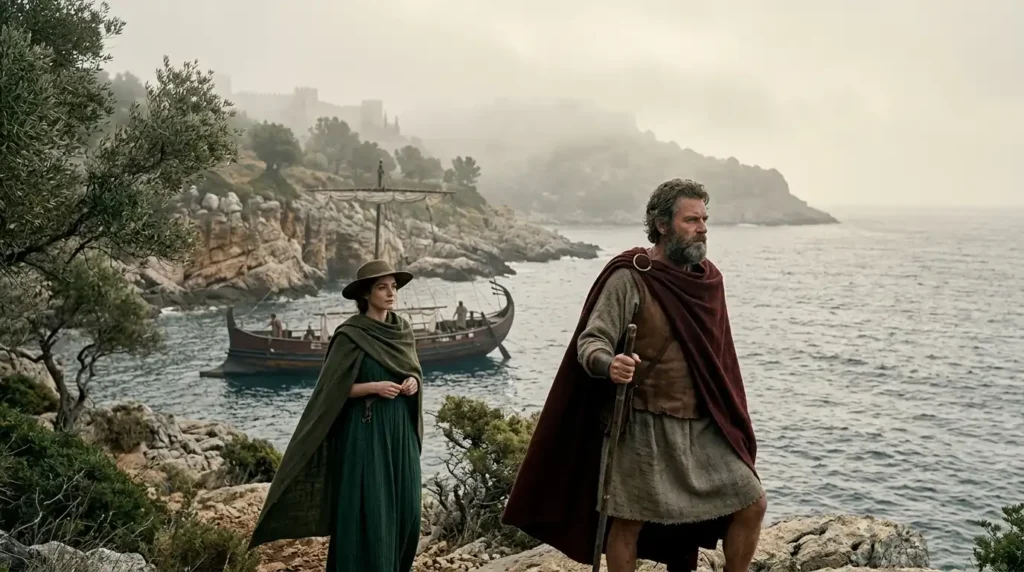
Kinship, Not Virtue
One commentary on Book 13 puts it neatly: Athena doesn’t champion Odysseus because he’s a good man or a devout worshipper but because they share similar traits. She says as much to his face.
That’s a striking admission. The goddess of wisdom favors the person who most resembles her, a gifted schemer, regardless of his morals.
What She Won’t Do
She also admits she held off helping him sooner because she wouldn’t fight her father’s brother Poseidon. A reader of the passage notes that Poseidon outranks her, so the “respect” is partly a limit.
Her cunning can manage mortals and some gods, but it doesn’t beat power it can’t outwit. I think that’s one of the most honest details in the whole epic.
Athens Made Her Its Face
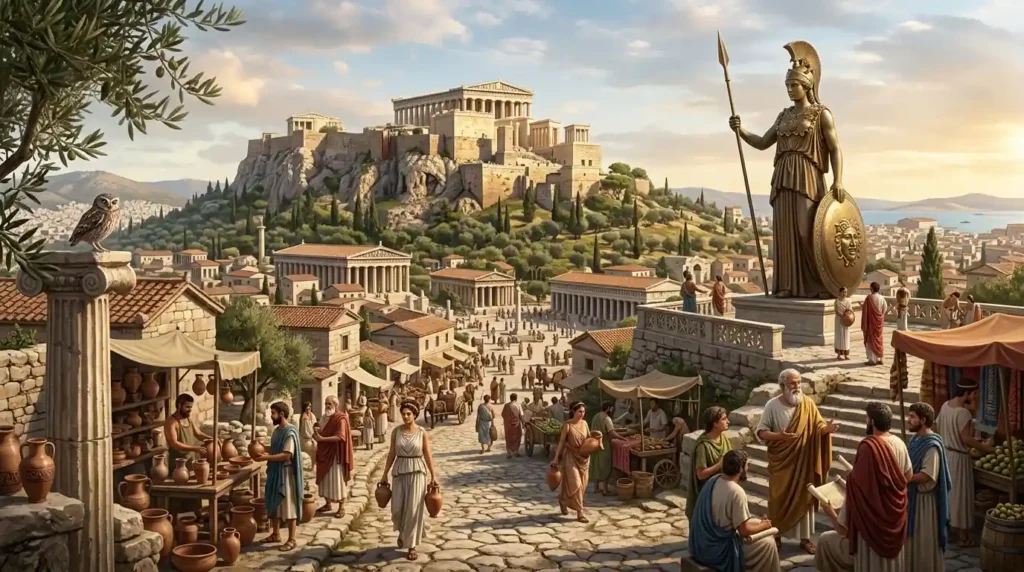
The Statue in the Parthenon
Phidias’s gold and ivory Athena Parthenos was dedicated in 438 BCE inside the Parthenon. Sources describe it as roughly forty feet tall, though the original is lost, so every figure comes from ancient descriptions and later copies.
It showed the goddess armed, which one museum writer sums up as “armed wisdom.” Athens put a warrior and a thinker in the same body, in the center of its Acropolis.
Why That Choice Matters
The statue wasn’t just a religious object. It was a statement of civic identity, and it fused military power and intellectual prestige in a way Athens wanted to claim for itself.
When a city makes its patron a goddess of strategy and craft, it’s describing the self image it hopes to project. I’d say the choice was as much political as devotional.
An Honest Counterargument
Wisdom May Be a Later Label
I’ve been writing as if her wisdom were the core of her identity. Many of her oldest epithets point at war and craft instead, and the neat “goddess of wisdom” label is much more common in later philosophical and Roman writing, where she becomes Minerva.
It’s possible that I’ve read Plato’s Athens back into Homer. The scenes I cited are real, but the idea that cunning intelligence is her essence is partly a scholarly pattern.
She’s Not Always Wise
She is also capable of harsh punishment. Later sources report her anger when the Locrian Ajax violated Cassandra in her shrine, and in those versions she wrecks the Greek fleet on the way home.
She does favor people like herself, takes political sides in the Eumenides, and sometimes can’t outthink a stronger god. A portrait of unmixed wisdom isn’t what the texts show, and any account that claims otherwise is smoothing it.
What This Reading Changes
If I’m right, calling Athena “goddess of wisdom” undersells her. She’s the goddess of using your head when you can’t use your muscles.
That’s why her enemies are brute force, her favorites are tricksters, and her city adopted her as its symbol. She makes thinking an act, and she does it with her hands.
Frequently Asked Questions
What is the aegis, and how does Athena use it?
The aegis is a goatskin shield or cloak, associated with Zeus and often shown bearing a Gorgon’s head. Athena carries it into battle, and in the Odyssey’s final fight its appearance terrifies the suitors.
Why is the owl linked to Athena?
The epithet glaukopis is usually read as bright or grey eyed, and some link it to glaux, the owl. Athenian coins later carried an owl, but the animal is far less central in Homer than later tradition suggests.
How does Roman Minerva differ from Athena?
Minerva shared Athena’s wisdom and craft associations and absorbed her myths. She was also tied to Roman guilds of craftsmen, though Roman religion kept her more focused on skill and less on direct warfare.
Did Athena have children?
Tradition describes her as a virgin, Parthenos. One story has Hephaestus attempting to pursue her and his seed falling on the ground, producing Erichthonios, whom Athena raised, but the story is a separate and strange legend.
What was the Panathenaia?
An Athenian festival honoring Athena, with a larger version held every four years. It included a procession that presented a new robe to the goddess and athletic and musical contests, with oil from sacred olive trees as prizes.
Final Thoughts
Athena stops Achilles with a hand in his hair, turns Zeus with his own words, and drops an invention because of how it looked. Cunning, timing, and restraint are her whole arsenal.
What I keep noticing is how rarely she wins by being the strongest. She wins by being the one who understood the situation first.
Related Articles
- Chaos: The Primordial Void Before the Greek Gods
- The 12 Olympian Gods: Powers, Symbols & Key Stories
- Greek Mythology 101: Gods, Heroes & Monsters
- 13 Legendary Greek Heroes, Ranked by Their Feats
- Gaia: Greek Mythology’s Original Mother Goddess
- Rhea: The Titaness Who Tricked a God-Eating Titan
Sources & Further Reading
Written by Batin Khan, a curious free spirit who loves reading and exploring the worlds of fantasy, mythology, and ancient stories. Through this blog, Batin hopes to share that sense of wonder with readers while building an exciting future along the way.