
 By
Quick Takeaways:
- The sea, earthquakes, and horses look like three unrelated jobs, but the Greeks grouped them because all three are powerful, restless, and impossible to command.
- Poseidon may be older than the Olympian system. Linear B tablets from Pylos record him more often than Zeus.
- His anger follows a pattern worth noticing. The stories keep punishing broken promises and violated shelter.
- The most famous disaster blamed on him, the drowning of Helike, is more disputed than most retellings admit.
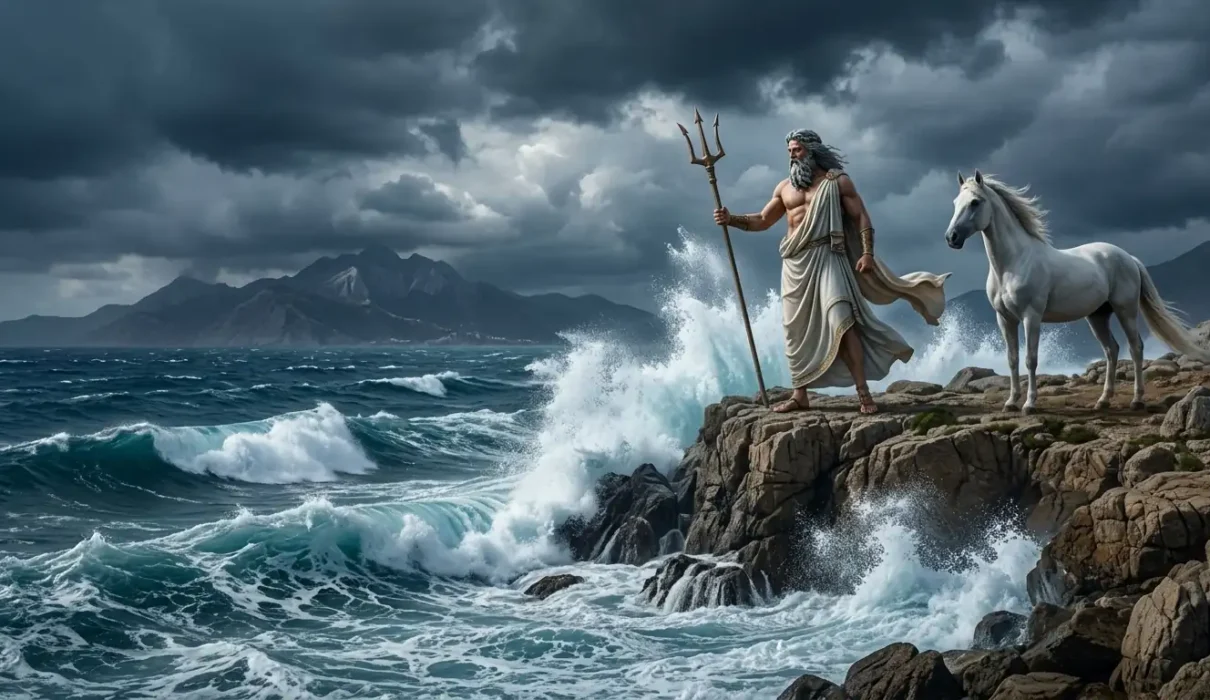
Ask most people what Poseidon does and you’ll hear sea, trident, bad temper. That summary skips the oldest evidence we have, which points somewhere stranger than the ocean.
I’ve covered his Athens contest and his grudge against Odysseus in my piece on the twelve Olympians. This article goes after the question those stories raise: why does one god own water, ground, and horses?
He Was Already Important Before the Olympians
The Pylos Tablets
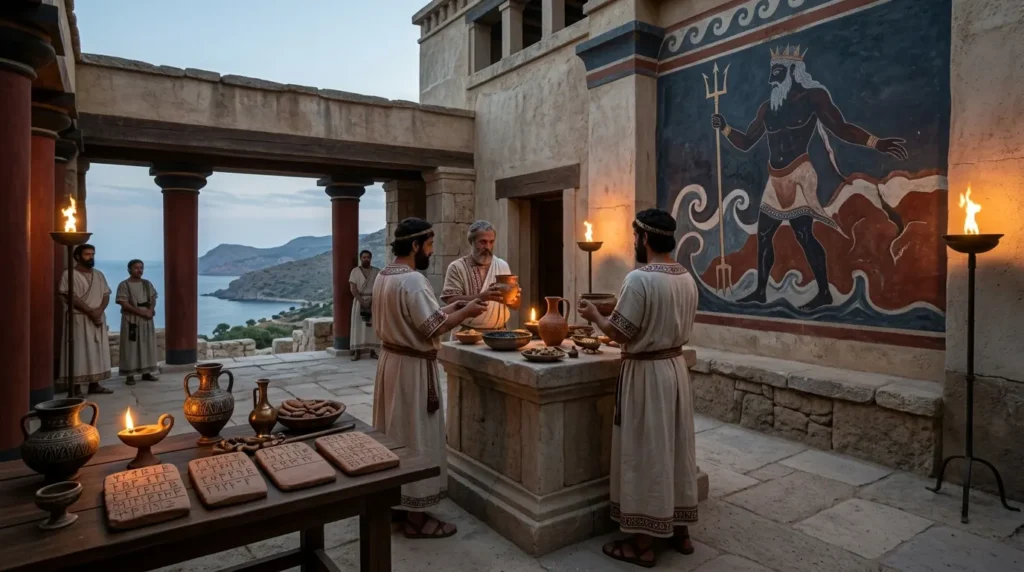
Linear B tablets from the Mycenaean palace at Pylos record offerings to Poseidon, and his name appears there more often than Zeus’s does, if the surviving tablets are a fair sample. Some scholars call him the chief god of Pylos.
The tablets also name “the Two Queens and Poseidon” as recipients of sacrifice. Those queens are often read as early forms of Demeter and Persephone, goddesses the later tradition never paired with him.
A Title Older Than Homer
The Mycenaean Knossos and Pylos tablets already use a form of the title Earth Shaker. That’s the same epithet Homer and Hesiod repeat centuries later.
An earthquake god is a reasonable thing to worship in a seismic region. The Aegean sits on active fault lines, and the epithet appears in the earliest written Greek we can read.
Why That Matters
The standard story has Poseidon winning the sea in a lottery with his brothers. In Iliad Book 15, Zeus, Poseidon, and Hades draw lots, and Poseidon gets the salt water.
The tablets suggest a different sequence. The sea may have been added to a god who started as something closer to a power of the earth, and the lottery may be a later way of fitting him into a new family.
Nobody Can Say What His Name Means
Two Halves, One Real Answer
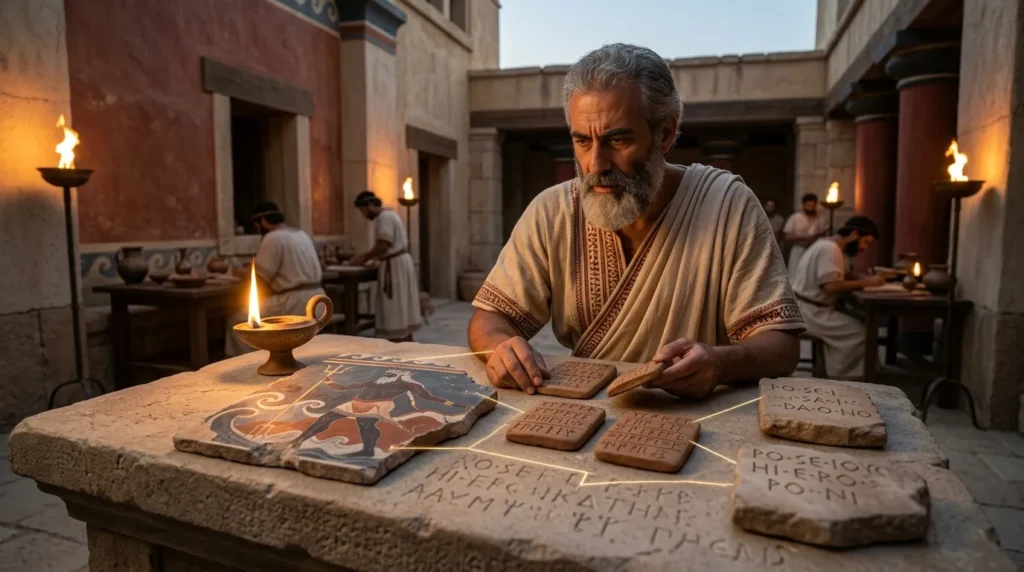
The first half of Poseidon is usually linked to a word for lord or husband. The second half, das or da, is where scholars stop agreeing.
A popular reading makes it a word for earth, so Poseidon becomes lord of the earth, which would fit his earthquake title. Robert Beekes, in his etymological dictionary, says there’s no sign the element means earth at all.
How I’d Treat This
Walter Burkert called the second element hopelessly ambiguous, and I think that’s the honest position. Anyone who tells you the name settles the origin of the god is guessing.
It does tell us something that the question exists. For most Olympians we can say what the name means. For Poseidon, we can’t, and that fits a god whose cult may predate the Greek language’s standard religious vocabulary.
Why Sea, Earth, and Horse Belong Together
Three Things You Can’t Command
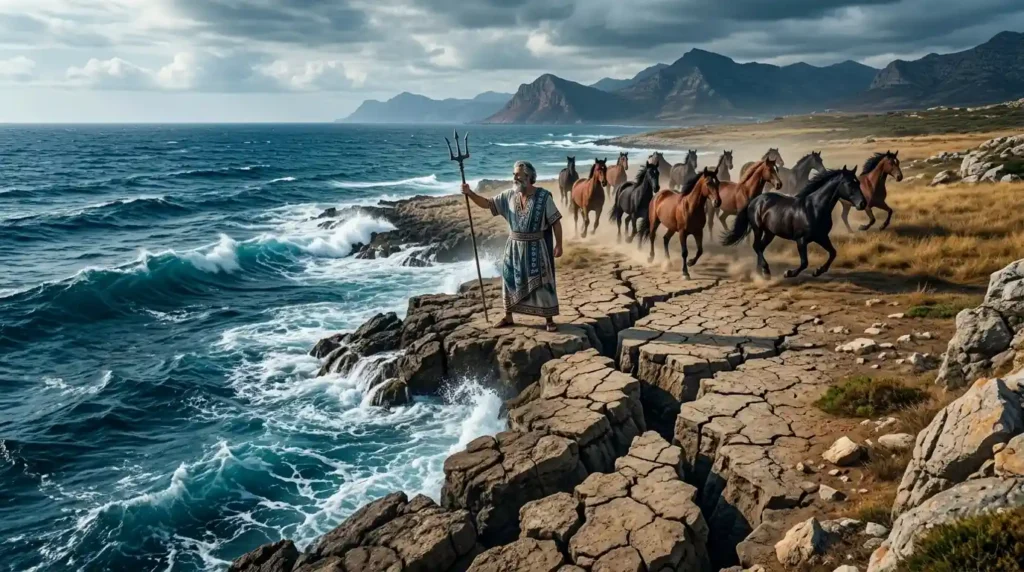
The sea drowns sailors without warning. The ground drops out from under a city. A horse is the fastest, strongest animal most Greeks ever dealt with, and it still bucks.
All three are enormous energy that humans can use but never fully control. That’s my reading of why one god covers them, and I think it’s more convincing than the neat modern idea that the Greeks simply assigned a sea god a few extra jobs.
The Epithets Back This Up
Poseidon was called Hippios, of horses, and Gaieochos, earth holder. He was also called Asphaleios, the securer, and Themeliouchos, upholder of foundations.
Those last two are the opposite of destruction. People prayed to the god who shook buildings to hold them steady, which is the logic of a power you bargain with rather than defeat.
The Horse Is Not an Afterthought
Where Horses Enter the Myths
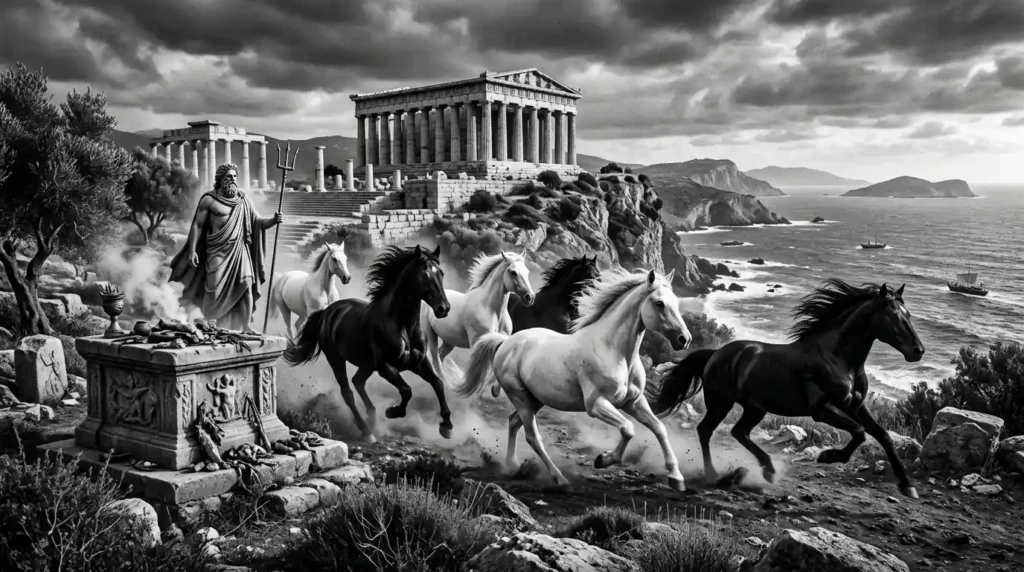
Hesiod makes Poseidon the father of Pegasus, born from Medusa’s neck. An Arcadian tradition, reported by Pausanias, has Poseidon pursue Demeter while she’s in mare form, producing the horse Arion.
In Sophocles’ Oedipus at Colonus, the chorus praises Poseidon as the god who gave the bridle to humans. The invention of horse control is credited to him.
Sacrifices That Make Sense Only If the Link Is Real
Pausanias reports that the Argives threw bridled horses into a spring as offerings to Poseidon. Drowning a horse in water gives him both of his animals at once.
I find that image hard to forget. It’s an offering that enacts the god’s two domains in a single act.
The Pattern Behind His Anger
Laomedon, Minos, and the Unpaid Bill
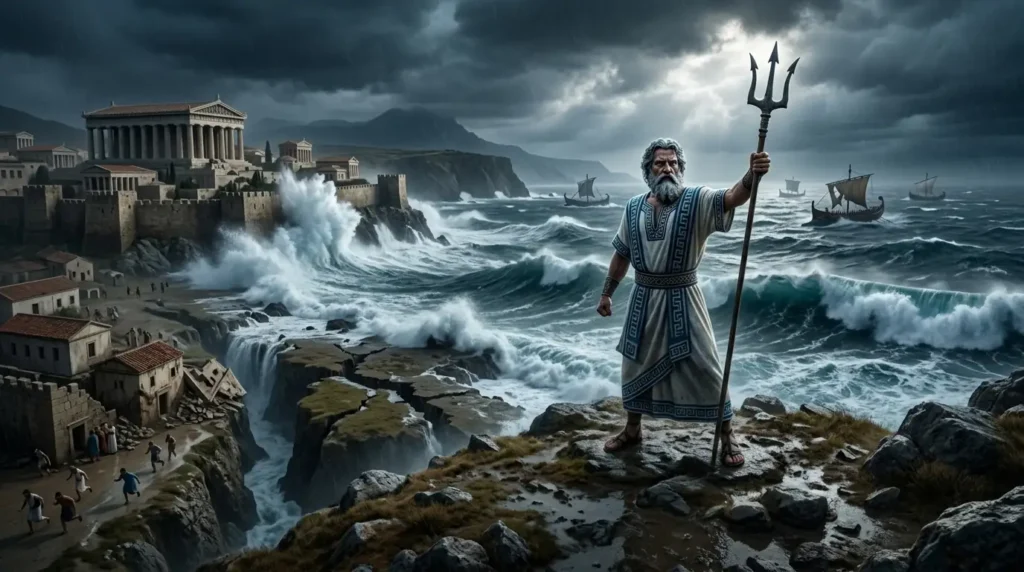
Poseidon and Apollo built the walls of Troy for King Laomedon, who then refused to pay them. Poseidon sent a sea monster, and his hostility to Troy runs through the Iliad.
King Minos asked Poseidon for a bull to sacrifice, promised to give it up, and kept it instead. The god made the bull a monster, and that line of events produced the Minotaur.
The Spartans at Taenarum
Thucydides reports that the Spartans dragged suppliants out of Poseidon’s sanctuary at Taenarum, and that Sparta blamed the devastating earthquake of the 460s BCE on that act. In his telling, they were punished for violating shelter under the god’s protection.
My Reading, Flagged as Mine
Put those together and Poseidon starts to look like an enforcer of obligations. Unpaid wages, a withheld sacrifice, a violated refuge.
That’s an interpretation, not a statement any ancient source makes. I think it’s more useful than “he’s moody,” and it explains why his punishments feel proportionate in the stories even when they’re brutal.
Homer’s Poseidon
The Odyssey’s Long Sulk
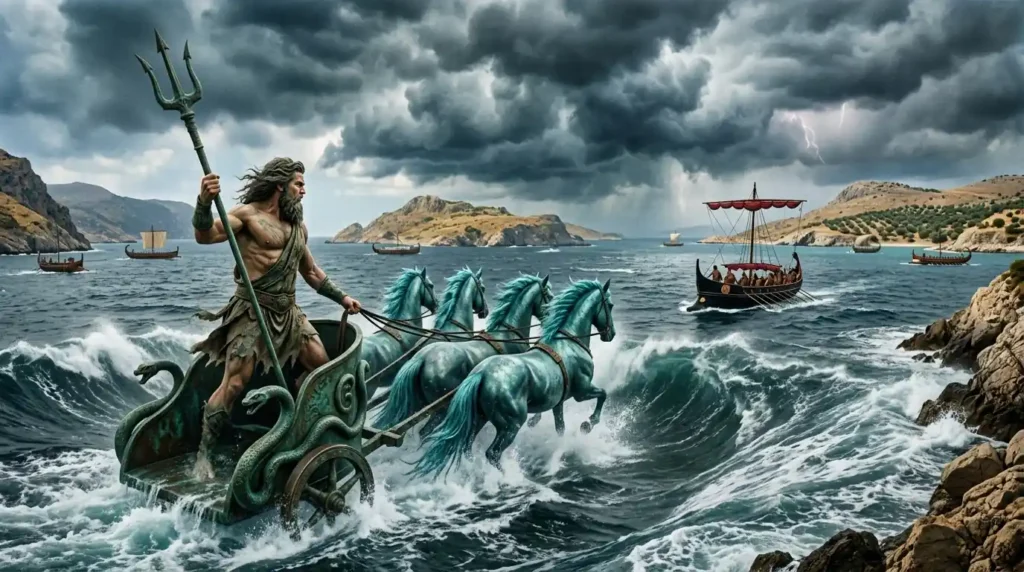
Poseidon’s anger at Odysseus starts when Odysseus blinds Polyphemus, Poseidon’s son. In Book 1, the other gods can discuss Odysseus’s return only because Poseidon is away visiting the Ethiopians.
He later turns the Phaeacians’ ship to stone for ferrying Odysseus home. For ten years he can delay the man but not kill him, because fate has already set the ending.
The Iliad’s Surprising Ally
In the Iliad, Poseidon sides with the Greeks. In Book 12, he and the other gods wash away the wall the Achaeans built, and he does it personally, trident in hand.
Few gods in epic act as directly as that. He’s one of the Olympians who comes closest to physical presence on the battlefield.
Worship Across Fifteen Centuries
From Bronze Age to Rome
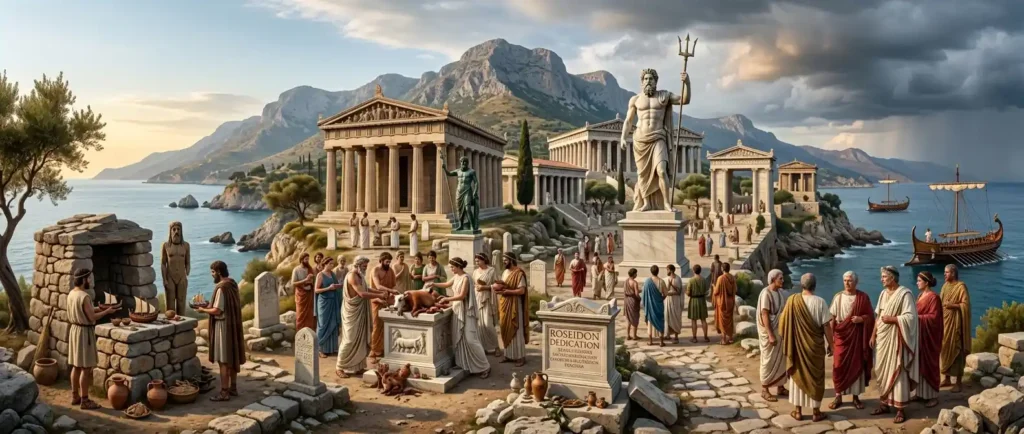
Scholars date his worship from the Late Bronze Age through the later Roman Empire, a span of well over a thousand years. Few Greek gods have a record that long.
The Isthmian Games at Corinth were held in his honor. His Doric temple at Sounion, built around the middle of the fifth century BCE, still stands over the sea, where sailors would have seen it as a landmark.
The Roman Neptune
Romans identified Poseidon with Neptune. As with several Roman gods, the match is partial. Some scholars think early Neptune was tied to fresh water, so the Greek sea god was laid over an older Italian figure.
I’d treat that as a debated suggestion rather than a settled fact.
The Helike Story Isn’t As Solid As It Sounds
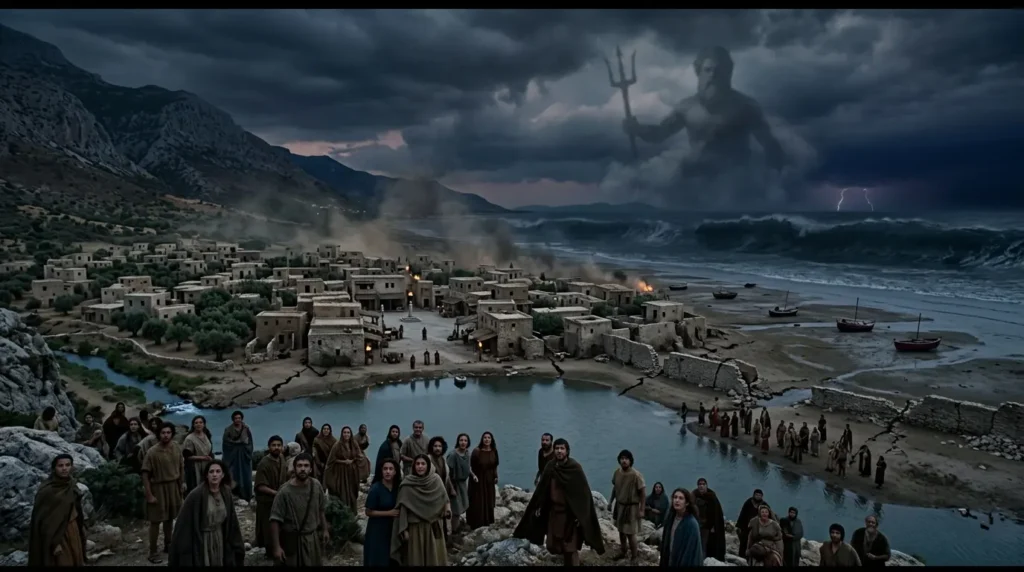
The standard tale of Poseidon’s wrath is Helike, a coastal town on the Gulf of Corinth said to have sunk beneath the waves in 373 BCE as punishment for a crime at his shrine. Aristotle, among others, is cited as writing about it.
A recent study of the evidence argues that the legend of total destruction appeared centuries later in Roman times. Its authors say excavation found undisturbed archaeological layers from before and after 373 BCE with no signs of a tsunami, and that Helike even issued coins after the supposed loss.
How Much To Trust That Challenge
That’s a single study, and there’s older scholarship that treats the disaster as real, with some exaggeration. I wouldn’t throw out the traditional account on this evidence alone.
I’d still be careful about citing Helike as proof that the Greeks blamed Poseidon for earthquakes, since the clearest textual link may come from a later layer of storytelling.
And the Bigger Caveat
My claim that Poseidon began as an earth god and acquired the sea is itself an inference from sparse tablets. Ritual lists don’t tell us what a worshipper believed, and the Mycenaean sample is small.
So read the Pylos evidence as a reason to question the lottery story, not as proof that I’ve reconstructed his original shape.
What I Take From All This
Poseidon is the god who shows why a modern list of domains misleads. Sea, quake, and horse look like a random bundle until you think about them as forces you can only negotiate with.
The stories where he’s furious are the ones where someone broke a deal. That makes him less a temperamental brother of Zeus and more a keeper of terms.
Frequently Asked Questions
Is the trident connected to a real tool?
Greek fishermen used three pronged spears, and many scholars see the trident as borrowed from that tool. The myths credit the Cyclopes with forging it, in the same workshop tradition that produced Zeus’s thunderbolt.
Where can you still see Poseidon’s sanctuaries?
The temple at Cape Sounion is the best known, with its columns still standing over the sea. You can also visit the sanctuary at Isthmia, where the Isthmian Games were held, and the site near Cape Taenarum.
Did Plato invent Atlantis, or was it an older myth?
Plato tells it in the Timaeus and Critias, naming Poseidon as the island’s founder and father of its kings. Most scholars think Plato built the story himself rather than inheriting it, though that’s argued.
Who were Poseidon’s best known children?
With Amphitrite he fathered Triton, a sea figure with a conch. The cyclops Polyphemus is his son, and some traditions name him as Theseus’s divine father, a claim the Athenians used to link their founder to the sea.
How did ancient writers explain earthquakes besides blaming Poseidon?
Aristotle’s Meteorologica gives a natural account, blaming wind trapped inside the earth. The two explanations coexisted for centuries, and Thucydides discusses earthquakes and tidal waves in rational terms alongside the religious ones.
Final Thoughts
The Pylos tablets show a god who was already being fed and addressed as Earth Shaker before anyone wrote down a story about him.
What keeps me coming back to him is how quietly the myths enforce fairness. A bull kept back, a wall unpaid for, a refuge violated, and the ground and sea answer.
The Greeks seem to have felt the same about their coastline, which could give or take everything, and Poseidon was how they argued with it.
Related Article
- How Zeus Overthrew His Father to Rule Olympus
- Who Were the Titans? Names, Powers & Their Downfall
- Gaia: Greek Mythology’s Original Mother Goddess
- Chaos: The Primordial Void Before the Greek Gods
- Cronus: The Titan Who Feared His Own Children
- Rhea: The Titaness Who Tricked a God-Eating Titan
- Hades Was Never the Devil: The Real God of the Underworld
- Athena: Why the Goddess of Wisdom Was Also a Warrior
Further Reading & Sources
- Homer. Iliad.
- Homer. Odyssey.
- Linear B Tablets – Damos
- Apollodorus. The Library.
- Herodotus, Histories
- Hesiod, Theogony
- Pausanias. Description of Greece.
- Ovid. Metamorphoses.
- Sophocles, Oedipus at Colonus, Richard Jebb
- Greek Religion – Walter Burkert
- Etymological Dictionary of Greek – Robert Stephen Paul Beekes, Lucien van Beek
- Thucydides, History of the Peloponnesian War, Thomas Hobbes
Written by Batin Khan, a curious free spirit who loves reading and exploring the worlds of fantasy, mythology, and ancient stories. Through this blog, Batin hopes to share that sense of wonder with readers while building an exciting future along the way.