
 By
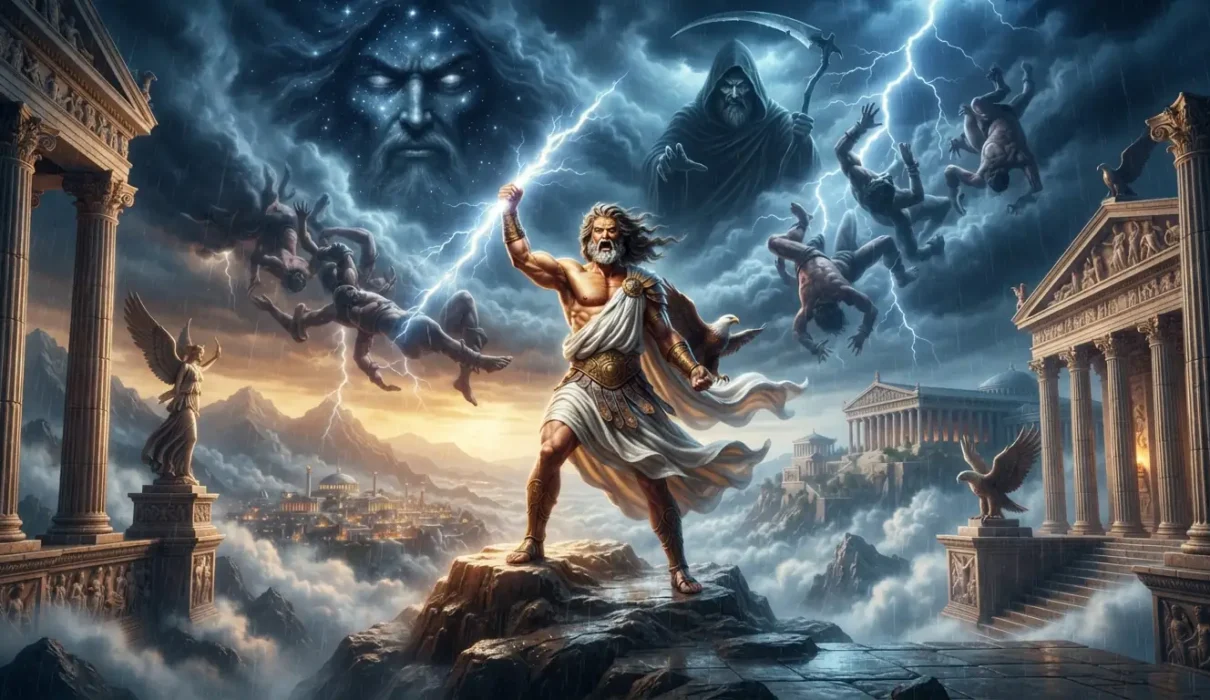
By From Chaos to Zeus, Three generations of divine rulers, each one overthrown by his own son. That’s the spine of Greek cosmology, and Hesiod lays it out with a directness that still surprises readers expecting something more mystical.
What most retellings leave out is that the Greeks didn’t invent this sequence. A cuneiform tablet recovered from a Hittite royal archive tells almost exactly the same story, and it’s older.
From Chaos To Zeus – The Sequence in Brief
Hesiod’s Theogony, composed somewhere around 730 to 700 BCE, gives the order plainly. Chaos comes into being first, with nothing before it and nothing causing it.
Gaia the earth, Tartarus the abyss, and Eros the generative force follow. Gaia then produces Ouranos, the sky, on her own, without a partner.
From there the story becomes a succession crisis repeated three times, and each repetition is more sophisticated than the last.
Round One: Ouranos and the Sickle
A Father Who Won’t Let His Children Be Born
Ouranos and Gaia produce the twelve Titans, the three Cyclopes, and the three Hecatoncheires: hundred-handed giants of enormous strength.
Ouranos hates them and pushes each one back into Gaia’s depths as they’re born, refusing to let them emerge into the world. Gaia’s pain from this is described in physical terms: a body strained past bearing.
The Weapon and the Volunteer
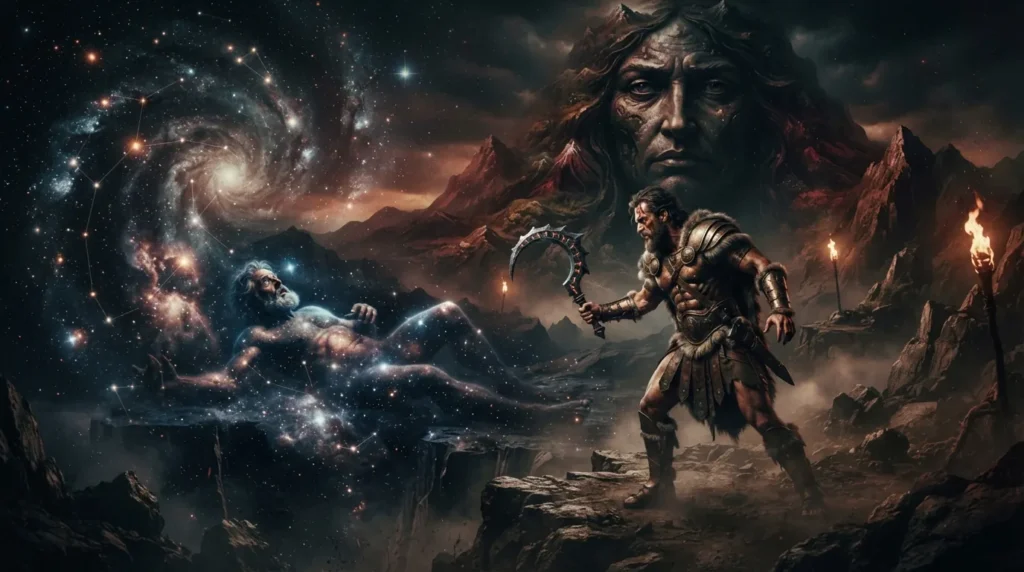
Gaia produces adamant, fashions a jagged sickle from it, and asks her children which of them will act against their father.
Every one of them refuses out of fear. Only Cronus, the youngest Titan, agrees to take the weapon.
What the Blood Produced
Cronus ambushes Ouranos, castrates him, and throws the severed genitals into the sea. From the foam that gathers around them, Aphrodite is born.
The blood falling on Gaia produces the Erinyes, the avenging Furies, along with the Giants and the Meliae, ash-tree nymphs. Violence in this cosmology doesn’t just remove a ruler. It generates new beings with their own agendas.
The Pattern This Establishes
Notice the specific shape. An angry mother allies with her youngest son against a tyrannical father, supplying both the weapon and the plan.
That’s not a one-time event in Hesiod. It’s a template the story will run again.
Round Two: Cronus and the Stone
He Repeats Exactly What He Punished
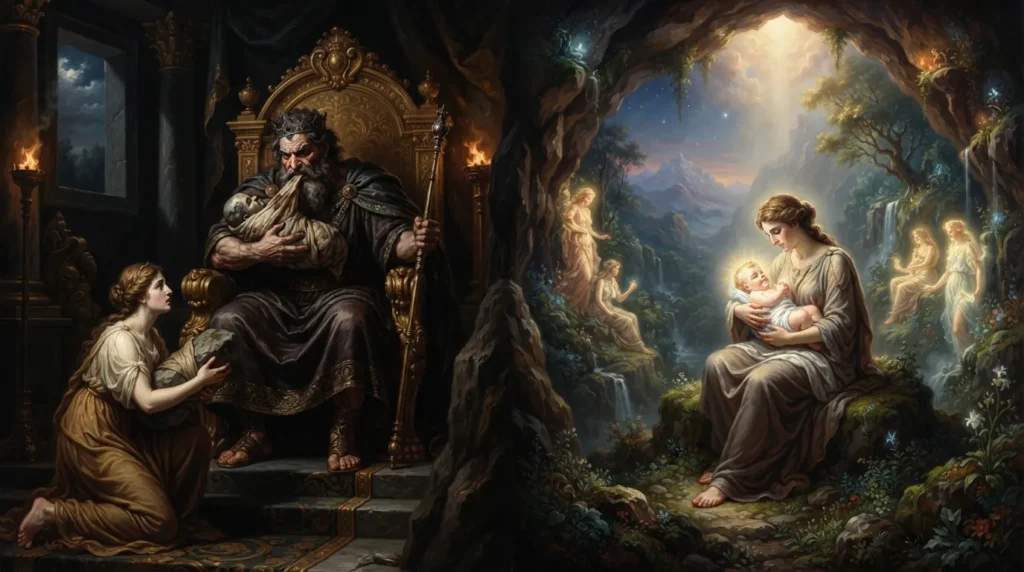
Cronus takes the throne and immediately develops the same fear his father had. Warned by Gaia and Ouranos that one of his own children will overthrow him, he swallows each newborn as Rhea delivers them.
Hestia, Demeter, Hera, Hades, and Poseidon all go down. The tyrant who overthrew a child-hating father becomes a child-hating father, which Hesiod presents without any apparent need to comment on the irony.
Rhea Runs the Same Play Gaia Ran
Pregnant with Zeus, Rhea seeks help from Gaia and Ouranos and gives birth in secret on Crete. She wraps a stone in swaddling cloth and hands it to Cronus, who swallows it without checking.
The infant Zeus is hidden and raised in concealment while his father digests a rock.
The Stone Had a Physical Afterlife
That stone reappears later in the story. Once Zeus forces Cronus to disgorge his swallowed siblings, the stone comes up first, and Zeus sets it at Delphi as a marker.
The Greeks called it the Omphalos, the navel of the world, and it was a real object that real pilgrims could see. A myth with a physical anchor point that visitors could stand next to is doing something a purely abstract story can’t.
Round Three: The Titanomachy
Ten Years With No Resolution
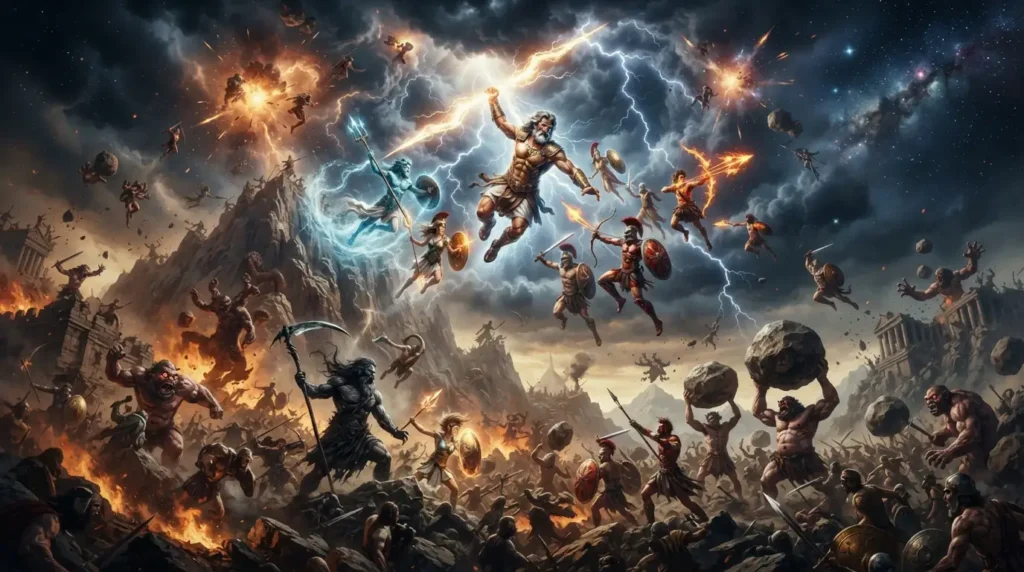
The war between the Olympians and the Titans runs a full decade in Hesiod’s account, with neither side able to force a conclusion.
That stalemate matters structurally. Zeus doesn’t win through raw superiority, which means the story needs him to win through something else.
The Decision That Won It
Zeus goes down to Tartarus and frees the Cyclopes and the Hecatoncheires, who had been imprisoned there since Ouranos first rejected them.
The Cyclopes give him thunder, lightning, and the thunderbolt in gratitude. The Hecatoncheires enter the battle hurling three hundred stones at once, and the Titans break under the barrage.
Why This Detail Is the Interesting One
Zeus wins because he recruits the beings every previous ruler imprisoned out of fear.
Ouranos feared them and buried them. Cronus left them buried. Zeus released them and gained both a weapon and an army, which is a genuinely different approach to power than either predecessor attempted. The story is quietly arguing that fear-based rule creates the exact resources your successor will use against you.
The Loose End: Typhon
Gaia isn’t finished. Angered by the Titans’ imprisonment, she couples with Tartarus and produces Typhon, a monstrous final challenger.
Hesiod’s account has Zeus defeating him with thunderbolts and casting him into Tartarus. Later sources including Apollodorus add a much harder version, with Typhon overpowering Zeus at Mount Kasios in Syria and cutting out his sinews before Zeus eventually recovers and wins.
Hold onto that mountain. It becomes relevant shortly.
How Zeus Broke the Cycle
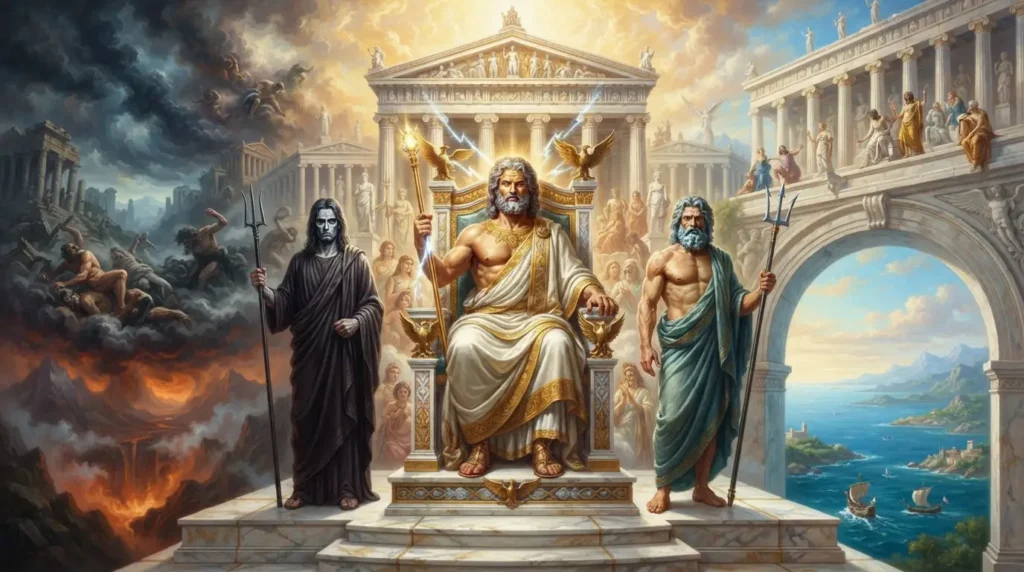
Three generations, three overthrows. Zeus should be next, and Hesiod tells you exactly why he isn’t.
The Prophecy About Metis
Zeus’s first wife is Metis, whose name means cunning intelligence. Gaia and Ouranos warn him that Metis will bear Athena first, and then a son who will overthrow him.
The Solution Nobody Before Him Found
Ouranos suppressed his children after birth. Cronus swallowed his children after birth. Both attacked the symptom, and both failed because the child still existed somewhere to eventually be freed.
Zeus swallows Metis herself, while she’s pregnant, absorbing the source rather than containing the product. The dangerous son is never conceived at all, and Athena is later born from Zeus’s own head.
That’s my reading of the sequence’s actual argument. The succession cycle ends not because Zeus is stronger than Cronus, but because he’s the first ruler in the sequence to correctly diagnose the problem. He also absorbs cunning intelligence into himself permanently, which is a fairly pointed thing for a myth to say about how lasting power actually works.
The Part Most Retellings Skip
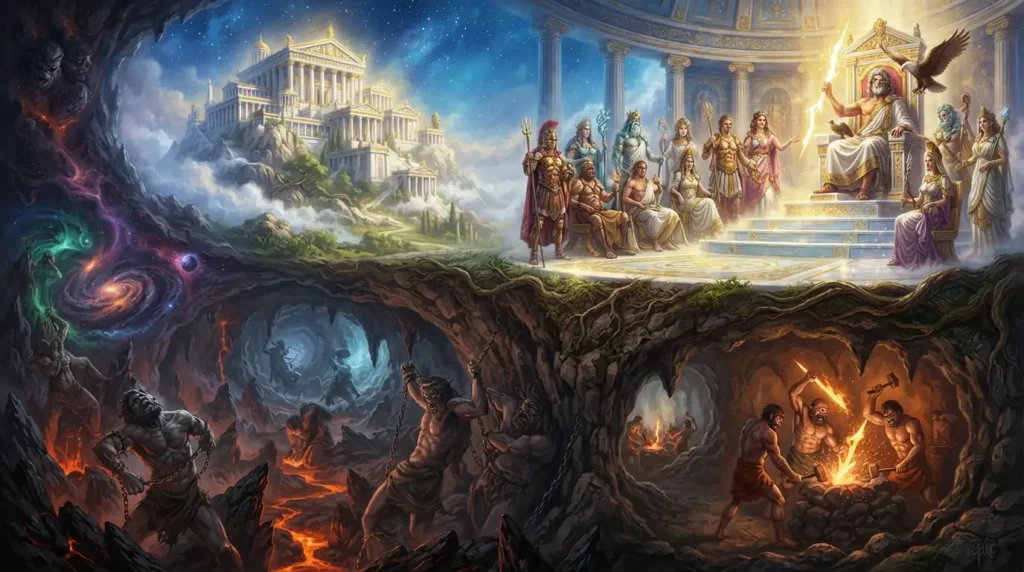
A Tablet From Hattusa
In the royal archives of the Hittite capital, excavators recovered a text catalogued as CTH 344, known variously as the Song of Kumarbi, Kingship in Heaven, the Song of Going Forth, or the Song of Emergence.
It’s a Hittite-language composition based on an earlier Hurrian original, and it tells this story.
The Hurrian Succession
Alalu rules in heaven for nine years. Anu, the sky god, attacks and overthrows him, and Alalu flees down to the Dark Earth.
Anu rules for nine years. Kumarbi attacks him, and as Anu flees upward, Kumarbi bites off and swallows his genitals.
Anu warns him not to rejoice at what he’s swallowed. Kumarbi becomes pregnant with three deities including Teshub, the storm god, and must eventually be cut open to deliver him. Teshub grows, overthrows Kumarbi, and takes the throne.
Setting Them Side by Side
| Element | Song of Kumarbi | Hesiod’s Theogony |
|---|---|---|
| First ruler | Alalu | Ouranos |
| Second ruler | Anu, sky god | Cronus |
| The castration | Kumarbi bites off Anu’s genitals | Cronus castrates Ouranos with a sickle |
| Swallowing | Kumarbi swallows and becomes pregnant | Cronus swallows his own children |
| Warning to the swallower | Anu warns Kumarbi | Gaia and Ouranos warn Cronus |
| Final ruler | Teshub, storm god | Zeus, storm god |
| Deposed predecessor | Kumarbi, possibly leader of the Former Gods | Cronus, leader of the Titans |
Castration, swallowing, a warning ignored, and a storm god ending the sequence. That’s not thematic resemblance. That’s the same plot.
How It Reached Greece
Scholars generally propose transmission through the Levant, with Phoenician intermediaries carrying the material westward during or after the Late Bronze Age.
There’s a genuinely specific geographic clue supporting this. Recent scholarship on the Song’s ritual context points to performance at festivals held at Mount Hazzi, known today as Jebel al-Aqra on the Mediterranean coast.
The Greeks called that same mountain Kasios. It’s where Apollodorus locates Zeus’s hardest moment in the Typhon battle.
The Sequel Matches Too
The Song of Ullikummi, catalogued as CTH 345, continues the cycle with Kumarbi fathering a monstrous stone giant to challenge Teshub’s rule.
A deposed predecessor generating a monstrous final challenger against the reigning storm god is exactly what Gaia does with Typhon. Cambridge scholarship describes this Hittite material as the clearest evidence available for Greek reception of Near Eastern mythology.
What the Greeks Contributed
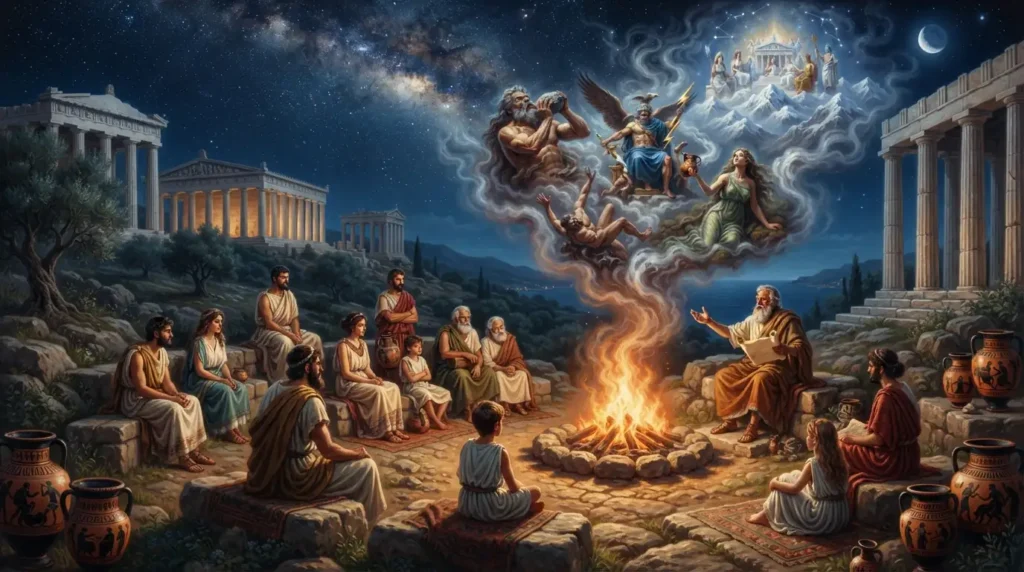
Inheriting a plot isn’t the same as copying it, and the differences are where Hesiod’s own thinking shows.
Chaos Is an Addition
The Hurrian sequence starts with Alalu already ruling. Hesiod opens instead with Chaos, a yawning gap existing before anything, with no creator preceding it.
That’s a genuinely different philosophical starting position, and I’ve written about Chaos separately on this blog because it deserves the space.
The Metis Solution Appears to Be Greek
The Hittite material continues its cycle of challenge and counter-challenge. Hesiod closes his, and closes it through a specific mechanism: absorbing the mother rather than the child.
Whether that innovation is Hesiod’s own or reflects a Greek tradition he inherited isn’t something I can settle. What’s clear is that the resolution isn’t present in the same form in the surviving Hurrian and Hittite material.
An Honest Counterargument
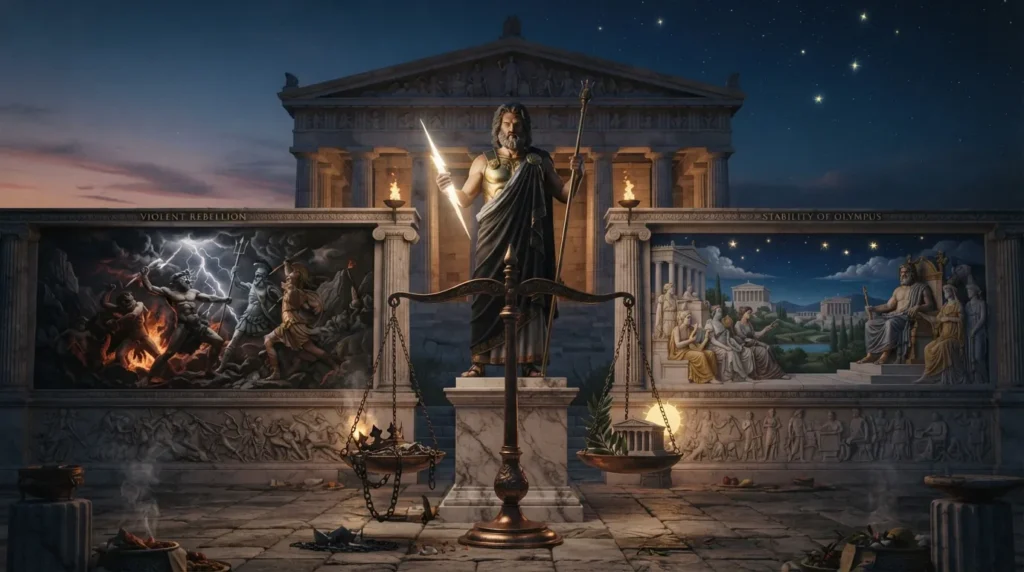
The transmission is inferred rather than documented, and that distinction deserves stating plainly.
Nobody has found a Greek text citing a Hurrian source, or an intermediary document showing the story moving west. The argument rests on structural resemblance plus plausible contact routes, which is strong circumstantial evidence rather than proof.
There’s also genuine unresolved debate inside Hittite scholarship itself. A 2021 article in the Journal of Ancient Near Eastern Religions weighs competing reconstructions of the internal genealogy in CTH 344, with Hoffner arguing for two rival dynasties alternating in power and Haas arguing for a single father-to-son line.
If specialists are still debating what the Hittite text says internally, some caution about mapping it onto Hesiod is warranted.
I still find the parallel compelling, because the specific details, castration followed by swallowing followed by a warning, are too particular to arrive independently. But compelling and proven aren’t the same standard, and mythology writing has an unfortunate habit of collapsing them.
Frequently Asked Questions
Where can I read the Song of Kumarbi in English translation?
Harry Hoffner’s Hittite Myths, published by the Society of Biblical Literature, remains the standard accessible English collection and includes the Kumarbi cycle texts with scholarly apparatus.
Did the Romans change this succession story when they adopted Greek myth?
Roman versions largely preserved the sequence while renaming its participants, with Saturn replacing Cronus and Jupiter replacing Zeus, though Roman Saturn also carried independent agricultural associations from earlier Italic religion that the Greek Cronus lacked.
Is there a comparable succession myth in Norse mythology?
Norse cosmology includes the killing of the primordial giant Ymir by Odin and his brothers, whose body becomes the world, but it lacks the repeated generational overthrow structure that defines both the Hurrian and Greek versions.
What happened to the Titans after their imprisonment?
Hesiod places them in Tartarus guarded by the Hecatoncheires. Later traditions, including Pindar, suggest Zeus eventually released some of them, and Cronus in particular appears in some accounts ruling over the Isles of the Blessed.
Why is Hesiod’s account considered more authoritative than Homer’s on divine genealogy?
Homer references the gods’ relationships incidentally while telling other stories, whereas Hesiod set out specifically to systematize divine descent, which makes the Theogony the closest thing Greek tradition produced to a deliberate reference work on the subject.
Chaos, then earth, then three kings who each learned the wrong lesson from the last one until Zeus finally learned the right one.
The Greeks told it beautifully. They just weren’t the first to tell it, and a clay tablet from a Hittite palace archive has been quietly holding the earlier draft for something like three thousand years.
Related Articles
- How Norse & Greek Mythology Built Modern Dark Fantasy
- Chaos: The Primordial Void Before the Greek Gods
- The 12 Olympian Gods: Powers, Symbols & Key Stories
- Greek Mythology 101: Gods, Heroes & Monsters
- Who Were the Titans? Names, Powers & Their Downfall
- 13 Legendary Greek Heroes, Ranked by Their Feats
- Poseidon: The God of the Sea, Earthquakes & Horses
- Hades Was Never the Devil: The Real God of the Underworld
Sources & Further Reading
- HESIOD, THEOGONY
- ‘Let Those Important Primeval Deities Listen’ (Chapter 1) – Gods and Mortals in Early Greek and Near Eastern Mythology
- Sexing and Gendering the Succession Myth in Hesiod and the Ancient Near East (Chapter 16)
- APOLLODORUS, THE LIBRARY BOOK 1
- Hittite Myths – Harry A. Hoffner
Written by Batin Khan, a curious free spirit who loves reading and exploring the worlds of fantasy, mythology, and ancient stories. Through this blog, Batin hopes to share that sense of wonder with readers while building an exciting future along the way.