
 By
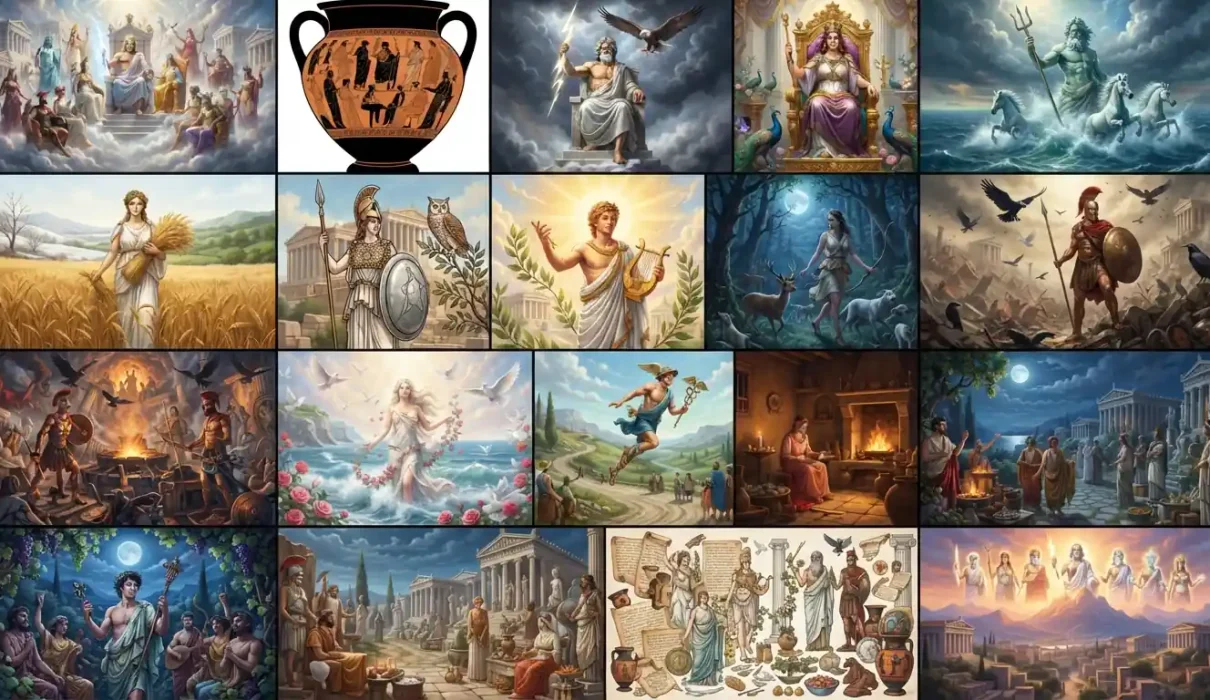
By Most lists of the twelve Olympian Gods read like a filing cabinet. God of war. God of the sea. God of wisdom. Those labels are technically accurate and almost useless, because they flatten figures whose real domains contradict themselves in interesting ways.
Apollo brings both plague and healing. Artemis protects childbirth and kills women in it. Hermes patronizes both honest merchants and the thieves who rob them. Those contradictions aren’t sloppy mythology. They’re the actual content, and this piece is built around them.
A few things worth knowing before you dive in. The twelve isn’t a fixed list at all: Hestia and Dionysus swap the final seat depending on your source, and different Greek cities recognized different groupings entirely. Divine power has real, specific limits, and the Iliad shows two Olympians wounded by a mortal.
Hades is deliberately excluded despite being Zeus’s equal in power, and the reason tells you what Olympian actually means. Every entry below includes the specific myths worth knowing, not a generic domain summary you could find anywhere.
First, the Twelve Isn’t Fixed
The Contested Seat
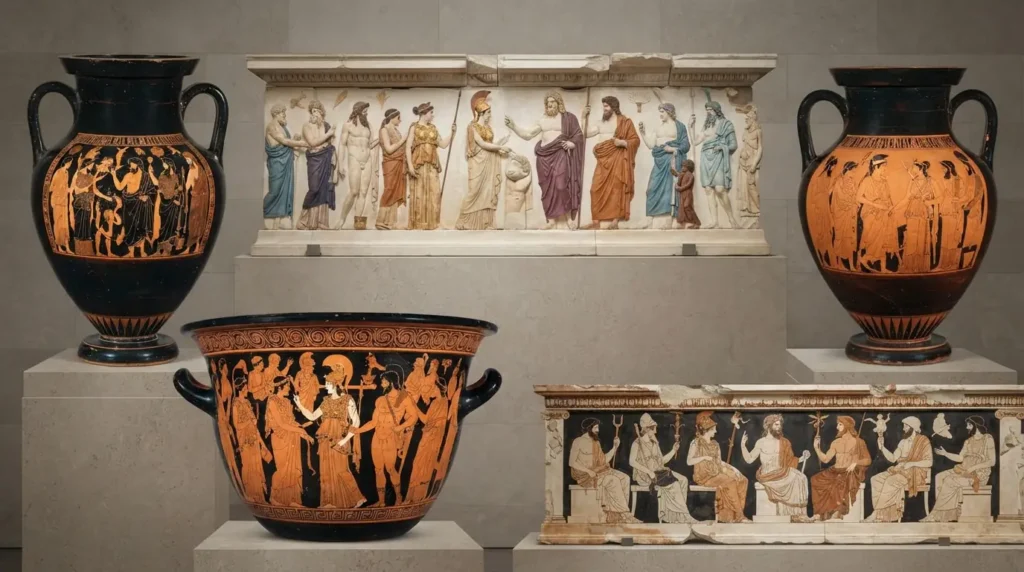
The standard modern list runs Zeus, Hera, Poseidon, Demeter, Athena, Apollo, Artemis, Ares, Aphrodite, Hephaestus, Hermes, and then either Hestia or Dionysus depending on which source you’re reading.
The traditional explanation is that Hestia gave up her seat when Dionysus arrived, preferring to tend the hearth rather than participate in Olympian politics. Whether that’s an ancient tradition or a later rationalization of conflicting sources is genuinely debated.
Regional Lists Varied
Different Greek cities recognized different twelve god groupings depending on local cult importance. The altar of the Twelve Gods in the Athenian Agora, established in the late sixth century BCE, is one of the clearest ancient references to a formal twelve, but the specific membership wasn’t universally standardized.
This matters practically. If you come across a fantasy novel or a scholarly text using a slightly different twelve, that’s usually a reflection of real ancient variation, not an error.
Why Hades Is Excluded
Hades is Zeus’s brother and holds equivalent power over his own domain, so his absence from the list confuses newcomers constantly.
The exclusion is geographic rather than hierarchical. Olympian means residing on Mount Olympus, and Hades rules the underworld instead. He isn’t lesser. He’s simply somewhere else.
Zeus – The Top Guy
Domain and Powers
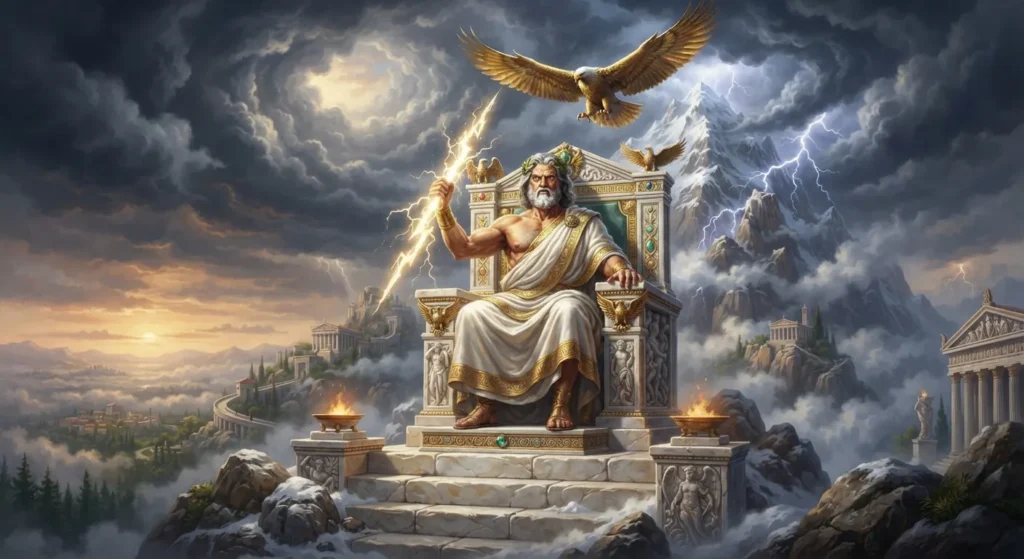
King of the gods, ruler of the sky, wielder of the thunderbolt, and the enforcer of oaths and hospitality specifically. That last function matters more than his weather control does for understanding Greek religious practice.
Zeus Xenios, Zeus of hospitality, protected the guest-host relationship, which was the closest thing the ancient Greek world had to international law between communities with no shared government.
The Succession He Ended
Zeus’s father Cronus swallowed each of his children at birth to prevent the prophecy that one would overthrow him. Rhea substituted a stone wrapped in cloth for the infant Zeus, who was raised in secret on Crete.
He returned, forced Cronus to disgorge his siblings, and led them in the Titanomachy, described in Hesiod’s Theogony as a ten-year war. Winning it made him king.
The Prophecy He Avoided
The detail worth knowing here is that Zeus nearly repeated his father’s fate. He was warned that his first wife, Metis, would bear a son greater than himself, so he swallowed Metis while she was pregnant. [The Olympian Gods, 886 – Hesiod, Theogony]
Athena was born from Zeus’s own head as a result. The son never existed. Zeus ended the succession cycle by consuming the threat before it could form, which is a lot darker than the sanitized version of Athena’s birth usually conveys.
His Real Limits
Zeus cannot simply override fate. In the Iliad, he grieves over the impending death of his own son Sarpedon and considers saving him, and Hera warns that doing so would invite every other god to save their own favorites, unraveling divine order entirely. He lets Sarpedon die.
That passage is one of the clearest statements in Greek literature that even the king of the gods operates within constraints he didn’t set.
Hera – The Queen
Domain and Powers
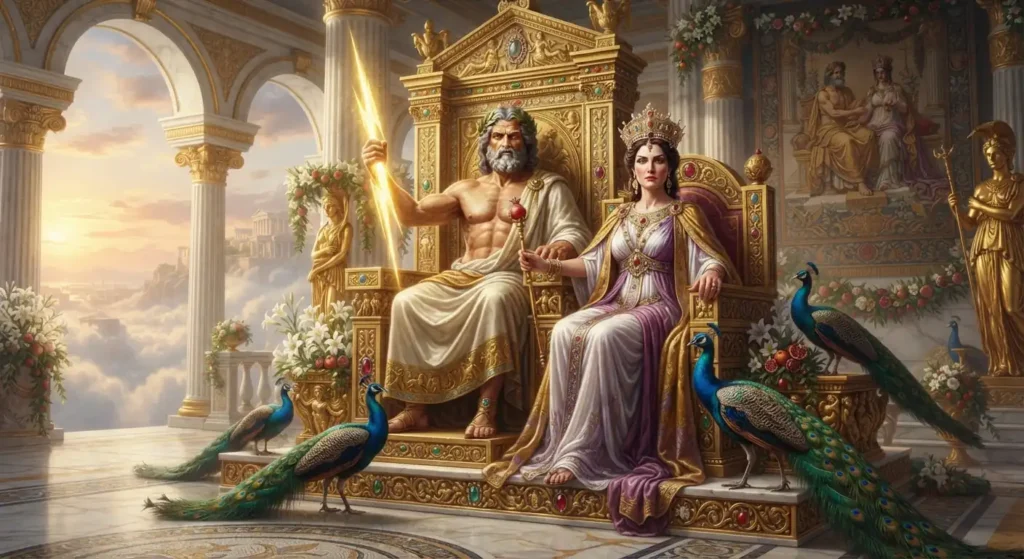
Hera, the Queen of the gods, goddess of marriage, women, and legitimate childbirth. Her domain is specifically the institution of marriage rather than love or desire, which belongs to Aphrodite entirely.
Hera’s cult was seriously major. The Heraion of Samos and the Heraion of Argos were significant sanctuaries, and she received serious civic worship independent of her mythological characterization.
The Reputation Problem
Popular retellings reduce Hera to a jealous wife punishing Zeus’s affairs, and that reduction badly misrepresents both her cult status and what her myths are really doing.
Consider the pattern honestly. Hera punishes Zeus’s victims (Io, Callisto, Semele, Leto) rather than Zeus himself. That’s not petty jealousy. It’s a description of how power distributes consequences downward, toward those least able to resist, told by people who lived under exactly that dynamic.
Her Persecution of Heracles
Heracles’ name means glory of Hera, which is either bitterly ironic or a genuine attempt at appeasement, depending on which reading you find convincing.
She sends serpents to his cradle. She drives him to madness, in which he kills his own wife Megara and their children. The Twelve Labors are penance for that killing, meaning Heracles’ entire famous career exists as a consequence of Hera’s hostility.
Poseidon
Domain and Powers
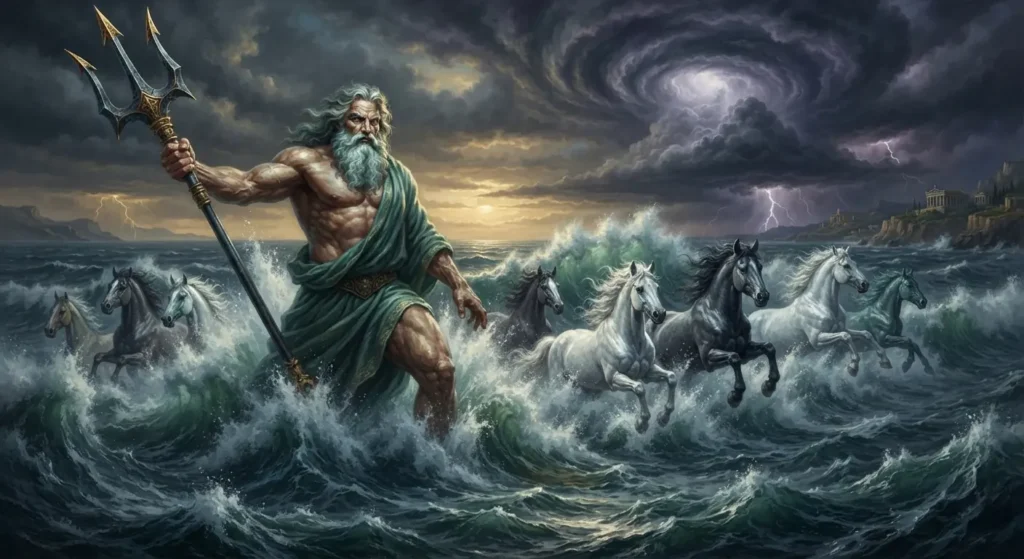
God of the sea, earthquakes, and horses. That third association surprises people, but it’s genuinely ancient and connects to his epithet as the earth shaker, since Greek thought linked the sea’s violence and the ground’s instability to the same underlying force.
Poseidon’s earthquake domain gave him serious practical importance in a seriously earthquake prone region.
The Contest for Athens
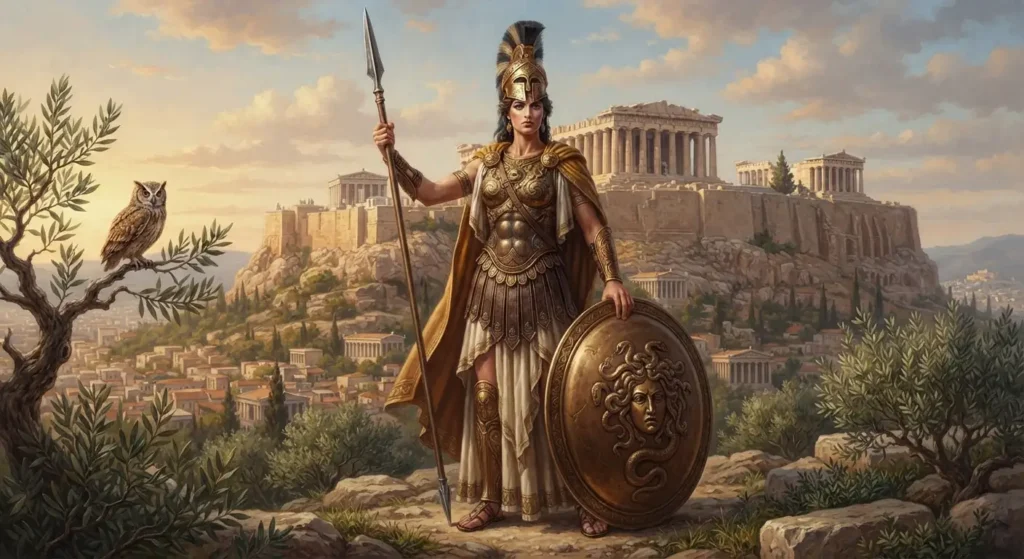
Poseidon and Athena competed for patronage of Athens. Poseidon struck the Acropolis with his trident and produced a saltwater spring. Athena produced the olive tree.
The Athenians chose Athena, and the olive’s practical value (food, oil, wood, trade) over undrinkable seawater tells you the story is about civic values rather than raw divine power.
His Grudges Last
Poseidon’s persecution of Odysseus across the entire Odyssey, following the blinding of his son Polyphemus, is the clearest example of Greek divine anger operating on an inhuman timescale.
He doesn’t kill Odysseus, which he could. He simply refuses to let him arrive home for ten years, which is a specific and much crueler kind of punishment.
Demeter
Domain and Powers
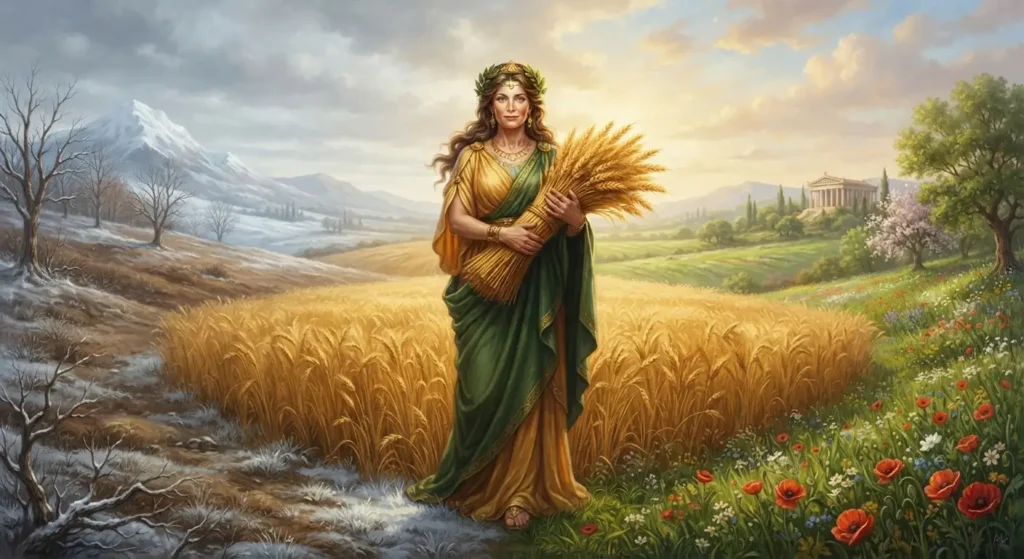
Goddess of grain, agriculture, and the harvest, with a domain that mattered more to ordinary Greek survival than almost any other god’s.
Demeter’s importance was practical and immediate. Crop failure meant famine, and Demeter was the deity most directly responsible.
The Abduction of Persephone
Hades abducts Demeter’s daughter Persephone to the underworld. Demeter searches for her, and in her grief withholds all growth from the earth, threatening universal starvation.
A compromise returns Persephone for part of the year, but she has eaten pomegranate seeds in the underworld, binding her to return there for the remainder. The seasons follow her movement.
The Eleusinian Mysteries
This myth anchored the Eleusinian Mysteries, one of the most significant religious institutions in the ancient Greek world, running for well over a thousand years and drawing initiates from across the Mediterranean.
Initiates were sworn to secrecy about what they experienced, and that secrecy held remarkably well. We still don’t actually know the central content of the Mysteries, which makes them one of antiquity’s most successful kept secrets.
Athena
Domain and Powers
Goddess of wisdom, strategic warfare, crafts, and weaving. The distinction between her warfare and Ares’ matters enormously and gets flattened constantly.
Athena represents warfare as strategy, discipline, and civic defense. Ares represents warfare as violence itself. Greek culture openly preferred Athena’s version and said so.
Born From Zeus’s Head
Athena emerged fully armored from Zeus’s skull after he swallowed her pregnant mother Metis, which makes her origin inseparable from Zeus’s own act of preemptive succession control.
She has no mother present in her own upbringing, which several classicists have read as directly relevant to her consistent alignment with paternal authority across her myths.
Arachne and Medusa
Athena’s punishments are among the harshest in Greek myth, and both famous cases involve women.
Arachne, in Ovid’s Roman account, was a mortal weaver whose only offense was being better than Athena at weaving. She was transformed into a spider.
Medusa, again in Ovid, was assaulted by Poseidon in Athena’s own temple, and Athena punished Medusa rather than the god who committed the assault. Both accounts are Ovidian rather than early Greek, which is worth flagging honestly, but both shaped how these figures are understood today.
Apollo
Domain and Powers
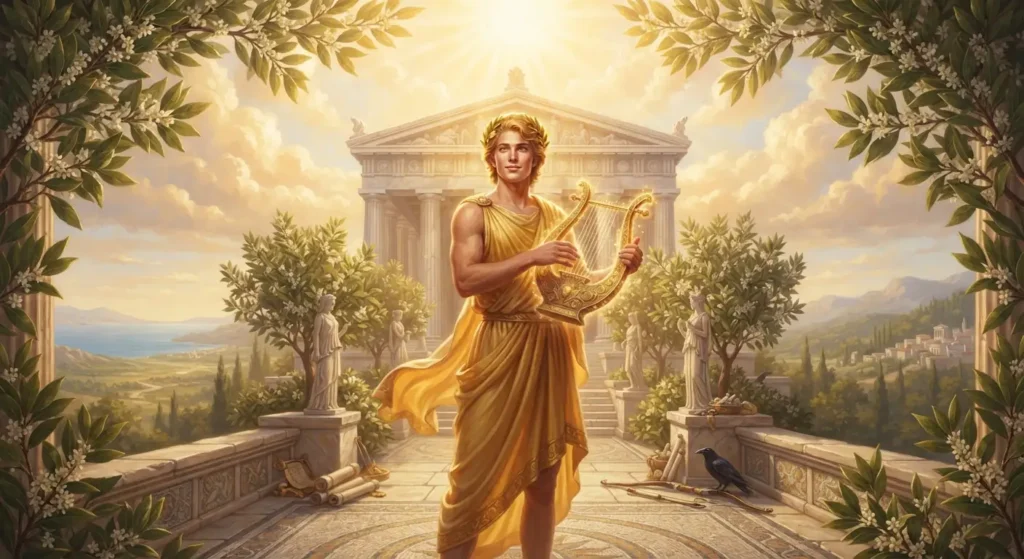
Prophecy, music, poetry, archery, light, healing, and plague. That last pairing is the one worth sitting with, because Apollo brings disease and cures it with the same authority.
The Iliad opens with Apollo sending plague through the Greek camp with his arrows. The god who heals is the god who sickens, and Greek thought held both without apparent discomfort.
Delphi
Apollo’s oracle at Delphi was arguably the single most influential religious institution in the Greek world. Cities consulted it before founding colonies. Individuals consulted it before major decisions.
The Pythia, Apollo’s priestess, delivered responses that were famously ambiguous. Croesus of Lydia was told that attacking Persia would destroy a great empire. He attacked. The empire destroyed was his own.
Daphne and Cassandra
Apollo’s pursuit of Daphne ends with her transformed into a laurel tree at her own request, escaping him permanently. The laurel became his sacred plant, which is a pretty uncomfortable detail once you sit with it.
Cassandra received the gift of prophecy from Apollo and then refused him. He couldn’t revoke the gift, so he added a curse that nobody would ever believe her. She foresees Troy’s fall accurately and is dismissed as mad throughout.
Artemis

Domain and Powers
Goddess of the hunt, wilderness, wild animals, the moon, and childbirth. The childbirth association is important and frequently underplayed.
Artemis protected women in labor and was also believed to cause the deaths of women who died in childbirth. Greek religion didn’t separate the protector from the threat.
The Actaeon Punishment
The hunter Actaeon accidentally saw Artemis bathing. She transformed him into a stag, and his own hunting dogs tore him apart before he could identify himself.
The accident is the point. Actaeon committed no deliberate offense, and the punishment arrived anyway. Greek divine justice frequently doesn’t distinguish intent.
Her Cult at Ephesus
The Temple of Artemis at Ephesus was one of the Seven Wonders of the ancient world, and the Artemis worshipped there was noticeably different from the huntress of Athenian myth, with a strong fertility association and distinct iconography.
Local cult and panhellenic myth frequently diverged this way, which is exactly the kind of variation a single unified list of twelve gods tends to obscure.
Ares
Domain and Powers
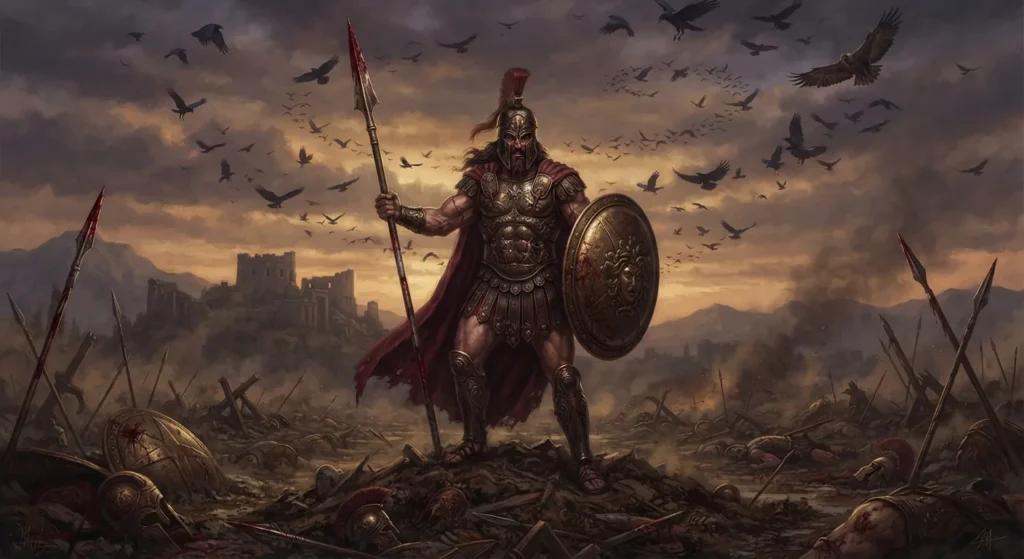
God of war specifically as bloodshed, violence, and the chaotic experience of combat rather than its strategy.
Ares is honestly disliked by other gods within the myths themselves. Zeus tells him directly in the Iliad that he is the most hateful of the gods on Olympus, which is unusually blunt characterization from a father.
He Loses Frequently
Ares’ combat record is oddly poor for a war god. He’s wounded by the mortal Diomedes in the Iliad, with Athena’s guidance, and retreats to Olympus to complain.
He’s also defeated by Athena directly in the same poem, and imprisoned in a bronze jar by the Aloadae giants in another myth for thirteen months.
Rome Rehabilitated Him
The Roman Mars is a much more dignified figure than the Greek Ares, holding genuine state importance connected to Rome’s own founding through Romulus and Remus.
This is one of the clearest cases where Roman renaming really changed a god’s character rather than just his label, and it’s worth knowing when a fantasy novel uses Mars rather than Ares.
Aphrodite
Domain and Powers
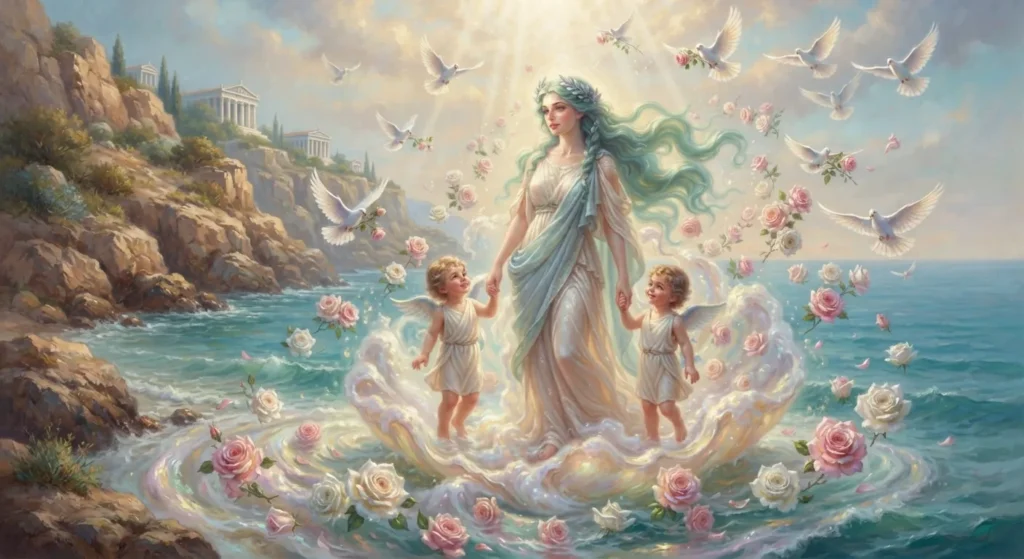
Goddess of love, beauty, desire, and procreation. Her power isn’t decorative. Desire in Greek mythology is a genuine compulsion that overrides judgment, and Aphrodite controls it.
Two competing birth stories exist. Hesiod’s Theogony has her born from sea foam, produced when Cronus castrates Ouranos and casts his genitals into the sea. Homer instead makes her a daughter of Zeus and the Titaness Dione.
The Judgment of Paris
Three goddesses (Hera, Athena, and Aphrodite) compete for a golden apple marked for the fairest. Paris of Troy judges. Each offers a bribe.
Hera offers political power. Athena offers military victory. Aphrodite offers the most beautiful woman in the world, Helen, who is already married to the Spartan king Menelaus. Paris chooses Aphrodite, and the Trojan War follows directly.
Her Marriage
Aphrodite is married to Hephaestus, the least conventionally attractive Olympian, and conducts a long affair with Ares.
Hephaestus catches them in an unbreakable net of his own making and displays them to the assembled gods, who laugh rather than condemn. The scene in the Odyssey is legitimately funny/tragic at the same time, which tells you something about how these myths actually functioned socially.
Hephaestus
Domain and Powers
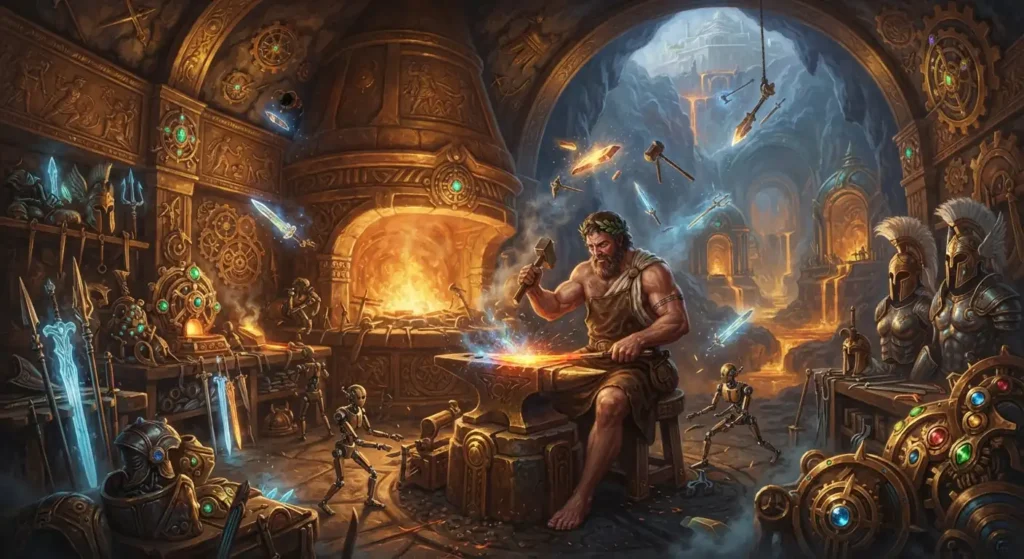
God of fire, metalworking, craftsmanship, and volcanoes. The only Olympian with a physical disability, and the only one who really works for a living.
He forges divine equipment: Achilles’ shield in the Iliad, Zeus’s thunderbolts, and the automatons that assist him in his workshop, which are among the earliest robots in Western literature.
His Fall From Olympus
Accounts differ on the cause. In one, Hera casts him from Olympus at birth for his lameness. In another, Zeus throws him for taking Hera’s side in an argument. Both versions end with him permanently injured.
The god of craft is the god who was discarded and made himself indispensable anyway, which might be the most sympathetic biography on Olympus.
His Revenge on Hera
Hephaestus built Hera a golden throne that trapped her when she sat in it, and refused to release her until the gods sent Dionysus to get him drunk and bring him back to Olympus.
He extracted concessions before releasing her. The craftsman won through skill rather than force, which is thematically consistent across everything he does.
Hermes
Domain and Powers
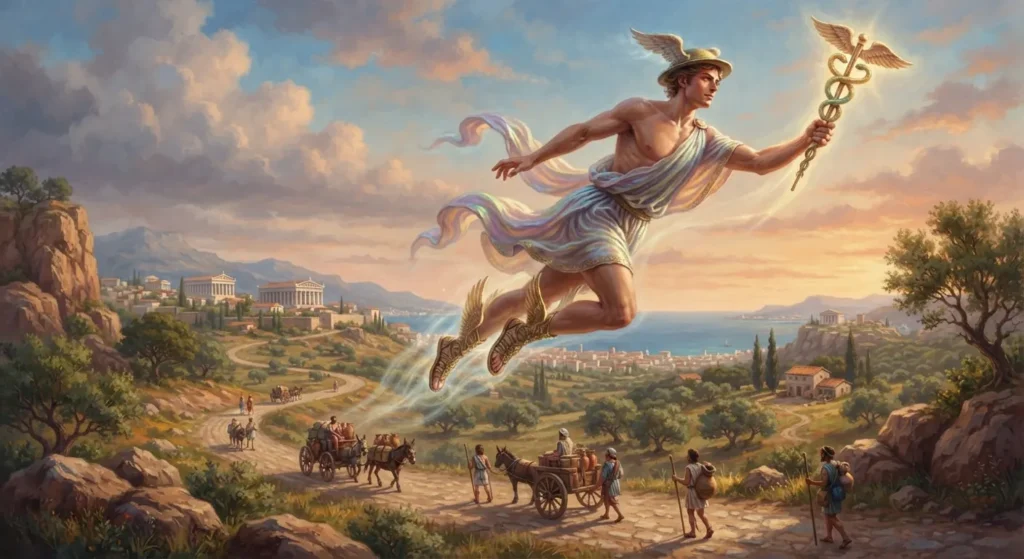
Messenger of the gods, and patron of travelers, merchants, thieves, boundaries, and eloquence simultaneously. He also serves as psychopomp, guiding souls to the underworld.
That combination (commerce and theft together) isn’t contradictory in Greek thought. Both involve moving goods across boundaries, and Hermes governs boundary crossing itself.
His First Day
The Homeric Hymn to Hermes describes his birth, and honestly, it’s one of the most entertaining texts in Greek literature.
Hermes is born in the morning, invents the lyre from a tortoise shell by midday, steals Apollo’s cattle by evening, and talks his way out of trouble by gifting Apollo the lyre. The trickster is fully formed within twenty-four hours.
The Psychopomp Role
Hermes’ function guiding souls to Hades gives him a solemnity his trickster myths don’t suggest. He’s one of very few gods who moves freely between the living world and the underworld.
That mobility is exactly why he holds the role. The god of boundaries can cross the one boundary nobody else crosses casually.
Hestia
Domain and Powers
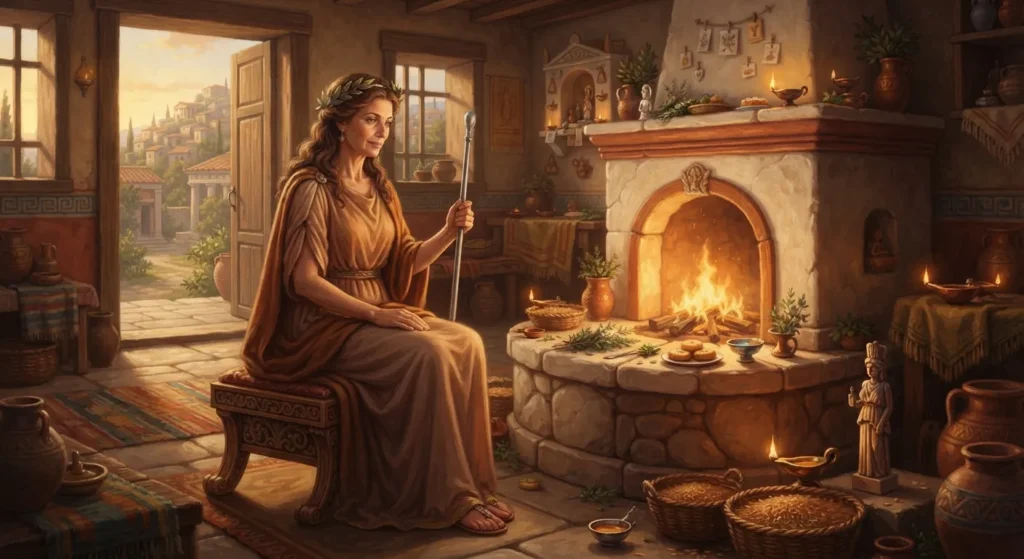
Goddess of the hearth, home, and the sacred flame of both household and city.
Hestia has almost no myths, and that absence is really the point rather than an oversight in the surviving record.
Why the Absence Matters
Hestia doesn’t have affairs, feuds, or contests. She swore to remain unmarried, rejecting both Poseidon and Apollo, and Zeus granted her the honor of receiving the first portion of every household sacrifice.
Her stability is her characteristic. In a pantheon defined by conflict and appetite, the goddess of the hearth simply stays put, and that consistency was itself worth worshipping in an unstable world.
Practical Worship
Every Greek household hearth was Hestia’s, and every city maintained a public hearth (the prytaneion) with a flame that was never allowed to go out.
Colonists founding a new city carried fire from their mother city’s hearth to light the new one. That’s a lovely practice, honestly, and it’s the closest thing Greek religion had to physical continuity across generations.
Dionysus
Domain and Powers
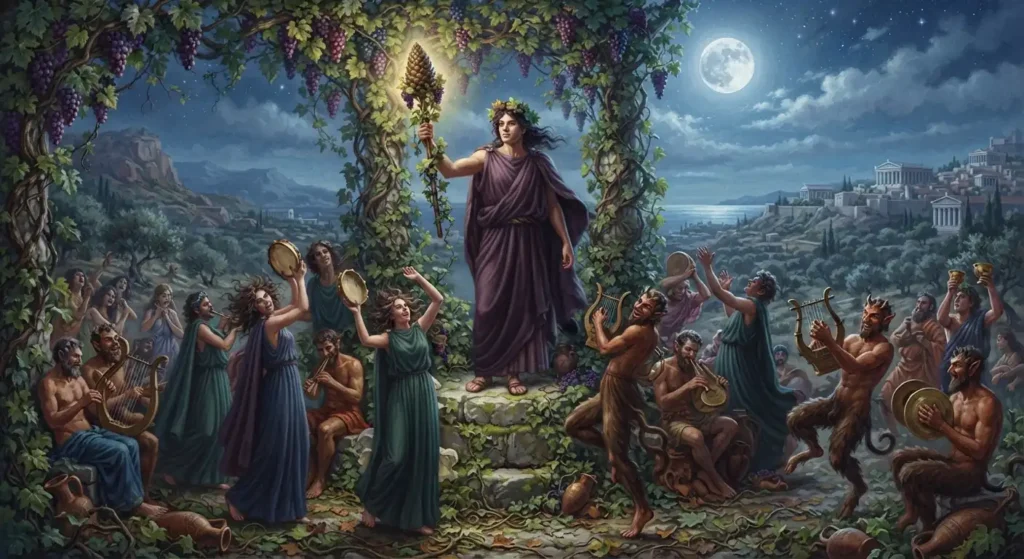
God of wine, ritual madness, theater, ecstasy, and religious frenzy. Also the only major Olympian with a mortal mother.
His domain is specifically the dissolution of ordinary boundaries (self-control, social role, individual identity), which makes him dangerous rather than simply festive.
His Double Birth
Semele, his mortal mother, was tricked by Hera into asking Zeus to reveal his true divine form. The sight destroyed her. Zeus rescued the unborn Dionysus and sewed him into his own thigh until he could be born.
That double birth (from mother, then from father) is why one of his epithets means twice-born.
The Bacchae
Euripides’ play The Bacchae is essential for understanding what Dionysus actually represents, and it’s deeply disturbing.
King Pentheus refuses to recognize Dionysus as a god. Dionysus drives the women of Thebes into ecstatic frenzy, including Pentheus’s own mother Agave, who tears her son apart with her bare hands while believing him a lion.
The god of wine and theater is also the god who destroys anyone who denies him, and Greek audiences understood both aspects as inseparable.
What These Gods Really Are
They Are Not Moral
The single most important adjustment for readers coming from fantasy is that Greek gods aren’t benevolent, and the myths never ask you to admire them.
They’re powerful, jealous, and frequently cruel. Artemis kills Actaeon for an accident. Athena punishes Medusa for being assaulted. Apollo curses Cassandra for refusing him.
These aren’t moral lessons about divine justice. They’re descriptions of what enormous power with no accountability structure produces, written by people who understood that dynamic from their own political experience.
They Have Real Limits
Fantasy frequently gives its gods either less or a lot more power than Greek gods really had.
Diomedes wounds both Aphrodite and Ares in the Iliad with Athena’s help. Zeus cannot override fate to save Sarpedon. Gods cannot freely undo each other’s actions.
Divine conflict in Greek myth is honestly constrained rather than a straightforward strength contest, which makes it a lot more interesting than most fantasy pantheons manage.
A Counterargument
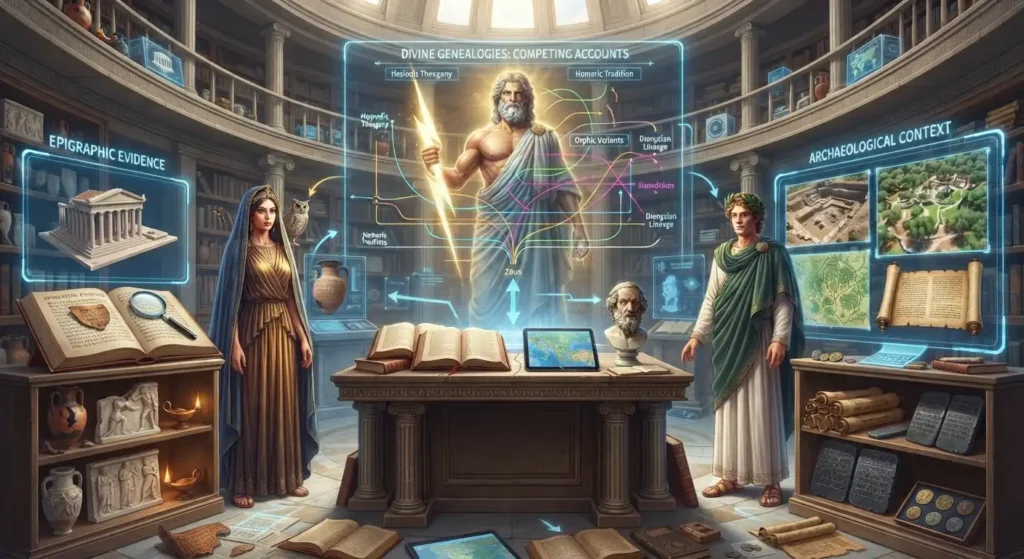
Everything above presents the twelve Olympians as a coherent pantheon worth studying as a unit, and honestly, that framing deserves pushback.
The version most readers encounter is heavily filtered. Mostly Athenian, mostly literary, mostly preserved because it was written down by people with the social position and resources to write, then filtered again through Roman reworking and later European classical education.
Local cult practice frequently diverged substantially from panhellenic myth. The Artemis of Ephesus barely resembles the Artemis of Athenian tragedy. Regional Zeus cults had characteristics the Homeric Zeus doesn’t show.
Treating the standardized twelve as Greek religion full stop flattens something a lot messier, and the beliefs of people who never wrote anything down are largely invisible to us. That invisibility isn’t the same as absence.
Frequently Asked Questions
Were the twelve Olympians worshipped together as a group in ancient Greece?
Yes, in some contexts. The altar of the Twelve Gods in the Athenian Agora, established in the late sixth century BCE, served as a collective cult site and a measuring point for distances from Athens, though individual gods received far more worship separately.
Which Olympian had the largest cult following in ancient Greece?
This varied enormously by region and period. Athena dominated Athens, Hera held major sanctuaries at Samos and Argos, and Apollo’s Delphic oracle drew panhellenic significance. No single god held universal primacy across all Greek territory.
Did any Olympian gods have children who became Olympians themselves?
Yes. Athena, Apollo, Artemis, Hermes, Ares, and Hephaestus are all children of Zeus, and Dionysus is as well. The Olympian twelve includes two generations, with Zeus’s siblings and his children seated together.
Why does Ovid’s version of certain myths differ from Greek sources?
Ovid was a Roman poet writing centuries after early Greek sources, reworking material substantially for his own literary purposes. Several widely known versions, including Medusa’s origin and Arachne’s transformation, appear in that form first in Ovid’s Metamorphoses.
What happened to Olympian worship after Christianity spread?
Official pagan worship declined significantly following imperial edicts in the late fourth century CE under Theodosius I, though local practice persisted in some rural areas much longer before eventually disappearing or being absorbed into Christian observance.
Final Thoughts
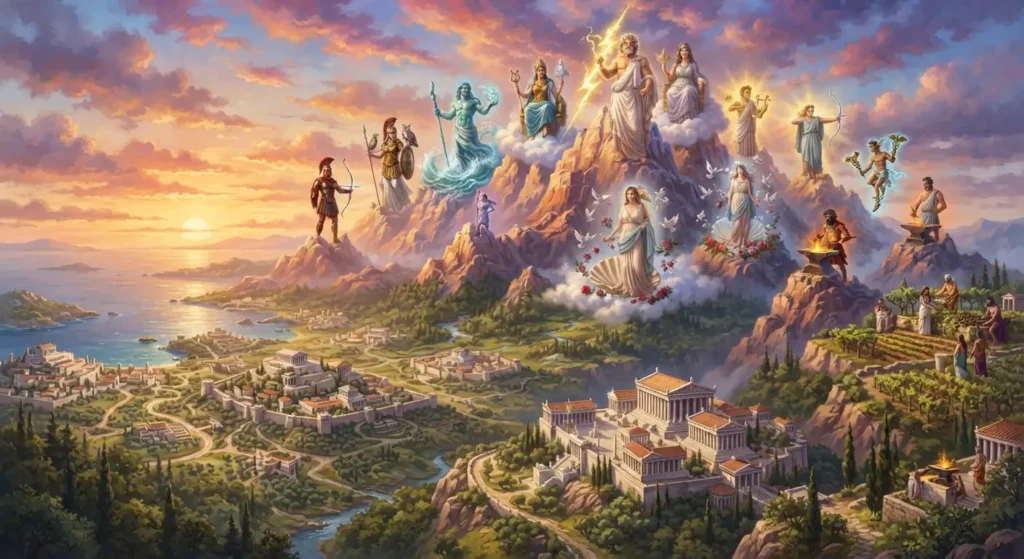
Twelve gods, one contested seat, and a pantheon whose most interesting quality is how consistently its members refuse to be the simple domain labels most summaries reduce them to.
Start with the Homeric Hymn to Hermes if you want the most immediately enjoyable primary source. It’s short, honestly funny, and it does more to explain what a Greek god really is than any list of domains ever manages.
Sources & Further Reading
Primary Sources
- Homer. Iliad.
- Homer. Odyssey.
- Hesiod. Theogony.
- Homeric Hymns.
- Euripides. Bacchae.
- Ovid. Metamorphoses.
- Pausanias. Description of Greece.
- Apollodorus. The Library.
Modern Scholarship
- Burkert, Walter. Greek Religion. Harvard University Press, 1985.
- Parker, Robert. On Greek Religion. Cornell University Press, 2011.
Related Article
- How Zeus Overthrew His Father to Rule Olympus
- Who Were the Titans? Names, Powers & Their Downfall
- Gaia: Greek Mythology’s Original Mother Goddess
- 13 Legendary Greek Heroes, Ranked by Their Feats
- Rhea: The Titaness Who Tricked a God-Eating Titan
Written by Batin Khan, a curious free spirit who loves reading and exploring the worlds of fantasy, mythology, and ancient stories. Through this blog, Batin hopes to share that sense of wonder with readers while building an exciting future along the way.