
 By
By What Kind Of Dark Fantasy Creatures Makes The Fantasy Dark
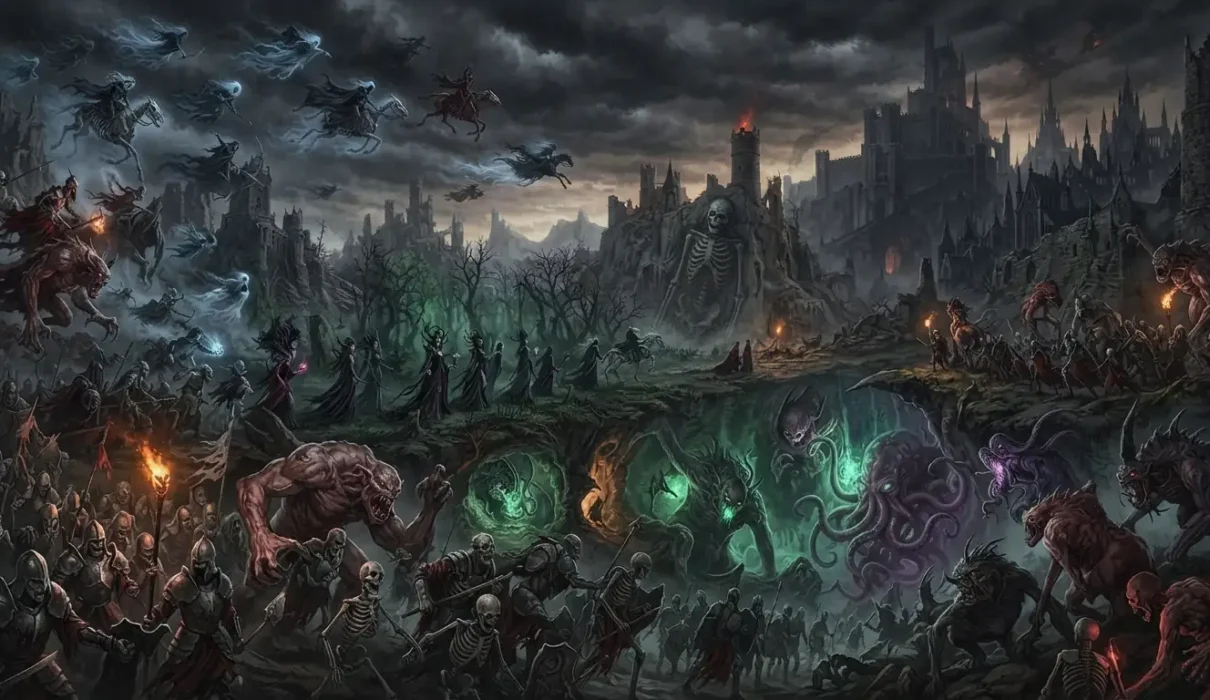
Skeletons in an army. A permanently grey sky. A body count that would embarrass a war epic. None of that is what actually makes fantasy dark, and you can prove it to yourself: plenty of straightforwardly heroic fantasy is soaked in blood and still isn’t dark fantasy in any way that matters.
What does the work is a creature that takes something you’d normally trust and turns it into the threat. A body. A neighbor. A dead brother. A bit of folklore about polite forest folk you’re supposed to leave milk out for.
The nine creatures below all do some version of that, and together they’re a real mix: centuries-old folklore sitting right next to fiction invented in the last twenty years. That mix is worth noticing on its own. Dark fantasy doesn’t have one point of origin. It’s a mood that keeps getting reinvented, because the fear underneath it, that the safe thing might not be safe, never really goes out of date.
Before the list starts: two entries, Sranc and the darkspawn’s broodmothers, touch on sexual violence and forced bodily transformation, in the course of describing what the source material itself does. Nothing graphic follows, but if that’s not what you’re up for today, skip straight past those two.
1. Wights and the Others (A Song of Ice and Fire)
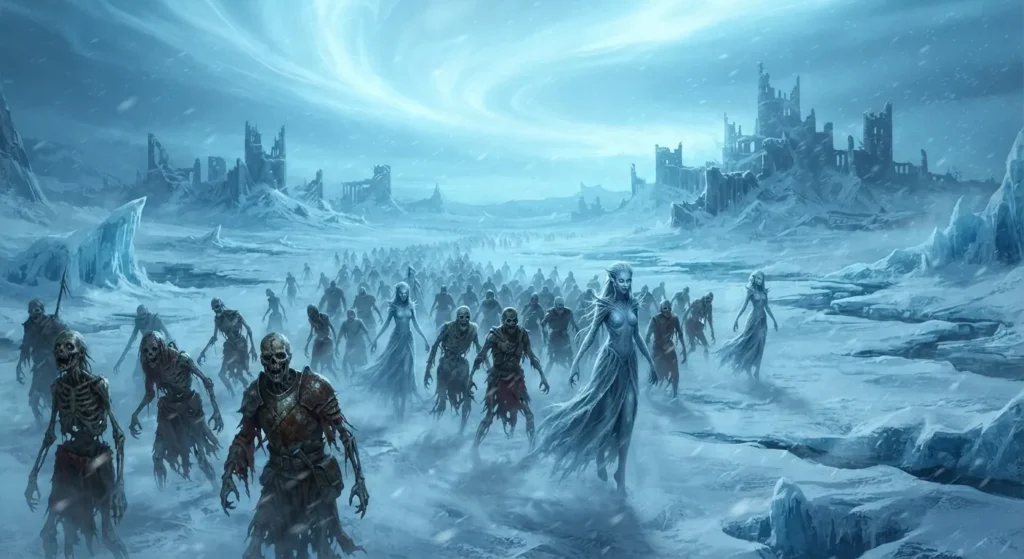
George R.R. Martin split this one cleanly in two, and the split is the point: the Others themselves aren’t undead. Martin has described them, when asked directly, as something like the Sidhe of Irish legend reimagined in ice beautiful, elegant, and simply not on humanity’s side, rather than evil in any straightforward sense.
Wights are the other half: the reanimated dead the Others raise and command, former Night’s Watchmen and wildlings among them, walking again with blue eyes and no interest in stopping.
This dread works on two registers at once. The Others are the classic dark fantasy move: a threat nothing in your worldview prepared you for, arriving after being written off as a bedtime story for six to eight thousand years. Wights are the more personal version of the body of someone you knew, doing what it’s told now.
One canon note worth having straight: “White Walker” is the name Game of Thrones gave them for television. Martin’s novels almost always just call them the Others. If you come to the books after the show, that’s not a different creature, just a different name from a different writers’ room, and the novels have revealed far less about their goals than the show eventually did.
2. Draugr (Norse folklore)
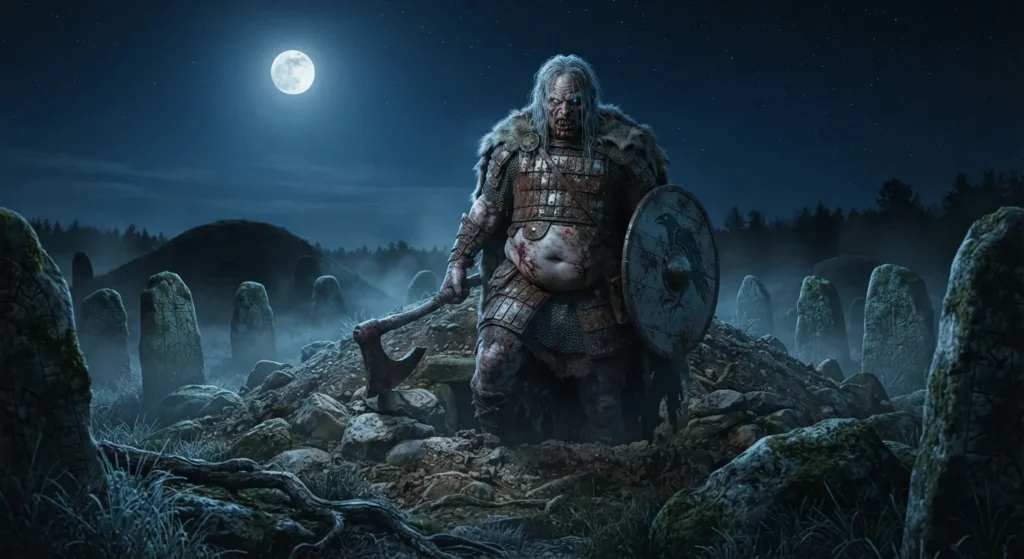
Modern zombies usually lose their minds along with their pulse. The draugr, from Old Norse and Icelandic saga tradition, doesn’t extend that mercy to you. It’s a reanimated corpse with its memory, its grudges, and its personality fully intact, which is exactly what makes the saga accounts still read as unsettling now, rather than just grotesque.
Draugar (the plural form) turn up across sagas like Grettis saga, Eyrbyggja saga, and Laxdaela saga, texts written down in the thirteenth and fourteenth centuries, drawing on older oral belief. They’re corporeal, not ghostly. Sources describe them swelling in size after death, turning corpse-blue or corpse-pale, and carrying the reek of the grave with them.
Some stay close to their burial mound, guarding grave goods with single-minded focus. Others, the aptrgangr or “again-walkers,” really do travel: breaking into farmhouses, killing livestock, settling scores with people who wronged them in life. The most famous, Glamr in Grettis saga, is strong enough after death to curse the hero who finally puts him down.
Across the sagas, the common thread is that draugar get made by improper burial, unfinished business, or simply having been a genuinely awful person while alive. So the story isn’t really “the dead came back.” It’s “the dead came back, and they’re still holding the grudge.”
3. Ghouls (Arabic folklore, by way of Dungeons & Dragons)
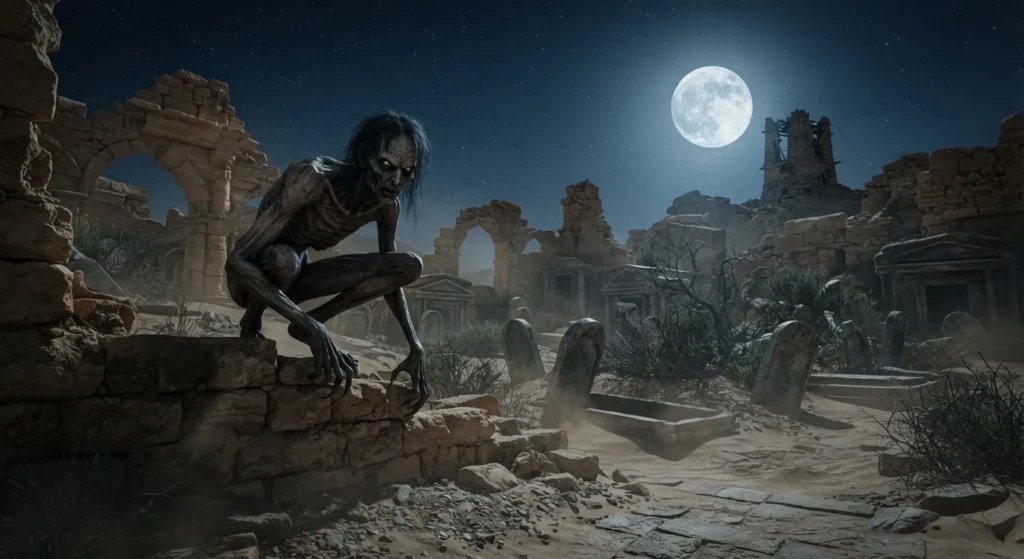
Strip away everything modern fantasy did to the word “ghoul” and you get the ghul: a shapeshifting demon from pre-Islamic Arabian belief, later folded into Islamic tradition as one of the jinn, the spirit beings of Arabian and Islamic cosmology, said to be sired by Iblis. The ghul haunted graveyards and desert wastes, and its favorite trick was disguise.
It could take the shape of a hyena or, more dangerously, a beautiful woman, luring lone travelers off the road before killing and eating them. Folklore did give you one way to catch it in the act: however convincing the disguise, a ghul could never hide its feet, which stayed the cloven hooves of a donkey. Look down before you follow a stranger into the dark.
The word crossed into English through William Beckford’s 1786 novel Vathek and kept drifting after that. Tabletop games flattened the shapeshifting desert demon into a straightforward undead monster, a corpse eater lurking in dungeons, which is the “ghoul” most fantasy readers picture today.
That drift didn’t stop at fantasy’s edge. Outside fantasy entirely, Fallout’s ghouls aren’t undead or demonic at all, just humans mutated by radiation, which says something about how far a folkloric name can travel once enough different writers borrow it.
What survives across every version jinn, corpse eater, or wasteland survivor is the same core unease: something that eats the dead, or resembles something that should be dead, wearing an ordinary face for exactly as long as it needs to.
4. Wendigo (Algonquian Tradition)
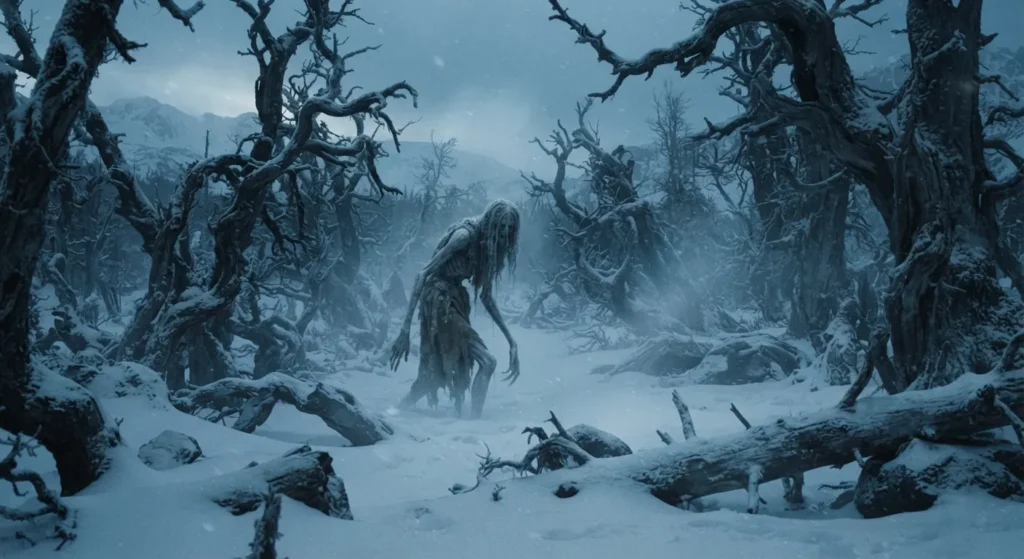
The wendigo comes from the oral traditions of Algonquian-speaking peoples, among them the Anishinaabe and Cree communities of the Great Lakes region and the Canadian subarctic. It isn’t folklore in the sense of something finished and archived.
It’s a living spiritual concept these communities still hold and discuss on their own terms, and some communities are reportedly uncomfortable with how casually the name gets thrown around outside them, worth knowing before you throw it around yourself.
In the traditions it comes from, a wendigo usually isn’t an outside invader. It’s what a person can become: most often through starvation-driven cannibalism, sometimes through spirit possession, sometimes through greed carried past the point of no return. The legend took shape around a real, recurring danger rather than a decorative one.
Brutal winters, deep isolation, and famine that was entirely possible. Read that way, it’s less a monster story than a warning about what scarcity can do to a person, one serious enough that some communities still handle the name itself with real caution.
Popular culture, dark fantasy included, mostly kept the hunger and the name and dropped almost everything else, adding the antlers and bleached deer skull you’ll recognize from horror films and video games, an image with little grounding in the older tradition.
Indigenous writers have also turned the concept back outward. The Anishinaabe economist and activist Winona LaDuke coined “wendigo economics” to describe institutional greed that consumes everything within reach, which is a lot closer to what the story was originally doing than a monster-of-the-week appearance is.
5. Darkspawn and Broodmothers (Dragon Age)
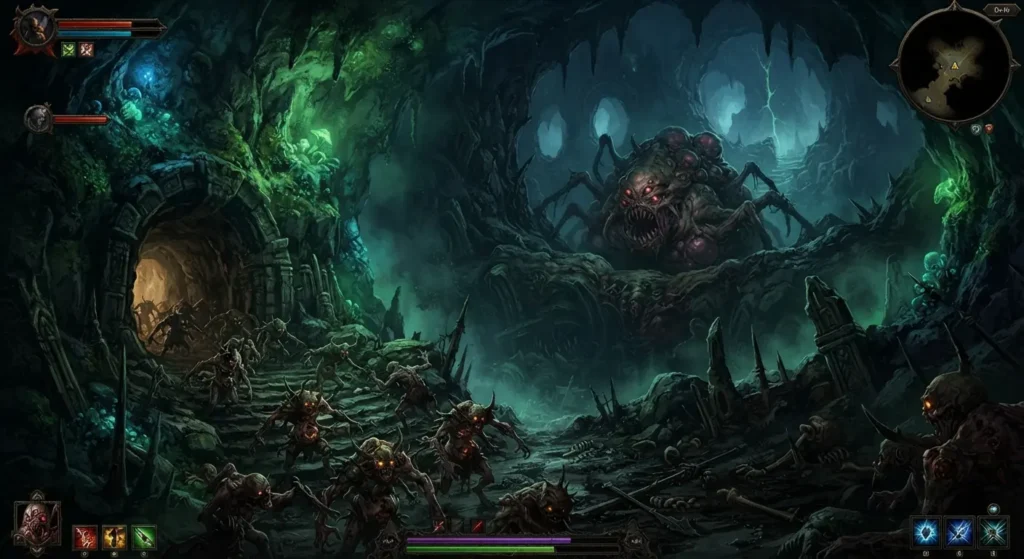
Dragon Age’s darkspawn were built, according to lead writer David Gaider, to solve a specific design problem: an evil horde players could fight without the story stopping to ask whether that was the right call. Their corruption, the Blight, does the heavier thematic lifting. It doesn’t just kill. It repurposes.
Nothing shows that better than the broodmother. In the game’s own account, she starts as a person, specifically a woman taken alive and kept by the Blight until the corruption running through her stops looking like sickness and starts looking like a new kind of anatomy. From that point she doesn’t die. She produces, in litters, for the rest of a long, unnatural life.
Dragon Age mostly doesn’t show you the process directly. It gives you another survivor’s fragmented, horrified account of it instead and lets you fill in the rest, which is a large part of why the reveal still gets cited as one of mainstream fantasy gaming’s more effective pieces of body horror, alongside real critical discussion of what it means that the horror specifically targets female bodies.
The wider point stands even if you never fight one. An enemy that kills you is bad. An enemy that turns what you used to be into more of itself is a different, worse kind of bad. Which is a lot of why body horror keeps showing up once fantasy decides to get properly dark instead of just violent.
6. Sranc (The Second Apocalypse)
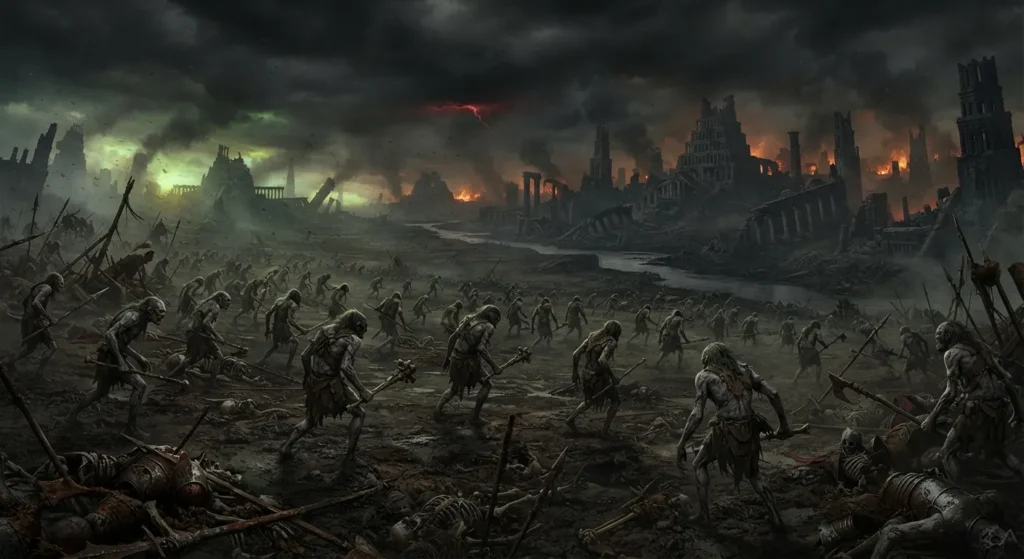
R. Scott Bakker’s Second Apocalypse novels, starting with the Prince of Nothing trilogy, do to orcs roughly what the series does to epic fantasy generally: take a genre-standard piece and push it until it stops being comfortable.
Sranc were engineered by the Inchoroi, the setting’s ancient alien antagonists, as a weapon race and a deliberate mockery of the Nonmen, the setting’s elf-equivalent. What they got is a race with no real inner life and almost no drive beyond violence, sexual violence included, and nothing resembling a choice to do otherwise.
Bakker doesn’t write around that to make the books an easier read, which is a real reason The Second Apocalypse gets cited, including by readers who already have a high tolerance for grimdark (fantasy’s cynical, morally bleak end of the pool) as some of the bleakest widely read epic fantasy in print.
What makes Sranc land as specifically dark fantasy, rather than just extreme, is the design logic underneath them. Something built to wear the human shape, with the part of you that would let you refuse taken out at the design stage, is a different kind of threat than a monster that simply attacks you.
It used to be a person, or it was built to look like one and never got to be one, and either version is worse than a fair fight.
7. The Unseelie Fae (Scottish and Gaelic folklore)
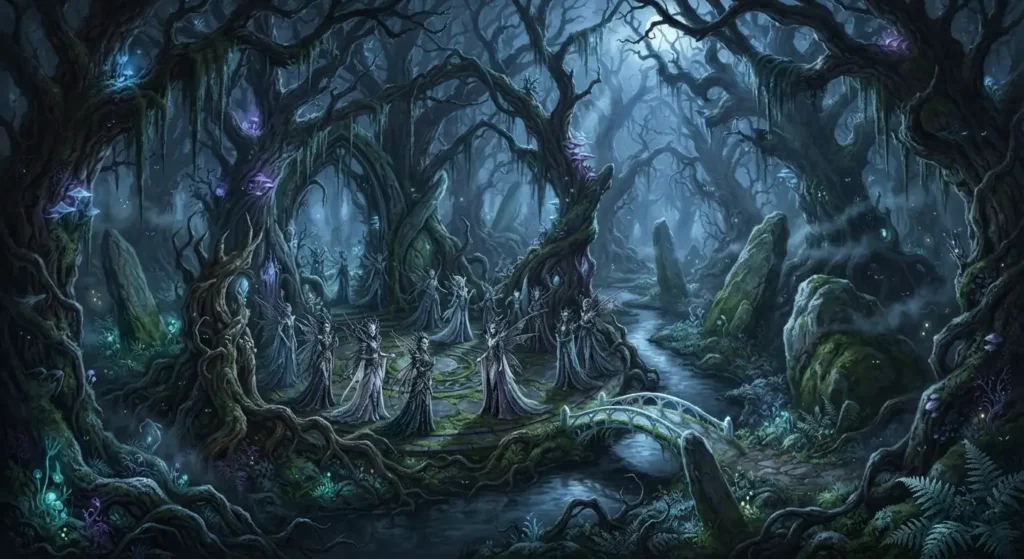
“Seelie” and “unseelie” come from Scots, meaning roughly blessed and unblessed. The Seelie Court covers fae who might help you, trade fairly with you, or at least leave you be if you follow the rules.
That courtesy doesn’t extend to the Unseelie Court. These are the fae folklore really does warn you about: not bound by human morality, not interested in being reasoned with, and dangerous specifically because they can look just as beautiful and refined as their friendlier cousins, right up until they aren’t.
The redcap makes the clearest case, out of the folklore of the border country between England and Scotland. He’s a small, vicious old man who lives in ruined castles and has to kill regularly to keep the cap he’s named for soaked in fresh blood. Let it dry out and he dies.
He carries an iron pike, wears iron boots, and folklore is consistent on one point: you cannot outrun him. There’s no bargain to strike and no riddle to win. You either stay away from the ruin he lives in, or you don’t.
The easy thing to miss is that in the tradition this comes from, “fae” was never a synonym for pretty. It was closer to “do not assume this one is on your side,” which is a much darker starting point than most fantasy readers bring to the word today.
8. The Wild Hunt (European Folklore)
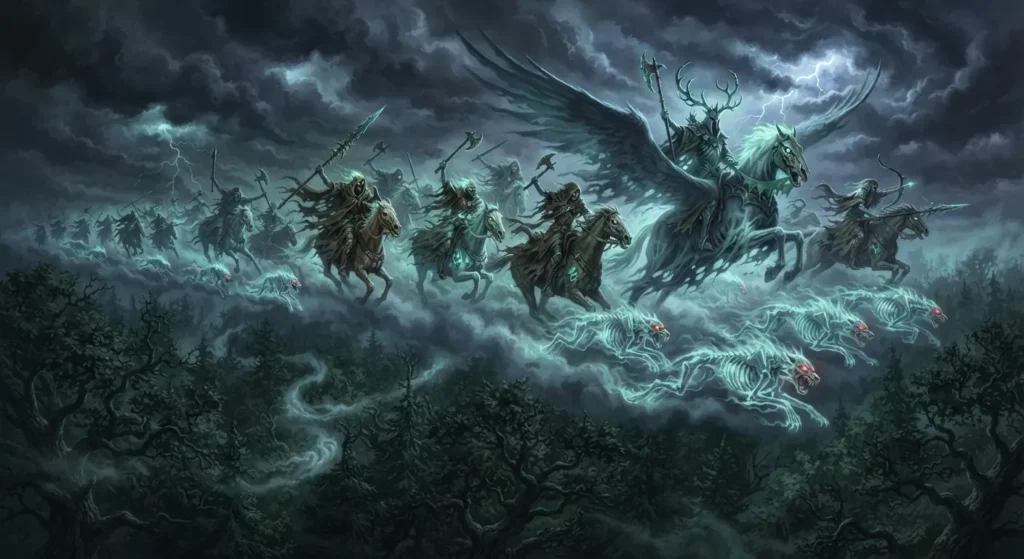
Long before any novelist got hold of it, the Wild Hunt was already one of Europe’s most widespread dark omens: a phantom company of riders and hounds tearing across the sky, or sometimes the ground, in pursuit of something usually left unspecified.
Regional names stack up fast. Wilde Jagd in German-speaking lands, Herlaþing in Anglo-Saxon England, Åsgårdsreia in Scandinavia, Dziki Gon in Poland. Odin or Woden leads it in several traditions; other regions swap in a local ghost king instead.
What barely changes from place to place is what seeing it means: nothing good. Traditionally, encountering the Hunt could mean being swept along with it, going mad, or simply not surviving the night.
Andrzej Sapkowski borrows the legend directly for his Witcher novels, where the Wild Hunt first appears as exactly what the folklore promises: a skeletal cavalcade crossing the winter sky, an omen nobody wants standing over them. The books eventually have their own answer for what’s behind it, tied closely to one specific character’s fate, and that’s territory this article will leave alone for anyone still working through the series.
What makes the Wild Hunt a real dark fantasy staple, rather than just a spooky weather event, is the total absence of negotiation. Most fantasy threats can be fought, bargained with, or at least understood eventually. This one just arrives, decides, and moves on. Folklore never offers a version of the story where standing your ground works.
9. The Nameless Things Beneath Moria (The Lord of the Rings)
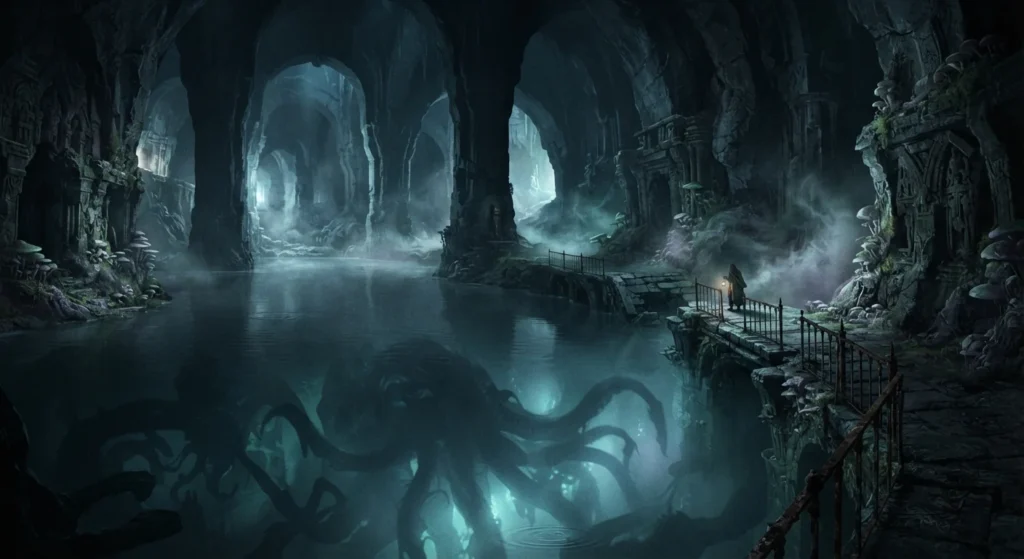
Here’s the one that surprises people. Even Tolkien, the writer most credited with making fantasy safe and heroic, has a moment of pure cosmic dread sitting in the middle of The Two Towers, and it isn’t Sauron.
After Gandalf falls fighting the Balrog beneath Moria, he tells Aragorn, Legolas, and Gimli what he found in the depths below the dwarves’ deepest tunnels. Something was already down there, older than Sauron and unknown even to him. In Gandalf’s own words, “the world is gnawed by nameless things.” He refuses to describe what he saw, saying only that he won’t darken the light of day by reporting it, and the book never raises the subject again.
That’s the whole entry in the text: a handful of sentences. It’s more unsettling than pages of description would have been. Readers have speculated for decades about what the Nameless Things are: leftover creations of Morgoth, something older than the created world itself, kin to the tentacled Watcher in the Water that attacks the Fellowship at Moria’s gate.
Tolkien never confirmed any of it, and treating a fan reading as settled fact would be a mistake. This is one of the real unresolved corners of Middle-earth, not a puzzle with a documented answer.
What earns the Nameless Things a place on this list is the reminder they give. Dark fantasy isn’t a genre invented in opposition to Tolkien. The seam was already there, in the foundational text, in the one moment even the wizard won’t say what he saw.
Final Thoughts: The Real Difference Between Scary And Dark
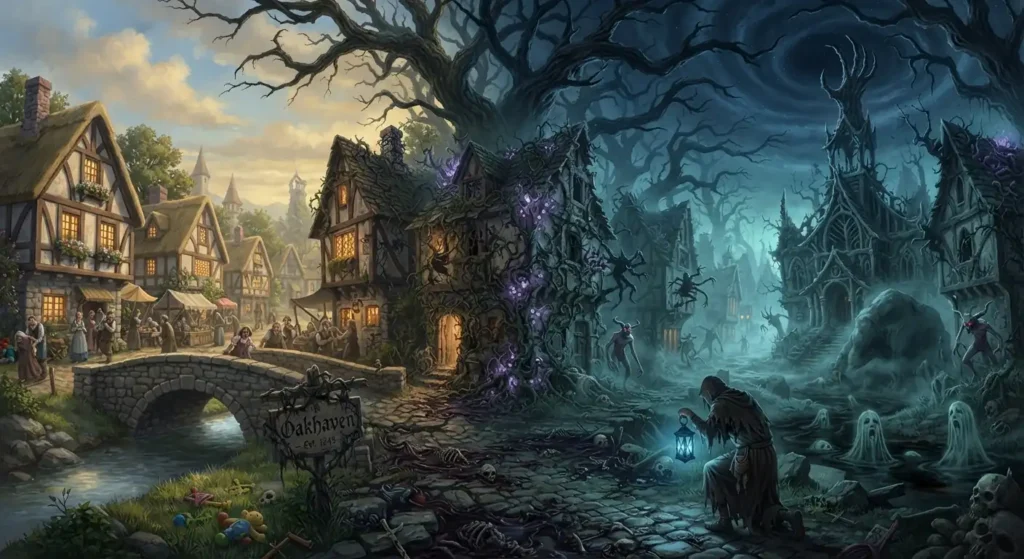
Line these nine up and a pattern falls out that has nothing to do with body count. The Others aren’t undead, yet they read as more alien than the wights they command. A broodmother is more upsetting than any straightforward monster fight in Dragon Age, because you know exactly what she used to be.
The wendigo unsettles precisely because becoming one is framed as a human possibility, not an invasion from outside. Even Tolkien’s single paragraph about the Nameless Things works through refusal: Gandalf could describe what he saw, and won’t.
None of that requires more blood than a standard dragon-slaying. It requires taking something the reader already trusts a body, a neighbor, a dead relative, a bit of folklore about polite forest folk and showing exactly how it stops being safe. That’s the real mechanism. Grey skies and skeleton armies are set dressing, borrowed because they’re associated with the real thing, not because they do the work themselves.
If you’re building or looking for dark fantasy of your own, that’s the test worth applying before any other one. Not how many people die. What the story is willing to corrupt to make you flinch.
Frequently asked questions
What’s the difference between dark fantasy and grimdark?
They overlap constantly, and plenty of books, A Song of Ice and Fire and Joe Abercrombie’s The First Law trilogy among them, genuinely qualify as both. But the core question each one asks is different. Dark fantasy asks how far the content can go, usually by borrowing horror’s tools: dread, the supernatural, body horror, atmosphere. Grimdark asks a more specific question about heroism and institutions, and usually answers that neither holds up under real scrutiny, with or without a single monster anywhere in the book.
Are these creatures based on real mythology, or did the authors just invent them?
Both, deliberately mixed across this list. Draugr, ghouls, the wendigo, the Unseelie fae, and the Wild Hunt all have real folkloric roots, though modern fantasy has reshaped most of them past easy recognition. Sranc and darkspawn have no traditional source at all. They’re recent literary and game inventions, which is worth knowing rather than assuming every properly dark creature has to trace back centuries.
Do the books ever explain what the Others want?
Not yet. As of the published A Song of Ice and Fire novels, the Others’ motives remain unresolved on the page. George R.R. Martin has indicated the far north and their homeland will get more attention in the still-unpublished Winds of Winter, but nothing currently in print spells out their goals the way the television adaptation eventually did.
Why do modern versions of folklore creatures often feel different?
Fantasy tends to simplify creatures so readers immediately understand what they are. The ghul becomes an undead corpse eater, while the traditional creature was a shapeshifting demon associated with deserts, graveyards, and deception. The wendigo has undergone a similar transformation, with popular culture favoring an antlered monster over the older spiritual concept.
Does a dark fantasy creature need to be evil?
No. Some of the most unsettling creatures are frightening precisely because they do not operate according to human ideas of good and evil. The Others are a useful example. They are presented as something alien and opposed to humanity, but that is not quite the same thing as being conventionally evil.
References & Further Reading
- A Game of Thrones – George R. R. Martin
- Grettis saga – Icelanders – Department of English | University of Saskatchewan
- EYRBYGGJA SAGA – The Saga Library Volume 2 · Translations · William Morris Archive
- The Laxdale Saga – Icelandic Saga Database
- Vathek – William Beckford
- Wendigo (folklore) | Religion and Philosophy | EBSCO Research
- Dragon Age: Here’s How the Darkspawn Were Created
- The Second Apocalypse Series by R. Scott Bakker
- Folklore Wild Hunt
- The Two Towers – J. R. R. Tolkien
Related Articles
- 12 Best Dark Fantasy Books 2026: You Should Never Miss Out
- How Norse & Greek Mythology Built Modern Dark Fantasy
- 14 Dark Fantasy Books That Don’t Need a Sequel [2026]
- 15 Most Iconic Fantasy Creatures: East & West Mythology
- How Great Fantasy Writers Adapt Mythology Without Stealing
- 9 Fantasy Creatures Authors Invented From Scratch
- Why Are So Many Mythical Creatures Hybrids?
Written by Batin Khan, a curious free spirit who loves reading and exploring the worlds of fantasy, mythology, and ancient stories. Through this blog, Batin hopes to share that sense of wonder with readers while building an exciting future along the way.