
 By
By Quick Takeaways:
- In a 2014 Rolling Stone interview, Martin summed up his entire disagreement with Tolkien in a single, specific question about Aragorn’s tax policy, and that question is the clearest entry point into how differently these two Tolkien & Martin actually built their worlds
- Tolkien built Middle earth backward from invented languages he’d been constructing since his teenage years, which is a genuinely unusual process that shaped everything downstream of it
- Martin built Westeros forward from real medieval history, specifically citing the Wars of the Roses as direct inspiration for his central political conflict
- Tolkien’s concept of eucatastrophe, the sudden joyous turn, gives his work its specific moral shape. Martin’s multiple viewpoint structure gives his work a genuinely different relationship to truth and reliability within the story itself
- Neither approach replaced the other. Fantasy today runs on both simultaneously, often within the same book
In 2014, George R.R. Martin gave Rolling Stone an answer that’s been quoted back at him ever since, and it’s a genuinely useful place to start this whole comparison. Tolkien gives us a long account of Aragorn’s successful reign, but very little interest in the administrative mechanics that made that reign work.
Martin pushed Tolkien’s treatment of Aragorn’s reign toward the practical questions that Tolkien’s kind of epic fantasy largely leaves unanswered. His most famous question was simple: “What was Aragorn’s tax policy?” He then wondered whether Aragorn maintained a standing army, how he dealt with floods and famine, and what happened to the Orcs who survived Sauron’s defeat.
Martin’s point was not simply that Tolkien had overlooked bureaucratic details; it was that the mundane administrative and political mechanics of ruling a kingdom largely disappear from view once Aragorn takes the throne.
That’s not a joke at Tolkien’s expense, whatever the internet has done with it since. It’s the clearest single sentence I know for explaining the actual gap between how these two men built their worlds, and everything else in this article is really just unpacking what that one question means.
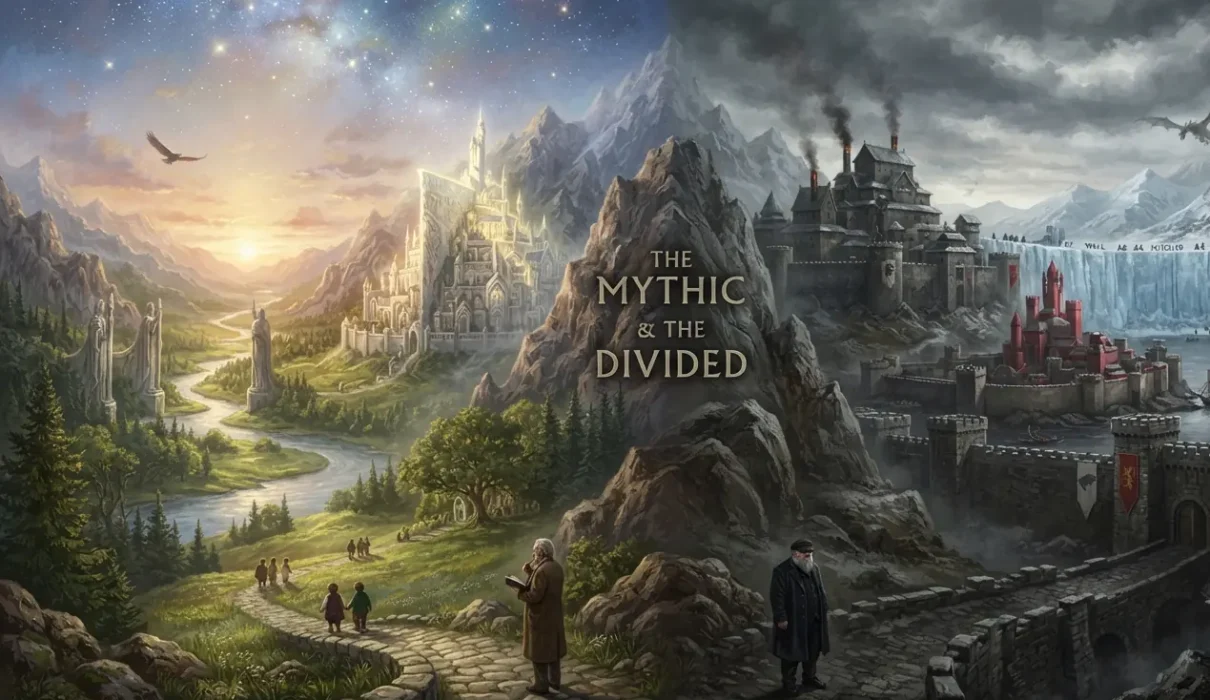
The difference between Tolkien and Martin isn’t simply that one is hopeful and the other is dark. Their bigger difference is what they believe fantasy needs to explain. Tolkien asks how a world acquires mythic meaning; Martin asks how a world produces political consequences.
Tolkien Built the World From the Inside Out
Language First, Story Second
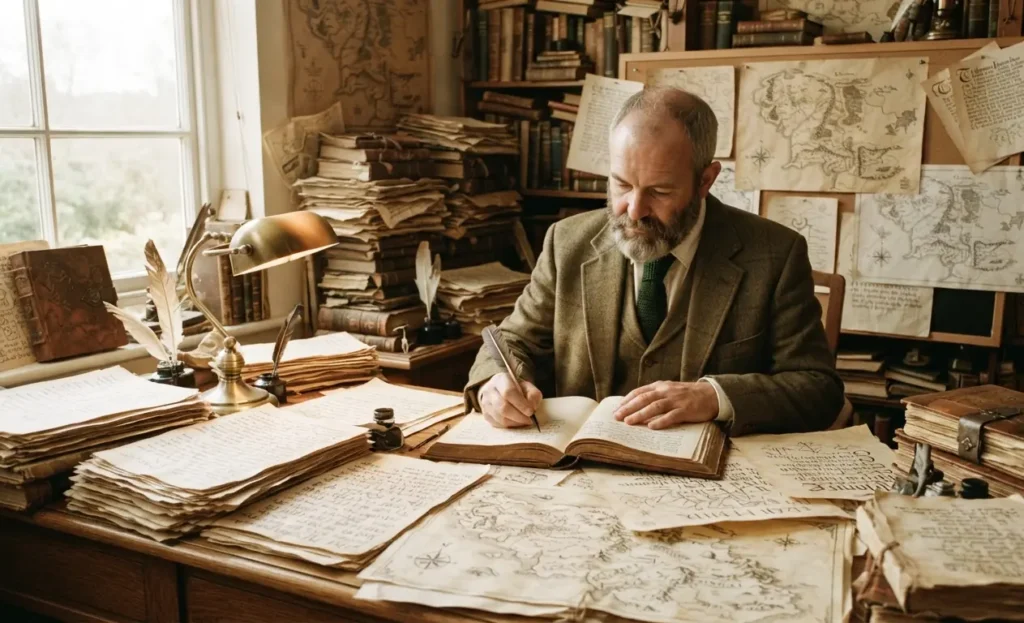
Here’s the detail that genuinely surprises people who haven’t read Tolkien’s own writings: he didn’t begin with Middle-earth as a fully formed setting and then invent Quenya and Sindarin to decorate it.
His invented languages had been developing for decades before The Lord of the Rings was published, and his mythology grew alongside that linguistic work. Tolkien’s own descriptions of the process make the relationship unusually clear: the languages needed peoples to speak them, histories to explain how they developed, and a world in which those histories could exist.
That is a genuinely unusual way to build a fantasy world, and it explains a huge amount about why Middle-earth feels so deep even when the story only gives you fragments of its history. A name isn’t merely a label if it belongs to a functioning language; it has a history behind it, and that history implies people, migration, cultural change and time.
Tolkien could therefore begin with something as small as a word and find himself needing to explain the world that made the word possible.
This is part of why the appendices to The Lord of the Rings matter so much. The genealogies, chronologies, languages and histories aren’t simply extra material added after the story was finished.
They reflect the enormous amount of underlying historical and linguistic structure Tolkien had developed around the narrative. Middle-earth often feels ancient because, in Tolkien’s creative process, it was being imagined as something that already had a past.
Read: 7 Things Modern Fantasy Writers Can Learn From Tolkien
The War He Didn’t Write About Directly
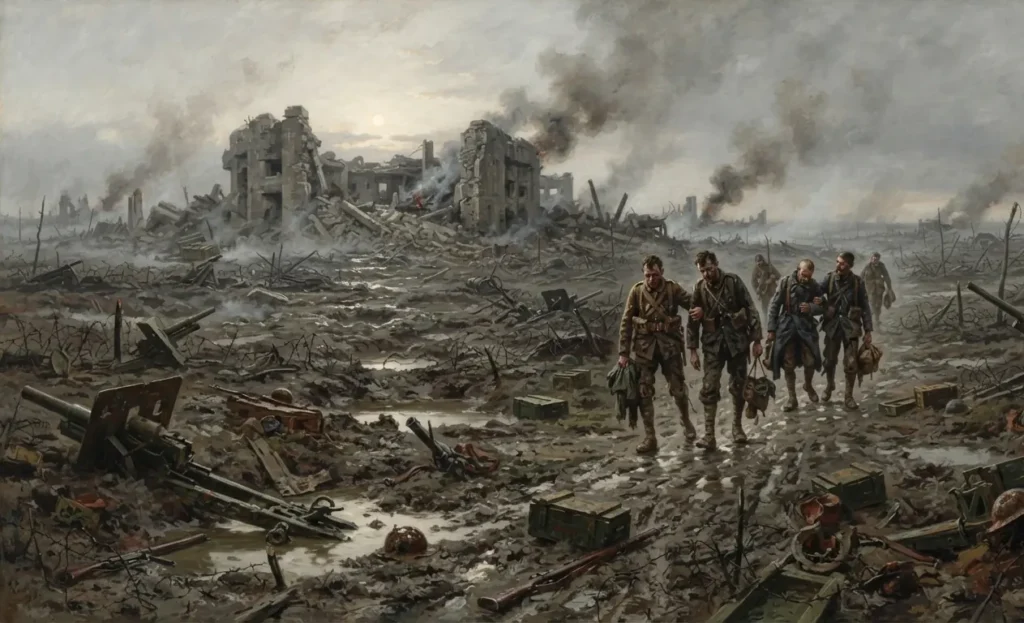
Tolkien’s experience of the First World War is impossible to separate entirely from the themes of The Lord of the Rings, even though that does not make the novel a straightforward allegory of the war. Tolkien served on the Western Front during the Battle of the Somme in 1916, and several of his closest friends from the Tea Club and Barrovian Society were killed during the war.
His experience of industrialized warfare, loss and the destruction of an entire generation inevitably forms part of the biographical context in which his later work was created.
But Tolkien himself strongly rejected the idea that The Lord of the Rings was a direct allegory for contemporary events. In the foreword to the second edition, he specifically objected to attempts to map the story onto the Second World War and insisted that the book should not be treated as an allegorical representation of it.
That distinction matters. Saying that Tolkien’s experience of war influenced his imagination is not the same thing as saying that Mordor represents Nazi Germany or that the Ring represents the atomic bomb.
The stronger argument is subtler: Tolkien had experienced the human cost of war firsthand, and that experience helps explain why his story takes sacrifice, friendship, death and the destruction of beautiful things so seriously without turning those subjects into a one-to-one historical allegory.
The result is a story in which victory is real but never costless. Frodo saves Middle-earth and is nevertheless permanently wounded by what happened to him.
Aragorn restores a kingdom, but the scars of the war remain. Sam returns to the Shire only to discover that even home has not been untouched. Tolkien’s war experience does not provide a secret code for decoding the novel; it provides part of the emotional history behind the world he created.
Eucatastrophe, the Idea That Explains the Ending
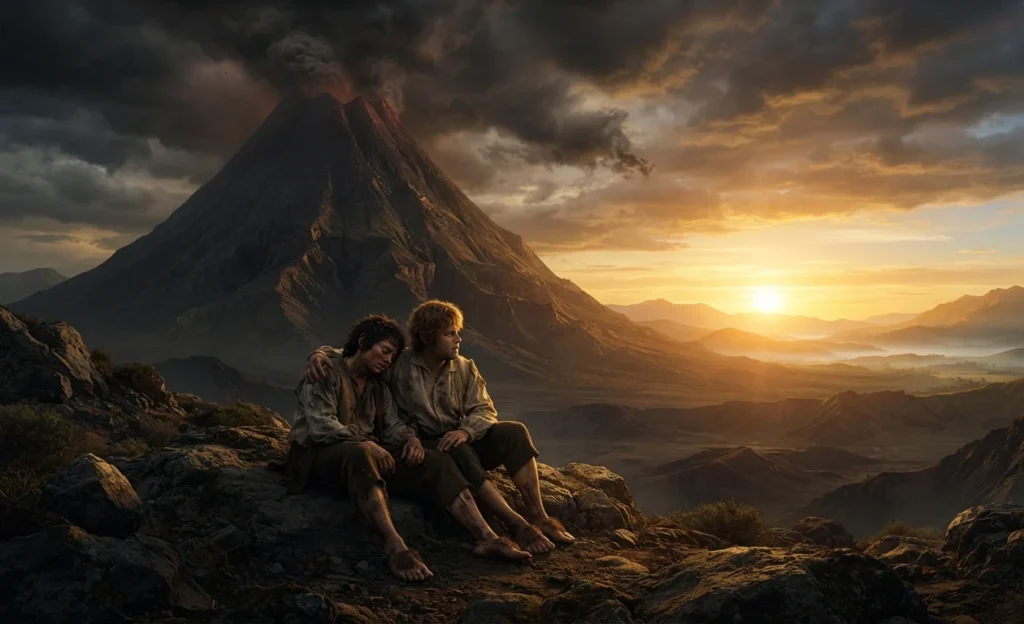
Tolkien’s essay On Fairy-Stories gives perhaps the clearest key to the moral architecture of his fiction. There he coined the term eucatastrophe for what he called the sudden “joyous turn” at the end of a story: the moment when catastrophe gives way unexpectedly to deliverance. For Tolkien, this wasn’t simply a preference for happy endings.
He connected the idea explicitly to the Christian story of the Resurrection, describing the eucatastrophic turn as a kind of distant reflection of that larger pattern of death followed by unexpected life.
That concept explains something fundamental about why Tolkien’s endings feel so different from Martin’s. Tolkien allows suffering to become almost unbearable, but he does not regard that suffering as the final truth of the story. Hope can survive precisely because the characters have reached the point where ordinary calculation says it should not.
The climax of The Lord of the Rings is a perfect example for me. Frodo cannot simply decide to destroy the Ring at the end; he claims it for himself. The resolution instead comes through the accumulated consequences of everything that happened before, including Gollum’s survival and the mercy Frodo showed him earlier in the story.
The unexpected turn is therefore not simply a convenient rescue. Tolkien has spent the entire narrative preparing the moral conditions that make the final reversal possible.
That is the important distinction. Eucatastrophe is not Tolkien refusing to acknowledge darkness. It is Tolkien arguing that darkness does not get the final word. Once you understand that principle, the ending of The Return of the King stops looking like a conventional happy ending and starts looking like the deliberate fulfillment of a literary theory Tolkien had already articulated.
Read: Chosen One vs Reluctant Hero: What Sets Them Apart
Martin Built the World From the Outside In
A Direct Answer to a Specific Complaint
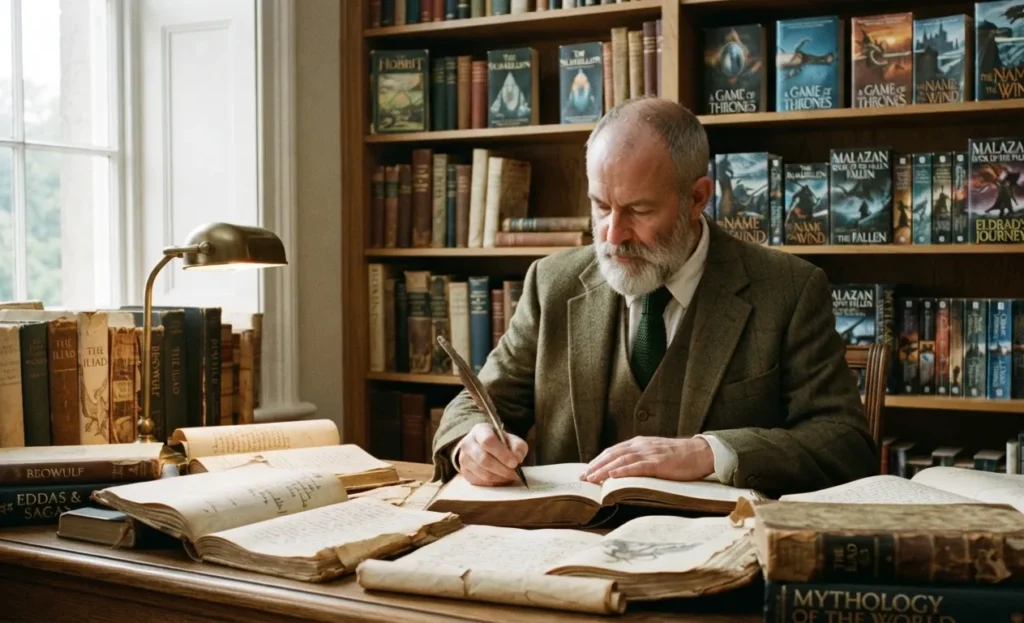
Back to the Rolling Stone Interview, what Martin actually says around the famous tax-policy question.
He describes The Lord of the Rings as carrying “a very medieval philosophy, that if the king was a good man, the land would prosper,” and contrasts that with the messier reality of history. Good kings still face famine. They still need armies. They still have to decide what to do with defeated enemies. Winning a throne is one thing; governing the kingdom that comes afterward is another.
I think this distinction gets at something fundamental about Martin’s fiction. His interest isn’t simply in making fantasy darker or more violent.
He repeatedly asks what happens when the heroic story is forced to continue after the hero has won: Who pays for the army? Who feeds the population? Who controls the roads? What happens to the defeated? What does a king actually have to do on an ordinary Tuesday?
That is where Martin’s version of fantasy becomes fundamentally different from Tolkien’s. This is my personal thought process: My reading is that Tolkien is more interested in the moral meaning of power and restoration, while Martin is more interested in what power looks like once it has to be administered.
The Wars of the Roses, Transformed Into Fantasy
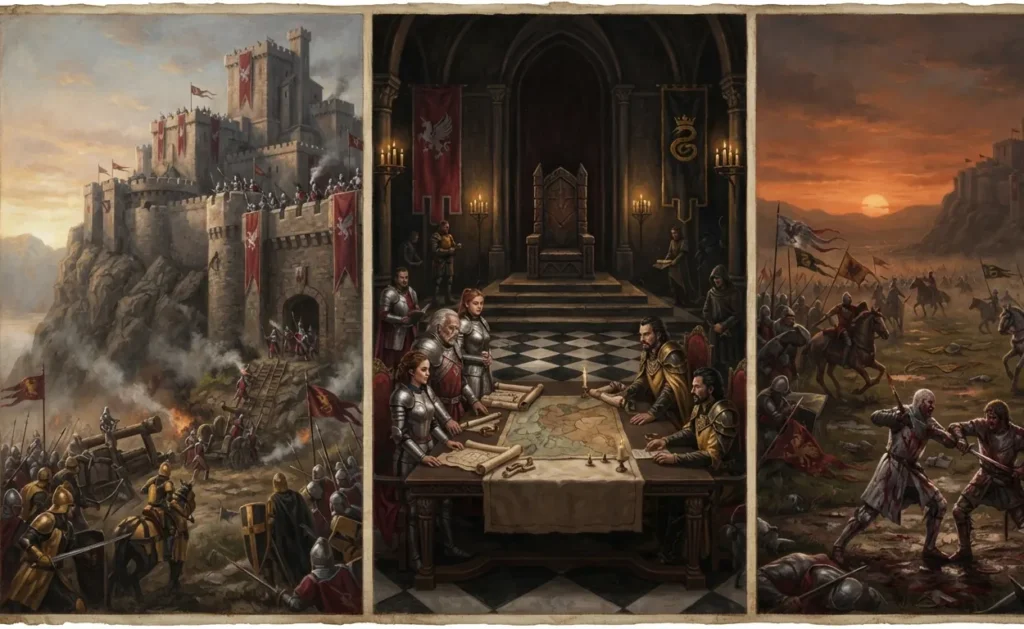
Martin has repeatedly cited the Wars of the Roses as an important historical influence on A Song of Ice and Fire, and the resemblance is obvious once you know where to look. The conflict between the Starks and Lannisters evokes the historical rivalry between York and Lancaster, while the larger story draws on the instability, shifting alliances and competing claims to legitimacy that characterized England’s dynastic struggles.
But Martin isn’t simply rewriting the Wars of the Roses with different names. The historical material is raw material rather than a blueprint. Real succession crises rarely divide neatly into heroes and villains; they involve rival claims, political marriages, opportunistic alliances, betrayals and military calculations that can change as quickly as the fortunes of the people making them.
That messiness is exactly what Martin carries into Westeros. Political legitimacy is never entirely settled. A character can have the stronger legal claim and still lose. An honorable decision can be politically disastrous. A ruthless decision can temporarily save a kingdom. The result is a fantasy world in which history doesn’t merely provide the setting; history becomes part of the mechanism driving the plot.
A Structural Difference That Matters as Much as the Tone
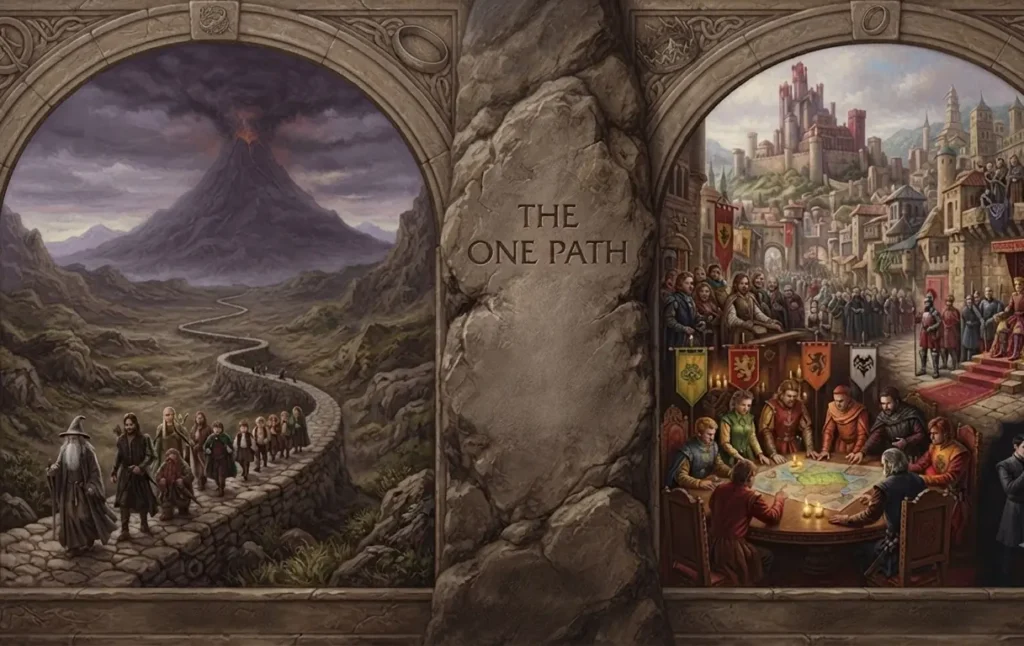
The tonal shift gets most of the attention when people compare Martin with Tolkien, but the more important difference may be structural. A Song of Ice and Fire distributes the story across multiple restricted points of view, giving readers access to characters whose knowledge is incomplete, whose interpretations can be wrong, and whose understanding of events often conflicts with that of other characters.
Martin didn’t invent multiple points of view, of course. What matters is how extensively he uses the technique to control what the reader is allowed to know. There is no single character whose perspective can safely be treated as the story’s permanent moral center. Even apparently reliable characters misunderstand events, misread other people and act on information that turns out to be incomplete.
Ned Stark’s death is the clearest early demonstration of what this structure allows Martin to do. His death is shocking not merely because an important character dies, but because the book has spent much of its first act establishing his perspective as one of its principal anchors.
When that anchor disappears, the reader discovers that the narrative has never promised the kind of security that traditional heroic storytelling often provides.
There is even quantitative evidence for how unusual Martin’s narrative structure can feel. A 2020 study, which I found quite interesting, published in Proceedings of the National Academy of Sciences, analyzed the character networks and event structure of A Song of Ice and Fire.
Among its findings was that significant deaths are distributed in a way that makes them statistically unpredictable from chapter to chapter, providing measurable support for the widespread perception that Martin can remove important characters without giving readers a reliable warning about when the next death will occur.
Tolkien’s narrative works differently. Even when The Lord of the Rings moves between different characters and locations, the reader is generally given a much more authoritative narrative framework. Martin instead keeps the reader inside the characters’ limited understanding of events.
That changes the fundamental relationship between reader and story. With Tolkien, the central question is often whether the characters will endure what the story demands of them. With Martin, there is an additional question hanging over almost every major event:
Do we even understand what is happening yet?
That uncertainty is not simply a consequence of Martin’s darker subject matter. It is built into the architecture of the books themselves.
What Each One Actually Left Behind
Tolkien’s Genre Conventions Are Still Load Bearing
Strip away the specific tonal debate and look at pure structural inheritance instead. The map at the front of the book. The deep appendix history readers can dip into optionally. The quest structure moving from a cozy, small scale beginning outward into genuinely epic stakes. Elves, dwarves, and orcs as now standard fantasy building blocks, themselves drawn from Norse and Germanic folklore Tolkien knew intimately as a professional philologist rather than invented from nothing.
Much of modern epic fantasy still works with a toolkit Tolkien helped popularize. Martin’s own books have a map. They have appendices. Rejecting Tolkien’s tone didn’t mean rejecting Tolkien’s architecture.
Martin’s Contribution Is About Reader Trust, Not Just Darkness
What Martin actually left behind, more precisely than just permission to be bleak, was a particularly influential form of reader uncertainty in modern epic fantasy. Once readers know major characters can die without narrative warning, every subsequent tense scene in every subsequent fantasy novel, written by anyone, carries a different weight, because the reader can no longer assume plot armor as a safety net.
That shift in expectation didn’t stay contained to Martin’s own books. It changed what tension itself feels like across the whole genre that came after him.
Neither One Actually Won
Both Approaches Run Side by Side Today
I think the honest ending here resists the tidy narrative that Martin simply corrected or surpassed Tolkien, because that framing misunderstands what each writer was actually trying to do. Tolkien wasn’t failing to notice that kings need tax policy. He was writing toward eucatastrophe deliberately, building a specific moral architecture that required the ending to resolve the way it does.
Martin wasn’t simply adding realism as an objective improvement. He was answering a specific frustration with a specific, deliberately different architecture of his own.
Contemporary fantasy runs on both simultaneously, frequently within a single writer’s body of work, hopeful, structurally clear epic sitting on the same shelf as morally unresolved, politically grounded epic, sometimes written by the same author in different books entirely. The genre didn’t pick a winner between these two approaches.
It kept both toolkits and just got considerably better at knowing which one a given story actually needs.
Final Thoughts
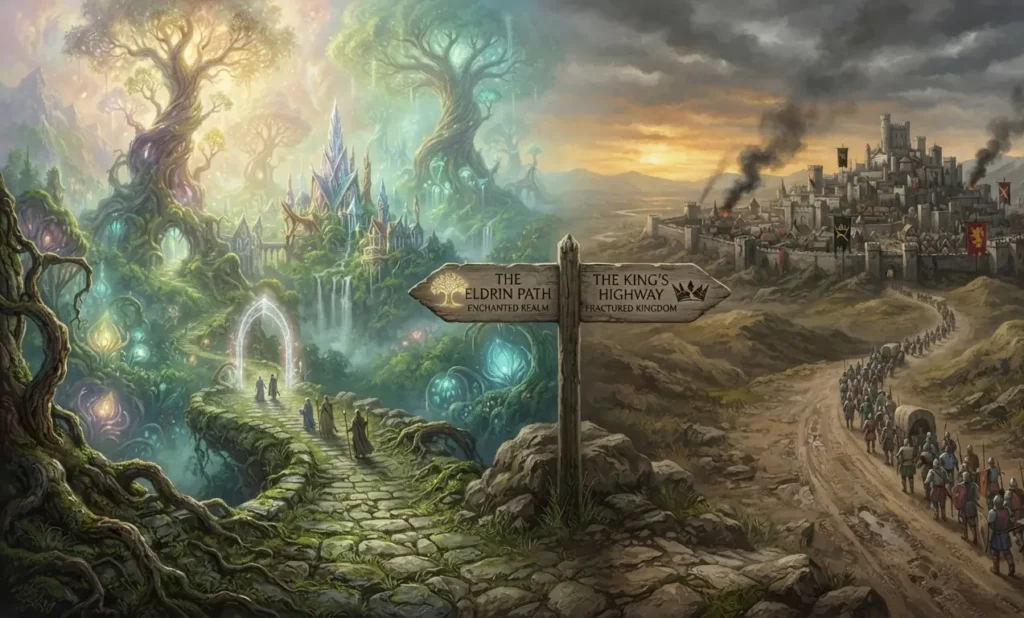
Tolkien built a world backward from an invented language and let hope win against reasonable odds because he’d decided, on purpose, that a genuine fairy story needed to end that way. Martin built a world forward from real English civil war and asked what actually happens to a good king once the crown stops being a metaphor and starts being an administrative problem.
Both questions turned out to be worth asking. Neither one cancels the other out. Fantasy just got a second toolkit to work with, and the best of what’s been written since tends to know exactly which one it’s actually reaching for.
Sources & Further Reading
- George R.R. Martin, Rolling Stone interview, 2014
- J.R.R. Tolkien, On Fairy-Stories
- J.R.R. Tolkien, The Lord of the Rings, Foreword to Second Edition
- J.R.R. Tolkien, The Letters of J.R.R. Tolkien
- Carl Hostetter, “Tolkien’s Invented Languages,” Tolkien Estate
- Verlyn Flieger, scholarship on On Fairy-Stories, Tolkien Estate
- Tolkien Estate chronology of Tolkien’s World War I service
- George R.R. Martin and the Myths of History: Postmodernism and Medievalism in ‘A Song of Ice and Fire’
- Narrative structure of A Song of Ice and Fire | PNAS
Written by Batin Khan, a curious free spirit who loves reading and exploring the worlds of fantasy, mythology, and ancient stories. Through this blog, Batin hopes to share that sense of wonder with readers while building an exciting future along the way.