

 By
By Quick Takeaways:
- Tolkien built most of his best effects out of restraint rather than addition, leaving things unexplained, using power sparingly, cutting away before a scene could resolve everything
- Several of these lessons are hard to copy honestly, since they depend on work most writers simply haven’t done, not just a stylistic choice they can adopt
- His academic background in Old English and Norse literature isn’t trivia. It’s the direct source of at least two items on this list
- A couple of these points get real pushback here rather than a clean endorsement, because the evidence for them is messier than the popular version usually admits
- None of this is really about writing “like Tolkien.” It’s about noticing what specific decisions were actually doing the work, since most imitators copy the surface and skip the decision
By carefully reading and analyzing Tolkien letters you would notice something that doesn’t come through in most craft advice built around him. People quote his prose. They rarely quote his reasoning. The reasoning is where the actual lessons live, and a lot of it is stranger and more specific than “build a detailed world.”
Depth Comes From What You Refuse to Explain
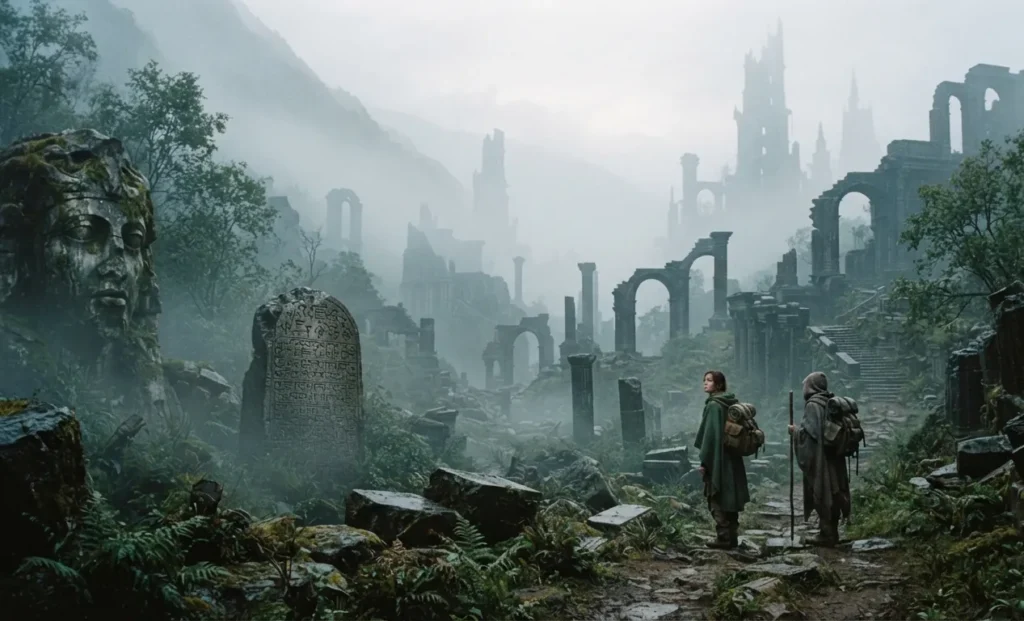
Tolkien spent his academic career studying Beowulf, a poem that survives as a single fragment gesturing constantly at a much larger world of feuds, kingdoms, and heroes the audience was clearly assumed to know already.
He took inspiration from that and used it directly in his own fiction. Aragorn mentions barrow wights and drowned kings in passing. Nobody explains them. The mention alone does the work. [Tom Shippey – The Tolkien Estate]
Most writers who try this leave a gap where the substance should be. Tolkien’s gaps hold weight because there’s an actual answer behind almost every one of them, buried in an appendix or a letter or his own private notes, whether or not the reader ever finds it. The technique only works if the unexplained thing is real to the author. Otherwise, you’re just being vague and hoping nobody checks.
He Treated Language as the Seed, Not the Costume
Many of Tolkien’s names in Middle earth are doing linguistic work, and the deeper trick is how differently he used language to mark different cultures.
Rohan’s names and songs are rendered in something close to actual Old English, a deliberate translation choice standing in for a language he imagined as related to Westron the way English is related to its own older forms. Sindarin leans Welsh in its sound. Quenya leans Finnish.
That’s not flavor text. It’s a whole invented apparatus for making one culture in the book sound meaningfully older and more foreign than another, without a single line of exposition telling you so. You feel Rohan’s antiquity in the cadence before anyone tells you a fact about it.[The Letters of J. R. R. Tolkien]
Every Victory Costs Something Real
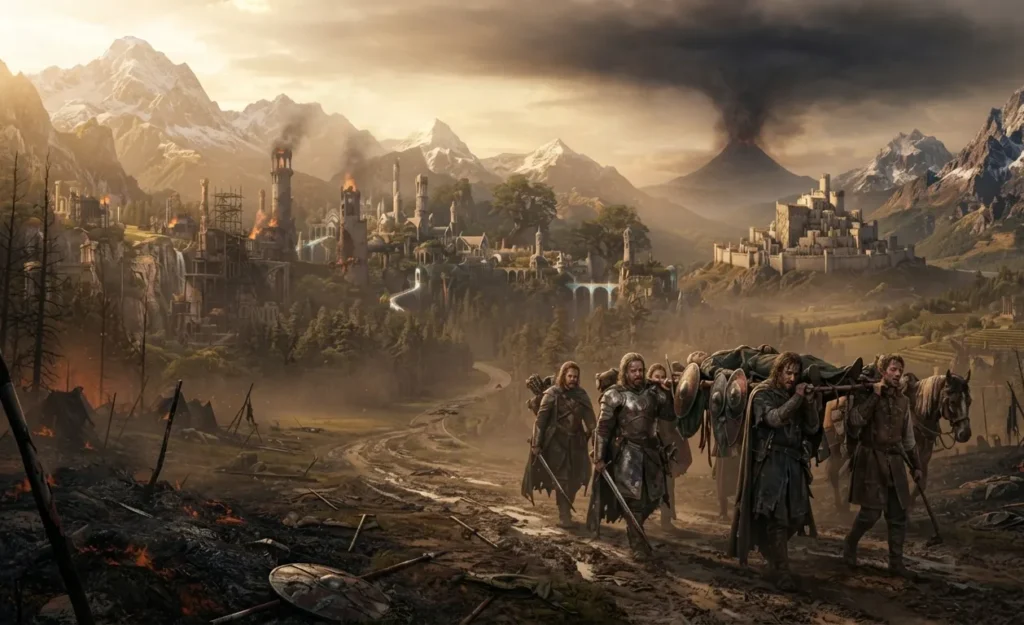
The Ring is destroyed. Sauron falls. And immediately afterward, Galadriel’s own ring loses its power, Lothlórien begins to fade, and the last ships leave for the Grey Havens carrying away exactly the kind of magic that just saved everyone. Tolkien built loss directly into triumph rather than saving grief for the parts where things go wrong. [The Return of the King]
I’ll admit this reading isn’t universal. Plenty of readers, and most film adaptations, land on the ending as pure relief rather than bittersweet cost, and that’s a fair response to the text too. But the elegy is there in the prose if you’re looking, and it’s doing something a purely happy ending can’t. Winning stops feeling free.
Heroism Doesn’t Require Good Odds
Tolkien’s academic writing on Beowulf specifically praised what he called the Northern theory of courage, the idea, present across Old Norse mythology, that even the gods know they’ll eventually lose at Ragnarok and choose to fight anyway. That’s a genuinely different foundation for heroism than winning deserves it. It’s courage as a stance you take regardless of outcome, not a strategy for guaranteeing one. [The Monster & The Critics]
You can feel this directly in the Battle of the Pelennor Fields, in Frodo and Sam’s final stretch through Mordor with no real expectation of survival. Most fantasy heroism gets its weight from the odds eventually favoring the hero. Tolkien’s gets its weight from characters who never stopped believing the odds didn’t matter to the decision.
The Mundane Has to Come First
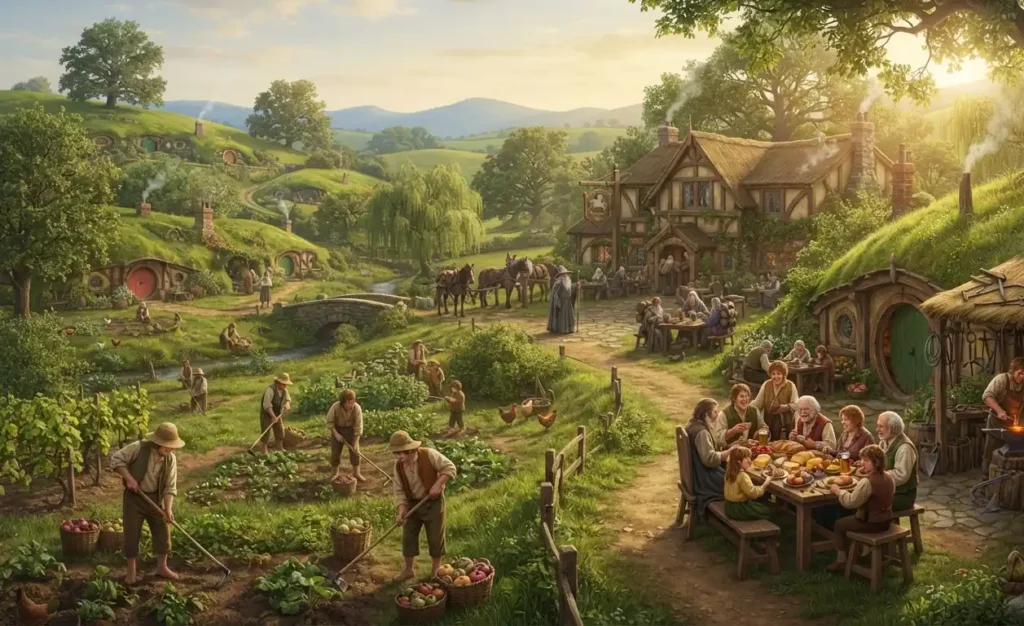
The Shire spends its early chapters on meals, pipe weed, genealogies, and small social friction before the story lets anything mythic happen at all. That’s not slow pacing. It’s calibration. You need a register this small and specific to make the scale of what follows actually register as vast, rather than as generic fantasy grandeur with nothing to measure it against.
Watch the prose itself shift as the story moves outward, plainer and more comic in the Shire, increasingly formal and archaic by the time you reach Gondor. The style is escalating right alongside the stakes, which most writers handle only through plot, never through the actual texture of the sentences.
He Was Disciplined With His Own Most Powerful Tools
Readers have complained for decades that the Eagles could have simply flown the Ring to Mordor and ended the book early. Tolkien’s own answer, from a letter written in response to a proposed film treatment, called the Eagles a dangerous machine and said he’d used them sparingly on purpose, right at the edge of what he considered credible.
Worth being honest about the context here. That comment came from pushing back on a screenplay, not from years of pre planned restraint readers had actually challenged him on. The complaint apparently never reached him from his own audience during his lifetime. So the “disciplined author” reading is partly retroactive.
What’s not in question is the actual practice on the page. A tool that powerful gets used exactly twice in the entire trilogy, and both times it arrives as rescue after the real work is already done, never as the solution itself.
He Wasn’t Writing a Story. He Was Building a Mythology
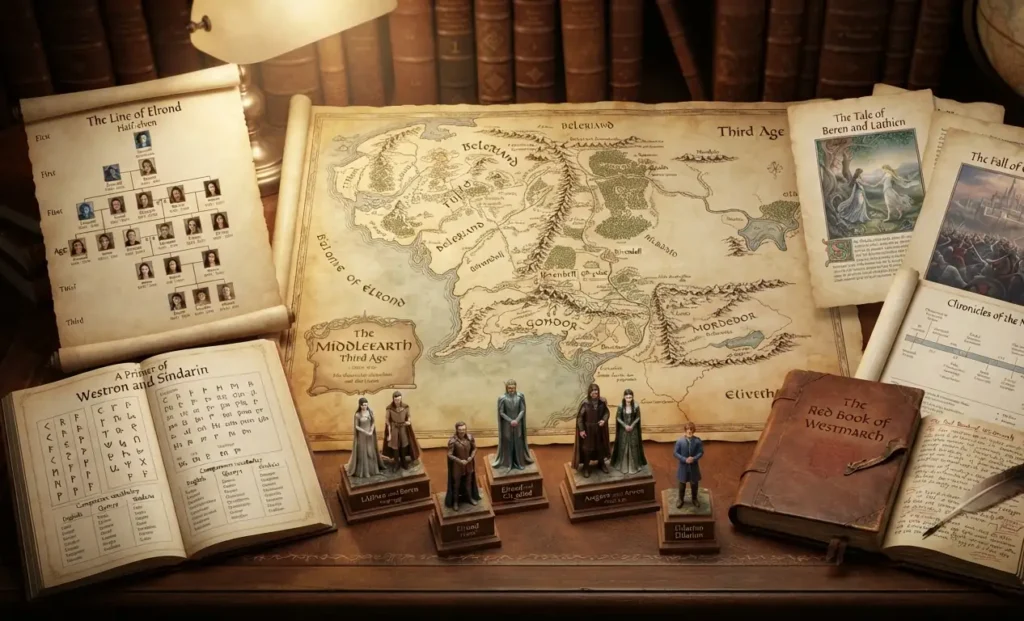
In a long 1951 letter to his editor Milton Waldman, Tolkien described wanting to build a connected body of legend he could dedicate, in his own words, to England, his country. He wanted the grand cosmogonic material and the smaller fairy story material to draw strength from each other, and he explicitly said he hoped to leave room for other people to eventually add their own tellings in paint, music, and drama.
That last detail is the one I think gets skipped most often. He wasn’t just building a setting he controlled completely. He was trying to build something with the open, communal texture of a real inherited mythology, something meant to outgrow a single author’s ownership of it.
Most fantasy worldbuilding aims at internal consistency for its own sake. Tolkien was aiming at something closer to cultural inheritance, and that ambition shows up in how willing the work is to leave threads for someone else to eventually pick up.
Frequently Asked Questions
Did Tolkien actually finish the languages before writing any story material?
Not entirely, but the order was reversed from typical practice. He’d been inventing Elvish languages since adolescence for personal enjoyment, and has stated the mythology grew specifically to give those languages speakers and a history, rather than languages being added afterward to decorate an existing plot.
Is there a specific scholarly source for the Northern theory of courage?
Yes. Tolkien discussed it directly in his 1936 lecture and essay “Beowulf: The Monsters and the Critics,” where he analyzed the poem’s treatment of courage maintained even against certain defeat, a concept scholars have since traced through much of his own fiction.
Was the Milton Waldman letter ever actually published as written?
A version appears at the front of most editions of The Silmarillion, though heavily abbreviated. The full roughly ten thousand word letter wasn’t widely available until The Letters of J.R.R. Tolkien collection, with a further expanded edition published in 2023 restoring additional material.
Did the eagle complaint actually reach Tolkien from readers during his lifetime?
There’s no clear evidence it did. His “dangerous machine” comment responds to a proposed film treatment that had the Eagles ferrying characters around more freely, not to a wave of reader letters, which complicates the idea that he was defending a rule against organized audience pushback.
Why does Rohan specifically get rendered in Old English rather than another language?
Tolkien’s fictional premise treats Westron as the common tongue “translated” into modern English for readers, with Rohan’s own language standing in a similar relationship to Westron that Old English holds to modern English, making Old English the natural translation choice for consistency within his own invented framework.
Final Thoughts
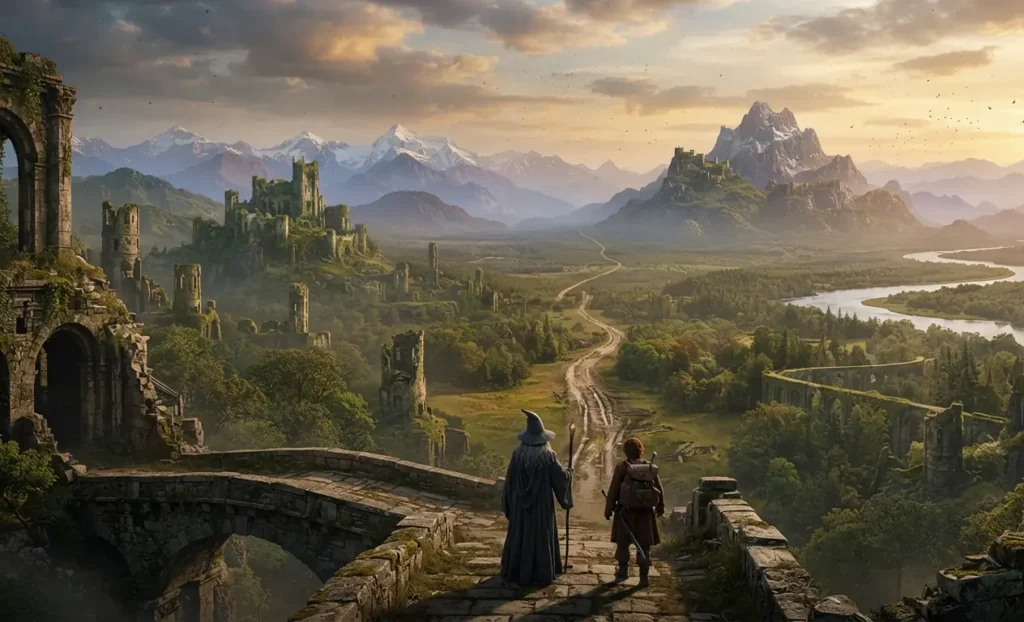
None of this really works as a checklist. You can’t borrow implied depth without doing the actual work behind it, and you can’t fake a mythology’s texture by simply refusing to explain things.
What you can take from this, honestly, is smaller and more useful than a technique. Notice what a choice is actually costing the story, the eagle you don’t use, the ending you don’t let stay clean, and you’ll usually find that’s exactly where the writing was doing its real work all along.
Sources & Further Reading
- The Tolkien Estate – Letter to Milton Waldman
- The Tolkien Estate – Tolkien’s Invented Languages, Carl Hostetter
- The Return of the King – J. R. R. Tolkien
- Tolkien, J.R.R. The Letters of J.R.R. Tolkien.
- Tolkien, J.R.R. “Beowulf: The Monsters and the Critics.” 1936.
- Tolkien, J.R.R. – On Fairy-stories.
- Tolkien, J.R.R. – A Secret Vice.
- Tom Shippey, ‘The Monsters and the Critics and other essays’ – The Tolkien Estate
Written by Batin Khan, a curious free spirit who loves reading and exploring the worlds of fantasy, mythology, and ancient stories. Through this blog, Batin hopes to share that sense of wonder with readers while building an exciting future along the way.