

 By
Quick Takeaways:
- The “foreign newcomer” label is wrong. Linear B tablets mention Dionysus around 1200 BCE, and Homer treats him as already well known.
- The famous double birth (Semele’s womb, then Zeus’s thigh) explains how a god with a mortal mother joined the Olympians.
- A third, more disputed story has him torn apart and reborn. Much of the evidence for it is late, and I’ll show where it gets shaky.
- My reading is that the myths keep returning to one idea: what survives being destroyed. I’ll flag that as my interpretation.
Ask people where Dionysus came from and many will say Asia, by way of Thrace. Euripides said so too, in a play where the god announces he’s just arrived from Lydia, Phrygia, Persia, and the lands beyond.
The tablets say otherwise. Linear B texts from Pylos and from Khania in Crete mention a god named Dionysus, which pushes his Greek worship back to roughly the thirteenth century BCE.
I’ve covered his double birth and the Pentheus story in my pieces on the twelve Olympians and on Zeus. Here I want to ask what “born twice” actually did for the Greeks.
The Newcomer Who Was Already Here

What the Tablets Show
The Pylos tablet that names Dionysus is generally dated to around 1200 BCE. A tablet from Khania lists him as a recipient of honey, in a context that suggests offerings.
Tablets are thin evidence. They give a name and a context, and nothing about what Mycenaeans believed about him. Still, the name is there.
Homer Already Knew Him
In Iliad Book 6, Diomedes tells a story about King Lycurgus, who chased the nurses of Dionysus across a mountain and made them drop their sacred implements. The god dove into the sea and Thetis took him in.
Zeus blinded Lycurgus for it. That makes Dionysus a god who suffers persecution and fights back, in one of the earliest surviving Greek poems.
Why the Foreigner Story Stuck
Greeks themselves told it. Herodotus thought the cult came by way of Egypt and the seer Melampus, and the Bacchae makes him an arrival from the east.
I read that as a story about how the god behaves. He shows up uninvited and demands recognition, and the Greeks liked explaining that with geography.
Two Births, Two Mothers
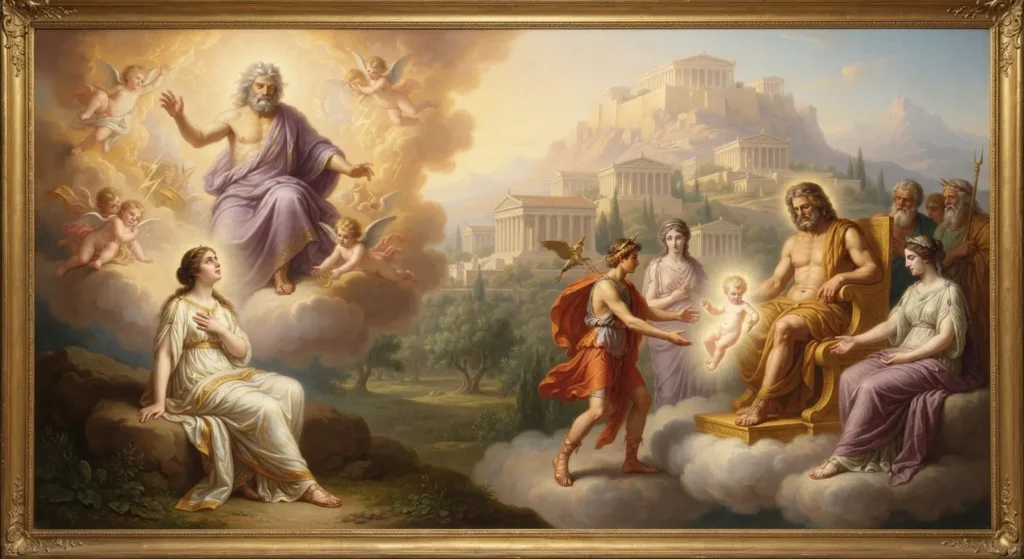
The Fire and the Thigh
The short version: Semele, a Theban princess, is tricked into asking Zeus to appear in his true form, and she’s incinerated. Zeus rescues the unborn child and sews him into his own thigh until he’s ready to be born.
I told that in my article on Zeus’s unions, so I’ll focus here on what it accomplishes. Dionysus ends up with a mortal mother and a divine birth.
The Names That Record It
Euripides has Zeus call the child Dithyrambos as he enters the thigh, and ancient writers took that as “he of the double door.” Modern scholars doubt that etymology, and the word may predate Greek.
Another title, Dimetor, means “of two mothers.” The god’s own epithets keep the double birth on record.
A Mortal Mother Matters
Every other member of the Olympian twelve has two divine parents. Dionysus is the exception.
I think the second birth works as a legal fix. It takes the son of a mortal woman and turns him, by a divine pregnancy, into someone who belongs at Zeus’s table.
And Semele Rose
Semele doesn’t stay dead. In some traditions, Dionysus later goes down to the underworld and brings her up, and she’s given the name Thyone and a place on Olympus.
The god who was born twice also, in that version, retrieves his mother from the dead. It’s the same pattern one step further along.
The Third Story: Torn Apart

What the Orphic Version Says
A different tradition makes Dionysus the child of Zeus and Persephone, under the name Zagreus. Hera sends the Titans, who lure him with toys, tear him to pieces, and eat him.
Athena saves his heart, and Zeus either swallows it or gives it to Semele, and Dionysus is born again. Zeus blasts the Titans with lightning, and humankind grows from the ashes, carrying both a Titanic and a divine element.
Where It Gets Shaky
The fullest account comes from Olympiodorus, writing in the sixth century CE. That’s more than a thousand years after the classical period.
Radcliffe Edmonds argued in 1999, in a paper titled “Tearing Apart the Zagreus Myth,” that the story as a single, coherent doctrine of original sin is a late construction. The earlier evidence has fragments, such as hints in Pindar and Plato, that don’t clearly add up to it.
Gold From the Graves
What we do have from the classical world are small gold leaves buried with the dead in southern Italy and Thessaly. Their dating runs from about the fifth to the fourth century BCE.
One text from Pelinna, in Thessaly, tells the dead person that now they’ve died and now they’ve come into being, thrice blessed on this very day. It tells them to say to Persephone that Bacchios himself has set them free.
I’m paraphrasing a translation here, so check the Greek. The point is that the god of wine appears in a burial text as the one who releases the dead.
A Line From Hipponion
A gold tablet from Hipponion in Italy, around 400 BCE, describes initiates called mystai and bakchoi walking a sacred road in the underworld. The word bakchoi attaches the dead to Dionysus.
Together, these tablets show that some Greeks associated the god with a second life after death. They don’t show the full Zagreus story.
A God Who Has to Arrive

Dionysus Eleuthereus
At Athens, the main festival of the god, the City Dionysia, opened with a procession that brought his statue in from the village of Eleutherai on the Boeotian border. The statue was a reenactment of his arrival.
That ritual is the clearest evidence I know that Athens treated him as a god who had to be welcomed in each year.
The Rejection Story
A scholion on Aristophanes reports that the Athenians first mistreated the man who carried the statue, and the god struck them with a disease in the genitals. An oracle told them to honor him with phallic processions.
I’d treat that as a later explanation of an existing ritual. It tells you that people expected a rejected Dionysus to punish.
The Queen and the God
At the Anthesteria, a spring wine festival, the wife of the chief magistrate, called the Basilinna, was ritually united with the god at a place called the Boukoleion. Aristotle’s Constitution of Athens mentions it.
The details of that union are debated, and many scholars think it was symbolic. It’s still a striking picture of a city giving its first lady to the god of wine.
The Theater
Greek tragedy and comedy were performed at his festivals, in a theater below the Acropolis that bore his name. The priest of Dionysus had a reserved front seat, and a carved marble throne survives.
A trilogy of tragedies was followed by a satyr play, with a chorus of his wild companions. I like that the god of dissolving boundaries sponsored the one civic ritual that required citizens to sit still and watch.
The Pirates and the Lion

Homeric Hymn 7
In this hymn, pirates seize a handsome youth on the shore, thinking he’s a king’s son. Only the helmsman realizes he’s a god.
Vines coil up the mast, wine flows over the deck, and Dionysus turns into a lion. The pirates leap into the sea and become dolphins, and only the helmsman is spared.
A Vase to Match
An Athenian cup by the painter Exekias, from around 530 BCE and now in Munich, shows the god reclining in a ship with a grapevine growing from the mast. Dolphins circle around.
I love that the hymn and the vase tell the same story. The god can’t be kidnapped, because anything that touches him turns into something else.
Myth Versus Ritual: What Maenads Did

The Bacchae’s Version
In the Bacchae, the women of Thebes are driven mad by Dionysus, flee to the mountains, and kill Pentheus with their bare hands, including his own mother. It’s one of the most violent scenes in Greek drama.
That’s a play, and the violence serves the story. Euripides is dramatizing an extreme.
What Real Rites May Have Looked Like
Albert Henrichs argued in a famous 1978 article that Greek maenadism was a real ritual practice, not just a literary fantasy. At Delphi, women called Thyiades climbed Mount Parnassus in winter to dance for the god every other year, according to Plutarch and Pausanias.
Whether those rites included tearing animals apart and eating raw flesh is disputed. I’d read the evidence as showing that something ecstatic took place without proving the bloody details.
My Reading: Survival After Destruction

One Pattern, Many Costumes
Look at what repeats. Semele is burned and the child survives. Dionysus is torn apart by Titans and returns. Pentheus is torn apart and the god’s cult survives.
A grape is crushed and becomes wine. A vine is cut back every winter and grows again. A person at a Dionysian initiation, as the Pelinna text implies, dies and is born on the same day.
Why I Find That Convincing
The god’s strange birth, his festivals, and his promises to the dead all point toward something living through damage. That connection is mine, though, and no ancient source states it as a single principle.
I’d offer it as a way to see why the second birth mattered. It wasn’t a curiosity. It was the model.
The Second Birth May Be a Legal Fix

The thigh story may exist mainly to put a mortal woman’s son on Olympus. In that case, the symbolism I’ve read into it is something I’ve added.
A comparison helps: Athena’s birth from Zeus’s head is another unusual delivery that settles a status question. The pattern might say more about Zeus’s paternity than about rebirth.
The Orphic Story May Be Late
If Edmonds is right, I’ve given the Zagreus tradition more weight than it deserves for the classical period. The gold tablets support a link between Dionysus and the afterlife, but they don’t confirm the Titan myth.
So the claim that every Greek knew Dionysus as the god who was torn apart and reborn is too strong. Some did, in some places, and the evidence is uneven.
The Wine Symbolism Is Tempting and Unproven
Linking the vine’s cycle to the god’s death and rebirth is the kind of neat analogy that modern readers love. Ancient texts mostly don’t make it explicit.
I’m not saying it’s wrong. I’m saying I can’t point to a Greek author who spells it out.
Arrival Stories Can Mislead
I used the Eleutherai procession as evidence that Athens treated him as an arriving god. Scholars read the ritual in different ways, and the reenactment could be a civic arrangement that tells us little about how Athenians felt about his origin.
What I Take From This
Dionysus isn’t a god who was born twice because the Greeks liked a good story. He’s a god whose story keeps asking whether anything can survive being broken.
The Greeks answered yes, with a festival, a theater, a cup of wine, and a gold leaf in a grave. I find that more hopeful than the stereotype of the party god.
Frequently Asked Questions
What happened to Dionysus’s cult in Rome?
Livy reports that in 186 BCE the Senate suppressed the Bacchanalia after an alleged scandal and many prosecutions. His account is dramatic and likely exaggerated, but the decree itself survives on a bronze tablet and shows the state worried about private Bacchic groups.
Did the Greeks drink wine straight?
Generally no. Wine was mixed with water in a large bowl called a krater before serving, and drinking it undiluted was linked to barbarians or excess. Mixing ratios varied, and writers argued over how strong a mixture was proper.
What is a thyrsus?
A staff made from a fennel stalk, wrapped with ivy and topped with a pine cone. Maenads and satyrs carry it in vase paintings, and in the Bacchae it appears as a sacred emblem that can also be a weapon.
Who were Silenus and the satyrs?
Satyrs are wild companions of the god, shown with horse features and a taste for wine and chasing nymphs. Silenus is an older figure, often described as the god’s tutor, and the satyr play that closed a day of tragedy gave them a comic stage.
How did Dionysus marry Ariadne?
Hesiod says he made Ariadne his wife and Zeus made her immortal. The Odyssey has a different version, in which Artemis kills her on the island of Dia after Dionysus bears witness against her, so the sources disagree.
Final Thoughts
A god whose name appears on a tablet around 1200 BCE turns out to be one of the oldest in the Greek pantheon, and also the one that cast itself as the stranger at the door.
I think that’s why the double birth lasted. It fit a god who kept arriving and refusing to stay dead
Written by Batin Khan, a curious free spirit who loves reading and exploring the worlds of fantasy, mythology, and ancient stories. Through this blog, Batin hopes to share that sense of wonder with readers while building an exciting future along the way.