
 By
By Quick Takeaways:
- Fantasy worlds feel real, not because they’re realistic, but because they’re internally consistent: the rules they establish are the rules they follow
- The best magic systems are defined as much by what they can’t do as by what they can, and the constraints are where the most interesting story possibilities live
- World-building works like an iceberg: the author needs to know far more than the reader ever sees, and the unseen depth is what makes the visible surface feel solid
- The relationship between magic and society is where most world-building either succeeds or fails: if magic exists, it changes economics, politics, warfare, and culture in specific ways that the world needs to reflect
- Understanding how world-building works makes you a better reader as well as a better writer, because you start noticing what the best fantasy authors are doing that less successful ones aren’t
The question I get asked often by readers new to fantasy is some version of: how do I know when a magic system is good?
The answer I’ve arrived at after years of reading across every major fantasy tradition is: a magic system is good when you feel the constraints as clearly as you feel the capabilities. When you understand not just what the magic can do but what it costs, what it can’t do, and what happens when those limits are pushed.
That principle extends beyond magic systems to the whole project of fantasy world-building. The worlds that feel most real aren’t the ones with the most elaborate histories or the most spectacular powers. They’re the ones where you can feel the internal logic operating at every level.
Here’s how that actually works.
What Makes a Fantasy World Feel Real

The Consistency Principle
Fantasy worlds don’t need to be realistic. They need to be consistent.
The distinction matters enormously. Tolkien’s Middle-earth is not remotely realistic: it has talking eagles, undead armies, and magic rings. But it feels real because everything in it follows from the same set of underlying principles. When something happens in Middle-earth, it happens the way it would in Middle-earth, not the way it would be convenient for the plot.
Readers detect inconsistency faster than they detect almost anything else. A magic system that prevents teleportation in chapter three and then uses teleportation to solve a problem in chapter twenty produces a specific readerly dissatisfaction that isn’t about the magic being unrealistic. It’s about the world not following its own rules.
The Lived-In Quality
The second thing that makes a fantasy world feel real is the sense that it existed before the story started and will exist after it ends.
When background characters have specific concerns that have nothing to do with the protagonist’s plot, when the economy of a city reflects the fact that trade routes exist, when the religious practices of a culture trace back to events the plot never directly addresses: these details don’t explain the world. They imply it.
The implication is more powerful than the explanation. A reader who understands that a culture’s burial practices reflect their mythology without being told this explicitly feels a world’s depth in a way that no amount of appendix-reading produces.
Read: Grimdark vs Dark Fantasy: Are They One & The Same
Magic Systems: Hard and Soft
The Distinction
Fantasy critics and authors have developed a useful vocabulary for categorizing magic systems that’s worth understanding before anything else.
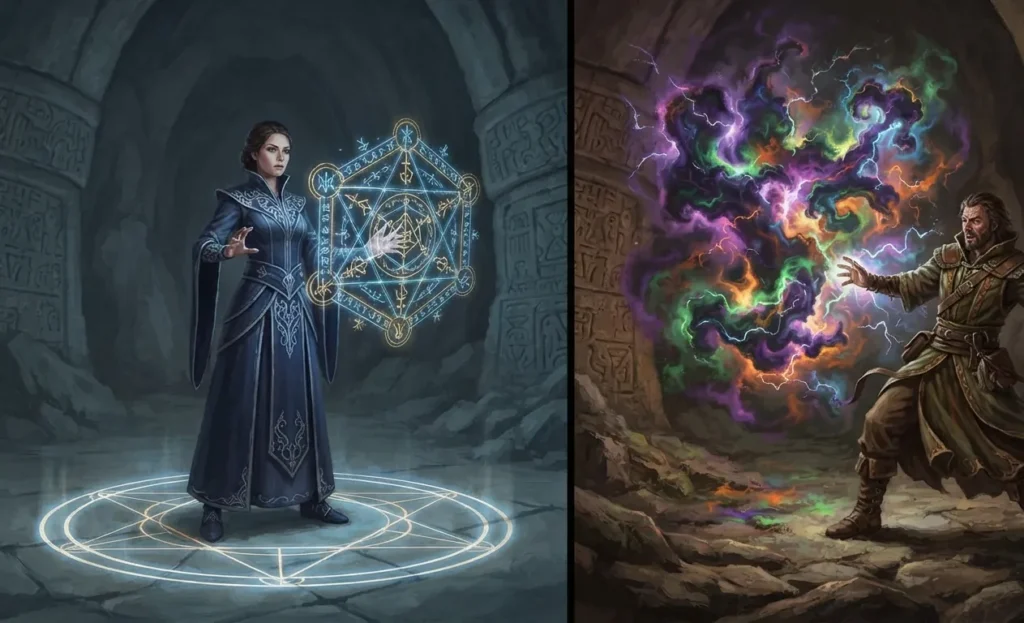
Hard magic systems have explicit, defined rules that are fully available to the reader. The reader knows what the magic can do, what it costs, and what its limits are. Sanderson’s Allomancy (Mistborn), where magic users swallow specific metals to produce specific effects, is the clearest example. Every rule is knowable. Every capability follows from the system. Problems are solved through mastery of understood mechanics.
Soft magic systems are more mysterious. The reader experiences magic’s effects without fully understanding its rules. Tolkien’s magic is the purest example: Gandalf does things, the elves do things, and the reader understands that these things are real and significant without being given a rulebook.
Neither is superior. They serve different narrative functions.
When to Use Which
Hard magic systems work best when the narrative is built around problem-solving. If the protagonist’s challenge is to defeat an antagonist or solve a specific puzzle, and you want the reader to understand that the solution follows from the established rules rather than from author convenience, you need a hard system. The reader needs to be able to see that the solution was available and earned.
Soft magic systems work best when mystery is the point. If the magic represents forces beyond human comprehension, if the wonder of the impossible is more important than the mechanics of it, if you want the magic to feel genuinely numinous rather than like a technology with supernatural properties: that’s the territory of soft magic.
The mistake authors make most consistently is treating their magic system as one type while structuring their narrative as if it were the other. You can’t use soft magic to solve hard problems without the reader feeling cheated, and you can’t use hard magic’s explicit rules to create genuine mystery.
Read: Hard Magic vs Soft Magic: What Every Reader Should Know
The Laws That Actually Work
Sanderson’s First Law
The most influential formulation of magic system principles comes from Brandon Sanderson, whose three laws are worth understanding directly:
First Law: An author’s ability to solve conflict with magic is directly proportional to how well the reader understands said magic.
This is the clearest statement of the hard magic principle I’ve encountered. If the reader doesn’t understand the system, a magical solution to a problem feels like cheating. If they do understand it, a magical solution can be genuinely satisfying because the reader can see that it was earned.
The corollary is equally important: if you’re not building a hard system, keep your magic away from your narrative’s most important problems. Let your soft magic create atmosphere, threat, and wonder, but let your plot problems be solved through character, information, or non-magical means.
Sanderson’s Second Law
Second Law: Limitations are more interesting than powers.
This is the principle that separates good magic systems from spectacular but empty ones. An invincible wizard with unlimited power is less narratively interesting than a wizard who can do extraordinary things but pays a specific cost, or who can accomplish almost anything except the one thing the story requires.
This law is consistently violated one in the genre. Authors fall in love with their magic’s possibilities and forget to build its constraints. The constraints are where the story lives.
Sanderson’s Third Law
Third Law: Expand what you already have before adding something new.
The depth of a magic system is more valuable than its breadth. A magic system with five capabilities that have been thoroughly explored, that have been applied to every narrative situation that the world presents, is more satisfying than a system with fifty capabilities that each appear once and are never developed further.
This principle applies to world-building broadly, not just to magic. A city with a thoroughly developed economic life, a documented religious history, and specific social tensions is more convincing than a map full of named cities that are never more than labels.
Read: High vs Low Fantasy: Why the Distinction Actually Matters
The Cost Principle

Why Magic Needs to Cost Something
The cost principle is the one that most newer fantasy readers haven’t consciously identified but immediately recognize when it’s violated.
If magic is free, it eliminates tension. If a character can do anything with no cost, there are no real stakes. If they can heal any injury, they can’t be harmed. If they can conjure anything, they can’t lack resources. If they can communicate anywhere instantly, distance loses its danger.
The cost is what creates the decisions that produce character. If teleportation costs ten years of the user’s life, then the decision to use it is a character moment. If healing magic consumes the healer’s own vitality, then using it is a sacrifice. The cost is the mechanism through which magic generates moral and dramatic content.
Types of Costs That Work
The most effective magic costs are:
Finite resource costs: The magic draws on something that can run out. Stamina, blood, specific materials, stored energy. The reader tracks the resource alongside the character and feels the tension of depletion.
Consequence costs: Using magic creates specific downstream consequences that must be managed. The town knows a mage has been here. The balance between worlds is disturbed. The user has been changed.
Opportunity costs: Using magic for one thing prevents using it for another. The character must choose which problem to solve magically, and the choice reveals character.
Moral costs: Magic that requires something ethically troubling to access. The decision to use it at all is the character moment.
Read: Why Millennials and Gen Z Love Dark Fantasy
The World-Building Iceberg

What the Author Needs to Know
The world-building iceberg is the principle that authors need to know significantly more about their worlds than they’ll ever put on the page.
This seems counterintuitive. Why build history that never appears? Why develop economic systems that the plot never directly addresses?
The answer is that readers feel depth without being told about it. A tavern scene that exists in a world where the author has thought through the local economy, the regional history, and the cultural practices of the community feels different from a tavern scene in a world where those things haven’t been considered. The characters make different choices. The background details cohere differently. The implicit logic operates at a level readers perceive without identifying.
What Goes on the Page
Very little of the iceberg should appear on the page directly. The author knows it. The reader feels it. They shouldn’t have to read it.
This is where many aspiring fantasy authors make their most consequential mistake: mistaking knowing the world for making the reader know the world. Extended histories, detailed cosmologies, and thorough explanations of how the magic works mechanically don’t produce the experience of a real world. They produce textbooks.
The experience of a real world comes from characters making choices that fit the world’s logic, from details that imply more than they state, and from problems that arise from the world’s specific nature rather than from generic fantasy difficulties.
Read: 15 Best Dragon Books for Adults [Dark & Epic Picks of 2026]
Geography, Ecology, and Economy
The Foundation Nobody Reads About
The deepest layer of fantasy world-building is the one readers are least aware of: geography and ecology.
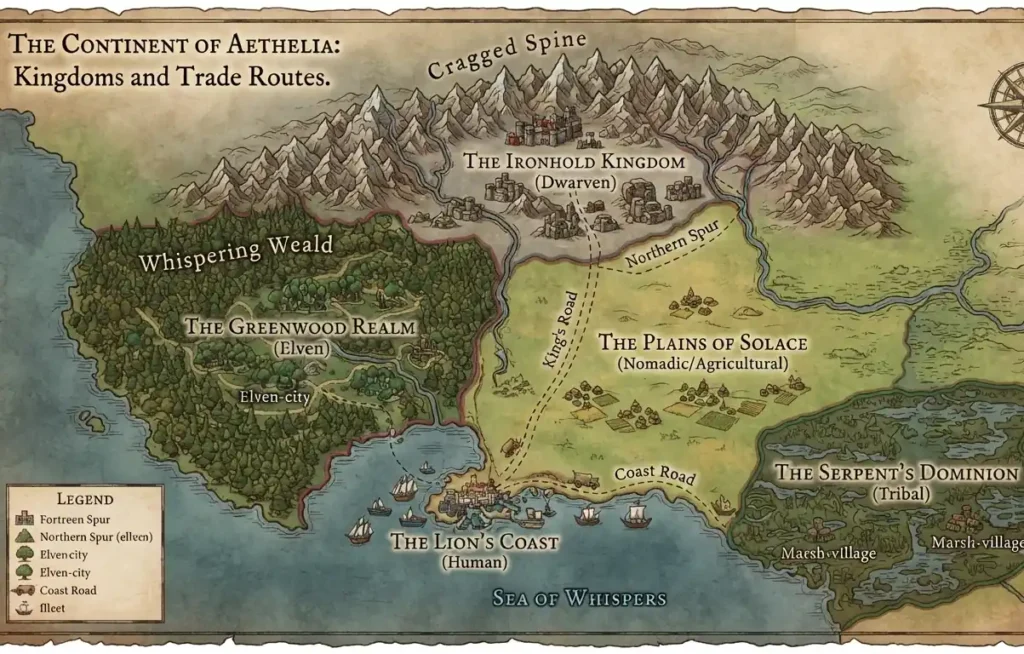
Where a civilization’s food comes from determines almost everything about it. Civilizations that depend on river flooding for agricultural fertility develop different political structures, different religious frameworks, and different relationships with their environment than civilizations that depend on rainfall. Ancient Egypt and ancient Greece are different civilizations partly because the Nile is not the same as the Aegean.
Fantasy worlds that ignore this produce the specific incoherence of a feudal agricultural civilization existing in a geography that would never produce it. The farmland doesn’t match the population density. The trade routes don’t follow water or defensible terrain. The economy doesn’t reflect the resource distribution.
Read: How Fantasy Geography Shapes Kingdoms & Their Politics
How Magic Changes Everything
If magic exists in a world, it changes the economy.
This is the principle most fantasy worlds get wrong. A magic that can produce unlimited water changes where civilization is possible. A magic that can heal injuries changes the military calculus entirely. A magic that can communicate across distance changes how trade and politics function. Ignoring these changes doesn’t make the magic feel more mysterious. It makes the world feel unreal.
The best fantasy worlds have worked through these implications. Sanderson’s Stormlight Archive has an ecology built around the periodic storms that define the world’s weather and resource distribution. Tolkien’s Shire is an agricultural community whose specific character reflects the specific geography it inhabits. The magic in both settings has consequences for the worlds that contain it.
Read: Why Dragons Dominate Every Fantasy Tradition on Earth
History, Mythology, and the Weight of the Past

Why the Past Matters
Fantasy worlds feel thin when they begin where the story begins. The sense that things happened before the story started, that the ruins mean something, that the current political arrangements reflect older conflicts: this is what the mythology layer provides.
The mythology layer doesn’t need to be explicit. Characters don’t need to recite histories. But the history needs to exist, and the present world needs to make sense as a consequence of it.
When a character passes a ruin and doesn’t know or care what it is, the ruin feels like decoration. When a character passes a ruin and the specific way they react, whether they avert their eyes or touch it reverently or spit on it, tells you something about who they are and what the ruin means in this world, the ruin becomes world-building.
Mythology as World Logic
The mythologies that underlie fantasy worlds are the most interesting layer of world-building because they encode the world’s deepest assumptions about reality.
A world whose mythology describes creation as an act of violence (the world made from the body of a slain divine being) will develop differently from a world whose mythology describes creation as an act of love or an act of accident. These mythological foundations shape how communities understand themselves, how they relate to power, and what they think the cosmos expects of them.
Fantasy worlds whose mythologies are coherent with the rest of their world-building produce the deepest immersion.
Read: 13 Overlooked Dragon Books Worth Reading in 2026
The Consistency Test

How Readers Detect Failures
Readers are remarkably good at detecting world-building failures even when they can’t articulate what’s wrong. The feeling of “the magic got the protagonist out of trouble too conveniently” or “that culture doesn’t make sense” is often accurate even when the reader doesn’t know enough about the world to specify the failure.
This happens because readers read fictional worlds the way they read real social situations: by pattern recognition. We learn to predict how worlds work through the patterns they establish, and when a world violates its own patterns, we feel it before we name it.
The consistency test is simply: does every element of this world follow from the same set of underlying principles? If yes, readers will feel the world as real even if its content is completely impossible. If no, they’ll feel it as false even if its content is relatively mundane.
The Magic Solution Problem
The most common consistency failure in fantasy is the magic solution problem: the protagonist uses a magical capability to solve a plot problem in a way that the established rules don’t clearly permit.
Every reader has encountered this. The mage suddenly does something that hasn’t been established as possible. The magical item whose limitations were described carefully in chapter two is used in a way that exceeds those limitations in chapter eighteen.
The solution isn’t to avoid magic solutions. It’s to either establish the capability before you need it (plant it before you use it) or to pay the cost explicitly enough that the reader accepts the exception as a genuine sacrifice rather than a cheat.
Frequently Asked Questions
Do all fantasy worlds need a hard magic system?
No. Hard and soft magic systems serve different narrative purposes. You need a hard system when magic solves your plot’s core problems. Soft magic works better when magic creates atmosphere, threat, or wonder without being the mechanism through which problems are resolved. Many excellent fantasy worlds combine both for different types of magical content.
How much world-building detail should actually appear in the text?
Very little of your total world-building should appear on the page. The author needs to know significantly more than readers ever read. What should appear is the minimum needed to make the world’s logic feel coherent and to make characters’ choices make sense within it. Extended info-dumps don’t create immersion; they interrupt it.
Why do some magic systems feel boring even when they’re complex?
Usually because the complexity is in capabilities rather than constraints. A magic system with fifty different powers but no meaningful limits doesn’t create interesting decisions because the character can always reach for another power. Complexity in constraints, in what the magic can’t do and what it costs, creates the interesting decisions that make magic narratively exciting.
Does magic need to be scientifically explainable to feel consistent?
No. Consistency and scientific plausibility are completely different criteria. Tolkien’s magic has no scientific explanation and is entirely consistent. The consistency requirement is internal: the magic follows the same rules throughout. Scientific explainability is optional and often actively harmful, since it can eliminate the sense of the genuinely miraculous.
How do Eastern cultivation fantasy worlds handle world-building differently?
Cultivation worlds typically have more explicit power hierarchies and more detailed progression systems than Western epic fantasy. The world-building is often cosmological in scale, with multiple realms and specifically tiered reality levels that reflect Daoist and Buddhist cosmological frameworks. The magic system is typically harder than most Western fantasy, with explicit stages and measurable advancement, while the world’s mythological layer is drawn from real Chinese religious tradition.
Final Thoughts
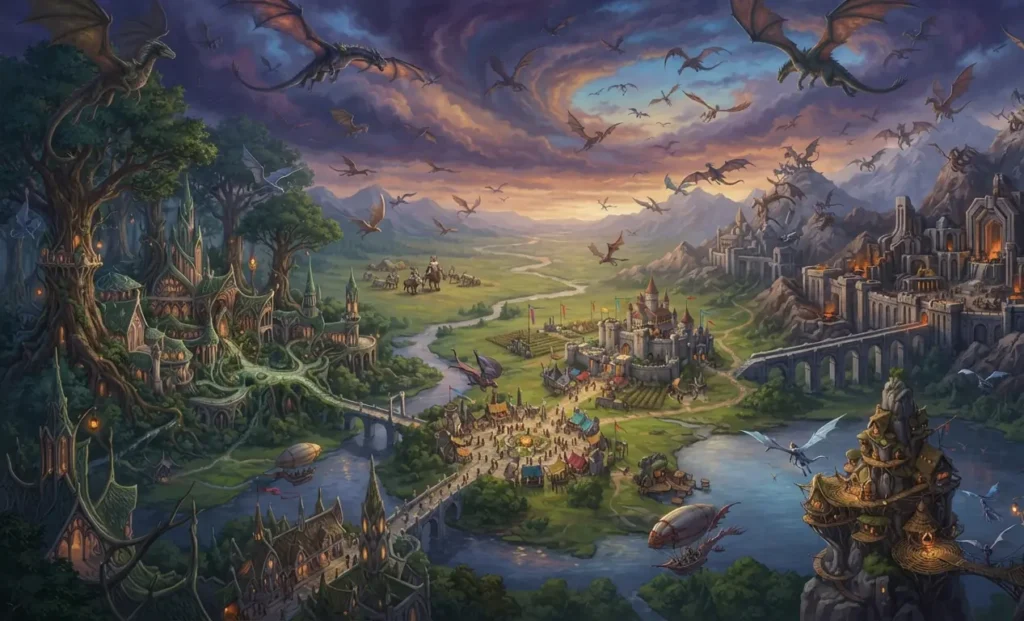
Fantasy worlds work through the same principle that all compelling fiction works through: the reader must be able to trust the logic.
In realistic fiction, that logic is the logic of human psychology and social reality. In fantasy, it’s the logic of the world’s internal rules. Both types of fiction ask the reader to believe that things happen because they follow from what’s been established, not because the author needed them to happen.
The magic systems, the geography, the history, the economics, the mythology: all of these are elements of a world’s internal logic. When they cohere with each other, when the magic has changed the economy in ways that the economy reflects, when the mythology explains the architecture, when the political arrangements follow from the history, the world feels real.
Not realistic. Real. There’s a difference, and the difference is everything.
Further Reading & References
- Rhetorics of Fantasy – Wesleyan University Press
- The Encyclopedia of Fantasy – John Grant, John Clute
- Strategies of Fantasy – Attebery, Brian
- The Hero with a Thousand Faces – Joseph Campbell
- Tolkien – On Fairy-Stories
- Ursula K. Le Guin – The Language of the Night
- Sanderson’s First Law – Brandon Sanderson
- Sanderson’s Second Law – Brandon Sanderson
- Sanderson’s Third Law of Magic – Brandon Sanderson
Related Articles
- 12 Best Cultivation Novels [Ranked by Genre Fans]
- 9 Best Progression Fantasy Books 2026 [Ranked List]
- What Is Fantasy? Do Cultivation Novels Actually Qualify?
- Why Fantasy Is Growing Faster Than Any Other Genre [2026]
- 15 Most Iconic Fantasy Creatures: East & West Mythology
- How to Build a Dark Fantasy World That Actually Disturbs
- 9 Dark Fantasy Creatures That Turn Familiar Into Fear
- How Great Fantasy Writers Adapt Mythology Without Stealing
Written by Batin Khan, a curious free spirit who loves reading and exploring the worlds of fantasy, mythology, and ancient stories. Through this blog, Batin hopes to share that sense of wonder with readers while building an exciting future along the way.