

 By
Quick Takeaways:
- “Goddess of love” is a fair shorthand, but the Greek sources describe something closer to desire as a force that acts on you whether you agree or not.
- Her cult titles include war, sea voyages, civic unity, and the night. A purely romantic reading leaves out most of her worship.
- Her oldest roots probably run through Cyprus and the Near East, not Olympus.
- I’ll offer a unifying idea, joining, and I’ll flag it as my own interpretation rather than ancient doctrine.
I’ve always found it odd that the most recognizable thing about Aphrodite is the thing the sources describe least gently. Pick up the Iliad and look at what she actually does to people. Almost none of it resembles a greeting card.
So the title’s question is a real one. Was she the goddess of love, or is that a label we’ve stuck on a much stranger figure?
First, the Word Problem
Greek Has Many Words for Love
English uses love for everything from romance to pizza. Greek split the territory. Eros is sexual desire, himeros is longing, pothos is the ache for someone absent, and philia is the affection of friends.
Aphrodite’s retinue in Hesiod includes Eros and Himeros. Her domain is the first cluster, the wanting, and not the second, the caring. That’s a narrower job than the English phrase suggests.
Hesiod’s Pun
In the Theogony, Hesiod explains her epithet philommeides by a wordplay. He says she is “genital loving” because she emerged from the severed genitals of Ouranos. Later tradition softened the word into “smile loving” or “laughter loving.”
I like that detail because it shows how earthy the early picture was. The goddess of love begins life as a goddess of bodies.
What Her Power Actually Does
The Girdle in Iliad 14
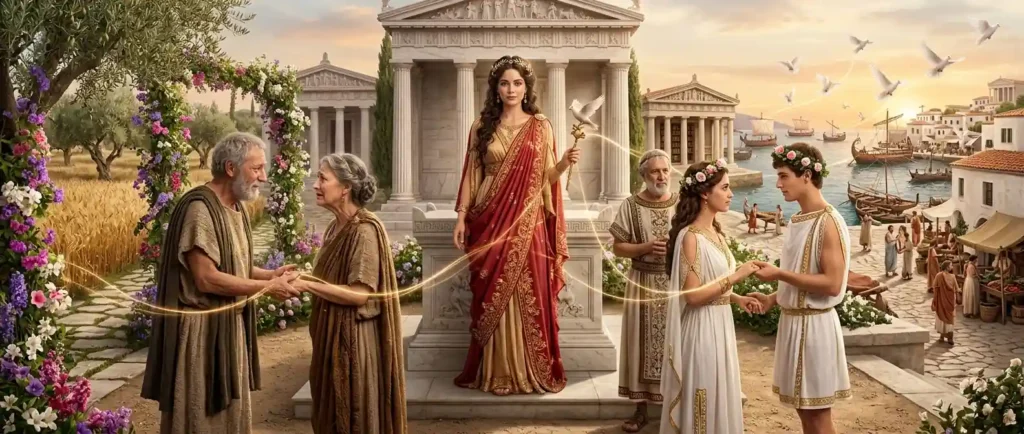
In Iliad Book 14, Hera borrows Aphrodite’s embroidered band, the kestos himas, to seduce Zeus. Homer lists what’s woven into it: love, desire, intimate talk, and persuasion that steals the wits even of the wise.
Notice the last item. This isn’t a gift of happiness. It’s a tool that overrides judgment, and Hera uses it on her husband in order to distract him from the war.
Helen Doesn’t Get a Vote
In Iliad Book 3, Aphrodite, disguised as an old woman, summons Helen to Paris’s bed. Helen recognizes her and objects angrily. Aphrodite threatens her, and Helen, frightened, goes.
That’s the clearest scene I know of what the Greeks meant by the goddess’s power. It’s compulsion with a pleasant face, and the poem doesn’t pretend otherwise.
Hippolytus Refuses Her
Euripides’ Hippolytus opens with Aphrodite herself explaining her plan. She says she rewards those who honor her and tramples the proud, and she’s furious that Hippolytus worships only Artemis.
Her revenge destroys Phaedra and Hippolytus both. In the play, love is not a blessing you earn. It’s a force that punishes people for ignoring it.
Born Twice, and Not Really in Greece

Two Births, Two Aphrodites
Hesiod has her born from the foam, aphros, after Cronus castrated Ouranos. Homer makes her the daughter of Zeus and Dione. Plato’s Symposium turns that contradiction into a doctrine.
In Pausanias’s speech there, Aphrodite Ourania, the heavenly one, is the older, motherless goddess who inspires spiritual love. Aphrodite Pandemos, of all the people, inspires common physical love. By Plato’s day, philosophers were separating the two, though the cults themselves didn’t clearly do so.
The Foam Etymology Is Probably Folk Wisdom
The Greeks themselves explained her name from aphros, foam. Modern scholars don’t trust that. Attempts to derive the name from the Semitic Ashtoret remain inconclusive, according to the reference works I checked.
I’d hold both ideas loosely. The foam story is ancient, charming, and almost certainly an after the fact explanation.
The Trail Leads East
Herodotus says the oldest temple of Aphrodite Ourania stood at Ascalon in Syria, and that the Cypriot temple derived from it through the Phoenicians. Pausanias gives a similar chain, naming the Assyrians first, then Cyprus, then Ascalon, with the cult carried on to Cythera.
Walter Burkert and others have argued that Aphrodite is largely a Near Eastern import, tied to Inanna and Ishtar. The epithet Ourania, heavenly, resembles Inanna as Queen of Heaven, which fits that picture.
The Armed Aphrodite
Sparta, Cythera, and Corinth
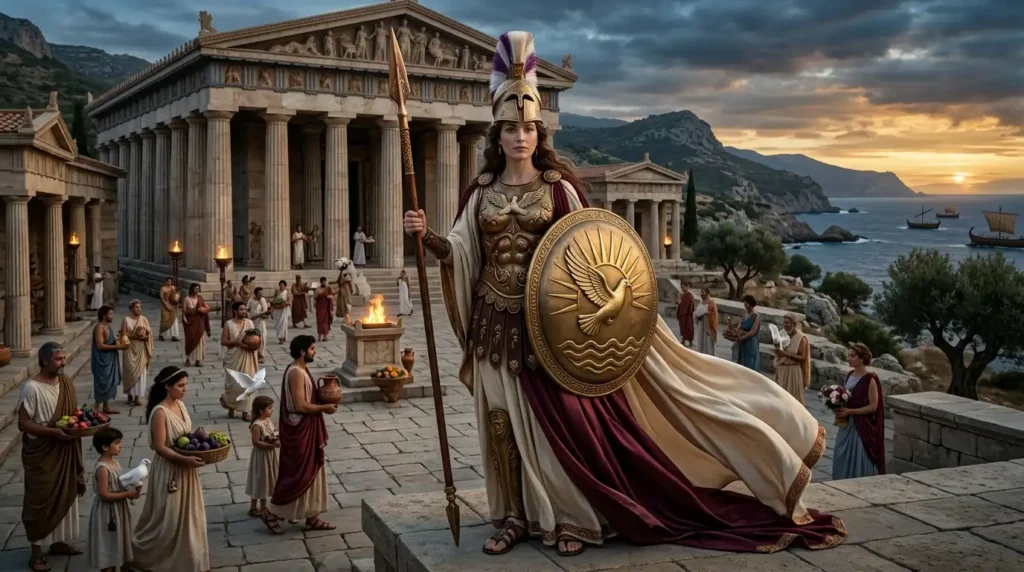
This is the part that surprises people. Pausanias records cult statues of Aphrodite holding weapons at Cythera, Sparta, and Corinth. In Sparta he describes two temples of Aphrodite Areia, the warlike.
Cyprus had an Aphrodite Encheios, with a spear, and some scholars suggest the Spartan cult came from there. There were warlike cults in Argos and Taras as well.
Homer Disagrees With His Own Audience
In Iliad Book 5, Diomedes wounds Aphrodite and she flees to Olympus. Zeus tells her war isn’t her business. She should concern herself with the works of marriage and leave fighting to Ares and Athena.
That’s Homer drawing a boundary. The cults, centuries later in places like Sparta, didn’t observe it. I read this as the epic’s neat division of labor colliding with local religious practice.
Sappho Asks for an Ally
In her famous poem, Sappho prays to Aphrodite for help in winning a reluctant beloved. The final line asks the goddess to be her ally, using a word that ordinarily means a fellow fighter in war.
I’m working from translations here, so check the Greek if you can. The language is playful, but it shows that even love poetry reached for a war metaphor when addressing her.
A Goddess of Cities
Theseus Builds Her a Cult
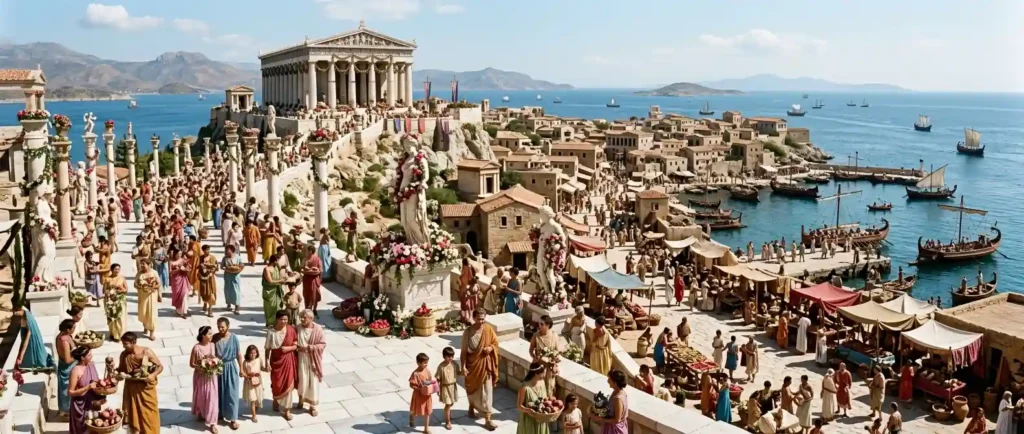
Pausanias, and Plutarch in his Life of Theseus, report that when Theseus united the Athenian demes into a single state, he established the cults of Aphrodite Pandemos and Peitho, Persuasion.
Read with the Greek in mind, Pandemos means of all the people. The goddess who draws lovers together is also credited with drawing a city together, and Persuasion stands beside her.
A Reading Worth Weighing
This changes how the title Pandemos looks. Later writers, including Plato’s speakers, treated it as vulgar love. The Athenian story attaches it to political unity.
I wouldn’t push this too hard, because the reports come from authors writing centuries after Theseus is supposed to have lived. They’re still evidence of how Greeks connected her to civic life.
The Sea, and the Night

She Helps Ships
Her epithets include Pontia, of the deep sea, and Euploia, of the fair voyage. Sailors honored her for safe crossings, which fits a goddess born from the sea near Cythera and Cyprus.
Two of the main centers of her cult were islands. Seafaring was how her worship moved around the Mediterranean in the first place.
The Black One
Pausanias reports a cult title Melainis, the Black One. His explanation is practical: unlike animals, people mostly make love at night.
I find that the most honest epithet on the list. It doesn’t romanticize anything, and it ties her to the dark, to appetite, and to secrecy.
My Reading: She Governs Joining
The Pattern I See
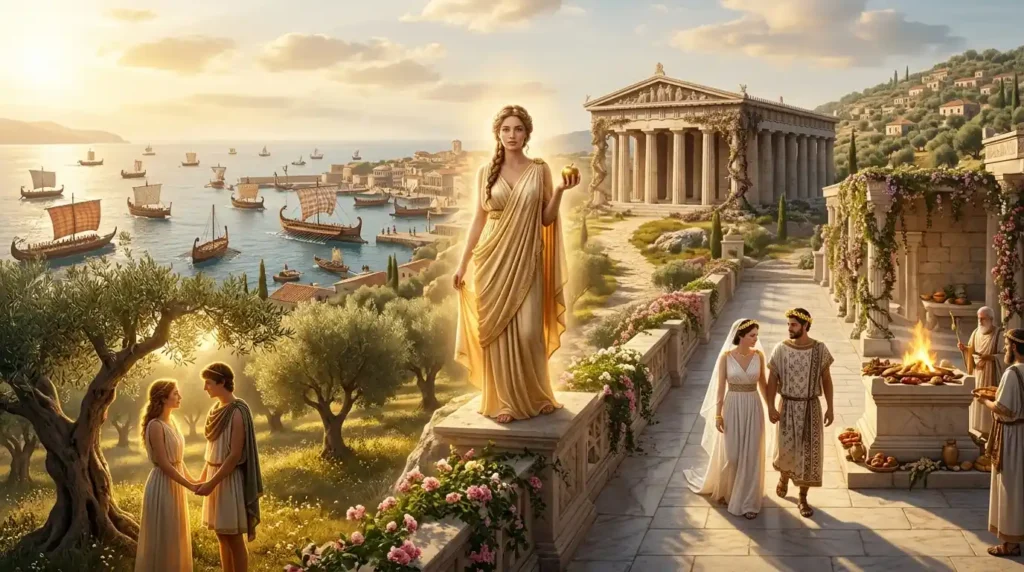
Put the evidence together. The girdle binds. Pandemos and Peitho join demes into a city. Euploia brings ships to harbor. Her union with a lover joins two bodies, and even her war aspect can be read as binding men into a unit.
My synthesis is that Aphrodite presides over whatever draws separate things into a pairing or a group. Love, in the English sense, is one case of that.
Why It Helps
It explains why one goddess shows up in bedrooms, harbors, and assemblies. It also explains why the Greeks feared her, because anything that joins can also drag you somewhere you didn’t plan to go.
I want to be clear that this is my interpretation. No ancient source states it, and I wouldn’t ask you to treat it as doctrine.
The Label Isn’t Wrong
I’ve spent most of this article taking the neat phrase apart, but it would be unfair to say it fails. Homer’s lovers, Sappho’s poems, and the Hellenistic and Roman traditions all fit it.
The simple reading captures what most Greeks and Romans pictured when they said her name. Mine is a way of explaining the leftovers.
The Evidence Is Uneven
Many of the cult details come from Pausanias in the second century CE, and the long lists of epithets circulate in modern compilations of varying quality. A few titles, such as the darker ones, rest on a single mention.
Some of the military and civic readings could reflect local habits or later reinterpretation. I’d trust the Spartan armed statues and the Pandemos reports more than the longer epithet lists.
The Sacred Prostitution Claim
You’ll often read that her temples, especially at Corinth, were staffed by sacred prostitutes. Strabo reports something like it, but Stephanie Budin’s book The Myth of Sacred Prostitution in Antiquity argues that the idea is largely a later construction.
I’d treat the claim as disputed rather than established. It’s a good example of how modern readers fill in a love goddess’s cult with what they expect to find.
What I Take From All This
Aphrodite is less a patron of romance than the Greek name for a force nobody can fully refuse. It binds lovers, cities, and sailors to their harbors, and it overrules gods when it wants to.
Calling her the goddess of love isn’t a mistake. It just compresses a larger job description into the one part we find most comfortable.
Frequently Asked Questions
How did Rome’s Venus differ?
Venus kept Aphrodite’s myths but gained a political role. Julius Caesar dedicated a temple to Venus Genetrix in 46 BCE, claiming descent from her through Aeneas, which made the goddess an ancestor of the ruling family.
What is the story of Aphrodite and Adonis?
Adonis is a beautiful youth she loves who dies young, often killed by a boar. His name likely comes from a Semitic word for lord. The Athenian Adonia festival featured women growing quick withering gardens on rooftops.
Did Aphrodite have mortal lovers other than Adonis?
Yes. The Homeric Hymn to Aphrodite tells how Zeus makes her fall for the Trojan Anchises, and their son is Aeneas. She conceals her identity at first, and the hymn shows even the goddess of desire being subject to it.
What does Anadyomene mean?
It means rising from the sea. It was the title of a famous lost painting by Apelles showing her wringing out her hair as she emerges from the water, and it inspired many later depictions of her birth.
Which animals and plants were associated with her?
Doves, sparrows, and swans appear in her imagery, with myrtle and roses among her plants. The pairings are conventional and vary by region, so treat any single symbol as a tendency rather than a rule.
Final Thoughts

The more I read the sources, the less Aphrodite looks like a gentle patron and the more she looks like the Greeks’ honest name for something unavoidable. Helen found it out in Book 3, and Hippolytus found it out the hard way.
Maybe that’s why the title question stays interesting. She was a goddess of love, and she was also something harder to love.
Related Articles
- Chaos: The Primordial Void Before the Greek Gods
- The 12 Olympian Gods: Powers, Symbols & Key Stories
- Greek Mythology 101: Gods, Heroes & Monsters
- 13 Legendary Greek Heroes, Ranked by Their Feats
- Gaia: Greek Mythology’s Original Mother Goddess
- Rhea: The Titaness Who Tricked a God-Eating Titan
Written by Batin Khan, a curious free spirit who loves reading and exploring the worlds of fantasy, mythology, and ancient stories. Through this blog, Batin hopes to share that sense of wonder with readers while building an exciting future along the way.