
 By
By Quick Takeaways:
- Fantasy geography doesn’t just decorate a fantasy map. In real history, it directly determined whether a region became a unified empire or a cluster of competing city-states, and the best fantasy worlds apply that same causal logic instead of just drawing pretty coastlines
- Mountainous terrain tends to fragment political power into smaller, competing units. Open river valleys tend to concentrate it into large, centralized ones
- A contested academic theory, the hydraulic empire thesis, argues that managing large scale water infrastructure specifically required the kind of centralized bureaucracy that produced China’s early imperial state
- Chokepoints, mountain passes, river fords, narrow straits, generate wealth and political leverage completely disproportionate to their size, in both real history and fantasy
- A handful of fantasy authors get this right by working backward from terrain to politics rather than forward from plot needs to a convenient map
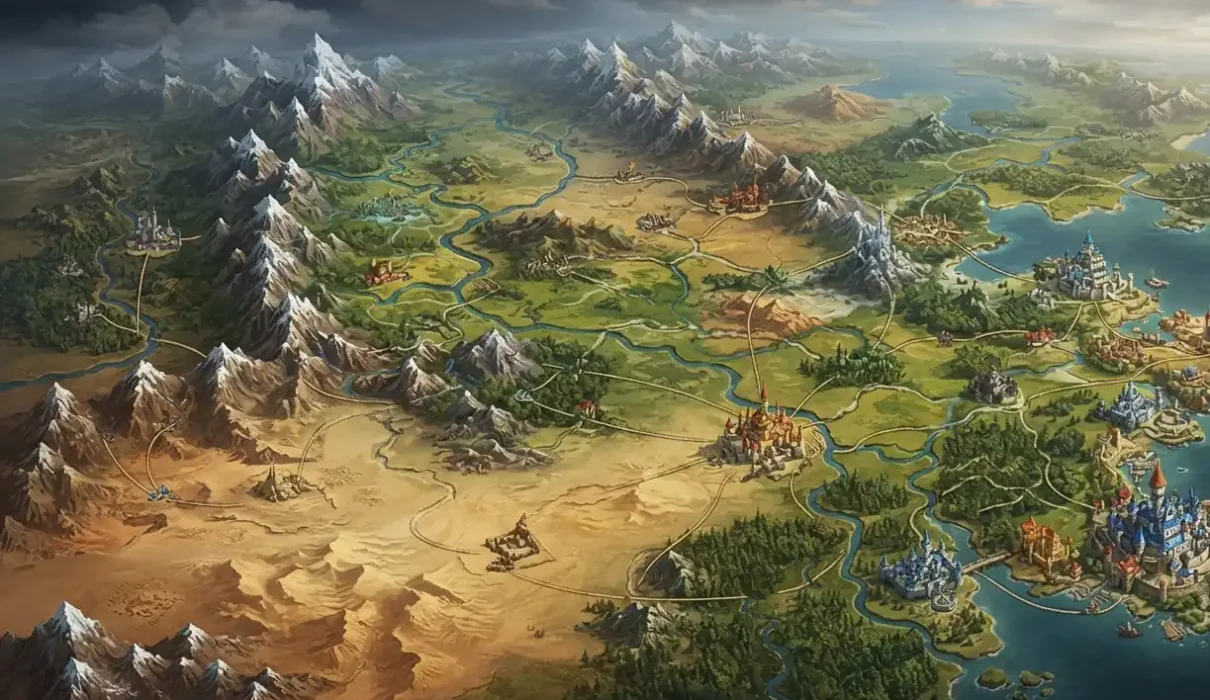
I’ve spent enough time with both history and fantasy to notice a pattern that most worldbuilding advice skips entirely. Real kingdoms didn’t get their political shape from the personalities of their kings. They got it from whether their territory was crossed by defensible mountains, a single life giving river, or open, indefensible plains, long before any specific ruler was born into the situation that terrain had already set up for them.
Fantasy worlds that understand this causal chain feel solid in a way that fantasy worlds with a gorgeous map and an arbitrary political system simply don’t.
Mountains Divide Power
The Real Life Example
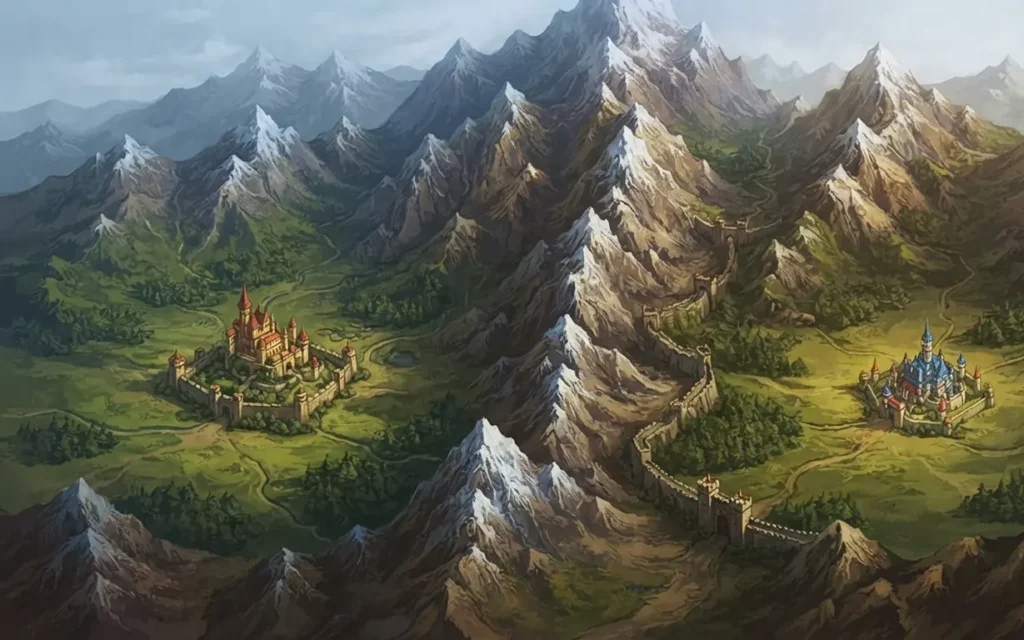
Classical Greece never unified into a single lasting empire the way its neighboring civilizations often did, and its terrain is a large part of why. The Greek mainland is cut into small, isolated pockets of arable land by mountain ranges running in almost every direction, which made projecting centralized military and administrative control across the whole region incredibly difficult using ancient logistics.
What that terrain produced instead was the polis, dozens of fiercely independent city states, each defensible in its own valley, each developing its own political character, from Athens’s democracy to Sparta’s military oligarchy, without any single power easily conquering and holding the rest.
The mountains didn’t cause democracy specifically. They caused fragmentation, and fragmentation created the competitive space where different political experiments could survive side by side long enough to matter.
How Fantasy Adapt This
Guy Gavriel Kay’s Tigana borrows exactly this mechanism rather than borrowing Renaissance Italy’s costumes. The Palm is a peninsula of proud, independent city-states specifically because its terrain and its historical development never allowed one power to swallow the rest cleanly, which is precisely why a foreign conqueror can exploit the fragmentation, playing cities against each other, in a way he couldn’t manage against a single unified kingdom.
That’s terrain doing real narrative work rather than sitting in the background as scenery. The fragmentation isn’t a plot convenience the author needed. It’s the logical output of the map he built first.
Rivers Gathers Power Around It
The Nile Case
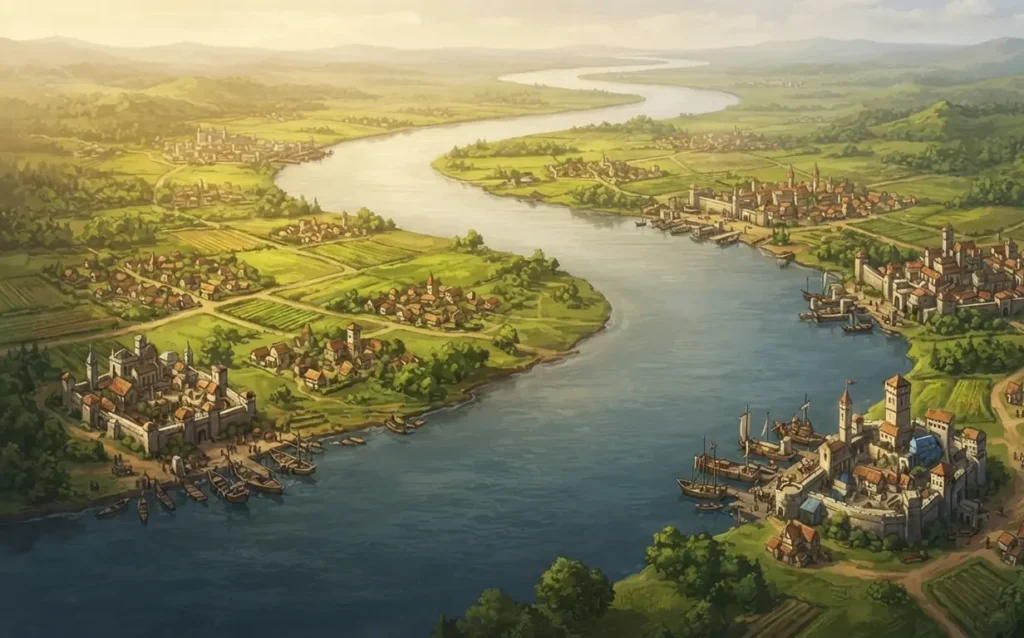
Egypt presents almost the exact opposite case. The Nile runs through an otherwise uninhabitable desert, creating a single narrow corridor of fertile land that’s remarkably easy to survey, tax, and administer from one central point, precisely because there’s essentially only one place people can actually live.
That geographic simplicity is a major reason Egypt maintained one of history’s most durable centralized states, under the authority of a single pharaoh, for an extraordinarily long stretch of ancient history.
Compare this to Mesopotamia, sitting between the Tigris and Euphrates, whose more unpredictable flooding and more complex dual river geography initially produced competing city-states, Ur, Uruk, Lagash, before centralization eventually caught up through different means. Same broad river valley civilization type. Different starting political geometry and different early political outcomes.
A Real but Debated Theory Worth Knowing
Historian Karl Wittfogel proposed a specific and influential, though contested, theory sometimes called the hydraulic empire thesis, arguing that large scale irrigation and flood control projects, the kind needed along rivers like China’s Yellow River, required a centralized bureaucratic authority capable of coordinating labor and resources at a scale ordinary local governance couldn’t manage, and that this administrative necessity is what produced early centralized imperial states in the first place.
I want to be honest that many historians have pushed back on Wittfogel’s thesis as too deterministic, and it shouldn’t be treated as settled fact.
But the underlying observation, that managing a river’s flooding at scale created genuine pressure toward centralized coordination, connects directly to the legendary flood tamer Yu the Great, whose success specifically at channeling the Yellow River’s floods is treated in Chinese mythology as the founding act that earned him the right to establish the Xia dynasty.
The Fantasy Application
Fantasy worlds set in river valley civilizations should genuinely ask themselves whether their central government’s legitimacy connects back to managing water.
A kingdom built along one dominant river has a natural, causally sound reason to centralize administration around whoever controls the irrigation, the flood barriers, or the grain transport that river makes possible, exactly the way Yu’s flood taming became the mythological justification for his entire dynasty’s founding legitimacy.
Chokepoints Generate Disproportionate Wealth
The Real World Scene
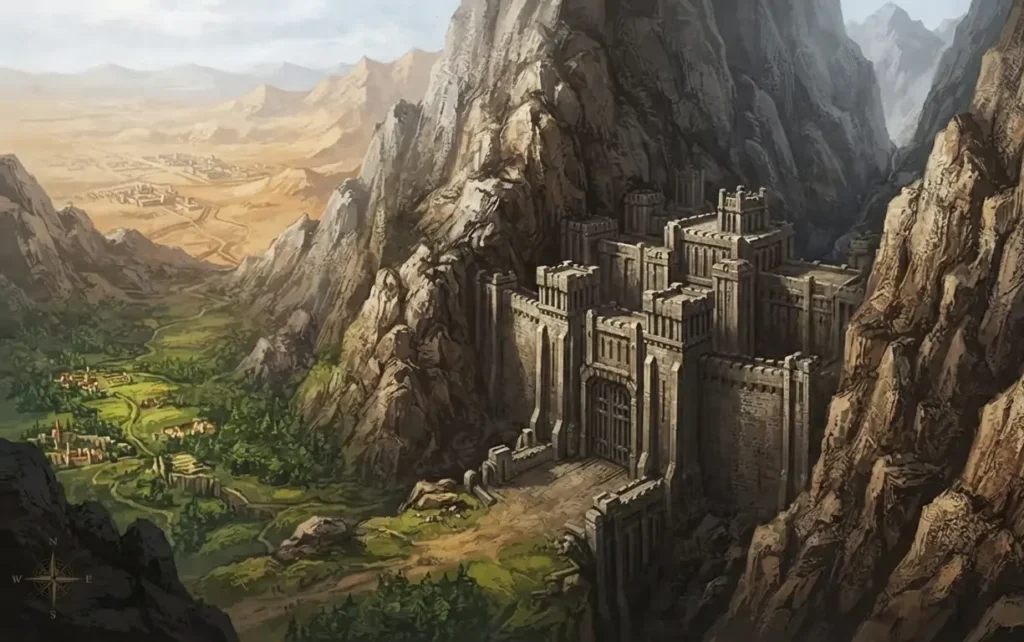
Some of history’s most politically significant cities became powerful not because of large territory or population, but because of position. Constantinople controlled the Bosphorus Strait, the narrow water passage connecting the Black Sea to the Mediterranean, meaning virtually all trade moving between those two economic worlds had to pass directly through and pay for the privilege of doing so.
Venice built an entire maritime empire on a similar logic, controlling key Adriatic trade routes and using that leverage to extract wealth and influence completely disproportionate to its small physical territory. Neither city was rich because of what it produced internally. Both were rich because of what they controlled the movement of.
I do not know when you are reading this article, but there is a modern example that illustrates the same principle. Consider the Strait of Hormuz. Iran sits astride one of the world’s most strategically important maritime chokepoints, where a significant share of global oil exports passes each day. That position gives Iran geopolitical influence far beyond what the narrow waterway itself might suggest.
The possibility of disruption can affect global energy prices, shipping costs, and international diplomacy. Like Constantinople and Venice before it, and Iran in its ongoing war doing just that. The value lies not in the strait itself, but in controlling a route that others depend on.
How It Works In Fantasy
This is one of the easiest and most underused tools available to fantasy worldbuilders. A city sitting at a mountain pass, a river ford, or a narrow strait between two larger powers doesn’t need a large population or fertile farmland to justify enormous political relevance.
It needs control over movement, and that control alone explains why smaller powers can punch dramatically above their apparent weight in your world’s actual politics, exactly the way small Venice once outmaneuvered considerably larger rivals through position rather than raw size.
Open Plains Produce a Different Kind of Politics Entirely
The Real Pattern
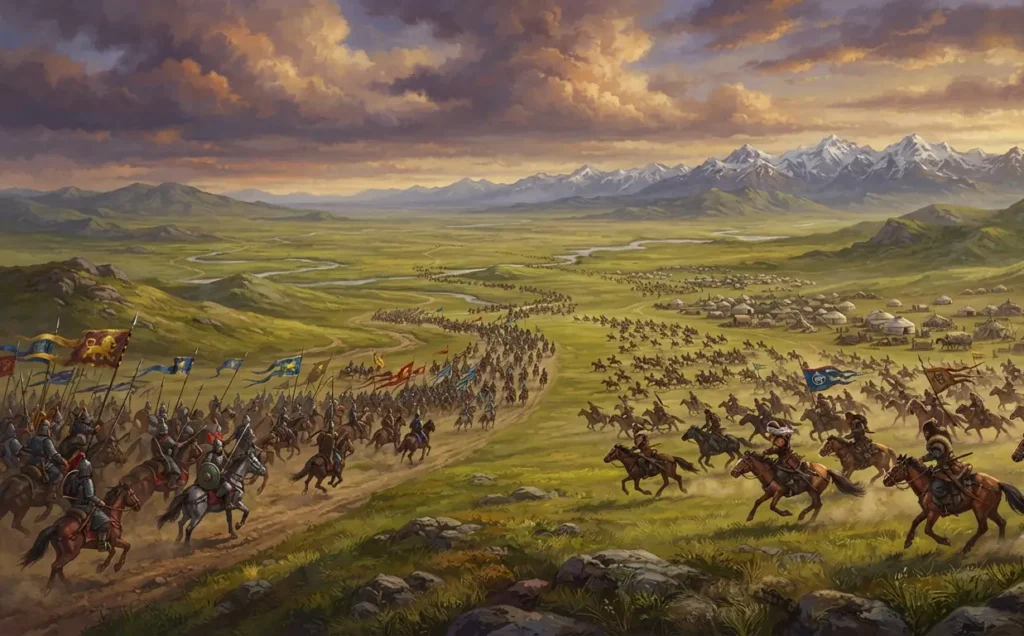
The Eurasian steppe, vast, relatively resource poor grassland stretching from Manchuria to Hungary, produced a distinct political pattern from settled agricultural civilizations.
Its terrain rewarded mobility, herding, and cavalry warfare rather than fixed settlement, and its confederations, the Xiongnu, later the Mongols under Genghis Khan, could unify enormous territories rapidly under a single charismatic leader precisely because the flat, open terrain made fast, coordinated movement across huge distances really possible in a way mountainous terrain never allows.
Settled agricultural civilizations facing these confederations, China chief among them, responded with a completely different political toolkit, walls, granaries, static administrative structures, built for defending fixed, valuable farmland rather than for the fast, mobile warfare the steppe rewarded.
Two entirely different political logics, produced directly by two entirely different terrains sitting next to each other.
The Fantasy Application
George R.R. Martin’s Dothraki, though drawn with real limitations worth acknowledging honestly, are structurally doing something recognizable here: a mobile, horse-based confederation whose political organization around a single dominant khal mirrors the same terrain driven logic.
Robert Jordan’s Aiel, a warrior people shaped entirely by the brutal scarcity of the Aiel Waste, develop an equally terrain determined social code, one built around water rights, honor, and a specific relationship to violence that makes complete sense once you understand the desert that produced it.
Tolkien’s Riders of Rohan works the same angle from the settled agricultural side, a horse culture occupying open grassland, its entire military identity built around cavalry precisely because its terrain rewards exactly that kind of mobility, in direct contrast to Gondor’s more static, river and coastal, bureaucratic kingdom sitting right beside it.
Climate as the Ultimate Reshaper
When Weather Itself Becomes the Terrain
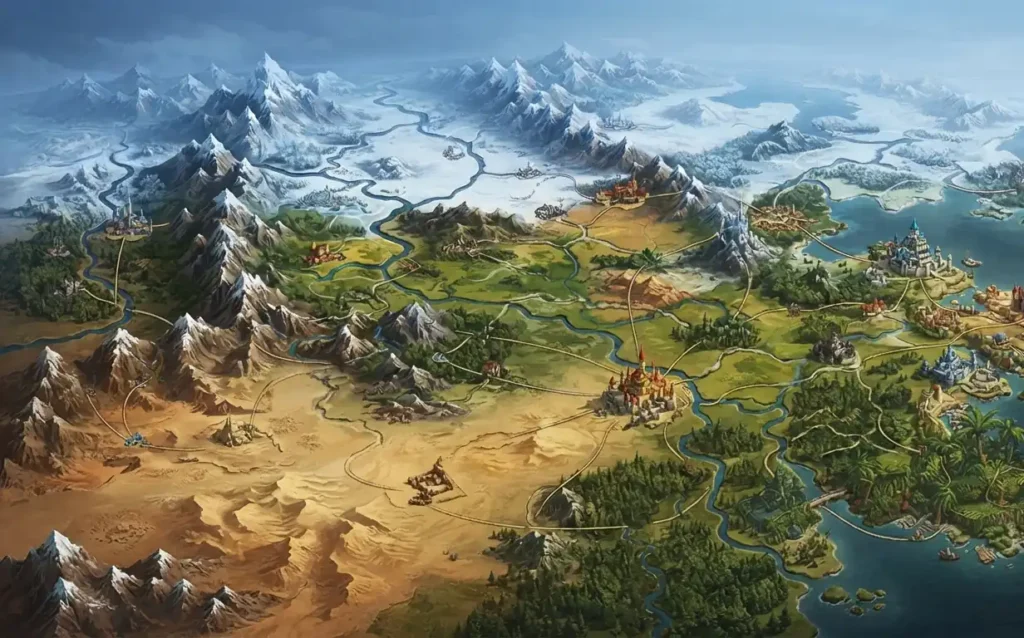
The clearest and most ambitious modern example of this whole principle taken to its logical extreme is Brandon Sanderson’s Stormlight Archive. The world of Roshar is periodically struck by highstorms, catastrophic weather events powerful enough to have reshaped the planet’s entire ecology and architecture across its history.
Buildings are built with rounded, leeward facing sides specifically to survive the storms. Plants retract into shells at the first sign of wind. Crustacean like creatures replace the insects and larger land animals a storm this frequent simply wouldn’t allow to evolve.
Political structure follows directly from this same climate logic. The Alethi warcamps are positioned with specific attention to storm direction. Settlement patterns, agricultural practices, and even the specific magic system tied to storm generated Stormlight are all direct downstream consequences of a single climate fact repeating on a predictable cycle.
Why This Example Matters
I bring this up specifically because it shows the principle taken all the way to its conclusion rather than applied halfway. Sanderson didn’t invent a magic system and then decorate a world around it. He established a climate fact first and then worked out, with real rigor, everything that fact should logically produce, biology, architecture, agriculture, and eventually the political and military structures built on top of all three.
That’s geography shaping politics through several layers of causation rather than a single direct line, and it’s exactly the kind of depth that separates a world that feels engineered from one that feels discovered.
The Practical Exercise

Work Backward From Your Map
If you’re building or evaluating a fantasy kingdom’s politics, here’s the actual exercise worth running. Look at your map before you look at your government. Ask whether the terrain is fragmented by mountains or open across plains, whether a single river dominates the territory or several competing water sources divide it, and whether any position on the map controls a true chokepoint other regions need to pass through.
Then ask honestly whether your kingdom’s actual political structure, centralized or fragmented, monarchic or confederated, follows logically from those terrain facts, or whether you simply invented the government you wanted and drew a map to match it afterward. The second approach is exactly backward from how this causation actually runs in real history, and readers, even ones who can’t articulate why, tend to feel the difference.
What to Do When the Answer Doesn’t Fit
If your terrain and your intended politics truly don’t match, that’s not necessarily a problem to fix by changing your map. It’s an opportunity to ask what specific historical event, a conqueror’s unusual innovation, a magical technology overriding normal logistics, a religious institution imposing unity from outside terrain’s usual constraints, explains the mismatch.
That explanation itself becomes some of your best worldbuilding, because it’s answering a question the terrain honestly raised rather than papering over one.
Quick Reference Table
| Terrain Type | Real World Example | Typical Political Pattern | Fantasy Example |
|---|---|---|---|
| Fragmented mountains | Classical Greece | Competing city states | Tigana’s Palm |
| Single dominant river | Ancient Egypt | Durable centralized state | Yu the Great and the Yellow River tradition |
| Chokepoint or strait | Constantinople, Venice | Disproportionate wealth and leverage | Small ports controlling key passes |
| Open plains or steppe | Mongol confederations | Mobile, rapidly unifying warrior states | Rohan, the Aiel Waste |
| Extreme, reshaping climate | No direct real world equivalent at this scale | Entire civilization built around one recurring event | The Stormlight Archive |
Frequently Asked Questions
Does every fantasy kingdom need this level of geographic justification?
Not every kingdom needs the same depth, but your world’s one or two most narratively important regions benefit from it. A background kingdom mentioned twice can stay simple. The kingdom your entire plot depends on should have political logic that actually follows from its terrain.
Is the hydraulic empire theory scientifically proven?
No, and it shouldn’t be treated as settled fact. Karl Wittfogel’s thesis linking large scale water management to centralized bureaucracy is influential but greatly contested among historians. It’s worth knowing as a real, debated idea rather than citing as an established historical law.
Why do mountains fragment power while rivers concentrate it?
Mountains make projecting centralized military and administrative control across long distances really difficult with pre modern logistics, favoring smaller, defensible, independent units. A single dominant river creates an easily surveyed, easily administered corridor, making centralized control from one point comparatively practical.
Can a fantasy world have terrain that contradicts its own politics on purpose?
Yes, and this can work well if the contradiction is explained rather than ignored. A centralized empire sitting on fragmented terrain needs a specific historical or magical reason for that unusual unity, a conquering hero, a unifying religion, a technology overriding normal geographic limits.
What’s the fastest way to check if my own fantasy kingdom’s politics actually make sense?
Cover the government section of your notes and look only at the map. Guess what political structure that terrain would logically produce on its own. If your guess doesn’t match what you’d already written, you’ve found the exact place your worldbuilding needs another look.
Final Thoughts
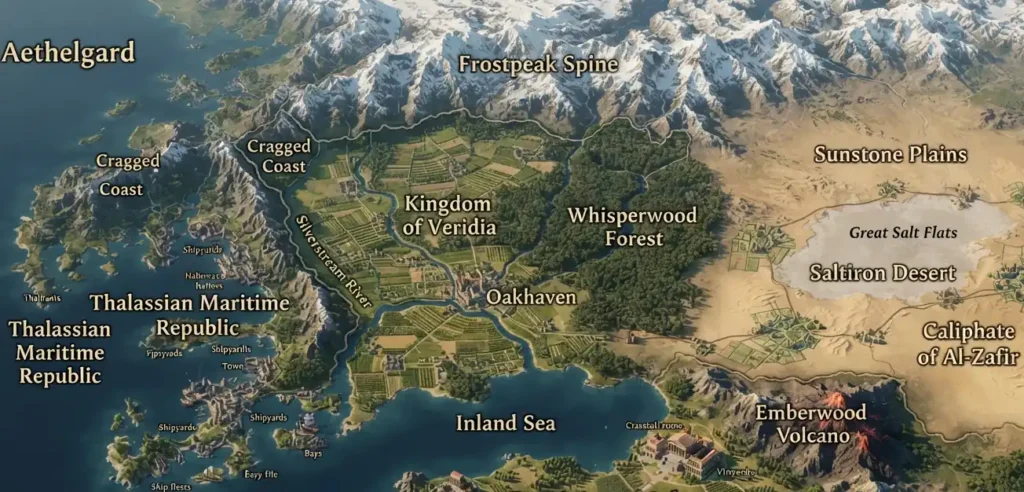
Geography isn’t backdrop. In real history it repeatedly decided whether a region became one empire or a dozen rival states, long before any specific ruler, war, or treaty entered the picture, and the fantasy worlds that actually hold together tend to respect that same order of operations.
Draw the mountains and the rivers first. Let the kings and the borders follow from what that terrain would actually allow. Readers may never consciously notice you did this. They’ll absolutely notice if you didn’t.
Related Articles
- Why Fantasy is More Popular Than Ever Backed By Data
- How Fantasy World-Building Actually Works [Full Breakdown]
- High vs Low Fantasy: Why the Distinction Actually Matters
- Hard Magic vs Soft Magic: What Every Reader Should Know
- How to Build a Fantasy World Readers Will Believe
- How to Build a Dark Fantasy World That Actually Disturbs
- How Tolkien & Martin Built Two Very Different Fantasies
- 7 Things Modern Fantasy Writers Can Learn From Tolkien
Further Reading
- Tzvetan Todorov – The Fantastic: A Structural Approach to a Literary Genre
- Clute, John & John Grant (eds.). The Encyclopedia of Fantasy. Orbit, 1997.
- The Heart of Fantasy According to Tolkien
- Braudel, Fernand. The Mediterranean and the Mediterranean World in the Age of Philip II.
- Kemp, Barry. Ancient Egypt: Anatomy of a Civilization.
- Osborne, Robin. Greece in the Making.
- Wittfogel, Karl. Oriental Despotism.
- Lane, Frederic C. Venice: A Maritime Republic.
- Lewis, Mark Edward. The Flood Myths of Early China.
- Morgan, David. The Mongols.
Written by Batin Khan, a curious free spirit who loves reading and exploring the worlds of fantasy, mythology, and ancient stories. Through this blog, Batin hopes to share that sense of wonder with readers while building an exciting future along the way.