
 By
By Quick Takeaways:
- The word romantasy itself dates back to a 1928 Pittsburgh department store advertisement describing decorative china imagery, long before anyone applied it to a book genre, and the modern usage traces to Urban Dictionary in 2008 before Bloomsbury’s marketing team popularized it around 2022.
- The lineage runs considerably deeper than BookTok, through medieval chivalric romance, Shakespeare’s fairy courts, and specific 1970s and 1980s novels that fit the modern definition before the term existed to describe them.
- Current market data shows this isn’t a passing trend. Romance and fantasy combined now account for nearly half of all self-published ebook sales, and independent authors are outgrowing traditional publishers within the category by a wide margin.
The word romantasy predates every romantasy novel currently on your shelf by nearly a century. A 1928 advertisement for Kaufmann’s department store in Pittsburgh described a china pattern’s decorative imagery, lovers fleeing across a bridge, turtle doves, as romantasies, a word coined independently and completely unrelated to fiction.
That coincidence isn’t the point of this article, but it’s a good reminder that the term’s recent explosion and the actual thing it describes are two separate stories, and the second one is considerably more interesting.
The Actual Definition, Not the Marketing One
The Test That Actually Works
The Science Fiction and Fantasy Writers Association offers the cleanest working definition I’ve encountered. Romantasy is fantasy where the plot really falls apart if you remove the romance.
Run that test against The Lord of the Rings and it fails immediately. Aragorn and Arwen’s romance could be cut entirely, the way Peter Jackson’s films already trimmed most of it, and the core plot, destroy the Ring, defeat Sauron, survives completely intact.
The Second Half of the Test
Book critic Danielle Tomilson adds the necessary counterpart. Dressing up a standard romance novel with elves and calling it romantasy doesn’t work either. The fantasy worldbuilding has to be central to the plot, not decorative scenery behind a romance that could just as easily happen at a contemporary ranch.
Put both tests together and you get real precision. Romantasy requires the romance to be load bearing for the plot, and it requires the fantasy world to be load bearing too. Neither element gets to be furniture for the other.
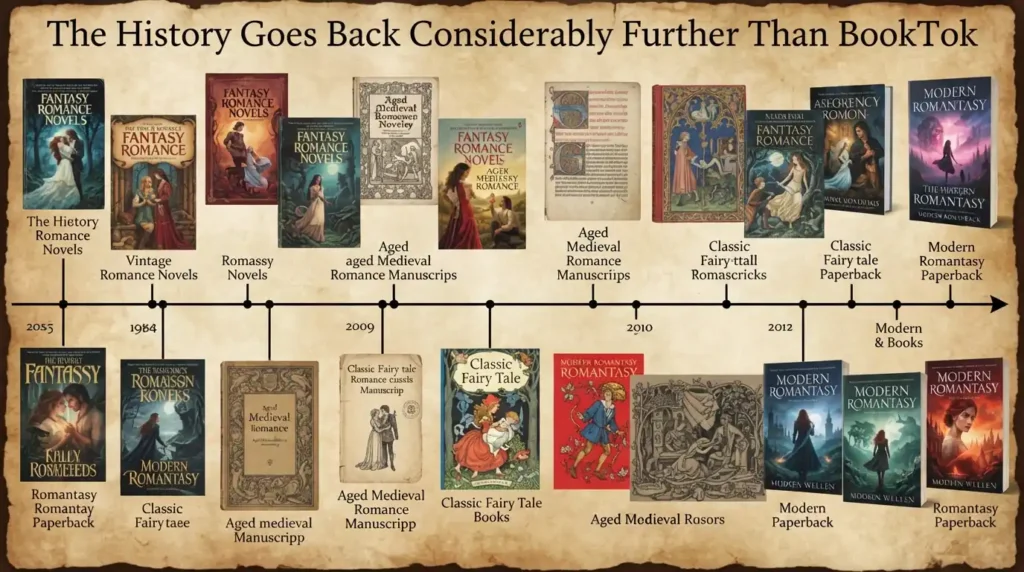
The History Goes Back Considerably Further Than BookTok
Before There Was a Word for It
Tomilson traces the genre’s actual beginning, using her own criteria, to Emma Bull’s War for the Oaks in 1987, a story about a musician drafted into a war between rival fairy courts. Robin McKinley’s Beauty, published in 1978, fits the same criteria even earlier, a Beauty and the Beast retelling with a central love story and a fully realized fantasy world around it.
Neither book had a marketing term to describe what it was doing. They simply did it.
Considerably Older Roots Still
The blending of romance and fantasy as a narrative structure reaches back to medieval chivalric romance, twelfth century stories of knights questing specifically to win a lady’s heart. The Tristan and Isolde legend, with its love potions and near miraculous complications, is a genuine structural ancestor of everything romantasy does now.
Shakespeare’s A Midsummer Night’s Dream, with its jealous fairy king and queen, Oberon and Titania, wielding magic specifically to manipulate desire and mortal minds, sits in this same lineage more directly than most people realize.
The Twentieth Century Bridge
Tamora Pierce’s YA fantasy through the 1980s and 1990s carried romantic elements alongside its central adventure plots. Twilight, arriving in 2005, reintroduced an entire generation to paranormal romance’s specific pleasures, whatever your opinion of the books themselves.
None of this was called romantasy at the time. The genre existed in practice for decades before it had a name anyone agreed on.
Where the Term Actually Came From
Urban Dictionary logged romantasy in its modern sense in 2008. It stayed a minor internet term until 2022, when Bloomsbury’s marketing team has claimed to have specifically coined or popularized it to describe Sarah J. Maas’s work.
Maas’s A Court of Thorns and Roses series, first published in 2015, became the genre’s true commercial breakthrough once it went viral on TikTok around 2020 and 2021, eventually racking up over 14 billion views under related hashtags and selling more than 13 million copies on its own. Rebecca Yarros’s Fourth Wing, arriving in 2023, then took the term fully mainstream, generating coverage from CNN and PBS NewsHour by 2024.
What’s Actually Driving the Current Numbers
This Isn’t a Passing Spike
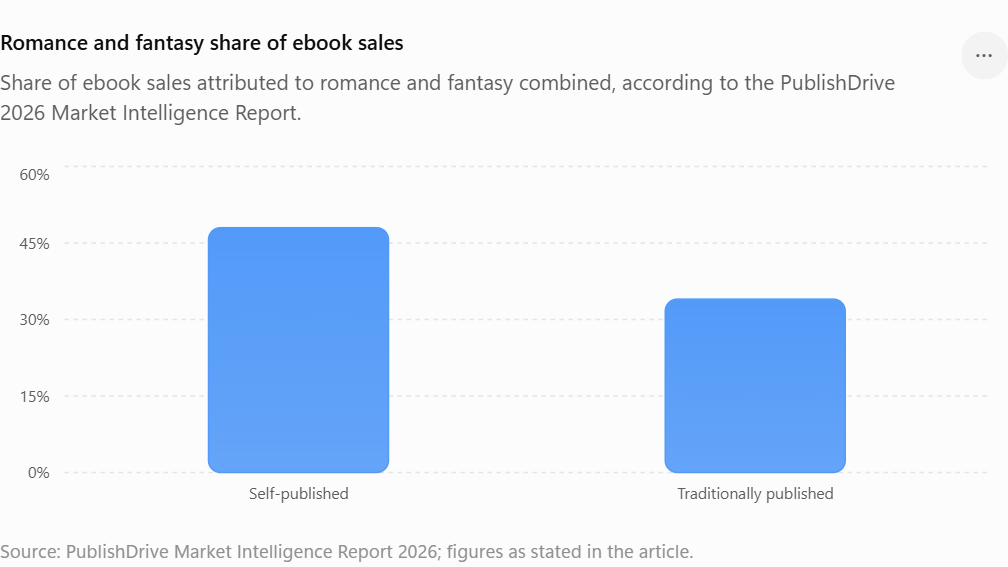
PublishDrive’s Market Intelligence Report for 2026 puts real figures behind what’s been an obviously visible trend. Romance is now the second largest fiction category overall, growing seventeen percent year over year, and romance and fantasy combined now account for forty eight percent of all self-published ebook sales, compared to just thirty four percent of traditionally published sales.
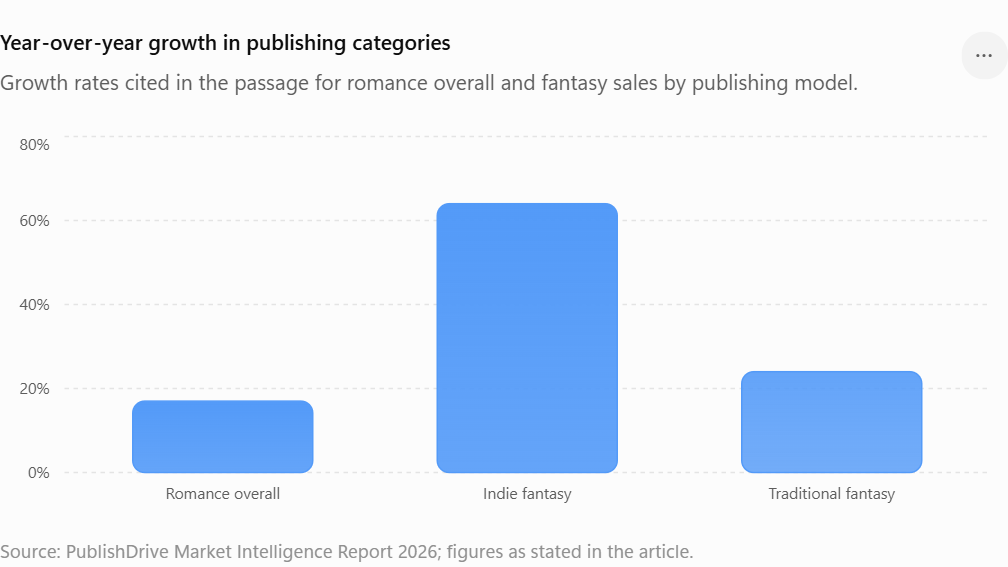
That gap matters. Fantasy readers specifically are the audience most likely to actively seek out independent authors, and indie sales within this category grew sixty four percent year over year on that platform, considerably outpacing traditional publisher growth of twenty four percent over the same period.
The Fan Fiction Pipeline Is Real
SenLinYu offers a genuinely remarkable case study here. Their work originated in fan fiction and appeared among the UK’s top ten selling speculative fiction titles in 2025, according to NielsenIQ BookData, a rare achievement for a writer working entirely outside traditional publishing’s usual gatekeeping.
That path, fan community to independent publishing to mainstream bestseller list, is becoming a real, repeatable pipeline within romantasy specifically in a way it hasn’t been for most other fiction categories.
The Fated Mate Is Romantasy’s Version of the Chosen One
A Genuinely Useful Comparison
Recently I wrote a blog post about why chosen one narratives keep working despite genuine reader fatigue, and I think romantasy’s fated mate device is doing structurally the same job, aimed at a different target.
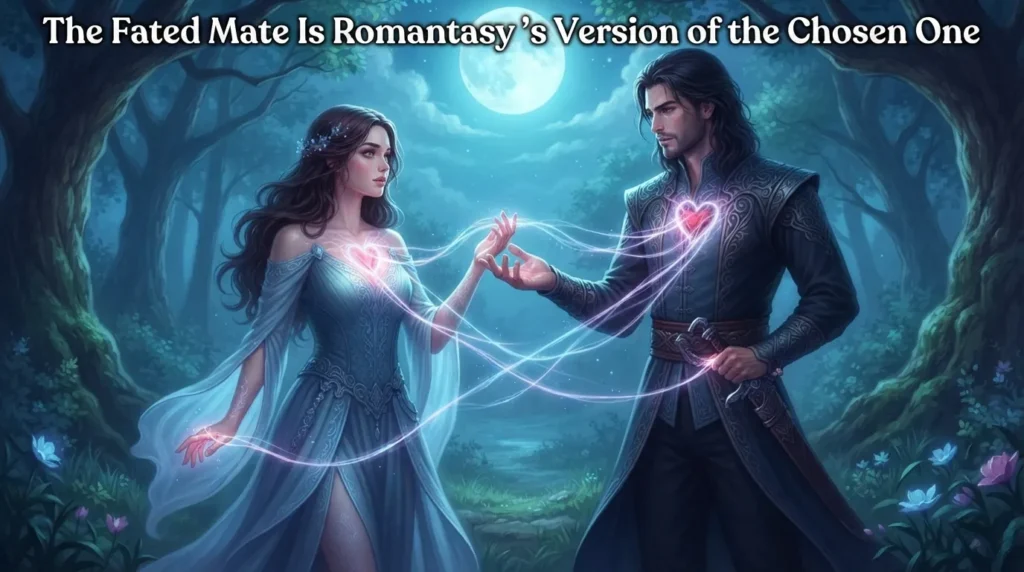
Traditional fantasy uses prophecy to tell you this specific person matters cosmically. Romantasy’s fated mate or soul bond device tells you this specific pairing matters romantically, with the same externally imposed certainty a prophecy provides. Both devices solve the same narrative problem, establishing stakes the reader can trust immediately, just applied to different questions.
Why This Device Specifically Suits the Genre
The fated mate trope gives romantasy something a standard romance can’t easily manufacture on its own, a cosmic, magical guarantee that this specific relationship is significant before the characters have done anything yet to earn that significance within the story.
That’s a real efficient narrative shortcut, and it explains why the device recurs so consistently across the genre’s biggest titles rather than being one author’s specific invention.
Tropes as Marketing Infrastructure
This Isn’t New to Romance Specifically
Category romance publishing has organized itself around named, searchable tropes for decades, predating romantasy by a considerable margin. What’s specifically different now is how visibly and directly BookTok turned individual trope names into discoverable search terms.
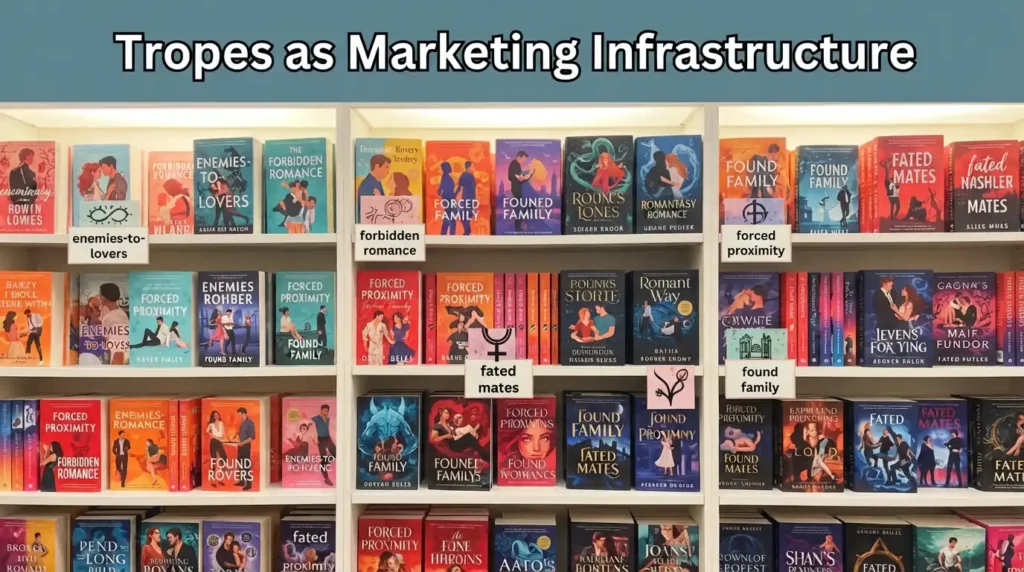
Enemies to lovers. Fated mates. One bed. Touch her and die. These function as genuine marketing infrastructure now, letting readers filter an enormous catalog of similar sounding books by the exact emotional beat they’re actually looking for.
Why This Matters for Discovery
This is a real structural advantage romantasy has over general fantasy discovery. A reader searching for a specific trope combination can find matching titles in seconds, which is a considerably more efficient discovery mechanism than browsing a general fantasy shelf hoping to stumble onto the right book.
An Honest Counterargument
I want to take a specific, unflattering framing of romantasy seriously rather than dismiss it. One critic describes the genre, at its most cynical, as simply a marketing term publishers coined to sell readers on the prospect of overtly sexual content dressed in fantasy trappings, nothing truly new beyond the label itself.
That critique isn’t baseless. Plenty of romantasy is, honestly, thin fantasy worldbuilding wrapped around what’s functionally still paranormal romance, and the marketing driven emergence of the term itself supports some of this skepticism directly.
Where I think the critique overreaches is in implying this makes the genre less legitimate or less worth serious attention. Romance fiction broadly has been dismissed as lesser and unserious for decades despite being one of publishing’s most commercially significant categories, and that dismissal has historically tracked closely with who the genre’s readers actually are.
The same gatekeeping instinct shows up whenever a genre primarily written for and read by women achieves major commercial success, and it’s worth naming that pattern honestly rather than pretending the skepticism is purely about craft.
Frequently Asked Questions
Is romantasy the same thing as paranormal romance?
Related but distinct. Paranormal romance, popularized through authors like J.R. Ward and Christine Feehan in the 1990s and 2000s, typically centers on contemporary or near contemporary settings with supernatural elements layered in. Romantasy usually builds a genuinely secondary fantasy world from the ground up.
Does romantasy require a happy ending?
Most romantasy follows romance genre convention here, requiring either a fully happy ending or a hopeful, unresolved one rather than a tragic one. This isn’t a hard universal rule, but breaking it is a notable exception rather than the genre’s default expectation.
Why do romantasy protagonists skew so heavily toward being female leads?
Industry analysis consistently frames this as core to the genre’s appeal, protagonists who gain personal agency and hidden power specifically through the story rather than existing primarily in service of a male lead’s arc, which several sources identify as a specific draw for the genre’s largely female readership.
Is Stephanie Garber’s Caraval considered true romantasy?
It’s frequently cited as an example of the genre working correctly, since readers report investing as heavily in the mystery driven fantasy plot as in the slow burn romance, satisfying both halves of the SFWA style test rather than leaning entirely on one element.
How much of current romantasy publishing happens outside traditional publishers?
A substantial and growing share. Independent authors already account for more than half of all romance novel sales industry wide, and self-published romance and fantasy titles combined now represent a larger share of ebook sales than their traditionally published counterparts.
Final Thoughts
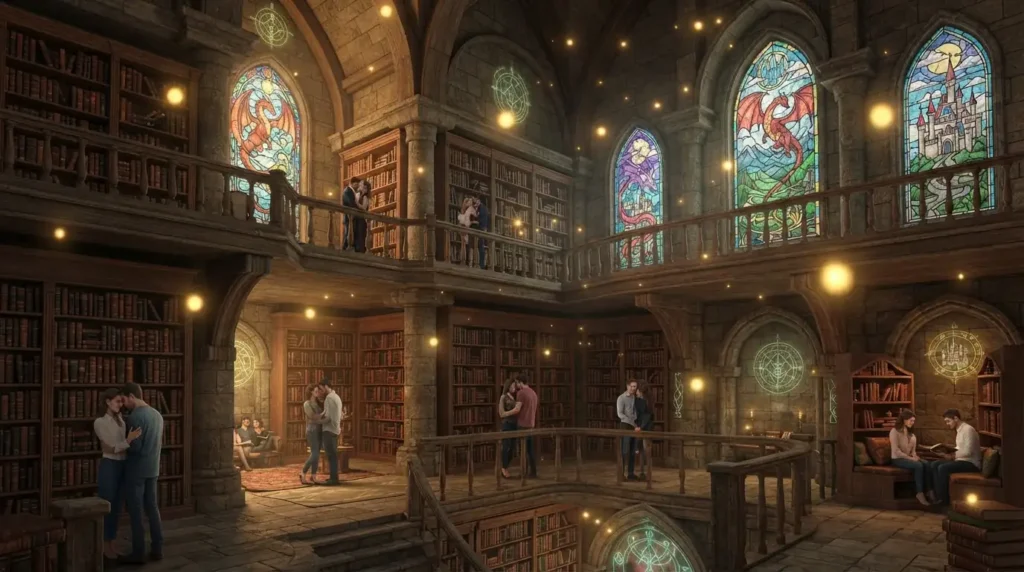
A word from a 1928 china advertisement. A definition that fantasy novels you think has romance would fail. A lineage running through medieval chivalric romance and Shakespeare’s fairy courts before landing on a marketing team’s desk in 2022.
Romantasy isn’t new. What’s new is a name specific enough to finally organize decades of scattered, unlabeled books into a category readers could actually search for, and a platform that let millions of them find each other at the same time.
Related Articles
- Why Dragons Took Over Romantasy, Thanks to Fourth Wing?
- Fourth Wing Review: Enjoyable, Not Groundbreaking
- Is Romantasy Actually a Genre or a Marketing Label?
- Why Romantasy Connects So Deeply With Female Readers
Further Reading & References
- Romantasy Old Genre With A New Name – SFWA
- 1928 Kaufmann’s Department Store Advertisement
- The History of the Wonderful Romantasy Genre – Danielle Tomilson
- War for the Oaks: A Novel – Emma Bull
- A Summary and Analysis of the Tristan and Isolde Myth
- A Midsummer Night’s Dream
- A Court of Thorns and Roses – Sarah J. Maas
- PublishDrive Market Intelligence Report 2026
Written by Batin Khan, a curious free spirit who loves reading and exploring the worlds of fantasy, mythology, and ancient stories. Through this blog, Batin hopes to share that sense of wonder with readers while building an exciting future along the way.