
 By
By Quick Takeaways:
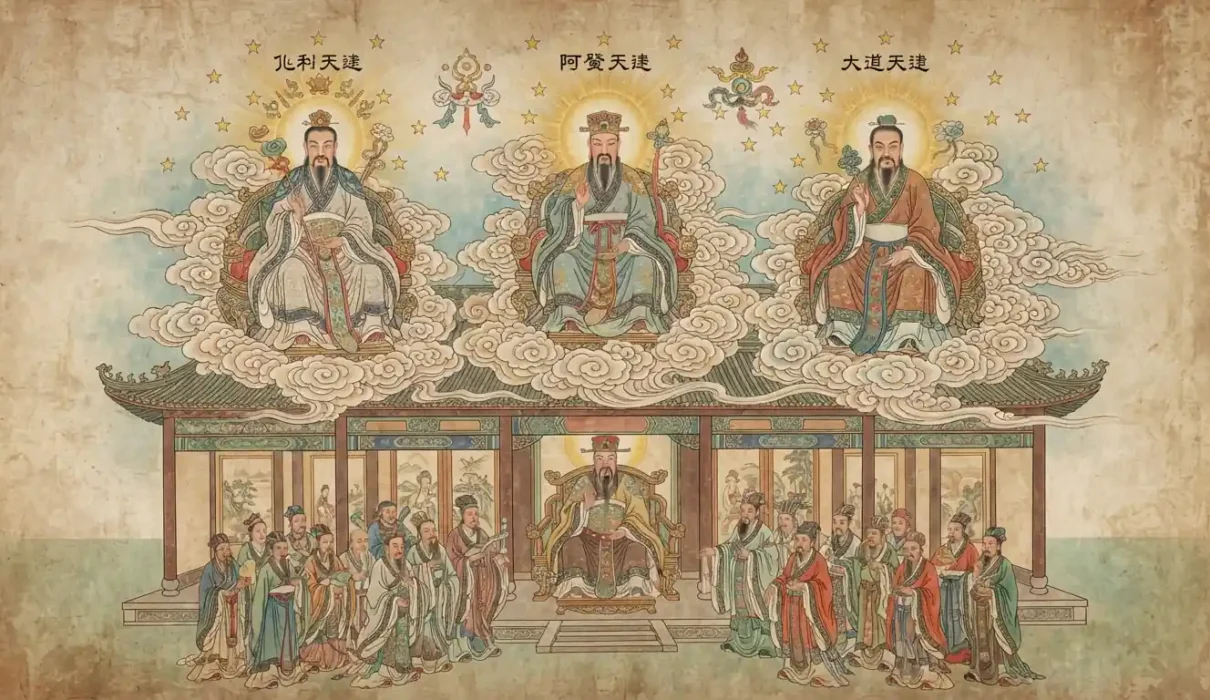
- The Three Pure Ones, or Sanqing, sit above the Jade Emperor in the formal Daoist cosmological hierarchy,
- They aren’t rulers of anything. They represent the sequential unfolding of the Dao itself, from pure undifferentiated potential into the ordered universe the Jade Emperor actually administers.
- Even some reference sources mix up Yuanshi Tianzun’s title, the Jade Pure One, with the Jade Emperor himself, which tells you something about how thoroughly the Jade Emperor’s fame has overshadowed the figures technically ranked above him.
- Popular recognition and theological rank are measuring two different things entirely, and by the time you finish this piece, you’ll understand exactly why that gap exists rather than assuming it’s some kind of oversight.
I’ve written extensively on my blog about the Jade Emperor, his court, his family, his powers ranked and compared against Zeus and against the Buddha. What I haven’t properly done is introduce the three figures who technically outrank him, and who most readers who’ve spent real time in Chinese mythology have still barely heard of.
That gap in recognition is itself the most interesting thing about the Three Pure Ones, and I want to spend real time on why it exists rather than just listing who they are.
Who the Three Pure Ones Actually Are
Yuanshi Tianzun, the Celestial Venerable of the Primordial Beginning
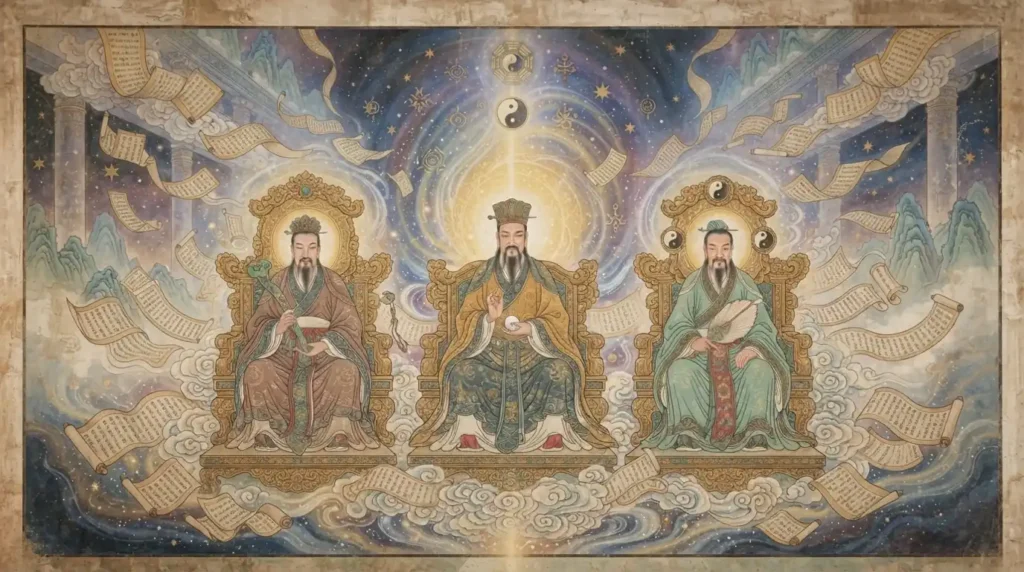
Yuanshi Tianzun ranks first among the three, and his position isn’t administrative. He’s described in the fourth century Daoist text Zhen Zhong Shu, attributed to the scholar Ge Hong, as residing in the Jade Pure Realm before the universe had even taken physical shape.
He’s associated with Wuji, the limitless void that exists prior to any distinction at all. That’s a specific and important theological point. He isn’t a creator standing outside the universe and building it. He’s presented as the first form the formless Dao itself takes on.
Lingbao Tianzun, the Celestial Venerable of the Numinous Treasure
Lingbao Tianzun rose to prominence specifically alongside the Lingbao school of Daoism during the Northern and Southern Dynasties period, roughly the fifth and sixth centuries CE, considerably earlier than most popular Daoist folk religion practices fully crystallized.
His specific cosmological role is separating yin from yang and sorting the elements into their proper categories, the actual mechanical process of differentiation that turns undifferentiated primordial unity into an ordered cosmos. He’s also traditionally regarded as the source and revealer of Daoist scripture itself.
Daode Tianzun, the Celestial Venerable of the Way and Its Virtue
The third Pure One is the deified form of Laozi, traditionally credited as the author of the Daodejing. Where Yuanshi Tianzun represents pure cosmic origin and Lingbao Tianzun represents the process of cosmic ordering, Daode Tianzun represents the Dao’s manifestation specifically within the human world, teaching virtue and cultivation directly to people.
This is the figure most readers have actually encountered before without necessarily connecting him to this triad. Laozi, the sage of the Daodejing, and Daode Tianzun, one of the three highest deities in Daoist cosmology, are understood as the same being in two different registers.
Why Three, Specifically
The Daodejing’s Own Cosmogony
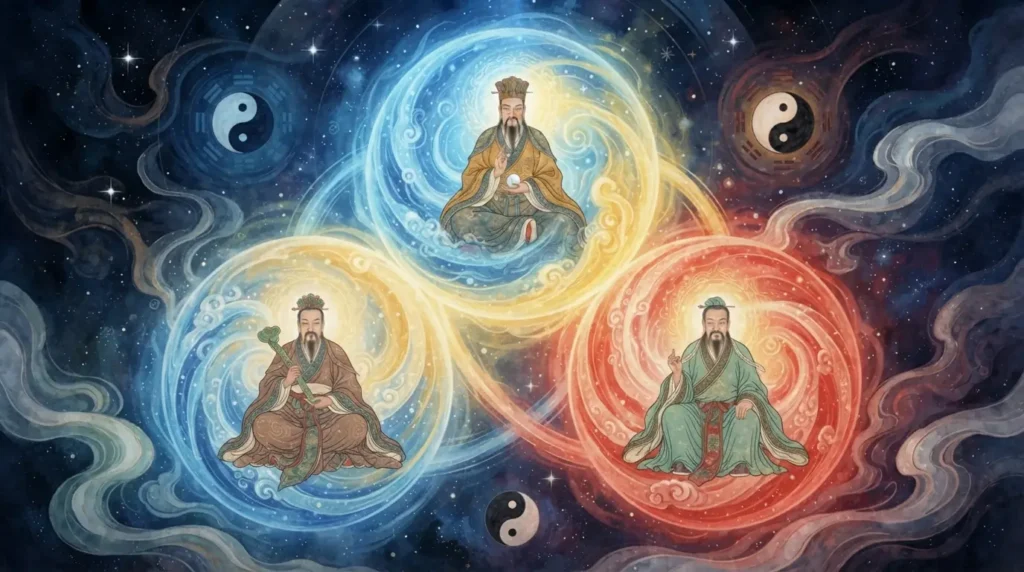
The number isn’t arbitrary, and it traces directly back to a specific, famous passage in the Daodejing itself, chapter forty-two, which describes the Dao producing One, One producing Two, Two producing Three, and Three producing the ten thousand things.
The Three Pure Ones map onto exactly this sequence. Yuanshi Tianzun represents the Dao in its most primordial, unified state. Lingbao Tianzun represents the moment of differentiation, yin separating from yang. Daode Tianzun represents that differentiated cosmic order finally reaching down into direct human teaching and practice.
A Genuine Scholarly Debate Worth Knowing
Several scholars of Chinese religion have noted the structural resemblance between this triad and Buddhism’s own Trikaya doctrine, the three bodies of the Buddha, which was already well established in China by the time the Sanqing configuration fully crystallized.
I want to be upfront about it as a scholarly argument rather than a settled fact. The timing and structural parallel are genuinely suggestive of Buddhist influence on how Daoism organized its own supreme godhead, but I don’t have a single definitive source confirming direct, conscious borrowing rather than parallel development. Treat it as a reasonable hypothesis rather than proven history.
Why the Jade Emperor Isn’t One of Them
Two Genuinely Different Kinds of Authority
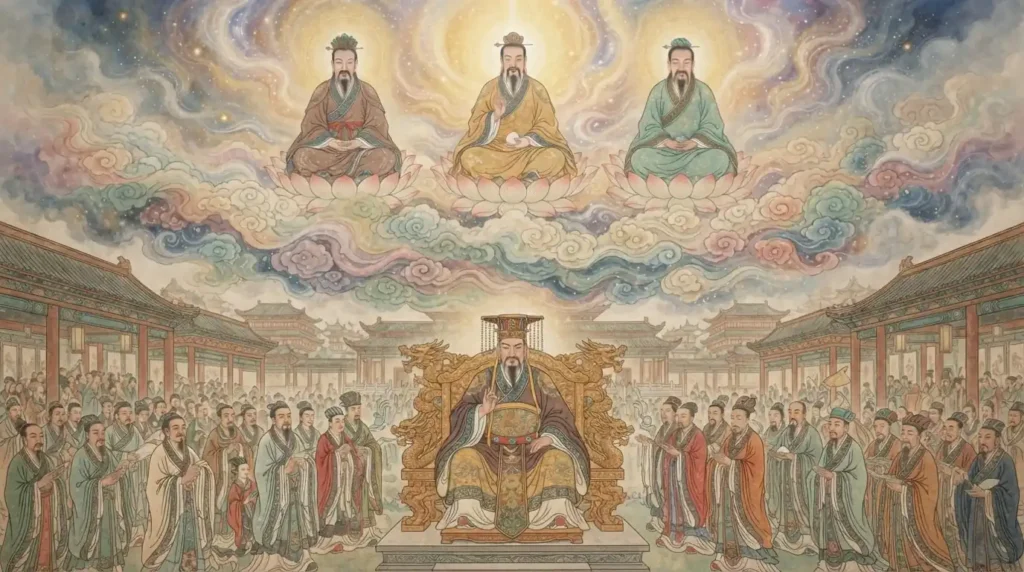
Here’s the theological distinction that actually matters, and it’s one I’ve gestured at in earlier pieces without ever making fully explicit. The Jade Emperor’s authority is administrative. He governs conditioned existence, heaven, earth, and the underworld, as a supreme bureaucrat who earned his position through 1,750 aeons of moral cultivation.
The Three Pure Ones don’t administer anything. They represent metaphysical stages of the Dao’s own unfolding, prior to and beneath the very possibility of administration existing at all. Asking whether Yuanshi Tianzun could override a decision the Jade Emperor makes is close to a category error. He isn’t in that business.
A Confusion Worth Correcting Directly
The Jade Emperor and Yuanshi Tianzun are sometimes conflated in secondary accounts, but the historical relationship between the two figures is more complicated than simply calling one a mistaken name for the other.
Different Daoist traditions have placed different figures at the summit of the celestial hierarchy, and some texts and later interpretations have treated the Jade Emperor and Yuanshi Tianzun as closely related or even equivalent supreme figures.
That is different from the hierarchical model presented in this article, in which Yuanshi Tianzun heads the Three Pure Ones while the Jade Emperor occupies an administrative position below them. The distinction is therefore not simply a matter of correcting an obvious naming error; it reflects the fact that Daoist divine hierarchies were not always represented in a single, universally agreed-upon system.
Where They Actually Sit in the Full Hierarchy
The fuller Daoist cosmological structure places the Three Pure Ones at the top, followed by the Four Sovereigns, a tier of administrative deities that includes the Jade Emperor specifically, followed by the vast remaining bureaucracy of divine officials. To see the full picture, read my blog post about the Chinese Heavenly Court.
The Four Sovereigns administer. The Three Pure Ones exist as the cosmic ground that administration is even possible within.
Where You Can Actually See This Hierarchy
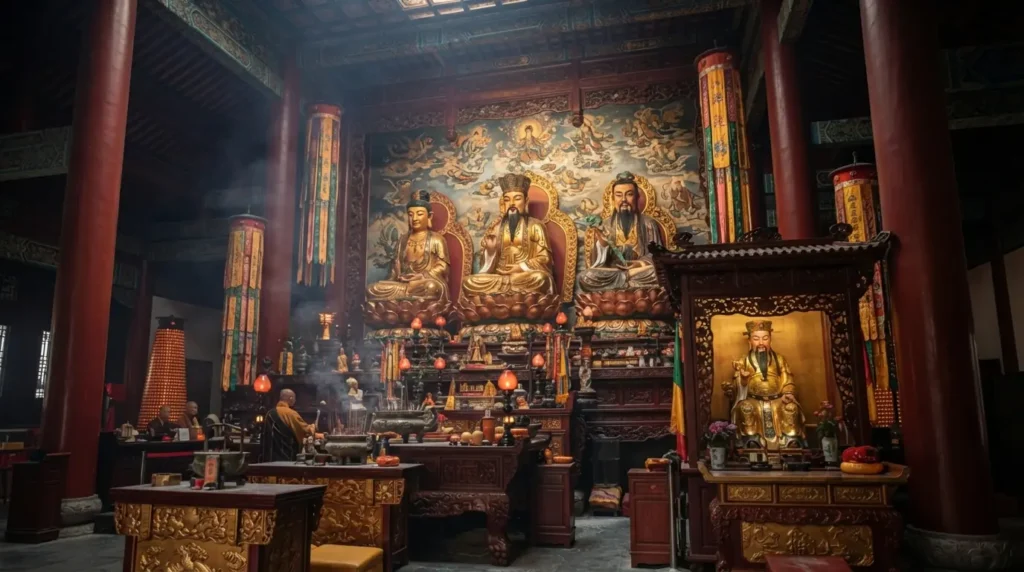
Temple Architecture Confirms It
This isn’t just textual theology. Traditional Daoist temple arrangement places the Three Pure Ones together in the main hall, with Yuanshi Tianzun seated centrally, Lingbao Tianzun to his left, and Daode Tianzun to his right.
The Jade Emperor, in temples that include him at all, typically occupies a separate, distinct hall or shrine, physically and architecturally marking the theological distinction between the two tiers rather than leaving it as abstract doctrine.
Their Festival Calendar
Yuanshi Tianzun’s birthday falls on the first day of the first lunar month, symbolically tied to renewal and the beginning of the cosmic cycle. Lingbao Tianzun’s falls on the fifteenth day of the same month, associated with universal harmony. Daode Tianzun’s falls on the fifteenth day of the second lunar month.
Offerings to the Three Pure Ones are traditionally kept deliberately simple, quiet, and sincere rather than elaborate, reflecting their nature as absolute, foundational purity rather than deities who intervene in specific daily fortune the way more approachable folk gods do.
Why Almost Nobody Talks About Them
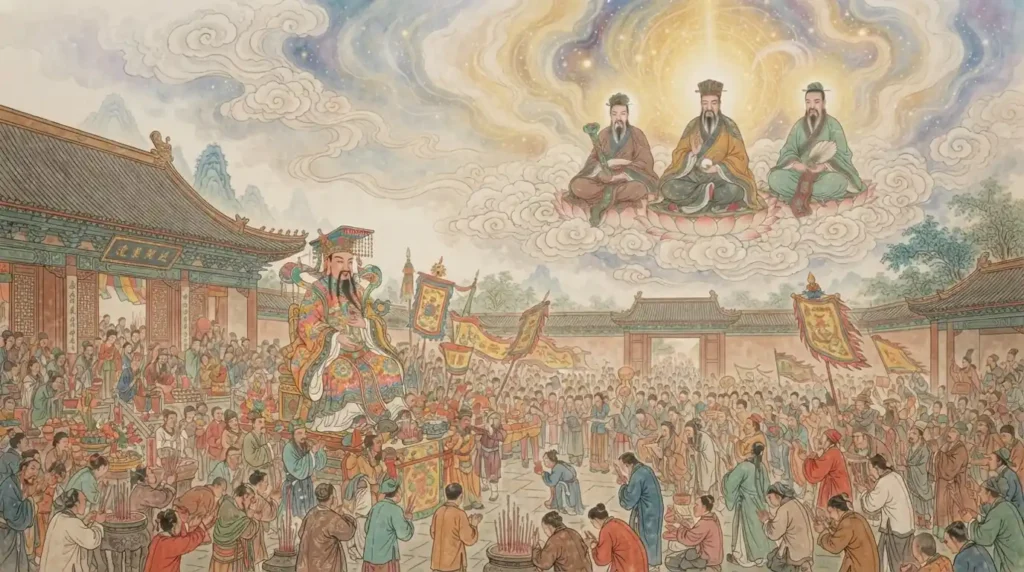
Narrative Utility Explains the Gap Better Than Theology Does
Here’s my actual argument, and it’s the reason I wanted to write this piece rather than just listing three names most readers would forget by tomorrow. The Jade Emperor is famous because he’s narratively useful. He has a court, a wife, children, rivals, political dramas, and specific stories where he makes decisions you can actually follow.
The Three Pure Ones don’t function this way, and one source describing their devotional practice states this almost explicitly. They aren’t worshipped as personalities the way lesser deities are. Their influence is foundational rather than interventionist, shaping the underlying conditions for spiritual clarity rather than showing up as characters in a story with choices to make.
Gods you can tell stories about get remembered by popular culture. Gods who represent pure metaphysical process, however theologically supreme, get relegated to temple contexts and specialist religious practice, regardless of their actual rank.
An Honest Counterargument
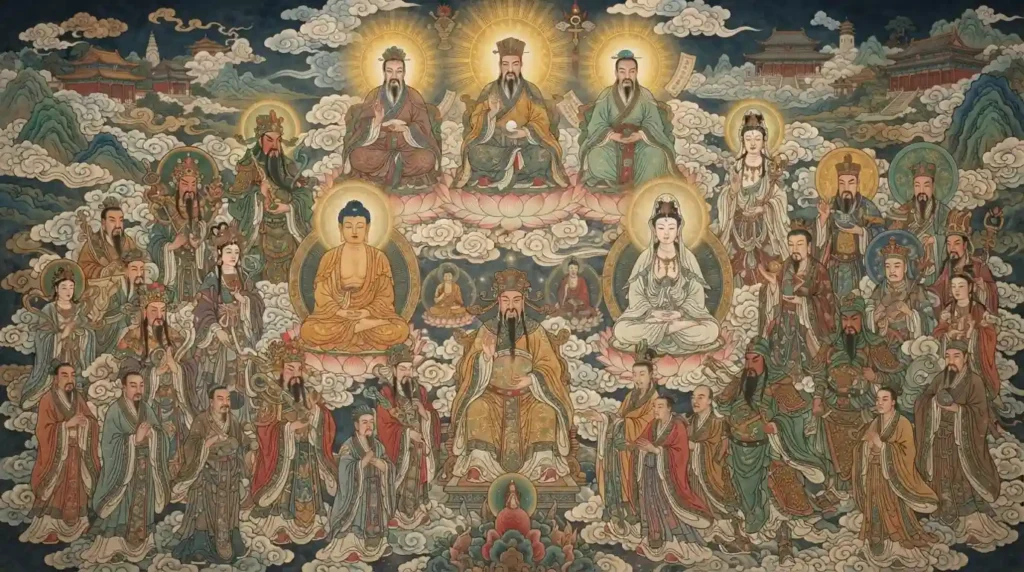
I want to complicate my own thesis here rather than let it stand as the whole picture. Theological rank and practical devotional importance are truly different axes, and by one real measure, the Jade Emperor might matter more than the Three Pure Ones do.
Ordinary religious practice, the annual Kitchen God report, the specific petitions communities make during drought or crisis, the birthday festivals that draw actual crowds, overwhelmingly centers on the Jade Emperor and the administrative tier beneath him rather than on the more abstract, philosophically remote Three Pure Ones.
So which figure actually matters more depends entirely on what you’re measuring. In formal theological hierarchy, the Three Pure Ones win decisively. In lived, daily religious practice across most of Chinese folk religious history, the Jade Emperor’s practical significance to ordinary worshippers likely exceeds theirs considerably.
Frequently Asked Questions
Is Laozi considered a historical person or purely a mythological figure in this context?
Both, depending on which tradition you’re asking within. Historically, Laozi is traditionally credited as the Daodejing’s author. Theologically, Daode Tianzun represents his deified, cosmic form, one of the Three Pure Ones, distinct from but connected to the historical sage figure.
Do the Three Pure Ones appear as characters in Journey to the West?
Not as active characters with dialogue and decisions the way the Jade Emperor does. Their metaphysical, non interventionist nature makes them poorly suited to narrative fiction, which is a large part of why the Jade Emperor dominates popular stories despite ranking below them.
Is the Shangqing school of Daoism directly connected to Lingbao Tianzun?
Yes, closely. Lingbao Tianzun’s associated heaven, the Shangqing or Upper Purity realm, gives its name directly to the Shangqing school of Daoism, one of the tradition’s most historically significant lineages, particularly associated with Mount Mao.
Why do the Three Pure Ones receive simpler offerings than more popular folk deities?
Their nature is understood as pure, foundational, and beyond ordinary personal intervention, so elaborate or theatrical offerings are considered inappropriate to what they actually represent. Quiet, sincere practice is favored specifically because it matches their described essence.
Is there a female equivalent figure ranked at the same tier as the Three Pure Ones?
No single female deity occupies an equivalent position within the formal Sanqing hierarchy itself. Figures like Xiwangmu, the Queen Mother of the West, hold independent, ancient authority in Daoist tradition, but occupy a different theological category rather than a fourth seat in this specific triad.
Final Thoughts
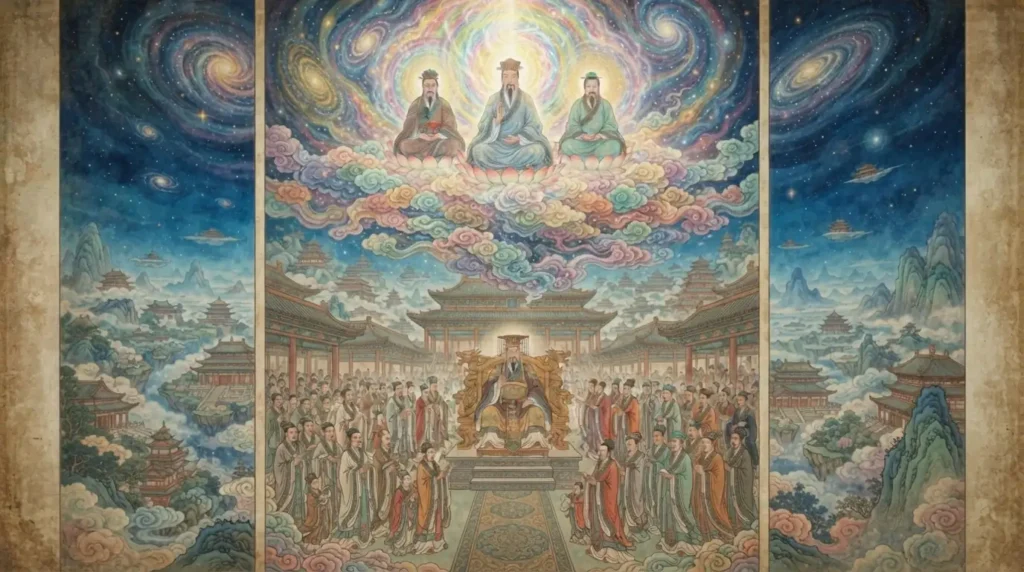
Three figures representing the Dao’s own unfolding, ranked above a supreme administrator I’ve spent considerably more time writing about, because he’s simply more interesting to tell stories about.
That’s not a flaw in Chinese theology. It’s an honest reflection of what popular religious memory actually preserves, and knowing the difference makes both tiers of this hierarchy considerably more interesting than treating the famous one as the whole story.
References
Primary Sources
Academic Sources
- What Do the Lingbao Celestial Scripts Tell Us about Some Fundamental Characteristics of Daoism?
- The Three Purities and Three-Stage Ontologies: From Daoism to the Baháʼí Faith
- Confucianism, Daoism, Buddhism, and Chinese Popular Religion | Oxford Academic
- The Encyclopedia of Eastern Philosophy and Religion: Buddhism, Hinduism
- Religious Daoism (Stanford Encyclopedia of Philosophy)