
 By
By Quick Takeaways:
- The Jade Emperor Family is extensive, complex, and includes some of Chinese mythology’s most compelling individual figures
- His consort the Heavenly Queen Mother has a distinct identity and role separate from the Queen Mother of the West, a distinction that confuses many readers
- His sister’s story is one of Chinese mythology’s most poignant divine narratives, a goddess punished for following her heart
- His nephew Erlang Shen operates with legendary independence, famously telling the Jade Emperor where to go with his commands
- Several of the family’s most dramatic stories revolve around the tension between divine duty and personal desire, a very human conflict in a very divine household
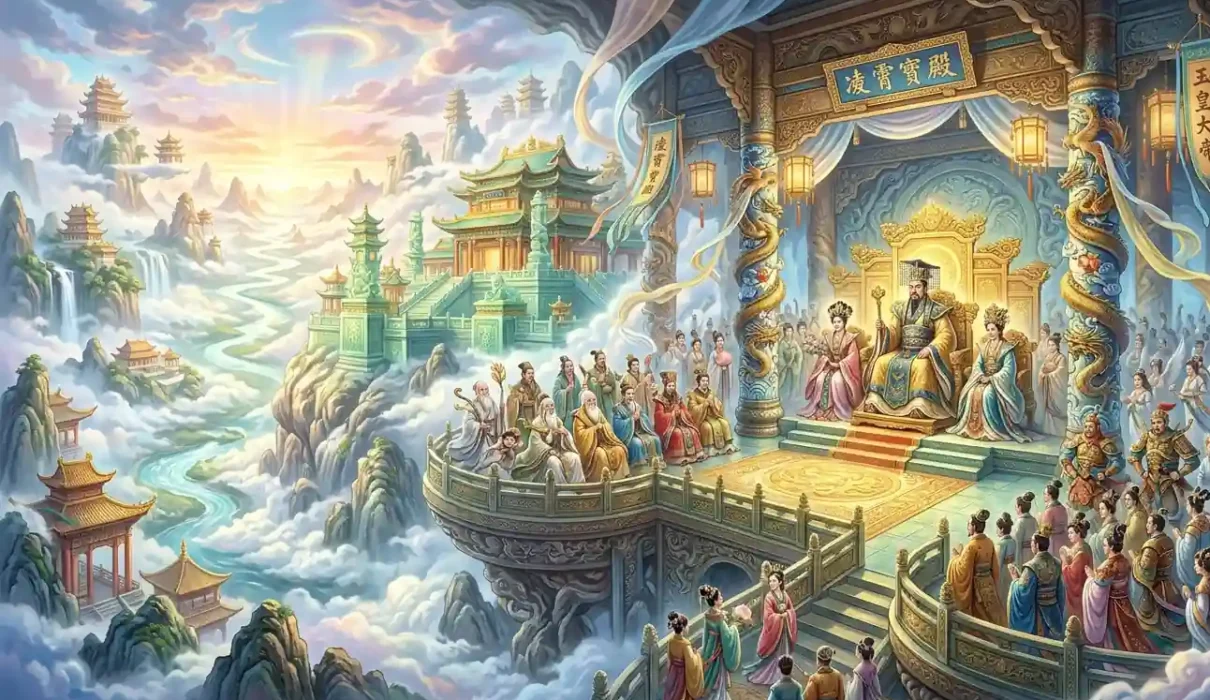
The Jade Emperor’s family is considerably more interesting than his official role suggests.
As the supreme ruler of the Heavenly Court, you might expect the Jade Emperor to have a harmonious, properly ordered divine household. And in official terms, he does. But scratch the surface, and you’ll find a divine family with genuine emotional complexity. A sister punished for love, a nephew who refuses to take orders, a daughter who fell for a mortal, and a consort who’s often portrayed as the practical intelligence behind the imperial throne.
That’s the family I want to introduce you to.
The Jade Emperor’s Consort: The Heavenly Queen
Who She is
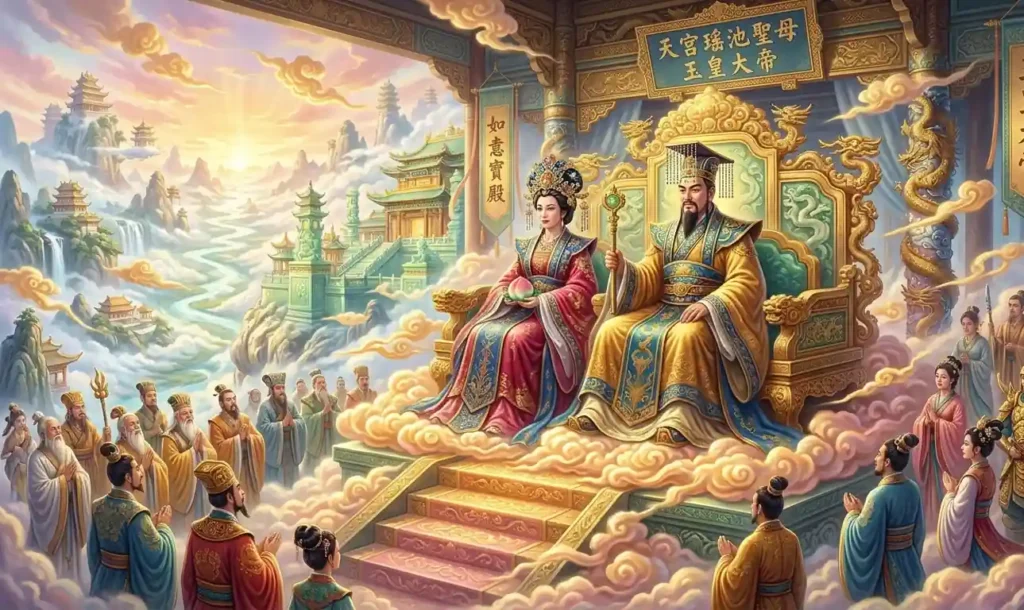
The Jade Emperor’s consort is Wang Mu Niangniang (Heavenly Queen Mother), a figure who’s frequently confused with the Queen Mother of the West (Xiwangmu), but who’s actually a distinct divine person in her own right.
This confusion is understandable. Both figures have “Queen Mother” in their common English translations. But they’re different beings with different origins, different domains, and different stories.
The Heavenly Queen is the Jade Emperor’s actual wife, the empress of the heavenly court, the mother of his children, and the figure who manages the domestic and ceremonial dimensions of divine imperial life.
Her Character and Role
In most accounts, she’s considerably more practically minded than her husband. While the Jade Emperor makes cosmic governance decisions, the Heavenly Queen tends to be the one who actually notices what’s happening around her and responds accordingly.
In Journey to the West, when Sun Wukong is causing chaos in heaven, she’s often more alert to the developing disaster than the officials who are supposed to be managing it. She’s pragmatic, observant, and possessed of a specific authority within the domestic sphere of the court that complements the Jade Emperor’s formal governance role.
She’s genuinely interesting as a divine figure precisely because her power isn’t the spectacular cosmic kind. It’s the power of the person who understands the household better than anyone else.
The Jade Emperor’s Sister: A Goddess Punished For Love
The Story of the Holy Mother of Mount Hua
This is the family story I find most affecting, and the one that most clearly reveals Chinese mythology’s complicated relationship with the tension between love and duty.
The Jade Emperor’s sister, sometimes called the Holy Mother of Mount Hua, fell in love with a mortal man and married him, leaving the divine realm to live a human life.
In the divine court’s framework, this was a profound transgression. A divine being abandoning her celestial station for mortal love violated the boundary between the divine and human realms, a boundary Chinese mythology treats with considerable gravity.
The Imprisonment
The Jade Emperor imprisoned his sister beneath Mount Hua.
I reckon this is one of the psychologically revealing moments in the entire Jade Emperor mythology, a supreme divine ruler imprisoning his own sister for the crime of loving someone he considered beneath her station.
The story doesn’t present this as obviously right. There’s genuine ambiguity about whether the Jade Emperor’s response is just cosmic enforcement of necessary boundaries or an exercise of family authority that has more to do with pride than principle.
The Rescue and Erlang Shen
The Holy Mother’s son by her mortal husband Chen Xiang (also called Yang Jian in some accounts, though this creates confusion with Erlang Shen) eventually grows powerful enough to rescue his mother.
In the most famous version, he wields a magical axe that cleaves mountains and splits the earth to free her from her imprisonment. His motivation is pure filial love, the determination to restore his mother regardless of what divine authority has decreed.
The story is one of Chinese mythology’s most direct expressions of filial piety overcoming even divine institutional authority, a genuinely radical narrative for a tradition that otherwise emphasizes appropriate deference to hierarchical power.
Erlang Shen: The Nephew Who Won’t Take Orders
The Most Independent Figure in the Divine Family
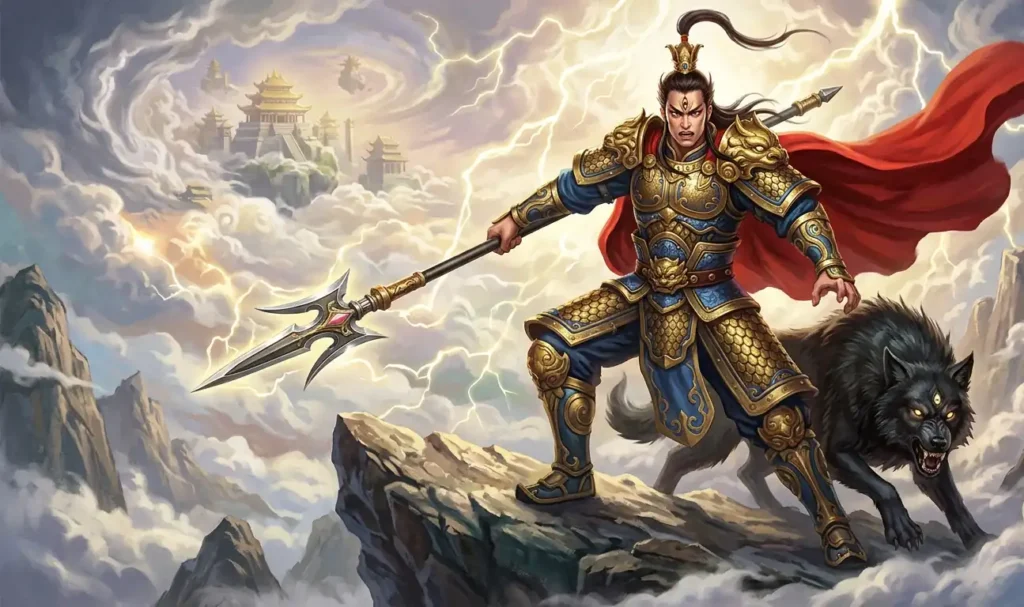
Erlang Shen (literally “Second Son God”) is traditionally identified as the Jade Emperor’s nephew either through the Holy Mother’s story or through a separate lineage, and he is, without question, the most dramatically interesting member of the extended divine family.
He’s the finest individual warrior in the Heavenly Court, as Journey to the West makes clear in the extended battle with Sun Wukong that requires Erlang Shen’s specific capabilities, where every other divine general has failed.
But what makes him interesting isn’t his power. It’s his relationship with authority.
The Legendary Independence
Erlang Shen governs from Guanjiang Mouth in Sichuan, and he has a long-established pattern of doing things his own way. When the Jade Emperor wants something done, Erlang Shen’s response is essentially: I’ll decide if I agree with that.
In Journey to the West, when the Jade Emperor asks for his help dealing with Sun Wukong, Erlang Shen agrees but on his own terms and through his own methods, not as an obedient subject following imperial direction. His battle with Sun Wukong is between two peers who’ve decided to fight, not a general responding to his emperor’s command.
The divine family dynamic here is genuinely interesting. The Jade Emperor, the supreme ruler of everything, has a nephew he can’t actually command. He can only ask. And the nephew will decide for himself.
What Erlang Shen’s Independence Reveals
I’ve spent years thinking about what Erlang Shen’s semi-independence within the divine family says about the Chinese mythological imagination.
My best reading: it reflects a genuine cultural understanding that family relationships create obligations of respect that institutional hierarchies don’t automatically override. The Jade Emperor can command his ministers. He can’t command his nephew the same way, because the nephew relationship carries different rules.
It also reflects something specifically Chinese about the limits of even supreme authority. The Jade Emperor is cosmically powerful. He’s not cosmically unlimited. Some things, the loyalty of someone who chooses to give it rather than being required to, can’t be commanded into existence.
The Jade Emperor’s Daughters
The Weaving Maid: The Most Famous Daughter
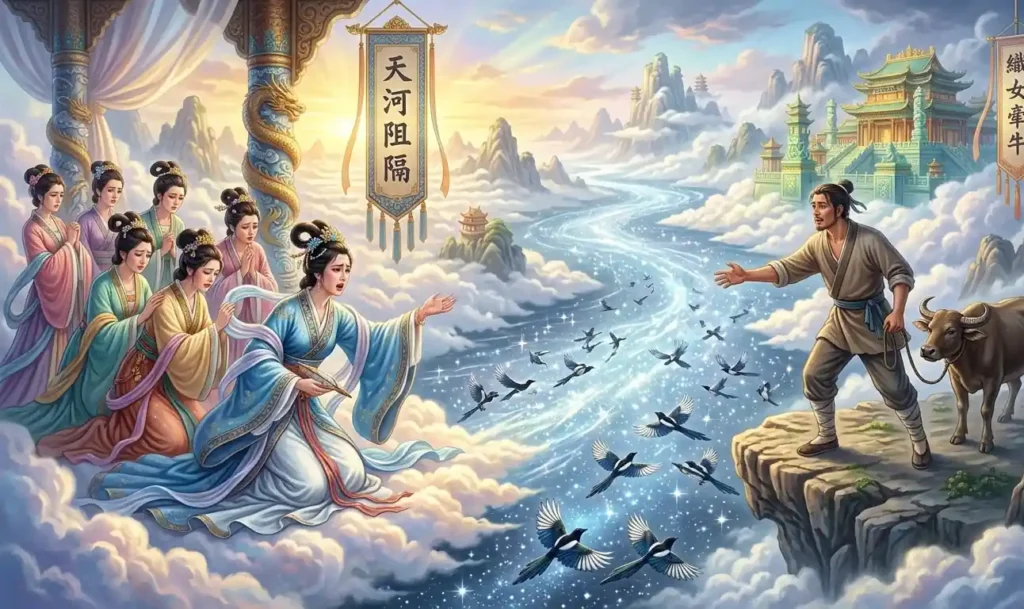
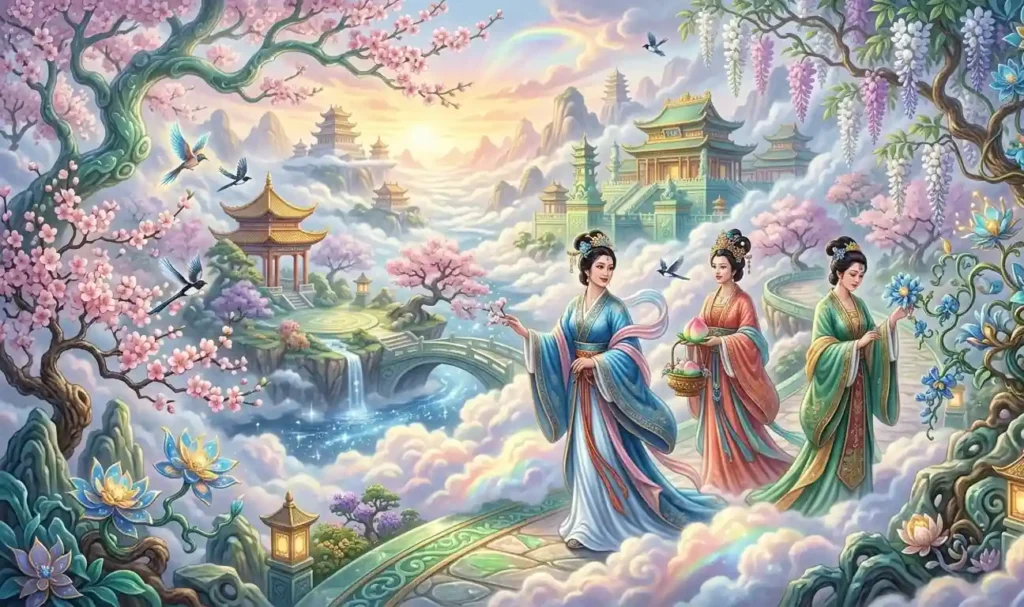
The Jade Emperor’s most famous daughter is Zhinü (the Weaving Maid), the divine weaver who fell in love with a mortal cowherd named Niulang and married him without her father’s permission.
The Jade Emperor’s response was characteristically severe. He separated them, placing Zhinü on one side of the Milky Way and Niulang on the other, permitting them to meet only once a year on the seventh day of the seventh lunar month when magpies form a bridge across the celestial river.
This story is one of Chinese mythology’s most enduring. It’s the origin of the Qixi Festival, sometimes called Chinese Valentine’s Day, which remains one of the most widely observed traditional festivals.
The Pattern in the Daughters’ Stories
Looking at the stories of the Jade Emperor’s female family members, his sister imprisoned beneath a mountain for loving a mortal, his daughter separated from her mortal husband by the Milky Way, a pattern emerges.
Divine women who love across the divine-mortal boundary are punished. The punishment is specifically spatial separation, imprisonment, and confinement. And in both cases, the stories are not triumphant. They’re melancholy.
This pattern tells you something important about what Chinese mythology thinks the divine-mortal boundary costs. The women who cross it don’t regret their choices. They’re just separated from what they loved, forever or nearly so. The mythology honours the love while enforcing the separation.
Other Daughters
The Jade Emperor has multiple daughters in various traditions, including the Seven Fairy Sisters who appear in various folk tales, often sneaking down to the human realm for adventures their father hasn’t approved.
The pattern continues: the daughters want connection with the human world. The Jade Emperor governs divine order. The tension between those two things generates story.
The Extended Divine Family
The Jade Emperor’s Mother
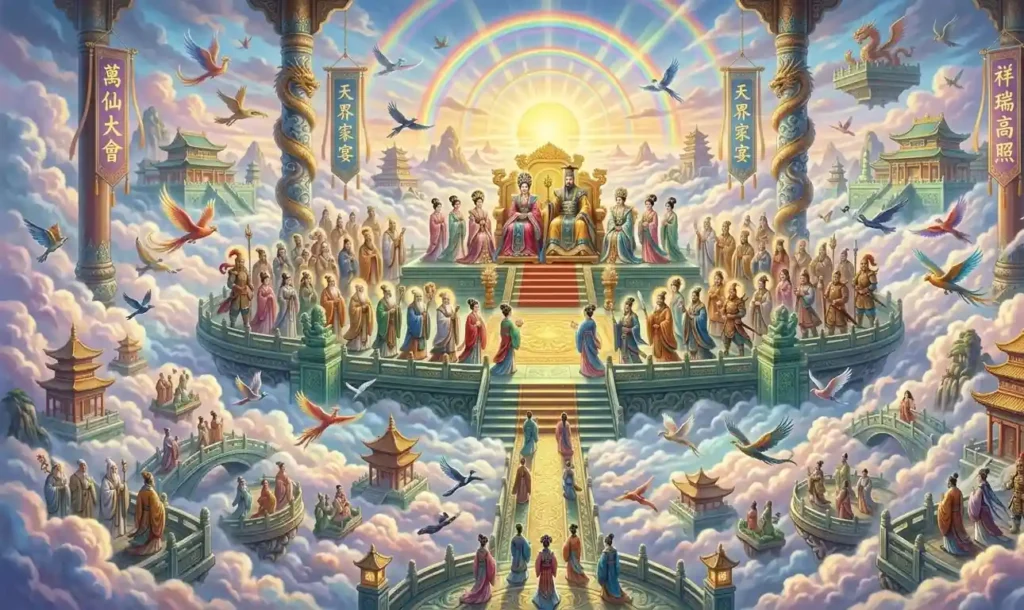
Some traditions describe the Jade Emperor’s mother as a divine figure in her own right, the queen of the Pure Felicity Kingdom who had the dream of Laozi presenting an infant. Her role in the mythology is limited primarily to the origin story, but her presence anchors the Jade Emperor in a family lineage rather than positioning him as a being who arose from nowhere.
Who Was the Jade Emperor Before He Became a Supreme Ruler?
Nezha: Not family But Practically Adjacent
Nezha isn’t literally the Jade Emperor’s family, but he functions as one of the court’s favoured divine figures in a way that has family-adjacent qualities.
His complex relationship with his own father, his self-sacrifice and lotus-flower resurrection, and his eventual role as a supreme divine marshal give him a biographical arc that puts him in frequent proximity to the Jade Emperor’s family dramas.
His story of family conflict, killing himself to free his father from cosmic consequences, then being reborn from lotus petals into a body that owes nothing to his father’s lineage, is one of Chinese mythology’s most psychologically acute family stories, even if it’s not technically the Jade Emperor’s family story.
The Family Dynamic as a Whole
What The Family Reveals About Chinese Values
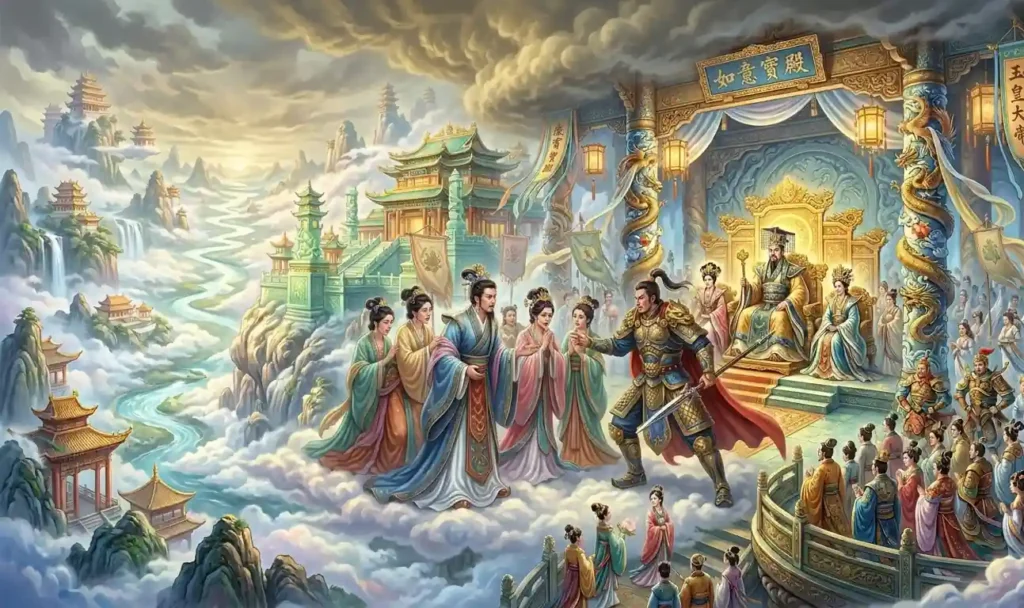
Looking at the Jade Emperor’s family as a whole, what strikes me most is how thoroughly it dramatizes the central tensions of Chinese family ethics:
The conflicts:
- Duty to divine order versus personal love (his sister, his daughter Zhinü)
- Institutional authority versus family relationship (his inability to truly command Erlang Shen)
- The cosmic versus the personal (enforcing divine boundaries while watching his family suffer for crossing them)
What gets honoured:
- Filial piety: Chen Xiang rescuing his mother is presented sympathetically even though it defies the Jade Emperor
- Loyalty that’s chosen: Erlang Shen’s voluntary assistance is worth more than commanded compliance
- Love that endures separation: The Weaving Maid and Cowherd’s annual reunion is romantic rather than pitiful
The divine family is, in this reading, a mythological space where Chinese culture works through its most fundamental value conflicts without being able to resolve them cleanly.
Frequently Asked Questions
Is the Queen Mother of the West the Jade Emperor’s wife?
This is the most common confusion about the divine family. The Jade Emperor’s consort is Wang Mu Niangniang, the Heavenly Queen Mother, not Xiwangmu. While some traditions blur the distinction, classical mythology treats them as separate figures. Xiwangmu predates Jade Emperor mythology and holds significant independent authority.
Why does the Jade Emperor keep imprisoning people who fall in love with mortals?
The mythology treats the divine mortal boundary as genuinely significant. Crossing it disrupts the cosmic order the Jade Emperor is tasked with maintaining. His responses remain institutionally consistent, even when personally painful. The stories present the punished figures sympathetically, while portraying the consequences as the expected logic of cosmic governance.
Is Erlang Shen always depicted as independent from the Jade Emperor?
Yes, consistently across sources. His semi-independence is one of his defining characteristics. He helps when asked but isn’t commanded. Some traditions explain this independence through his mixed divine-mortal heritage, which positions him as someone who doesn’t entirely belong to the divine hierarchy’s usual authority structures.
Why are the Jade Emperor’s daughters important in Chinese mythology?
Stories about his daughters often explore themes of love, duty, and the consequences of crossing the boundary between the divine and mortal worlds. The tale of the Weaver Girl is one of the most famous examples.
How does the Jade Emperor’s family reflect Chinese mythology?
The Jade Emperor’s family mirrors the structure of the celestial bureaucracy, with relatives and attendants holding specific responsibilities. Their stories emphasize order, hierarchy, virtue, and the balance between personal desires and cosmic law.
Final Thoughts
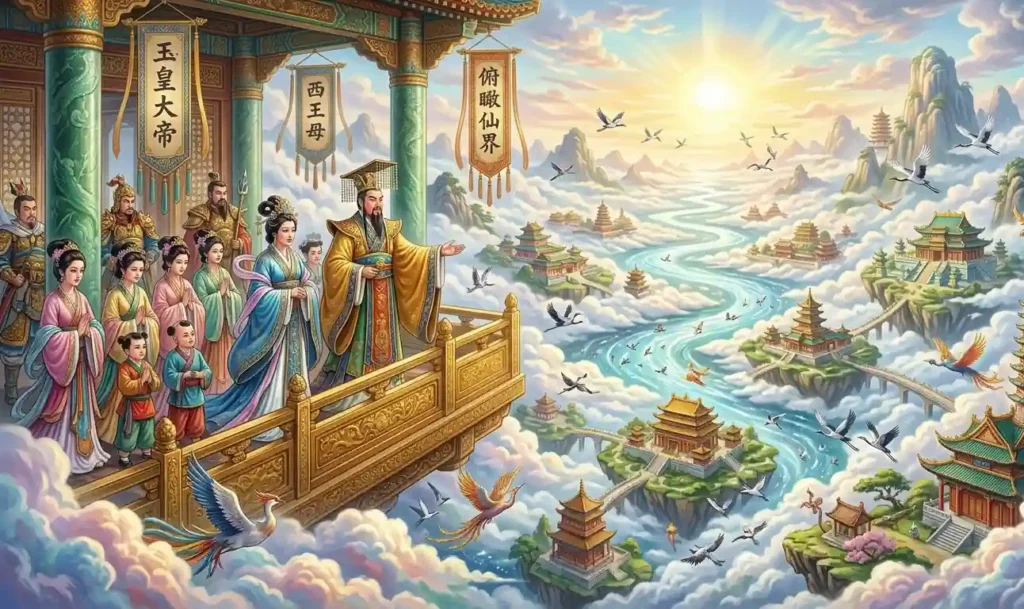
The Jade Emperor’s family is, on paper, the most ordered and powerful divine household imaginable. The supreme ruler, his consort, their children, their extended relations. Everything should run smoothly.
And yet a sister imprisoned beneath a mountain. A daughter separated from her husband by the width of the Milky Way. A nephew who’ll help you but won’t obey you. Children who keep falling in love with the wrong beings.
This is not a failure of the mythology. This is the mythology being genuinely truthful about what family is like, even at the divine level. Especially at the divine level, where the stakes of every conflict are cosmically high, and the authority to enforce decisions is absolute, which makes the choices that defy that authority all the more meaningful.
The Jade Emperor’s family is interesting for exactly the same reason every family is interesting: because the people in it are genuinely themselves, and genuine selves don’t always cooperate with the official plan.
Related Articles
- Jade Emperor: Origin, Powers & Sacred Meaning in Mythology
- What Is the Heavenly Court? Chinese Myth’s Divine Authority
- Who Was the Jade Emperor Before He Became a Supreme Ruler?
- Are the Jade Emperor & Queen Mother of the West Married?
- 11 Surprising Jade Emperor Facts Most Readers Miss
- Jade Emperor and the Chinese Zodiac: The Great Race Story
- Was the Jade Emperor Weak? The Answer Might Surprise You
References
- Birrell, Anne. Chinese Mythology: An Introduction.
- Major, John. Heaven and Earth in Early Han Thought.
- Kohn, Livia. Daoism and Chinese Culture.
- Allan, Sarah. The Shape of the Turtle.Hanshu (Book of Han).
- Shiji (Records of the Grand Historian).
- Tao Te Ching – Translated by J. Legge
- Daozang – Daoist Canon
- Investiture Of The Gods
- Journey To The West
- Jade Emperor Origin Scripture
- The Taoist Body – Kristofer Schipper
- The Book of Songs
- The Legend of San Shengmu and Chen Xiang
- Transcendence and Divine Passion: The Queen Mother of the West in Medieval China – Suzanne Elizabeth Cahill
- The Encyclopedia of Taoism