
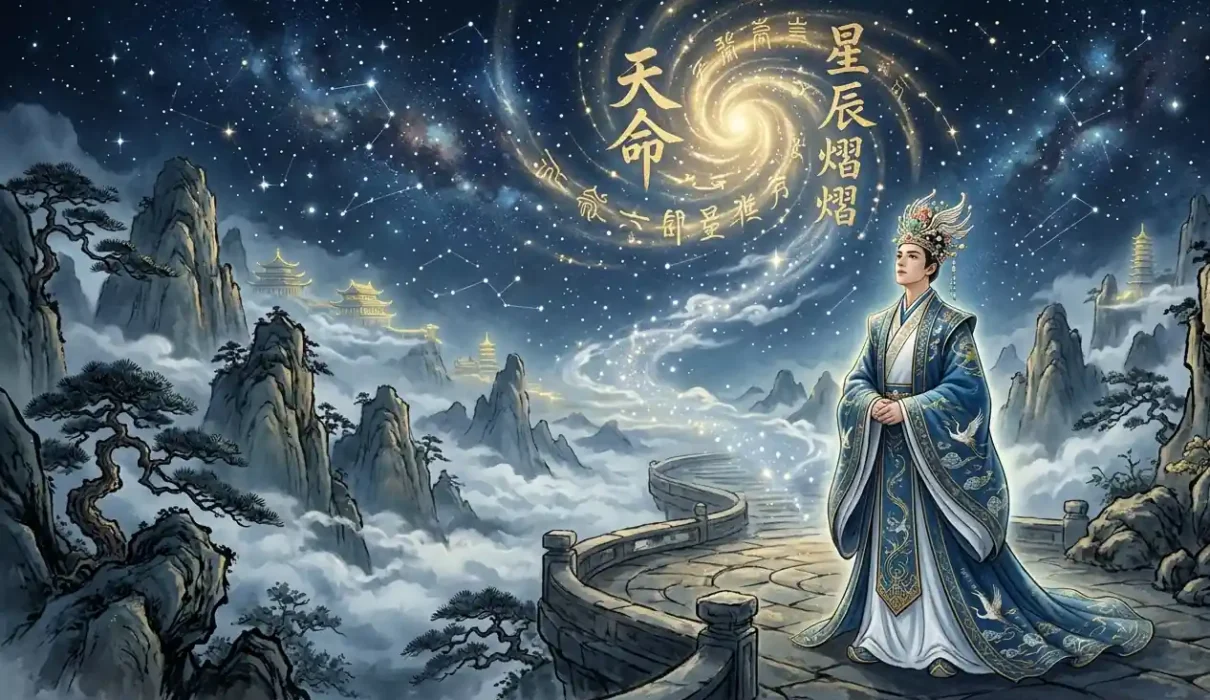
 By
By Quick Takeaways:
- The Jade Emperor wasn’t born divine. He was born a prince who chose to abandon royal comfort for a path of cultivation and compassion
- His journey to divinity took 1,750 aeons of practice, moral development, and trials, a duration so vast it functions as a mythological statement about what genuine virtue actually requires
- The Jade Emperor origin story comes primarily from the Gaoshang Yuhuang Benyuan Jing (The Jade Emperor’s Origin Scripture), a Song Dynasty Daoist text
- His ascent wasn’t a smooth progression. It involved specific trials, suffering, and moments of choice that tested whether his compassion was genuine
- The story is philosophically significant because it grounds cosmic authority in earned virtue rather than birth or conquest
Jade Emperor origin story is a story about choice.
Not a story about a predestined hero. Not a story about a being who was always going to become a god. A story about a prince who looked at a life of comfort and power, understood what it was, and walked away from it in favour of something harder and more important.
That choice is where the story begins.
The Kingdom Before the Cosmos

A Prince of Remarkable Fortune
The story opens in a realm called the Pure Felicity and Majestic Jade Kingdom, a divine or semi-divine realm of considerable beauty and abundance.
The king and queen had longed for a child for many years. When the queen finally conceived, she reportedly dreamed of Laozi appearing to her and placing an infant in her arms, a divine signal that what was coming was extraordinary.
The child born from this pregnancy was immediately recognized as exceptional. He possessed qualities that set him apart from birth:
- Extraordinary intelligence that manifested as a child
- A natural disposition toward compassion rather than the pleasures typical of royal upbringing
- A specific concern with suffering that went beyond ordinary royal empathy
- The quality Daoist tradition calls spontaneous virtue, the sense of a person whose good character requires no cultivation because it’s simply their nature
this birth narrative is interesting precisely because it doesn’t rely on supernatural spectacle. No miraculous birth from a stone. No cosmic light show. Just a child who was naturally oriented toward goodness in ways that made those around him recognize something unusual.
Read: Jade Emperor Family: The Divine Family of Chinese Mythology
The Great Renunciation

When the Crown Meant Nothing
The king died while his son was still young, and the prince ascended to the throne of the Pure Felicity Kingdom. He had everything a prince could want. Authority, resources, the loyalty of a people, and, by every conventional measure, a life of exceptional fortune.
He abdicated.
This is the origin story’s central dramatic hinge, and it’s worth sitting with. The prince looked at the throne, the thing that most ambitious people in most cultures have spent their lives pursuing, and recognized it as an obstacle to what actually mattered to him.
What actually mattered to him was the relief of suffering. Not the suffering of his subjects through governance, though presumably that mattered too. The suffering of all beings, the vast, cosmological suffering of every creature caught in the cycles of impermanence and death.
The Departure
He left the palace. He retreated to the mountains. He began to study and practice the Dao.
This narrative beat will be familiar to anyone who knows the life of the historical Buddha, and the similarity isn’t coincidental. By the Song Dynasty, when this origin scripture was composed, Buddhist and Daoist traditions had been in dialogue for centuries, and the great renunciation narrative had become a recognized template for what genuine spiritual commitment looked like.
But there’s a specifically Daoist element that distinguishes this renunciation. The prince doesn’t leave in order to escape. He leaves in order to develop something. The capacity to actually relieve suffering, not just to witness it with compassion, requires cultivation. Cultivation requires conditions different from palace life. So he leaves.
The 1,750 Aeons

A Number Beyond Comprehension
The tradition says the Jade Emperor cultivated for 1,750 aeons before achieving his current status.
Let me put that in perspective. An aeon in Chinese cosmological thinking is already an inconceivably long period sometimes described as equivalent to a kalpa in Buddhist cosmology, which itself represents billions of years. 1,750 of them is a number that functions mythologically rather than mathematically.
It’s saying: whatever you imagine the cultivation path requires, multiply it by a number that makes your imagination inadequate. The Jade Emperor’s authority didn’t come cheap. It came from a duration of practice and development so vast that human time-consciousness simply doesn’t have the right equipment to process it.
I find this philosophically honest in a way that many divine origin stories aren’t. Most origin stories grant divinity quickly. A hero completes a quest, a being undergoes a single dramatic trial, and divinity follows. The Jade Emperor’s story refuses that shortcut. 1,750 aeons say. There are no shortcuts. The cultivation of genuine virtue at a cosmic scale takes cosmically long.
What Happened During Those Aeons
The origin text doesn’t give us a chapter-by-chapter account of 1,750 aeons. But it describes the character of that cultivation:
- Moral practice across countless lifetimes: Dying and being reborn repeatedly, accumulating merit through each existence
- Service to suffering beings: Using each lifetime to relieve suffering wherever it was encountered
- Trials of virtue: Situations that tested whether the compassion was genuine or conditional, whether it held when it was costly as well as when it was convenient
- Progressive insight: Deepening comprehension of the Dao’s nature through direct experience rather than conceptual study
What emerges from this account is a portrait of divine authority built the way a mountain is built through accumulation, through time, through the deposit of genuine moral substance across so many lifetimes that the quantity eventually becomes a qualitative transformation.
The Trials
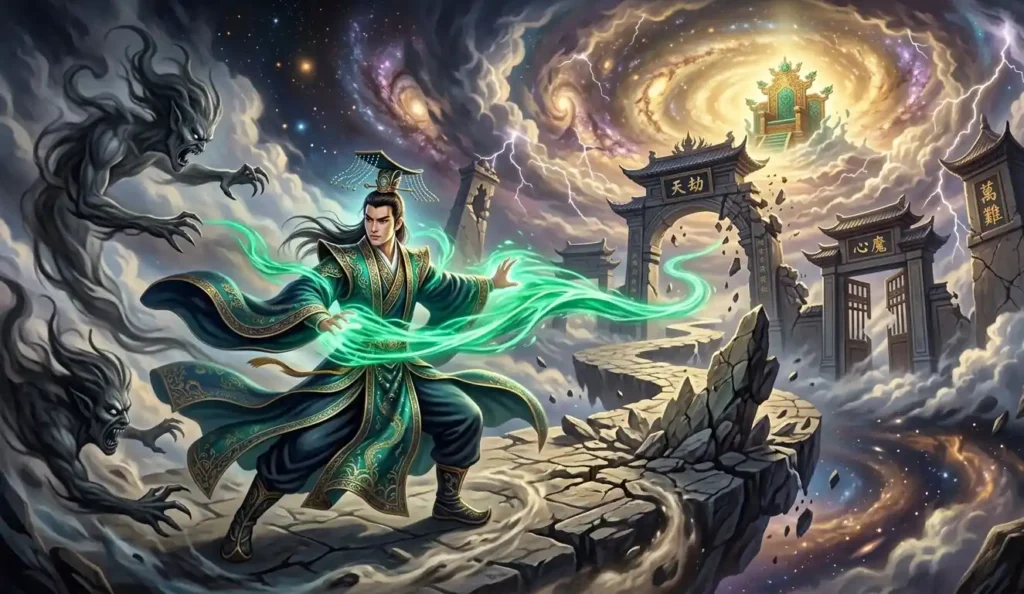
The Test of Genuine Compassion
The origin text describes specific trials that punctuate the cultivation period, tests designed to determine whether the developing divine figure’s compassion and virtue were real or performative.
The nature of these trials is worth examining because they reveal what the tradition thinks genuine virtue actually looks like under pressure.
The suffering trial: In one account, the prince encounters beings in extreme suffering states of existence so painful that the appropriate response might seem to be simple removal. He doesn’t remove it. He enters it with the suffering beings, sharing their condition, using his presence and cultivation to transform the quality of the experience from within rather than simply eliminating it from outside.
This matters philosophically. The trial isn’t testing whether he can eliminate suffering. It’s testing whether his compassion is real enough to sustain presence in suffering rather than retreating to a comfortable distance.
The power trial: At various points during the cultivation period, the developing figure encounters opportunities to use accumulated power for personal benefit to make his own existence more comfortable, to protect himself from challenges, and to take shortcuts. He consistently declines.
This trial is about whether power corrupts, whether the gradual accumulation of cosmic capability changes the character of the being who holds it. The origin story’s answer is that it doesn’t, for this being, because the character was established before the power arrived.
Becoming Who He Already Was
Here’s the thing I find most interesting about these trials. The prince consistently passes them not by performing virtue under examination but by expressing what he genuinely was.
He doesn’t resist the temptation to use power selfishly by gritting his teeth and making the virtuous choice. He resists it because the selfish choice genuinely doesn’t appeal to him. The suffering trial doesn’t require courage on his part. It requires the expression of a compassion that was real enough not to need maintaining through effort.
This is the tradition’s sophisticated point about the relationship between cultivation and character. True cultivation doesn’t impose virtuous behavior on an unwilling person. It develops character until the virtuous response is the natural one.
The Ascent and the Authority
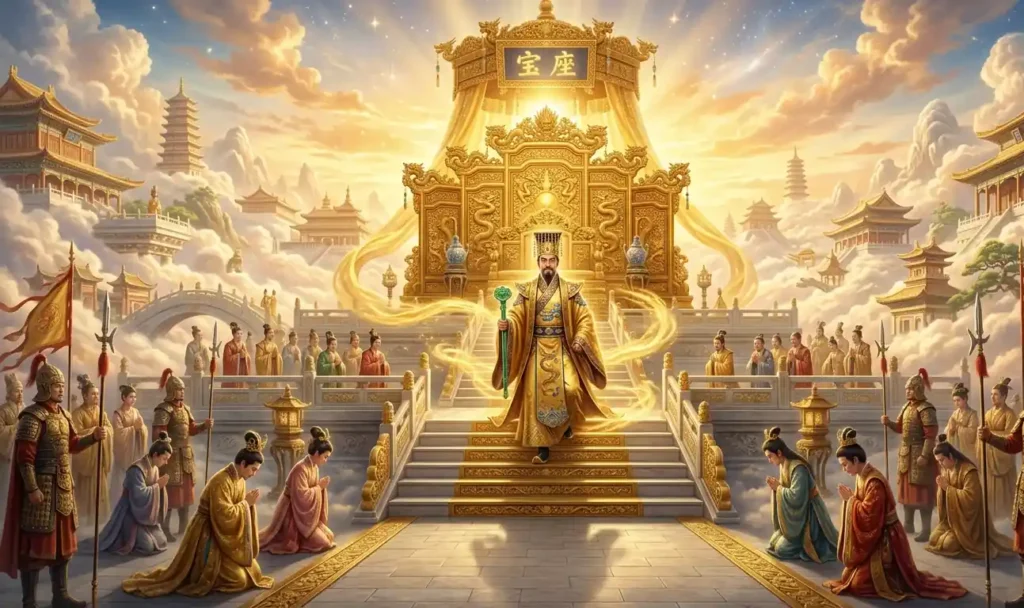
What 1,750 Aeons Produces
At the end of this inconceivably long period of cultivation, the prince who had abdicated his throne had become something that the tradition calls Yuanling High Perfected, a being whose character had been refined to the point of alignment with the Dao’s own nature.
This state produced specific qualities:
- Universal compassion that had been tested across enough lifetimes to be genuinely unconditional
- Complete insight into the nature of reality, unobstructed by the limitations that shape ordinary consciousness
- The natural authority of virtue, not the imposed authority of power, but the kind of authority that emerges when others recognize genuine wisdom and genuine goodness
Why This Authority is Different
At this point, the cosmic court elevated him to the position of supreme ruler of the three realms.
What I want to emphasize is why this matters as a theological claim. The Jade Emperor doesn’t rule because he won a war. He doesn’t rule because he was born to rule. He doesn’t rule because he seized power.
He rules because 1,750 aeons of cultivation made him the being most capable of governing in alignment with the Dao, the being whose own nature was most completely an expression of the principles that should govern everything.
This is the Chinese tradition’s answer to the question of why legitimate authority deserves obedience. The Jade Emperor’s authority is legitimate not because of what he holds but because of what he is. And what he is, was built through cultivation rather than given.
Frequently Asked Questions
Where does the Jade Emperor’s origin story come from?
The primary source is the Gaoshang Yuhuang Benyuan Jing (The Jade Emperor’s Origin Scripture), a Daoist text from the Song Dynasty (960–1279 CE). Sponsored by Emperor Huizong, it established the Jade Emperor’s origin story in the form that became widely accepted throughout later tradition.
Is the 1,750 aeons figure meant literally?
No. It functions mythologically rather than as a literal duration. In Chinese cosmology, aeons already represent unimaginably vast spans of time. The figure of 1,750 aeons conveys that the cultivation required to attain the Jade Emperor’s authority lies beyond ordinary human comprehension. The emphasis is on scale, not arithmetic precision.
Why did the origin story develop so late compared to the Jade Emperor’s appearance in mythology?
The Jade Emperor appears as Heaven’s supreme ruler in Chinese sources before his origin story was formally developed. The Song Dynasty scripture provided a retrospective explanation for his authority. Earlier texts accepted his supremacy without detailing its origins, while the later narrative reflects growing Daoist theological sophistication and the influence of Buddhist storytelling traditions.
Is the Jade Emperor’s origin story meant to be taken literally?
Most scholars view the story as a religious and mythological narrative rather than a historical account. Its purpose is to illustrate the virtues, spiritual cultivation, and cosmic legitimacy required to attain supreme authority in Heaven.
Was the Jade Emperor born divine or human?
The Jade Emperor was not born as the ruler of Heaven. Traditional accounts describe him as a royal prince whose extraordinary wisdom and compassion set him on a path toward spiritual perfection and eventual divinity.
Final Thoughts

The Jade Emperor’s origin story is philosophically interesting. It makes a specific claim about the nature of legitimate authority that it emerges from cultivated virtue rather than from birth, conquest, or divine appointment, and it grounds that claim in a narrative that’s emotionally compelling rather than merely doctrinally convenient.
The prince who walked away from a throne. The 1,750 aeons of cultivation. The trials that tested whether compassion was real. The final ascent to authority not seized but recognised.
That’s a story worth knowing. Not because the Jade Emperor is a religious figure you might pray to, but because the question it’s answering is what makes authority legitimate? is one that every society has to answer somehow.
The answer here is: virtue. Built slowly. Over time so long it exceeds comprehension. Through choices that were consistently costly and consistently made anyway.
Whatever you think about Chinese mythology, that’s not a bad answer.
Related Articles
- Jade Emperor: Origin, Powers & Sacred Meaning in Mythology
- What Is the Heavenly Court? Chinese Myth’s Divine Authority
- Jade Emperor Family: The Divine Family of Chinese Mythology
- Are the Jade Emperor & Queen Mother of the West Married?
- 11 Surprising Jade Emperor Facts Most Readers Miss
- Jade Emperor and the Chinese Zodiac: The Great Race Story
- Was the Jade Emperor Weak? The Answer Might Surprise You
References
- Birrell, Anne. Chinese Mythology: An Introduction.
- Major, John. Heaven and Earth in Early Han Thought.
- Kohn, Livia. Daoism and Chinese Culture.
- Allan, Sarah. The Shape of the Turtle.Hanshu (Book of Han).
- Shiji (Records of the Grand Historian).
- Tao Te Ching – Translated by J. Legge
- Daozang – Daoist Canon
- Zhuangzi – Chinese Text Project
- Taipingjing – Chinese Text Project
- Jade Emperor Origin Scripture
- The Taoist Body – Kristofer Schipper