
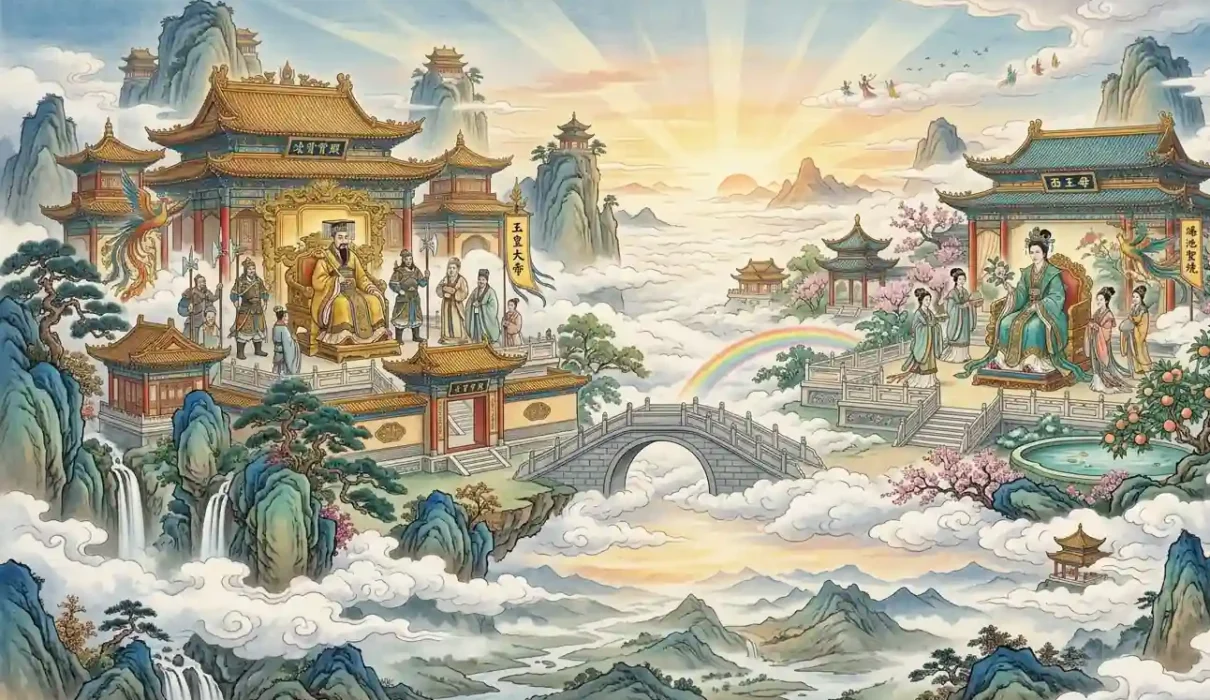
 By
By Quick Takeaways:
- The short answer: it’s complicated, and the complication involves two different figures being conflated under the “Queen Mother” label
- The Jade Emperor’s actual consort is Wang Mu Niangniang (Heavenly Queen Mother), a distinct figure from the Queen Mother of the West (Xiwangmu)
- Popular tradition, folk religion, and some later texts do pair the Jade Emperor & Queen Mother of the West as a divine couple, but this pairing is not consistent across all sources
- The Queen Mother of the West’s ancient origins significantly predate the Jade Emperor mythology, giving her an independent authority that makes the “wife” framing somewhat limiting
- Understanding the distinction makes both figures considerably more interesting than the simple “they’re the top divine couple” summary suggests
Let me give you the direct answer first, then the interesting context.
The direct answer: In popular Chinese folk religion and many contemporary representations, yes, the Jade Emperor and the Queen Mother of the West are presented as a divine couple. But in classical sources, the situation is messier and more interesting. There are actually two different “Queen Mother” figures, and conflating them produces a mythological confusion that’s worth untangling.
Now let me explain why this matters.
The Two Queen Mothers: The Root of the Confusion
Queen Mother 1: Xiwangmu
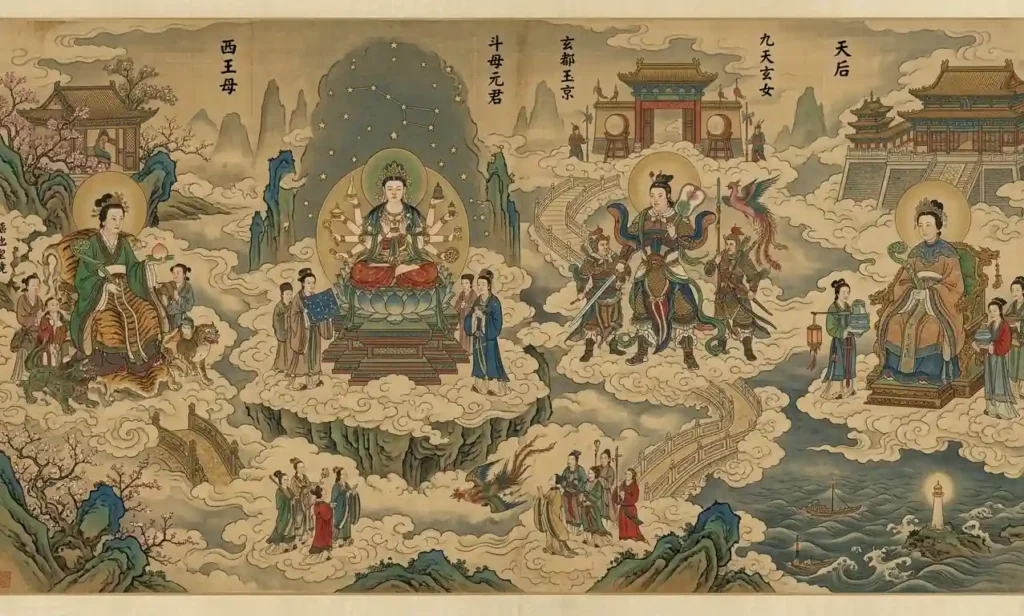
Xiwangmu (Queen Mother of the West) is one of China’s oldest divine figures, appearing in oracle bone inscriptions from the Shang Dynasty and described in vivid, wild detail in the Shanhaijing (Classic of Mountains and Seas).
She’s the keeper of the immortality peaches. She presides over Kunlun Mountain. Her origins are ancient, her power is specific, and she has an independent divine identity that predates the Jade Emperor mythology by centuries.
Queen Mother 2: Wang Mu Niangniang
Wang Mu Niangniang (Heavenly Queen Mother or Royal Mother Lady) is the Jade Emperor’s actual consort, the empress of the heavenly court, and the mother of his children.
She’s a distinct figure, but her name is deceptively similar to the common shortened form of Xiwangmu’s title. Both are called “Queen Mother” or “Mother of the West” in various contexts. This name overlap is the primary driver of the conflation that’s been building in popular tradition for centuries.
How the Conflation Happened
By the time popular Chinese literature of the Ming Dynasty (1368–1644 CE), particularly Journey to the West, was shaping public understanding of Chinese mythology, the two figures had been partially merged in popular imagination.
In Journey to the West, the figure who hosts the Pantao Banquet in the Jade Emperor’s court feels like she operates within the Jade Emperor’s domestic sphere in ways that suggest consort status. The strict distinction between independent Xiwangmu and consort Wang Mu Niangniang is blurred throughout.
This is the version of the mythology that most people encounter first, which means most people encounter the blurred version before the classical distinction.
What Sources Actually Say About Jade Emperor & Queen Mother of the West
The Jade Emperor’s Consort in Classical Texts
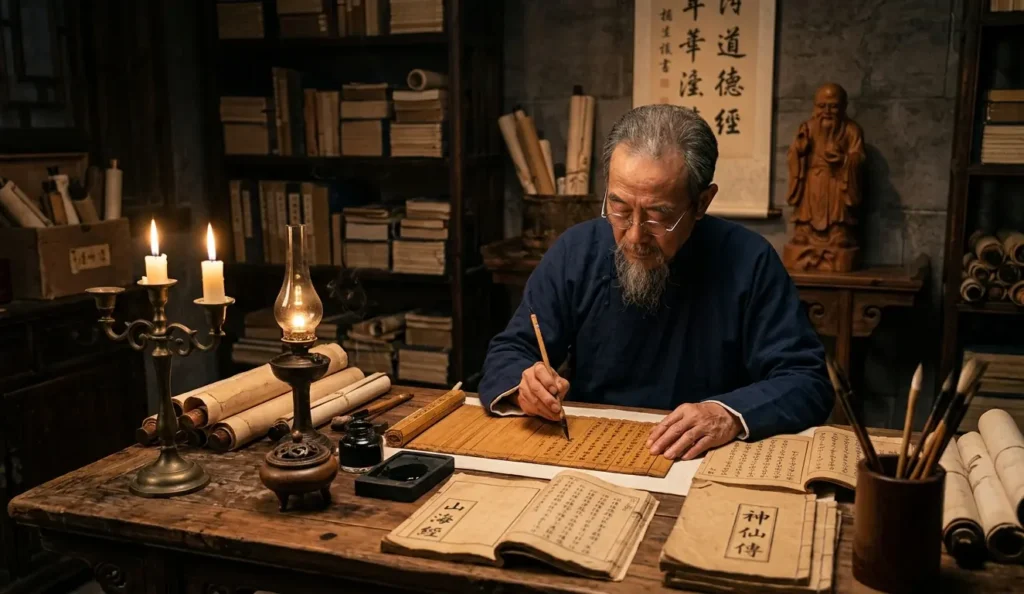
Classical Daoist texts that discuss the Jade Emperor’s divine household describe Wang Mu Niangniang as his consort. She manages the domestic and ceremonial dimensions of the heavenly court, she’s the mother of his daughters (including the Weaving Maid, Zhinü), and she operates as the empress of heaven in the administrative sense.
Her identity is separate from Xiwangmu’s. She doesn’t have Xiwangmu’s ancient origins, her wild tiger-toothed Shanhaijing form, or Xiwangmu’s specific domain as keeper of immortality peaches on Kunlun Mountain.
Xiwangmu’s Independent Status
What I find most interesting about Xiwangmu’s classical portrayal is how thoroughly independent she is.
Her earliest descriptions in the Shanhaijing describe a deity of considerable autonomous power controlling plague and punishment, with animal features, presiding over the western wilderness. She’s not defined by a relationship with any male deity. She exists on her own authority.
Her later Daoist form as the keeper of immortality peaches maintains this independence. She hosts the Pantao Banquet. She controls access to immortality. She has her own mountain palace. She receives worthy seekers who journey to find her specifically.
This is not the portrayal of someone defined primarily as a consort.
Where the Pairing Appears
The Jade Emperor and Xiwangmu are most explicitly paired in:
- Popular folk religion from the Song Dynasty onward
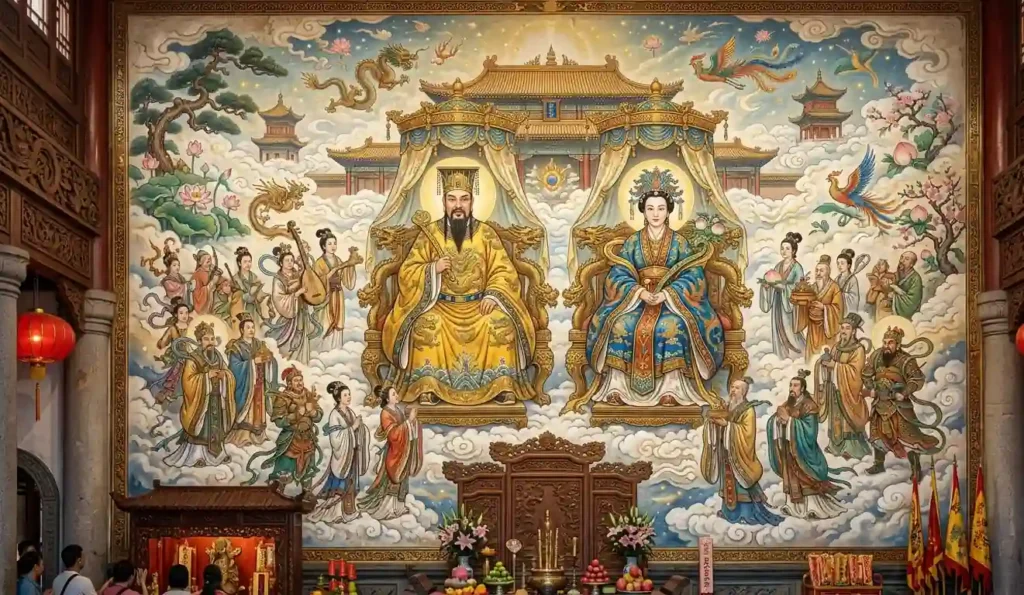
- Temple iconography where they’re often depicted together as the supreme divine couple
- Popular literature including Journey to the West and Investiture of the Gods
- Festival traditions where both figures feature in the same ceremonial context
The pairing is real. It’s just later, folk-religion-driven, and not universally consistent across the full range of classical sources.
The Four Things That Make the Relationship Interesting
1. The Power Dynamic isn’t What You’d Expect
If Xiwangmu and the Jade Emperor are a couple, it’s not a straightforward senior-junior relationship.
The Jade Emperor’s origin story has him achieving his position through 1,750 aeons of cultivation. Xiwangmu’s origins predate his mythology by a significant margin. She’s not a figure whose divine authority derives from the Jade Emperor or depends on her relationship with him.
When they appear together, it tends to be as two cosmic powers operating in their respective domains, the Jade Emperor governing the heavenly court’s administrative machinery, Xiwangmu governing the immortality tradition and her western domain rather than as a ruler and his consort in the ordinary imperial sense.
2. They Have Genuinely Different Domains
The Jade Emperor governs everything. That’s his job the administrative oversight of heaven, earth, and the underworld simultaneously.
Xiwangmu has a specific, bounded domain: the immortality peaches, Kunlun Mountain, the western paradise. She’s not a general-purpose supreme deity. She’s the supreme deity of a specific and crucially important domain.
When people pray to the Jade Emperor and Xiwangmu for different things, governance intervention versus immortality cultivation, they’re correctly identifying that these are two different kinds of divine authority even if the figures are relationally linked.
3. The “Couple” Pairing Serves Specific Cultural Functions
The desire to pair these two figures into a divine couple reflects something real about how Chinese culture organizes its divine hierarchy.
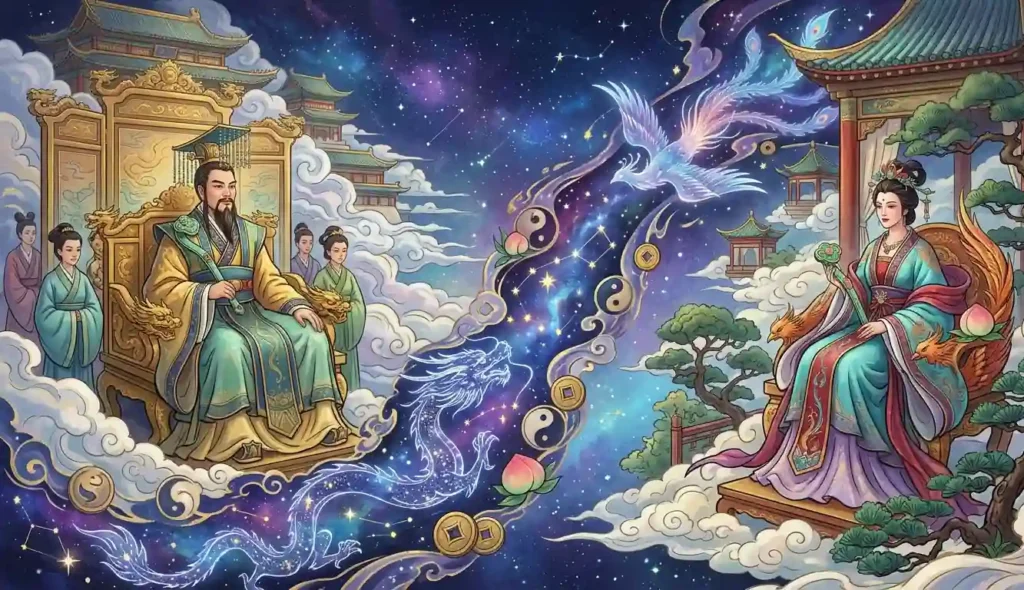
Chinese cosmological thinking tends toward balance and complementarity, the dragon paired with the Fenghuang, yin paired with yang, the earthly with the celestial. Having the supreme male deity and the supreme female deity paired as a couple creates a complete and balanced picture of cosmic authority.
The pairing is cosmologically satisfying even if it’s not consistently supported by classical sources. This is mythology doing what mythology does, organizing the divine world in ways that reflect human values and needs.
Read More: Pantao Banquet: Queen Mother of the West’s Heavenly Feast
4. The Question Reveals Something About How Mythology Evolves
I am interested in questions like this one, not just because they have interesting answers, but because the question itself reveals how mythological traditions develop.
The Jade Emperor-Xiwangmu pairing isn’t a textual error or a scholarly misunderstanding. It’s a real development in how Chinese folk religion organized its highest divine figures over centuries. The tradition moved toward pairing them. The reasons are culturally coherent. The result is a divine couple that functions meaningfully in contemporary Chinese religious practice, even if classical scholars would note it’s not the whole story.
What Popular Tradition Believes Today
The Temple Tradition
Walk into a Daoist temple in contemporary Taiwan, China, or Southeast Asia and you’ll often find the Jade Emperor and the Queen Mother depicted together sometimes as a formal paired portrait, sometimes in adjacent shrines, sometimes in iconographic programs that clearly treat them as the supreme divine couple.
For living religious practice, the pairing is essentially standard. Practitioners pray to them as complementary aspects of the supreme divine, the ruler and his queen, heaven’s governing pair.
This is real religious tradition, not mythology in the purely historical sense. Dismissing it as a confusion or error would be missing the point of how living religious traditions develop.
The Festival Connection
The Jade Emperor’s birthday (ninth day of the first lunar month) and Xiwangmu’s birthday (seventh day of the third lunar month) are both celebrated, and in some communities these celebrations have complementary characters, the ruler’s birthday and the queen’s birthday as events in the same divine household’s ceremonial calendar.
This festival pairing reinforces the popular identification of them as a couple in living practice, independent of whatever classical texts say about their distinct origins.
The Honest Answer with Full Context
Here’s my summary of working with these figures:
In popular tradition and living folk religion: Yes, they’re treated as a divine couple. This is the version most people encounter and it’s a real and meaningful tradition.
In classical Daoist theology: The Jade Emperor’s consort is properly Wang Mu Niangniang (Heavenly Queen Mother), and Xiwangmu (Queen Mother of the West) is a distinct figure with independent divine authority that predates and exceeds the “consort” framing.
Historically: The two figures have been partially merged over centuries of popular tradition, primarily through name similarity and the narrative logic of pairing the tradition’s supreme male and female deities.
Philosophically: Xiwangmu’s independent authority is actually one of the most interesting features of her mythology. She’s the tradition’s most powerful specifically female deity, and her power doesn’t derive from the Jade Emperor or depend on their relationship.
Whether you read them as married depends on which layer of the tradition you’re working with. Both readings are legitimate. The distinction is worth knowing.
Frequently Asked Questions
Who is the Jade Emperor’s actual wife in classical texts?
Wang Mu Niangniang (Heavenly Queen Mother or Royal Mother Lady) is the Jade Emperor’s consort in classical Daoist theology. She rules as empress of the heavenly court and is the mother of his daughters, including the Weaving Maid. She is distinct from Xiwangmu (Queen Mother of the West), though they are often conflated in popular tradition.
Does Xiwangmu have children with the Jade Emperor?
In most classical sources, Xiwangmu’s children are not described as having the Jade Emperor as their father. Some later folk traditions portray the Seven Fairy Sisters as daughters of both deities, but this reflects popular religious integration rather than classical theology. Xiwangmu’s origins as an independent goddess long predate any role as a consort.
Why are there two “Queen Mothers” in Chinese mythology?
The two figures have different Chinese names: Xiwangmu (Queen Mother of the West) and Wang Mu Niangniang (Heavenly Queen Mother). Their frequent conflation stems from overlapping English translations and similar popular usage. Recognizing them as distinct deities is essential for accurately understanding classical Chinese religious and mythological sources.
Is Xiwangmu more powerful than the Jade Emperor?
They wield different kinds of authority. The Jade Emperor governs the cosmos through broad administrative power, overseeing the heavenly bureaucracy and universal order. Xiwangmu holds supreme authority within her own domain, particularly immortality, the western paradise, and spiritual cultivation. Because their roles are complementary rather than competitive, comparing their power is not straightforward.
Is the Queen Mother of the West a Daoist deity?
Yes. She became a major figure in Daoism, though her origins predate organized Daoist religion and can be traced to much earlier Chinese beliefs.
Final Thoughts
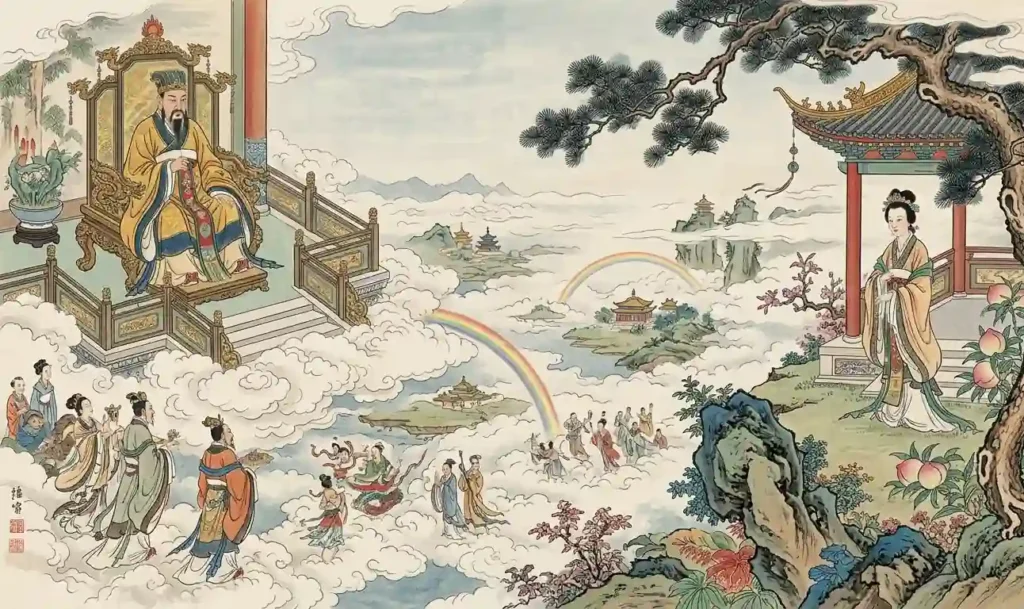
The question “are the Jade Emperor and Queen Mother of the West married?” is one of those mythology questions that rewards a more complicated answer than the simple yes or no it seems to call for.
The complication isn’t a problem to be solved. It’s evidence of a living tradition that has evolved, adapted, and developed its own internal logic over centuries. The popular pairing of the Jade Emperor and Xiwangmu as a divine couple reflects genuine mythological and cultural intelligence, a desire for the divine world to model the complementarity of male and female authority that Chinese cosmological thinking values.
The classical distinction between Xiwangmu and Wang Mu Niangniang reflects something equally real, Xiwangmu’s ancient, independent authority as one of China’s most powerful divine figures, predating and exceeding any definition of her as primarily someone’s wife.
Both things are true. That’s what mythology is.
Related Articles
- 11 Surprising Jade Emperor Facts Most Readers Miss
- Jade Emperor: Origin, Powers & Sacred Meaning in Mythology
- What Is the Heavenly Court? Chinese Myth’s Divine Authority
- Queen Mother of the West: Myths, Symbolism & Sacred Power
- Who Was the Jade Emperor Before He Became a Supreme Ruler?
- Jade Emperor and the Chinese Zodiac: The Great Race Story
- Xiwangmu vs Jade Emperor: Who is More Powerful in Chinese Myth?
References
- Birrell, Anne. Chinese Mythology: An Introduction.
- Major, John. Heaven and Earth in Early Han Thought.
- Kohn, Livia. Daoism and Chinese Culture.
- Allan, Sarah. The Shape of the Turtle.Hanshu (Book of Han).
- Shiji (Records of the Grand Historian).
- Tao Te Ching – Translated by J. Legge
- Daozang – Daoist Canon
- Zhuangzi – Chinese Text Project
- Investiture Of The Gods
- Journey To The West
- The Book of Rites
- The Taoist Body – Kristofer Schipper
- Transcendence and Divine Passion: The Queen Mother of the West in Medieval China – Suzanne Elizabeth Cahill
- Mutianzi Zhuan – Chinese Text Project