
 By
By Quick Takeaways:
- The Peaches of Immortality (xiantao or pantao) grow in Xiwangmu’s garden on Kunlun Mountain and come in three grades, each conferring a progressively more complete immortality
- The three-tier system, 3,000, 6,000, and 9,000 year ripening cycles, encodes Chinese mythology’s understanding of immortality as a spectrum rather than a single threshold
- Sun Wukong’s theft of the peaches is the most famous story involving them, but several other mythological figures have equally important relationships with the fruit
- The peach’s symbolism in Chinese culture extends far beyond the divine fruit into everyday life. Birthday peach buns, longevity gifts, and protective peach wood all reflect the same underlying mythological tradition
- Understanding the peaches changes how you read Xiwangmu, Sun Wukong, the immortality tradition, and Chinese folk religious practice simultaneously
Here’s something that became clear to me only after years of following Chinese mythology: the Peaches of Immortality aren’t just a story prop. They’re a philosophical framework about what immortality actually means, expressed in the specific language of a fruit.
The three-tier system alone contains more theological precision than most mythological objects I’ve encountered in twenty years. Each grade of peach corresponds to a different quality of immortal existence, not just “more immortal” but genuinely different kinds of transcendence. The garden that produces them is the most carefully described location in the immortality tradition. And the stories of who eats them, who steals them, and who guards them are some of Chinese mythology’s most psychologically compelling narratives.
Let me walk you through all of it.
The Garden: Where The Peaches Grow
Xiwangmu’s Pantao Yuan
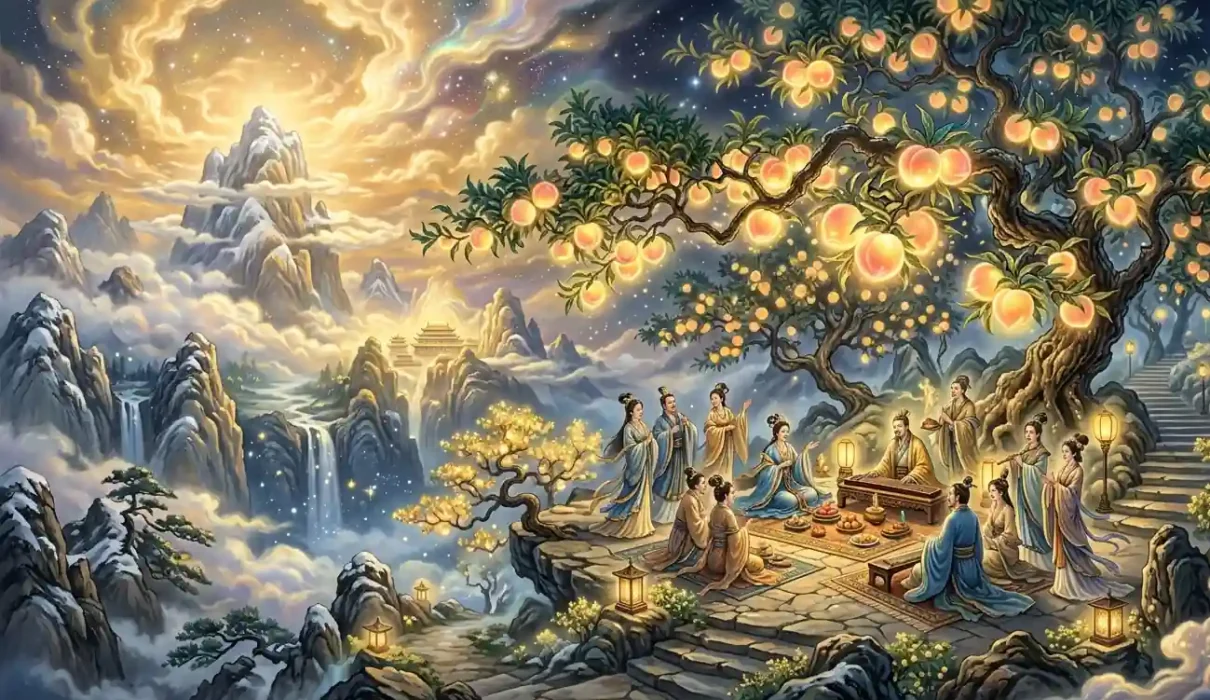
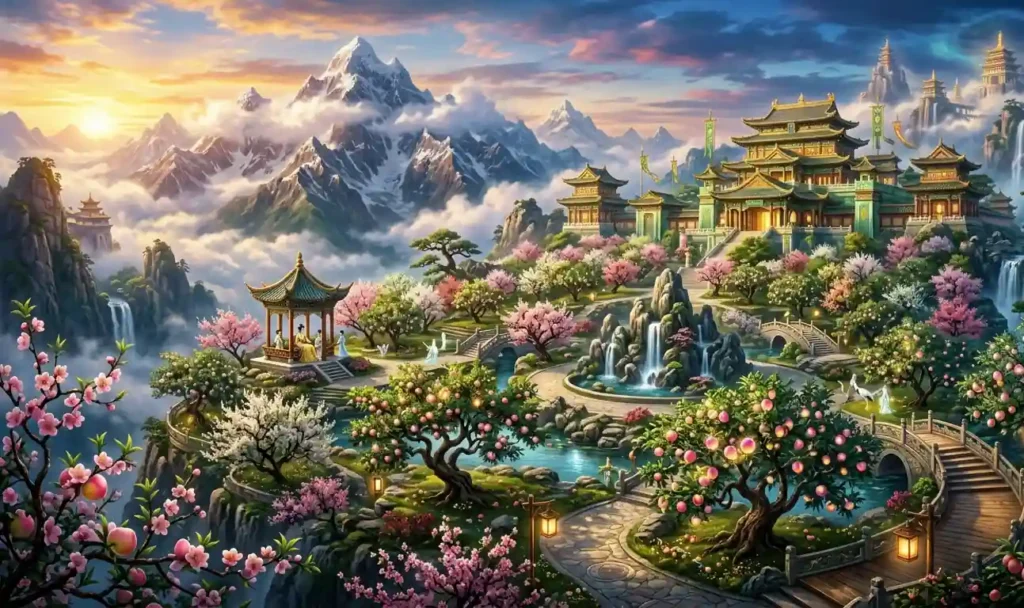
The Pantao Yuan (Flat Peach Garden) sits within Xiwangmu’s palace complex on Kunlun Mountain, the mythological axis mundi where heaven and earth connect. The garden’s location is cosmologically precise: the fruit that bridges the mortal and immortal conditions should grow at the world’s center, where the cosmic connection is strongest.
The garden is tended under Xiwangmu’s direct supervision. This is deliberate. The Queen Mother of the West doesn’t delegate immortality’s source material to divine ministers. She governs the garden personally because the governance of who can access immortality is too important to be routine administration.
The garden produces fruit continuously on three different timescales. And it’s in those three timescales that the mythology’s most interesting theological content is hiding.
The Three Grades: Immortality is a Spectrum
First Tier: 3,000 Years
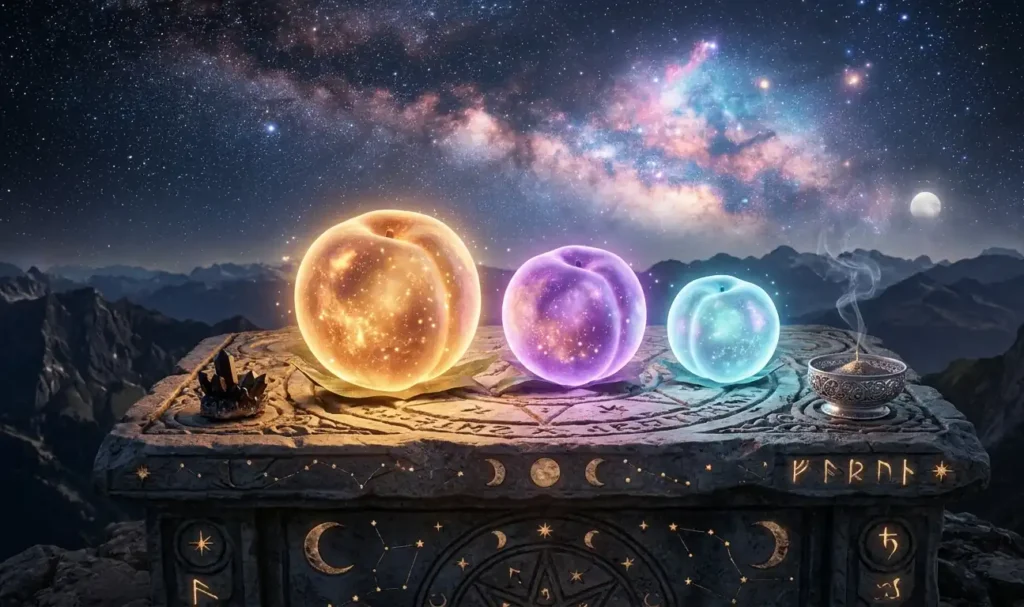
The first-tier peaches ripen every 3,000 years. Their effects:
- The body becomes light and capable of ascent
- The practitioner achieves immortality in its initial form
- The capacity to move between the earthly and celestial realms opens
Three thousand years is an inconceivably long time by human standards, but in the context of Chinese cosmological time, where aeons span billions of years, 3,000 years is the entry-level tier. This first-grade immortality is real transcendence, but it’s the beginning of the spectrum rather than its endpoint.
Second Tier: 6,000 Years
The second-tier peaches ripen every 6,000 years. Their effects:
- The ability to ascend through clouds
- The achievement of eternal youth not just extended life but the reversal of the aging process
- A qualitatively different relationship with time than even the first tier produces
Double the ripening time. Qualitatively deeper transformation. The second tier isn’t simply more immortality than the first, it’s a different kind of immortality. The distinction between living indefinitely and actually reversing the aging process encodes something philosophically important: genuine youth is not the same as extended age.
Third Tier: 9,000 Years
The third-tier peaches ripen every 9,000 years. Their effects:
- Lifespan coeval with heaven and earth themselves
- Existence at a scale that encompasses the cosmos’s entire temporal span
- The fullest possible participation in the Dao’s eternity
9,000 years nine times 1,000, the supreme yang number cubed, is the cycle of the most sacred peaches. A being who eats one doesn’t just live longer. They exist on the same temporal scale as the universe itself.
This three-tier system is one of Chinese mythology’s most elegant theological constructions. Immortality isn’t binary. You either have it or you don’t. It’s a spectrum, and where you are on that spectrum depends on what you’ve eaten, what you’ve cultivated, and what the cosmos has seen fit to grant you.
Sun Wukong and the Peaches: The Famous Theft
What Actually Happened
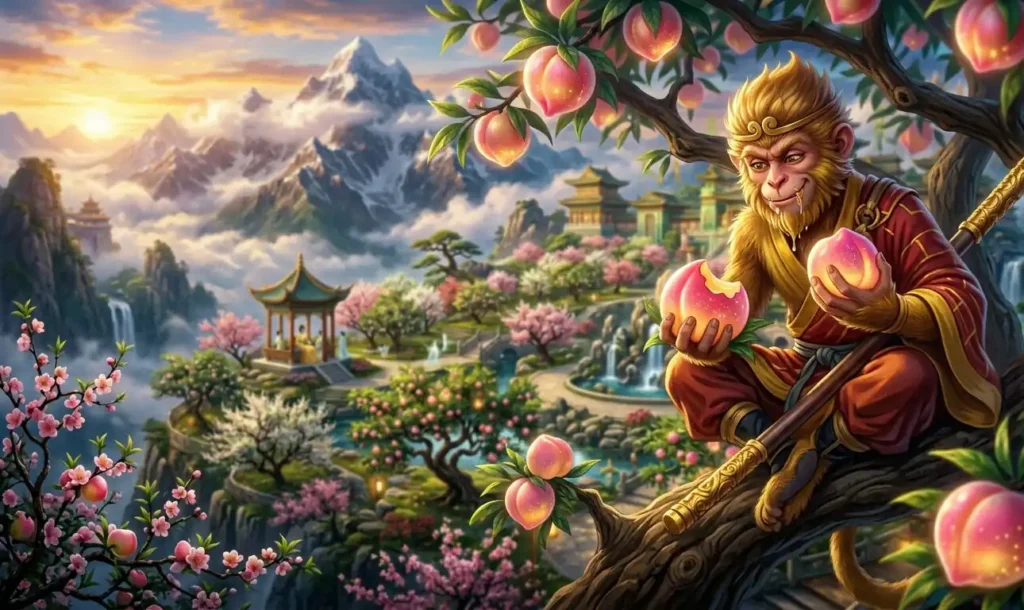
Sun Wukong’s relationship with the Pantao Garden is the most famous peach story in Chinese mythology, and most people know the surface version: he was appointed garden guardian, ate all the best peaches, and caused catastrophic trouble.
The specifics are worth knowing because they reveal Sun Wukong’s character more precisely than the summary does.
When Sun Wukong was given the title of garden superintendent, a position the Jade Emperor offered partly to keep him occupied and partially controlled, he immediately began inspecting his domain. He assessed the three tiers of trees with professional attention to the different ripening cycles.
Then he ate them. Systematically. The third-tier peaches, the 9,000-year fruit intended for the Pantao Banquet that Xiwangmu was planning, were consumed by a divine monkey who had been in the position for weeks.
The theft isn’t random mischief. It’s Sun Wukong acting on his conviction that supreme capability entitles supreme access. If he’s worth placing in charge of the garden, he’s worth eating the garden’s best fruit. His logic is consistent with his character, which is exactly what makes him such an interesting figure.
The Consequences
The Pantao Banquet couldn’t proceed. Xiwangmu discovered the devastation. Sun Wukong then, at a separate moment, broke into Laozi’s palace and consumed his refined immortality pills.
By the time the divine court caught up with him, he had eaten immortality peaches of the highest tier, consumed immortality wine, and processed Laozi’s alchemical products. His subsequent near-invulnerability surviving the divine armies, surviving Laozi’s Eight Trigrams Furnace, flows directly from these accumulated immortality consumptions.
The peaches didn’t just make him harder to kill. They made him the specific kind of problem that required the Buddha rather than any military instrument to resolve.
Other Figures and the Peaches
Yi the Divine Archer
Hou Yi, the archer who shot down nine of the ten suns, saving the world from solar incineration, received an immortality elixir from Xiwangmu as a reward for his cosmic service. In some versions, this elixir is specifically described as produced from the peaches; in others, it’s a distinct substance.
The connection matters: Yi’s cosmic heroism earned him access to Xiwangmu’s immortality provision. His wife Chang’e subsequently took the elixir and ascended to the moon, producing one of Chinese mythology’s most emotionally resonant separation narratives, where the fruit of immortality becomes the mechanism of an eternal loneliness.
The peach’s gift is always double-edged in Chinese mythology. Immortality separates you from everything mortal.
The Eight Immortals at the Pantao Banquet
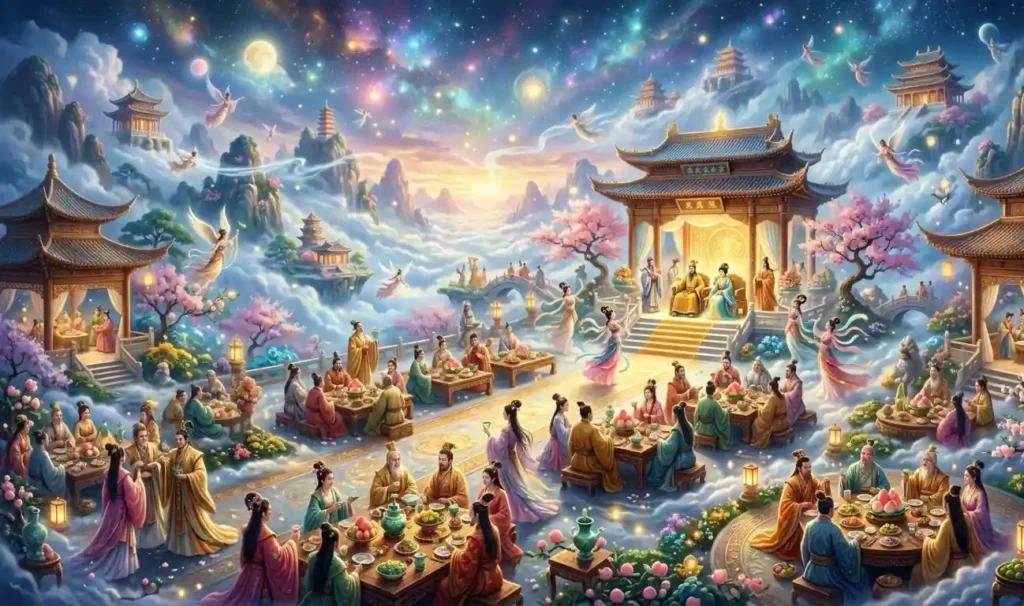
The Pantao Banquet, itself the gathering Xiwangmu hosts every time the third-tier peaches ripen, is attended by the Eight Immortals and the most exalted divine figures of the Chinese pantheon.
This feast is one of the Chinese divine court’s most significant events: the moment when the Queen Mother dispenses the fruit that renews and sustains the divine beings who govern existence. The Eight Immortals aren’t powerful and long-lived by accident. Their participation in the Pantao cycle is part of the maintenance system for divine vitality.
The banquet that Sun Wukong disrupted wasn’t just a party. It was a cosmic renewal ceremony.
Why The Peach Specifically
The Peach in Chinese Symbolic Tradition
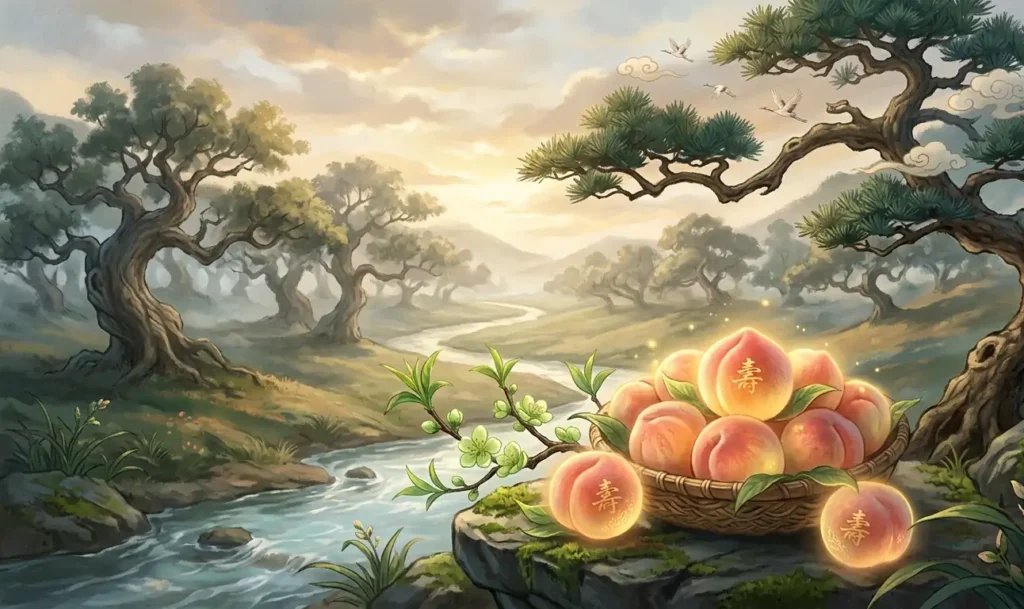
The Peaches of Immortality didn’t become China’s immortality fruit arbitrarily. The peach carries deep symbolic associations in Chinese culture that predate and inform the mythology:
- Longevity: Peaches have been associated with long life in Chinese culture since ancient times. The fruit’s shape, its sweetness, and its relatively short production period (needing care across years before bearing fruit) all contributed to its longevity associations
- Protection: Peach wood (táo mù) is one of Chinese folk religion’s most powerful protective materials used in talismans, warding off evil spirits, and making protective objects
- New year significance: Peach branches appear in new year traditions as protective decorations
- Romance: The peach has connections to romantic love in Chinese classical poetry, with peach blossoms among the most frequent romantic metaphors
This cultural weight means the Pantao mythology wasn’t created in a vacuum. It elaborated an existing symbolic tradition into its cosmic expression, taking what Chinese culture already understood the peach to represent (protection, longevity, transformation) and extending it to its divine extreme.
Birthday Peach Buns
The most living expression of the Peaches of Immortality mythology in contemporary Chinese culture is the birthday peach bun (shòu táo) the steamed buns shaped like peaches and filled with sweet lotus paste that appear at Chinese birthday celebrations, particularly for elderly people’s milestone birthdays.
Offering birthday peach buns expresses the wish that the birthday person will have the longevity associated with Xiwangmu’s divine fruit, not the literal immortality of the mythological peaches, but the cultural blessing of their symbolic meaning translated into an edible gift.
Every time I see birthday peach buns at a Chinese celebration, I think about this chain of transmission: Xiwangmu’s garden on Kunlun Mountain, the three-tier immortality system, the Pantao Banquet, and finally a steamed bun at a birthday table. That’s mythology still working in living practice, which is exactly what the best mythology does.
The Philosophical Content: What the Peaches Say About Immortality
Immortality Requires Preparation
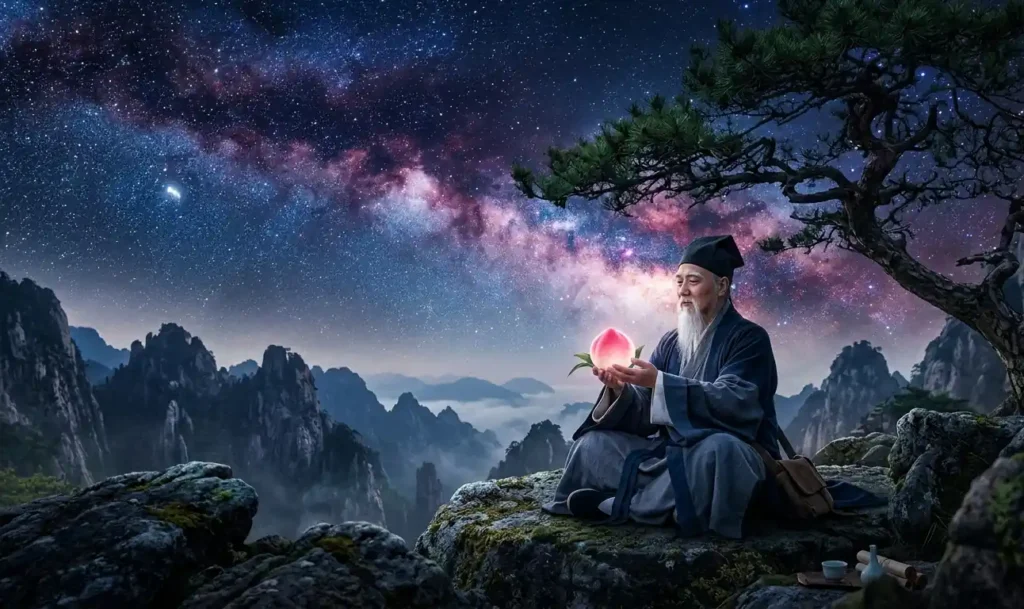
The three-tier peach system makes a specific theological point that I find particularly interesting: not everyone who eats the peaches would benefit equally. The divine beings at the Pantao Banquet have cultivated the capacity to receive and integrate what the highest-tier peaches offer.
The Pantao Banquet’s guest list isn’t random. It reflects achieved status that makes the fruit’s full benefit available.
This connects to the broader Daoist cultivation tradition’s understanding that immortality isn’t a simple acquisition. The body and consciousness must be prepared through cultivation before they can receive and integrate what the immortality sources offer. Sun Wukong’s ability to process the highest-tier peaches speaks to his genuine cultivation level. He’s powerful enough to benefit from what he stole.
Immortality at Different Scales
The three tiers also encode something philosophically sophisticated about scale. Different grades of immortality correspond to different temporal scales of existence. The first tier grants lightness and transcendence of ordinary earthly limitation. The second tier grants genuine youth a qualitative difference in how time operates for the being. The third tier grants coevality with heaven and earth existence at the cosmos’s own scale.
This isn’t an arbitrary graduation. It reflects a genuine philosophical question: what would it actually mean to be immortal? And the answer the tradition gives is: at different levels of cultivation, immortality looks and feels like something genuinely different.
That’s theological precision. And it comes wrapped in a peach.
Frequently Asked Questions
Why is the Pantao Garden specifically called the Flat Peach Garden?
Pantao literally means “coiled peach” or “flat peach,” referring to the divine peach variety depicted in Chinese art as flatter and rounder than ordinary peaches. The name distinguishes these sacred fruits while also evoking cosmological ideas of entwined, serpentine forces within Chinese thought.
Did eating the peaches make Sun Wukong permanently immortal?
Yes, alongside the immortality wine and Laozi’s alchemical pills he consumed. Sun Wukong’s near invulnerability, including surviving Laozi’s Eight Trigrams Furnace, resulted from this accumulation of immortal substances. His eventual title of Victorious Fighting Buddha reflects both his attained immortality and the wisdom he gained during the pilgrimage.
Why does Xiwangmu control immortality rather than the Jade Emperor?
Xiwangmu’s authority over immortality predates and exists independently of the Jade Emperor’s celestial court. As an ancient cosmic figure associated with the Western Paradise and longevity, she possessed sovereignty over the immortality tradition long before later divine bureaucracies emerged. Her peach garden remains her domain, with even the Jade Emperor’s court attending her banquets as honored guests rather than administrators.
How do birthday peach buns connect to the mythology?
Birthday peach buns (shoutao, longevity peaches) are a living expression of the Peaches of Immortality tradition. They symbolize the wish that the recipient will enjoy the longevity associated with Xiwangmu’s divine fruit. Their distinctive peach shape directly references the mythical original, transforming an ancient cosmological symbol into a familiar birthday celebration.
Do the Peaches of Immortality have a modern cultural influence?
Yes. Their symbolism survives in Chinese culture through longevity imagery, birthday celebrations, and peach-shaped buns known as shoutao. These traditions express wishes for a long, prosperous life and draw directly from the ancient mythology of Xiwangmu’s sacred fruit.
Final Thoughts

The Peaches of Immortality are, in one sense, a story detail a specific object in specific narratives involving Xiwangmu, Sun Wukong, and the heavenly court.
In another sense, they’re one of Chinese mythology’s most precisely constructed theological objects. The three-tier system encodes an entire philosophy of transcendence. The garden’s location at the world’s center connects immortality’s source to cosmic geography. The stories of who eats them and under what circumstances reveal what the tradition thinks immortality actually requires.
And then there’s the birthday peach bun on the celebration table, the most living evidence that mythology isn’t a thing that happened in the past. It’s a framework that cultures keep finding new ways to express in the present.
Twenty years of mythology has shown me that the most durable symbolic objects are the ones that operate at multiple levels simultaneously. The Peaches of Immortality work as a story element, as theological content, as cultural symbol, and as everyday practice all at once.
That’s not a coincidence. That’s what it looks like when mythology is really working.
Related Articles
- Pantao Banquet: Queen Mother of the West’s Heavenly Feast
- Kunlun Mountains: The Sacred Home of China’s Queen Mother
- Yao Chi: The Sacred Jade Pool of Xiwangmu & Chinese Myth
- Why Immortal Characters Lose All Their Stakes
References
- Birrell, Anne. Chinese Mythology: An Introduction.
- Kohn, Livia. Daoism and Chinese Culture.
- Shanhaijing (Classic of Mountains and Seas).
- Journey To The West
- The Taoist Body – Kristofer Schipper
- Eberhard, Wolfram. A Dictionary of Chinese Symbols.
- Lewis, Mark Edward. The Construction of Space in Early China.
- Mu Tianzi Zhuan
- Daozang – Daoist Canon
- The Legend of Chang’e and Hou Yi
Written by Batin Khan | Mythology and philosophy reader across world cultures (20 years), Cultivation novels reader for the past 10 years | Specialist in Xianxia, Eastern and Western mythological traditions, and fantasy worldbuilding